


Overview

The classical dance forms of India are the dance traditions that trace their theory and practice to the Sanskrit Natya Shastra. The Sangeet Natak Akademi, India's national academy of music, dance and drama, recognises eight: Bharatanatyam, Kathak, Kathakali, Kuchipudi, Manipuri, Mohiniyattam, Odissi and Sattriya. Each comes from a region, most grew in temples or courts, and all share one grammar of pure dance, expressive dance and drama.
Classical Dances of India: How Many Forms and What Makes Them Classical
How Many Classical Dances in India: The 8 Forms and Their States
The count depends on who is counting. The number of Indian classical dance styles ranges from six to eight to twelve or more, depending on the source and scholar. The standard answer for an examination is the Sangeet Natak Akademi's eight, each rooted in a region and its language.

| Dance | State and roots |
|---|---|
| Bharatanatyam | Tamil Nadu: temple dancers; once called Sadir |
| Kuchipudi | Andhra Pradesh: dance-drama of Kuchipudi village |
| Kathakali | Kerala: story play, 17th century |
| Mohiniyattam | Kerala: temple dance of Mohini |
| Kathak | North India: storytellers, Mughal courts |
| Odissi | Odisha: maharis in temple service |
| Manipuri | Manipur: Vaishnava faith of the Meiteis |
| Sattriya | Assam: sattras of Shankaradeva |
What Makes a Dance Classical: The Natya Shastra, Margi and Desi
A dance is called classical, shastriya in Sanskrit, when it rests on the shastra, above all the Natya Shastra attributed to Bharata Muni. Its first complete compilation is dated to between 200 BCE and 200 CE, though estimates range from 500 BCE to 500 CE, and the most studied version has about 6,000 verses in 36 chapters on drama, stage, acting, dance and music.
- Margi and desi: The Natya Shastra calls religious art margi, a spiritual path, and folk entertainment desi, a regional popular practice.
- Settings: The classical forms were performed in or near temples, in royal courts, or by travelling troupes at festivals.
- Four regional traditions: The text names four pravrittis of dance-drama, Avanti, Dakshinatya, Panchali and Odra-Magadhi.
- Later texts: The Abhinaya Darpana, Abhinava Bharati and others expanded the repertoire.
Natya Shastra: The Grammar of Indian Classical Dance
Nritta, Nritya, Natya, Abhinaya, Rasa and the Tribhanga Pose
Every classical dance combines three elements. Nritta is pure or abstract dance, patterns of steps and movement that convey no meaning; nritya is expressive dance that unfolds a narrative through gesture; natya is drama. A recital moves between them, so the same dancer is by turns a pattern-maker and a storyteller.
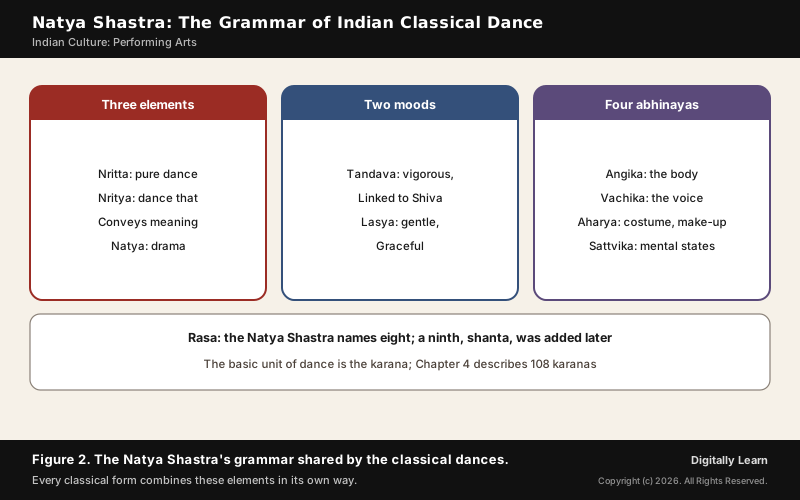
The text also describes two moods of dance. Tandava, the dance of Shiva, is vigorous and brisk; lasya, the dance of Parvati in response, is gentle and graceful. Manipuri's jagoi and cholom are its gentle and vigorous streams, and Mohiniyattam follows the lasya style.
- Abhinaya: The art of expression, in four aspects: angika, the body; vachika, the voice; aharya, costume, make-up and scenery; and sattvika, mental states.
- Rasa: The emotion evoked in the audience; Bharata named eight rasas, and later authors added a ninth, shanta, giving the navarasa.
- Mudras: Hand gestures; the Natya Shastra describes 24 and the Abhinaya Darpana of Nandikeshvara 28.
- Karana: The basic unit of dance, a combination of hand and foot movement with posture and gait; Chapter 4 describes 108 karanas.
One pose recurs across Indian art. In the tribhanga, the triple-bend, the body bends one way at the knees, the other way at the hips and the first way again at the shoulders and neck. It has been used for at least 2,000 years in sculpture and painting, and is characteristic of Odissi, where it gives the dance its sculpturesque look.
Tandava in Temple Sculpture and Inscriptions
The Tandava is recorded in stone as well as text. The fourth chapter of the Natya Shastra, the Tandava Lakshana, describes its 108 karanas, and Shiva as Nataraja, the king of dance, dances it as the cosmic cycle of creation, preservation and dissolution. Reliefs of Nataraja are found across the subcontinent, some from the 6th century or earlier, as at Aihole and Badami.
- Chidambaram: The walls of the Nataraja temple display all 108 karanas of the Natya Shastra, postures that form a foundation of Bharatanatyam.
- Thanjavur: The Brihadisvara temple, early 11th century, carves 81 of the 108 karanas on its upper corridor, and its paintings show Shiva as Nataraja and dancing figures.
- The inscription of 1011 CE: On its north wall the Thanjavur temple lists over 600 people it employed, among them dance gurus, dancing girls, singers and musicians, paid in parcels of land.
- Numbers: An 11th-century inscription suggests 400 devadasis were attached to the Thanjavur temple.
Classical Dance Forms of South India
Bharatanatyam: Tamil Nadu's Temple Dance
The classical dance of Tamil Nadu grew out of the art of dancers dedicated to temples and was earlier known as Sadir or Dasi Attam. It was the first of India's traditional dances to be refashioned as a theatre art and shown widely at home and abroad. The present format of a recital, and much of its music, was created by the Tanjore Quartet of the nineteenth century, the brothers Ponniah, Chinnaiah, Sivanandam and Vadivelu.
- Technique: A fixed upper torso, bent legs and flexed knees, the aramandi, with footwork and a vocabulary of hand, eye and facial gestures.
- Themes: Human and divine love, grouped under shringara and bhakti.
- Music: Carnatic; a vocalist, a mridangam player, a flute, violin or veena player, and the nattuvanar, the conductor who recites the dance syllables with small cymbals.
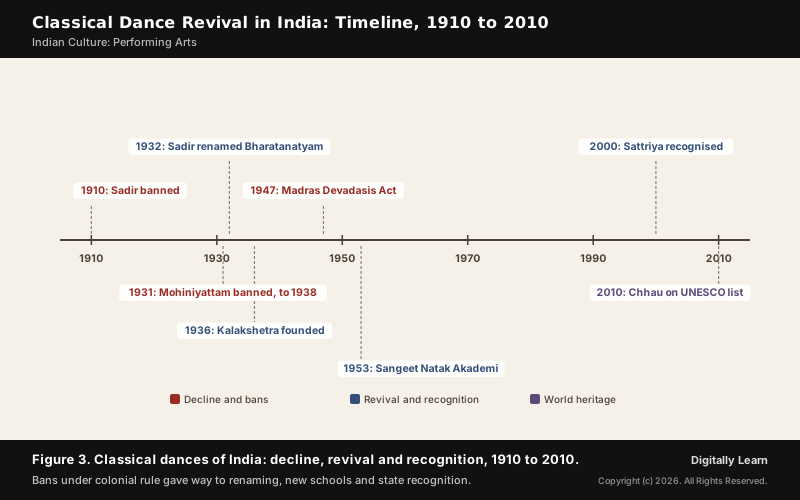
- Revival: In 1932 E. Krishna Iyer and Rukmini Devi Arundale proposed renaming Sadir as Bharatanatyam, and in 1936 Rukmini Devi founded Kalakshetra at Adyar, Chennai.
Kuchipudi: The Dance-Drama of Andhra Pradesh
Andhra Pradesh's dance-drama takes its name from the village of Kuchelapuram, where scholars and artists built up its repertoire and refined its technique. It grew largely as a product of the Bhakti movement, and tradition credits Siddhendra Yogi, in the 17th century, with founding its modern form. Historically it was a dance-drama, with an all-male troupe playing several roles.
Kuchipudi combines speech, mime and pure dance: its nritta has teermanams and jatis, its nritya sabdams, and its natya acting with mudras. The dancer becomes several characters on stage through swift changes of mime, and the music is Carnatic, in Telugu. Today it is performed as a solo, a duet or a group.
Kathakali and Mohiniyattam: The Two Classical Dances of Kerala
The story play of Kerala took shape in the seventeenth century. Its plays, drawn mostly from the Ramayana and the Mahabharata, are in Malayalam, and unlike most classical dances it developed in the courts and theatres of Hindu principalities and uses movements from Kerala's martial and athletic traditions.
- Make-up: Faces are painted by type, green for heroes, kings and divinities, red and black for the evil and fierce.
- Silent actors: The performer never speaks; two singers on stage sing the text, and the story is enacted through facial expression and hand gesture.
- Drums: The Chenda, the Maddalam and the Idakka.
- Length: A traditional performance begins in the evening and ends at daybreak.
- Training: The dominant style is taught at the Kerala Kalamandalam.
Kerala's second classical form, Mohiniyattam, takes its name from Mohini, the enchantress form of Vishnu. It is a dance of feminine grace, grown out of performances connected with Kerala's temples, and traditionally a solo dance by women. Swati Tirunal of Travancore was one of its chief architects in the nineteenth century.
The footwork is gentle and sliding, with no heavy steps; the body rises and falls with the torso, and restraint is its hallmark. The songs are in Manipravalam, a Malayalam and Sanskrit blend, set to Carnatic music with the Edakka, mridangam, veena, flute and cymbals, in the lasya style. Banned by laws from 1931 to 1938, it was revived in the 1930s by the poet Vallathol Narayana Menon, who founded the Kerala Kalamandalam.
Classical Dance Forms of North and East India
Kathak: The Storytellers' Dance of North India
The principal dance of northern India is practised in Uttar Pradesh, Rajasthan, Delhi and Madhya Pradesh. It is believed to come from the Kathakaras, storytellers who recited the epics and Puranas; it moved to the courts, flowered under Mughal rule, and in the nineteenth century centred on the courts of Lucknow, Jaipur and Raigarh.
- Style: Footwork, with bells on the ankles, and pirouettes; pre-eminently a dance of rhythm-play.
- Recital: It opens with an amad and moves through that, gat nikas, paran and tatkar.
- Music: Thumri and other songs, with the tabla, pakhawaj and sarangi; the Thumri’s link with Kathak grew in the court of Wajid Ali Shah at Lucknow.
- Gharanas: The schools of Jaipur, Banaras, Lucknow and Raigarh.
- Distinctive: The only classical form with Persian elements, from its Mughal years.
Odissi: The Sculpturesque Dance of Odisha
The classical dance of Odisha began as part of temple service by maharis, female temple servants; boys dressed as girls, the gotipuas, developed a more athletic style. Suppressed under British rule, it was remoulded as a theatre art around the middle of the twentieth century from the living dance and from dance in Odisha's sculpture, painting and literature.
Its content is the lore of Krishna and Radha, with Jayadeva's Gitagovinda given pride of place. Its technique uses hastas, footwork, gaits and spins, and two stances, the serpentine tribhangi and the square chowk, make it look sculpturesque. A recital runs from an invocation through nritta, nritya and natya to moksha, a climax that stands for spiritual release. Kelucharan Mohapatra and other gurus revived it in the late 1940s and early 1950s.
Manipuri: The Devotional Dance of Manipur
The dance of Manipur is anchored in the Vaishnava faith of the Meiteis of the Manipur valley, and temples are still among its main stages; its theme is devotion, drawn from the lore of Radha and Krishna. It was first formally developed by King Bhagyachandra and draws on four traditions: Lai Haraoba, Huyen Langlon, Nata Sankirtana and the Raas Leela.
- Restraint: The artist never makes eye contact with the audience; movements are circular and continuous, and facial expression is subdued.
- Two streams: Jagoi, gentle, and cholom, vigorous, matching lasya and tandava.
- Footwork: Soft and never audible, unlike most Indian dances.
- Music: The pung drum and the flute.
- Revival: After seeing Manipuri dance in 1919, Rabindranath Tagore invited its gurus to teach at Shantiniketan.
Sattriya: The Monastic Dance of Assam
Assam's classical form is the dance and danced drama developed in the sattras, the monasteries, of Assam since the sixteenth century, when the Vaishnava faith of the saint and reformer Shankaradeva swept the land. It began in the Bhaona, performances of Shankaradeva's one-act Ankiya Nat plays, and remains a living tradition of the sattras.
- Grammar: An evolved language of hand gesture, footwork, movement and expression, with a repertoire centred on devotion to Krishna.
- Pieces: Ramdani, Chali, Mela Nach and Jhumura for pure dance; Geetar Nach for expression.
- Music: Songs by Shankaradeva and Madhavdev set to classical ragas, with the khol drum played by hand.
- Recognition: The Sangeet Natak Akademi recognised Sattriya as a classical dance on 15 November 2000.
Chhau, the Sangeet Natak Akademi and the Revival of Classical Dance
Chhau Dance: Masks, Martial Arts and the UNESCO List
The masked dance of eastern India, in Odisha, Jharkhand and West Bengal, blends martial traditions, temple ritual and folk performance, and is often called semi-classical. It enacts episodes from the Mahabharata, the Ramayana, the Puranas and local legend to an ensemble mostly of indigenous drums, and is tied to the spring festival of Chaitra Parva.
- Three styles: Seraikella in Jharkhand, Purulia in West Bengal and Mayurbhanj in Odisha; the first two use masks.
- No singing: Vocal music is not used, though the melodies draw on Jhumur folk song, Kirtan and Hindustani ragas.
- Recognition: The Ministry of Culture lists it with the classical forms, and UNESCO inscribed it on its Representative List of intangible heritage in 2010.
Decline, Revival and the Sangeet Natak Akademi
Most classical dances were once sustained by temples and courts, often by women dedicated to temple service. Under colonial rule that system came under attack: Sadir was banned by the colonial government in 1910, Mohiniyattam by laws of 1931 to 1938, and Madras passed a Devadasis Act in 1947. The dances were then reshaped for the public stage.
- Revivers: Rukmini Devi Arundale for Bharatanatyam, Vallathol for Mohiniyattam through the Kerala Kalamandalam, Tagore for Manipuri, and Kelucharan Mohapatra and others for Odissi.
- The Akademi: Set up by a resolution of 31 May 1952 and inaugurated in 1953, the Sangeet Natak Akademi is an autonomous body of the Ministry of Culture and the apex body for the performing arts.
- Its institutions: The Jawaharlal Nehru Manipur Dance Academy in Imphal, the Kathak Kendra in Delhi, and centres for Sattriya and Chhau.
- Heritage role: It is the nodal office for intangible cultural heritage and prepares India’s UNESCO nominations.
Previous Year UPSC-CSE Questions
Previous Year UPSC-CSE Questions By the end you will be able to draft model answers for the following UPSC questions. Each question carries a collapsible framework showing how to approach it in the exam.
- UPSC Mains 2013 GS-Ia. Discuss the Tandava dance as recorded in the early Indian inscriptions.
How to structure the answer in the exam
Introduction: Define the Tandava as Shiva's vigorous dance, described in the Natya Shastra's fourth chapter with 108 karanas.
Body (sub-themes to develop):
- Text: the Tandava Lakshana and its 108 karanas; tandava and lasya.
- Image: Shiva as Nataraja, with reliefs from the 6th century at Aihole and Badami.
- Carving: all 108 karanas at Chidambaram; 81 at Thanjavur, early 11th century.
- Inscription: Thanjavur, 1011 CE, lists dance gurus and dancing girls with their land wages.
- Continuity: the karanas as a foundation of Bharatanatyam.
Conclusion: Conclude that stone preserved the Tandava's grammar and the dancers' place in the temple, the base on which the modern classical forms were rebuilt.
- UPSC Prelims 2013 Prelims-GSIn the context of cultural history of India, a pose in dance and dramatics called ‘Tribhanga’ has been a favourite of Indian artists from ancient times till today. Which one of the following statements best describes this pose?
How to approach this Prelims question
Approach: Picture the triple bend: the body curves one way, then the other, then back.
Trap to watch: Options (b) to (d) describe abhinaya and make-up, not a pose.
Key facts to recall:
- Tri means three, bhanga a bend
- Characteristic of Odissi
Answer signal: One leg bent and the body oppositely curved at waist and neck, option (a).
- UPSC Prelims 2014 Prelims-GSWith reference to Sattriya, consider the following statements:
- It is a combination of music, dance and drama.
- It is a centuries-old living tradition of the Vaishnavites of Assam.
- It is based on classical Ragas and Talas of devotional songs composed by Tulsidas, Kabir and Mirabai.
Which of the statements given above is/are correct?
How to approach this Prelims question
Approach: Test each statement against Sattriya's Assamese Vaishnava roots.
Trap to watch: Tulsidas, Kabir and Mirabai are north Indian poets; Sattriya's songs are Shankaradeva's.
Key facts to recall:
- Sattras of Assam
- Ankiya Nat and Bhaona
- Recognised in 2000
Answer signal: 1 and 2 only, option (b).
- UPSC Prelims 2017 Prelims-GSWith reference to Manipuri Sankirtana, consider the following statements:
- It is a song and dance performance.
- Cymbals are the only musical instruments used in the performance.
- It is performed to narrate the life and deeds of Lord Krishna.
Which of the statements given above is/are correct?
How to approach this Prelims question
Approach: Check the instruments: Sankirtana is ritual singing, drumming and dancing.
Trap to watch: 'Cymbals are the only instruments' is false because drums are central.
Key facts to recall:
- Singing, drumming and dancing
- Lives and deeds of Krishna
- UNESCO 2013
Answer signal: 1 and 3 only, option (b).
Sources
- Ministry of Culture, Government of India: Dance
- Sangeet Natak Akademi: About the Akademi
- Sangeet Natak Akademi: Dance section
- PIB: Intangible Cultural Heritage of India (backgrounder)
- NCERT: An Introduction to Indian Art Part I (Class XI, Fine Arts)
- Wikipedia: Indian classical dance
- Wikipedia: Natya Shastra
- Wikipedia: Bharatanatyam
- Wikipedia: Kuchipudi
- Wikipedia: Kathakali
- Wikipedia: Mohiniyattam
- Wikipedia: Kathak
- Wikipedia: Odissi
- Wikipedia: Manipuri dance
- Wikipedia: Sattriya
- Wikipedia: Chhau dance
- Wikipedia: Tandava
- Wikipedia: Tribhanga
- Wikipedia: Abhinaya
- Wikipedia: Mudra
- Wikipedia: Rasa (aesthetics)
- Wikipedia: Karana (dance)
- Wikipedia: Thillai Nataraja Temple, Chidambaram
- Wikipedia: Brihadisvara Temple, Thanjavur
- Wikipedia: Manipuri Sankirtana
- Wikipedia: Sangeet Natak Akademi
- UPSC: Civil Services Examination question papers
Editorial Disclaimer
This article draws on the Ministry of Culture, the Sangeet Natak Akademi and the other sources listed on this page. Dates for the early history of each form are approximate.


