


Overview
11 languages
The classical languages of India are 11 languages recognised by the Government of India for the high antiquity of their early texts and their ancient literature. They are Tamil (the first, in 2004), Sanskrit, Telugu, Kannada, Malayalam and Odia, and Marathi, Pali, Prakrit, Assamese and Bengali, added on 3 October 2024 under revised criteria. In October 2026 the government approved Centres of Excellence for the five newest.
Classical Languages of India: Meaning, Number and the 2026 Centres
Classical Languages of India by Date of Recognition and Language Family
The Government created the category on 12 October 2004 and declared Tamil the first classical language that day. Five more followed between 2005 and 2014 under the criteria of 2004 and 2005, and the Union Cabinet added another five on 3 October 2024 under revised criteria.
By family the 11 fall into three groups. Tamil, Telugu, Kannada and Malayalam are the four largest Dravidian languages; Odia, Marathi, Assamese and Bengali are Indo-Aryan languages still spoken; and Sanskrit, Pali and Prakrit are historic Indo-Aryan languages.
| Language | Date recognised |
|---|---|
| Tamil | 12 October 2004 |
| Sanskrit | 25 November 2005 |
| Telugu | 31 October 2008 |
| Kannada | 31 October 2008 |
| Malayalam | 8 August 2013 |
| Odia | 1 March 2014 |
| Marathi, Pali, Prakrit, Assamese, Bengali | 3 October 2024 (Cabinet approval) |
Five Centres of Excellence for Assamese, Bengali, Marathi, Pali and Prakrit
In October 2026 the Union government approved five Centres of Excellence for the five languages recognised in 2024. The Ministry of Education said they will support advanced research, the preservation and digitisation of linguistic and literary heritage, and wider dissemination of knowledge about these languages.
- Classical Assamese: Tezpur University, Assam.
- Classical Bengali: Visva-Bharati University, West Bengal.
- Classical Marathi: Deccan College Post-Graduate and Research Institute, Pune.
- Classical Pali: Central University of Odisha.
- Classical Prakrit: Central University of Gujarat.

The new centres join an existing network. On 6 January 2026 the Ministry of Education released 55 volumes of literary works in classical languages. The Centres of Excellence under the Central Institute of Indian Languages brought out 41 of them, and the Central Institute of Classical Tamil brought out 13 books and a sign-language series of the Tirukkural. Later that month the President inaugurated the Granth Kutir at Rashtrapati Bhavan, a library and archive of manuscripts and books in the 11 classical languages.
Criteria for Classical Language Status: 2004, 2005 and 2024
Classical Language Criteria of 2004 and the 2005 Revision
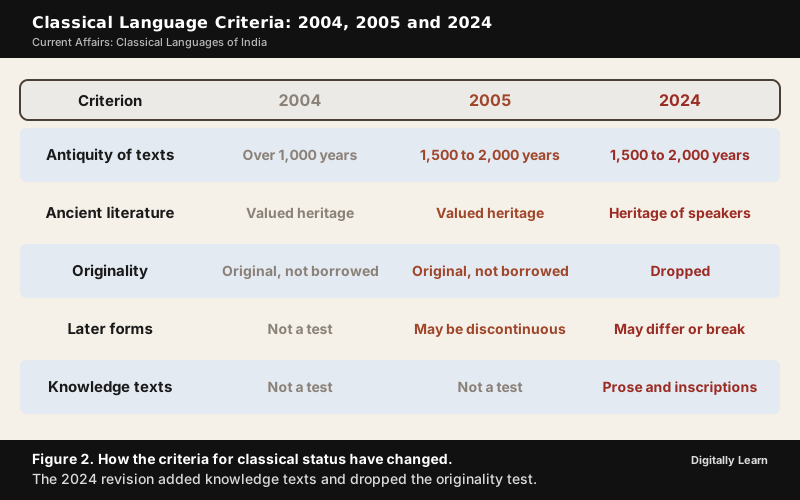
The first criteria, set in 2004 when Tamil was declared, had three parts. The revision of November 2005, under which Sanskrit was declared, raised the bar on antiquity and added a fourth test.
| Criterion | 2004 | 2005 |
|---|---|---|
| Antiquity of early texts or recorded history | Over a thousand years | 1,500 to 2,000 years |
| Ancient literature | A body of texts valued as heritage by speakers | The same |
| Originality | Not borrowed from another speech community | The same |
| Later forms | Not a test | The classical form may be discontinuous with later forms |
Six languages qualified under these rules: Tamil, Sanskrit, Telugu, Kannada, Malayalam and Odia. Marathi was recommended by the Linguistic Experts Committee after a proposal from Maharashtra in 2013, but it was not notified then. During inter-ministerial consultations in 2017, the Ministry of Home Affairs advised that the criteria be revised and made stricter, and the Prime Minister's Office asked how many other languages were likely to become eligible.
The 2024 Revision of Criteria and the Five New Classical Languages
Proposals for Pali, Prakrit, Assamese and Bengali then arrived from Bihar, Assam and West Bengal. On 25 July 2024, the Linguistic Experts Committee under the Sahitya Akademi unanimously revised the criteria and found that all five languages, Marathi among them, met them. The revised criteria are:
- High antiquity of early texts or recorded history over a period of 1,500 to 2,000 years.
- A body of ancient literature or texts considered a heritage by generations of speakers.
- Knowledge texts, especially prose in addition to poetry, with epigraphical and inscriptional evidence.
- The classical language and its literature may be distinct from its current form, or discontinuous with later forms of its offshoots.
Who Confers Classical Status and the Benefits It Brings
Linguistic Experts Committee, Sahitya Akademi and the Union Cabinet
Classical status is conferred by the Government of India, not by the Constitution. The Ministry of Culture constituted a Linguistic Experts Committee (LEC) under the Sahitya Akademi in November 2004 to examine proposed languages, and the Sahitya Akademi is the nodal agency for the committee.
- Proposal: A State government usually sends the request, as Maharashtra did for Marathi in 2013 and Bihar, Assam and West Bengal did for the other four.
- Examination: The LEC tests the language against the criteria and recommends.
- Decision: The Union Cabinet approves the status, as it did on 3 October 2024.
- Promotion: The Ministry of Education promotes the language, largely through the Central Institute of Indian Languages, part of its Language Bureau.
Benefits of Classical Status: Awards, Chairs and Centres of Excellence
Under the 2004 resolution, a classical language receives two major international awards each year for scholars of eminence, a Centre of Excellence for Studies in Classical Languages, and a request to the University Grants Commission to create professional chairs, starting with the central universities. The Ministry of Education now describes the benefits as national awards, chairs in universities and centres for promotion.
- Sanskrit: Three central universities were set up by an Act of Parliament in 2020, namely the Central Sanskrit University and Shri Lal Bahadur Shastri National Sanskrit University in New Delhi, and the National Sanskrit University in Tirupati.
- Tamil: The Central Institute of Classical Tamil in Chennai studies the Tamil language and literature of the period up to 600 CE; it has had the Tirukkural translated into 28 Indian and over 30 world languages and into Braille.
- Kannada, Telugu, Malayalam and Odia: Centres of Excellence under the Central Institute of Indian Languages at Mysuru, Nellore, Tirur and Bhubaneswar.
These centres research the languages, digitise manuscripts with State museums and archives, publish, and translate classical texts into Indian and foreign languages.
Marathi, Pali, Prakrit, Assamese and Bengali: Why They Qualified
The Literary Evidence for the Five Languages Added in 2024
Each of the five offered old texts and inscriptions to meet the revised tests. Two are ancient languages of religious literature; three are major spoken languages of today with medieval and older roots.
- Marathi: The Gathasaptasati, attributed to the Satavahana king Hala and compiled around the 1st century CE, is its earliest known literary work, and the Naneghat inscription shows its early use.
- Pali: The language of the Buddhist canon, the Tipitaka, with its Vinaya, Sutta and Abhidhamma Pitakas, and of the Jataka tales.
- Prakrit: A spectrum of Middle Indo-Aryan languages used by the Buddha and Mahavira to preach; the inscriptions of Ashoka and Kharavela are mainly in Prakrit.
- Assamese: Flourishing by the 8th century CE; the earliest pre-modern Assamese is found in the Charyapadas, Buddhist texts of the 8th to 12th centuries.
- Bengali: Its earliest specimens are the 47 Charyapada hymns, and its earliest works date from between the 10th and 12th centuries CE.
The States most concerned are Maharashtra (Marathi); Bihar, Uttar Pradesh and Madhya Pradesh (Pali and Prakrit); West Bengal (Bengali); and Assam (Assamese). The government expects jobs in academic research, archiving, translation, publishing and digital media to follow from the preservation of their texts.
Classical Languages Versus the Eighth Schedule of the Constitution
Eighth Schedule Languages and the Constitutional Amendments
The Eighth Schedule is part of the Constitution. It began with 14 languages in 1950 and now lists 22 scheduled languages, and the Union is bound to develop them. The 2011 Census recorded 121 major languages in India, of which these 22 are scheduled.
- 21st Amendment (1967): Sindhi was added as the 15th language.
- 71st Amendment (1992): Konkani, Manipuri and Nepali were added, making 18.
- 92nd Amendment (2003): Bodo, Dogri, Maithili and Santali were added, making 22.
- 96th Amendment (2011): Oriya was renamed Odia.
The schedule is linked to Articles 344(1), on the Official Languages Commission, and 351, on the promotion of Hindi. As of December 2023, the Ministry of Home Affairs listed demands for the inclusion of 38 more languages.
| Feature | Classical status | Eighth Schedule |
|---|---|---|
| Source | Government decision on the LEC's advice | The Constitution |
| How added | Cabinet approval | Constitutional amendment |
| Number | 11 languages | 22 languages |
| Basis | Antiquity and ancient literature | Languages listed for development |
| Example | Pali and Prakrit, classical but not scheduled | Gujarati, scheduled but not classical |
Previous Year UPSC‑CSE Questions
Each question is explained option by option.
- UPSC Prelims 2024The Constitution (71st Amendment) Act, 1992 amends the Eighth Schedule to the Constitution to include which of the following languages?
- Konkani
- Manipuri
- Nepali
- Maithili
Select the correct answer using the code given below:
How to approach this Prelims question
Approach: Match each language to the amendment that added it. The 71st Amendment of 1992 added Konkani, Manipuri and Nepali. Maithili was added by the 92nd Amendment of 2003, with Bodo, Dogri and Santali.
Trap to watch: Maithili is a scheduled language, but it came in 2003, not 1992.
Why each option is right or wrong:
- (a) 1, 2 and 3: Correct. Konkani, Manipuri and Nepali were added in 1992.
- (b) 1, 2 and 4: Wrong. It includes Maithili and leaves out Nepali.
- (c) 1, 3 and 4: Wrong. It includes Maithili and leaves out Manipuri.
- (d) 2, 3 and 4: Wrong. It includes Maithili and leaves out Konkani.
Answer: (a) 1, 2 and 3. Maithili came later, with the 92nd Amendment of 2003.
- UPSC Prelims 2015Which one of the following was given classical language status recently?
How to approach this Prelims question
Approach: Find the option notified as classical last before the 2015 paper. Odia was notified on 1 March 2014. Konkani and Bhojpuri have never been declared classical, and Assamese was added only in 2024.
Trap to watch: Assamese is classical today, but it was not in 2015.
Why each option is right or wrong:
- (a) Odia: Correct. It was declared classical on 1 March 2014.
- (b) Konkani: Wrong. It is in the Eighth Schedule but is not classical.
- (c) Bhojpuri: Wrong. It has never been declared classical.
- (d) Assamese: Wrong. It became classical only in October 2024.
Answer: (a) Odia. It was notified as classical on 1 March 2014.
- UPSC Prelims 2014Consider the following languages:
- Gujarati
- Kannada
- Telugu
Which of the above has/have been declared as 'Classical Language/Languages' by the Government?
How to approach this Prelims question
Approach: Test each language against the list of notified classical languages. Kannada and Telugu were both notified on 31 October 2008. Gujarati is a scheduled language but has never been declared classical.
Trap to watch: Being in the Eighth Schedule does not make a language classical.
Why each option is right or wrong:
- (a) 1 and 2 only: Wrong. Gujarati is not classical, and Telugu is left out.
- (b) 3 only: Wrong. Kannada was declared classical with Telugu in 2008.
- (c) 2 and 3 only: Correct. Kannada and Telugu are classical; Gujarati is not.
- (d) 1, 2 and 3: Wrong. Gujarati is not a classical language.
Answer: (c) 2 and 3 only. Kannada and Telugu were declared classical in 2008; Gujarati never was.
Sources
- PIB (Cabinet): Classical language status to Marathi, Pali, Prakrit, Assamese and Bengali, 3 October 2024
- PIB: Government's commitment to India's linguistic heritage, 18 December 2024
- PIB: Classical Languages of India, backgrounder, 27 October 2025
- PIB: Classical Languages of India, backgrounder (PDF), October 2025
- The Hindu (Delhi): Education Minister releases 55 volumes of literary works, 7 January 2026, p. 14
- The Hindu (Delhi): The President inaugurates the Granth Kutir at Rashtrapati Bhavan, 24 January 2026, p. 12
- The Hindu (Delhi): Centres of Excellence approved for five classical languages, 4 October 2026, p. 11
- NCERT: Democratic Politics (Class X), Chapter 2, Federalism
- Wikipedia: Classical languages of India
- Wikipedia: Eighth Schedule to the Constitution of India
- UPSC: Civil Services Examination question papers
Editorial Disclaimer
This article draws on the documents in the Sources section, chiefly PIB releases on Cabinet and Ministry of Education decisions.
See more of our UPSC articles in Google Search
Add to Preferred Sources