


Overview
Cyber crime is any offence in which a computer, a phone or a network is either the target of the crime or the tool used to commit it. The National Crime Records Bureau (NCRB) counts it as crime "involving communication devices as medium/target". Cyber crime in India is punished under two laws, the Information Technology Act, 2000 (IT Act), which defines offences against computers and data, and the Bharatiya Nyaya Sanhita, 2023 (BNS), the general criminal law in force since 1 July 2024, which covers cheating, extortion, forgery and stalking whether they are committed offline or online.
Cyber Crime: Meaning and Scale in India
Cyber Crime Versus Cyber Attack
A cyber attack is an attack through cyberspace on an organisation's computers or networks, made to disrupt, disable, destroy or take control of them, or to damage data or steal protected information. The term describes what happens to a computer system. Cyber crime, by contrast, is a legal term that covers every act that a law punishes when it is committed through or against a computer resource.
The two overlap but are not the same. A ransomware attack that locks a hospital's records is both a cyber attack and a crime under the IT Act. Many cyber crimes, however, involve no attack on any system. In a digital arrest fraud the criminals deceive a person over a video call, and the phone works exactly as designed; the person, not the machine, is the target. In such crimes the computer is the tool, while in hacking or ransomware it is the target.
The difference decides who responds. Attacks on systems, especially critical information infrastructure, are handled by the Indian Computer Emergency Response Team (CERT-In), the national agency for incident response under Section 70B of the IT Act, and by the national nodal agency for critical information infrastructure designated under Section 70A. Crimes against citizens are investigated by State police with the I4C's support. Attacks by one country on another fall under cyber warfare.
| Aspect | Cyber crime | Cyber attack |
|---|---|---|
| Nature of the term | Legal category of offences | Technical description of hostile action |
| Main target | A person, a company or the State | Computers, networks and data |
| Typical example | Phishing, digital arrest fraud, cyber stalking | Ransomware, denial of service, intrusion into a power grid |
| Lead response in India | State police, supported by the I4C | CERT-In and the nodal agency under Section 70A |
| Main law | IT Act and BNS | IT Act, including Sections 66, 66F, 70 and 70B |
Trends in Reported Cyber Crime
Registered cyber crime in India doubled between 2020 and 2024. NCRB recorded 50,035 cases in 2020, 52,974 in 2021, 65,893 in 2022, 86,420 in 2023 and 1,01,928 in 2024. The rise of 17.9 per cent in 2024 took the crime rate from 6.2 to 7.3 cases per lakh people. In 2024, 44,872 cases were registered under the IT Act, 56,747 under the Indian Penal Code (IPC) or the BNS read with the IT Act, and 309 under other special laws such as the Copyright Act.
Fraud drives the trend. In 2024, 73,987 cases, or 72.6 per cent of the total, were committed for the motive of fraud, followed by sexual exploitation with 3,190 cases (3.1 per cent) and extortion with 2,536 cases (2.5 per cent).

Cyber Crime by State, FIRs and Pending Trials
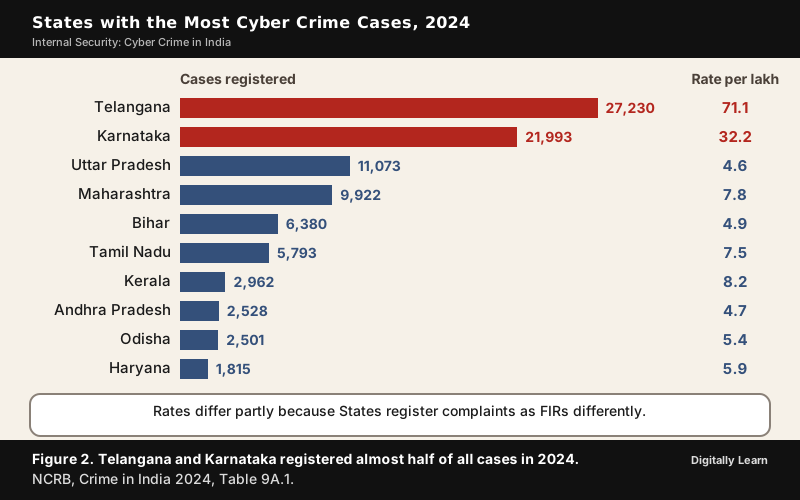
Registration of cyber crime is concentrated in a few States. Telangana recorded 27,230 cases and Karnataka 21,993, together almost half the national total, and Telangana's rate was 71.1 cases per lakh people. States cannot be compared on these figures alone, because the numbers also reflect how readily each State's police register complaints as first information reports (FIRs).
The case counts understate the problem, because NCRB counts only registered FIRs. From 2023‑24 to 2025‑26, the National Cyber Crime Reporting Portal received 53,87,905 cyber fraud complaints, but only 1,81,271 FIRs were registered on them, fewer than four for every hundred complaints. The complaints reported a loss of more than ₹56,087 crore.
Cases that are registered move slowly. In 2024 the police filed charge-sheets in 31.9 per cent of the cyber crime cases they disposed of. Courts completed trials in 4,567 cases, and 90,630 of the 99,693 cases before them were still pending at the end of the year. Where trials did end, the conviction rate was 56.8 per cent.
Types of Cyber Crime
Crimes Against Computers and Computer-Enabled Crimes
Cyber crimes fall into two broad groups:
- Crimes against computers: The system itself is attacked, as in hacking, data theft, ransomware and cyber terrorism. The IT Act is the main law, through Sections 43, 66 and 66F.
- Computer-enabled crimes: An old crime such as cheating, extortion or stalking is carried out through phones, apps and social media. The BNS is the main law, through sections such as 318(4) for cheating, 308 for extortion and 78 for stalking, alongside IT Act sections such as 66C and 66D.
Most cyber crime reported in India belongs to the second group. Its three families are financial fraud, coercive scams, and crimes against persons and society.
Financial Fraud, Phishing and Identity Theft
In phishing, a criminal tricks a person into revealing sensitive personal information, such as a password, card number or one-time password (OTP), by pretending to be a trustworthy body in an electronic message. A message that seems to come from a bank or another trusted body leads the victim to a fake website or app. The same trick through a phone call is vishing, and through a text message it is smishing. Phishing is usually the first step of a financial fraud, because the stolen credentials let the criminal move money out of the victim's account.
NCRB recorded 29,758 cyber fraud cases under the BNS and IPC in 2024, and they took many forms.
| Type of fraud | Cases in 2024 |
|---|---|
| Online banking fraud | 4,659 |
| Credit or debit card fraud | 3,829 |
| Marketing or investment fraud | 3,044 |
| ATM fraud | 1,659 |
| Fraud call (vishing) | 1,264 |
| Gaming app or website fraud | 1,019 |
| OTP fraud | 965 |
| E‑wallet or Unified Payments Interface (UPI) fraud | 723 |
| Other frauds | 12,596 |
| All cyber fraud | 29,758 |
The table counts cases registered under the fraud head; another 19,296 cyber cases were registered as cheating in 2024.
Section 66C of the IT Act punishes identity theft, the fraudulent or dishonest use of another person's electronic signature, password or any other unique identification feature. Stolen identities are used for further frauds and for fake profiles on social media; NCRB counted 266 fake-profile cases in 2024.
Stolen money is moved through money mules, people who let criminals use their bank accounts, often in return for a small share. The criminals pass the money through several layers of such accounts, so that it is hard to trace and recover. Mule accounts are why speed matters in reporting. The sooner a fraud is reported, the more likely the money is still in a first-layer account where it can be frozen.

Digital Arrest, Sextortion and Investment Scams
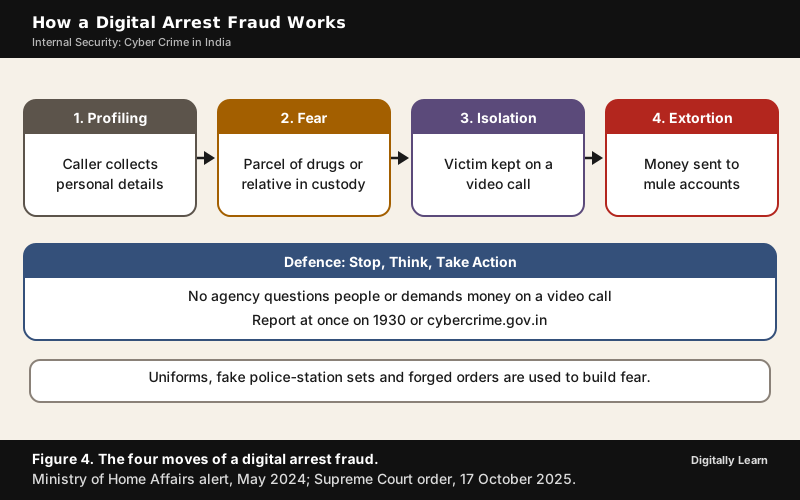
A digital arrest is a fraud in which criminals pose as officers of the police, the Central Bureau of Investigation (CBI), the Enforcement Directorate, a narcotics agency or the Reserve Bank of India (RBI), accuse the victim of a crime over a phone or video call, keep the victim on camera under a fake "arrest", and extort money to settle the case. Indian law has no procedure called digital arrest, and no government agency questions people or demands money over a video call.
The fraud follows a set pattern. The caller first gathers personal details, then claims that a parcel in the victim's name holds drugs, fake passports or other contraband, or that a relative is in custody. Fear is built with uniforms, sets made to look like police stations and government offices, and forged documents. In the final step the victim is put under time pressure and told that arrest will follow unless money is transferred at once. The Ministry of Home Affairs describes the digital arrest as an organised online economic crime run by cross-border crime syndicates.
Complaints of digital arrest on the national portal fell from 1,23,672 in 2024 to 58,239 in 2025, and stood at 16,377 for the period up to 30 June 2026. By March 2025 the I4C had blocked more than 3,962 Skype IDs and 83,668 WhatsApp accounts used for digital arrest, alongside awareness campaigns in newspapers, on radio and on social media.
In sextortion, sexual images or information are used to blackmail the victim into paying money or granting sexual favours. Social media and messaging apps are often both the source of the material and the threatened means of sharing it with the victim's contacts. Investment and part-time job scams work through greed rather than fear. In an investment scam the victim is drawn to a fake trading website or app that may show early "returns" to win trust before large deposits are taken; in a part-time job scam the victim is paid small sums for simple tasks, such as posting reviews or watching videos, and then persuaded to deposit large amounts for "premium tasks".
Crimes Against Children, Cyber Stalking and Hate Content
Crimes against children online include publishing, collecting, browsing or downloading sexually explicit material depicting children, enticing children into online relationships for sexual acts, and recording such abuse. Section 67B of the IT Act punishes all of these with up to five years' imprisonment and a fine of up to ₹10 lakh on first conviction, and up to seven years on a second.
The term for this material has changed in the courts. In 2024 the Supreme Court directed that courts must not use the term "child pornography" and should use child sexual exploitation and abuse material (CSEAM) instead, because such images and videos are records of a child's exploitation and abuse. The Court also asked Parliament to amend the Protection of Children from Sexual Offences Act (POCSO) to use the same term.
Using the internet or other electronic means to follow, watch or harass a person is called cyber stalking. Section 78 of the BNS makes it stalking when a man monitors a woman's use of the internet, e-mail or any other electronic communication, punishable with up to three years' imprisonment on first conviction and up to five years on a second. NCRB recorded 1,240 cases of cyber stalking or bullying of women and children in 2024. Related offences include capturing or sharing images of a person's private areas without consent (Section 66E of the IT Act) and voyeurism, which includes sharing such images (Section 77 of the BNS).
Hate content and false information online can disturb public order. Section 353 of the BNS punishes making or circulating false information or rumours, including through electronic means, that are meant to cause public alarm or to promote enmity between groups. NCRB recorded 483 cases of fake news on social media in 2024. Platforms can also be required to remove such content under Section 79(3)(b) of the IT Act.
Laws Against Cyber Crime
Offences Under the IT Act, 2000
The IT Act was amended in 2008 to create most of today's cyber offences, and the changes came into force on 27 October 2009. Its main offences and their maximum punishments are:
- Section 43: Accessing, copying or damaging a computer without the owner's permission, or introducing a virus, makes a person liable to pay compensation; it is a civil wrong, not a crime.
- Section 65: Tampering with computer source code, up to three years, or a fine of up to ₹2 lakh, or both.
- Section 66: Any act under Section 43 done dishonestly or fraudulently, up to three years, or a fine of up to ₹5 lakh, or both.
- Section 66C and Section 66D: Identity theft, and cheating by personation using a computer resource, each up to three years and a fine of up to ₹1 lakh.
- Section 66E: Violation of privacy by capturing or sharing images of a person's private areas, up to three years, or a fine of up to ₹2 lakh, or both.
- Section 66F: Cyber terrorism, up to imprisonment for life.
- Sections 67, 67A and 67B: Obscene material, sexually explicit material, and material depicting children in sexually explicit acts; on a repeat conviction the term can reach five years under Section 67 and seven years under the other two.
- Section 70: Unauthorised access to a protected system, up to ten years and a fine.
The Act also sets the procedure. Offences punishable with three years or more are cognizable, and those punishable with three years are bailable (Section 77B). Only a police officer of the rank of Inspector or above may investigate an offence under the Act (Section 78). The Act applies to an offence committed outside India by any person if it involves a computer system or network located in India (Section 75).
Section 66A, which punished "offensive" messages sent through a computer, was struck down by the Supreme Court in Shreya Singhal v. Union of India on 24 March 2015 for violating the freedom of speech under Article 19(1)(a). The Jan Vishwas (Amendment of Provisions) Act, 2023, formally omitted it with effect from 30 November 2023; the same Act turned some offences, such as breach of confidentiality under Section 72, into civil penalties.
Cyber Offences in the Bharatiya Nyaya Sanhita
The BNS replaced the Indian Penal Code on 1 July 2024 and brought digital acts into many old offences. Its definition of a document now includes electronic and digital records, so forging a screenshot, an e-mail or a fake court order is forgery under Section 336, punishable with up to seven years when the forged record is meant for cheating. The main cyber-relevant sections are:
- Section 318: Cheating; when the victim is induced to hand over property, the punishment rises to seven years and a fine (Section 318(4)).
- Section 319: Cheating by personation, by pretending to be another real or imaginary person, up to five years.
- Section 308: Extortion, up to seven years; the Sanhita's own illustration is a threat sent through an electronic device that a child will be killed unless money is paid.
- Sections 77 and 78: Voyeurism and stalking, including monitoring a woman's electronic communication.
- Section 294: Sale or circulation of obscene material, which now includes the display of content in electronic form.
- Section 353: False statements and rumours spread through electronic means that cause public mischief.
Two new provisions target cyber crime as an industry. Organised crime under Section 111 is a continuing unlawful activity by a syndicate, and the section lists cyber crimes among such activities; the punishment is at least five years, extending to life, with a fine of at least ₹5 lakh, and death or life imprisonment if a death results. NCRB recorded 60 organised cyber crime cases in 2024, the first year of the new law. Section 112 punishes petty organised crime, such as theft through card skimming, by gangs. The BNS also reaches beyond India's borders, because it applies to any person outside India who commits an offence targeting a computer resource located in India (Section 1(5)(c)).
Two Layers of Cyber Crime Law Compared
The IT Act and the BNS work as two layers of law. The IT Act is a special law that defines offences existing only because computers exist, such as hacking or tampering with source code, and that sets the procedure for investigating them. The BNS is the general criminal law, and it applies whenever an ordinary crime, such as cheating or extortion, is committed with a phone or a computer. A single fraud is therefore usually charged under both, and most types of cyber crime have a section in each law.
| Type of cyber crime | IT Act, 2000 | Bharatiya Nyaya Sanhita, 2023 |
|---|---|---|
| Hacking and damage to data | Sections 43 and 66 | Sections 303 and 305 to 307 (theft), under which NCRB counts data theft |
| Identity theft and fake profiles | Section 66C | Section 319 (cheating by personation) |
| Online fraud and phishing | Section 66D | Section 318(4) (cheating) |
| Digital arrest and sextortion | Section 66D (Section 66E also for sextortion) | Sections 308 (extortion), 318(4), 336 (forgery) and 61 (criminal conspiracy) |
| Child sexual exploitation and abuse material | Section 67B | Section 294 (obscene material), with the POCSO Act |
| Cyber stalking and voyeurism | Section 66E | Sections 77 and 78 |
| False information and hate content | No offence since Section 66A was struck down | Sections 196 and 353 |
| Organised cyber fraud by gangs | None | Section 111 (organised crime) |
Institutions Fighting Cyber Crime
Indian Cyber Crime Coordination Centre and Its Seven Components
Because police is a State subject, every cyber crime FIR is registered and investigated by State or Union Territory police, in cyber cells and cyber police stations. The Union Government's role is to coordinate, to build capacity and to provide national platforms. It has released ₹132.93 crore under the Cyber Crime Prevention against Women and Children (CCPWC) scheme to set up cyber forensic-cum-training laboratories, which are working in 33 States and Union Territories.
The Indian Cyber Crime Coordination Centre (I4C) is the Ministry of Home Affairs' centre for dealing with all types of cyber crime in a coordinated way. Its scheme was approved on 5 October 2018 on the recommendation of an expert group, it was dedicated to the nation on 10 January 2020, and it became an attached office of the Ministry from 1 July 2024. Its objectives are to act as the national nodal point against cyber crime, to strengthen the fight against cyber crime targeting women and children, to make complaints easy to file, to warn police forces early about new trends, and to train police officers, prosecutors and judges.
The I4C works through seven components, called verticals:
- National Cyber Crime Reporting Portal: The single online window for citizens to report any cyber crime.
- National Cybercrime Threat Analytics Unit (NCTAU): Gathers cyber crime information from open sources, the reporting portal, CERT-In and other agencies, analyses it with the police, the private sector and academia, and passes it to the agencies that must act.
- National Cybercrime Ecosystem Management Unit (NCEMU): Brings academia, industry and government together against cyber crime and runs awareness campaigns on social media, by SMS and on radio.
- Joint Cybercrime Coordination Teams (JCCTs): Seven teams for the hotspots of Mewat, Jamtara, Ahmedabad, Hyderabad, Chandigarh, Visakhapatnam and Guwahati, where cases cross State lines.
- National Cybercrime Forensic Laboratory (NCFL): Now called the National-Digital Investigation Support Centre, it has worked in New Delhi since 2019 and in Assam since 2025; the New Delhi centre had helped State police in more than 14,064 cases by 30 June 2026.
- National Cybercrime Training Centre (NCTC): Trains police officers, prosecutors and judicial officers; the I4C's CyTrain online platform had more than 1,63,344 registered police and judicial officers by 30 June 2026.
- National Cybercrime Research and Innovation Centre (NCR&IC): Set up at the Bureau of Police Research and Development, it tracks new technology that criminals could exploit and develops indigenous software tools for investigating cyber crime against women and children.
Around these verticals the I4C runs operational platforms. The Cyber Fraud Mitigation Centre seats banks, payment firms, telecom companies, internet platforms and State police together for immediate action on frauds. The Samanvaya platform shares cyber crime data between States and maps the links between crimes and criminals; its Pratibimb module shows where criminals and their infrastructure are located, and the platform has led to more than 29,837 arrests. The Suspect Registry, launched with banks on 10 September 2024, has shared 32.08 lakh first-layer mule accounts and helped decline transactions worth ₹25,698 crore by 30 June 2026. The Sahyog portal sends notices to platforms to remove content used for crime.
National Cyber Crime Reporting Portal and the 1930 Helpline
A cyber crime in India is reported on the National Cyber Crime Reporting Portal (cybercrime.gov.in) or, for a financial fraud, on the toll-free national helpline 1930, and the State police then register the FIR and investigate. The portal accepts every type of cyber crime, with special focus on crimes against women and children.
For money lost to fraud, the speed of reporting decides whether it can be recovered. A call to 1930 or a portal complaint then moves through three steps:
- It enters the Citizen Financial Cyber Fraud Reporting and Management System (CFCFRMS), launched in 2021, which is linked directly to banks and payment firms.
- The bank that received the money is alerted at once and can hold it, by marking a lien on the amount, before it moves to the next layer of mule accounts.
- The amount is later returned to the victim through the Money Restoration Module, which became functional in April 2026.
By 30 June 2026 more than ₹11,158 crore had been saved in more than 32.80 lakh complaints.
The complaint must also become an FIR so that the case can be investigated. Under the e-Zero FIR system, launched as a pilot in Delhi in May 2025, a complaint of loss above ₹10 lakh made on the portal or 1930 is automatically registered as a Zero FIR and sent to the cyber police station with jurisdiction; the victim then has three days to visit that police station and have it converted into a regular FIR. By August 2026 the e-Zero FIR system was working in 19 States.
The victim must also tell the bank. Under the Reserve Bank's rules of 2017, now consolidated in its directions of 2025, a customer bears no loss from an unauthorised electronic transaction caused by a breach outside the bank if the customer informs the bank within three working days.
Revised directions issued on 24 June 2026 apply to transactions from 1 January 2027 and make three changes:
- Zero liability: It extends to cases reported within five calendar days.
- Time limit: Banks must decide domestic complaints within 45 calendar days.
- Small frauds: A victim with a gross loss of up to ₹50,000 is compensated by 85 per cent of the net loss or ₹25,000, whichever is less, once in a lifetime. The fraud must have been reported on the portal or the helpline and to the bank within five calendar days.
State Initiatives: Kerala's CyberDome
Kerala's CyberDome is the cyber centre of excellence of the Kerala Police, a technological research and development centre under the Kerala Police Cyber Division, set up as a public-private partnership. It is located at Technopark in Thiruvananthapuram. It brings together government departments, police and other law enforcement agencies, industry, academia, international organisations and individual experts to strengthen the State's ability to deal with cyber threats and to protect its digital assets.
Its most distinctive feature is an online office of selected ethical hackers, investigators and cyber security professionals, people with professional competence and a clean background, who assist the police in investigation, forensics and keeping up with new threats. Industry partners contribute expertise, software and training, which a police force could not build on its own. Its main initiatives are:
- Counter Child Sexual Exploitation Centre: Traces offenders, removes child sexual exploitation and abuse material and runs awareness work on crimes against children.
- Security Operations Centre: Monitors the computers of police headquarters, city commissionerates and police stations round the clock.
- Drone Forensic Lab and Research Centre: Works on drone and counter-drone uses for the police and on drone forensics.
- KidGlove: Teaches teachers, parents and children about online safety.
- Hac'KP: A hackathon in which technologists build solutions to real policing problems.
CyberDome helps control internet crime in three ways. It prevents crime by building a cyber-resilient ecosystem across government departments; it closes the skills gap between fast-changing technology and a police force trained for physical crime; and it gives investigators expert help in tracing offenders and handling digital evidence. Its limits are those of any State body. A centre in Thiruvananthapuram cannot compel a platform or a bank abroad to share data, which needs national and international channels. The Supreme Court has since directed every State to set up a State Cybercrime Coordination Centre linked to the I4C.
Measures Needed Against Cyber Crime
Police Capacity, Cyber Forensics and Cross-Border Evidence
The figures on FIRs, charge-sheets and pending trials point to the weakest link, the gap between a complaint and a conviction. Investigating a cyber crime needs digital forensics, quick data from banks and platforms, and officers who understand both, and the IT Act's rule that no officer below the rank of Inspector may investigate its offences narrows the pool further.
Capacity has grown but remains thin:
- Training: More than 24,600 police officers, prosecutors and judicial officers had been trained under the CCPWC scheme by July 2026.
- Forensic laboratories: Seven Central and 28 State forensic science laboratories now help investigate cyber crime.
- Cyber Commandos: The programme, launched on 10 September 2024 to create a specially trained wing, had trained 281 commandos by July 2026.
- State coordination centres: By August 2026 only 14 States had notified their State Cybercrime Coordination Centres, and the Supreme Court directed the rest to do so within four weeks.
Cross-border evidence is the hardest problem. The scam centres, servers and accounts behind many frauds lie outside India, and both the IT Act and the BNS reach offences committed abroad against computers in India, but evidence still has to be obtained from foreign governments and companies. The I4C signed a memorandum of understanding with the United States Department of Homeland Security on cooperation in cyber crime investigations on 17 January 2025, and the Supreme Court asked the CBI to work through Interpol.
A global treaty may ease the problem. India signed the United Nations Convention against Cybercrime in September 2026; the treaty, adopted by the General Assembly in December 2024 and opened for signature at Hanoi in October 2025, enters into force only after 40 countries ratify it, and only three had done so by 30 September 2026.
The measures needed follow from these gaps:
- More FIRs, faster: Extending e-Zero FIR to every State, and to losses below ₹10 lakh, so that a fraud complaint is registered as an FIR at once.
- Specialised investigators: Cyber police stations in every district, cadres of trained investigators and forensic laboratories close to them.
- Coordination: State Cybercrime Coordination Centres in every State, working with the I4C and the JCCTs, and a wider reach for the CBI, which begins an investigation only when the fraud exceeds ₹10 crore; by August 2026 an inter-departmental committee had asked it to consider lowering this threshold and taking up cases of one network whose frauds together exceed it.
- Faster evidence from abroad: Bilateral agreements and, once in force, the UN convention.
- A clearer law: An offence that covers organised impersonation frauds such as the digital arrest, which no section names, since most IT Act offences date from the 2008 amendment.
Awareness, Bank Coordination and Mule Account Control
Prevention depends on banks, telecom companies and citizens as much as on the police. Banks are the choke point, because almost every financial fraud passes through a bank account:
- MuleHunter.AI: The Reserve Bank's tool that uses artificial intelligence to detect mule accounts was live in 26 banks by March 2026.
- Indian Digital Payment Intelligence Corporation: It was incorporated on 16 October 2025 to detect digital payment fraud in real time.
- Court directions: The Supreme Court has allowed the CBI to investigate bank officials who help open mule accounts and has directed the RBI to adopt a procedure for temporary debit holds on suspect accounts.
The gap between money frozen and money returned remains wide. Of more than ₹9,079 crore placed under lien from 2023‑24 to 2025‑26, only about ₹206 crore had been refunded to victims.
Telecom controls attack the other end of the fraud. By 30 June 2026 more than 15.75 lakh SIM cards and 5.77 lakh mobile handsets (by their IMEI numbers) reported by the police had been blocked, and telecom companies were directed to block international calls that display Indian numbers. The Supreme Court has found an "alarming, negligent, and irresponsible attitude" by telecom companies in issuing SIM cards and has asked the Department of Telecommunications to propose stricter rules.
Awareness is the cheapest defence, because most frauds work by deceiving the victim. The Government's message for a suspicious call is "Stop, Think, Take Action". It means staying calm and sharing nothing, remembering that no agency questions people or demands money on a video call, and reporting at once on 1930 or the portal. The I4C spreads such warnings through its CyberDost social media accounts and a caller-tune campaign run with telecom companies, also in regional languages.
Insurance spreads the cost of the losses that remain. A personal cyber insurance policy covers an individual against cyber risks. One such policy, whose wording is published by the Insurance Regulatory and Development Authority of India (IRDAI), pays the cost of restoring data and programs damaged by malware, the expenses and payments needed to end a cyber extortion threat, including a security consultant's fees, and the legal defence costs if a third party sues the insured. The same policy excludes damage to tangible property, so the cost of a new computer wilfully destroyed by a miscreant is not covered.
Previous Year UPSC‑CSE Questions
Each Prelims question is explained option by option, and each Mains question comes with an answer outline.
- UPSC Prelims 2020In India, under cyber insurance for individuals, which of the following benefits are generally covered, in addition to payment for the loss of funds and other benefits?
- Cost of restoration of the computer system in case of malware disrupting access to one's computer
- Cost of a new computer if some miscreant wilfully damages it, if proved so
- Cost of hiring a specialized consultant to minimize the loss in case of cyber extortion
- Cost of defence in the Court of Law if any third party files a suit
Select the correct answer using the code given below:
How to approach this Prelims question
Approach: Test each benefit by asking whether it is a loss to data, money or legal standing caused through cyberspace, or damage to a physical object. A personal cyber policy covers the first kind and excludes the second.
- Statement 1: Restoring data and programs after malware is a cyber loss, so it is covered.
- Statement 2: Replacing a computer that someone physically damaged is damage to tangible property, which is excluded.
- Statement 3: A consultant's fees to limit a cyber extortion loss are part of the extortion cover.
- Statement 4: Legal defence costs when a third party sues the insured are a cyber liability, which the policy covers.
Why each option is right or wrong:
- (a) 1, 2 and 4 only: Wrong. It includes statement 2, the cost of a new computer after wilful physical damage, which personal cyber policies exclude as damage to tangible property.
- (b) 1, 3 and 4 only: Correct. Restoration after malware, a consultant's fees to limit a cyber extortion loss and legal defence costs against a third-party suit are covered, while physical damage is not.
- (c) 2 and 3 only: Wrong. It leaves out the restoration and defence covers and includes the excluded physical damage.
- (d) 1, 2, 3 and 4: Wrong. Statement 2 is excluded, because a cyber policy does not pay for physical damage to hardware.
Answer: (b) 1, 3 and 4 only. Personal cyber insurance covers digital restoration, cyber extortion costs and legal defence, but not physical damage to a computer.
- UPSC Mains 2020 GS‑IIIDiscuss different types of cyber crimes and measures required to be taken to fight the menace.
Answer outline
The outline sets out what the question asks, the main arguments, relevant examples and the direction of the conclusion; it is not a full model answer.
Introduction: Cyber crime is any offence in which a computer, phone or network is the target or the tool, and registered cases in India rose from 50,035 in 2020 to 1,01,928 in 2024.
Body (sub-themes to develop):
- Crimes against computers: Hacking, data theft, ransomware and cyber terrorism under Sections 43, 66 and 66F of the IT Act.
- Financial crimes: Phishing, vishing, UPI and card fraud, identity theft and mule accounts; fraud was the motive in 72.6 per cent of cases in 2024.
- Coercive frauds: Digital arrest, sextortion, investment and part-time job scams run by cross-border syndicates.
- Crimes against persons and society: Child sexual exploitation and abuse material, cyber stalking and online hate content.
- Legal measures: IT Act and BNS sections, Section 111 on organised crime and the reach of both laws beyond India.
- Institutional measures: The I4C, the 1930 helpline and CFCFRMS, e-Zero FIR, JCCTs and State centres such as CyberDome.
- Measures still needed: More FIRs and trained investigators, forensic capacity, mule account and SIM controls, foreign cooperation and public awareness.
Conclusion: Cyber crime moves faster than police jurisdictions, so India's response must match speed with coordination between police, banks, telecom companies and citizens.
- UPSC Mains 2019 GS‑IIIWhat is CyberDome Project? Explain how it can be useful in controlling internet crimes in India.
Answer outline
Introduction: CyberDome is the Kerala Police's cyber centre of excellence, a public-private partnership based at Technopark, Thiruvananthapuram.
Body (sub-themes to develop):
- Structure: A research and development centre under the Kerala Police Cyber Division, linking government, industry, academia and international agencies.
- Online office: Selected ethical hackers and cyber professionals assist the police in investigation and forensics.
- Initiatives: Counter Child Sexual Exploitation Centre, a round-the-clock Security Operations Centre, a drone forensic lab, KidGlove awareness and the Hac'KP hackathon.
- Usefulness: Prevention through a cyber-resilient ecosystem, closing the police skills gap, faster tracing of offenders and public awareness.
- Limits: A State centre cannot compel foreign platforms or banks, so it depends on the I4C and international cooperation.
Conclusion: CyberDome shows how a State police force can draw on expertise from outside government, a model the Supreme Court's call for State Cybercrime Coordination Centres now extends to every State.
Sources
- NCRB: Crime in India 2024, Volume I
- NCRB: Crime in India 2024, Volume II, Chapter 9A, Cyber Crimes
- Press Information Bureau: National cyber crime data, Rajya Sabha reply (21 July 2026)
- Press Information Bureau: National cybercrime response mechanism (22 July 2026)
- Press Information Bureau: Cyber crime mitigation measures (28 July 2026)
- Press Information Bureau: Home Ministry reply of 12 August 2026
- Press Information Bureau: Steps against digital arrest frauds (12 March 2025)
- Press Information Bureau: Alert on digital arrest by cyber criminals (14 May 2024)
- Press Information Bureau: Mann Ki Baat, 115th episode (27 October 2024)
- Press Information Bureau: The e-Zero FIR initiative (19 May 2025)
- Press Information Bureau: Indian Cyber Crime Coordination Centre (17 December 2025)
- Press Information Bureau: Digital payment fraud measures (24 March 2026)
- Ministry of Electronics and IT: Information Technology Act, 2000
- Ministry of Electronics and IT: Jan Vishwas amendments to the IT Act (3 November 2023)
- India Code: Bharatiya Nyaya Sanhita, 2023
- Supreme Court of India: Order of 17 October 2025 in SMW(Crl) 3/2025
- Supreme Court of India: Order of 1 December 2025 in SMW(Crl) 3/2025
- Supreme Court of India: Order of 4 August 2026 in SMW(Crl) 3/2025
- Supreme Court of India: Just Rights for Children Alliance v. S. Harish (23 September 2024)
- Indian Cyber Crime Coordination Centre: About I4C
- Indian Cyber Crime Coordination Centre: National Cybercrime Threat Analytics Unit
- Indian Cyber Crime Coordination Centre: National Cybercrime Ecosystem Management Unit
- Indian Cyber Crime Coordination Centre: National Cybercrime Research and Innovation Centre
- Reserve Bank of India: Customer protection, limiting liability in unauthorised electronic banking transactions (6 July 2017)
- Reserve Bank of India: Directions of 24 June 2026 on unauthorised electronic transactions
- IRDAI: Personal cyber risks policy wording
- Kerala Police: About CyberDome
- Kerala Police: Hac'KP and CyberDome
- UNODC: New countries sign the UN Convention against Cybercrime (2026)
- NIST CSRC Glossary: Phishing
- NIST CSRC Glossary: Cyber attack
- Wikipedia: Cybercrime
- Wikipedia: Phishing
- Wikipedia: Money mule
- Wikipedia: Sextortion
- Wikipedia: Pig butchering scam
- Wikipedia: Cyberstalking
- Wikipedia: Shreya Singhal v. Union of India
- Wikipedia: United Nations Convention against Cybercrime
- NCERT: Class 7 Exploring Society: India and Beyond Book 2, Chapter 8
- UPSC: Civil Services Examination question papers
Editorial Disclaimer
This article draws on NCRB data, Home Ministry releases, the Supreme Court's orders and the texts of the IT Act and the BNS. Figures are as the dated official releases give them.
See more of our UPSC articles in Google Search
Add to Preferred Sources

