
Overview
Eastern and Western Himalaya, Altitudinal Zonation, Endemic Life
One of 36 global hotspots, spanning Afghanistan to Myanmar, holding about 3,160 endemic plants and iconic fauna from the snow leopard to the red panda.
Previous Year UPSC-CSE Questions By the end you will be able to draft model answers for the following UPSC questions. Each question carries a collapsible framework showing how to approach it in the exam.
- UPSC Prelims 2022 General StudiesWith reference to "Gucchi" sometimes mentioned in the news, consider the following statements:
- It is a fungus.
- It grows in some Himalayan forest areas.
- It is commercially cultivated in the Himalayan foothills of north-eastern India.
Which of the statements given above is/are correct?
How to approach this Prelims question
Approach: Three-statement evaluation testing knowledge of Himalayan minor forest produce and commercial cultivation status. The fungus identity and Himalayan habitat are factually established; commercial cultivation is the trap.
Trap to watch: Aspirants may assume that any high-value mushroom must be commercially cultivated. The trap is that Gucchi resists cultivation; the mycorrhizal relationship and microclimate requirements are not yet replicated commercially.
Key facts to recall:
- Gucchi (Morchella esculenta): Morel fungus; high-value edible.
- Habitat: Himalayan moist temperate forests at 2,500-3,500 metres.
- Commercial cultivation: NOT successful; wild-collected only.
- Price: Rs 25,000-30,000 per kilogram, supports rural Himalayan livelihoods.
Answer signal: 1 and 2
- UPSC Prelims 2019 General StudiesRecently, there was a growing awareness in our country about the importance of Himalayan nettle (Girardinia diversifolia) because it is found to be a sustainable source of
How to approach this Prelims question
Approach: Single-fact recall on a specific Himalayan plant species and its primary commercial application. The four options test distinct economic uses; only one is correct.
Trap to watch: Aspirants familiar with Himalayan medicinal plants may guess anti-malarial. The trap is that the awareness mentioned in the question stem refers specifically to the textile-fibre application, not medicinal value.
Key facts to recall:
- Girardinia diversifolia: Himalayan nettle; family Urticaceae.
- Primary commercial use: Textile fibre from stem; high tensile strength.
- Traditional weavers: Indigenous communities of Uttarakhand and Sikkim.
- Contemporary commercialisation: Women's self-help groups under Mission Himalaya livelihoods programme.
Answer signal: textile fibre
- UPSC Mains 2020 GS-IHow will the melting of Himalayan glaciers have a far- reaching impact on the water resources of India?
How to structure the answer in the exam
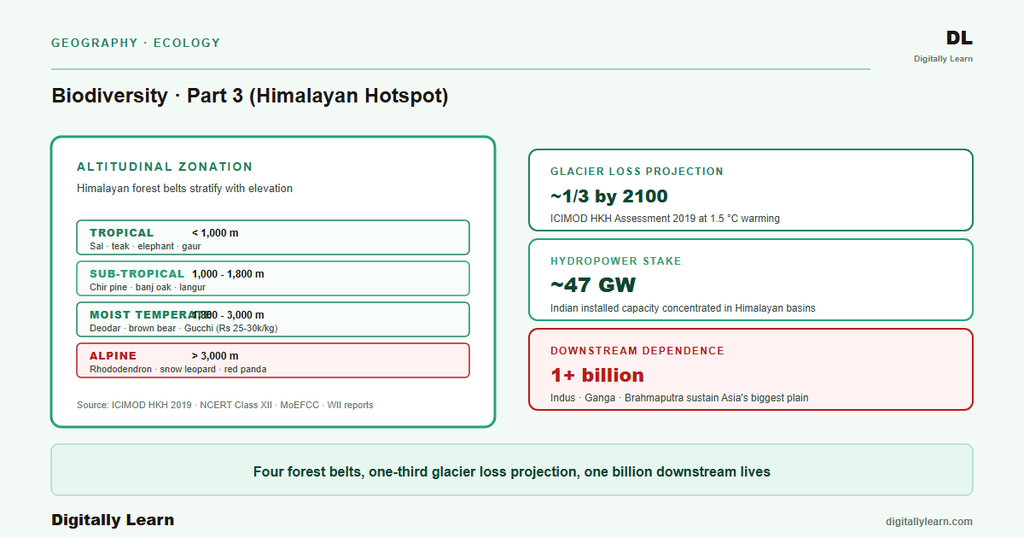
Introduction: Open by stating that the Himalaya holds approximately 15,000 glaciers covering 33,000 square kilometres whose meltwater contributes 30-50 per cent of dry-season streamflow to India's three great river systems. The ICIMOD Hindu Kush Himalaya Assessment 2019 projects one-third glacier loss by 2100 under 1.5 degree warming, with cascading impacts on Indian water resources.
Body (sub-themes to develop):
- Seasonal-flow regime shift: Dry-season streamflow declines as glacial buffer shrinks; summer monsoon flooding intensifies as more precipitation falls as rain rather than accumulating as snow; the Indus and Brahmaputra are particularly glacier-dependent.
- Irrigation and agricultural impact: 55 per cent of Indian net sown area is rainfed but the irrigated 45 per cent depends critically on Himalayan-sourced perennial flow; Punjab and Haryana wheat-rice systems, Uttar Pradesh sugarcane, and Bihar paddy face declining canal-water reliability.
- Hydropower impact: India's installed hydropower capacity of approximately 47 gigawatts is concentrated in the Himalayan and sub-Himalayan basins; reduced dry-season flow plus increased sediment loads damage turbines and reduce generation.
- GLOF (Glacial Lake Outburst Flood) risk: Increased glacial lake formation as glaciers retreat creates rising GLOF risk; Chamoli February 2021, Sikkim Lhonak Lake October 2023 illustrate the catastrophic potential.
- Urban water security: Delhi, Lucknow, Patna, Kolkata, Allahabad all draw from Himalayan-sourced rivers; reduced perennial flow stresses urban supply systems and groundwater recharge.
Conclusion: Conclude by noting that the integrated response requires the National Mission for Sustaining the Himalayan Ecosystem, transboundary coordination through ICIMOD, climate-adaptive irrigation under PMKSY, hydropower-sector diversification toward solar and wind, and GLOF early-warning systems coordinated by NDMA. The Himalayan glacier story is not a distant climate signal but an immediate water-security challenge for the entire Indo-Gangetic plain.
The Himalayan Biodiversity Hotspot is one of 36 global biodiversity hotspots designated by Conservation International. It spans the Himalayan mountain arc from Afghanistan in the west to Myanmar in the east, covering parts of Bhutan, Nepal, India, north Myanmar, and the southern Tibetan Plateau. The Indian portion includes the entire Western Himalaya (Ladakh, Jammu and Kashmir, Himachal Pradesh, Uttarakhand) and the Eastern Himalaya (Sikkim, north-eastern Bengal, Arunachal Pradesh). The hotspot hosts approximately 10,000 plant species with 3,160 endemic species, supports the world's highest mountain biodiversity, and harbours iconic mammals including the snow leopard, red panda, Himalayan musk deer, Tibetan antelope, and Himalayan tahr. The 1,500 endemic vascular plant and 70 per cent habitat loss criteria are met decisively, with continued threats from infrastructure expansion, climate-driven glacier retreat, and unregulated tourism.
Background and Historical Context
The Himalaya is the cradle of Asia's three great river systems, the Indus, the Ganga, and the Brahmaputra, sustaining the livelihoods of approximately 1.4 billion people downstream. The hotspot's ecosystem services span freshwater provision, climate regulation through monsoon-orographic precipitation capture, carbon sequestration in alpine and temperate forests, and cultural-spiritual heritage rooted in Hindu, Buddhist, and indigenous belief systems. UPSC Prelims questions on Himalayan biodiversity have appeared regularly in 2013, 2019, 2022, 2024, and 2025; UPSC GS-I Mains draws on Himalayan ecology and climate-change vulnerability while GS-III focuses on glacier hydrology and disaster management.
What is the significance of mastering Himalayan biodiversity? The hotspot exemplifies altitudinal zonation, a biogeographic principle whose vertical compression of climatic zones into a few kilometres of elevation produces extraordinary species diversity. The same mountain that hosts tropical moist deciduous forest at 500 metres carries sub-tropical pine at 1,500 metres, Himalayan moist temperate at 2,500 metres, sub-alpine birch and rhododendron at 3,500 metres, and alpine meadow above 4,000 metres. The transboundary nature of the hotspot makes conservation a diplomatic exercise: protected-area connectivity requires coordination with Nepal, Bhutan, Myanmar, and China for the snow leopard and red panda corridors.
Climate change is reshaping the Himalayan hotspot faster than any other Indian biogeographic region. The Hindu Kush Himalaya Assessment 2019 projects that one-third of Himalayan glaciers will disappear by 2100 even under the most optimistic 1.5 degree warming scenario. The Himalayan State Regional Council coordinates 13 Himalayan states and union territories on shared conservation priorities. Mission LiFE announced 2022 includes Himalayan tourism-management as a behavioural-change target. The National Mission for Sustaining the Himalayan Ecosystem (NMSHE), one of eight missions under the National Action Plan on Climate Change, allocates Rs 800 crore for research on Himalayan climate vulnerability.
Geographical Extent and Transboundary Nature
The Himalayan arc: Afghanistan to Myanmar
The Himalayan Biodiversity Hotspot extends across the entire 2,500-kilometre arc of the Himalayan mountain system, from the Hindu Kush in Afghanistan in the west to the Patkai-Arakan in northern Myanmar in the east. The arc curves through Pakistan, India, Nepal, Bhutan, southern Tibet, and northern Myanmar; the hotspot designation covers approximately 750,000 square kilometres of mountain territory above 500 metres.
The Indian portion is the most extensive and ecologically diverse. It spans the entire Western Himalaya (Ladakh, Jammu and Kashmir, Himachal Pradesh, Uttarakhand) and the Eastern Himalaya (Sikkim, the Darjeeling hills of West Bengal, and Arunachal Pradesh).
The hotspot's transboundary nature drives both conservation challenge and opportunity. Snow leopard ranges cross five international borders (India, Nepal, China, Bhutan, Pakistan); red panda populations move between India, Nepal, and Bhutan; medicinal-plant trade spans all four Himalayan countries. The key shared framework is the International Centre for Integrated Mountain Development (ICIMOD), headquartered in Kathmandu with all eight Hindu Kush Himalaya countries as members.
Eastern Himalaya: Endemism Concentration
Why the Eastern Himalaya is the global hotspot core
The Eastern Himalaya (Sikkim, Darjeeling hills, Bhutan, southern Tibet, Arunachal Pradesh, northern Myanmar) is the original Conservation International designation core because of its exceptional endemism. The region holds the larger share of the hotspot's endemic plants, along with the world's highest concentration of mountain biodiversity at any latitude. Three factors drive the concentration: high annual rainfall above 4,000 millimetres in some valleys, sharp altitudinal compression of climatic zones, and refugium effects during Pleistocene glaciations.
Distinguishing features of the Eastern Himalaya stand out across protected-area network, altitudinal compression, and endemic-mammal recovery. The Apatani agricultural-paddy-cum-fish system in Arunachal's Ziro Valley is a Globally Important Agricultural Heritage System designated by FAO, reflecting the integration of indigenous knowledge with high-biodiversity landscapes.
- Khangchendzonga National Park (Sikkim): Designated a UNESCO Mixed Heritage Site in 2016, India’s first such mixed natural-cultural inscription.
- Arunachal Pradesh altitudinal compression: Tropical evergreen lowlands at 300-500 metres give way to alpine meadows above 4,500 metres within 50 horizontal kilometres.
- Endemic charismatic mammals: Mishmi takin, red panda, and the recently-described Arunachal macaque (Macaca munzala, 2005) concentrate the region’s mammalian endemism.
- Khangchendzonga National Park: UNESCO Mixed Heritage Site 2016; spans 1,784 sq km in Sikkim, the core of the larger Khangchendzonga Biosphere Reserve; covers the world’s third-highest peak.
- Namdapha National Park: Arunachal Pradesh’s largest park at 1,985 sq km; hosts four big cats (tiger, leopard, clouded leopard, snow leopard).
- Eastern Himalaya endemic plants: the larger share of the hotspot’s endemics, including blue poppy (Meconopsis spp.) and Rhododendron arboreum.
- Bugun liocichla: A passerine bird first described in 2006; range restricted to Eaglenest Wildlife Sanctuary in western Arunachal Pradesh.
- Arunachal macaque: Described in 2005; restricted to high-altitude forests of western Arunachal.
Western Himalaya: Trans-Himalayan Cold Desert and Temperate Mosaic
Contrast with Eastern Himalaya: drier, colder, fewer endemics, distinct ecology
The Western Himalaya (Ladakh, Kashmir, Himachal Pradesh, Uttarakhand) contrasts sharply with the wetter Eastern half. Annual rainfall declines from approximately 2,500 millimetres in the Kashmir-Jammu foothills to under 200 millimetres in the trans-Himalayan Ladakh and Spiti cold deserts. Endemism is lower than in the East but distinctive: roughly 1,300 endemic plant species concentrated in the alpine and trans-Himalayan zones. The deodar (Cedrus deodara), blue pine (Pinus wallichiana), and Himalayan oak (Quercus semecarpifolia) communities define the temperate-forest landscape.
Observable outcomes at the Western Himalaya level span an apex-predator population, a critically endangered endemic stag, a wild-goat endemic, and an alpine medicinal-plant economy. Each is named below. The Great Himalayan National Park in Kullu, Himachal Pradesh, was designated a UNESCO World Heritage Site in 2014 for its exceptional biodiversity in a single protected area covering 1,171 square kilometres.
- Snow leopard: Trans-Himalayan apex predator with an approximate Indian population of 718 individuals (2024 census) across Ladakh, Spiti, and Lahaul.
- Hangul (Kashmir stag): Critically endangered endemic with ~320 individuals (2025 census) confined to the Dachigam National Park, Jammu and Kashmir.
- Markhor (Capra falconeri, IUCN Near Threatened) Restricted to the Pir Panjal range and parts of Jammu and Kashmir.
- Alpine medicinal-plant economy: Supports traditional Amchi (Sowa-Rigpa) medicine practised in Ladakh and Spiti.
| Parameter | Eastern Himalaya | Western Himalaya |
|---|---|---|
| Indian states covered | Sikkim, Darjeeling, Arunachal Pradesh | Ladakh, Jammu and Kashmir, Himachal Pradesh, Uttarakhand |
| Annual rainfall | 2,000 to 4,000 millimetres | Under 200 (cold desert) to 2,500 millimetres |
| Endemic plant share | Larger share of the hotspot's endemics | Smaller, distinctive alpine and trans-Himalayan endemics |
| Dominant temperate flora | Rhododendron, Magnolia, oak, blue poppy | Deodar, blue pine, Himalayan oak |
| Charismatic endemic mammal | Red panda, Mishmi takin, Arunachal macaque | Snow leopard, Hangul, Markhor (Capra falconeri, IUCN Near Threatened) of the Pir Panjal range |
| Flagship protected area | Khangchendzonga (UNESCO Mixed 2016) | Great Himalayan National Park (UNESCO 2014) |
| Climate-change profile | Higher precipitation variability and GLOF risk | Glacier retreat and cold-desert expansion |
Altitudinal Zonation: Vertical Compression of Climatic Zones
Five vertical bands from terai to alpine
The Himalayan biodiversity hotspot demonstrates altitudinal zonation with exceptional clarity: climatic zones that would otherwise span thousands of kilometres of latitude are compressed into a few vertical kilometres. The Champion-Seth (1968) classification recognises five primary Himalayan vegetation bands, each with distinctive flora, fauna, and ecological characteristics.
- Tropical moist deciduous (0-1,200 metres): Terai-bhabar belt at the Himalayan foothills; sal (Shorea robusta) dominant; tiger and Indian rhinoceros habitat in Corbett and Kaziranga.
- Sub-tropical pine (1,000-1,800 metres): Chir pine (Pinus roxburghii) dominant; fire-adapted ecology; black bear and rhesus macaque habitat.
- Himalayan moist temperate (1,800-3,000 metres): Deodar, blue pine, Himalayan oak; brown bear, Himalayan tahr, musk deer habitat.
- Sub-alpine (3,000-3,800 metres): Himalayan silver fir (Abies spectabilis), birch (Betula utilis), rhododendron; red panda and snow leopard habitat begin here.
- Alpine meadow (above 3,800 metres): Bugyals (Uttarakhand) and Valley of Flowers; medicinal herbs including Aconitum and Picrorhiza; snow leopard, bharal, ibex.
Endemic Flora and Fauna: From Snow Leopard to Himalayan Nettle
Iconic endemic mammals and birds
The Himalayan hotspot's endemic fauna is concentrated in the higher elevations where geographic isolation is most pronounced. The snow leopard (Panthera uncia) is the apex predator of the Indian trans-Himalaya and sub-alpine zone, with an Indian population of approximately 718 individuals (2024 census) tracked through the SECURE Himalaya Project camera-trap network. The red panda (Ailurus fulgens) is restricted to Eastern Himalayan bamboo and rhododendron understorey at 2,200-4,800 metres; the Indian population is approximately 5,000 individuals in Sikkim and Arunachal Pradesh.
- Snow leopard: Panthera uncia; 718 in India; SECURE Himalaya Project monitoring; status Vulnerable on IUCN Red List.
- Red panda: Ailurus fulgens; ~5,000 individuals in Eastern Himalayan India; bamboo and rhododendron habitat.
- Himalayan musk deer: Moschus chrysogaster; Endangered; musk-pod harvesting has caused steep decline.
- Hangul (Kashmir stag): Cervus hanglu hanglu; Critically Endangered; ~320 in Dachigam National Park, Jammu and Kashmir.
- Western tragopan: Tragopan melanocephalus; Vulnerable; Great Himalayan National Park HP.
Endemic flora, medicinal plants, and minor forest produce
The Himalayan endemic flora includes flagship species used in traditional medicine, textile, and edible-produce applications. The Himalayan nettle (Girardinia diversifolia), tested in Prelims 2019, is a sustainable source of high-strength textile fibre traditionally woven by indigenous communities in Uttarakhand and Sikkim. The plant is now commercialised by women's self-help groups under a livelihoods programme.
The Gucchi mushroom (Morchella esculenta), tested in Prelims 2022, is a high-value edible fungus of Himalayan moist temperate forests at 2,500-3,500 metres in Himachal Pradesh, Uttarakhand, and Jammu and Kashmir. It resists commercial cultivation and sells for Rs 25,000 to Rs 30,000 per kilogram, sustaining rural collector livelihoods.
Other commercially important endemic plants include Kuth (Saussurea costus), listed under CITES Appendix I; Atis (Aconitum heterophyllum), used in Ayurveda; Kutki (Picrorhiza kurroa), used for liver disorders; and Brahma Kamal (Saussurea obvallata), the state flower of Uttarakhand. The traditional knowledge associated with these species is documented in the Traditional Knowledge Digital Library and protected under the Biological Diversity Act 2002 access-and-benefit-sharing framework.
Threats: Glacier Retreat, Infrastructure, Tourism, Deforestation
Climate change and Himalayan glacier retreat
Climate change is the single largest threat to the Himalayan biodiversity hotspot. The Hindu Kush Himalaya Assessment 2019 by ICIMOD projects that one-third of Himalayan glaciers will disappear by 2100 even if warming is held to 1.5 degrees Celsius; under a 2-degree pathway, two-thirds disappear.
The Himalaya holds approximately 15,000 glaciers covering 33,000 square kilometres, and their meltwater contributes 30-50 per cent of dry-season streamflow to the Indus, Ganga, and Brahmaputra. Mains 2020 GS-I tested exactly this glacier-water interaction, recognising the cascading impact on Indian agriculture, hydropower, and downstream urban water supply.
- Treeline shift: Western Himalayan treelines are advancing upward at 15-20 metres per decade.
- Range loss: alpine medicinal plants lose habitat as warming compresses their narrow elevation niches.
- Prey fragmentation: snow leopard prey species (bharal, ibex) are pushed higher, fragmenting predator habitat.
These species-level impacts are already documented in the field. The National Mission for Sustaining the Himalayan Ecosystem (NMSHE), launched in 2010 under the National Action Plan on Climate Change, allocates Rs 800 crore for Himalayan climate-vulnerability research coordinated through the GB Pant National Institute of Himalayan Environment in Almora.
Infrastructure expansion and tourism pressure
Beyond climate, four anthropogenic threats compound Himalayan biodiversity loss. They span infrastructure expansion, hydropower development, unregulated tourism, and persistent deforestation. Each operates across the Indian Himalaya at a scale that fragments habitats and erodes the ecological connectivity on which endemic mammals and alpine flora depend.
- Road construction: all-weather projects including the Char Dham highway (900 kilometres, Rs 12,000 crore), the Arunachal frontier highway, and Border Roads Organisation expansion fragment habitats and trigger landslides.
- Hydropower: over 600 projects are operational or planned across the Indian Himalaya; tunnels alter sub-surface hydrology and reservoir inundation drowns valley ecosystems.
- Unregulated tourism: the Char Dham pilgrimage exceeds 5 million visitors annually and Ladakh tourism crossed 3 lakh in 2024, driving waste, water-table draw-down, and habitat disturbance.
- Deforestation: fuelwood, fodder, and timber extraction is partly offset by Joint Forest Management and Van Panchayat institutions, yet remains a net negative in many Western Himalayan districts.
Prelims MCQ practice
Each question below tests one specific concept on the topic. Click to reveal the answer and a full option-wise explanation.
Q1. Consider the following statements about the Himalayan biodiversity hotspot:
- The Himalayan hotspot includes the Indian Himalayas (Jammu and Kashmir, Ladakh, Himachal Pradesh, Uttarakhand, Sikkim, Arunachal Pradesh, Darjeeling hills) and parts of Bhutan, Nepal, and northern Myanmar.
- It is one of the world's youngest mountain ranges and shows steep altitudinal variation from sub-tropical to alpine ecosystems.
Which of the statements given above is/are correct?
- 1 only
- 2 only
- Both 1 and 2
- Neither 1 nor 2
Show answer and explanation
Answer: Both 1 and 2
Explanation.
Correct: c (Both 1 and 2). Both statements are correct. The Himalayan hotspot spans the Indian Himalayas plus Bhutan, Nepal, and northern Myanmar. It is one of the world's youngest mountain ranges (uplift continues) with steep altitudinal variation from sub-tropical foothills to alpine zones above the tree line.
Q2. Consider the following statements about flagship fauna of the Himalayan hotspot:
- Snow leopard, red panda, Himalayan tahr, and musk deer are flagship mammals of the Himalayan hotspot.
- The Western Tragopan and Himalayan Monal are pheasants endemic to the Himalayan region.
Which of the statements given above is/are correct?
- 1 only
- 2 only
- Both 1 and 2
- Neither 1 nor 2
Show answer and explanation
Answer: Both 1 and 2
Explanation.
Correct: c (Both 1 and 2). Both statements are correct. Flagship Himalayan mammals include snow leopard, red panda, Himalayan tahr, and musk deer. Western Tragopan (Himachal state bird) and Himalayan Monal (Uttarakhand state bird) are pheasants endemic to the Himalayan region.
Q3. Consider the following statements about altitudinal zonation in the Himalayas:
- Sub-tropical broadleaf forests dominate the lower elevations.
- Temperate coniferous forests (pine, deodar, fir) dominate the mid-elevations.
- Alpine meadows and tundra-like ecosystems dominate above the tree line.
Which of the statements given above are correct?
- 1 and 2 only
- 2 and 3 only
- 1 and 3 only
- 1, 2 and 3
Show answer and explanation
Answer: 1, 2 and 3
Explanation.
Correct: d (1, 2 and 3). All three are correct. The Himalayan altitudinal zonation runs sub-tropical broadleaf (lower elevations) to temperate coniferous (pine, deodar, fir, spruce at mid-elevations) to sub-alpine birch-rhododendron to alpine meadows and tundra-like vegetation above the tree line.
Q4. Consider the following statements about snow leopard conservation in India:
- The snow leopard (Panthera uncia) is found across the Indian Himalayas at high altitudes typically 3,000-5,400 m.
- Project Snow Leopard was launched by the Ministry of Environment, Forest and Climate Change in 2009.
Which of the statements given above is/are correct?
- 1 only
- 2 only
- Both 1 and 2
- Neither 1 nor 2
Show answer and explanation
Answer: Both 1 and 2
Explanation.
Correct: c (Both 1 and 2). Both statements are correct. Snow leopards (Panthera uncia) inhabit the Indian Himalayas at 3,000-5,400 m elevations across Ladakh, Himachal, Uttarakhand, Sikkim, and Arunachal. Project Snow Leopard was launched by MoEFCC in 2009.
Q5. Consider the following statements about Eastern vs Western Himalayan biodiversity:
- The Eastern Himalayas (Sikkim, Arunachal Pradesh) host higher species diversity and endemism than the Western Himalayas.
- Higher rainfall, warmer climate, and biogeographic connectivity with Indo-Burma drive higher Eastern Himalayan biodiversity.
Which of the statements given above is/are correct?
- 1 only
- 2 only
- Both 1 and 2
- Neither 1 nor 2
Show answer and explanation
Answer: Both 1 and 2
Explanation.
Correct: c (Both 1 and 2). Both statements are correct. The Eastern Himalayas (Sikkim, Arunachal) host higher species diversity and endemism than the Western Himalayas. Drivers include higher rainfall (Eastern Himalayas receive much more monsoon precipitation), warmer climate, and biogeographic connectivity with the adjoining Indo-Burma hotspot.
Q6. Consider the following statements about Himalayan protected areas in India:
- Great Himalayan National Park (Himachal Pradesh) is a UNESCO World Heritage site.
- Khangchendzonga National Park (Sikkim) is also a UNESCO World Heritage site listed under mixed natural-cultural criteria.
- Valley of Flowers National Park (Uttarakhand) is part of the Nanda Devi-Valley of Flowers UNESCO World Heritage site.
Which of the statements given above are correct?
- 1 and 2 only
- 2 and 3 only
- 1 and 3 only
- 1, 2 and 3
Show answer and explanation
Answer: 1, 2 and 3
Explanation.
Correct: d (1, 2 and 3). All three are correct. Great Himalayan NP (HP), Khangchendzonga NP (Sikkim, listed under mixed natural and cultural criteria), and Nanda Devi and Valley of Flowers NPs (Uttarakhand) are all UNESCO World Heritage sites along the Indian Himalayan arc.
Sources and Further Reading
- NCERT Class 11 India: Physical Environment, Chapter 5 – Natural Vegetation
- Wikipedia – Himalayas
- Wikipedia – Eastern Himalaya
- Wikipedia – Western Himalaya
- Wikipedia – Snow leopard
- Wikipedia – Red panda
- Wikipedia – Hindu Kush Himalaya Assessment
- Wikipedia – International Centre for Integrated Mountain Development
- Wikipedia – Project Snow Leopard
- Wikipedia – Indian Himalayan Region
- Wikipedia – Biodiversity hotspot
Disclaimer
This article is intended for UPSC preparation and general awareness. Species counts, population figures, and protected-area details follow published authoritative sources and may be updated as fresh assessments are released. Readers should verify the latest figures against primary government and scientific publications before citing them in examinations.