
Overview
Previous Year UPSC-CSE Questions By the end you will be able to draft model answers for the following UPSC questions. Each question carries a collapsible framework showing how to approach it in the exam.
- UPSC Prelims 2020 GS Paper IWellesley established the Fort William College at Calcutta because
How to approach this Prelims question
Approach: Recall Wellesley's purpose in founding Fort William College.
Trap to watch: The college was meant to train British civilians for administration, not to revive oriental learning or to employ William Carey.
Key facts to recall:
- Fort William College, Calcutta, 1800
- Founded by Lord (Richard) Wellesley
- Purpose: train British civil servants
Answer signal: To train British civilians for administration, so option (d).
- UPSC Prelims 2018 GS Paper IWith reference to educational institutions during colonial rule in India, consider the following pairs of an institution and its founder:
- Sanskrit College at Benaras – William Jones
- Calcutta Madarsa – Warren Hastings
- Fort William College – Arthur Wellesley
Which of the pairs given above is/are correct?
How to approach this Prelims question
Approach: Match each institution to its true founder.
Trap to watch: Fort William College was founded by Richard (Lord) Wellesley, not Arthur; the Benaras Sanskrit College by Jonathan Duncan, not William Jones (who founded the Asiatic Society).
Key facts to recall:
- Calcutta Madrasa = Warren Hastings (correct)
- Fort William College = Richard Wellesley (not Arthur)
- Benaras Sanskrit College = Jonathan Duncan (not Jones)
Answer signal: Only pair 2 is correct, so option (b).
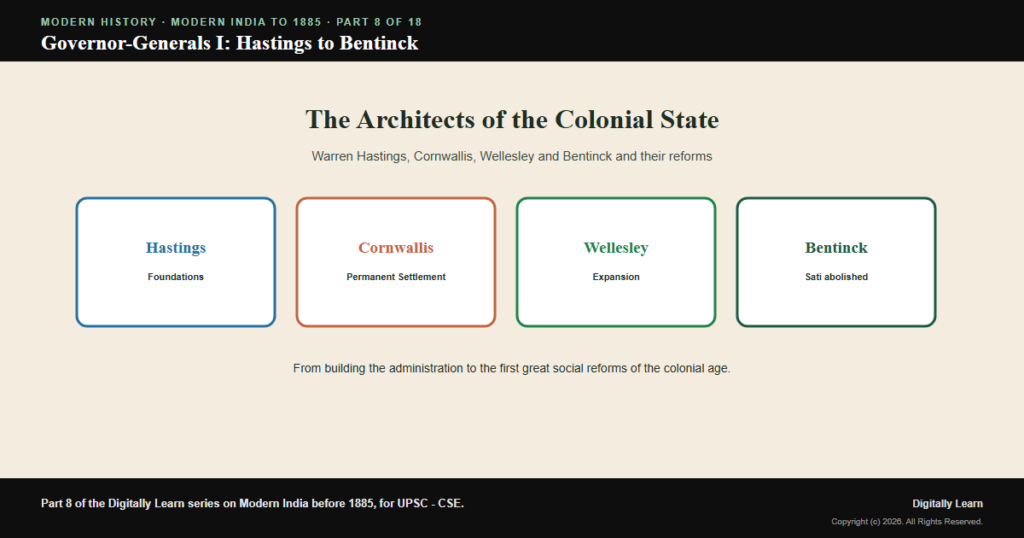
The early Governor-Generals, from Warren Hastings to Lord Bentinck, were the men who built the machinery of British rule in India between 1773 and 1835. Warren Hastings laid the first judicial and revenue foundations; Cornwallis gave India the Permanent Settlement, the Cornwallis Code and a salaried civil service; Wellesley vastly expanded British power through the Subsidiary Alliance; and Lord William Bentinck was the first to turn the colonial state to social reform, abolishing Sati and reshaping education. Together they were the architects of the colonial order.
Introduction: The Architects of the Colonial State
The Men Who Built British Rule
Why this matters: behind the laws and the conquests stood the Governor-Generals, the men who actually governed India for the Company. Their personal reforms, in revenue, law, the civil service and society, gave colonial rule its lasting shape.
What is the significance of this theme: it shows the colonial state being built, not just won. From the administrative foundations of Warren Hastings to the social reforms of Bentinck, these decades created institutions that endured, as the timeline below sets out.
Warren Hastings: Judicial and Revenue Reforms and the Controversies
The First Governor-General of Bengal
What is the significance of Warren Hastings: he was the first Governor-General of Bengal and the real founder of the Company's administration. He ended the disastrous Dual Government, reorganised revenue collection, and built a system of civil and criminal courts in the districts.
Distinguishing his record: a scholar and patron, he founded the Calcutta Madrasa in 1781 for the study of Muslim law. Yet his rule was dogged by controversy, the Rohilla War and other affairs, and on his return he faced a long and famous impeachment in Britain, from which he was finally acquitted, as the panel below sets out.
Lord Cornwallis: The Permanent Settlement, the Code and the Civil Service
The Organiser of the Administration
What is the significance of Cornwallis: he organised the administration that Hastings had begun. His Permanent Settlement of 1793 fixed the land revenue of Bengal with the zamindars in perpetuity, a momentous decision whose mechanism and effects are treated fully in the part on land revenue.
Distinguishing his reforms: the Cornwallis Code separated revenue and judicial functions and laid down a body of regulations, while his reform of the civil service, reserving higher posts for Europeans and raising salaries to curb corruption, earned him the name of father of the civil service in India. He also set up a district police on the thana system, as the panel below shows.
Lord Wellesley: The Subsidiary Alliance and Fort William College
The Architect of Expansion
What is the significance of Wellesley: he was the great expander of British power. Through his Subsidiary Alliance system, treated in detail in the part on the conquest of Mysore and the Marathas, he brought one Indian state after another under British control, and defeated Tipu Sultan.
Distinguishing his other legacy: to train the young Britons who would administer this growing empire, Wellesley founded the Fort William College at Calcutta in 1800. It was Richard Wellesley, the Governor-General, who founded it, not his brother Arthur, the general who later became the Duke of Wellington. The Calcutta Madrasa of Warren Hastings and, later, the Benaras Sanskrit College of Jonathan Duncan, were the other notable institutions of these years.
Lord Hastings: The Anglo-Maratha Wars and British Paramountcy
The Completion of Paramountcy
Observable outcomes followed under Lord Hastings, who is not to be confused with Warren Hastings: he completed the work of expansion. During his tenure from 1813 to 1823 the third Anglo-Maratha and Pindari wars were fought, breaking the Maratha confederacy.
Distinguishing the result: by 1818 the Company stood as the paramount power over the whole subcontinent, a story told in full in the part on the Maratha wars. Lord Hastings also encouraged the Ryotwari settlement in the south and a free press, before financial pressures and a banking scandal clouded his last years.
Lord William Bentinck: Social, Educational and Financial Reforms
The First Great Reforming Governor-General
What is the significance of Bentinck: he was the first Governor-General to use the power of the state for social reform. In 1829, working with reformers such as Raja Ram Mohan Roy, he passed the regulation that abolished Sati, the burning of widows, the act for which he is best remembered.
Distinguishing his other reforms: he suppressed the Thuggee gangs of ritual murderers through Colonel William Sleeman; and, on the advice of Macaulay, his government adopted English as the medium of higher education by the English Education Act of 1835. He also cleared the Company's deficit and reformed the courts, as the panel below sets out.
Significance: How the Governor-Generals Shaped British India
From Building the State to Reforming Society
Contemporary linkages run from these reforms into the structure of modern India. The revenue systems, the civil service, the codes of law and the principle of state-led social reform that these Governor-Generals established were carried forward, by Dalhousie and the Crown, and in altered form into independent India.
The larger significance is a clear shift of purpose over these decades, from simply building and expanding the colonial state under Hastings, Cornwallis and Wellesley, to using it to reshape Indian society under Bentinck. The points below gather the threads, and the next part turns to Lord Dalhousie and the machinery of modern administration.
| Governor-General | Tenure | Key reforms |
|---|---|---|
| Warren Hastings | 1773 to 1785 | Judicial and revenue order; Calcutta Madrasa; ended Dual Government |
| Lord Cornwallis | 1786 to 1793 | Permanent Settlement; Cornwallis Code; civil service; police |
| Lord Wellesley | 1798 to 1805 | Subsidiary Alliance; expansion; Fort William College |
| Lord Hastings | 1813 to 1823 | Anglo-Maratha and Pindari wars; paramountcy by 1818 |
| Lord William Bentinck | 1828 to 1835 | Abolition of Sati 1829; Thuggee suppressed; English Education Act 1835 |
- Warren Hastings founded the administration and ended the Dual Government of Bengal.
- Cornwallis gave India the Permanent Settlement, the Cornwallis Code and a salaried civil service.
- Wellesley expanded British power through the Subsidiary Alliance and founded Fort William College.
- Lord Hastings completed British paramountcy by 1818.
- Bentinck abolished Sati in 1829 and made English the medium of higher education in 1835.
Prelims MCQ practice
Each question below tests one specific concept on the topic. Click to reveal the answer and a full option-wise explanation.
Q1. Who was the first Governor-General of Bengal?
- Robert Clive
- Warren Hastings
- Lord Cornwallis
- Lord Wellesley
Show answer and explanation
Answer: Warren Hastings
Explanation.
Option (b) is correct. Warren Hastings was the first Governor-General of Bengal under the Regulating Act of 1773. Hence option (b).
Q2. The Permanent Settlement of land revenue in Bengal was introduced by:
- Lord Cornwallis
- Warren Hastings
- Lord Wellesley
- Lord Bentinck
Show answer and explanation
Answer: Lord Cornwallis
Explanation.
Option (a) is correct. Lord Cornwallis introduced the Permanent Settlement in 1793. Hence option (a).
Q3. The practice of Sati was legally abolished in 1829 during the governor-generalship of:
- Lord Wellesley
- Lord Hastings
- Lord William Bentinck
- Lord Cornwallis
Show answer and explanation
Answer: Lord William Bentinck
Explanation.
Option (c) is correct. Sati was abolished in 1829 under Lord William Bentinck, with Raja Ram Mohan Roy. Hence option (c).
Q4. Consider the following statements about Lord Cornwallis:
- He is often called the father of the civil service in India.
- He separated the revenue and judicial functions of the administration.
Which of the statements given above is/are correct?
- 1 only
- 2 only
- Both 1 and 2
- Neither 1 nor 2
Show answer and explanation
Answer: Both 1 and 2
Explanation.
Both statements are correct: Cornwallis is called the father of the civil service and his Code separated revenue and judicial functions. Hence option (c).
Q5. The Thuggee gangs were suppressed during Bentinck's rule chiefly through the efforts of:
- Thomas Macaulay
- William Sleeman
- William Carey
- Jonathan Duncan
Show answer and explanation
Answer: William Sleeman
Explanation.
Option (b) is correct. Colonel William Sleeman led the suppression of Thuggee under Bentinck. Hence option (b).
Q6. The English Education Act of 1835, making English the medium of higher education, is associated with the advice of:
- Thomas Babington Macaulay
- William Sleeman
- Lord Cornwallis
- Raja Ram Mohan Roy
Show answer and explanation
Answer: Thomas Babington Macaulay
Explanation.
Option (a) is correct. The English Education Act of 1835 followed Macaulay's famous Minute. Hence option (a).
Sources and Further Reading
- Wikipedia: Warren Hastings
- Wikipedia: Charles Cornwallis, 1st Marquess Cornwallis
- Wikipedia: Richard Wellesley, 1st Marquess Wellesley
- Wikipedia: Lord William Bentinck
- Wikipedia: Permanent Settlement
- NCERT, Themes in Indian History and Our Pasts (Modern India)
- Indian Culture Portal, Ministry of Culture
- National Portal of India
- Press Information Bureau, Government of India
- National Archives of India
Editorial Disclaimer
This article is prepared for UPSC examination preparation. Verify key facts and interpretations against standard reference histories before relying on them.