
Overview
Previous Year UPSC-CSE Questions By the end you will be able to draft model answers for the following UPSC questions. Each question carries a collapsible framework showing how to approach it in the exam.
- UPSC Mains 2017 GS-IClarify how mid-eighteenth-century India was beset with the spectre of a fragmented polity.
How to structure the answer in the exam
Introduction: Open with the dissolution of Mughal central authority into many regional powers.
Body (sub-themes to develop):
- The successor states (Bengal, Awadh, Hyderabad) as hereditary Mughal provinces.
- The new and insurgent states (Marathas, Sikhs, Jats, Rohillas).
- The independent states (Mysore, the Rajputs, Travancore).
- Mutual rivalry and the absence of a common front.
Conclusion: Conclude that a polycentric but divided India lay open to a determined external power.
- UPSC Prelims 2021 GS Paper IWith reference to Indian history, which of the following statements is/are correct?
- The Nizamat of Arcot emerged out of Hyderabad State.
- The Mysore Kingdom emerged out of Vijayanagara Empire.
- Rohilkhand Kingdom was formed out of the territories occupied by Ahmad Shah Durrani.
Select the correct answer using the code given below.
How to approach this Prelims question
Approach: Test each statement on the origin of a regional state.
Trap to watch: Mysore did emerge from the Vijayanagara legacy; the Nizamat of Arcot grew under Hyderabad's authority but is not said to have emerged 'out of Hyderabad State', and Rohilkhand was an Afghan-Rohilla settlement, not a Durrani creation.
Key facts to recall:
- Mysore (Wodeyars) from the Vijayanagara legacy
- Arcot/Carnatic under Hyderabad's nominal authority
- Rohilkhand = Afghan Rohilla settlers
Answer signal: Only statement 2 is correct, so option (b).
- UPSC Prelims 2006 GS Paper IWhen Raja Wodeyar founded the kingdom of Mysore, who was the ruler of the Vijayanagar Empire?
How to approach this Prelims question
Approach: Link the founding of Wodeyar Mysore to the contemporary Vijayanagara ruler.
Trap to watch: Raja Wodeyar asserted Mysore's independence around 1610, during the reign of Venkata II, not the earlier Sadasiva or Tirumala.
Key facts to recall:
- Mysore under the Wodeyar dynasty
- Raja Wodeyar c.1610
- Vijayanagara ruler then = Venkata II
Answer signal: Venkata II, so option (d).
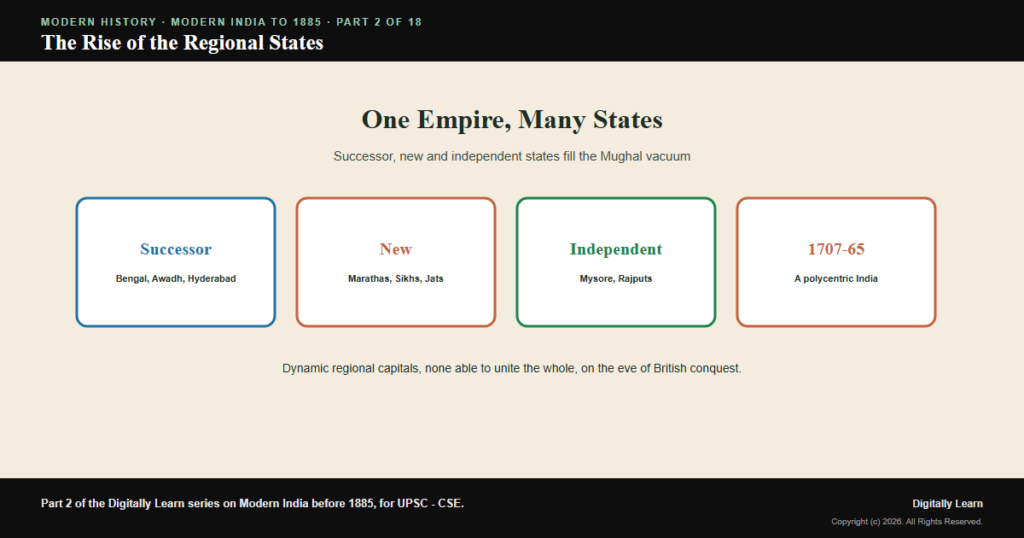
The regional states were the powers that rose across the subcontinent as the Mughal Empire declined in the eighteenth century. Historians group them in three kinds: the successor states of Bengal, Awadh and Hyderabad, where Mughal governors made their provinces hereditary; the new and insurgent states of the Marathas, the Sikhs, the Jats and the Rohillas, which rose against Mughal authority; and the independent states such as Mysore, the Rajput kingdoms and Travancore. Dynamic but divided, it was these powers, not a united India, that the English East India Company would face.
Introduction: A Polycentric India after the Mughals
What Rose from the Wreckage of Empire
Why this matters: the decline of the Mughals did not leave a void so much as a crowd. As central authority withered, a whole constellation of regional states took shape, each with its own court, army and revenue, and together they made up the India that the European companies would deal with.
What is the significance of this theme: it corrects the idea of the eighteenth century as mere anarchy. The age was polycentric, not empty, and understanding the strengths and the fatal divisions of these states is the key to understanding how a trading company could later conquer so vast a land.
The Three-Fold Classification: Successor, New and Independent States
How Historians Group the Regional States
What is the significance of the classification: it brings order to a crowded map. Historians sort the regional states into three kinds by how they came into being, and the distinction explains a great deal about each state's strengths and weaknesses.
Distinguishing the three types: the successor states were former Mughal provinces whose governors made their office hereditary; the new and insurgent states were powers that rose in revolt against the Mughals; and the independent states were kingdoms long autonomous or newly carved out, as the diagram below sets out.
The Successor States: Bengal, Awadh and Hyderabad
Bengal under Murshid Quli Khan and Alivardi Khan
What is the significance of Bengal: it was the richest of the successor states and the prize that would draw the Company into conquest. Murshid Quli Khan, the Mughal governor, made Bengal effectively independent in the early eighteenth century, paying Delhi a tribute while ruling as he pleased.
Distinguishing its order: under Murshid Quli Khan and later Alivardi Khan, Bengal enjoyed strong revenue administration and a measure of peace, even as it grew rich on trade. That wealth, and the friction with European traders that came with it, set the stage for the conflicts of the 1750s.
Awadh under Saadat Khan and Hyderabad under Nizam-ul-Mulk
Observable outcomes followed the same pattern further west and south. Saadat Khan founded the Nawabi of Awadh in 1722, building a prosperous state in the Gangetic plain, while Nizam-ul-Mulk left the Mughal court to found Hyderabad and the Asaf Jahi line in the Deccan in 1724.
Distinguishing the Carnatic: in the far south the Nawab of the Carnatic, based at Arcot, broke away from the authority of Hyderabad to rule in his own right. Each of these successor states kept the forms of Mughal administration while answering to Delhi in name alone, as the table later in this article sets out.
The New and Insurgent States: Marathas, Sikhs, Jats and Rohillas
Powers That Rose Against the Mughals
What is the significance of the insurgent states: they were the powers that had fought their way up against the empire, and the greatest of them, the Marathas, came closest to replacing it. Under the Peshwas the Maratha confederacy spread across much of the north before being checked at Panipat in 1761.
Distinguishing the others: in Punjab the Sikhs organised into fighting bands, or misls, that would later be united by Ranjit Singh; the Jats built a state around Bharatpur; and the Afghan Rohillas held Rohilkhand in the upper Ganga plain. Each was formidable in its region but limited in its reach.
The Independent States: Mysore, the Rajputs and Travancore
Old Kingdoms and New Ambitions
What is the significance of the independent states: they were powers that owed little or nothing to Mughal authority. The Rajput kingdoms of Rajputana were old and proud, if often divided, while Travancore in the far south was consolidated into a strong state by Marthanda Varma in the mid-century.
Distinguishing Mysore: the most dynamic of all was Mysore. Once a dependency of Vijayanagara and ruled by the Wodeyar dynasty, it was transformed after about 1761 by Haidar Ali and his son Tipu Sultan into the most modern and aggressive state in the south, as the next section sets out.
Haidar Ali, Tipu Sultan and the Modernisation of Mysore
Building a Modern State in the South
What is the significance of Mysore's modernisation: it shows that an Indian power could match and even outpace the Europeans in state-building. Haidar Ali, who rose from soldier to ruler, and Tipu Sultan after him built a Western-style army, reformed land revenue and strengthened the treasury.
Distinguishing Tipu's ambition: Tipu promoted state trade, manufacture and sericulture, planned a navy and sent embassies to France, the Ottomans and other courts in search of allies against the British. The panel below sets out these reforms; his wars with the Company are treated in a later part of this series.
The Regional States at a Glance
Observable outcomes can be gathered in a single view. The table below lists the major regional states, their founders and capitals, and their type, so that the polycentric order of the eighteenth century can be seen whole.
Distinguishing the common thread: for all their variety, these states shared one fatal trait. Each was strong in its own region but jealous of its neighbours, and none could combine the rest into a common front, which is precisely the opening the Company would exploit.
| Regional state | Founder or key ruler | Capital | Type |
|---|---|---|---|
| Bengal | Murshid Quli Khan | Murshidabad | Successor |
| Awadh | Saadat Khan | Faizabad, later Lucknow | Successor |
| Hyderabad | Nizam-ul-Mulk | Hyderabad | Successor |
| The Marathas | The Peshwas | Poona | New and insurgent |
| Mysore | Haidar Ali and Tipu Sultan | Srirangapatna | Independent |
| Travancore | Marthanda Varma | Thiruvananthapuram | Independent |
Significance: A Polycentric India on the Eve of Conquest
Why a Divided India Could Be Conquered
Contemporary linkages run directly to the conquest that followed. The regional states were vigorous, but they were rivals, and the English East India Company would use their mutual distrust, allying with one against another, to defeat them piece by piece over the next century.
The larger significance is that the eighteenth century was an age of political vitality as well as disorder, but a vitality fatally divided. The points below gather the threads, and the next part turns to the Europeans whose trading companies had been quietly gathering strength on the coasts all the while.
- The regional states are grouped as successor, new and insurgent, and independent states.
- The successor states (Bengal, Awadh, Hyderabad) were Mughal provinces turned hereditary.
- The Marathas were the strongest, but were checked at Panipat in 1761.
- Mysore under Haidar Ali and Tipu became the Company’s fiercest southern rival.
- The states’ mutual rivalry, not Indian weakness, gave the Company its opening.
Prelims MCQ practice
Each question below tests one specific concept on the topic. Click to reveal the answer and a full option-wise explanation.
Q1. The successor states of the eighteenth century are best described as:
- kingdoms that never owed allegiance to the Mughals
- former Mughal provinces whose governors made their office hereditary
- European trading settlements
- states founded by Nadir Shah
Show answer and explanation
Answer: former Mughal provinces whose governors made their office hereditary
Explanation.
Option (b) is correct. The successor states (Bengal, Awadh, Hyderabad) were Mughal provinces whose governors made their office hereditary. Hence option (b).
Q2. The founder of the Asaf Jahi line and the state of Hyderabad was:
- Saadat Khan
- Murshid Quli Khan
- Nizam-ul-Mulk
- Alivardi Khan
Show answer and explanation
Answer: Nizam-ul-Mulk
Explanation.
Option (c) is correct. Nizam-ul-Mulk Asaf Jah founded Hyderabad and the Asaf Jahi line in 1724. Hence option (c).
Q3. Consider the following pairs of a successor state and its founder:
- Bengal : Murshid Quli Khan.
- Awadh : Saadat Khan.
Which of the pairs given above is/are correctly matched?
- 1 only
- 2 only
- Both 1 and 2
- Neither 1 nor 2
Show answer and explanation
Answer: Both 1 and 2
Explanation.
Both pairs are correct: Murshid Quli Khan in Bengal and Saadat Khan in Awadh. Hence option (c).
Q4. Which power came closest to replacing the Mughals across northern India before being checked at Panipat in 1761?
- the Sikhs
- the Marathas
- the Jats
- the Rohillas
Show answer and explanation
Answer: the Marathas
Explanation.
Option (b) is correct. The Marathas, under the Peshwas, came closest to an all-India dominance before their defeat at the Third Battle of Panipat in 1761. Hence option (b).
Q5. The state of Travancore was consolidated into a strong kingdom in the eighteenth century by:
- Haidar Ali
- Marthanda Varma
- Saadat Khan
- Raja Wodeyar
Show answer and explanation
Answer: Marthanda Varma
Explanation.
Option (b) is correct. Marthanda Varma consolidated and expanded Travancore in the mid-eighteenth century. Hence option (b).
Q6. Consider the following statements about Mysore under Haidar Ali and Tipu Sultan:
- They built a Western-style army and reformed the land revenue system.
- Tipu Sultan sent embassies to foreign courts such as France and the Ottomans.
Which of the statements given above is/are correct?
- 1 only
- 2 only
- Both 1 and 2
- Neither 1 nor 2
Show answer and explanation
Answer: Both 1 and 2
Explanation.
Both statements are correct: Haidar Ali and Tipu modernised the army and revenue, and Tipu sent embassies abroad in search of allies. Hence option (c).
Sources and Further Reading
- Wikipedia: Maratha Empire
- Wikipedia: Nawabs of Bengal and Murshidabad
- Wikipedia: Hyderabad State
- Wikipedia: Kingdom of Mysore
- Wikipedia: Awadh
- NCERT, Themes in Indian History and Our Pasts (Modern India)
- Indian Culture Portal, Ministry of Culture
- National Portal of India
- Press Information Bureau, Government of India
- National Archives of India
Editorial Disclaimer
This article is prepared for UPSC examination preparation. Verify key facts and interpretations against standard reference histories before relying on them.