
Overview
Previous Year UPSC-CSE Questions By the end you will be able to draft model answers for the following UPSC questions. Each question carries a collapsible framework showing how to approach it in the exam.
- UPSC Mains 2022 GS-IWhy did the armies of the British East India Company – mostly comprising of Indian soldiers – win consistently against the more numerous and better equipped armies of the Indian rulers? Give reasons.
How to structure the answer in the exam
Introduction: Open with the Company defeating even Mysore and the Maratha confederacy despite smaller numbers.
Body (sub-themes to develop):
- Discipline, regular pay and superior arms and artillery.
- Unified command and finance versus divided Indian powers.
- Exploiting rivalry among Mysore, the Marathas and the Nizam.
- The Subsidiary Alliance, which neutralised states without war.
Conclusion: Conclude that organisation, money, unity and diplomacy, not numbers, decided the outcome.
- UPSC Prelims 2018 GS Paper IWhich one of the following statements does not apply to the system of Subsidiary Alliance introduced by Lord Wellesley?
How to approach this Prelims question
Approach: Identify the aim that the Subsidiary Alliance did NOT serve.
Trap to watch: The system kept a British army at the ruler's expense, guarded against the Napoleonic danger, and built paramountcy; securing a 'fixed income' was not its purpose.
Key facts to recall:
- Army maintained at the ally's expense
- Defence against the French/Napoleonic threat
- Aimed at paramountcy, not a fixed income
Answer signal: The non-applicable aim is a fixed income, so option (c).
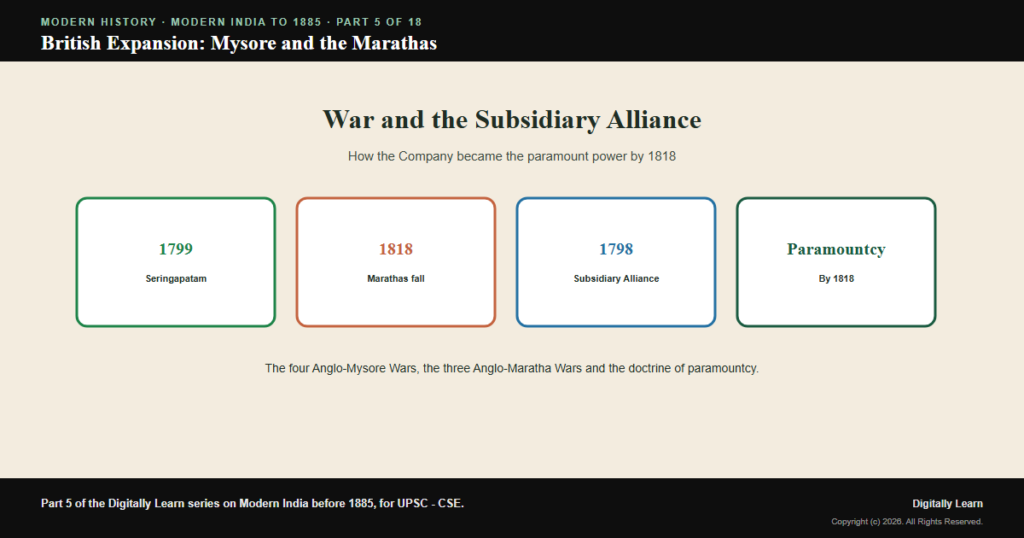
British expansion against Mysore and the Marathas was the process by which the East India Company, between the 1760s and 1818, destroyed the last great Indian powers and became the paramount authority in the subcontinent. The four Anglo-Mysore Wars ended with the fall of Seringapatam and the death of Tipu Sultan in 1799, and the three Anglo-Maratha Wars crushed the Maratha confederacy by 1818. Alongside war, Lord Wellesley's Subsidiary Alliance bound one Indian state after another to the Company without the need for battle.
Introduction: The Conquest of the Last Great Powers
From a Bengal Base to All-India Mastery
Why this matters: with the revenue of Bengal in hand, the Company turned to the two powers that could still stand against it, Mysore in the south and the Marathas in the west and centre. Their defeat between the 1760s and 1818 made the Company the paramount power in India.
What is the significance of this theme: it completes the conquest begun in Bengal. The Company used two instruments together, outright war and the Subsidiary Alliance, a treaty system that turned independent states into protected dependants, as the map below sets out.
From Ring-Fence to Paramountcy: The Doctrine of Expansion
Three Stages of Growing Control
What is the significance of the doctrine: it shows expansion as a deliberate strategy, not a series of accidents. The ring-fence policy of Warren Hastings sought to defend the Company's frontiers by making buffer states of its neighbours, paying for their defence.
Distinguishing the later stages: Lord Wellesley turned defence into dominance through the Subsidiary Alliance, and Lord Hastings completed the process with a policy of paramountcy, by which the Company claimed to be the supreme power to which all Indian states were subordinate, achieved by 1818, as the flow below shows.
The Subsidiary Alliance System of Lord Wellesley
Conquest Without a Battle
What is the significance of the Subsidiary Alliance: it was a way of conquering states without fighting them. Under the system devised by Wellesley, an Indian ruler agreed to host a British force, to pay for its upkeep, to accept a British Resident at his court, and to conduct no diplomacy or war without British consent.
Distinguishing its effect: in return the Company promised protection, but the ruler lost his independence of action and often ceded territory to meet the cost. It did not secure a fixed income for the Company so much as extend British control; the terms are set out below.
The States That Were Bound
Observable outcomes followed quickly. Hyderabad was the first to sign, in 1798, followed by Mysore after Tipu's defeat, by Awadh in 1801, and by the Maratha Peshwa and others; Travancore and many smaller states were drawn in too.
Distinguishing the strategy: each alliance disarmed a potential enemy, planted a British garrison at its heart, and made it pay for its own subjection, so that the Company grew stronger and richer as its dependants grew weaker.
The Four Anglo-Mysore Wars and the Fall of Seringapatam 1799
Haidar Ali, Tipu Sultan and the Fall of Mysore
What is the significance of the Anglo-Mysore Wars: Mysore was the most formidable Indian opponent the Company faced. Under Haidar Ali and his son Tipu Sultan, Mysore fought four wars against the Company between 1767 and 1799, at times allied with the French and very nearly defeating the British in the south.
Distinguishing the outcome: the tide turned in the third war, and in the fourth the Company stormed the island capital of Seringapatam in 1799, where Tipu Sultan died fighting. Mysore was reduced, the old Wodeyar dynasty restored under a Subsidiary Alliance, and the southern threat ended.
The Three Anglo-Maratha Wars and the End of the Confederacy
The Confederacy, Its Treaties and Its Fall
What is the significance of the Anglo-Maratha Wars: the Marathas were the strongest Indian power, a confederacy of great houses, the Peshwa at Poona and the Scindias, Holkars, Gaekwads and Bhonsles. Their defeat in three wars removed the last serious challenge to British supremacy.
Distinguishing the three wars: the first ended in the Treaty of Salbai in 1782 and roughly twenty years of peace; the second, after the Peshwa accepted the Subsidiary Alliance by the Treaty of Bassein in 1802, broke the power of Scindia and Bhonsle; and the third, from 1817 to 1818, crushed the confederacy entirely.
Observable outcomes followed in the final war. It opened as a campaign against the Pindaris, freebooters whom the Marathas sheltered, and ended with the Peshwa pensioned off and his lands annexed. By 1818 the Maratha confederacy was destroyed and the Company was supreme.
Significance: The Company Becomes the Paramount Power
Why the Company Prevailed
What is the significance of these victories: they show the same advantages that had won Bengal now applied across India. The Company's armies were disciplined, well paid and better armed, its finances and command were unified, and it exploited the divisions among Mysore, the Marathas and the Nizam to defeat them one by one.
Distinguishing the role of the alliance: above all the Subsidiary Alliance let the Company neutralise states without fighting, turning the wealth and armies of its dependants to its own ends, so that war and diplomacy together completed the conquest, as the table and timeline below record.
| War | Years | Outcome |
|---|---|---|
| Anglo-Mysore Wars (four) | 1767 to 1799 | Seringapatam falls; Tipu Sultan dies; Mysore reduced |
| First Anglo-Maratha War | 1775 to 1782 | Treaty of Salbai; about twenty years of peace |
| Second Anglo-Maratha War | 1803 to 1805 | Treaty of Bassein; Scindia and Bhonsle defeated |
| Third Anglo-Maratha War | 1817 to 1818 | Confederacy crushed; British paramountcy |
- The four Anglo-Mysore Wars ended at Seringapatam in 1799 with Tipu Sultan’s death.
- The three Anglo-Maratha Wars crushed the confederacy by 1818.
- The Subsidiary Alliance bound states such as Hyderabad (first, 1798) and Awadh to the Company.
- The doctrine ran ring-fence, then subsidiary alliance, then paramountcy.
- By 1818 no Indian power could challenge the Company; the frontier wars remained, in Part 6.
Prelims MCQ practice
Each question below tests one specific concept on the topic. Click to reveal the answer and a full option-wise explanation.
Q1. Tipu Sultan died defending his capital in the Fourth Anglo-Mysore War. That capital was:
- Mysore
- Seringapatam
- Bangalore
- Mangalore
Show answer and explanation
Answer: Seringapatam
Explanation.
Option (b) is correct. Tipu Sultan died defending Seringapatam (Srirangapatna) in 1799. Hence option (b).
Q2. The Subsidiary Alliance system was introduced by:
- Lord Cornwallis
- Lord Wellesley
- Lord Hastings
- Lord Dalhousie
Show answer and explanation
Answer: Lord Wellesley
Explanation.
Option (b) is correct. The Subsidiary Alliance was introduced by Lord Wellesley. Hence option (b).
Q3. Which Indian state was the first to accept the Subsidiary Alliance, in 1798?
- Hyderabad
- Awadh
- Mysore
- the Maratha Peshwa
Show answer and explanation
Answer: Hyderabad
Explanation.
Option (a) is correct. Hyderabad was the first state to accept the Subsidiary Alliance, in 1798. Hence option (a).
Q4. The First Anglo-Maratha War ended with the:
- Treaty of Bassein
- Treaty of Salbai
- Treaty of Allahabad
- Treaty of Seringapatam
Show answer and explanation
Answer: Treaty of Salbai
Explanation.
Option (b) is correct. The First Anglo-Maratha War ended with the Treaty of Salbai (1782). Hence option (b).
Q5. Consider the following statements about British expansion:
- By the Treaty of Bassein in 1802 the Maratha Peshwa accepted the Subsidiary Alliance.
- The Third Anglo-Maratha War, ending in 1818, destroyed the Maratha confederacy.
Which of the statements given above is/are correct?
- 1 only
- 2 only
- Both 1 and 2
- Neither 1 nor 2
Show answer and explanation
Answer: Both 1 and 2
Explanation.
Both statements are correct: the Treaty of Bassein (1802) bound the Peshwa, and the Third Anglo-Maratha War (1817 to 1818) crushed the confederacy. Hence option (c).
Q6. The Third Anglo-Maratha War began as a campaign against which group of freebooters sheltered by the Marathas?
- the Thugs
- the Pindaris
- the Rohillas
- the Ramoshis
Show answer and explanation
Answer: the Pindaris
Explanation.
Option (b) is correct. The Third Anglo-Maratha War opened as a campaign against the Pindaris, freebooters sheltered by the Marathas. Hence option (b).
Sources and Further Reading
- Wikipedia: Anglo-Mysore Wars
- Wikipedia: Anglo-Maratha Wars
- Wikipedia: Subsidiary alliance
- Wikipedia: Tipu Sultan
- Wikipedia: Treaty of Bassein (1802)
- NCERT, Themes in Indian History and Our Pasts (Modern India)
- Indian Culture Portal, Ministry of Culture
- National Portal of India
- Press Information Bureau, Government of India
- National Archives of India
Editorial Disclaimer
This article is prepared for UPSC examination preparation. Verify key facts and interpretations against standard reference histories before relying on them.