
Overview
Previous Year UPSC-CSE Questions By the end you will be able to draft model answers for the following UPSC questions. Each question carries a collapsible framework showing how to approach it in the exam.
- UPSC Prelims 2019 GS Paper IConsider the following statements about 'the Charter Act of 1813':
- It ended the trade monopoly of the East India Company in India except for trade in tea and trade with China.
- It asserted the sovereignty of the British Crown over the Indian territories held by the Company.
- The revenues of India were now controlled by the British Parliament.
Which of the statements given above are correct?
How to approach this Prelims question
Approach: Test each statement against the provisions of the Charter Act of 1813.
Trap to watch: The 1813 Act opened trade (except tea/China) and asserted Crown sovereignty, but it did not transfer control of Indian revenues to Parliament.
Key facts to recall:
- 1813: trade monopoly ended except tea and China
- 1813: Crown sovereignty over Company territories asserted
- Revenues not placed under Parliament (statement 3 wrong)
Answer signal: Statements 1 and 2, so option (a).
- UPSC Prelims 2007 GS Paper IConsider the following statements:
- Robert Clive was the first Governor-General of Bengal.
- William Bentinck was the first Governor-General of India.
Which of the statements given above is/are correct?
How to approach this Prelims question
Approach: Match each office to its first holder.
Trap to watch: The first Governor-General of Bengal (1773) was Warren Hastings, not Clive; the first Governor-General of India (1833) was Bentinck.
Key facts to recall:
- Regulating Act 1773 created the GG of Bengal = Warren Hastings
- Charter Act 1833 created the GG of India = Bentinck
- Clive was Governor (not Governor-General) of Bengal
Answer signal: Only statement 2 is correct, so option (b).
- UPSC Prelims 2006 GS Paper IConsider the following statements:
- The Charter Act 1853 abolished East India Company's monopoly of Indian trade.
- Under the Government of India Act, 1858, the British Parliament abolished the East India Company altogether and undertook the responsibility of ruling India directly.
Which of the statements given above is/are correct?
How to approach this Prelims question
Approach: Date each change correctly.
Trap to watch: The monopoly of Indian trade ended in 1813 and the Company's commercial functions in 1833, not in 1853; the 1858 Act abolished the Company.
Key facts to recall:
- 1813 ended the Indian-trade monopoly; 1833 ended commerce
- 1853 = open competition, not the end of monopoly
- 1858 abolished the Company; Crown rule
Answer signal: Only statement 2 is correct, so option (b).
The colonial constitutional framework is the chain of British laws, from the Regulating Act of 1773 to the Indian Councils Act of 1861, by which the government of British India took shape. Early Acts brought the East India Company under parliamentary control through the Board of Control; the Charter Acts renewed the Company's charter every twenty years while steadily turning it from a trader into an administrator; and the Government of India Act of 1858 abolished the Company altogether and placed India under the direct rule of the Crown.
Introduction: From a Trading Company to a Government
Why Parliament Took Control
Why this matters: once the Company held the revenue of Bengal, it was no longer a mere trader but the ruler of millions, and a private company governing an empire alarmed the British Parliament, especially when famine and corruption followed.
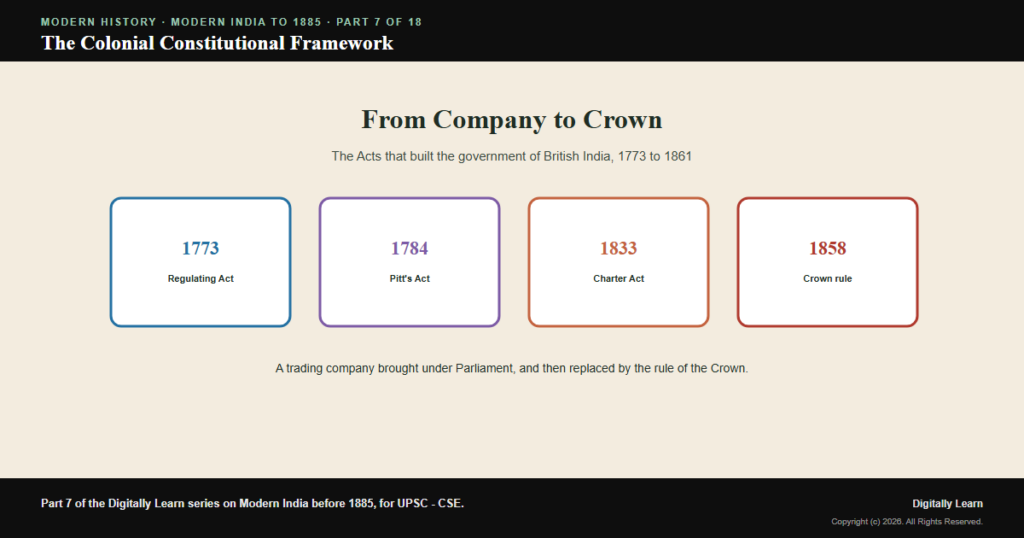
What is the significance of this theme: it is the story of how a trading company was gradually brought under the British state and finally replaced by it. The Acts traced here built, piece by piece, the constitution of colonial India, as the timeline below sets out.
The Regulating Act 1773 and the Amending Act 1781
The First Step in Parliamentary Control
What is the significance of the Regulating Act: it was the first attempt by Parliament to control the Company's Indian affairs. The Regulating Act of 1773 made the Governor of Bengal the Governor-General of Bengal, with a council, gave him a loose authority over Madras and Bombay, and set up a Supreme Court at Calcutta.
Distinguishing its flaws: the Act was vague, and the powers of the new Supreme Court clashed with those of the Governor-General in Council. The Amending Act of 1781, or Act of Settlement, was passed to fix this, exempting the Governor-General, the Council and revenue matters from the Court's jurisdiction.
Pitt's India Act 1784 and the Act of 1786
The Board of Control and the System of Dual Control
What is the significance of Pitt's India Act: it made the British government, not the Company, the master of Indian policy. Pitt's India Act of 1784 created a Board of Control to direct the Company's political and military affairs, while the Court of Directors kept commerce and patronage, a system known as dual control.
Distinguishing the later adjustment: the Act of 1786 gave Lord Cornwallis, as Governor-General, the combined power of commander-in-chief and the right to override his council, the strong authority he demanded before taking office. The structure of dual control is set out below.
The Charter Acts of 1793, 1813, 1833 and 1853
Twenty-Year Renewals That Reshaped Company Rule
What is the significance of the Charter Acts: through them Parliament renewed the Company's charter every twenty years and, each time, tightened its grip and changed the Company's character. The Act of 1793 renewed the charter and paid officials from Indian revenues.
Distinguishing the 1813 and 1833 Acts: the Charter Act of 1813 ended the Company's trade monopoly, except for tea and the China trade, asserted the sovereignty of the Crown over the Company's territories, and granted a sum for education and an opening to missionaries. The Charter Act of 1833 made the Governor-General of Bengal the Governor-General of India, centralised law-making, ended the Company's commercial functions entirely, and set up the first Law Commission under Macaulay.
The Charter Act of 1853 and Open Competition
Observable outcomes came with the last of the series. The Charter Act of 1853 renewed the Company's rule but, for the first time, without a fixed term, a sign that the end was near, and it threw open the civil service to open competition rather than the patronage of the directors.
Distinguishing its importance: open competition was the foundation of the modern Indian Civil Service, although the examination was held in England, in English, which kept Indians effectively excluded for years. The Act also separated the legislative and executive functions of the Governor-General's council.
The Government of India Act 1858 and the Indian Councils Act 1861
The End of the Company and the Rule of the Crown
What is the significance of the 1858 Act: it ended Company rule. In the aftermath of the revolt of 1857, the Government of India Act of 1858 abolished the East India Company and the Board of Control, and transferred the government of India directly to the British Crown.
Distinguishing the new offices: a Secretary of State for India in the British cabinet, advised by a Council of India, now answered to Parliament, while the Governor-General in India took the additional title of Viceroy as the Crown's representative. The change is set out below.
The Indian Councils Act 1861 and the First Devolution
Observable outcomes followed in the first reform of the new order. The Indian Councils Act of 1861 allowed Indians to be nominated as non-official members of the legislative council, a small but symbolic first step, and restored some legislative powers to Bombay and Madras.
Distinguishing its method: the Act also introduced the portfolio system, by which members of the council were each given charge of a department, the beginning of cabinet-style government in India. It closes the constitutional story of this period, gathered in the table below.
Significance: The Constitution of Colonial India
Why These Acts Mattered
Contemporary linkages run from these Acts to the structure of government that lasted until 1947 and, in part, beyond. The offices and institutions they created, the Governor-General and Viceroy, the central legislature, the Law Commissions and the civil service, were the framework that later reforms would extend.
The larger significance is that the conquest of India was matched by a steady constitutional reordering, in which a private company was first regulated, then stripped of trade, and finally abolished in favour of the Crown. The points below gather the threads, and the next part turns to the Governor-Generals who worked within this framework.
| Act | Year | Key provision |
|---|---|---|
| Regulating Act | 1773 | Governor-General of Bengal; Supreme Court at Calcutta |
| Pitt's India Act | 1784 | Board of Control; dual control |
| Charter Act | 1813 | Trade opened (except tea, China); Crown sovereignty asserted |
| Charter Act | 1833 | Governor-General of India; first Law Commission |
| Charter Act | 1853 | Open competition for the civil service |
| Government of India Act | 1858 | Company abolished; Crown rule; Secretary of State |
| Indian Councils Act | 1861 | Indians nominated; portfolio system |
- The Regulating Act 1773 began parliamentary control and created the Governor-General of Bengal.
- Pitt’s India Act 1784 set up the Board of Control and dual control.
- The Charter Act 1813 opened trade and asserted Crown sovereignty; 1833 created the Governor-General of India.
- The Charter Act 1853 introduced open competition for the civil service.
- The Government of India Act 1858 abolished the Company; the Indian Councils Act 1861 began devolution.
Prelims MCQ practice
Each question below tests one specific concept on the topic. Click to reveal the answer and a full option-wise explanation.
Q1. The Regulating Act of 1773 created the office of:
- Governor-General of Bengal
- Governor-General of India
- Viceroy of India
- Secretary of State for India
Show answer and explanation
Answer: Governor-General of Bengal
Explanation.
Option (a) is correct. The Regulating Act (1773) created the office of Governor-General of Bengal (first held by Warren Hastings). Hence option (a).
Q2. The Board of Control to supervise the Company's affairs was set up by:
- the Regulating Act 1773
- Pitt's India Act 1784
- the Charter Act 1833
- the Government of India Act 1858
Show answer and explanation
Answer: Pitt's India Act 1784
Explanation.
Option (b) is correct. Pitt's India Act (1784) created the Board of Control. Hence option (b).
Q3. The office of Governor-General of India (in place of Governor-General of Bengal) was created by the:
- Charter Act 1813
- Charter Act 1853
- Charter Act 1833
- Regulating Act 1773
Show answer and explanation
Answer: Charter Act 1833
Explanation.
Option (c) is correct. The Charter Act of 1833 created the office of Governor-General of India. Hence option (c).
Q4. Open competition for entry into the civil service was first introduced by the:
- Charter Act 1833
- Government of India Act 1858
- Indian Councils Act 1861
- Charter Act 1853
Show answer and explanation
Answer: Charter Act 1853
Explanation.
Option (d) is correct. The Charter Act of 1853 introduced open competition for the civil service. Hence option (d).
Q5. Consider the following statements about the Government of India Act of 1858:
- It abolished the East India Company and transferred the government of India to the Crown.
- It created the office of the Secretary of State for India.
Which of the statements given above is/are correct?
- 1 only
- 2 only
- Both 1 and 2
- Neither 1 nor 2
Show answer and explanation
Answer: Both 1 and 2
Explanation.
Both statements are correct: the 1858 Act abolished the Company and created the Secretary of State for India. Hence option (c).
Q6. The portfolio system, by which each councillor was given charge of a department, was introduced by the:
- Indian Councils Act 1861
- Charter Act 1853
- Government of India Act 1858
- Pitt's India Act 1784
Show answer and explanation
Answer: Indian Councils Act 1861
Explanation.
Option (a) is correct. The Indian Councils Act of 1861 introduced the portfolio system. Hence option (a).
Sources and Further Reading
- Wikipedia: Regulating Act 1773
- Wikipedia: Pitt's India Act
- Wikipedia: Charter Act 1833
- Wikipedia: Government of India Act 1858
- Wikipedia: Indian Councils Act 1861
- NCERT, Themes in Indian History and Our Pasts (Modern India)
- Indian Culture Portal, Ministry of Culture
- National Portal of India
- Press Information Bureau, Government of India
- National Archives of India
Editorial Disclaimer
This article is prepared for UPSC examination preparation. Verify key facts and interpretations against standard reference histories before relying on them.