
Overview
Previous Year UPSC-CSE Questions By the end you will be able to draft model answers for the following UPSC questions. Each question carries a collapsible framework showing how to approach it in the exam.
- UPSC Prelims 2021 GS Paper IDuring the first half of the 17th century, at which of the following places was/were the English East India Company factory/factories located?
- Broach
- Chicacole
- Trichinopoly
Select the correct answer using the code given below:
How to approach this Prelims question
Approach: Test each place against the early English factory network.
Trap to watch: Broach (Bharuch) near Surat was an early English factory; Chicacole and Trichinopoly were not English factories in the first half of the seventeenth century.
Key facts to recall:
- Surat the early English base (1613)
- Broach an early western factory
- Madras 1639, Bombay 1668, Calcutta 1690 came later
Answer signal: Only Broach, so option (a), 1 only.
- UPSC Prelims 2022 GS Paper IWith reference to Indian history, consider the following statements :
- The Dutch established their factories/warehouses on the east coast on lands granted to them by Gajapati rulers.
- Alfonso de Albuquerque captured Goa from the Bijapur Sultanate.
- The English East India Company established a factory at Madras on a plot of land leased from a representative of the Vijayanagara empire.
Which of the statements given above are correct ?
How to approach this Prelims question
Approach: Test each statement on a European settlement's origin.
Trap to watch: Albuquerque took Goa from Bijapur (2 correct); Madras 1639 was leased from a Vijayanagara-linked local ruler (3 correct); the Dutch east-coast grant was not from the Gajapati rulers (1 incorrect).
Key facts to recall:
- Albuquerque captured Goa from Bijapur, 1510
- Madras factory 1639, leased from a local Nayaka
- Statement 1 (Gajapati grant) is the wrong one
Answer signal: Statements 2 and 3, so option (b).
- UPSC Prelims 2020 GS Paper IWith reference to the history of India, consider the following pairs:
- Aurang – In-charge of treasury of the State
- Banian – Indian agent of the East India Company
- Mirasidar – Designated revenue payer to the State
Which of the pairs given above is/are correctly matched?
How to approach this Prelims question
Approach: Test each term-meaning pair from the world of Company trade and revenue.
Trap to watch: An aurang was a warehouse or place of manufacture, not the state treasury, so pair 1 is wrong; banian and mirasidar are correctly matched.
Key facts to recall:
- Aurang = warehouse (not treasury)
- Banian = Indian agent of the Company
- Mirasidar = a designated revenue payer
Answer signal: Pairs 2 and 3, so option (b).
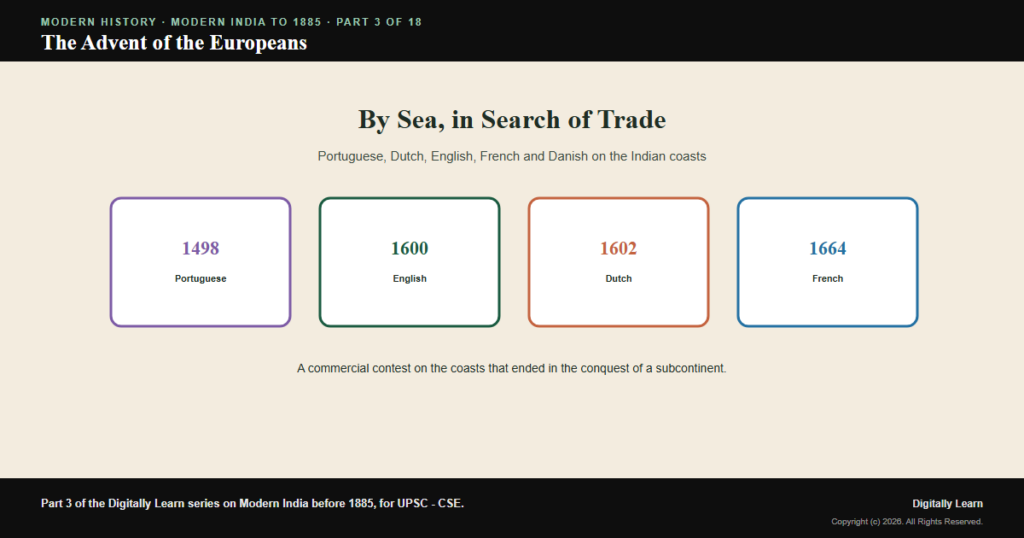
The advent of the Europeans was the arrival, from 1498, of a succession of European trading companies on the coasts of India, drawn by the spice and textile trade. The Portuguese came first and built a sea-borne empire around Goa; the Dutch were strong on the Coromandel before turning to the spice islands; and the English and French East India Companies became the great rivals, with the Danish a minor presence. What began as a contest for commerce became, in English hands, the beginning of the conquest of India.
Introduction: Why Europe Came to India by Sea
Spices, Textiles and the New Sea Route
Why this matters: the wealth of India, its spices, its cottons and its silks, had drawn traders for centuries, but the overland routes were long and controlled by middlemen. When Vasco da Gama reached Calicut in 1498, a direct sea route from Europe opened, and with it a scramble among the trading nations.
What is the significance of this theme: it is the hinge on which modern Indian history turns. The European companies arrived as traders, not conquerors, yet the commercial contest they began on the coasts would, in the case of the English, slowly become a contest for territory, as the map below sets out.
The Portuguese: Estado da India, the Cartaz System and Decline
The First and the Longest-Lasting
What is the significance of the Portuguese: they were the pioneers who opened the sea route and the last Europeans to leave. Under Almeida and especially Albuquerque, who captured Goa from the Bijapur Sultanate in 1510, they built the Estado da India, a chain of fortified coastal bases from Goa to Diu, Daman and Cochin.
Distinguishing their method: the Portuguese sought a monopoly of the sea itself. Through the cartaz, a pass system, they required Indian and other ships to buy a licence and to call at their ports, backed by naval power, a policy sometimes called the Blue Water Policy.
Observable outcomes turned to decline by the seventeenth century. Religious intolerance, corruption, the rise of the Dutch and English, and the small size of Portugal itself eroded their position, though Goa remained Portuguese long after the rest of India had changed hands.
The Dutch and the Amboyna Pivot to the Spice Islands
Strong on the Coromandel, Drawn to the Spices
What is the significance of the Dutch: for a time they were the strongest European power in Asian trade. The Dutch East India Company, formed in 1602, set up factories on the Coromandel coast at Pulicat and elsewhere, dealing in textiles, indigo and spices.
Distinguishing their choice: after friction with the English, sharpened by the Amboyna episode of 1623 in the spice islands, the Dutch concentrated on the immensely profitable spice trade of the East Indies, today Indonesia, and left the Indian mainland increasingly to the English and French.
The English East India Company: Charter, Factories and Farmans
From a Royal Charter to a Chain of Factories
What is the significance of the English Company: it would become the eventual ruler of India, but it began as a trading body. The English East India Company was chartered by Queen Elizabeth I in 1600, and through the missions of Hawkins and Sir Thomas Roe to the Mughal court it won the right to trade at Surat.
Observable outcomes were a chain of fortified factories: Surat early in the century and an early western post at Broach, then Madras in 1639, where the Company built Fort St George on land leased from a local Nayaka ruler of the old Vijayanagara south, followed by Bombay in 1668 and Calcutta in 1690. The flow below traces this rise from charter to foothold.
The 1717 Farman and the World of Company Trade
What is the significance of the 1717 farman: it tilted the field decisively. In 1717 the Mughal emperor Farrukhsiyar granted the Company duty-free trade in Bengal, a concession so valuable it was called the Magna Carta of the Company, and a constant source of friction with the Nawabs.
Distinguishing the trade's machinery: the Company worked through a world of its own terms. Its goods were gathered in a warehouse, or aurang, and much of its business was handled by an Indian agent, the banian, while in the south it dealt with mirasidars and other local revenue-holders, as the table later in this article sets out.
The French and the Danes: The Last Arrivals
The Great Rival and the Minor Presence
What is the significance of the French: they were the only Europeans to seriously challenge the English for mastery of India. The French East India Company, refounded in 1664, built its power at Pondicherry and Chandernagore, and the rivalry of the two companies would erupt in the Carnatic Wars treated in the next part.
Distinguishing the Danes: the Danish presence was the smallest, based at Tranquebar on the Coromandel coast and at Serampore in Bengal. The Danes were never a serious contender for power and eventually sold their settlements to the British.
The Trading Companies Compared
The Five Companies at a Glance
Observable outcomes can be gathered in a single view. The roster and table below set out the five companies, when they came, their chief Indian base and their eventual fate, so the shape of the contest can be seen whole.
Distinguishing the common pattern: every one of them began as a trading venture seeking profit, not territory. The decisive difference was that the English, and very nearly the French, found that protecting their trade in a fragmenting India drew them step by step into politics and war.
| Company | Arrived or chartered | Chief Indian base | Fate |
|---|---|---|---|
| Portuguese | 1498 | Goa | First in, last out; reduced to Goa, Diu and Daman |
| English | 1600 | Surat, later Calcutta | Became the ruling power in India |
| Dutch | 1602 | Pulicat | Turned to the spice islands of the East Indies |
| Danish | c.1620 | Tranquebar | Minor; settlements sold to the British |
| French | 1664 | Pondicherry | The great rival; defeated in the Carnatic Wars |
Significance: The Commercial Prelude to Political Power
How Trade Became the Road to Conquest
Contemporary linkages run from this commercial age straight into the colonial one. The factories, forts and trading privileges described here were the base from which the English Company, once the Mughal order weakened, would turn from trade to territory in Bengal and the south.
The larger significance is that the European advent reframes the conquest of India as the outcome of a long commercial contest, decided as much by sea power, finance and organisation as by arms. The points below gather the threads, and the next part turns to the Carnatic Wars and the conquest of Bengal, where trade finally became empire.
- The Portuguese opened the sea route in 1498 and pioneered European trade and sea power.
- The Dutch were strong on the Coromandel but chose the spice islands after Amboyna.
- The English East India Company (1600) built Surat, Madras, Bombay and Calcutta.
- The 1717 farman of Farrukhsiyar gave the English near duty-free trade in Bengal.
- The French were the great rivals, setting up the Carnatic Wars of the next part.
Prelims MCQ practice
Each question below tests one specific concept on the topic. Click to reveal the answer and a full option-wise explanation.
Q1. Who reached the Indian port of Calicut by the sea route in 1498?
- Christopher Columbus
- Vasco da Gama
- Alfonso de Albuquerque
- Bartholomew Diaz
Show answer and explanation
Answer: Vasco da Gama
Explanation.
Option (b) is correct. Vasco da Gama of Portugal reached Calicut in 1498, opening the sea route from Europe to India. Hence option (b).
Q2. Alfonso de Albuquerque captured Goa in 1510 from the:
- Vijayanagara Empire
- Bijapur Sultanate
- Marathas
- Mughals
Show answer and explanation
Answer: Bijapur Sultanate
Explanation.
Option (b) is correct. Albuquerque captured Goa from the Bijapur Sultanate in 1510, making it the capital of the Portuguese Estado da India. Hence option (b).
Q3. The English East India Company was chartered by Queen Elizabeth I in the year:
- 1498
- 1600
- 1664
- 1717
Show answer and explanation
Answer: 1600
Explanation.
Option (b) is correct. The English East India Company received its royal charter in 1600. Hence option (b).
Q4. Consider the following statements about the European trading companies in India:
- The Dutch, after friction with the English, concentrated on the spice trade of the East Indies.
- The French built their main base in India at Pondicherry.
Which of the statements given above is/are correct?
- 1 only
- 2 only
- Both 1 and 2
- Neither 1 nor 2
Show answer and explanation
Answer: Both 1 and 2
Explanation.
Both statements are correct: the Dutch turned to the spice islands, and the French based themselves at Pondicherry. Hence option (c).
Q5. The 1717 farman that granted the English Company duty-free trade in Bengal was issued by the Mughal emperor:
- Aurangzeb
- Bahadur Shah I
- Farrukhsiyar
- Muhammad Shah
Show answer and explanation
Answer: Farrukhsiyar
Explanation.
Option (c) is correct. The 1717 farman, the 'Magna Carta of the Company', was granted by Farrukhsiyar. Hence option (c).
Q6. The Danish settlement on the Coromandel coast was at:
- Pondicherry
- Tranquebar
- Pulicat
- Chinsurah
Show answer and explanation
Answer: Tranquebar
Explanation.
Option (b) is correct. The Danes were based at Tranquebar on the Coromandel coast (and Serampore in Bengal). Pondicherry was French, Pulicat and Chinsurah were Dutch. Hence option (b).
Sources and Further Reading
- Wikipedia: Europeans in India (colonial)
- Wikipedia: Portuguese India
- Wikipedia: East India Company
- Wikipedia: Dutch India
- Wikipedia: French India
- NCERT, Themes in Indian History and Our Pasts (Modern India)
- Indian Culture Portal, Ministry of Culture
- National Portal of India
- Press Information Bureau, Government of India
- National Archives of India
Editorial Disclaimer
This article is prepared for UPSC examination preparation. Verify key facts and interpretations against standard reference histories before relying on them.