
Overview
Previous Year UPSC-CSE Questions By the end you will be able to draft model answers for the following UPSC questions. Each question carries a collapsible framework showing how to approach it in the exam.
- UPSC Mains 2022 GS-IWhy did the armies of the British East India Company – mostly comprising of Indian soldiers – win consistently against the more numerous and better equipped armies of the Indian rulers? Give reasons.
How to structure the answer in the exam
Introduction: Open with the paradox: smaller Company armies of Indian sepoys beating larger Indian forces.
Body (sub-themes to develop):
- Discipline and drill: European-trained, regularly paid sepoys versus irregular, often unpaid armies.
- Material edge: superior artillery and firearms, command of the sea, and deep financial credit.
- Unity of command and steady leadership versus divided and rival Indian courts.
- Diplomacy, alliances and treachery (Mir Jafar) that turned Indian divisions to advantage.
Conclusion: Conclude that organisation, money, firepower and a divided opposition mattered more than numbers.
- UPSC Prelims 2004 GS Paper IConsider the following statements:
- In the Third Battle of Panipat, Ahmed Shah Abdali defeated Ibrahim Lodi.
- Tipu Sultan was killed in the Third Anglo-Mysore War.
- Mir Jafar entered in a conspiracy with the English for the defeat of Nawab Siraj-ud-daulah in the Battle of Plassey.
Which of these statements given above is/are correct?
How to approach this Prelims question
Approach: Test each statement; only the Plassey-Mir Jafar one is true.
Trap to watch: Panipat 1761 was Abdali vs the Marathas (not Ibrahim Lodi, who fell at the FIRST Panipat 1526); Tipu died in the FOURTH Anglo-Mysore War 1799, not the Third.
Key facts to recall:
- Mir Jafar's conspiracy at Plassey 1757 (true)
- Third Panipat 1761 = Abdali vs Marathas (statement 1 false)
- Tipu killed in the Fourth Anglo-Mysore War 1799 (statement 2 false)
Answer signal: Only statement 3 is correct, so option (b).
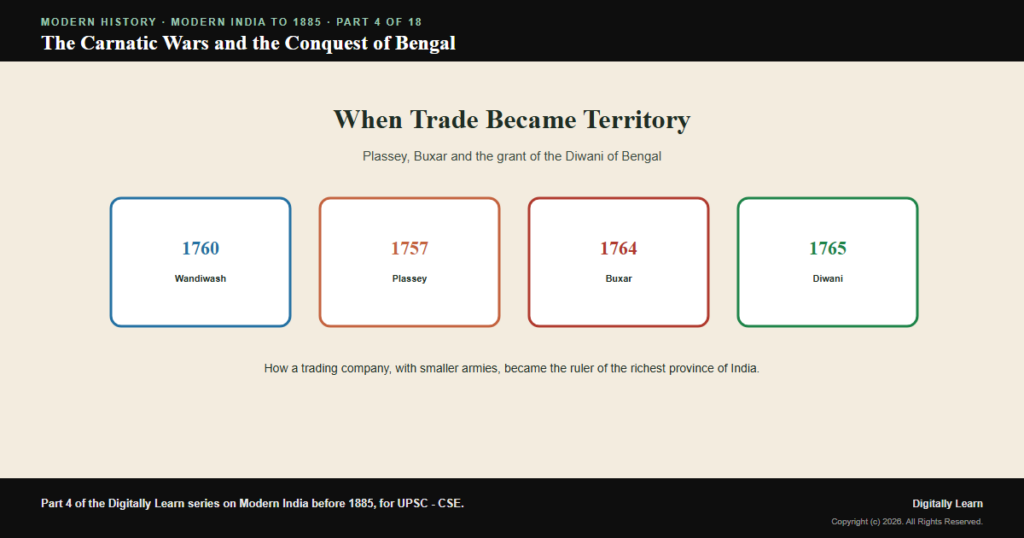
The conquest of Bengal and the Carnatic Wars are the events through which the English East India Company turned from a trader into a ruling power between 1746 and 1765. In the south the three Carnatic Wars, decided at Wandiwash in 1760, broke French ambitions in India. In the east the Battle of Plassey in 1757 made the Company kingmaker in Bengal, and the Battle of Buxar in 1764, followed by the Treaty of Allahabad and the grant of the Diwani in 1765, made it the master of the richest province of India.
Introduction: When Trade Became Territory
The Two Theatres of the Early Conquest
Why this matters: this is the moment the European presence stopped being merely commercial. Between 1746 and 1765, in two theatres, the English East India Company defeated its French rival and the Nawab of Bengal, and emerged as a territorial power with the revenue of a great province in its hands.
What is the significance of this theme: it is the foundation of British rule in India. The Carnatic Wars settled which European power would dominate, while Plassey, Buxar and the Diwani gave the Company both the means and the legal pretext to rule, as the map below sets out.
The Anglo-French Rivalry: The Three Carnatic Wars
Dupleix, the Subsidiary Idea and the Contest for the South
What is the significance of the Carnatic Wars: they decided that the English, not the French, would master India. Fought between 1746 and 1763 in the south-east, they grew out of the wider Anglo-French wars in Europe and the ambition of the French governor Dupleix, who pioneered the use of trained Indian troops and intervention in local succession disputes.
Distinguishing the three wars: the first was an offshoot of a European war; the second was a contest over rival claimants in the Carnatic and the Deccan, in which the young Robert Clive rose to fame; and the third sealed the outcome.
Wandiwash 1760 and the Treaty of Paris 1763
Observable outcomes came at Wandiwash in 1760, where the English under Eyre Coote decisively defeated the French. The Treaty of Paris in 1763 ended the war, restored French settlements such as Pondicherry as trading posts but stripped them of fortification and military power.
Distinguishing the result: France was finished as a serious contender for political power in India. The contest for the subcontinent was now effectively between the English Company and the Indian powers, the first of which to fall would be Bengal.
The Conflict in Bengal: The Farman Abuses and the Black Hole 1756
Trade Privileges, the Nawab and the Road to War
What is the significance of the Bengal quarrel: it turned a trade dispute into a war for a kingdom. The Company abused the 1717 farman, extending its duty-free privilege to private trade and fortifying Calcutta without leave, which the new Nawab, Siraj-ud-Daulah, saw as a challenge to his sovereignty.
Distinguishing the flashpoint: in 1756 Siraj-ud-Daulah seized Calcutta, an episode followed by the disputed Black Hole affair. The Company recovered the city under Clive and prepared, by intrigue as much as arms, to replace the Nawab himself.
The Battle of Plassey 1757: Siraj-ud-Daulah, Clive and the Conspiracy
A Victory Won by Intrigue
What is the significance of Plassey: it made the Company the power behind the throne of Bengal. At Plassey in 1757, Clive defeated Siraj-ud-Daulah less by fighting than by conspiracy, having bought over the Nawab's commander Mir Jafar, whose army stood aside during the battle.
Distinguishing its character: Plassey was a political turning point rather than a great military feat. Mir Jafar was placed on the throne as a puppet, and the Company drained Bengal of wealth, but real sovereignty still rested formally with the Nawab.
Mir Jafar, Mir Qasim and the Battle of Buxar 1764
The Decisive Victory and the Dastak Dispute
What is the significance of Buxar: it was the truly decisive battle, fought against a far stronger coalition. The able Nawab Mir Qasim, installed in place of Mir Jafar, tried to assert independence and ended the abuse of the dastak, the free-trade pass, by abolishing all duties, which the Company would not accept.
Distinguishing the stakes: at Buxar in 1764 the Company defeated the combined armies of Mir Qasim, the Nawab of Awadh and the Mughal emperor Shah Alam II. Where Plassey had given influence, Buxar gave the Company undisputed military mastery of the east.
The Treaty of Allahabad and the Grant of the Diwani 1765
The Right to Collect a Kingdom's Revenue
Observable outcomes were settled by the Treaty of Allahabad in 1765. The Mughal emperor granted the Company the Diwani, the right to collect the revenue, of Bengal, Bihar and Orissa, in return for a tribute, while the Nawab kept the Nizamat, the duties of administration and justice.
Distinguishing its importance: the Diwani gave the Company a vast and legal source of income, which it could use to buy Indian goods, pay its armies and expand, all in the emperor's name. It was the financial foundation of empire, set out in the flow below.
The Dual Government and Its Consequences
What is the significance of the Dual Government: it was power without responsibility, and it ruined Bengal. Under the system Clive devised, the Company held the Diwani and the real power of the purse, while the Nawab held the Nizamat and the burden of administration, so that neither was fully answerable.
Distinguishing the human cost: revenue was extracted ruthlessly while administration decayed, a misrule that contributed to the catastrophic Bengal famine of 1770. The system was so discredited that it was abolished by Warren Hastings, who became the first Governor-General of Bengal under the Regulating Act of 1773.
Significance: Why the Company's Smaller Armies Won
Organisation, Money, Firepower and a Divided India
What is the significance of the Company's victories: they were won, again and again, by armies that were smaller but better organised. The Company's sepoys were European-drilled, regularly paid and disciplined, while Indian armies were often larger but irregular, unpaid and loosely commanded.
Distinguishing the deeper reasons: the Company enjoyed superior artillery and firearms, command of the sea, deep financial credit, and a single unity of command, and it used diplomacy, alliance and the bribery of rivals such as Mir Jafar to turn India's own divisions against it. The cards below set out why it won.
The Foundation of British Rule
Contemporary linkages run from these battles to the colonial state itself. The revenue of Bengal, won at Plassey and Buxar, financed the further conquest of India, so that the empire was in large part paid for by Indians themselves, as the table and timeline below record.
The larger significance is that the conquest of Bengal shows British rule beginning not as a grand invasion but as the seizure of an existing state's revenue by a well-organised trading company. The points below gather the threads, and the next part turns to the wars against Mysore and the Marathas.
| Battle | Year | Defeated | Outcome |
|---|---|---|---|
| Plassey | 1757 | Siraj-ud-Daulah (by intrigue) | Company becomes kingmaker in Bengal |
| Wandiwash | 1760 | The French | French power in India broken |
| Buxar | 1764 | Mir Qasim, Awadh, the Mughal emperor | Company gains military mastery of the east |
- The Carnatic Wars broke the French; Wandiwash 1760 was decisive.
- Plassey 1757 was a political turning point won by the intrigue with Mir Jafar.
- Buxar 1764 was the decisive military victory over a Nawab-Emperor-Awadh coalition.
- The Diwani of 1765 gave the Company the legal right to Bengal’s revenue.
- The Company won with smaller but disciplined, well-paid, well-armed and well-led armies.
Prelims MCQ practice
Each question below tests one specific concept on the topic. Click to reveal the answer and a full option-wise explanation.
Q1. The Battle of Plassey was fought in the year:
- 1757
- 1760
- 1764
- 1765
Show answer and explanation
Answer: 1757
Explanation.
Option (a) is correct. The Battle of Plassey was fought in 1757, when Clive defeated Siraj-ud-Daulah. Hence option (a).
Q2. At the Battle of Buxar in 1764, the English defeated the combined forces of the Nawab of Bengal, the Nawab of Awadh and the:
- Nizam of Hyderabad
- Mughal emperor Shah Alam II
- Peshwa
- Nawab of the Carnatic
Show answer and explanation
Answer: Mughal emperor Shah Alam II
Explanation.
Option (b) is correct. At Buxar (1764) the Company defeated Mir Qasim, the Nawab of Awadh and the Mughal emperor Shah Alam II. Hence option (b).
Q3. By the Treaty of Allahabad in 1765, the East India Company obtained the Diwani of:
- Bengal, Bihar and Orissa
- the Carnatic
- Mysore
- Punjab
Show answer and explanation
Answer: Bengal, Bihar and Orissa
Explanation.
Option (a) is correct. The Treaty of Allahabad (1765) granted the Company the Diwani of Bengal, Bihar and Orissa. Hence option (a).
Q4. The decisive battle of the Carnatic Wars, which broke French power in India, was the Battle of:
- Plassey
- Wandiwash
- Buxar
- Panipat
Show answer and explanation
Answer: Wandiwash
Explanation.
Option (b) is correct. The Battle of Wandiwash (1760) decisively broke French power in India. Hence option (b).
Q5. Consider the following statements about the conquest of Bengal:
- The Battle of Plassey was won largely through the conspiracy of Mir Jafar.
- The Battle of Buxar was a far more decisive military victory than Plassey.
Which of the statements given above is/are correct?
- 1 only
- 2 only
- Both 1 and 2
- Neither 1 nor 2
Show answer and explanation
Answer: Both 1 and 2
Explanation.
Both statements are correct: Plassey turned on Mir Jafar's conspiracy, and Buxar was the decisive military victory. Hence option (c).
Q6. Under the Dual Government in Bengal, the East India Company held the Diwani while the Nawab held the:
- Nizamat (administration and justice)
- right to coin money
- Diwani as well
- command of the Company's army
Show answer and explanation
Answer: Nizamat (administration and justice)
Explanation.
Option (a) is correct. Under the Dual Government the Company held the Diwani (revenue) and the Nawab the Nizamat (administration and justice). Hence option (a).
Sources and Further Reading
- Wikipedia: Battle of Plassey
- Wikipedia: Battle of Buxar
- Wikipedia: Carnatic Wars
- Wikipedia: Treaty of Allahabad
- Wikipedia: Battle of Wandiwash
- NCERT, Themes in Indian History and Our Pasts (Modern India)
- Indian Culture Portal, Ministry of Culture
- National Portal of India
- National Archives of India
- Press Information Bureau, Government of India
Editorial Disclaimer
This article is prepared for UPSC examination preparation. Verify key facts and interpretations against standard reference histories before relying on them.