
Overview
Classical and Dynamic Theories, Onset, and Withdrawal
How land-sea heating, the ITCZ shift, and the jet stream switch combine to drive India's monsoon cycle from Kerala onset to December withdrawal.
Previous Year UPSC-CSE Questions By the end you will be able to draft model answers for the following UPSC questions. Each question carries a collapsible framework showing how to approach it in the exam.
- Prelims 2012 GS-IConsider the following statements:
- The duration of the monsoon decreases from southern India to northern India.
- The amount of annual rainfall in the northern plains of India decreases from east to west.
Which of the statements given above is/are correct?
How to approach this Prelims question
Approach: Recall the Kerala 1 June to mid-July all-India progression. Onset 1 June over Kerala plus mid-July all-India coverage means the southern peninsula receives monsoon for over four months while the north-west gets only six to eight weeks. For rainfall direction across northern plains, monsoon depressions originate over Bay of Bengal and weaken as they move west, producing east-to-west rainfall decline.
Trap to watch: Do not confuse duration gradient with intensity. Annual rainfall direction across northern plains is east heavy and west low; do not mix it with the north-south rainfall gradient.
Key facts to recall:
- Onset Kerala 1 June; withdrawal western Rajasthan first week September
- Southern India receives monsoon roughly four months; north-west India roughly six weeks
- Bay of Bengal depressions weaken westward; northern plains rainfall declines east to west
- Kolkata receives 119 cm SW monsoon rainfall; Delhi 56 cm
Answer signal: Both statements correct; option Both 1 and 2.
- Prelims 2020 GS-IConsider the following statements:
- Jet streams occur in the Northern Hemisphere only.
- Only some cyclones develop an eye.
- The temperature inside the eye of a cyclone is nearly 10 degrees Celsius lesser than that of the surroundings.
Which of the statements given above is/are correct?
How to approach this Prelims question
Approach: Statement 1: jet streams are bihemispheric; STWJ and polar-front jet exist in both hemispheres. Reject. Statement 2: eyes form only in strong, mature tropical cyclones; weak depressions do not develop an eye. Accept. Statement 3: cyclone eye is warmer than surroundings due to adiabatic compression of subsiding air. Reject the lesser claim.
Trap to watch: Statement 3 reverses the actual eye-temperature relationship; the eye is warmer not cooler. Statement 1 is a common error because Indian textbooks discuss STWJ over India.
Key facts to recall:
- Jet streams occur in both hemispheres at polar-front and subtropical positions
- Cyclone eye is a calm warm core; develops only in mature tropical cyclones
- Eye is warmer than surroundings due to adiabatic compression of subsiding air
- Tropical easterly jet over India at 15 degrees North is the southern-hemisphere-adjacent counterpart
Answer signal: Only statement 2 correct; option 2 only.
- Prelims 2002 GS-IFor short-term climate prediction, which one of the following events, detected in the last decade, is associated with occasional weak monsoon rains in the Indian sub-continent?
How to approach this Prelims question
Approach: Eliminate by ruling out. La Nina is associated with above-normal Indian monsoon, not weak monsoon. Movement of jet streams is a global feature, not a short-term predictor of weak monsoon. Greenhouse effects are a long-term climate forcing, not short-term prediction. ENSO is the canonical short-term predictor of weak Indian monsoon, with El Nino events of 1987, 2002, 2009, 2015 all producing deficient rainfall.
Trap to watch: La Nina is the opposite phase and strengthens the monsoon. Greenhouse effects operate on multi-decadal timescales and are not a short-term predictor.
Key facts to recall:
- ENSO is the canonical short-term predictor of Indian monsoon variability
- El Nino weakens the monsoon; La Nina strengthens it
- Major El Nino drought years in India: 1972, 1987, 2002, 2009, 2015
- NCERT Chapter 4 names El Nino as the short-term predictor used by IMD
Answer signal: El Nino and Southern Oscillations; option C.
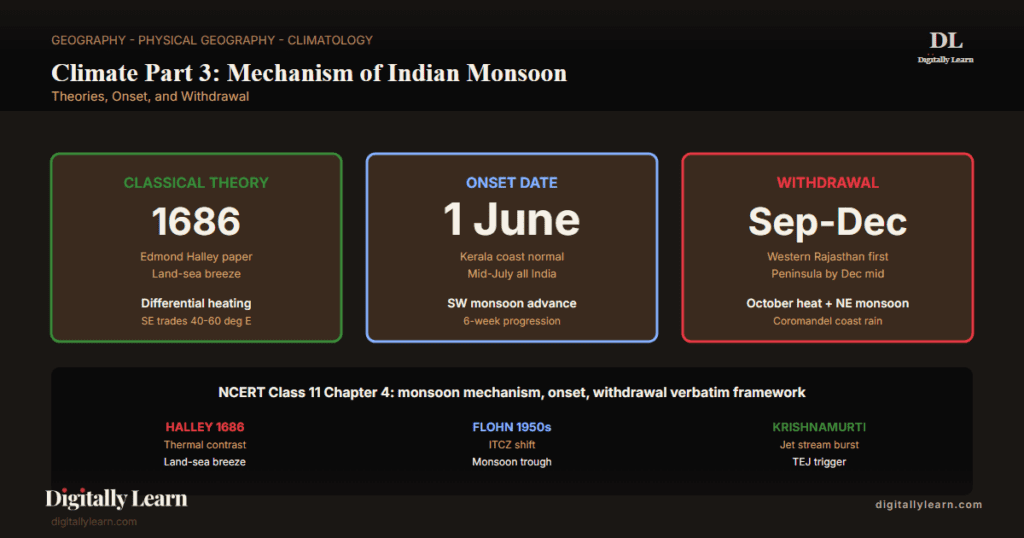
The Indian monsoon is a seasonal reversal of wind direction and the associated precipitation cycle that delivers approximately 75 per cent of India's annual rainfall between June and September. Two theoretical frameworks explain its mechanism. The classical thermal theory holds that differential heating of land and sea creates a continental low-pressure trough that draws in moisture-laden south-east trades after they cross the Equator. The modern dynamic theory traces the monsoon to the seasonal northward shift of the Inter-Tropical Convergence Zone (ITCZ), the withdrawal of the westerly subtropical jet stream, and the establishment of the easterly tropical jet stream at 15 degrees North that triggers the monsoon burst. The monsoon enters India over Kerala by 1 June and engulfs the subcontinent by mid-July. Withdrawal begins from western Rajasthan in early September and clears the Peninsula by mid-December.
Background and Historical Context
The Indian monsoon is the single most important climatic event of the agricultural year, supplying the kharif cropping season with the moisture on which over 50 per cent of cultivated area depends. The timing of onset over Kerala, the rate of advance, the distribution of burst-and-break spells, and the date of withdrawal together determine whether a year is normal, deficient, or excess. UPSC has tested monsoon mechanism, onset, withdrawal, jet streams, and ENSO teleconnection in Prelims 2012, 2017, 2020, 2022, 2024 and in Mains GS-I climatology papers across the past decade.
What is the significance of distinguishing classical and dynamic monsoon theories? The two frameworks differ in scale, mechanism, and explanatory power. The classical theory proposed by Edmond Halley in 1686 treats the monsoon as a giant land-sea breeze driven by temperature contrast between the heated Indian landmass and the cooler Indian Ocean. The dynamic theory advanced by Hermann Flohn from the 1950s treats it as a planetary phenomenon driven by ITCZ shift, jet-stream bifurcation, and the tropical easterly jet. The textbook synthesis integrates both: differential heating sets the stage, and the jet-stream switch triggers the burst.
The India Meteorological Department issues its first-stage long-range monsoon forecast in April based on sixteen indicators including the Southern Oscillation Index, Eurasian snow cover, and Tibetan Plateau heating. The 2024 south-west monsoon delivered 8 per cent above-normal rainfall under transitioning ENSO conditions, consistent with the dynamic-theory framework that integrates Pacific and Indian Ocean signals (covered in our Climate Part 2 entry on jet streams and oceanic teleconnections). Winter precipitation over north-west India continues to be supplied by Western Disturbances moving along the southern branch of the subtropical westerly jet (covered in our Western Disturbances entry). The Mission Mausam programme launched by the Ministry of Earth Sciences in 2024 aims to upgrade observational density and numerical-prediction skill for monsoon forecasting.
Classical Thermal Theory: The Land-Sea Differential Heating Framework
Halley 1686 and the late-nineteenth-century synthesis
The earliest scientific theory of the monsoon was offered by the English astronomer Edmond Halley in his 1686 paper, where he proposed that the seasonal reversal of winds over the Indian subcontinent results from the differential heating of land and sea. The land surface, having lower specific heat capacity than water, warms quickly during summer and creates a thermal low-pressure cell over the Asian interior. Cooler oceanic air then flows landward to fill this pressure deficit.
In winter the situation reverses: the continent cools faster, develops a high-pressure cell, and pushes dry air outward toward the warmer ocean. Halley's framework treats the monsoon as a giant, planetary-scale land-sea breeze operating at the scale of the whole subcontinent rather than a coastal strip.
Towards the end of the nineteenth century, this thermal framework was refined into the dominant explanatory model for the Indian monsoon. During April and May, when the sun shines vertically over the Tropic of Cancer, the large landmass north of the Indian Ocean heats intensely. This causes the formation of an intense low pressure in the north-western part of the subcontinent.
Since the pressure in the Indian Ocean south of the landmass is high because water heats slowly, the continental low-pressure cell attracts the south-east trade winds across the Equator. These winds, deflected by the Coriolis force after crossing the Equator between 40 degrees East and 60 degrees East longitudes, become the south-west monsoon current that delivers moisture to India.
- Mechanism: Differential heating between Asian landmass and Indian Ocean creates a continental thermal low and an oceanic high-pressure cell.
- Wind reversal: South-east trades from the southern hemisphere cross the Equator and become south-west monsoon over India after Coriolis deflection.
- Crossing zone: South-east trades cross the Equator between 40 degrees East and 60 degrees East longitudes.
- Winter reversal: Land cools faster than ocean; high pressure builds over Central Asia; dry north-easterly winds blow outward toward the warmer southern oceans.
- Halley’s contribution (1686): First scientific articulation of the monsoon as a continental-scale land-sea breeze driven by thermal contrast.
Limitations of the purely thermal framework
The classical thermal theory explains the broad seasonal reversal but cannot account for several observed features of the Indian monsoon. The monsoon does not begin gradually as land-sea temperature contrast would predict; instead, it arrives in a sudden burst within a few days of crossing Kerala. The Tibetan Plateau, located at approximately 4,500 metres elevation, plays a critical role that surface-temperature arguments cannot explain, since the plateau heats the upper troposphere directly.
Year-to-year variability driven by the El Nino-Southern Oscillation, which Walker described in the 1920s, and by Indian Ocean Dipole signals cannot be derived from land-sea contrast alone. These limitations motivated the search for a more comprehensive dynamic framework from the 1950s onward.
| Feature | Classical theory explanation | Limitation |
|---|---|---|
| Seasonal wind reversal | Continental thermal low draws in ocean air | Strong; well captured |
| Monsoon onset burst | Gradual warming should produce gradual onset | Cannot explain the sudden burst |
| Inter-annual variability | Cannot derive from land-sea contrast alone | Major limitation |
| Tibetan Plateau role | Surface-temperature framing inadequate | Requires upper-atmospheric mechanism |
| Withdrawal pattern | Gradual cooling implied | Observed retreat shows definite spatial sequence not predicted |
Modern Dynamic Theory: ITCZ Shift and Jet Stream Switch
Flohn 1950s and the ITCZ-shift hypothesis
The German climatologist Hermann Flohn advanced from the 1950s the view that the Indian monsoon is not primarily a thermal land-sea phenomenon but a manifestation of the seasonal northward migration of the planetary Inter-Tropical Convergence Zone (ITCZ). In winter the ITCZ sits south of the Equator and the Indian region experiences north-east trade winds blowing out from the Central Asian high.
As the sun migrates northward through spring, the ITCZ also shifts north, and by July it lies between 20 and 25 degrees North over the Indo-Gangetic plain, where it becomes the monsoon trough.
Under Flohn's framework, the south-west monsoon is the continuation of the south-east trades of the southern hemisphere that, drawn in by the ITCZ-aligned low-pressure trough over India, cross the Equator and undergo Coriolis deflection to become south-westerly. The same process operates over West Africa and other monsoonal regions of the tropics. The Indian monsoon, in Flohn's view, is a regional expression of a planetary system rather than a unique Indian phenomenon.
- ITCZ position: Winter at 5-10 degrees South; summer at 20-25 degrees North over Indo-Gangetic plain ( Chapter 4).
- Monsoon trough: The summer ITCZ over India is termed the monsoon trough; the depth and oscillation of this trough determines spatial rainfall distribution.
- South-east trades: Cross the Equator between 40 degrees East and 60 degrees East longitudes; Coriolis deflection makes them south-westerly.
- Planetary framework: Flohn situates Indian monsoon in the global tropical-circulation system rather than as a local Indian phenomenon.
- Modern synthesis: Flohn’s ITCZ-shift framework remains the textbook framing in NCERT and in most contemporary climatology references.
Jet stream theory and the monsoon burst trigger
The jet-stream extension of dynamic theory, developed from the 1960s by T. N. Krishnamurti and others, traces the explosive monsoon burst to the seasonal switch between two upper-tropospheric jet streams. In winter, the subtropical westerly jet (STWJ) flows at around 9-13 kilometres altitude across central Asia.
The Tibetan Plateau bifurcates this jet, and its southern branch lies near the mean position of 25 degrees North in February at the 200-300 millibar pressure level, just south of the Himalayas. This southern STWJ steers Western Disturbances from the Mediterranean into north-west India, supplying winter precipitation.
As summer advances and the Tibetan Plateau heats up, the STWJ withdraws northward. Once the STWJ vacates the position south of the Himalayas, the tropical easterly jet (TEJ) establishes itself along approximately 15 degrees North latitude over peninsular India.
The TEJ flows east-to-west, reaches a maximum speed of around 90 kilometres per hour in June, and is held responsible for the burst of the monsoon in India. The TEJ also steers the tropical depressions originating in the Bay of Bengal across the subcontinent, and their tracks become the highest-rainfall corridors during the monsoon season.
- STWJ winter position: 25 degrees North mean February position at 200-300 millibar level, south of Himalayas.
- Bifurcation: Tibetan Plateau splits the westerly jet; northern branch flows over plateau; southern branch over north India.
- STWJ withdrawal: The northward withdrawal of the southern STWJ branch is the necessary condition for monsoon burst.
- TEJ establishment: Tropical easterly jet sets in at 15 degrees North only after the westerly jet has withdrawn; held responsible for monsoon burst.
- TEJ speed: Maximum 90 km per hour in June; confined to 15 degrees North in August and 22 degrees North in September.
- Synthesis: Classical thermal mechanism creates conditions; jet stream switch is the trigger that releases the burst.
| Aspect | Classical thermal (Halley, late 19th c) | Modern dynamic (Flohn, Krishnamurti, post-1950) |
|---|---|---|
| Primary driver | Land-sea differential heating | ITCZ northward shift and jet stream switch |
| Spatial scale | Continental land-sea contrast | Planetary tropical circulation |
| Onset mechanism | Gradual pressure-gradient build | Sudden burst triggered by jet stream switch |
| Role of Tibetan Plateau | Not central | Critical: bifurcates westerly jet, heats upper troposphere |
| Inter-annual variability | Not derivable | Integrates ENSO, IOD, southern oscillation signals |
| NCERT framing | Late 19th century opinion (acknowledged) | Adopted canonical synthesis |
Onset of South-West Monsoon: From Kerala to Mid-July All-India
The all-India onset progression
The south-west monsoon sets in over the Kerala coast by 1 June and moves swiftly to reach Mumbai and Kolkata between 10 and 13 June. By mid-July the south-west monsoon engulfs the entire subcontinent. The advance is not uniform: it follows the two branches established by the Western Ghats and the Bay of Bengal.
The Arabian Sea current rolls up the west coast while the Bay of Bengal current sweeps north-east into Assam before curving westward across the Indo-Gangetic plain. The all-India onset progression takes approximately six weeks, with the duration of the monsoon decreasing from southern India to northern India, the spatial gradient tested in Prelims 2012.
- 1 June: Monsoon sets in over Kerala (normal date); advances to Karnataka and coastal Andhra Pradesh within days.
- 5 June: Reaches Tamil Nadu interior, Karnataka plateau, southern Andhra Pradesh.
- 10 June: Reaches Mumbai (Western Ghats) and coastal Maharashtra; Bay of Bengal branch reaches Kolkata.
- 15 June: Covers Gujarat, Madhya Pradesh, Chhattisgarh, Jharkhand, and Bihar in the central belt.
- 1 July: Reaches Delhi, Haryana, Punjab in the north-west; eastern Uttar Pradesh in the central north.
- 15 July: Monsoon engulfs the entire subcontinent including western Rajasthan, which receives feeble monsoon (NCERT mid-July all-India coverage).
Two rain-bearing systems: Arabian Sea and Bay of Bengal branches
Two rain-bearing systems operate in India during the south-west monsoon. The Arabian Sea branch brings rain to the west coast of India, particularly to the Western Ghats where moisture-laden winds are forced to rise along the windward slopes. Much of the rainfall along the Western Ghats is orographic in origin.
The intensity of rainfall over the west coast depends on offshore meteorological conditions and on the position of the equatorial jet stream along the eastern coast of Africa. A weak offshore trough can suppress rainfall even when the broad monsoon current is active over the Arabian Sea.
The Bay of Bengal branch originates over the Bay of Bengal, where tropical depressions form periodically and travel west-north-west across the subcontinent. These depressions are steered by the tropical easterly jet stream and play a significant role in distributing monsoon rainfall; their tracks become the highest-rainfall areas of the season.
The frequency of Bay of Bengal depressions varies from year to year, and the axis of the monsoon trough oscillates north and south. These oscillations produce the active and break spells of the monsoon over the Indo-Gangetic plain.
| Branch | Origin | Coverage area | Rainfall character |
|---|---|---|---|
| Arabian Sea branch | Arabian Sea moisture | Western Ghats, Mumbai, Konkan, Malabar coast, Gujarat | Orographic; heavy on windward slopes; rain-shadow on Deccan |
| Bay of Bengal branch | Bay of Bengal tropical depressions | Eastern India, Indo-Gangetic plain, north-east, central India | Cyclonic; depression-track-aligned heavy rainfall belts |
| Convergence zone | Both branches merge | Central and eastern Indo-Gangetic plain | Combined orographic plus cyclonic precipitation |
Break in the Monsoon: Active and Dry Spells Within the Season
Why dry spells punctuate the rainy season
During the south-west monsoon period, after having rains for a few days, if rain fails to occur for one or more weeks, it is known as a break in the monsoon. These dry spells are quite common during the rainy season and reflect the intra-seasonal oscillation of the monsoon trough. Break monsoon weather is regionally specific in its cause.
- In northern India: Rains are likely to fail if the rain-bearing storms are not very frequent along the monsoon trough or the ITCZ over this region.
- Over the west coast: The dry spells are associated with days when winds blow parallel to the coast rather than perpendicular to the Western Ghats.
- Intra-seasonal driver: The Madden-Julian Oscillation (MJO), a 30-60 day eastward-propagating tropical convection wave, modulates active and break monsoon spells through its position over the Indian Ocean.
- Agricultural impact: Prolonged breaks during July and early August damage the kharif sowing window and reduce yields of paddy, pulses, and oilseeds.
Withdrawal and the Retreating North-East Monsoon
September-December withdrawal sequence
The months of October and November are known for retreating monsoons. By the end of September the south-west monsoon becomes weak as the low-pressure trough of the Ganga plain begins moving southward in response to the southward march of the sun. The withdrawal sequence is spatially ordered rather than uniform across the country.
The monsoon retreats from western Rajasthan by the first week of September and withdraws from Rajasthan, Gujarat, the Western Ganga plain, and the Central Highlands by the end of the month. By early October the low pressure covers northern parts of the Bay of Bengal, by early November it moves over Karnataka and Tamil Nadu, and by the middle of December the centre of low pressure is completely removed from the Peninsula.
- First week of September: Monsoon retreats from western Rajasthan.
- End of September: Withdraws from Rajasthan, Gujarat, Western Ganga plain, Central Highlands.
- Early October: Low pressure covers northern parts of the Bay of Bengal.
- Early November: Low pressure moves over Karnataka and Tamil Nadu.
- Middle of December: Centre of low pressure completely removed from the Peninsula.
October heat and cyclogenesis over the Bay of Bengal
The retreating south-west monsoon season is marked by clear skies and a rise in temperature. The land is still moist from the rainy season, and the combination of high temperature and high humidity makes the weather oppressive. This phenomenon is commonly known as the October heat.
In the second half of October the mercury begins to fall rapidly, particularly in northern India. The retreating-monsoon weather is dry over north India but is associated with rain in the eastern Peninsula, where October and November are the rainiest months of the year.
The widespread rain in this season is associated with cyclonic depressions that originate over the Andaman Sea and cross the eastern coast of the southern Peninsula. These tropical cyclones are very destructive, and the thickly populated deltas of the Godavari, Krishna, and Kaveri are their preferred targets.
A few cyclonic storms also strike the coast of West Bengal, Bangladesh, and Myanmar. A bulk of the rainfall of the Coromandel coast is derived from these depressions and cyclones, while such storms are less frequent in the Arabian Sea.
- October heat: High humidity plus rising temperature; moist land surface; oppressive weather.
- NE monsoon onset: Reversed wind direction; north-east winds carry moisture from Bay of Bengal to peninsular India.
- Andaman Sea cyclones: Tropical depressions originate over Andaman Sea; cross eastern Peninsula coast; destructive.
- Preferred targets: Godavari delta, Krishna delta, Kaveri delta – heavily populated and at maximum cyclone risk.
- Coromandel coast: Bulk of annual rainfall derived from retreating-monsoon cyclones; October-November are rainiest months.
- Arabian Sea: Cyclonic storms less frequent than Bay of Bengal due to lower sea-surface temperatures and unfavourable shear conditions.
Prelims MCQ practice
Each question below tests one specific concept on the topic. Click to reveal the answer and a full option-wise explanation.
Q1. With reference to the classical thermal theory of the Indian monsoon:
- Edmond Halley in 1686 proposed that the monsoon is a giant land-sea breeze driven by thermal contrast.
- Land has higher specific heat than water, leading to slower heating of the Asian continent.
- South-east trade winds cross the Equator between 40 degrees East and 60 degrees East longitudes.
Which of the statements given above is/are correct?
- 1 only
- 1 and 2 only
- 1 and 3 only
- 1, 2 and 3
Show answer and explanation
Answer: 1 and 3 only
Explanation.
Statement 1 correct: Halley 1686 proposed the land-sea breeze framework (Wikipedia Edmond Halley). Statement 2 INCORRECT: land has LOWER specific heat than water, so land heats FASTER, not slower. Statement 3 correct: NCERT Chapter 4 40-60 degrees East crossing zone. The correct answer is option three.
Q2. With reference to the modern dynamic theory of the Indian monsoon:
- Hermann Flohn from the 1950s framed the monsoon as a manifestation of seasonal ITCZ migration.
- T. N. Krishnamurti contributed the jet-stream framework integrating the Tibetan Plateau role.
- The tropical easterly jet establishes itself only after the westerly subtropical jet withdraws northward.
Which of the statements given above is/are correct?
- 1 only
- 1 and 2 only
- 2 and 3 only
- 1, 2 and 3
Show answer and explanation
Answer: 1, 2 and 3
Explanation.
All three statements are correct. Statement 1: Flohn proposed the ITCZ-shift framework in the 1950s (Wikipedia Hermann Flohn). Statement 2: Krishnamurti integrated jet-stream dynamics with Tibetan-Plateau heating. Statement 3: NCERT Chapter 4 – easterly jet sets in along 15 degrees North only after westerly jet withdraws. The correct answer is option four.
Q3. With reference to the onset of the south-west monsoon in India:
- The monsoon sets in over the Kerala coast by 1 June and reaches Mumbai and Kolkata between 10 and 13 June.
- By mid-July, the south-west monsoon engulfs the entire subcontinent.
- The Arabian Sea branch brings rain to the west coast and the Bay of Bengal branch to north India.
Which of the statements given above is/are correct?
- 1 only
- 1 and 2 only
- 2 and 3 only
- 1, 2 and 3
Show answer and explanation
Answer: 1, 2 and 3
Explanation.
All three statements are correct. Statement 1: Kerala 1 June; Mumbai-Kolkata 10-13 June. Statement 2: mid-July all-India coverage. Statement 3: Two rain-bearing systems: Arabian Sea branch (west coast) and Bay of Bengal branch (north India plains). The correct answer is option four.
Q4. With reference to the break in the monsoon:
- A break is defined as failure of rain for one or more weeks during the south-west monsoon season.
- In northern India, breaks correlate with infrequent rain-bearing storms along the monsoon trough.
- Over the west coast, breaks are associated with winds blowing parallel to the coast rather than perpendicular to it.
Which of the statements given above is/are correct?
- 1 only
- 1 and 2 only
- 2 and 3 only
- 1, 2 and 3
Show answer and explanation
Answer: 1, 2 and 3
Explanation.
All three statements are correct. Statement 1: NCERT definition of break. Statement 2: NCERT – northern India breaks correlate with infrequent storms along monsoon trough. Statement 3: NCERT – west coast breaks linked to coast-parallel winds. The correct answer is option four.
Q5. With reference to the withdrawal of the Indian monsoon and the October heat:
- Withdrawal begins from western Rajasthan in the first week of September.
- By middle of December the centre of low pressure is completely removed from the Peninsula.
- October heat is caused by clear skies, rising temperature, and moist land surface producing oppressive conditions.
Which of the statements given above is/are correct?
- 1 only
- 1 and 2 only
- 2 and 3 only
- 1, 2 and 3
Show answer and explanation
Answer: 1, 2 and 3
Explanation.
All three statements are correct. Statement 1: NCERT records withdrawal from western Rajasthan in the first week of September. Statement 2: NCERT records full withdrawal from the Peninsula by middle of December. Statement 3: NCERT characterises October heat as clear skies combined with rising temperature and moist land surface producing oppressive conditions. The correct answer is option four.
Q6. With reference to retreating-monsoon cyclones over the eastern Peninsular coast:
- Tropical cyclones during October-November originate over the Andaman Sea and cross the eastern Peninsular coast.
- The Godavari, Krishna, and Kaveri deltas are the preferred targets of these cyclones.
- Such cyclonic storms are less frequent in the Arabian Sea than in the Bay of Bengal.
Which of the statements given above is/are correct?
- 1 only
- 1 and 2 only
- 2 and 3 only
- 1, 2 and 3
Show answer and explanation
Answer: 1, 2 and 3
Explanation.
All three statements are correct. Statement 1: NCERT – Andaman Sea origin, cross eastern Peninsula. Statement 2: NCERT – Godavari, Krishna, Kaveri deltas preferred targets. Statement 3: NCERT – Arabian Sea storms less frequent than Bay of Bengal. The correct answer is option four.
Sources and Further Reading
- NCERT Class 11 India: Physical Environment, Chapter 4 – Climate
- Wikipedia – Monsoon of South Asia
- Wikipedia – Monsoon
- Wikipedia – Edmond Halley
- Wikipedia – Hermann Flohn
- Wikipedia – Intertropical Convergence Zone
- Wikipedia – Tropical easterly jet
- Wikipedia – Jet stream
- Wikipedia – India Meteorological Department
Disclaimer
This article is a UPSC study resource on the mechanism, onset, and withdrawal of the Indian monsoon. Concepts follow NCERT Class 11 Geography and are cross-checked against standard reference sources. Readers should verify current-year monsoon figures against the latest IMD bulletins.