


Overview
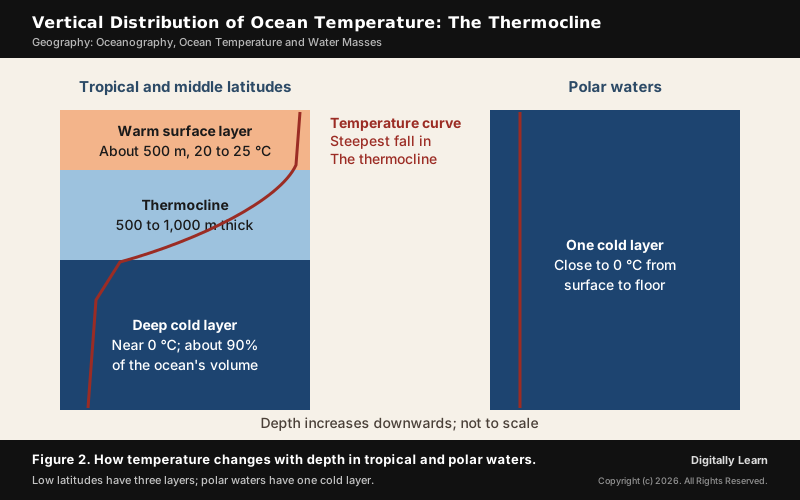
Sea surface temperature is the temperature of the ocean's top layer; it averages about 27 °C and falls by roughly 0.5 °C for each degree of latitude towards the poles. Below a warm surface layer about 500 m thick, temperature falls fast through the thermocline, and about 90 per cent of the ocean lies below it, near 0 °C. Water that forms at the surface sinks as water masses with their own temperature and salinity, identified on a T-S diagram and separated by ocean fronts.
Temperature of Ocean Water: Sea Surface Temperature and Its Distribution
Sea Surface Temperature: Meaning and Horizontal Distribution
Sea surface temperature is the temperature of the ocean water close to the surface, usually measured somewhere between 1 millimetre and 20 metres below it. The ocean is heated by the sun just as land is, but it heats and cools more slowly. Even so, the surface changes through the day: on calm days it can vary by 6 °C, and on breezy days by less, because the wind mixes the water.
Across the globe the surface temperature follows latitude. The average surface temperature of the oceans is about 27 °C, and it falls gradually from the equator towards the poles, generally by about 0.5 °C for each degree of latitude. It is about 22 °C at 20° latitude, 14 °C at 40° and close to 0 °C near the poles. The highest temperatures are found not at the equator but slightly to the north of it.
The two hemispheres also differ. The oceans of the northern hemisphere average about 19 °C a year and those of the southern hemisphere about 16 °C, because the northern oceans are in contact with a much larger extent of land, which passes more heat to them. Enclosed seas follow their latitude even more strongly than the open sea: in the low latitudes they are warmer than the open sea, and in the high latitudes colder.
Factors Affecting the Temperature of Ocean Water
The temperature of ocean water at any place depends on how much heat it receives and on what moves heat in or out. Four factors explain most of the pattern on a map of sea surface temperature.
- Latitude: Insolation decreases towards the poles, so surface water grows colder away from the equator.
- Distribution of land and water: The oceans of the northern hemisphere receive more heat because they touch a larger extent of land than those of the southern hemisphere.
- Prevailing winds: Winds blowing from the land towards the sea drive warm surface water away from the coast, and cold water wells up from below in its place; onshore winds pile warm water against the coast and raise its temperature.
- Ocean currents: Warm currents raise the temperature of cold regions and cold currents lower it in warm ones. The Gulf Stream warms the eastern coast of North America and the west coast of Europe, while the cold Labrador Current lowers the temperature near the north-east coast of North America.
The third factor explains why sea surface temperature varies along the same parallel and not only with latitude. Where offshore winds drive surface water away, the cold, dense water that rises from below keeps the surface cool, and the nutrients it brings support some of the world's most productive fisheries. Upwelling is taken up again in the section on fronts and convergence zones.
Vertical Distribution of Temperature: Mixed Layer and Thermocline
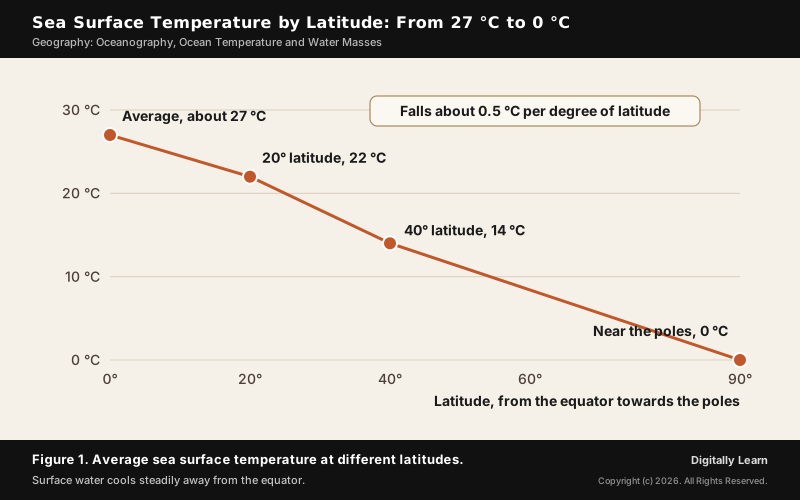
Temperature in the ocean is highest at the surface, because the surface receives the sun's heat directly, and it decreases with depth. The fall is not uniform: the temperature drops very rapidly down to about 200 metres and much more slowly below that. Over the low and middle latitudes, the ocean can be described as three layers from the surface to the floor.
- The warm surface layer: About 500 metres thick, with temperatures between 20 °C and 25 °C. In the tropics it is present throughout the year; in the middle latitudes it develops only in summer. Its upper part is the mixed layer, in which waves and turbulence keep the temperature nearly uniform, often in the upper 100 metres.
- The thermocline: A boundary layer that usually begins about 100 to 400 metres below the surface and is 500 to 1,000 metres thick, in which temperature falls rapidly with depth.
- The deep layer: Very cold water extending to the ocean floor. About 90 per cent of the ocean’s volume lies here, below the thermocline, where temperatures approach 0 °C.
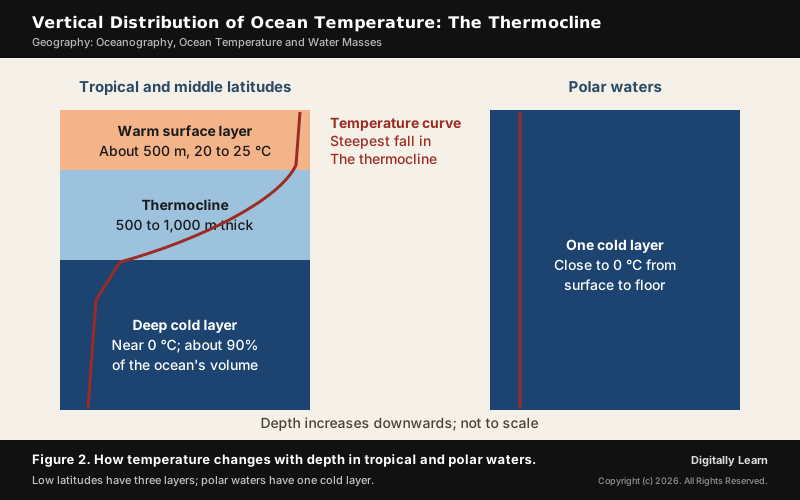
The thermocline is therefore the layer of rapid temperature change that separates the warm, mixed surface water from the calm, cold deep water. It is semi-permanent in the tropics, varies with the season in temperate waters, and is shallow or absent in the polar regions, where the water is cold from the surface to the bottom and only one layer exists. Because the sudden change in density reflects sound, the thermocline matters in submarine warfare: it can bend or reflect sonar signals. The layer in which salinity changes sharply, the halocline, and the deep circulation that both layers shape are explained in thermohaline circulation.
Sea Surface Temperature Rise and Tropical Cyclones
Sea Surface Temperature Rise: How Much the Ocean Has Warmed
Sea surface temperature rise is the long-term warming of the ocean's surface caused by global warming. Global mean sea surface temperature very likely rose by 0.88 °C between 1850-1900 and 2011-2020, and most of that, 0.60 °C, came between 1980 and 2020. The land warms faster than the ocean, but the ocean takes in far more of the heat: it absorbs about 90 per cent of the excess heat that greenhouse gases trap.
That heat does not stay at the surface. Between 1971 and 2018 the rising heat content of the ocean accounted for over 90 per cent of the Earth's excess energy from global warming, and the warming that began in the upper 700 metres has spread to intermediate depths. It is measured largely by a network of nearly 4,000 Argo robotic floats, deployed since 2000, which record temperature and salinity at many depths.
How Sea Surface Temperature Affects the Formation of Tropical Cyclones
Tropical cyclones form only over warm water, and sea surface temperature is the first condition they need. The ocean must be at least 26.5 °C through a depth of about 50 metres. This warm layer supplies the heat and moisture that keep the storm's warm core going: water evaporates from the warm sea, the moist air rises and cools, and the heat released when the vapour condenses into cloud and rain powers the storm.
- More fuel: A warmer surface releases more water vapour and heat, so a cyclone over warm water can grow stronger.
- Depth of warm water: A cyclone stirs up the upper ocean and leaves a cool wake behind it, mixing the top 30 metres or so. If the warm layer is shallow, cooler water rises and weakens the storm; a deep warm layer keeps feeding it. That is why the heat content of the upper ocean, not the surface temperature alone, has been suggested as a better guide to a cyclone’s intensity in the Indian Ocean. Forecasters treat the depth of warm water above the thermocline as the size of the storm’s fuel tank.
- Over cooler water: A cyclone that moves over water much cooler than 26.5 °C loses its warm core and decays into a remnant low.
Sea surface temperature also shapes weather far beyond cyclones. It modifies the air masses that pass over it, influences sea breezes and sea fog along coasts, and, in the Indian Ocean, the heat stored in the upper ocean of the south-west during January to March has been found to predict whether the monsoon will be above or below average better than surface temperature does.
Water Masses of the Ocean: Formation and Identification
What Is a Water Mass: Origin, Properties and Depth
A water mass is an identifiable body of ocean water with a common formation history and physical properties distinct from the water around it. Its temperature and salinity are set at the surface, where it forms, by the local balance of heating, cooling, evaporation, rain and ice. Once it sinks away from the surface it keeps those properties for a long time, because nothing below adds or removes heat or fresh water except slow mixing with its neighbours.
Water masses are recognised by tracers. Temperature and salinity are conservative tracers, which change only by mixing; dissolved oxygen, silicate, nitrate and phosphate are non-conservative ones, which change as living things use or release them. Water masses are also classed by their vertical position, into surface, intermediate and deep water masses, because each settles at the depth where its density matches the water around it.
Density is what sorts them. Cold water is denser than warm water, and salty water denser than fresh water, so a water mass that forms cold and salty sinks deep, while one that is cold but fresher stops at an intermediate depth. Sea water freezes at about −2 °C, and when sea ice forms, the salt is left in the water beneath, making it colder, saltier and heavier: this is how the densest water of the world ocean is made.
T-S Diagram: How Oceanographers Identify Water Masses
The standard tool for identifying a water mass is the T-S diagram, a graph of temperature against salinity. Instead of plotting each property against depth, it plots potential temperature on the vertical axis and salinity on the horizontal axis, so that each sample of water becomes a single point. Curved lines of equal density, called isopycnals, run across the diagram, because temperature and salinity together decide how dense sea water is.
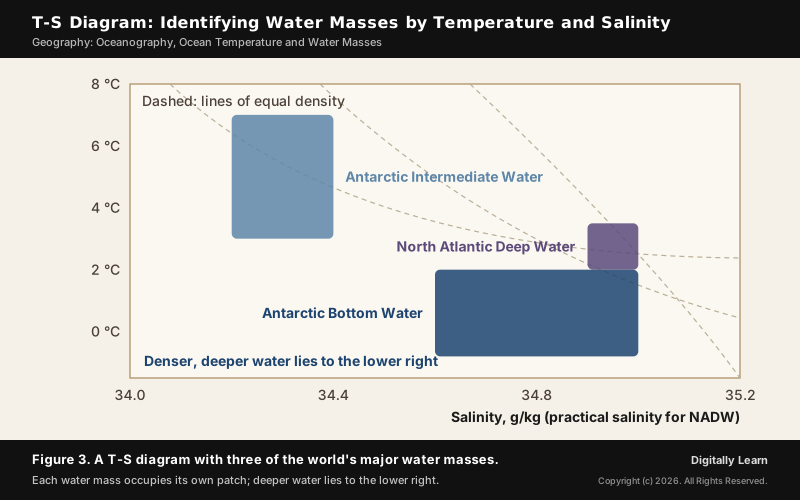
Because a deep water mass keeps its temperature and salinity once it leaves the surface, its samples cluster in one part of the diagram wherever they are collected, and they can be traced back to where the water formed. In general, deeper water lies towards the lower right of the diagram, where salinity is high and temperature low. The same tool tracks changes: regions of unusual sea surface salinity in the North Atlantic have been followed across the ocean in recent decades, affecting local ecosystems and the sinking of water masses.
Major Water Masses: Antarctic Bottom Water, North Atlantic Deep Water and Intermediate Waters
A few water masses fill most of the deep ocean, and each is made in a particular place by a particular process. Learning where and how they form explains how the deep ocean is layered.
| Water mass | Where it forms | Temperature and salinity | Depth it occupies |
|---|---|---|---|
| Antarctic Bottom Water | Weddell and Ross Seas, off the Adélie Coast and by Cape Darnley | −0.8 to 2 °C; 34.6 to 35.0 g/kg | Below 4,000 m in basins open to the Southern Ocean |
| North Atlantic Deep Water | The North Atlantic, where salty surface water cools and sinks | 2.0 to 3.5 °C; 34.9 to 35.0 | 1,500 to 4,000 m |
| Antarctic Intermediate Water | The Antarctic Convergence zone, between 50° S and 60° S | 3 to 7 °C; 34.2 to 34.4 when formed | 700 to 1,200 m |
- Antarctic Bottom Water: The densest water mass of the oceans. It forms near the surface in coastal polynyas, openings in the sea ice, where winter ice formation leaves salt in the water beneath; cold winds off the continent push the ice away and keep the polynyas open. Because it forms at the surface it carries oxygen down, ventilating the deep ocean.
- North Atlantic Deep Water: Warm surface water flowing north gains salt through evaporation, then cools in the North Atlantic and sinks. It is traced by its high salinity and oxygen, and its sinking pulls the North Atlantic Drift northward, forming part of the Atlantic overturning circulation.
- Antarctic Intermediate Water: Unusual because it sinks while relatively fresh. It forms at the Antarctic Convergence and spreads north at intermediate depths, recognisable by its salinity minimum.
- Mediterranean outflow: Salty water leaving the Mediterranean at Gibraltar mixes strongly as it passes the strait and then spreads into the Atlantic at depth.
Together these explain the layering of an ocean basin: warm surface water on top, intermediate water below it, North Atlantic Deep Water lower still, and Antarctic Bottom Water on the floor. The salty Mediterranean outflow and its two-layer exchange at Gibraltar are described in highest salinity sea in the world.
Mixing in the Ocean: Salt Fingering and Double Diffusion
Salt Fingering and Thermohaline Staircases
Water masses do not stay separate for ever; they mix, and one of the ways they mix depends on salinity directly. Salt fingering happens where relatively warm, salty water lies over colder, fresher water. Heat passes through water more readily than salt does. So a small parcel of warm, salty water that sinks into the cold layer loses its heat before it loses its salt, becomes denser than the water around it, and keeps sinking; a parcel of cold, fresh water pushed upwards gains heat, becomes lighter and keeps rising.
The result is a pattern of thin, finger-like columns that carry salt downwards. Salt fingering is one example of double diffusion, mixing driven by the different rates at which heat and salt spread. It can build thermohaline staircases, stacks of well-mixed layers a few metres thick that extend for hundreds of kilometres, as in the Caribbean Sea. The process was first described mathematically by Melvin Stern in 1960.
Ocean Fronts and Convergence Zones
Ocean Fronts, the Antarctic Convergence and Upwelling: Why They Are Productive
Where two water masses meet, the boundary between them is an ocean front. On either side of a front the water differs in temperature, salinity or density, and often in its life. Fronts can be as narrow as a few hundred metres or as wide as several tens of kilometres; most form and fade quickly, but some persist for long periods.
The older definition, drawn from research cruises, treated fronts as fixed lines between water masses: in the Southern Ocean it identified five continuous fronts circling Antarctica. Satellites now measure the height of the sea surface continuously, which reveals the strong currents that run along fronts. Seen this way, the Southern Ocean's fronts are not continuous rings, and their positions shift with events such as El Niño.
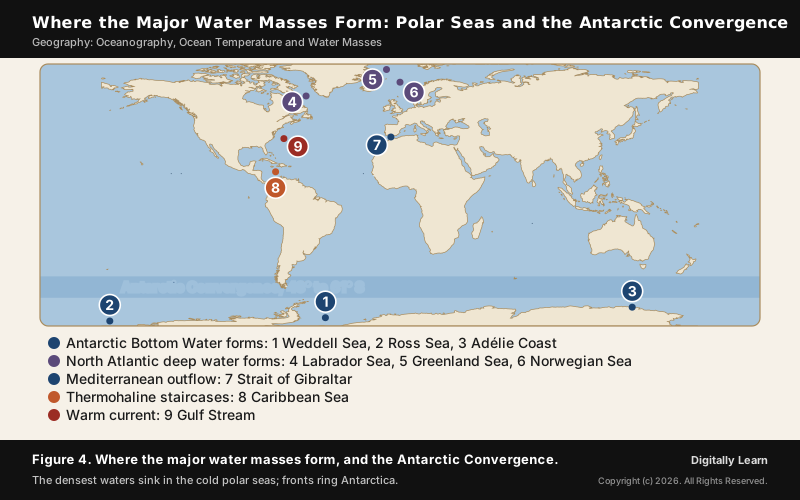
The best-known front is the Antarctic Convergence, also called the Antarctic Polar Front, a belt encircling Antarctica where cold Antarctic water flowing north meets the warmer sub-Antarctic water. It is about 37 to 55 km wide and lies between about 48° S and 61° S, shifting with the season and with longitude. The cold Antarctic water sinks beneath the warmer water, and the mixing and upwelling along the line make it very rich in marine life, especially Antarctic krill. It also divides two regions of distinct climate and life.
Upwelling explains why such zones are so productive. In upwelling, winds move dense, cooler and usually nutrient-rich water from the deep towards the surface, replacing warm surface water that has been stripped of nutrients. The deep water is rich in nitrate, phosphate and silicic acid, released by the decay of dead plankton that sank from above. Brought into the light, these nutrients feed phytoplankton, and through them the whole food chain.
- Small area, large catch: About a quarter of the world’s marine fish catch comes from five upwelling regions that cover only 5 per cent of the ocean.
- Easy to recognise: Upwelling zones show up on satellite images as cool sea surface temperatures and high concentrations of chlorophyll.
- Mixing of currents: Where warm and cold currents meet, the mixing replenishes oxygen and favours the growth of plankton, the primary food of fish; the best fishing grounds of the world lie mainly in these mixing zones.
Ocean Currents and Water Masses: Impacts on Marine Life and Coastal Environment
How Ocean Currents and Water Masses Differ in Their Impacts
Ocean currents and water masses are related but not the same. A current is water in motion along a path, and its effects are felt mainly at the surface and along coasts. A water mass is a body of water defined by its properties, and its effects are felt mainly at depth, where it carries the temperature, salinity and oxygen of its birthplace across whole basins. Their impacts on life and on coasts differ accordingly.
| Point of comparison | Ocean currents | Water masses |
|---|---|---|
| What they are | Horizontal movement of water along set paths | Bodies of water with their own temperature, salinity and tracers |
| Climate of coasts | West coasts in tropical and subtropical latitudes beside cold currents are cool, foggy and arid; west coasts of higher latitudes beside warm currents have mild winters and cool summers | Little direct effect on coastal air; their influence is felt through the layering of the sea |
| Marine life | Where warm and cold currents mix, oxygen is replenished and plankton thrive, making rich fishing grounds | Deep water masses such as Antarctic Bottom Water carry oxygen into the deep ocean; fronts between water masses are productive |
| Examples | Gulf Stream warming western Europe; Labrador Current cooling north-east North America | Antarctic Bottom Water on the ocean floor; North Atlantic Deep Water at 1,500 to 4,000 m |
The two meet at fronts and upwelling zones. A current can bring two water masses together, and where it drives surface water away from a coast, it draws up deep, nutrient-rich water from below. That is why the most productive seas lie where currents and water masses interact, and why both shape the fisheries and climate of the coasts beside them. India's own seas, where the monsoon reverses the currents, are described in salinity of the Indian Ocean.
Previous Year UPSC-CSE Questions
Previous Year UPSC-CSE Questions By the end you will be able to draft model answers for the following UPSC questions. Each question carries a collapsible framework showing how to approach it in the exam.
- UPSC Mains 2024 GS-IWhat is sea surface temperature rise? How does it affect the formation of tropical cyclones?
Answer outline: how to structure the answer
What the question asks, the main arguments, relevant examples and the direction of the conclusion. This is not a full model answer.
Introduction: Define sea surface temperature as the temperature of the top layer of the ocean, and its rise as the warming of about 0.88 °C since 1850-1900, most of it after 1980, as the ocean absorbs about 90 per cent of the excess heat of global warming.
Body (sub-themes to develop):
- Threshold: tropical cyclones need water of at least 26.5 °C through about 50 m.
- Mechanism: evaporation from warm water, rising moist air, heat released on condensation powers the warm core.
- Rising SST: more heat and moisture, so storms can grow stronger; over cooler water they lose the warm core.
- Depth: cyclones mix the top 30 m and leave a cool wake; a deep warm layer (high ocean heat content) keeps feeding them, which is why heat content is a better guide to intensity in the Indian Ocean.
Conclusion: Conclude that a warming ocean supplies more energy to cyclones, so forecasting must watch the heat stored in the upper ocean, not only the surface.
- UPSC Mains 2019 GS-IHow do ocean currents and water masses differ in their impacts on marine life and coastal environment? Give suitable examples.
Answer outline: how to structure the answer
What the question asks, the main arguments, relevant examples and the direction of the conclusion. This is not a full model answer.
Introduction: Distinguish a current, water moving along a set path, from a water mass, a body of water with its own temperature, salinity and tracers set where it formed.
Body (sub-themes to develop):
- Currents and coasts: cold currents and cool, foggy, arid west coasts in tropical latitudes; warm currents and mild marine climates in higher latitudes; Gulf Stream and western Europe, Labrador Current and north-east North America.
- Currents and marine life: mixing of warm and cold currents replenishes oxygen and plankton, making the richest fishing grounds; coastal upwelling brings nutrients.
- Water masses and marine life: Antarctic Bottom Water carries oxygen to the deep ocean; fronts such as the Antarctic Convergence are rich in krill.
- Water masses and the coast: they act mainly through the layering of the sea; where currents draw deep water up, they bring nutrient-rich water to the surface.
Conclusion: Conclude that currents act mostly at the surface and along coasts, water masses mostly at depth, and the most productive seas lie where the two interact.
- UPSC Prelims 2011 Prelims-GSIn the context of ecosystem productivity, marine upwelling zones are important as they increase the marine productivity by bringing the
- Decomposer microorganisms to the surface,
- Nutrients to the surface,
- Bottom-dwelling organisms to the surface.
Which of the statements given above is/are correct?
How to approach this Prelims question
Approach: Step 1: upwelling moves deep water to the surface. Step 2: deep water is rich in nutrients released by decaying plankton, and those nutrients feed phytoplankton, so statement 2 is correct. Step 3: it is the nutrients, not decomposers or bottom-dwelling organisms, that raise productivity, so statements 1 and 3 are not the reason. Step 4: 2 only.
Trap to watch: Decomposers do make the nutrients in the deep, which makes statement 1 sound right, but what upwelling brings up is the nutrients themselves.
Key facts to recall:
- (a) 1 and 2: wrong. Statement 1 is not why upwelling raises productivity; the nutrients are.
- (b) 2 only: right. Upwelled water carries nutrients that feed phytoplankton.
- (c) 2 and 3: wrong. Bottom-dwelling organisms are not brought to the surface by upwelling.
- (d) 3 only: wrong. It misses the nutrients, which are the real cause.
Answer signal: 2 only: option (b), the official answer, because upwelling raises productivity by bringing nutrients to the surface.
Sources
- NCERT: Fundamentals of Physical Geography (Class XI), Chapter 12, Water (Oceans)
- NCERT: Fundamentals of Physical Geography (Class XI), Chapter 13, Movements of Ocean Water
- Wikipedia: Sea surface temperature
- Wikipedia: Thermocline
- Wikipedia: Mixed layer
- Wikipedia: Ocean heat content
- Wikipedia: Tropical cyclone
- Wikipedia: Water mass
- Wikipedia: Temperature–salinity diagram
- Wikipedia: Antarctic bottom water
- Wikipedia: North Atlantic Deep Water
- Wikipedia: Antarctic Intermediate Water
- Wikipedia: Mediterranean outflow
- Wikipedia: Salt fingering
- Wikipedia: Front (oceanography)
- Wikipedia: Antarctic Convergence
- Wikipedia: Upwelling
- Venugopal and others (2018), Scientific Reports (NOAA repository): southwestern Indian Ocean heat content and the Indian summer monsoon
- IMD RSMC New Delhi: Frequently Asked Questions on Tropical Cyclones
- NOAA National Ocean Service: What is a thermocline?
- The Hindu (Delhi), 20 April 2026: How is global warming affecting the sea-land breeze?
- UPSC: Civil Services Examination question papers
Editorial Disclaimer
This article draws on the NCERT textbooks and the other sources listed on this page.