


Overview
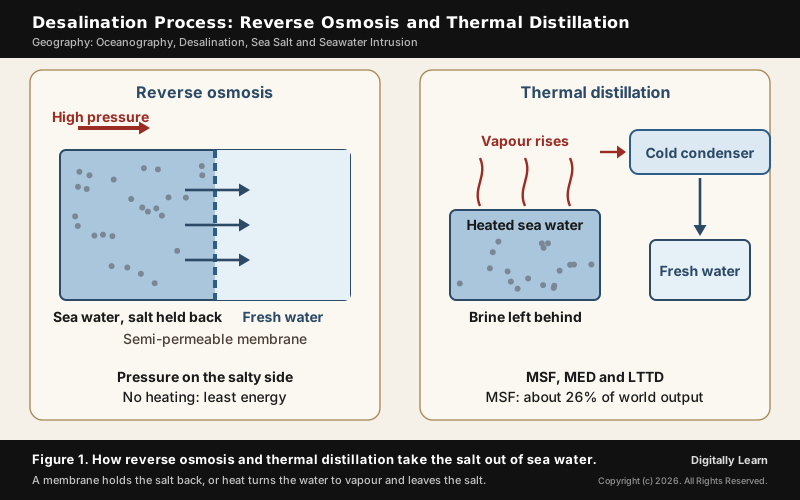
Desalination is the removal of dissolved salts from sea water to make fresh water, by reverse osmosis through a membrane or by distillation; about 95 million cubic metres a day are made worldwide. In India, Chennai relies on large reverse osmosis plants and Lakshadweep on low temperature thermal desalination. The salt of the sea also gives India 80 per cent of its salt, returns as brine from desalination plants, and creeps into coastal aquifers as seawater intrusion.
Desalination: Meaning, Methods and Why Salinity Makes It Necessary
What Is Desalination: Turning Seawater into Fresh Water
Desalination is the artificial process of converting salt water, usually sea water, into fresh water, and it always leaves a concentrated salty by-product called brine. The need for it comes straight from the salinity of the ocean, the amount of salt in grams dissolved in 1,000 grams of sea water. Its average is about 35 parts per thousand, far too much to drink or to irrigate with, so a coast can stand beside an ocean and still run short of water. The amount of salt in sea water and its variation from sea to sea are explained in highest salinity sea in the world.
Desalination matters because, with recycled waste water, it is one of the few sources of water that does not depend on rainfall. That is why cities that face failed monsoons or have no river of their own turn to it. Its scale has grown fast: by 2020 the world had over 16,800 operating plants with a capacity of roughly 97 million cubic metres a day, and contracted projects would push that beyond 114 million.
The price is energy. Pulling salt out of water takes work, so desalinated sea water generally costs more than water from rivers, groundwater, recycling or conservation. The energy needed has fallen sharply, from 20 to 30 kilowatt-hours per cubic metre in 1970 to about 3 in 2018, a tenfold improvement, yet in 2016 desalination still used about a quarter of all the energy consumed by the water sector.
Desalination Process: Reverse Osmosis, Multi-Stage Flash and Multi-Effect Distillation
All desalination works in one of two ways: it separates the water from the salt with a membrane, or it turns the water into vapour and condenses it, leaving the salt behind. The membrane method depends on osmosis. In osmosis, water moves on its own through a semi-permeable membrane from the side with less dissolved salt to the side with more, tending to equalise the two.
A desalination plant pushes the water the other way by reverse osmosis. High pressure is applied to the salty side, greater than the osmotic pressure, so that water molecules are forced through the membrane while the salt is held back on the pressurised side. The purified water collects on the far side. Because it needs no heating, reverse osmosis uses far less energy than distillation, and almost all new desalination plants now use it; as of 2013 the largest, at Sorek in Israel, produced 624 thousand cubic metres a day.
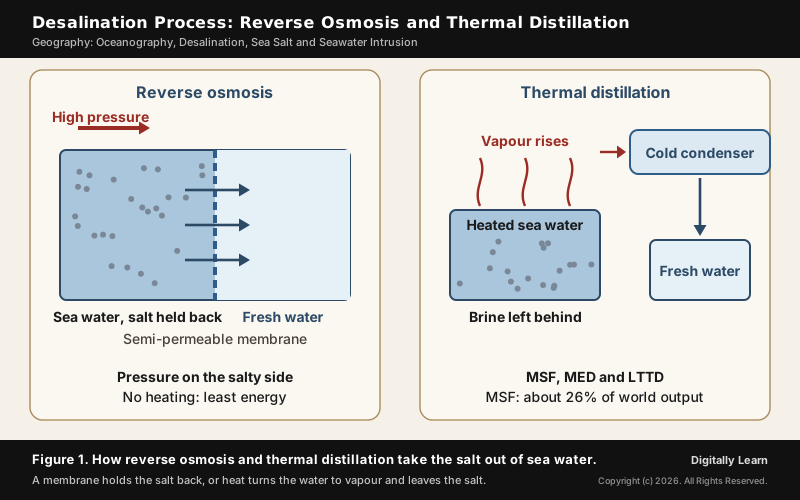
- Multi-stage flash distillation (MSF): Heated sea water flows through a series of chambers, up to 30 stages, each at a lower pressure, so part of it flashes into steam in every stage; the steam is condensed into fresh water. MSF plants produce about 26 per cent of the world’s desalinated water.
- Multi-effect distillation (MED): Sea water is sprayed on tubes heated by steam; the vapour it gives off heats the next stage, so each stage reuses the energy of the one before, at a lower temperature and pressure.
- Low temperature thermal desalination (LTTD): A vacuum lets warm sea water evaporate at its own temperature, and cold deep sea water condenses the vapour; it needs no fuel to heat the water.
Low Temperature Thermal Desalination: Kavaratti and the Lakshadweep Plants
The method used in Lakshadweep, low temperature thermal desalination (LTTD), uses a simple fact: water boils at a lower temperature when the pressure is low. Vacuum pumps lower the pressure in a chamber until warm surface sea water evaporates at its own temperature. Cold water pumped up from the deep sea, from depths of as much as 600 metres, runs through coils and condenses the vapour, and that condensate is the fresh water. In principle the water evaporates with a temperature difference of as little as 8 °C between the two waters; a working plant needs more.
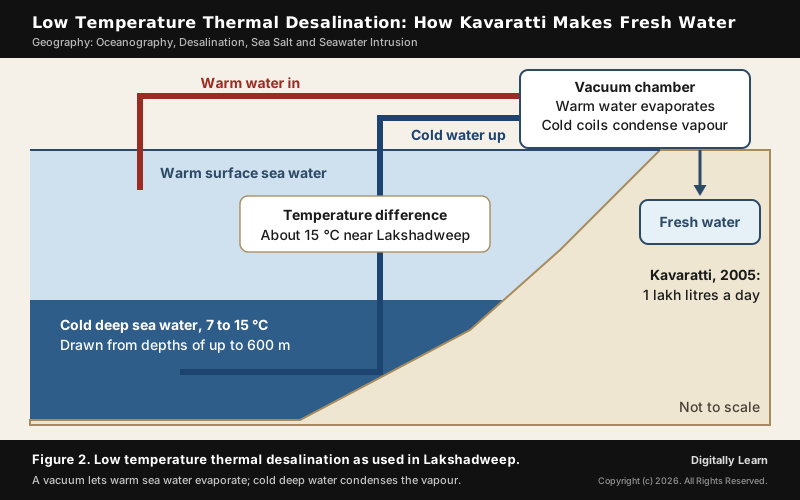
India's National Institute of Ocean Technology (NIOT), an autonomous institute of the Ministry of Earth Sciences, studied LTTD from 2004 and opened its first plant in 2005 at Kavaratti in Lakshadweep. That plant makes 1 lakh litres of drinking water a day, using deep sea water at 7 to 15 °C, at a capital cost of about ₹5 crore. Agatti and Minicoy followed, each also at 1 lakh litres a day. NIOT then tried the idea at a larger scale and in a new setting:
- 2007: An experimental floating plant off the coast of Chennai, with a capacity of 10 lakh litres a day.
- 2009: A smaller plant at the North Chennai Thermal Power Station, using the power plant’s warm cooling water instead of warm surface sea water.
- Next phase: Six more plants of 1.5 lakh litres a day each at Amini, Androth, Chetlat, Kadmat, Kalpeni and Kiltan, entrusted by the Ministry of Home Affairs through the Lakshadweep administration, at a total cost of ₹187.75 crore.
LTTD suits Lakshadweep for a reason of geography. The plants need a temperature difference of about 15 °C between surface sea water and deep sea water close to the shore, and in 2022 the Ministry of Earth Sciences reported that such a difference is found, as of now, only in the vicinity of the Lakshadweep coasts. That is why the LTTD plants that supply drinking water are on the islands, while Chennai's large plants use reverse osmosis.
Desalination Plants in India and the Limits of Desalination
Desalination Plants in India: Minjur, Nemmeli and Perur in Chennai
Chennai is India's clearest case for desalination. The city has no perennial river to draw on; its reservoirs fill mainly from the north-east monsoon, and whenever that monsoon fails the city runs short of water. As a drought-proofing measure the government invested in desalination plants on the Bay of Bengal coast; the newer ones are seawater reverse osmosis (SWRO) plants.
| Plant | Capacity | Status | Areas served |
|---|---|---|---|
| Minjur, north of Chennai | 100 MLD | Inaugurated 31 July 2010; built on a Design, Build, Own, Operate and Transfer basis | Northern Chennai: Manali, Ennore, Tiruvottiyur and nearby areas, about 12 lakh people |
| Nemmeli, East Coast Road | 110 MLD | Operational since 2013; ₹805.08 crore with full central assistance | Southern Chennai: Sholinganallur, Neelangarai and nearby areas |
| Nemmeli (second plant) | 150 MLD | On the same Nemmeli site; funded by KfW of Germany and AMRUT | The expanded city |
| Perur, near Nemmeli | 400 MLD | Planned; the largest of the four | Tambaram, Pallavaram and the southern suburbs, about 22.67 lakh people |
The figures show how much a city can come to lean on the sea: a single 400 MLD plant is meant to supply more than twenty lakh people. Desalination is also spreading beyond city water supply. Gujarat's 2026 policy for data centres, for example, offers financial assistance for captive desalination plants to meet the sector's high demand for water.
Costs and Limits of Desalination: Energy, Price and Security
Desalination solves a water problem by creating an energy problem. Even at about 3 kilowatt-hours per cubic metre, a large plant needs a steady supply of power, and where that power comes from coal or gas, every litre of fresh water adds to carbon emissions. That is why desalinated water generally costs more than fresh water from rivers or aquifers, and why it is chosen only where those cheaper sources are absent or exhausted.
- Energy and carbon: The main running cost; plants are increasingly paired with solar and wind power, and LTTD avoids fuel altogether by using the ocean’s own temperature difference.
- Cost of the water: More expensive than surface water, groundwater, recycling or conservation, so it is a supplement and a drought reserve rather than a first choice.
- Brine: Every plant returns a salty waste stream to the sea, the subject of the next section.
- Concentration of risk: A city or country that draws most of its drinking water from a few plants depends on their safety.
Brine Discharge: The Environmental Cost of Desalination
Brine Discharge and Its Effects on Marine Life
Every desalination plant splits sea water into two streams: fresh water for people and a concentrated brine that carries all the salt that was removed. Desalination plants worldwide discharge around 142 million cubic metres of brine a day, more than the volume of fresh water they produce, and from coastal plants it is returned to the sea.
The harm comes from three properties of that brine. It is saltier than the sea, so it is denser, and it sinks to the sea floor and spreads along it instead of mixing, raising the salinity around the outfall above what bottom-dwelling plants and animals can bear. It is often warmer than the sea. And it carries residues of the chemicals used to clean the membranes and stop scaling and fouling, with heavy metals from corrosion, especially in thermal plants.
- Dilution: Mixing the brine with another outflow, such as a power plant’s cooling water or a treated waste-water outfall, before it enters the sea lowers its salinity.
- Dispersal: Spreading the discharge and siting outfalls where currents carry it away keeps the brine from pooling in one place; some plants are even mounted on ships so that the brine never builds up at a single spot.
- Reuse: Brine can be a resource; its high salt content gives a steeper salt gradient than sea water, and a company in Denmark is building a commercial osmotic power plant that runs on high-salinity brine.
Sea Salt and Minerals: Salt Production in India
Salt Production in India: Gujarat, Rajasthan and Tamil Nadu
India is the third-largest producer of common salt in the world, after China and the United States, with about 266 lakh tonnes produced in 2021-22. Most of it is sea salt: salt is made mainly by the solar evaporation of sea water, and sea salt makes up about 80 per cent of the country's output. The rest comes from inland brines, such as the subsoil brine of the Little Rann of Kutch and the salt lakes of Rajasthan.
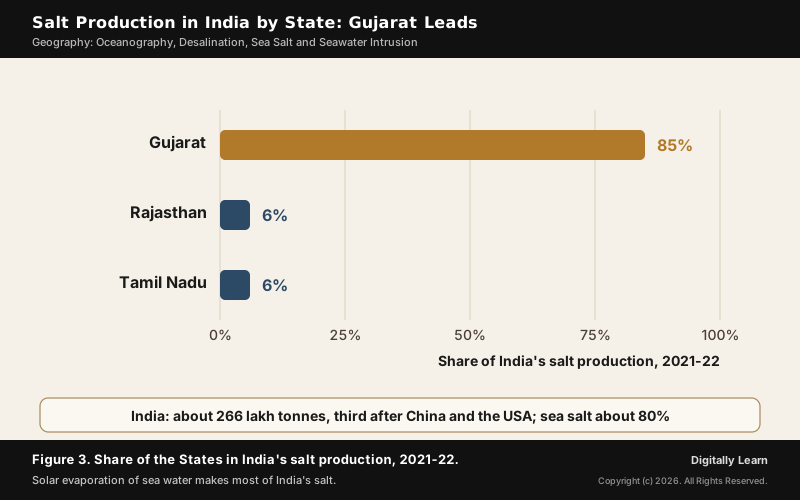
Gujarat dominates, with 85 per cent of the output, followed by Rajasthan and Tamil Nadu with about 6 per cent each. Because salt is made by the sun, weather decides the harvest, and Gujarat's dry coast and the flats of the Rann suit it. Private producers made 97.12 per cent of the salt in 2021-22. India achieved self-sufficiency in salt in 1953, after meeting its shortfall through imports at the time of Independence, and now exports it, mainly to China, the Republic of Korea, Japan and Qatar.
- A Union subject: Salt is Item 58 of the Union List in the Seventh Schedule of the Constitution, so the Central Government controls its manufacture, supply and distribution.
- The regulator: The Salt Commissioner’s Organisation in Jaipur, an attached office of the Department for Promotion of Industry and Internal Trade, monitors production, quality, prices and supply.
- Annual requirement: About 63 lakh tonnes a year for eating, including for cattle, and 118 lakh tonnes for industry; consumption is about 14 kg a person a year, counting edible and industrial salt.
- Rock salt: Scanty in India; the only resources, about 12.78 million tonnes, lie at Mandi in Himachal Pradesh.
Sea water holds more than common salt. Magnesium is the second most abundant cation in it, about one-eighth of the mass of the sodium ions, which makes sea water and sea salt commercial sources of the metal. Adding lime precipitates magnesium hydroxide, which is turned into magnesium chloride and then into the metal by electrolysis. Bromine makes up about 65 parts per million of sea water, far more than in rocks, because the oceans have gathered it by long leaching; Israel and Jordan are its main producers.
In India these minerals come mostly from the salt works themselves: the salt industry recovers gypsum, bromine, magnesium chloride, magnesium sulphate, ammonium bicarbonate, soda ash, caustic soda and sodium bicarbonate as by-products of making salt.
Solar Salt Pans: From the Rann of Kutch to Ongole
A salt pan is a shallow, wide pond in which sea water or brine is left for the sun to evaporate until the salt crystallises and can be raked up. The pans are separated by low banks called levees. The water's colour changes with its salinity, because different algae and microbes thrive at each stage, from green through orange to deep red. The salt pans also give waterbirds a place to feed and rest, though building them can destroy mangroves and mudflats.
Salt-making on the Indian coast is very old. The Harappan site of Padri on the Saurashtra coast is interpreted as a centre that specialised in sea-salt production in about 2200 to 2000 BCE. Today the work follows the seasons. In the Little Rann of Kutch, the monsoon fills the ground with salt water; after it recedes in October, workers pump the brine into the fields and let the sun do the rest, producing most of India's inland salt over six to seven hard months.
Seawater Intrusion in the Coastal Aquifers of India
Seawater Intrusion: Meaning and the Ghyben-Herzberg Relation
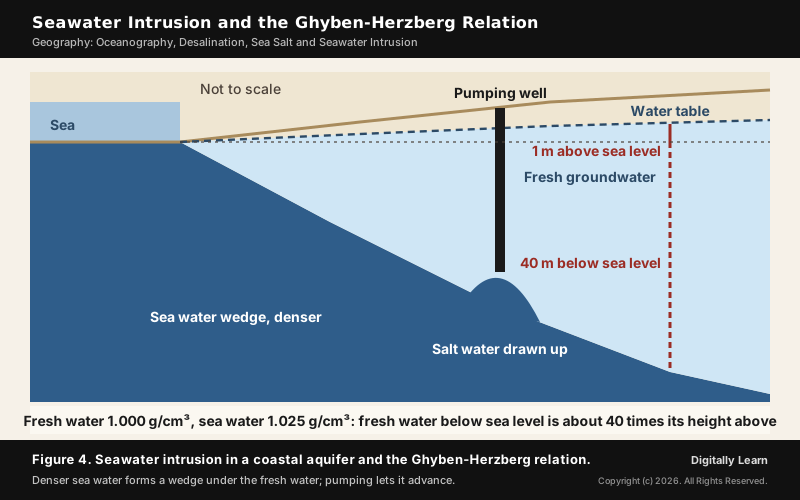
Along many coasts the groundwater is turning salty through seawater intrusion, also called saltwater intrusion or salinity ingress. It is the movement of saline water into the fresh groundwater of coastal aquifers. It happens because sea water, with its dissolved salts, is denser than fresh water. Along the coast, fresh groundwater flowing towards the sea meets saline groundwater pushing in from the ocean, and the denser salt water slides inland beneath the fresh water as a wedge, with a zone of mixing between the two.
Normally the wedge stays near the coast, because the fresh water stands higher inland and its weight holds the salt water back. The Ghyben-Herzberg relation puts a number on that balance. Fresh water has a density of about 1.000 grams per cubic centimetre and sea water about 1.025, so for every metre that fresh groundwater stands above sea level, the fresh water extends about forty metres below sea level.
Causes of Seawater Intrusion in India: Over-Pumping, Tides and Sea-Level Rise
Seawater intrusion in India has both natural and human causes, and the human ones have made it spread. The main cause is the over-extraction of groundwater: when coastal wells draw water faster than rain can replace it, the fresh water table falls, its pressure drops, and the denser sea water moves inland. A well that sits over the salt wedge can also pull salt water up from below, a process called upconing.
- Over-pumping: Wells for irrigation, towns and industry lower the water table; in the Vasai-Virar area near Mumbai, excessive groundwater use for irrigation is the main cause of the ingress observed.
- A seasonal reverse gradient: On the Gujarat coast the water table falls before the monsoon, and near the shore the slope of the water table reverses, so sea water flows landward; after the monsoon the gradient turns back and fresh groundwater discharges into the Arabian Sea.
- Tidal ingress: High tides flood low-lying marshy land, and the salt water seeps down into the upper aquifers; creeks carry it inland.
- Canals and channels: Navigation, drainage and agricultural channels give salt water a path inland, and drainage lowers the fresh water table.
- Salt pans: Brine from salt pans and the canals that feed them adds salt to nearby groundwater.
- Sea-level rise and storm surges: A higher sea pushes the wedge further inland, and cyclone surges flood the coast with sea water.
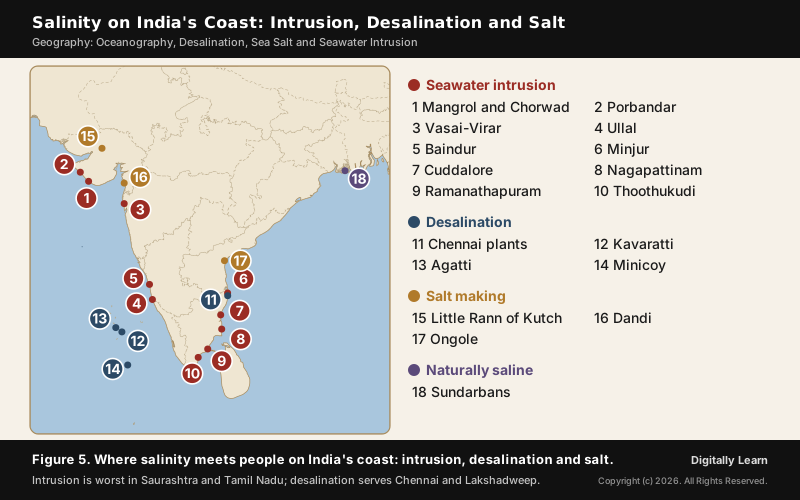
The problem is most conspicuous in Gujarat and Tamil Nadu. The Central Ground Water Board has found salinity ingress along the Mangrol, Chorwad and Porbandar belt of the Saurashtra coast. In Tamil Nadu the affected areas include Minjur north of Chennai, the Tiruvanmiyur to Kovalam tract, the Cuddalore coast and the districts of Ramanathapuram, Nagapattinam, Thanjavur, Tiruvarur and Thoothukudi. At Minjur the interface between fresh and salt water lay about 3.5 km inland in 1972; by 2022 it had moved about 15 km inland. Elsewhere the problem is local: isolated pockets in Maharashtra, Ullal and Baindur on the Karnataka coast, seasonal tidal ingress in Kerala, and naturally saline groundwater in coastal Odisha and the Sundarbans.
Remedial Measures for Seawater Intrusion: Recharge, Barriers and Regulation
Because the cause is a falling fresh water table, the remedies aim to raise it again, to block the paths salt water takes, and to control pumping. Water is a State subject in India, so the States carry most of this work, while the Centre supports conservation, rainwater harvesting and monitoring through the Central Ground Water Board; the National Water Policy, 2012 calls for interventions to tackle salinity.
- Artificial recharge: Rainwater harvesting and other recharge works put water back into the aquifer and raise the fresh water table that holds the salt water back.
- Regulating extraction: Gujarat has declared parts of its coast dark zones to curb over-pumping, and has encouraged micro-irrigation to cut the demand for groundwater.
- Barriers against the sea: Kerala has installed tidal regulators in major inlets to keep sea water out of its backwaters; Karnataka is building vented dams and salt water exclusion dams in coastal rivers and rejuvenating its kharlands.
- Coast-wide planning: Gujarat’s High Level Committees on salinity ingress in Saurashtra and Kutch drew up and costed works to arrest the ingress and push the saline front back towards the sea.
- Alternative supply: Desalinated water, as in Chennai, reduces the pressure on coastal aquifers.
Salinity Gradient Energy: Osmotic Power Where Rivers Meet the Sea
Osmotic Power: Pressure Retarded Osmosis and Reverse Electrodialysis
Where a river flows into the sea, fresh water and salt water mix, and the difference in their salt content holds energy that is normally lost. Osmotic power, also called salinity gradient power or blue energy, is the attempt to capture it. The idea goes back to 1954; the method of pressure retarded osmosis was invented by Sidney Loeb in Israel in 1973, partly while watching the Jordan River flow into the Dead Sea.
- Pressure retarded osmosis (PRO): Fresh water passes by osmosis through a membrane into a chamber of pressurised sea water; the rising volume and pressure drive a turbine.
- Reverse electrodialysis (RED): Alternating anion and cation exchange membranes between river and sea water generate electricity directly, in effect a salt battery.
The technology has worked in laboratories, but not yet at a profit. Norway's Statkraft opened the world's first prototype osmotic power plant on the Oslo fjord on 24 November 2009. It produced only about 4 kilowatts, and in January 2014 Statkraft announced that it would not continue, having found the salt gradient between river and sea too small to be economic with existing membranes. Higher gradients exist in desalination brines and geothermal brines, so the future of osmotic power may lie beside desalination plants rather than at river mouths.
Previous Year UPSC-CSE Questions
Previous Year UPSC-CSE Questions By the end you will be able to draft model answers for the following UPSC questions. Each question carries a collapsible framework showing how to approach it in the exam.
- UPSC Mains 2025 GS-IIISeawater intrusion in the coastal aquifers is a major concern in India. What are the causes of seawater intrusion and the remedial measures to combat this hazard?
Answer outline: how to structure the answer
What the question asks, the main arguments, relevant examples and the direction of the conclusion. This is not a full model answer.
Introduction: Define seawater intrusion as the movement of denser sea water into the fresh groundwater of coastal aquifers, held in check by the fresh water table (Ghyben-Herzberg: 1 m above sea level supports about 40 m of fresh water below it).
Body (sub-themes to develop):
- Causes, human: over-extraction for irrigation, towns and industry (Vasai-Virar); upconing below wells; canals and drainage channels; salt pans.
- Causes, natural and climatic: tidal ingress into low-lying land; the pre-monsoon reverse gradient on the Gujarat coast; sea-level rise and storm surges.
- Extent: Mangrol, Chorwad and Porbandar on the Saurashtra coast; Minjur, where the interface moved from about 3.5 km inland in 1972 to about 15 km; Cuddalore, Nagapattinam, Ramanathapuram, Thoothukudi.
- Remedies: rainwater harvesting and artificial recharge; regulating extraction (dark zones in Gujarat) and micro-irrigation; tidal regulators (Kerala), vented dams and salt water exclusion dams (Karnataka); Gujarat's High Level Committees; desalinated water to relieve aquifers (Chennai).
- Governance: water is a State subject; the CGWB monitors; the National Water Policy, 2012 calls for interventions against salinity.
Conclusion: Conclude that intrusion is reversible only if the fresh water table is restored, so recharge and regulation must go together, coast by coast.
- UPSC Prelims 2008 Prelims-GSWhere was the first desalination plant in India to produce one lakh litres freshwater per day based on low temperature thermal desalination principle commissioned?
How to approach this Prelims question
Approach: Step 1: LTTD needs a temperature difference of about 15 °C between surface and deep sea water near the shore. Step 2: in India that is found near the Lakshadweep coasts. Step 3: NIOT's first LTTD plant, of 1 lakh litres a day, opened at Kavaratti in 2005.
Trap to watch: Port Blair is also an island capital, but India's LTTD plants are all in Lakshadweep.
Key facts to recall:
- (a) Kavaratti: right. NIOT's first LTTD plant opened there in 2005, making 1 lakh litres a day.
- (b) Port Blair: wrong. It is in the Andaman and Nicobar Islands, not where the LTTD plants were built.
- (c) Mangalore: wrong. It is a mainland port; the LTTD plants are on the Lakshadweep islands.
- (d) Valsad: wrong. It is on the Gujarat coast; India's LTTD plants are in Lakshadweep.
Answer signal: Kavaratti: option (a), the official answer, because India's first LTTD plant was built there.
- UPSC Prelims 2005 Prelims-GSConsider the following statements :
- During the process of osmosis, the solvent travels from the concentrated solution to the dilute solution.
- In the reverse osmosis, external pressure is applied to the dilute solution.
Which of the statements given above is/are correct?
How to approach this Prelims question
Approach: Step 1: in osmosis the solvent moves from the dilute solution to the concentrated one, so statement 1, which reverses this, is incorrect. Step 2: in reverse osmosis the external pressure is applied to the concentrated solution to push water out of it, so statement 2, which says the dilute solution, is incorrect. Step 3: neither statement is correct.
Trap to watch: Both statements sound plausible because each simply swaps 'dilute' and 'concentrated'.
Key facts to recall:
- (a) 1 only: wrong. In osmosis water moves from the dilute side to the concentrated side.
- (b) 2 only: wrong. In reverse osmosis the pressure is applied to the concentrated, salty side.
- (c) Both 1 and 2: wrong. Both statements reverse the real direction.
- (d) Neither 1 nor 2: right. Each statement swaps the dilute and the concentrated solution.
Answer signal: Neither 1 nor 2: option (d), the official answer, because both statements reverse the direction of osmosis and of applied pressure.
Sources
- NCERT: Fundamentals of Physical Geography (Class XI), Chapter 12, Water (Oceans)
- NOAA National Ocean Service: Why is the ocean salty?
- Wikipedia: Desalination
- Wikipedia: Reverse osmosis
- Wikipedia: Osmosis
- Wikipedia: Multi-stage flash distillation
- Wikipedia: Multiple-effect distillation
- Wikipedia: Low-temperature thermal desalination
- Wikipedia: Saltwater intrusion
- Wikipedia: Salt evaporation pond
- Wikipedia: Little Rann of Kutch
- Wikipedia: Salt March
- Wikipedia: Magnesium
- Wikipedia: Bromine
- Wikipedia: Osmotic power
- PIB, Ministry of Earth Sciences (21 July 2022): indigenous technology for conversion of sea water to potable water
- PIB, Ministry of Jal Shakti (21 March 2022): Salinity in Coastal Areas
- Central Ground Water Board: Overview of ground water quality
- Indian Bureau of Mines: Indian Minerals Yearbook 2022, Salt
- Chennai Metropolitan Water Supply and Sewerage Board: Annual Performance Report
- Chennai Metropolitan Water Supply and Sewerage Board: 150 MLD SWRO desalination plant, Nemmeli
- Chennai Metropolitan Water Supply and Sewerage Board: 400 MLD SWRO desalination plant, Perur
- The Hindu (Delhi), 10 July 2026: Gujarat unveils Data Centre Policy
- The Hindu (Delhi), 18 July 2026: U.S. targets bridges in Iran as attacks widen
- The Hindu (Delhi), 22 August 2026: the Cauvery delta and the Mettur dam
- The Hindu (Delhi), 20 September 2026: the salt pans of Ongole
- UPSC: Civil Services Examination question papers
Editorial Disclaimer
This article draws on official reports and the other sources listed on this page.