


Overview
An estuary is the tidal mouth of a river where fresh and saline water mix, a semi-enclosed body of water open to the sea in which seawater is measurably diluted by fresh water. Its salinity runs from near zero at the tidal limit to about 3.4 per cent at the mouth and changes with tide and season, so its life is built of salt-tolerant specialists such as mangroves and euryhaline animals. Estuaries are nurseries, filters and coastal defences, and India's include the Narmada estuary, Chilika, Pulicat, Vembanad and the Sundarbans.
What Is an Estuary: Meaning and Definition
Estuary Meaning: Where River Water Meets the Sea
An estuary is the tidal mouth of a river where fresh and saline water mix. The most widely accepted definition calls it a semi-enclosed coastal body of water with a free connection to the open sea, within which seawater is measurably diluted with fresh water from land drainage. The word comes from the Latin aestuarium, a tidal inlet of the sea, from aestus, the tide. A broader definition also takes in lagoons, fjords, river mouths and tidal creeks, and even water bodies whose link to the sea closes for part of the year.
An estuary is an ecotone, a zone where two ecosystems overlap. Tides, waves and the intrusion of seawater act on it from one side; the flow of fresh water and the sediment it carries act from the other. The mixing brings high levels of nutrients into the water and the sediment, so estuaries are among the most productive natural habitats in the world. Most of today's estuaries formed during the Holocene, when the sea began to rise about 10,000 to 12,000 years ago and flooded river valleys. How an estuary differs from a delta, the other landform at a river mouth, is covered in river landforms, deltas and estuaries.
Types of Estuaries by Landform and by Mixing
Types of Estuaries by Landform: Drowned Valley, Bar-Built, Fjord and Tectonic
Estuaries are classified by their shape and origin, by how their water circulates, by their salinity and by their energy. By landform there are four types, each with its own setting.
- Drowned river valley: The sea has risen into a river valley and the estuary keeps the valley’s shape, wide and rarely deeper than 30 metres. It is the most common type in temperate climates.
- Bar-built or lagoon type: Sediment has kept pace with the rising sea, so the estuary is shallow and cut off from the sea by sand spits or barrier islands, with only narrow inlets. It is common in tropical and subtropical lands. Chilika Lake formed this way, behind a 60 km barrier beach built by currents in the Bay of Bengal, and the barrier island of Sriharikota separates Pulicat Lake from the sea.
- Fjord type: Glaciers deepened a valley into a U shape, leaving a shallow sill at the mouth; the upper reaches can be deeper than 300 metres.
- Tectonic: Faulting, volcanoes or landslides let the sea in. These are few; San Francisco Bay is one.
Types of Estuaries by Mixing: Salt Wedge, Partially Mixed, Well Mixed and Inverse
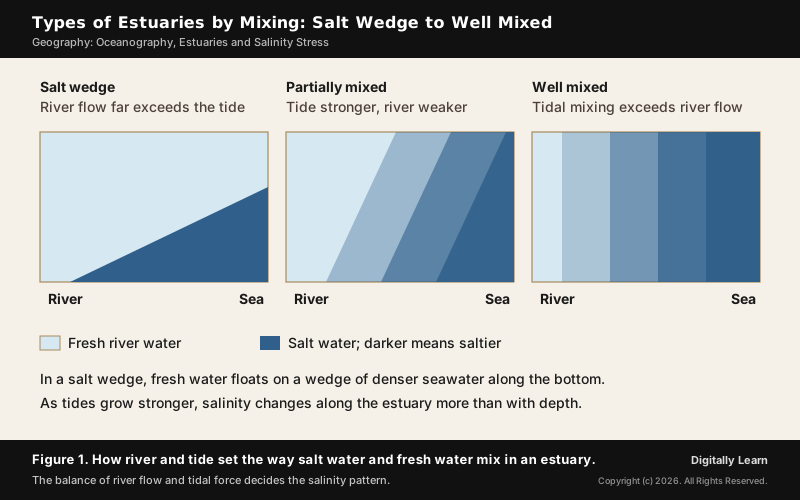
How fresh and salt water mix depends on the balance between the river and the tide, and it sets the salinity pattern a plant or animal meets.
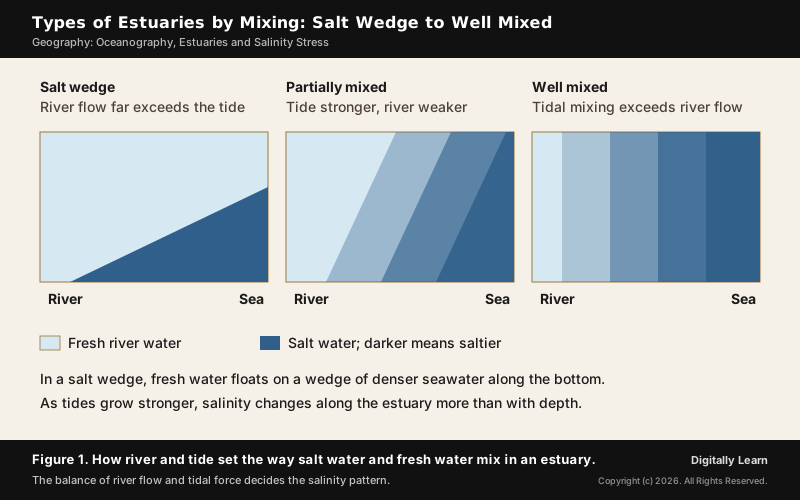
- Salt wedge: River output far exceeds the inflow from the sea and the tide matters little. Fresh water floats on top, and denser seawater pushes landward along the bottom as a wedge. The Mandovi estuary in Goa behaves this way in the monsoon.
- Partially mixed: The tide is stronger and the river weaker, so turbulence mixes the whole column and salinity changes more along the estuary than with depth.
- Well mixed: Tidal mixing exceeds river flow, the vertical salinity gradient disappears, and the boundary between fresh and salt water is erased.
- Inverse: In dry climates evaporation far exceeds the inflow of fresh water, so the estuary is saltiest inside, not at the mouth.
Salinity Gradient and Salinity Stress in an Estuary
Salinity Gradient: How Salinity Changes Along an Estuary
The salinity gradient is the change in salinity from the river end of an estuary to the sea. It runs from near zero at the tidal limit of the rivers to about 3.4 per cent, the salinity of the sea, at the mouth. In estuaries salinity fluctuates seasonally anywhere from 0 to 35 parts per thousand. How the seawater is diluted depends on the volume of fresh water, the tidal range and the amount of evaporation.
The gradient also moves. At any one point salinity changes a great deal over the tides and the seasons, which makes an estuary a harsh place to live. Dissolved oxygen and sediment vary too: sediment settles on intertidal mudflats that are hard to colonise and can clog the feeding and breathing organs of animals. Chilika Lake shows the range in one water body, from 0 parts per thousand near the mouth of the Daya River to 42 in the outlet channel in the dry season.
Salinity Stress in Animals: Euryhaline, Stenohaline and Osmoregulation
Animals meet salinity stress through osmoregulation, the active process by which an organism keeps its water content steady, so that its body fluids become neither too dilute nor too concentrated. There are two strategies.
- Osmoconformers: They match the concentration of their body fluids to the water around them. Most marine invertebrates do this.
- Osmoregulators: They hold their body concentration constant whatever the water. A freshwater fish takes up salt through its gills and passes very dilute urine to get rid of the water that diffuses in.
How wide a range an animal tolerates divides species into two groups. Euryhaline organisms adapt to a wide range of salinity and are common in estuaries and tide pools; the green crab lives in salt and brackish water, and salmon and eels move between fresh water and the sea in their life cycle. Stenohaline organisms survive only a narrow range: most freshwater fish, such as the goldfish, die in seawater, and most marine fish, such as the haddock, die in fresh water. An estuary therefore favours euryhaline life.
Halophytes and Mangroves: How Plants Survive Salt
A halophyte is a salt-tolerant plant that grows where soil or water is saline, in salt marshes, mangrove swamps and on seashores. Perhaps only 2 per cent of plant species are halophytes; most plants are glycophytes and are damaged easily by salt. Mangroves are the only woody halophytes living in salt water along tropical and subtropical coasts.
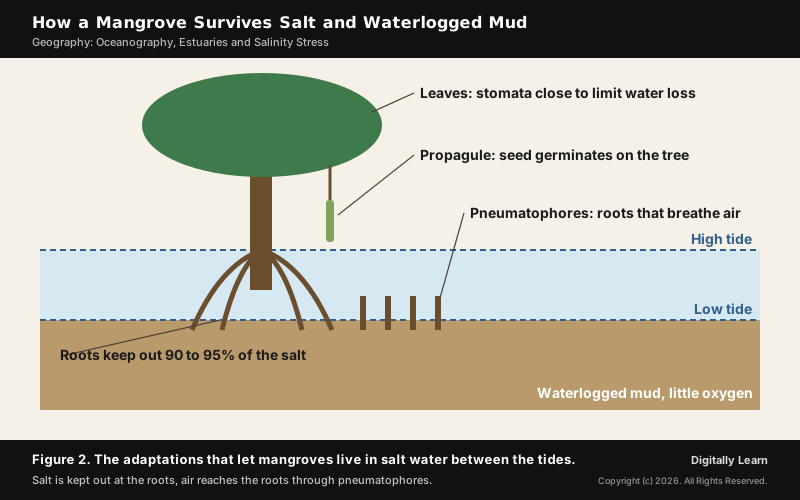
- Keeping salt out: Highly impermeable roots act as a filter; the roots of the Indian mangrove Avicennia officinalis exclude 90 to 95 per cent of the salt in the water the plant takes up.
- Saving water: Fresh water is scarce in salty soil, so mangroves restrict the opening of their stomata and limit the water they lose through their leaves.
- Breathing in waterlogged mud: The mud holds little free oxygen, so roots called pneumatophores rise out of it to take in air.
- Seeds that start early: Many mangroves are viviparous: the seed germinates while still on the tree, and the propagule that drops can float and stay viable for up to a year.
Estuary Ecosystem: Productivity and Services
Estuary Ecosystem Services: Nurseries, Filters and Coastal Defence
The estuary ecosystem joins land, rivers and the sea into one system. Species from fresh water, the sea and the land live together in complex food webs, and the services the ecosystem provides reach far beyond its shores.
- Nurseries: Estuaries shelter the young of many marine fish and shellfish, and serve as migration corridors for fish that move between rivers and the sea. Brackish waters such as estuaries and lagoons are important fish reservoirs.
- Filters: Swamps and salt marshes trap the sediment, nutrients and pollutants that rivers carry, and clear the water.
- Coastal defence: Mangrove swamps protect coasts from erosion, storm surges during tropical cyclones and tsunamis, and salt marsh grasses stabilise the shoreline. A dense tangle of prop roots lets mangroves stand through the daily rise and fall of the tide and slows the moving water so that sediment settles.
- Carbon store: Mangroves are an important source of blue carbon, storing about 4.19 Gt of carbon worldwide in 2012, and their primary production equals that of tropical evergreen forests and coral reefs.
Threats to Estuaries: Eutrophication, Algal Blooms and Dead Zones
Eutrophication and Red Tides: Harmful Algal Blooms in Estuaries
Many of an estuary's problems arrive with its rivers. Eutrophication, an excess of nutrients in the water, comes mainly from nitrogen and phosphate in farm runoff, sewage and animal wastes. It feeds a harmful algal bloom, an overgrowth of algae that harms other organisms through toxins, loss of oxygen or physical damage. In coastal waters such blooms are often called red tides, after blooms of pigmented dinoflagellates.
- Human causes: Runoff carrying fertiliser, sewage and livestock waste from the land.
- Natural causes: River floods and the upwelling of nutrients from the sea floor; in some places blooms are a seasonal result of coastal upwelling.
- Conditions that help: Warmer water and low circulation.
India has reported more blooms each year. When a bloom dies, the microbes that decompose it use up the oxygen, which can kill fish and leave a dead zone behind.
Dead Zones: Hypoxia and Its Consequences for Marine Life
A dead zone is a hypoxic area of the ocean or a large lake, where dissolved oxygen falls to 2 mg per litre or less. Below 0.5 mg per litre, mass mortality follows. Rivers carry nutrients from farms and cities; the nutrients raise productivity; the organic matter sinks and is respired; and the respiration uses up the oxygen. The UN Environment Programme counted 146 dead zones in the world's oceans in 2004, and in the Baltic Sea they grew from about 5,000 to more than 60,000 square kilometres.
- Life moves out or dies: Fish and other mobile animals leave as oxygen falls, while bottom-living animals suffer severe losses below 0.5 mg per litre.
- Jellyfish take over: Jellyfish can thrive in dead zones in vast numbers and change the food web.
- Fisheries lose: Biodiversity falls and bottom populations collapse, narrowing the catch.
Dams, Siltation, Aquaculture and Changing Salinity
Nutrients are not the only pressure. Estuaries degrade through soil erosion, deforestation, overfishing, the filling of wetlands, pollutants such as heavy metals and hydrocarbons, and dams or dikes built for flood control or to divert water. Several of them change the salinity gradient itself.
- Less fresh water, more salt: The Sundarbans suffer increasing salinity from sea-level rise and a reduced supply of fresh water.
- More silt, less salt: In Chilika, silt from upstream shrank the lake, lowered its salinity and let freshwater weeds spread, and the expansion of commercial prawn aquaculture added to the decline of its fisheries and birds.
- Barriers: In Kerala, the Thanneermukkom barrier keeps salt water out of the Kuttanad lowlands but stops fish and prawns migrating upstream and lets weeds grow.
Even the fresh water an estuary receives can be engineered. Most of the water that flows into the Hooghly comes not from the river's natural source but from the Farakka Feeder Canal, into which the Farakka Barrage diverts water from the Ganga. The Hooghly also shows the force of the tide in an estuary: where the estuary narrows suddenly into the river, the advancing tide forms a tidal bore that often exceeds 2.1 metres.
Estuaries in India: Estuaries, Lagoons and Mangroves
Estuaries and Lagoons of India's West and East Coasts
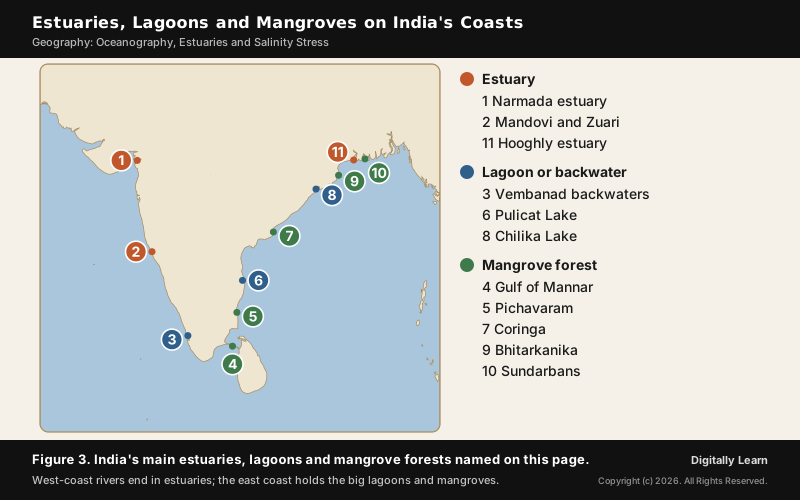
India's two coasts hold different kinds of estuary. The western coastal plain is a submerged coast, and the rivers that cross it do not form deltas; the Narmada and the Tapi also flow in trough faults and carry little deltaic material. The Narmada meets the Arabian Sea south of Bharuch in a broad estuary 27 km long, and Marmagao, Goa's natural harbour, stands at the entrance of the Zuari estuary. The Malabar coast has backwaters, or kayals, used for fishing and inland navigation. The eastern coastal plain is broader, with the deltas of the Mahanadi, Godavari, Krishna and Kaveri and with large lagoons.
| Water body | Where | What makes it notable |
|---|---|---|
| Chilika Lake | Odisha, at the mouth of the Daya River | Largest brackish water lagoon on India's east coast; among India's first Ramsar sites |
| Pulicat Lake | Andhra Pradesh and Tamil Nadu | Second-largest brackish water lagoon in India, 759 sq km, behind Sriharikota |
| Vembanad | Kerala | Longest lake in India, 2,033 sq km; Kuttanad lies on its southern side |
| Narmada estuary | Gujarat, south of Bharuch | A broad estuary 27 km long on the west coast |
Mangroves of India: Sundarbans, Bhitarkanika, Coringa and Pichavaram
Mangroves grow along India's coasts in salt marshes, tidal creeks, mudflats and estuaries. India's total mangrove cover was 4,992 square kilometres in 2023. They are most developed in the Sundarbans and in the Andaman and Nicobar Islands, with other important stands in the deltas of the Mahanadi, Godavari and Krishna.
- Sundarbans: The world’s largest mangrove forest, 10,277 square kilometres across the Ganga delta, about 4,260 of them in West Bengal. The sundri tree, Heritiera fomes, is among its most abundant, and the Indian part was assessed as endangered in 2020.
- Bhitarkanika: A mangrove wetland of 650 square kilometres in the Brahmani and Baitarani deltas of Odisha, with about 62 mangrove species and the saltwater crocodile; a Ramsar site since 2002.
- Coringa: An estuary near Kakinada in Andhra Pradesh and the third-largest stretch of mangroves in India, with 24 mangrove tree species.
- Gulf of Mannar and Pichavaram: The Gulf of Mannar biosphere reserve off Tamil Nadu comprises 21 islands with estuaries, sea grasses, coral reefs, salt marshes and mangroves, and the Pichavaram mangrove forest is counted among the most ecologically significant coastal wetlands in India.
Managing Estuaries: Chilika Restoration and the Vembanad Salt Barrier
Chilika shows that an estuary can be repaired by restoring its salinity. By 1993 its decline had put it on the Montreux Record, the Ramsar list of sites whose ecology is changing through human action. The Chilika Development Authority was set up by Odisha in 1992, and in September 2000 a new mouth was opened to the sea through the barrier beach at Satapura. The new mouth shortened the outflow channel by 18 km, gave the whole lake a higher and steadier salinity, raised the fish yield and reduced freshwater weeds. In 2002 Chilika received the Ramsar Wetland Conservation Award.
Vembanad shows the opposite choice. The Thanneermukkom barrier, 1,252 metres long, was built to keep tidal salt water out of the Kuttanad lowlands, where rice is grown below sea level. Its gates are opened in July to release floods and stay closed until mid-November. The farms gained fresh water, but fish and prawns lost their route upstream and water hyacinth spread. Both cases show that managing an estuary means managing its salinity gradient.
Previous Year UPSC-CSE Questions
Previous Year UPSC-CSE Questions By the end you will be able to draft model answers for the following UPSC questions. Each question carries a collapsible framework showing how to approach it in the exam.
- UPSC Mains 2018 GS-IWhat are the consequences of spreading of ‘Dead Zones’ on marine ecosystem?
Answer outline: how to structure the answer
What the question asks, the main arguments, relevant examples and the direction of the conclusion. This is not a full model answer.
Introduction: Define a dead zone as a hypoxic area where dissolved oxygen falls to 2 mg per litre or less, created when river nutrients feed blooms whose decay uses up the oxygen.
Body (sub-themes to develop):
- Spread: 146 dead zones in 2004; the Baltic Sea's grew from about 5,000 to over 60,000 sq km.
- Organisms: mobile fish leave; bottom-living animals die below 0.5 mg per litre.
- Food web: biodiversity falls and jellyfish can take over in vast numbers.
- Economy: collapsing bottom populations narrow the fisheries catch.
Conclusion: Conclude that dead zones start on land and in estuaries, so cutting nutrient runoff is the remedy.
- UPSC Mains 2019 GS-IDiscuss the causes of depletion of mangroves and explain their importance in maintaining coastal ecology.
Answer outline: how to structure the answer
What the question asks, the main arguments, relevant examples and the direction of the conclusion. This is not a full model answer.
Introduction: Introduce mangroves as the only woody halophytes of tropical coasts; India has 4,992 sq km of mangrove cover (India State of Forest Report 2023).
Body (sub-themes to develop):
- Causes of depletion: aquaculture such as prawn farming, siltation and pollution, dams and barriers that cut fresh water, and rising salinity from sea-level rise, as in the Sundarbans.
- Importance: nurseries for fish and shellfish, filters for river sediment and pollutants.
- Coastal defence: roots resist tides and slow water; swamps reduce erosion, storm surge and tsunami damage.
- Carbon: mangroves are a major blue carbon store; Pichavaram's services were valued at ₹2,485.38 crore.
Conclusion: Conclude that protecting mangroves protects fisheries, coasts and the climate together.
- UPSC Prelims 2011 Prelims-GSThere is a concern over the increase in harmful algal blooms in the seawaters of India. What could be the causative factors for this phenomenon?
- Discharge of nutrients from the estuaries.
- Run-off from the land during the monsoon.
- Upwelling in the seas.
Select the correct answer from the codes given below:
How to approach this Prelims question
Approach: Step 1: nutrients discharged from estuaries feed blooms, so 1 is a cause. Step 2: runoff from the land carries fertiliser and sewage, so 2 is a cause. Step 3: upwelling lifts nutrients from the sea floor and is a natural cause, so 3 is a cause too. Answer 1, 2 and 3.
Trap to watch: Upwelling sounds like a natural, harmless process, but it brings up the same nutrients that feed blooms.
Key facts to recall:
- (a) 1 only: wrong. It leaves out land runoff and upwelling.
- (b) 1 and 2 only: wrong. It leaves out upwelling, a natural source of nutrients.
- (c) 2 and 3 only: wrong. It leaves out the nutrients discharged from estuaries.
- (d) 1, 2 and 3: right. All three bring the nutrients that feed harmful algal blooms.
Answer signal: 1, 2 and 3: option (d), the official answer, because estuary discharge, land runoff and upwelling all supply nutrients to blooms.
- UPSC Prelims 1998 Prelims-GSEstuaries possess distinct blooms of excessive growth of a pigmented dinoflagellate. These blooms are called
How to approach this Prelims question
Approach: Step 1: the question describes a bloom of a pigmented dinoflagellate in estuaries. Step 2: such coastal blooms of these dinoflagellates are called red tides. Answer (a).
Trap to watch: Every option contains a sea word; only one is the name used for dinoflagellate blooms.
Key facts to recall:
- (a) Red tides: right. The term comes from blooms of several dinoflagellate species.
- (b) Sea tides: wrong. Tides are the rise and fall of the sea, not a bloom.
- (c) Black tides: wrong. It is not the name for dinoflagellate blooms.
- (d) Sea flowers: wrong. It is not a term for algal blooms.
Answer signal: Red tides: option (a), the official answer, because dinoflagellate blooms in coastal waters are called red tides.
- UPSC Prelims 2011 Prelims-GSThe 2004 Tsunami made people realize that mangroves can serve as a reliable safety hedge against coastal calamities. How do mangroves function as a safety hedge?
How to approach this Prelims question
Approach: Step 1: the question asks how mangroves act as a safety hedge. Step 2: their protection comes from the roots, which hold the trees through tides and slow the water. Answer (d).
Trap to watch: Option (c) sounds protective, but mangroves are a buffer because of their roots, not because people shelter under them.
Key facts to recall:
- (a) A zone where people do not live: wrong. The protection comes from the forest itself, not from keeping people away.
- (b) Food and medicines: wrong. These are products, not a defence against a calamity.
- (c) Tall trees as shelter: wrong. Mangroves are not shelters; the swamp slows water and holds the shore.
- (d) Extensive roots resist uprooting: right. The dense roots hold the trees through tides and storms.
Answer signal: Extensive roots: option (d), the official answer, because mangrove roots stand firm through tides and storm waters and slow them.
Sources
- NCERT: Fundamentals of Physical Geography (Class XI), Chapter 12, Water (Oceans)
- NCERT: India Physical Environment (Class XI), Chapters 2, 3 and 5
- NCERT: India People and Economy (Class XII), Chapter on transport
- NCERT: Science (Class IX), Improvement in Food Resources
- Wikipedia: Estuary
- Wikipedia: Brackish water
- Wikipedia: Osmoregulation
- Wikipedia: Euryhaline
- Wikipedia: Stenohaline
- Wikipedia: Halophyte
- Wikipedia: Mangrove
- Wikipedia: Harmful algal bloom
- Wikipedia: Dead zone (ecology)
- Wikipedia: Chilika Lake
- Wikipedia: Pulicat Lake
- Wikipedia: Vembanad
- Wikipedia: Sundarbans
- Wikipedia: Bhitarkanika Mangroves
- Wikipedia: Coringa Wildlife Sanctuary
- Wikipedia: Hooghly River
- NOAA National Ocean Service: What is an estuary?
- PIB: Union Minister releases India State of Forest Report 2023 (21 December 2024)
- The Hindu (Delhi), 3 September 2026: How valuable are mangroves? (Pichavaram study)
- UPSC: Civil Services Examination question papers
Editorial Disclaimer
This article draws on the NCERT textbooks and the other sources listed on this page.