


Overview
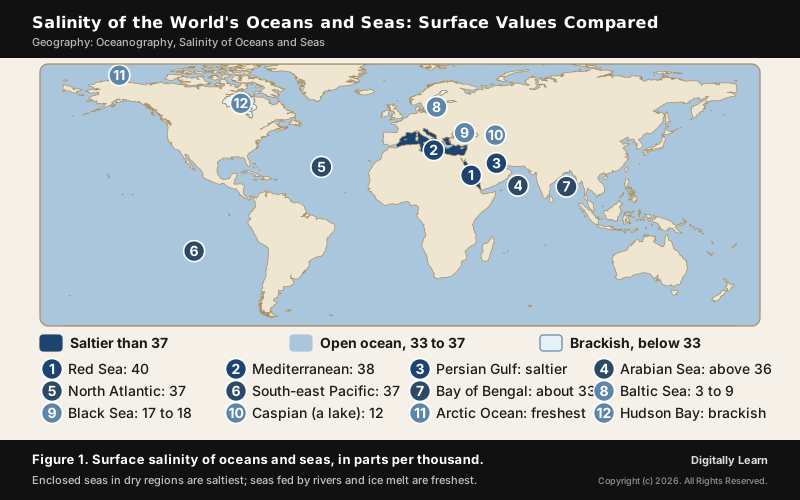
The highest salinity sea in the world is the Red Sea, whose surface water averages about 40 parts per thousand against the ocean's 35, because desert surrounds it, no river enters and evaporation is intense. Salt lakes with no outlet, such as the Dead Sea at 342 parts per thousand, are far saltier. Among the oceans the Atlantic is saltiest and the Arctic freshest, and the Baltic is the world's largest brackish sea.
Highest Salinity Sea in the World: The Red Sea
Salinity of the Red Sea: Why It Is the Saltiest Open Sea
The total amount of salt dissolved in sea water is its salinity, measured as grams of salt in 1,000 grams of water and written in parts per thousand. The open ocean ranges between 33 and 37 parts per thousand, so a sea that sits at 40 stands well outside the normal band. The Red Sea does, and the reason lies in where it sits and how it is shut in. The meaning of salinity, its sources and its main controls are explained in salinity of ocean water.
The Red Sea is a long, narrow sea between the Arabian Peninsula and Africa, about 2,250 km long and 355 km across at its widest, set between arid land, desert and semi-desert. Rain is scarce, and no significant river or stream drains into it, so the sea receives almost no fresh water. Evaporation removes as much as 2,050 mm of water a year from its surface, and the salt stays behind.
- Almost no rain: The scarcity of rainfall means the sea gains little fresh water from the sky.
- No rivers: No significant river or stream reaches it, so nothing dilutes the surface from the land.
- Heavy evaporation: As much as 2,050 mm of water a year evaporates from its surface, and its salinity changes little from season to season.
- A narrow outlet: Its only link to the ocean is in the south, through the strait of Bab-el-Mandeb into the Gulf of Aden, so the salty water cannot easily be replaced.
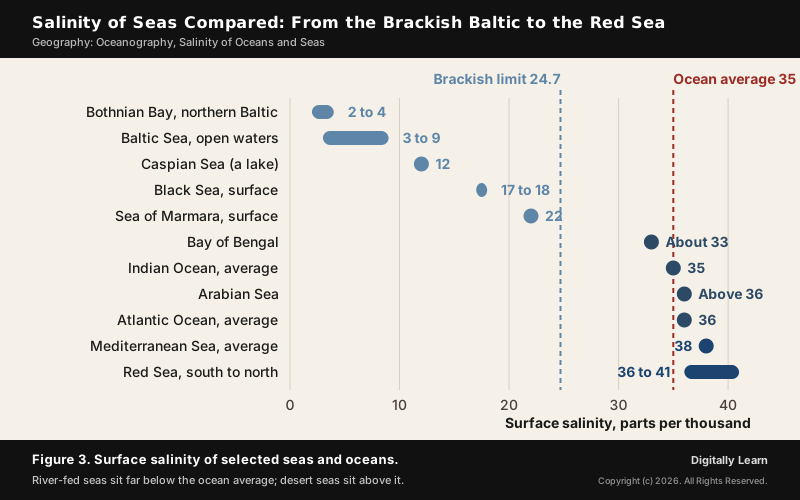
The result shows in the numbers. Salinity rises from about 36 parts per thousand in the south, where ocean water comes in, to 41 in the north around the Gulf of Suez, and averages 40. On the floor of its central part lie hot, salty brines, first reported by a deep-water survey in 1949 and later measured at about 60 °C. Its shores run along Egypt, Sudan and Eritrea in Africa and Saudi Arabia and Yemen in Arabia, with Israel and Jordan on the Gulf of Aqaba; the southern strait lies between Yemen and Djibouti and Eritrea.
Persian Gulf Salinity: Evaporation and the Hormuz Outflow
The Persian Gulf works the same way as the Red Sea, on a smaller and shallower scale. It is an inland sea of about 251,000 square kilometres, on average only about 35 metres deep and at most about 100, joined to the Gulf of Oman by the Strait of Hormuz, which is about 56 km wide at its narrowest.
The Gulf loses about 1.84 metres of water a year to evaporation and gains only 0.08 metres from rain. Even with the Tigris and Euphrates entering through the Shatt al-Arab, it runs a deficit of 416 cubic kilometres a year. Ocean water flowing in at the surface through the Strait of Hormuz makes up the deficit, while the Gulf's saltier, denser water leaves along the bottom of the strait.
Salinity also shapes the Gulf's coastal life. Near the Shatt al-Arab, river water brings heavy sediment and wide swings in temperature and salinity, which reef-building corals tolerate poorly, so coral growth is limited there. Its mangroves, by contrast, need exactly such a mix of fresh and salt water and the tidal flow that brings it.
Which Sea Has the Highest Salinity: Seas Against Salt Lakes
A sea is part of the ocean, joined to it by a strait, and its salinity can only climb so far before ocean water flowing in holds it down. A lake with no outlet has no such check. Water leaves only by evaporation, the salts brought in by streams stay, and over thousands of years the water turns into brine, water so salty that salts begin to crystallise out of it. That is why every record for salinity belongs to a lake or a pond, not to a sea.
| Water body | Where | Salinity | Why it is so salty |
|---|---|---|---|
| Don Juan Pond | Antarctica | 200 to 474 grams per litre, varying over time | A shallow calcium chloride pond; stays liquid down to −50 °C |
| Gaet'ale Pond | Danakil Depression, Ethiopia | About 43 per cent | Reported as the saltiest water body on Earth |
| Lake Assal | Djibouti | 34.8 per cent | No outflow and very high evaporation, 155 m below sea level |
| Garabogazköl | Lagoon of the Caspian, Turkmenistan | About 35 per cent | A shallow lagoon that evaporates the Caspian water flowing into it |
| Dead Sea | Israel, West Bank and Jordan | 34.2 per cent (2011) | Fed by the Jordan River, it has no outlet stream |
| Great Salt Lake | Utah, United States | 5 to 27 per cent | No outlet; salinity rises and falls with the lake's level |
| Red Sea | Between Africa and Arabia | About 4 per cent (40 parts per thousand) | The saltiest sea open to the ocean |
| World ocean | Average | About 3.5 per cent (35 parts per thousand) | The reference against which the others are read |
Textbook lists differ, because these lakes change with their water level. NCERT gives Lake Van in Turkey (330 parts per thousand), the Dead Sea (238) and the Great Salt Lake (220) as the most saline water bodies; other accounts give the Dead Sea 342 grams per kilogram in 2011 and the Great Salt Lake's main basin anywhere from 50 to 270. For the examination, the NCERT list is the safe reference.
Which Ocean Has the Highest Salinity: Atlantic, Pacific, Indian and Arctic
Salinity of the Atlantic Ocean: Why It Is the Saltiest Ocean
The Atlantic is the saltiest of the major oceans. Its average salinity is about 36 parts per thousand, and the surface of its open waters ranges from 33 to 37 with latitude and season. The highest values lie in the subtropics: the maximum, 37 parts per thousand, lies between 20° N and 30° N and between 20° W and 60° W, where the air is dry and evaporation is strong. Salinity falls away towards the north.
Two processes keep the Atlantic salty. Some of the water evaporated from the subtropical Atlantic is carried as vapour across to the Pacific, a transfer called the atmospheric bridge, so the Atlantic loses fresh water that it never gets back as rain. In the south, rings of water leaking around the tip of Africa, the Agulhas leakage, bring salty Indian Ocean water into the South Atlantic. The salty outflow from the Mediterranean adds salt to the eastern North Atlantic.
- Lowest values: Just north of the equator, because of heavy tropical rain, and in the high latitudes and along coasts where large rivers enter.
- Highest values: At about 25° north and south, in the subtropics with low rain and high evaporation.
- North Sea: Saltier than its high latitude suggests, because the North Atlantic Drift brings saline water into it.
- Baltic Sea: Very low, because rivers pour in large amounts of fresh water.
Salinity of the Pacific Ocean: Why It Is Fresher
The Pacific's salinity varies mainly because of its shape and its vast area. It is far broader than the Atlantic and takes in a great deal of rain, so its surface is, on average, less salty. In the western parts of the northern hemisphere, salinity falls from 35 to 31 parts per thousand because melted water flows in from the Arctic region, and south of about 15° to 20° S it drops to 33.
- Highest: Up to 37 parts per thousand in the south-eastern Pacific.
- At the equator: As low as 34, because rain falls heavily there through the year.
- Far north: Below 32, since little sea water evaporates in the cold.
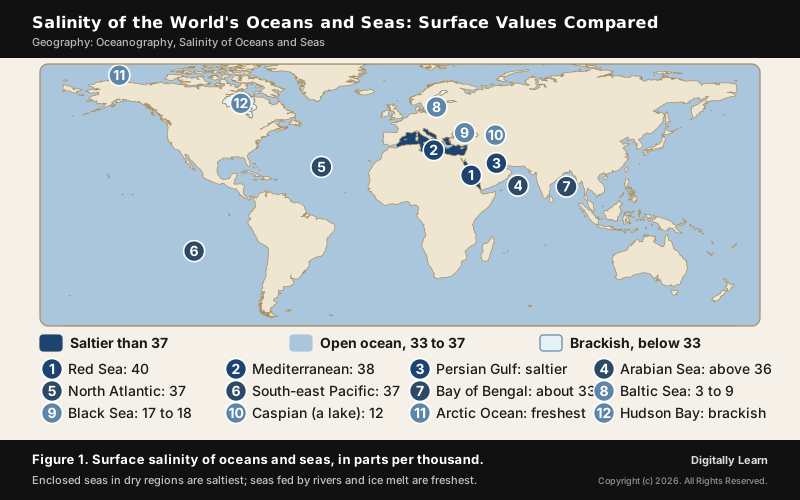
Set side by side on the map, the oceans follow one rule. Salinity is generally low at the equator and at the poles and high in the mid-latitudes, highest of all in seas enclosed by desert, and lowest where rain, rivers or melting ice add fresh water. The Pacific is fresher than the Atlantic largely because more fresh water reaches it, including vapour carried over from the Atlantic.
Salinity of the Indian Ocean: Arabian Sea and Bay of Bengal
The Indian Ocean averages about 35 parts per thousand, with a sharp contrast between its two northern arms. The Arabian Sea is the saltiest part, above 36, because evaporation exceeds rain there and few rivers enter. The Bay of Bengal is the freshest, about 33, because the Ganga and the other great rivers pour in fresh water and the monsoon rain is heavy. Off western Sumatra, water arriving from the Pacific through the Indonesian Throughflow keeps the sea near 34. The two Indian seas are compared in detail in salinity of the Indian Ocean.
| Ocean | Average or range | Saltiest part | Freshest part | Main reason |
|---|---|---|---|---|
| Atlantic | About 36; open ocean 33 to 37 | Subtropics, about 25° N and S (37) | Just north of the equator; river mouths | Vapour lost to the Pacific; Mediterranean outflow |
| Pacific | Fresher than the Atlantic | South-east Pacific (37) | Far north (below 32) | Vast area and heavy rain; Arctic meltwater |
| Indian | About 35 | Arabian Sea (above 36) | Bay of Bengal (about 33) | Evaporation in the west, rivers and monsoon in the east |
| Arctic | Lowest of the five | Water below the halocline | Surface layer | Low evaporation, large rivers, little exchange |
Salinity of the Arctic Ocean and the Southern Ocean
The Arctic Ocean has the lowest average salinity of the five oceans. Little water evaporates in the cold, the great rivers of Siberia and Canada, the Ob, Yenisei, Lena and Mackenzie, pour fresh water into it, and it has only a limited connection to the saltier oceans. Its top layer, about 50 metres thick, is fresher and colder than the water below and floats on it, separated by a halocline, a layer in which salinity rises sharply with depth.
The Southern Ocean around Antarctica works in the opposite direction at depth. When sea ice forms, the salt is left behind in the water beneath, and that very cold, highly saline and dense water becomes Antarctic Bottom Water. Even so, the waters of the Ross Gyre have grown somewhat fresher since the 1950s.
Mediterranean Sea Salinity and the Strait of Gibraltar
Mediterranean Sea Salinity: Why It Is Saltier Than the Atlantic
The Mediterranean Sea averages 38 parts per thousand near the surface, well above the Atlantic beside it. Evaporation in the basin greatly exceeds the rain and the river water it receives, and the gap is widest in the east, so the sea grows saltier and its level lower from west to east. The Nile, the Rhône and the Po are the only rivers that bring it more than 1,000 cubic metres a second, and much of the land around it is desert.
The Atlantic water that enters the Mediterranean is cool and relatively fresh. It moves east along the coast of North Africa, warming and gaining salt on the way. By the time it reaches the Levantine Sea in the far east it is dense enough to sink, forming the Levantine Intermediate Water. The sea's coasts run from Spain, France, Italy, Croatia, Albania and Greece in Europe to Turkey, Syria, Lebanon and Israel in Asia and Egypt, Libya, Tunisia, Algeria and Morocco in Africa.
The Adriatic, the Aegean, the Ionian and the Tyrrhenian are arms of the Mediterranean and part of the same basin. The Adriatic is bordered by Italy on one side and by Slovenia, Croatia, Bosnia and Herzegovina, Montenegro and Albania on the Balkan side.
Strait of Gibraltar: Two-Layer Exchange of Atlantic and Mediterranean Water
The Mediterranean meets the Atlantic only at the Strait of Gibraltar, which separates the Iberian Peninsula from Morocco by just 14 km. Because the Mediterranean water is so much saltier, it is also denser, and the two waters do not simply mix. They pass each other in two layers, a two-layer exchange: a larger flow of fresher, lighter Atlantic water moves east at the surface, while a smaller flow of saltier, denser Mediterranean water moves west along the bottom.
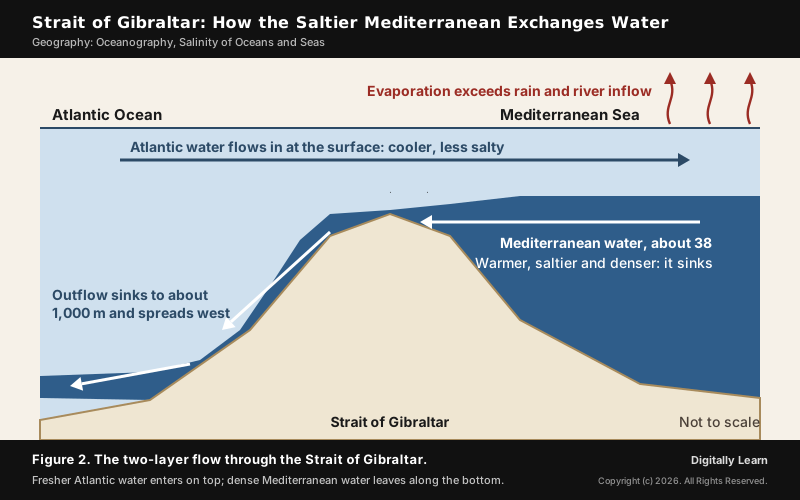
- The Camarinal Sill, the shallowest point of the strait, limits mixing between the two waters.
- On the Atlantic side a density boundary at about 100 m separates the outflow from the water above it.
- The outflow runs down the continental slope, losing salt, until it settles and spreads at about 1,000 m.
- It can be traced for thousands of kilometres west of the strait before it loses its identity.
Messinian Salinity Crisis: When the Mediterranean Dried Up
The balance of the flow through Gibraltar is eastward, because the Mediterranean loses more water to evaporation than all its rivers and rain put back. Shut the strait and the sea would dry out. That has happened before. About 5.96 million years ago the gateways to the Atlantic closed, and in the Messinian salinity crisis that followed the Mediterranean partly or wholly dried up, laying down salt beds up to 2 km thick in the Levantine Sea. It was refilled about 5.3 million years ago when the Atlantic broke through at Gibraltar.
Lowest Salinity Seas: Baltic Sea, Black Sea and Caspian Sea
Baltic Sea: The World's Largest Brackish Sea
The Baltic Sea is the world's largest brackish sea. Brackish water is saltier than fresh water but well below sea water, with 24.7 parts per thousand taken as its upper limit, and the open waters of the Baltic hold only 3 to 9. In the far north, in Bothnian Bay, salinity falls to 2 to 4, low enough for pike, whitefish and perch to live in it, and the Gulf of Bothnia freezes over for five months a year.
About two hundred rivers drain into the Baltic, and their yearly runoff equals about a fortieth of the sea's volume. It exchanges water with the ocean only through the narrow Danish straits. A layer of brackish water flows out at the surface, about 940 cubic kilometres a year, while saltier North Sea water creeps in below it, about 475 cubic kilometres. The salty water stays on the bottom, mostly below 40 to 70 metres, and mixes with the water above only slowly.
That layering has costs. The deep salty water is cut off from the air, so its oxygen is used up and bacteria release hydrogen sulphide. Only occasional major inflows of North Sea water, large pulses about once in ten years, renew the deep basins. The sea's life is a mix: cod survive in its deeper, saltier water and need it to breed, while pike keep to the fresher surface, and in Bothnian Bay about two-thirds of the species are freshwater ones.
Black Sea Salinity: Bosporus Two-Layer Flow and Anoxic Depths
The Black Sea is brackish at the surface, about 17 to 18 parts per thousand, because rivers pour in far more water than evaporation removes. It is bordered by Bulgaria, Romania, Ukraine, Russia, Georgia and Turkey, and it has a positive water balance: about 300 cubic kilometres a year more water flows out through the Bosporus and the Dardanelles to the Aegean than flows in.
The Bosporus carries the mirror image of Gibraltar. Fresher Black Sea water leaves at the surface, about 16,000 cubic metres a second at a salinity of 17, while denser Mediterranean water, about 38.5, enters along the bottom at about 11,000 cubic metres a second. Between the two seas lies the Sea of Marmara, about 22 parts per thousand at the surface and about 38 at the bottom.
The heavy water that sinks into the Black Sea never mixes back up. A sharp density layer at 100 to 200 metres seals off the deep water, where salinity rises to 22.3, bacteria use up every trace of oxygen and the water is anoxic, without dissolved oxygen. More than 90 per cent of the deep Black Sea is anoxic, which is why ancient shipwrecks lie preserved on its floor.
Caspian Sea Salinity: A Brackish Lake and Garabogazköl
The Caspian Sea is the world's largest lake, not a sea, and its salinity of about 1.2 per cent, 12 grams a litre, is about a third of the ocean's, which makes it brackish. The Volga, Europe's longest river, brings about 80 per cent of its inflow into the shallow north, so the northern Caspian is almost fresh and the water grows saltier towards the south. It is most saline along the Iranian shore, where little river water arrives. Its coasts are shared by Russia, Kazakhstan, Turkmenistan, Iran and Azerbaijan.
On its eastern side lies Garabogazköl, a shallow lagoon in Turkmenistan where Caspian water flows in and evaporates. Its salinity averages about 35 per cent, ten times the ocean's. When workers blocked the link in March 1980 to slow the fall of the Caspian, the lagoon dried out completely by 1984; the flow has since been restored.
Salinity of the Dead Sea and Other Salt Lakes
Salinity of the Dead Sea: Why Swimmers Float
The salinity of the Dead Sea was 342 grams per kilogram, or 34.2 per cent, in 2011, which makes it 9.6 times as salty as the ocean. It lies in the Jordan Rift Valley between Israel and the West Bank on one side and Jordan on the other. The Jordan River flows in, and water leaves only by evaporation, so over thousands of years the salt has piled up. At 304 metres deep it is the deepest hypersaline lake in the world, a lake whose salinity is higher than the ocean's 35 parts per thousand.
All that salt makes the water dense, 1.24 kilograms a litre against about 1.02 for sea water, and so a swimmer floats as if lying on it. The same salt is why it is called dead: no fish or water plants can live in it, though bacteria and microscopic fungi do. Its salts are mostly magnesium chloride and sodium chloride, and its brine is worked for potash on both the Israeli and Jordanian shores, and for bromine and magnesium on the Israeli side.
The Dead Sea is shrinking. Its surface has lost about a third of its area since the 1960s, partly because far less water now flows down the Jordan River after the building of Israel's National Water Carrier. As the level drops, fresh groundwater dissolves the salt layers near the shore, and the ground collapses into sinkholes.
Aral Sea and Great Salt Lake: Shrinking Lakes Grow Saltier
The Aral Sea between Kazakhstan and Uzbekistan was once the third-largest lake in the world, about 68,000 square kilometres. It began to shrink in the 1960s, when Soviet irrigation projects diverted the Amu Darya and the Syr Darya, the two rivers that fed it, to grow crops. As the water went, the salt stayed: salinity rose, and the Aral trout, the sturgeons and almost all the other native fish died out. By 2007 much of it had become desert.
Part of the lake has come back. Kazakhstan completed the Kok-Aral Dam, 13 km long, in 2005 to hold the Syr Darya's water in the North Aral Sea. Its level rose, its salinity fell, and by 2013 there were fish enough for some fishing again. The southern part gets no help from the Amu Darya, which no longer reaches the lake.
The Great Salt Lake in Utah shows how a lake's salinity follows its level. Its main basin ranges from 5 to 27 per cent as the water rises and falls, and the bays where rivers enter can turn almost fresh in the spring snowmelt. A railway causeway has cut off its northern arm, Gunnison Bay, which receives almost no river water and has become far saltier than the rest. The lake supplies 35 to 45 per cent of the world's brine shrimp cysts, and its industries, recreation and harvest add about $1.3 billion a year to Utah's economy.
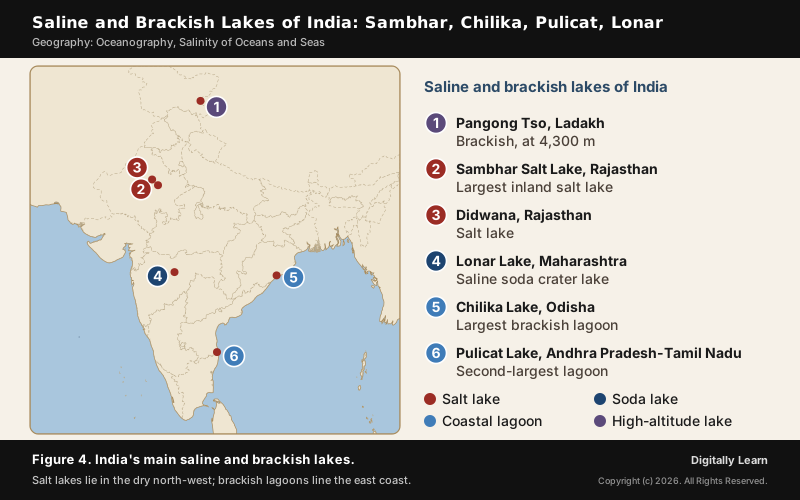
Saline and Brackish Lakes of India: Sambhar to Chilika
Sambhar Salt Lake and the Salt Lakes of Rajasthan
Sambhar Salt Lake in Rajasthan is India's largest inland salt lake and the largest playa of the Thar Desert. It straddles the Nagaur and Jaipur districts, and its water, three to four times as salty as the sea, spreads as an extensive saline wetland whose depth swings from about 60 cm in the dry season to about 3 metres at the end of the monsoon. Streams bring the salt in, and the dry air does the rest.
- Salt: Salt has been made by evaporating its brine for a thousand years; today the lake produces about 196,000 tonnes of clean salt a year, most of Rajasthan’s output.
- Ramsar site: It was designated a wetland of international importance in 1990; its plants and animals thrive mainly in the rainy season, when its salinity falls.
- Threats: Illegal salt pans and borewells have lowered the groundwater and shrunk the wetland, and in 2019 between 18,000 and 23,000 birds died of avian botulism.
Sambhar is not alone. Didwana, to its north-west in the same dry belt, sits beside the Didwana Salt Lake, another inland salt lake of Rajasthan. Salt lakes like these form where streams end in closed basins and the water evaporates. When the same salts collect in farm soils, they produce the saline soils explained in saline and alkaline soils.
Chilika, Pulicat, Lonar and Pangong Tso: Brackish and Soda Lakes
Chilika Lake in Odisha is the largest brackish-water lagoon of the east coast and the second-largest coastal lagoon in the world. Its salinity runs from 0 parts per thousand near the mouth of the Daya River to 42 in the outlet channel in the dry season, because river water, evaporation, wind and the tide all pull on it. It was among India's first two Ramsar sites, designated in 1981. When silt choked its link to the sea, the lake turned fresher and weeds spread; a new mouth cut in September 2000 restored its salinity.
Pulicat Lake on the Andhra Pradesh and Tamil Nadu border is India's second-largest brackish lagoon, 759 square kilometres. Its salinity swings from almost nothing in the monsoon to about 52 parts per thousand before and after it, because the lagoon acts as an evaporating basin whenever its sand bar closes.
- Lonar Lake, Maharashtra: A saline and highly alkaline soda lake, with a pH of about 9 to 10.5, in India’s only crater lake of meteoritic origin; it was designated a Ramsar site in July 2020.
- Pangong Tso, Ladakh: One of the highest brackish lakes in the world, at about 4,300 m; its eastern part holds 0.68 grams of dissolved salts a litre and its western part 11.02, and the Line of Actual Control passes through it.
Why Are There Differences in the Salinity of Oceans and Seas
Factors Behind Differences in Salinity of Oceans and Seas
There are differences in the salinity of oceans and seas because every body of water balances the fresh water it gains against the fresh water it loses, and that balance differs from place to place. The salt itself hardly changes; what changes is how much water it is dissolved in. Every sea described above fits one or more of the same few controls.
- Evaporation against precipitation: The main control on surface salinity. Dry subtropics and desert seas such as the Red Sea run salty; rainy equatorial waters run fresher.
- River inflow: Great rivers dilute the sea near their mouths, as in the Bay of Bengal, the Baltic and the Black Sea.
- Freezing and melting of ice: Freezing leaves salt behind and makes the water below saltier; melting adds fresh water, as in the Arctic.
- Winds and ocean currents: They move water from one region to another, as the North Atlantic Drift carries saline water into the North Sea.
- Enclosure and the depth of the strait: A narrow or shallow link to the ocean, such as Bab-el-Mandeb or the Danish straits, slows exchange, so a sea keeps whatever its climate gives it.
The last factor explains why the extremes are all enclosed. An open stretch of ocean is constantly mixed with its neighbours, so its salinity stays within 33 to 37. A sea behind a strait can drift far from that band in either direction: up to 40 or 41 under a desert sun, down to 3 or less where rivers dominate. A lake with no outlet at all can go to a third of its weight in salt.
Effects of Salinity Variations: Density, Life, Climate and Economy
Salinity matters because it changes how water behaves. Salt makes water denser, so surface sea water weighs about 1,020 to 1,029 kilograms a cubic metre depending on its temperature and salinity, and salty water sinks beneath fresher water. Salt also lowers the freezing point: ordinary sea water freezes at about −2 °C, and the salt in Lake Van usually keeps it from freezing despite its height and cold winters.
- Circulation: Dense salty water drives the exchanges at Gibraltar and the Bosporus and the deep circulation of the Atlantic; salinity also tracks water masses as they travel.
- Layering and oxygen: A fresh layer over a salty one blocks mixing, which leaves the deep Black Sea and the Baltic basins short of oxygen.
- Ecosystems: Each species tolerates a range; the Dead Sea has no fish, the Baltic mixes freshwater and marine species, and the Aral lost its native fish as its salt rose.
- Economy: Salt from Sambhar, potash and bromine from the Dead Sea and brine shrimp from the Great Salt Lake are all products of high salinity; desalination plants on the Red Sea return brine to the sea.
- Climate: Saltier water holds less carbon dioxide, and the fresh regions of the ocean are projected to get fresher and the salty ones saltier as the climate warms; the Mediterranean is expected to grow saltier and more layered by the end of this century.
The human uses and costs of salinity, from desalination and sea salt to seawater intrusion, are taken up in desalination and the impacts of ocean salinity, and its role in estuaries and coastal ecosystems in estuaries and marine ecosystems.
Previous Year UPSC-CSE Questions
Previous Year UPSC-CSE Questions By the end you will be able to draft model answers for the following UPSC questions. Each question carries a collapsible framework showing how to approach it in the exam.
- UPSC Mains 2017 GS-IAccount for variations in oceanic salinity and discuss its multi-dimensional effects.
Answer outline: how to structure the answer
What the question asks, the main arguments, relevant examples and the direction of the conclusion. This is not a full model answer.
Introduction: Define salinity as grams of dissolved salt per kilogram of sea water, about 35 parts per thousand on average and 33 to 37 in the open ocean, with enclosed seas far outside that band.
Body (sub-themes to develop):
- Evaporation against precipitation: Red Sea about 40 (arid shores, no rivers, 2,050 mm evaporation); equatorial Atlantic and Pacific fresher under heavy rain.
- River inflow: Bay of Bengal about 33 against the Arabian Sea above 36; Baltic 3 to 9; Black Sea 17 to 18.
- Ice: freezing leaves salt in the water beneath (Antarctic Bottom Water); melting freshens the Arctic, the freshest ocean.
- Winds, currents and enclosure: North Atlantic Drift raises North Sea salinity; the atmospheric bridge exports Atlantic vapour to the Pacific; narrow straits (Gibraltar, Bab-el-Mandeb, Danish straits) slow exchange.
- Physical effects: density and two-layer exchange at Gibraltar and the Bosporus; the Atlantic overturning depends on high salinity; haloclines and anoxic deeps in the Black Sea and Baltic; lower freezing point.
- Biological and economic effects: Dead Sea with no fish, Baltic species mix, Aral fisheries lost and partly regained; salt from Sambhar, potash and bromine from the Dead Sea, desalination brine.
- Climate effects: saltier water holds less carbon dioxide; fresh regions getting fresher and salty ones saltier; Greenland meltwater freshening the North Atlantic.
Conclusion: Conclude that salinity, set by the local water balance, is a small number with large consequences for the ocean's circulation, life and economies, and that its changing pattern is an indicator of a changing climate.
- UPSC Prelims 2024 Prelims-GSConsider the following statements:
- The Red Sea receives very little precipitation in any form.
- No water enters the Red Sea from rivers.
Which of the statements given above is/are correct?
How to approach this Prelims question
Approach: Step 1: statement 1: the Red Sea is set between arid land, desert and semi-desert, and its rainfall is scarce, so it receives very little precipitation; correct. Step 2: statement 2: no significant river or stream drains into it; correct. Step 3: both statements are correct, and together they explain its salinity of about 40 parts per thousand.
Trap to watch: Statement 2 sounds too absolute to be true, but the Red Sea has no river inflow worth the name; the Nile reaches the Mediterranean, not the Red Sea.
Key facts to recall:
- (a) 1 only: wrong. Statement 2 is also correct; no significant river drains into the Red Sea.
- (b) 2 only: wrong. Statement 1 is also correct; rainfall over the Red Sea is scarce.
- (c) Both 1 and 2: right. Little rain and no river inflow are the two reasons it is so salty.
- (d) Neither 1 nor 2: wrong. Both statements describe the Red Sea correctly.
Answer signal: Both 1 and 2: option (c), the official answer, because the Red Sea gets almost no rain and no river water.
- UPSC Prelims 2018 Prelims-GSWhich of the following has/have shrunk immensely/dried up in the recent past due to human activities?
- Aral Sea
- Black Sea
- Lake Baikal
Select the correct answer using the code given below:
How to approach this Prelims question
Approach: Step 1: Aral Sea: shrank from the 1960s after its two feeder rivers were diverted for irrigation and had largely dried into desert by 2007; correct. Step 2: Black Sea: more water flows out of it than in, about 300 cubic kilometres a year, so it has not dried up; incorrect. Step 3: Lake Baikal: still the world's deepest lake; incorrect. Step 4: only the Aral Sea, option (a).
Trap to watch: The Caspian and the Dead Sea are also falling, but neither is in this question; the Black Sea gains more water from its rivers than it loses to evaporation.
Key facts to recall:
- (a) 1 only: right. Only the Aral Sea shrank because of human water use.
- (b) 2 and 3: wrong. Neither the Black Sea nor Lake Baikal has dried up.
- (c) 2 only: wrong. The Black Sea has a positive water balance and a net outflow.
- (d) 1 and 3: wrong. Lake Baikal has not shrunk; it remains the world's deepest lake.
Answer signal: 1 only: option (a), the official answer, because the Aral's rivers were diverted for irrigation.
- UPSC Prelims 2009 Prelims-GSIn India, which one of the following States has the largest inland saline wetland?
How to approach this Prelims question
Approach: Step 1: the largest inland saline wetland is Sambhar Salt Lake. Step 2: Sambhar lies in Rajasthan, in the Nagaur and Jaipur districts. Step 3: so the state is Rajasthan.
Trap to watch: Coastal saline areas do not count; the question asks for an inland wetland.
Key facts to recall:
- (a) Gujarat: wrong. The largest inland saline wetland, Sambhar, is not in Gujarat.
- (b) Haryana: wrong. Sambhar lies in Rajasthan, not Haryana.
- (c) Madhya Pradesh: wrong. Sambhar lies in Rajasthan, not Madhya Pradesh.
- (d) Rajasthan: right. Sambhar Salt Lake, India's largest inland salt lake, is in Rajasthan.
Answer signal: Rajasthan: option (d), because Sambhar Salt Lake is India's largest inland saline wetland.
- UPSC Prelims 2019 Prelims-GSConsider the following pairs: Sea – Bordering country
- Adriatic Sea : Albania
- Black Sea : Croatia
- Caspian Sea : Kazakhstan
- Mediterranean Sea : Morocco
- Red Sea : Syria
Which of the pairs given above are correctly matched?
How to approach this Prelims question
Approach: Step 1: Adriatic Sea and Albania: correct, Albania lies on its Balkan side. Step 2: Black Sea and Croatia: incorrect, the Black Sea is bordered by Bulgaria, Romania, Ukraine, Russia, Georgia and Turkey, while Croatia lies on the Adriatic. Step 3: Caspian Sea and Kazakhstan: correct. Step 4: Mediterranean Sea and Morocco: correct. Step 5: Red Sea and Syria: incorrect, Syria's coast is on the Mediterranean. Step 6: pairs 1, 3 and 4, option (b).
Trap to watch: Syria and Croatia are both Mediterranean-region countries, which makes the wrong pairs look plausible.
Key facts to recall:
- (a) 1, 2 and 4 only: wrong. Pair 2 is incorrect; Croatia is on the Adriatic, not the Black Sea.
- (b) 1, 3 and 4 only: right. Albania, Kazakhstan and Morocco are on the seas named.
- (c) 2 and 5 only: wrong. These are exactly the two incorrect pairs.
- (d) 1, 2, 3, 4 and 5: wrong. Pairs 2 and 5 are incorrect.
Answer signal: 1, 3 and 4 only: option (b), the official answer, because Croatia and Syria do not border the seas they are paired with.
- UPSC Prelims 2003 Prelims-GSWhich one of the following countries does NOT border the Caspian Sea?
How to approach this Prelims question
Approach: Step 1: the Caspian's coasts are shared by Russia, Kazakhstan, Turkmenistan, Iran and Azerbaijan. Step 2: check each option against that list. Step 3: Armenia is not on it.
Trap to watch: Azerbaijan does border the Caspian, so an option list mixing it with Armenia tests whether the five coastal states are known as a set.
Key facts to recall:
- (a) Armenia: right. It is not among the five countries on the Caspian's coast.
- (b) Azerbaijan: wrong. It borders the Caspian on the south-west.
- (c) Kazakhstan: wrong. It borders the Caspian on the north-east.
- (d) Turkmenistan: wrong. It borders the Caspian on the south-east.
Answer signal: Armenia: option (a), because the Caspian's coasts belong to Azerbaijan, Kazakhstan, Turkmenistan, Russia and Iran.
Sources
- NCERT: Fundamentals of Physical Geography (Class XI), Water (Oceans)
- Wikipedia: Red Sea
- Wikipedia: Bab-el-Mandeb
- Wikipedia: Persian Gulf
- Wikipedia: Dead Sea
- Wikipedia: Lake Assal (Djibouti)
- Wikipedia: Don Juan Pond
- Wikipedia: Hypersaline lake
- Wikipedia: Garabogazköl
- Wikipedia: Great Salt Lake
- Wikipedia: Atlantic Ocean
- Wikipedia: Sargasso Sea
- Wikipedia: Pacific Ocean
- Wikipedia: Indian Ocean
- Wikipedia: Arctic Ocean
- Wikipedia: Southern Ocean
- Wikipedia: Mediterranean Sea
- Wikipedia: Strait of Gibraltar
- Wikipedia: Adriatic Sea
- Wikipedia: Baltic Sea
- Wikipedia: Gulf of Bothnia
- Wikipedia: Black Sea
- Wikipedia: Bosporus
- Wikipedia: Sea of Marmara
- Wikipedia: Caspian Sea
- Wikipedia: Aral Sea
- Wikipedia: Lake Baikal
- Wikipedia: Sambhar Salt Lake
- Wikipedia: Didwana
- Wikipedia: Chilika Lake
- Wikipedia: Pulicat Lake
- Wikipedia: Lonar Lake
- Wikipedia: Pangong Tso
- Wikipedia: Lake Van
- Wikipedia: Salinity
- Wikipedia: Seawater
- NOAA National Ocean Service: Why is the ocean salty?
- Ministry of Environment, Forest and Climate Change: Ramsar sites of India (31 January 2024)
- The Hindu (Delhi), 7 June 2026: Industrial salt pans threaten Sambhar Lake's survival
- UPSC: Civil Services Examination question papers
Editorial Disclaimer
This article draws on the NCERT textbooks and the other sources listed on this page.