Overview

Previous Year Questions By the end of this article you will be able to draft model answers for the following UPSC questions. Each question carries a collapsible framework showing how to approach it in the exam.

  1. UPSC Mains 2017 GS-I: Account for variations in oceanic salinity and discuss its multi-dimensional effects.
    How to structure the answer in the exam

    Directive verb: Account for and Discuss · Approach: First account for variations by walking through climatic, hydrological, and geographical factors; then discuss multi-dimensional effects spanning circulation, climate, marine ecosystems, and economy · Word count: 250 words within the 15-mark frame

    Introduction: Ocean salinity averages 35 parts per thousand globally with surface values ranging from 5 ppt in the Baltic Sea to 41 ppt in the Red Sea. Variations arise from systematic interactions between climate, hydrology, and geography; the effects ripple across physical, ecological, and economic dimensions of ocean systems.

    Body (sub-themes to develop):

    • Climatic causes: evaporation, precipitation, temperature, humidity, and wind set the surface salinity at every latitude; subtropical highs maximise salinity and equatorial plus polar belts minimise it
    • Hydrological causes: river discharge, ice formation and melt, and freshwater inflow dilute coastal and polar waters; Bay of Bengal at 30 ppt versus Arabian Sea at 37 ppt illustrates the contrast
    • Geographical causes: enclosed basins like the Red Sea reach 41 ppt and the Baltic falls to 5 ppt; latitude, depth, and coast-vs-open-ocean position all shape the distribution
    • Multi-dimensional effects on circulation: thermohaline circulation driven by salinity-density gradient; North Atlantic Deep Water formation depends on Gulf Stream salinity
    • Multi-dimensional effects on climate, ecology, and economy: monsoon-rainfall coupling through Indian Ocean salinity, coral and fish tolerance windows, salt production, desalination, and aquaculture

    Conclusion: Ocean salinity is a master variable of physical oceanography, climate, and marine ecology. Climate change is shifting the global pattern, freshening polar oceans, and intensifying subtropical maxima. Understanding salinity is foundational to anticipating ocean responses to a warming world.

  2. UPSC Prelims 2018: Which of the following is/are the possible consequence/s of heavy sand mining in riverbeds?
    1. Decreased salinity in the river
    2. Pollution of groundwater
    3. Lowering of the water-table Select the correct answer using the code given below :
    1. 1 only
    2. 2 and 3 only
    3. 1 and 3 only
    4. 1, 2 and 3
    How to approach this Prelims question

    Question type: Multi-statement consequence analysis with one false statement as elimination trap

    Approach: Test each statement against the actual hydrology of sand mining; the false statement here is the inversion (sand mining causes INCREASED salinity through saltwater intrusion, not decreased)

    Trap to watch: Statement 1 reads plausibly because sand mining changes river chemistry; the inversion trap is that the change is in the opposite direction

    Key facts to recall:

    • Sand mining in riverbeds lowers the water table by removing the porous-aquifer recharge surface
    • Pollution of groundwater follows from disrupted overburden and exposed acquifers
    • Salinity dynamics: removing sand allows saltwater wedges to intrude further upstream, raising not lowering river salinity
    • Coastal river systems like the Cauvery delta and the Krishna-Godavari deltas show this saltwater intrusion under sand-mining pressure

    Answer signal: Statements 2 and 3 are correct; statement 1 is incorrect because sand mining typically allows saltwater intrusion that raises riverine salinity

Ocean salinity measures the concentration of dissolved salts in seawater, expressed in parts per thousand or in the Practical Salinity Unit. The global average sits near 35 grams of dissolved solids per kilogram of seawater, with surface values ranging from 5 ppt in the Baltic Sea to over 41 ppt in the Red Sea. Salinity shapes seawater density, drives global thermohaline circulation, and frames the chemistry on which marine life depends.

Definition, Measurement, and Why Ocean Salinity Matters

What ocean salinity is and how it is measured

Ocean salinity is the total concentration of dissolved inorganic salts in seawater, conventionally expressed as grams of dissolved solids per kilogram of seawater. The standard scientific notation uses parts per thousand (ppt or ‰) and, since the late twentieth century, the dimensionless Practical Salinity Unit (PSU) derived from conductivity measurements. The global average ocean salinity sits at 35 parts per thousand, meaning roughly 35 grams of dissolved salt accompany every kilogram of seawater.

Salinity is the master chemical variable of the ocean. It controls seawater density alongside temperature, drives the deep thermohaline circulation that redistributes heat across the planet, sets the physiological boundary for marine organisms, and stamps a measurable signature on the global hydrological cycle.

The aspirant preparing for General Studies Paper I, Geography Optional Paper II, or the Environment portion of the General Studies syllabus needs to grasp ocean salinity as a foundation concept that links physical oceanography to climate, ecology, and policy.

  • Parts per thousand (ppt or ‰). The classical notation, used in geography textbooks and ocean atlases. A salinity of 35 ppt means 35 grams of dissolved solids per kilogram of seawater.
  • Practical Salinity Unit (PSU). A dimensionless measure adopted by the Intergovernmental Oceanographic Commission in 1978 and revised through the Thermodynamic Equation of Seawater 2010 framework. PSU values match ppt values closely, so a 35 PSU reading equals 35 ppt for practical purposes.
  • Chlorinity. The older nineteenth-century measure expressed as grams of chloride ions per kilogram of seawater. The Knudsen relationship of 1902 converts chlorinity to salinity through the formula salinity equals 1.80655 times chlorinity, an equation that anchored a century of oceanographic work before electronic conductivity profilers replaced manual titration.

Modern measurement uses three complementary instruments. Conductivity-Temperature-Depth profilers lowered from research ships record salinity continuously down to the seabed. Argo floats, the global array of nearly four thousand autonomous profiling robots, sample salinity throughout the upper two thousand metres on a ten-day cycle. Satellite missions, beginning with NASA's Aquarius from 2011 to 2015 and continuing with the Soil Moisture Active Passive satellite, retrieve sea-surface salinity from microwave emissions, giving global coverage every few days.

HMS Challenger and the founding of modern salinity science

Systematic ocean salinity science begins with the voyage of HMS Challenger, which sailed from Portsmouth in December 1872 and returned three and a half years later having logged the first global oceanographic survey.

The Challenger expedition collected seawater samples at 362 stations across the Atlantic, Pacific, Indian, Southern, and Antarctic Oceans. Chemical analyses by William Dittmar at the University of Glasgow established that the proportions of major dissolved salts stay almost constant from ocean to ocean, even as the total concentration varies.

This finding, codified as Marcet's Principle of Constant Proportions, is the bedrock of practical oceanography. It means that measuring the chloride content alone, then multiplying by a known factor, yields the full salinity figure with sufficient accuracy. The Knudsen tables of 1902 turned this principle into a working procedure that ocean-going chemists used for the next seventy years. Modern conductivity-based methods bypass titration entirely, yet the principle still holds for the open ocean away from coastal mixing zones.

HMS Challenger Expedition (1872-1876)Ocean Salinity Part 1Dec 1872Departed Portsmouth1873Atlantic transect; deep-sea trawls1874Indian Ocean + Antarctic; 4,000+ samples1875Pacific traverse; salinity ionic ratiosMay 1876Returned with 50-volume reportKey Outcome:Confirmed Marcet (1819): the relative proportions of major ions inseawater are nearly identical worldwide. The Principle of ConstantProportions became the foundation of physical oceanography.Reference: Wikipedia Challenger expedition; NOAA Office of Ocean Exploration.Figure 5. HMS Challenger and the birth of modern salinity science1872 departure, 4-year voyage, 492 deep-sea stations, 77 chemical analyses…Digitally LearnCopyright (c) 2026. All Rights Reserved.
HMS Challenger and the birth of modern salinity science. The 1872-76 expedition catalogued 4,000+ samples and confirmed the Principle of Constant Proportions.

The salinity to density relationship in one paragraph

Seawater density depends on three variables: temperature, salinity, and pressure. A one ppt rise in salinity raises density by roughly 0.78 kilograms per cubic metre at typical ocean conditions, while a one degree Celsius rise lowers density by roughly 0.20 kilograms per cubic metre.

The implication is decisive. Saltier water is denser water, and denser water sinks. This single mechanism powers the deep ocean circulation that Parts 5 and 6 of the series cover. Part 1 establishes the chemistry; the dynamics follow later.

Salinity, Temperature, and Density CouplingOcean Salinity Part 1303234363840102010221024102610281030T = 0°CT = 15°CT = 25°CDensity (kg/m^3) vs Salinity (ppt) at three temperaturesDensity (kg/m^3)Salinity (ppt)Figure 6. The salinity-density relationshipEach 1 ppt salinity increase raises seawater density ~0.78 kg/m^3…Digitally LearnCopyright (c) 2026. All Rights Reserved.
Salinity-density relationship. Each 1 ppt salinity increase raises density ~0.78 kg/m^3; temperature drop has a comparable density effect.

TEOS-2010 and the modern measurement framework

Salinity science reached its current standardisation in 2010 with the adoption of the Thermodynamic Equation of Seawater 2010, abbreviated TEOS-2010. The framework replaced the 1980 Practical Salinity Scale with a more accurate Absolute Salinity variable, denoted SA, which accounts for spatial variations in seawater composition that the older PSU treated as uniform.

Absolute Salinity differs from Practical Salinity by typically 0.0 to 0.03 grams per kilogram, a small correction that matters for high-precision climate modelling but rarely changes the basic geographical conclusions. The two scales are interconvertible, and Argo float data are now reported in both. The IOC-UNESCO joint committee maintains the conversion tables and validates instrument calibration standards globally.

On a modern research ship, salinity measurement runs as follows. The CTD instrument records conductivity, temperature, and pressure as it descends. Conductivity at known temperature converts to salinity through the calibrated TEOS-2010 polynomial. Bottles attached to the CTD rosette collect water samples at chosen depths for laboratory checks against a standard reference seawater prepared by the IAPSO Standard Seawater Service in Wormley, England. The chain of calibration links every research-vessel measurement to an internationally agreed reference.

Satellite missions overlay this in-situ network with global mapping. NASA's Aquarius mission, operational from June 2011 to June 2015, used L-band microwave radiometry to retrieve sea-surface salinity to roughly 0.2 ppt accuracy in monthly composites. The European Space Agency's Soil Moisture and Ocean Salinity (SMOS) mission, launched November 2009, has continued the L-band record.

The NASA Soil Moisture Active Passive (SMAP) satellite, launched January 2015, primarily targets soil moisture but also delivers global salinity maps. The combined satellite-plus-Argo record now lets climate scientists track multi-decadal salinity shifts that no single platform could reveal in isolation.

Composition of Salts in Ocean Water

Major dissolved salts and their proportions

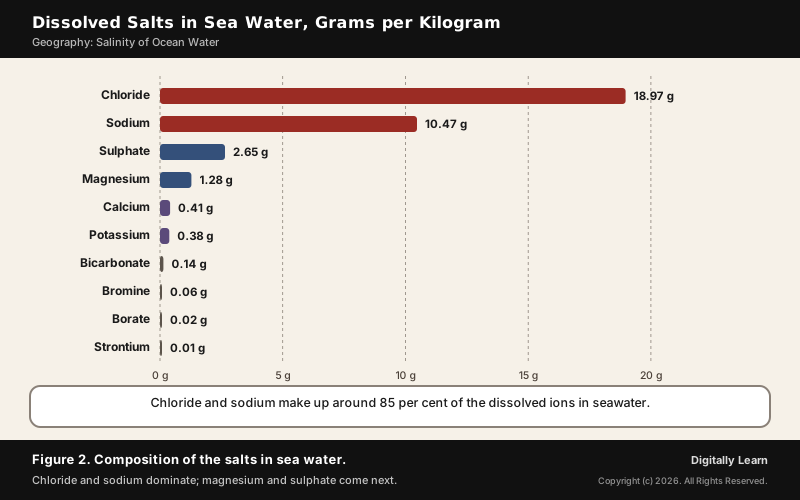
What is the significance of seawater chemistry? The composition of ocean salt is remarkably uniform across the world's ocean basins, a uniformity that itself encodes geological deep history. Six ions account for over ninety-nine percent of all dissolved solids in seawater, with sodium chloride dominating the inventory.

The proportional breakdown matters for three reasons: it explains why the ocean is salty in a specific chemical sense, it identifies the river and weathering inputs that maintain the balance, and it sets the platform for understanding marine biological chemistry that Parts 4 and 7 of the series develop.

  • (a) Chloride (Cl-). About 55 percent by mass of total dissolved solids. Sourced from continental weathering of chloride-bearing rocks, volcanic outgassing of hydrogen chloride, and ancient atmospheric deposition over geological time.
  • (b) Sodium (Na+). About 30 percent by mass. Largely from weathering of feldspar and other sodium-bearing silicate minerals on continents, transported to the ocean by rivers.
  • (c) Sulphate (SO4 2-). About 8 percent by mass. Sourced from weathering of sulphide-bearing rocks and from volcanic emissions of sulphur dioxide that oxidise in the atmosphere.
  • (d) Magnesium (Mg2+). About 4 percent by mass. From hydrothermal vent activity at mid-ocean ridges plus weathering of magnesium silicates and carbonates.
  • (e) Calcium (Ca2+). About 1 percent by mass. From limestone and dolomite weathering on continents. Marine organisms remove calcium from seawater to build shells and skeletons, balancing the river input.
  • (f) Potassium (K+). About 1 percent by mass. From silicate weathering and clay-mineral exchange. The remaining sub-percent inventory includes bicarbonate, bromide, strontium, and a long tail of trace elements down to gold and uranium at extremely low concentrations.

Sodium chloride dominance explained

Sodium chloride dominates because the two ions are unusually stable in aqueous solution and resist removal by marine biological or geochemical processes. Most other dissolved species cycle through the ocean rapidly. Calcium and silica are stripped by shell-building organisms in years to decades.

Composition of Sea Salt by WeightOcean Salinity Part 1Percentage share of major dissolved salts in seawaterSodium chloride (NaCl)77.7%Magnesium chloride (MgCl2)10.9%Magnesium sulphate (MgSO4)4.7%Calcium sulphate (CaSO4)3.6%Potassium sulphate (K2SO4)2.5%Other salts0.6%Sodium chloride alone accounts for over three-quarters of all dissolved salts.The next five compounds together make up the remaining 22 percent.Trace elements account for less than one percent of total dissolved solids.Reference: Garrison, Essentials of Oceanography; NCERT Class 11 Fundamentals of Physical Geography.Figure 1. Sea-salt compositionMajor dissolved salts as percentage of total salt weightDigitally LearnCopyright (c) 2026. All Rights Reserved.
Sea-salt composition by weight. Sodium chloride dominates the total dissolved salts at 77.7 percent.

Iron is biolimiting and present in vanishingly small concentrations. Sodium and chloride, by contrast, have ocean residence times of over fifty million years for sodium and roughly one hundred million years for chloride, allowing their concentrations to build up to the present levels.

The residence-time concept is critical to understanding why oceans are salty. Rivers supply roughly the same dissolved load today as they did in the geological past, but the slow residence time of sodium and chloride lets them accumulate. Marine organisms do not remove them efficiently, and the only major sink is evaporation in restricted basins that deposit halite. Over four billion years of ocean history, this asymmetry of input over removal explains why seawater carries the salinity it does.

Magnesium, calcium, potassium, sulphate, and their origins

Magnesium enters the ocean through two routes. The first is the slow weathering of magnesium-rich silicates and dolomites on continents, delivered by rivers. The second is hot reaction at mid-ocean ridges, where seawater circulates through fresh basalt and exchanges sodium and calcium for magnesium. Hydrothermal vents are therefore both a source of dissolved metals and a sink of magnesium, a balance that the geochemist Robert Berner mapped in his classic 1970s work on the long-term carbon cycle.

Calcium in seawater comes principally from continental limestone and dolomite weathering. The carbonate-bicarbonate system buffers ocean pH and supplies the calcium that coral reef builders, shellfish, and planktonic foraminifera use for their carbonate skeletons. The mass-balance closes when these organisms die, sink, and bury calcium carbonate in deep-sea sediments. Today's ocean acidification driven by anthropogenic carbon dioxide threatens this calcium cycle, a thread Part 4 of the series develops in the marine-ecosystem context.

Potassium reaches the ocean from silicate weathering but is partially stripped by clay-mineral ion exchange in shelf sediments. Sulphate arrives from continental sulphide weathering and from volcanic sulphur dioxide that oxidises in the atmosphere. Both ions sit at the one-to-eight-percent range of total dissolved load, sufficient to influence the ionic chemistry that controls coral physiology, fish osmoregulation, and seawater taste.

Chlorinity concept and its history

Chlorinity is the older measure of seawater salt content, defined as grams of chloride per kilogram of seawater. The Danish oceanographer Martin Knudsen published the canonical 1902 conversion formula salinity equals 1.80655 multiplied by chlorinity, which let chemists at sea measure chloride by silver-nitrate titration and then derive total salinity.

The 1902 standard remained the working procedure for nearly seventy years until conductivity-based instruments displaced it. Aspirants need to recognise chlorinity in Prelims questions on historical oceanography even though the field has moved on to PSU.

Residence times and why oceans stay at their present salinity

A natural follow-up question is why the ocean is at 35 ppt today, neither fresher nor saltier. The answer turns on the residence time of each dissolved species in seawater, which is the average time an atom of that species stays in solution before being removed by some natural sink.

Sodium has an ocean residence time of roughly fifty million years. Chloride, with very weak removal pathways, has a residence time near one hundred million years. Calcium, by contrast, is removed by shell-building organisms in about one million years.

Iron is biolimiting and present in trace amounts, with a residence time near a few hundred years. The wide range of residence times means that the dissolved load reflects a steady state between continental and volcanic inputs on one side, and biological plus geochemical removal on the other.

  • (i) Chloride. Roughly 100 million years. The most stable major ion in seawater because chloride binds weakly and is removed only by evaporite precipitation in restricted basins.
  • (ii) Sodium. Roughly 50 million years. Removed mainly by burial in evaporite deposits and through cation exchange in marine clays.
  • (iii) Magnesium. Roughly 10 million years. Removed at mid-ocean ridge hydrothermal systems where hot basalt scrubs magnesium from circulating seawater.
  • (iv) Potassium. Roughly 7 million years. Taken up by clay-mineral formation on the sea floor and by ridge hydrothermal alteration.
  • (v) Calcium. Roughly 1 million years. Pulled out steadily by marine organisms building calcium-carbonate shells and skeletons.
  • (vi) Bicarbonate. Roughly 100,000 years. The shortest residence time among the major dissolved species because biological carbon cycling moves it through the ocean rapidly.

The intuitive question of why oceans do not keep getting saltier as rivers keep delivering salt has a satisfying answer. Halite deposition in restricted basins through evaporite formation removes sodium and chloride at roughly the rate rivers supply them, on geological time scales.

The Mediterranean Sea did this entirely during the Messinian salinity crisis between 5.96 and 5.33 million years ago when the Strait of Gibraltar closed, evaporating most of the Mediterranean and leaving thick salt deposits across the seabed. Similar processes operate today at smaller scale in the Persian Gulf, the Red Sea, and the Dead Sea basin. The salt budget closes over geological time, holding the ocean near its present chemistry.

Trace elements tell the same residence-time story at smaller scale. Gold sits at 4 nanograms per litre, uranium at 3.3 micrograms per litre, iron at less than 1 microgram per litre in open-ocean surface water. Each has a distinctive removal pathway: scavenging by sinking particles, biological uptake, or sulphide precipitation. The trace-element fingerprint of seawater encodes the long history of biogeochemical cycling that geographers and geologists use to date ocean processes.

Sources of Ocean Salinity

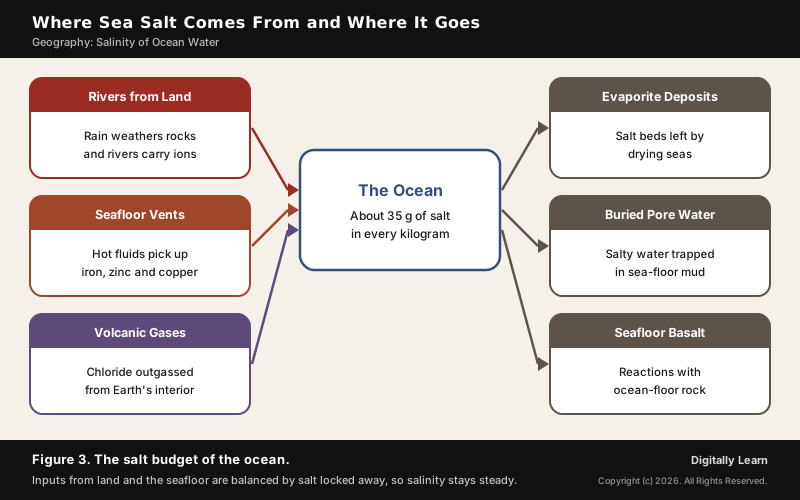
Continental weathering and riverine transport

The ocean's salt inventory accumulates from five geological sources, each with distinct chemistry, time scale, and exam-question relevance:

  • (i) Continental weathering of crustal rocks. Carbon dioxide dissolved in rainwater forms a weak carbonic acid that breaks down feldspar, mica, hornblende, and other silicate minerals on the continents. Dissolved sodium, potassium, calcium, magnesium, and bicarbonate enter rivers and reach the ocean. This is the primary long-term source of ocean salt, delivering roughly four billion tonnes of dissolved solids per year globally.
  • (ii) Riverine transport of dissolved minerals. Rivers integrate the weathering signal of continental drainage basins. The Amazon, Congo, Mississippi, and Ganga-Brahmaputra systems carry the largest dissolved loads. The Ganga-Brahmaputra discharge into the Bay of Bengal alone delivers enough freshwater and dissolved load to depress local surface salinity by several parts per thousand, a pattern Part 5 of the series develops in the Indian Ocean context.
  • (iii) Volcanic and hydrothermal activity. Submarine volcanism at mid-ocean ridges drives circulating seawater through fresh basalt at temperatures up to 350 degrees Celsius. The chemistry returning to the ocean is enriched in iron, manganese, copper, and zinc, depleted in magnesium and sulphate. Land-based volcanoes contribute hydrogen chloride, sulphur dioxide, and dissolved metals through ash deposition. The combined volcanic flux is a significant secondary source on geological time scales.
Continental Weathering and Riverine Salt TransportOcean Salinity Part 1Rocks weatherSilicate + carbonateweathering on landreleases Na, Mg, Ca, K, HCO3Rivers transport~37,000 km^3/year flowcarrying 3.7 bn t/yr saltsto oceans worldwideOceans receiveMajor ions accumulateremoved by sinks at ratematching deliverySelected rivers and dissolved-salt flux (million tonnes per year)RiverCountrySalt flux (Mt/yr)AmazonBrazil1,200GangaIndia490BrahmaputraIndia550YangtzeChina475MississippiUSA510Reference: Berner and Berner 2012, Global Environment; CWC India water resources data.Figure 7. Weathering and the riverine ion-delivery pipelineGlobal rivers deliver ~3.7 billion tonnes of dissolved salts to oceans…Digitally LearnCopyright (c) 2026. All Rights Reserved.
The continental weathering to riverine to ocean pipeline. Global rivers deliver ~3.7 billion tonnes of dissolved salts annually.

Atmospheric inputs and submarine volcanism

Atmospheric inputs add a fourth dimension to the salt budget. Sea-salt aerosols lofted from breaking waves carry chloride and sodium back to the ocean after short atmospheric residence. Wind-blown desert dust from the Sahara, the Gobi, and the Thar deposits significant iron and calcium across the open ocean, supporting plankton productivity in iron-limited regions like the equatorial Pacific. Anthropogenic sulphate from industrial sulphur dioxide emissions and acid rain has added a measurable signal to the ocean since the industrial revolution.

Submarine volcanism deserves separate treatment because its salt-budget effect runs through the unique chemistry of hydrothermal vent fluids. Black smoker vents at the East Pacific Rise, the Mid-Atlantic Ridge, and the Carlsberg Ridge in the Indian Ocean exchange salts between rock and water on a continuous basis.

The net effect is a long-term recycling system that has held ocean composition approximately steady for the last few hundred million years even as continents have shifted, sea levels have risen and fallen, and atmospheric chemistry has evolved.

A final source, sometimes overlooked, is groundwater discharge through coastal aquifers. Submarine groundwater discharge delivers nitrogen, phosphorus, and trace metals into nearshore zones. Recent estimates put this flux at roughly six percent of global riverine discharge, large enough to influence coastal-ocean chemistry and small enough to be excluded from open-ocean salt-budget calculations.

Geological time scales and the long-term salt balance

The five sources above operate on widely different time scales, and any account of ocean salinity benefits from recognising this temporal layering. Continental weathering delivers dissolved load on a geological time scale of millions to billions of years. Riverine transport responds on a seasonal-to-decadal scale, with monsoon-driven discharge concentrating most of the year's load into a few months. Submarine volcanism operates on a continuous geological scale tied to plate tectonics.

Atmospheric inputs operate on the shortest scale, with sea-salt aerosols cycling on days to weeks and dust deposition on annual cycles. Anthropogenic atmospheric inputs accelerated dramatically after the industrial revolution and now influence open-ocean acidity through atmospheric carbon dioxide more than through direct salt addition. The acidification effect, although chemically separate from salinity, interacts with the calcium and bicarbonate cycle that the composition section established.

The salt mass-balance equation in its simplest form reads: rate of salt addition equals rate of salt removal. The addition side aggregates river input, hydrothermal vent flux, volcanic emissions, and atmospheric deposition. The removal side aggregates evaporite deposition in restricted basins, ion exchange in sediments, and biological uptake. Modern estimates put each side at roughly four billion tonnes of salt per year on average, with the ocean returning to steady state on a few-million-year time scale after any perturbation.

Indian rivers contribute meaningfully to the global salt flux. The Ganga-Brahmaputra system delivers roughly 1.2 billion tonnes per year of total suspended and dissolved load to the Bay of Bengal, the second-highest globally after the Amazon.

The river system drains the weathering products of the world's youngest mountain range, which weathers faster than older shield areas elsewhere. Indian river chemistry, monitored by the Central Water Commission and ICAR institutes, captures this signature and forms the empirical basis for studies of Indian-Ocean salinity that Part 5 of the series develops.

Factors Affecting Ocean Salinity

Climatic factors: evaporation, precipitation, temperature, humidity, wind

Salinity at any ocean location reflects the balance of inputs and outputs to surface water. The textbook formula is straightforward: where evaporation exceeds precipitation, surface water concentrates and salinity rises; where precipitation exceeds evaporation, surface water dilutes and salinity falls. Three climatic forces drive this balance day-to-day and season-to-season.

Evaporation is the dominant salinity raiser. Tropical and subtropical seas under cloudless skies lose surface water to the atmosphere at rates exceeding 200 centimetres of water per year. The Red Sea, the Persian Gulf, and the western Mediterranean all sit in this evaporation-dominant regime and carry surface salinities above 38 ppt. Evaporation rate scales with sea-surface temperature, atmospheric humidity gradient, and wind speed through the bulk aerodynamic formula used in climate models.

Precipitation dilutes surface salinity wherever it exceeds evaporation. The equatorial belt under the Intertropical Convergence Zone receives over 200 centimetres of rain annually, and surface salinity in the eastern equatorial Pacific drops to 33-34 ppt as a result. The North Atlantic west of Britain receives heavy frontal rainfall through the year, and surface salinity falls accordingly.

Temperature influences salinity through three channels. Higher temperature drives more evaporation, raising salinity. Higher temperature also reduces gas solubility, expelling dissolved carbon dioxide and oxygen but not significantly affecting the dissolved-solid inventory. Finally, low temperatures at polar latitudes drive sea-ice formation, which concentrates salt in the residual liquid and creates dense brine plumes that sink to form intermediate and deep water masses.

Humidity and wind control the evaporation rate alongside temperature. Low atmospheric humidity above a warm ocean drives rapid evaporation, while high humidity suppresses it. Strong winds increase the moisture flux from sea to air and accelerate the salinity-concentration effect. The trade-wind belts that dominate the subtropical oceans combine high temperature, low humidity, and steady wind, producing the global salinity maxima found at roughly 25 to 35 degrees north and south latitude.

Evaporation minus Precipitation: The Dominant Salinity ControlOcean Salinity Part 160S30SEq30N60N-1500-1000-500050010001500Evaporation, precipitation, and E – P balance by latitude (mm/year)EvaporationPrecipitationE – P (net flux to atmosphere)Rate (mm/year)LatitudeFigure 8. E-P balance across the open oceanSubtropical highs (positive E-P) raise salinity; equatorial belt and high…Digitally LearnCopyright (c) 2026. All Rights Reserved.
Evaporation-minus-precipitation balance across the open ocean. Positive E-P regions concentrate salts; negative E-P regions dilute them.

Hydrological factors: rivers, freshwater, ice, ocean mixing

The second factor family operates through the freshwater side of the balance. River discharge dilutes coastal and marginal-sea waters wherever continental drainage reaches the ocean. The Amazon discharges roughly 200,000 cubic metres per second into the equatorial Atlantic and pushes a tongue of low-salinity water hundreds of kilometres into the open ocean. The Ganga-Brahmaputra system in the Bay of Bengal pushes salinity down from open-ocean values near 35 ppt to monsoon-season values near 30 ppt in the northern Bay.

Freshwater inflow from other land surfaces includes glacial melt, snowmelt runoff, and ungauged groundwater discharge. The Arctic Ocean receives substantial freshwater from Siberian and Canadian rivers as well as melting sea ice, holding surface salinity below 30 ppt across much of the central basin.

Ice formation and melting exert a two-way effect. When sea ice forms in polar winter, salt is excluded from the ice crystal and concentrates in the residual water, creating dense brine that sinks. When ice melts in spring, freshwater is added back, freshening the upper ocean. Polar oceans cycle between these states annually and on multi-year ice-sheet melt time scales.

Ocean currents and water mixing redistribute salinity across the basin. The Gulf Stream carries warm, salty subtropical water northward into the Norwegian Sea, where cooling and densification trigger the North Atlantic Deep Water formation that Part 2 of the series develops in detail. The California Current and the Benguela Current similarly carry their salinity signatures equatorward along the western continental margins.

Wind-driven mixing, Ekman pumping, and salinity homogenisation

A separate factor that crosses the climatic and hydrological categories is wind-driven mixing. Steady winds blowing across the ocean surface drag the top few metres of water in the direction of the wind. The Earth's rotation deflects this surface drift to the right in the Northern Hemisphere and to the left in the Southern Hemisphere through the Ekman mechanism. The net mass transport sits at right angles to the wind direction.

Ekman pumping produces a dome-and-basin structure of the upper ocean. Under the subtropical high-pressure cells, surface waters converge and sink, deepening the warm, salty mixed layer of the subtropical gyres. Under the polar low-pressure systems, surface waters diverge and upwell, bringing colder, slightly fresher water to the surface. The salinity imprint of these Ekman patterns is visible in satellite-derived global salinity maps as smooth, basin-scale features that follow the surface wind field.

Storm mixing homogenises the surface mixed layer on shorter time scales. A passing tropical cyclone or extratropical storm can mix the upper hundred metres of the ocean in a few hours, erasing the day-to-day salinity gradient that calm conditions establish. In the Bay of Bengal during the southwest monsoon, intense cyclonic activity combines with heavy river inflow and rainfall to produce extreme upper-ocean salinity gradients that Part 5 of the series treats in detail.

Internal waves and turbulence below the surface mixed layer redistribute salinity at scales smaller than satellite measurement can resolve. The cumulative effect of these small-scale processes determines how quickly the salty surface layer of the subtropics communicates with the fresher waters below. Climate models that fail to represent this sub-grid mixing accurately produce systematic salinity biases that bias their projections of future climate states.

Geographical factors: latitude, enclosed seas, coastal vs open ocean, depth

The third factor family is geographical. Latitude controls the global pattern through its effect on climate. Equatorial latitudes receive heavy rainfall and show salinity minima. Subtropical latitudes under high-pressure cells receive little rain and show salinity maxima. Polar latitudes receive moderate precipitation but also receive heavy freshwater input from ice melt and river discharge, producing salinity minima at high latitudes as well.

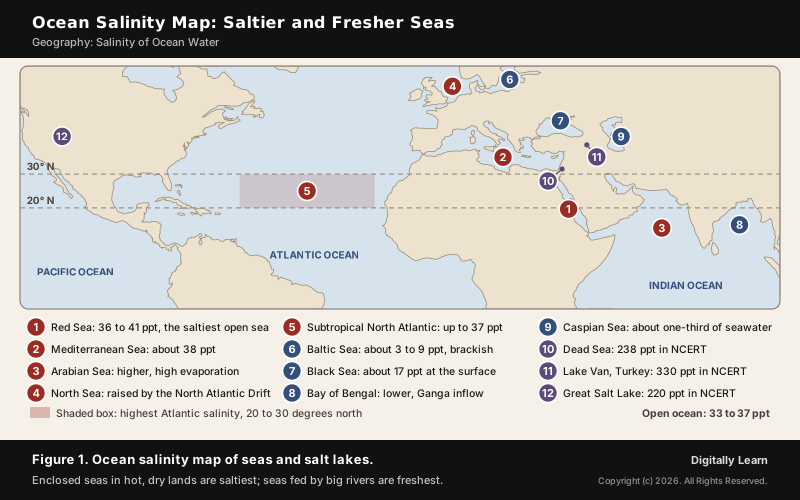
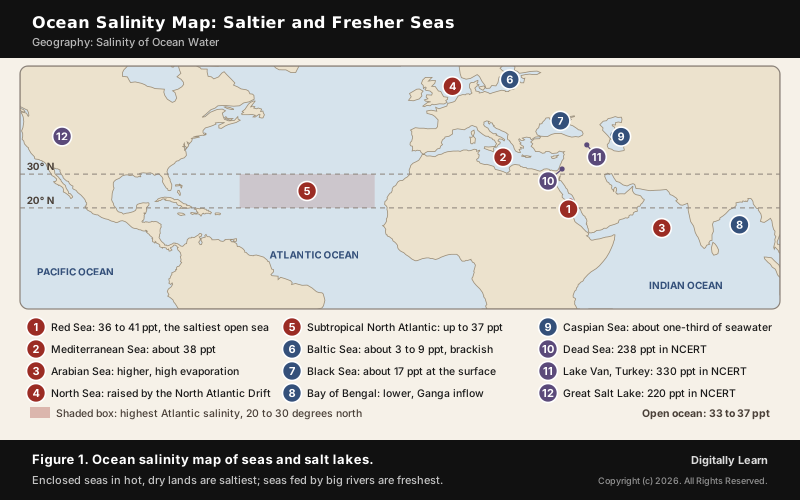
Enclosed seas versus open oceans show salinity ranges much wider than the open ocean's 32 to 38 ppt band. Restricted exchange with the open ocean lets local climate conditions dominate. The Red Sea, restricted to the Indian Ocean through the 30-kilometre-wide Bab-el-Mandeb strait, reaches salinity above 41 ppt under intense evaporation.

The Mediterranean Sea, restricted to the Atlantic through the Strait of Gibraltar, sustains 37 to 38 ppt. The Baltic Sea, restricted by the Danish Straits and receiving heavy river input, falls as low as 5 ppt in the Gulf of Bothnia. The Dead Sea, which has no outflow, reaches an astonishing 275 ppt and supports only specialised salt-tolerant microorganisms.

Marginal seas and ocean basins compared. Restricted exchange + evaporation-precipitation balance + river input together determine the wide salinity spread.
Sea or basin Surface salinity (ppt) Dominant driver
Baltic Sea 5 to 15 Massive river input plus low evaporation in a restricted basin
Black Sea 17 to 18 Heavy river discharge plus restricted exchange via the Bosphorus
Bay of Bengal 30 to 34 Ganga-Brahmaputra discharge plus monsoon rainfall
Pacific (open) 34 to 35 Higher precipitation plus river input plus weaker evaporation
Arabian Sea 35 to 36 Moderate evaporation; monsoon-driven seasonal variability
Atlantic (open) 35 to 37 Higher net evaporation; trade-wind regime
Mediterranean Sea 37 to 38 Strong evaporation; weak river input; restricted Gibraltar
Persian Gulf 37 to 41 Extreme evaporation; restricted Strait of Hormuz
Red Sea 40 to 41 Extreme evaporation; zero river input; restricted Bab-el-Mandeb

Coastal versus open-ocean salinity differs systematically. River discharge depresses coastal salinity near major delta systems, and the proximity to land allows weathering inputs to influence coastal chemistry. Open-ocean salinity, by contrast, reflects the longer-term integrated balance of evaporation, precipitation, and basin-scale circulation. Coastal upwelling regions add another wrinkle: cold, salty deep water rises to the surface and lifts coastal salinity above the open-ocean value at the same latitude.

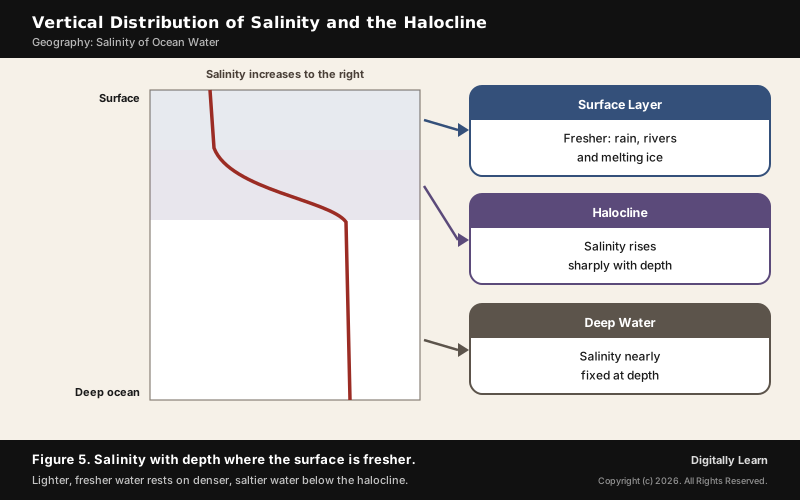
Depth variation in salinity reveals a layered ocean. The surface mixed layer responds to weather-scale forcing through evaporation and precipitation. Below the mixed layer, a halocline separates the variable surface from the more uniform deep ocean.

Deep waters below the halocline carry the salinity signature of their formation region. North Atlantic Deep Water originating in the Norwegian Sea sits near 34.9 ppt across the deep Atlantic. Antarctic Bottom Water originating around Antarctica sits near 34.7 ppt across the deep Indian and Pacific Oceans.

Distribution of Ocean Salinity

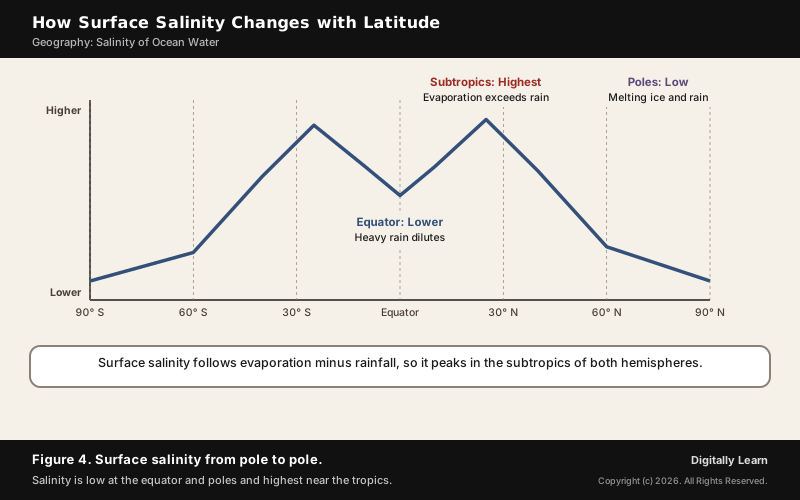
Latitudinal distribution: equatorial low, subtropical high, polar low

Latitudinal salinity follows a global pattern set by the climate factors above. Three zones repeat in mirror image across the equator:

  • (a) Equatorial low-salinity belt. From roughly 5 degrees south to 10 degrees north, the Intertropical Convergence Zone delivers heavy rainfall and net precipitation exceeds evaporation. Surface salinity falls to 33 to 35 ppt. The eastern equatorial Pacific shows the lowest open-ocean salinities globally outside polar regions, reflecting both rainfall and the river discharge of the Amazon and the Congo.
  • (b) Subtropical high-salinity zones. Between roughly 20 and 35 degrees north and south, descending atmospheric circulation under subtropical high-pressure cells produces dry, cloudless conditions with intense evaporation. Surface salinity rises to 36 to 38 ppt across the North Atlantic Subtropical Gyre, the South Atlantic Subtropical Gyre, the South Pacific Subtropical Gyre, and the central Indian Ocean. These are the saltiest open-ocean waters on Earth.
  • (c) Polar low-salinity regions. Poleward of 55 degrees, freshwater input from sea-ice melt, glacier discharge, and river systems combines with reduced evaporation under cold conditions. Surface salinity falls to 32 to 34 ppt across most of the Arctic Ocean and the Southern Ocean. The Arctic, with substantial river inflow from Siberia and Canada and pronounced summer ice melt, shows the freshest open-ocean surface waters at high latitudes.
Latitudinal Distribution of Surface SalinityOcean Salinity Part 1Surface salinity (ppt) by latitude across the open ocean33343536373890S60S30SEq30N60N90NSubtropical highSubtropical highEquatorial lowPolar lowPolar lowSalinity (ppt)LatitudeReference: NOAA World Ocean Atlas 2018; IMD Marine Climatology; NCERT Class 11.Figure 2. Latitudinal salinity zonesSubtropical highs near 25 degrees, equatorial dip from rainfall, polar low…Digitally LearnCopyright (c) 2026. All Rights Reserved.
Latitudinal salinity zones. Subtropical highs near 25 degrees, equatorial dip from rainfall, polar low from melt and runoff.
Global Surface Salinity DistributionOcean Salinity Part 1Atlantic~36 pptPacific~34.5 pptIndian32-37 pptSalinity bands:Subtropical high (36-37 ppt)Equatorial low (34-35 ppt)Polar low (32-33 ppt)Reference: NOAA World Ocean Atlas 2018 climatology; schematic representation only.Figure 9. Schematic global surface salinity (Atlantic vs Pacific vs Indian)Atlantic averages ~36 ppt; Pacific averages ~34.5 ppt; Indian Ocean shows…Digitally LearnCopyright (c) 2026. All Rights Reserved.
Global surface salinity distribution. Atlantic averages higher than Pacific; Indian Ocean shows the widest spread.

Vertical distribution: surface, halocline, deep ocean

The vertical structure of salinity reveals three distinct zones. The surface mixed layer, typically the upper 50 to 200 metres, responds to the climate factors discussed above and shows the largest spatial variability. The halocline, a zone of rapid salinity change with depth, separates the variable surface from the more uniform deep ocean. The deep ocean, from below the halocline down to the seafloor, carries the salinity signature of its formation region almost unchanged for centuries.

The halocline forms differently in different latitudes. In subtropical regions, evaporation makes the surface saltier than the water below, producing an unstable column that mixes vertically until temperature stratification stabilises it. In polar regions, surface freshening from ice melt and river inflow produces a stable halocline with fresh water above and saltier water below. The Arctic Ocean halocline is particularly pronounced and plays a central role in Arctic sea-ice dynamics.

Vertical Salinity Profile of the Open OceanOcean Salinity Part 1Depth (m) versus salinity (ppt) showing mixed layer, halocline, deep ocean050010002000300040003334353637Mixed layer (0-100 m)Halocline (100-1000 m)Deep ocean (1000-4000 m)Depth (m, 0 = surface)Salinity (ppt)Low-latitude / subtropical profileHigh-latitude / polar profileFigure 3. Vertical salinity profileMixed layer, halocline, and deep ocean across low and high latitudesDigitally LearnCopyright (c) 2026. All Rights Reserved.
Vertical salinity profile of the open ocean. Mixed layer, halocline, and deep-ocean band shown across low-latitude and high-latitude conditions.

Deep ocean salinity sits in a narrow band from 34.6 to 34.9 ppt almost everywhere below 1,500 metres depth. This uniformity tells the story of slow ocean turnover: deep water originating in the North Atlantic and around Antarctica spreads across the global ocean over a 1,000 to 2,000 year cycle, carrying its formation-region salinity intact.

The slow turnover is also why anthropogenic carbon dioxide takes centuries to penetrate the full ocean depth, a thread Part 3 of the series develops in the climate-change context.

Regional distribution: Atlantic, Pacific, Indian, Mediterranean, Baltic, Red Sea

Regional salinity values reveal each ocean basin's distinctive climate signature. The Atlantic Ocean sustains the highest open-ocean salinity globally, averaging 35 to 37 ppt in the surface layer. The basin sits under the strongest trade-wind belts and loses more freshwater to evaporation than the Pacific receives. The North Atlantic Subtropical Gyre near Bermuda reaches 37 ppt regularly.

The Pacific Ocean averages roughly 34 to 35 ppt at the surface, slightly fresher than the Atlantic. Three factors lower Pacific salinity: heavier precipitation in the equatorial and western Pacific Warm Pool, substantial river input from the western Pacific rim, and less efficient evaporation under the western Pacific's cloud cover. The North Pacific Subtropical Gyre reaches 35 ppt but rarely 36 ppt.

The Indian Ocean shows the largest internal salinity contrast of any ocean basin. The northern Arabian Sea sustains 36 to 37 ppt under intense evaporation and limited river inflow. The Bay of Bengal falls to 30 to 33 ppt under heavy monsoon rainfall and massive Ganga-Brahmaputra discharge. This north-Indian-Ocean salinity dichotomy is a Mains-paper staple and receives a full part-length treatment in Part 5 of the series.

Regional Surface Salinity ComparisonOcean Salinity Part 1Representative surface salinity values (ppt) for selected ocean regions and marginal seasRed Sea40.5 pptExtreme evaporation, no riversPersian Gulf39.0 pptHigh evaporation, restricted exchangeMediterranean Sea37.5 pptStrong evap, Gibraltar restrictionAtlantic (open)36.0 pptHigher than Pacific averageArabian Sea35.5 pptModerate evaporation, monsoonPacific (open)34.5 pptHigher precipitation, river inputBay of Bengal32.0 pptGanga-Brahmaputra dischargeBaltic Sea10.0 pptMassive river input, low evapReference: NOAA World Ocean Atlas 2018; INCOIS Annual Reports; ICAR-CMFRI bulletins.Figure 4. Regional salinity contrastSurface salinity (ppt) across open oceans, marginal seas, and Indian Ocean…Digitally LearnCopyright (c) 2026. All Rights Reserved.
Regional surface salinity. Red Sea is the saltiest at over 40 ppt; Baltic Sea is the freshest at around 10 ppt; the Bay of Bengal sits ~3 ppt below the Arabian Sea due to massive river discharge.

Marginal seas illustrate the geographical-factor effects at their extreme. The Mediterranean Sea sustains 37 to 38 ppt under semi-enclosed conditions, with the eastern basin reaching 39 ppt off the Levantine coast. Mediterranean outflow at the Strait of Gibraltar contributes a dense, saline tongue to the North Atlantic Deep Water that Part 2 develops in detail.

The Baltic Sea falls to 3 to 15 ppt across its basin, with the Gulf of Bothnia at the north essentially brackish at 5 ppt. The Red Sea reaches 40 to 41.5 ppt, the highest open marine salinity globally, under semi-arid climate and restricted exchange with the Indian Ocean through the 30-kilometre-wide Bab-el-Mandeb strait.

Satellite missions are reshaping the regional distribution picture in real time. NASA's Aquarius mission from 2011 to 2015 produced the first global sea-surface salinity maps with monthly resolution. The Soil Moisture Active Passive satellite continues the record. Indian satellite-based salinity monitoring is run by the Indian National Centre for Ocean Information Services in Hyderabad alongside the Ministry of Earth Sciences ocean observation network.

The Argo programme operates roughly four thousand profiling floats across the global ocean and provides continuous subsurface salinity data feeding climate models, monsoon forecasting, and fisheries advisories. Climate-change-driven shifts in salinity, including freshening of polar oceans and intensifying subtropical maxima, are now measurable on satellite records and discussed across Parts 3 and 7 of the series.

Indian Ocean: Arabian Sea vs Bay of Bengal ContrastOcean Salinity Part 1Arabian Sea35.0 – 36.5 pptHigh evaporation, low riverinput, semi-enclosed basinEvaporation: HIGHRiver inflow: LOWMonsoon: variableBottom water: O2-poorBay of Bengal30.0 – 34.0 pptMassive Ganga-Brahmaputradischarge, monsoon rainfallGanga: 490 Mt/yr saltsBrahmaputra: 550 Mt/yrSurface fresheningStrong vertical gradient~3 ppt salinity contrastdriven by E-P balance and river forcingReference: INCOIS Indian Ocean climatology; CWC river-discharge data; ICAR-CMFRI bulletins.Figure 10. The Arabian Sea-Bay of Bengal salinity asymmetryBay of Bengal 30-34 ppt (heavy Ganga-Brahmaputra discharge); Arabian Sea…Digitally LearnCopyright (c) 2026. All Rights Reserved.
The Arabian Sea-Bay of Bengal salinity asymmetry. ~3 ppt contrast driven by river forcing on the Bengal side and evaporation dominance on the Arabian side.

Atlantic-Pacific salinity asymmetry and observed shifts

A long-standing puzzle in physical oceanography is the persistent salinity asymmetry between the Atlantic and the Pacific. The Atlantic averages roughly 35 to 37 ppt at the surface, while the Pacific averages 34 to 35 ppt. This 1 to 2 ppt difference is small in absolute terms but powers a major feature of global circulation, namely the formation of North Atlantic Deep Water that does not have a Pacific counterpart.

The asymmetry arises from a combination of atmospheric water-vapour transport and basin geometry. Trade winds blow westward across the tropical Atlantic and lift moisture from the Atlantic surface into the atmosphere. This moisture is then carried across Central America by the prevailing easterlies and deposited as rain over the eastern Pacific. The net effect is to remove freshwater from the Atlantic and add it to the Pacific, raising Atlantic salinity and lowering Pacific salinity by roughly the observed amount.

Climate models that close the Atlantic to vapour transport across the isthmus of Panama produce a near-symmetric Atlantic-Pacific salinity pattern. Models that include the transport reproduce the observed asymmetry. This finding, published across multiple modelling studies since the 1990s, anchors a broader argument that subtle atmospheric pathways shape ocean chemistry on long time scales.

Observed multi-decadal shifts in salinity have emerged clearly since the Argo era began in 2000. The subtropical Atlantic and Indian Oceans have saltened by roughly 0.1 ppt per decade in the surface mixed layer, while polar Arctic and sub-Arctic waters have freshened by similar magnitudes.

This pattern is consistent with an intensifying global hydrological cycle under warming: more evaporation in subtropical regions concentrates surface salt, while more polar precipitation plus ice melt freshens high latitudes. The intensification rate is several times what climate models projected through the 2000s, which has prompted urgent re-evaluation of climate sensitivity in the salinity context.

Prelims MCQ practice

Each question below tests one specific concept from this article. Click to reveal the answer and a full option-wise explanation.

Q1. Consider the following statements about ocean salinity:

  1. Ocean salinity is conventionally expressed in parts per thousand and the dimensionless Practical Salinity Unit.
  2. The global average ocean salinity is approximately 35 grams of dissolved solids per kilogram of seawater.

Which of the statements given above is/are correct?

  1. 1 only
  2. 2 only
  3. Both 1 and 2
  4. Neither 1 nor 2
Show answer and explanation

Answer: Both 1 and 2

Explanation.

Correct: c (Both 1 and 2). Statement 1 is correct: ppt remains the classical notation and PSU was adopted by IOC-UNESCO in 1978. Statement 2 is correct: 35 ppt or 35 g/kg is the canonical global mean from the HMS Challenger expedition onwards, refined by modern CTD and Argo data.

· Trap type: definitional_completeness

Q2. With reference to the composition of major dissolved salts in seawater, consider the following statements:

  1. Chloride accounts for approximately 55 percent of total dissolved solids by mass.
  2. Sodium accounts for approximately 30 percent of total dissolved solids by mass.
  3. Calcium accounts for approximately 40 percent of total dissolved solids by mass.

Which of the statements given above are correct?

  1. 1 and 2 only
  2. 2 and 3 only
  3. 1 and 3 only
  4. 1, 2 and 3
Show answer and explanation

Answer: 1 and 2 only

Explanation.

Correct: a (1 and 2 only). Statement 1 is correct: chloride dominates at 55 percent. Statement 2 is correct: sodium follows at 30 percent. Statement 3 is incorrect: calcium accounts for only about 1 percent of total dissolved solids; magnesium is at 4 percent and sulphate at 8 percent. The inversion of the calcium figure is the trap.

· Trap type: numerical_inversion

Q3. Consider the following statements regarding the foundation of modern ocean salinity science:

  1. HMS Challenger sailed from Portsmouth in 1872 and conducted the first systematic global ocean survey.
  2. Marcet's Principle of Constant Proportions states that the relative proportions of major dissolved salts remain almost constant across ocean basins, even as total concentration varies.

Which of the statements given above is/are correct?

  1. 1 only
  2. 2 only
  3. Both 1 and 2
  4. Neither 1 nor 2
Show answer and explanation

Answer: Both 1 and 2

Explanation.

Correct: c (Both 1 and 2). Statement 1 is correct: the Challenger expedition ran from December 1872 to May 1876 and established systematic oceanography. Statement 2 is correct: William Dittmar's chemical analyses of Challenger seawater samples codified the constant-proportions principle, which underpins modern conductivity-based salinity measurement.

· Trap type: historical_factual

Q4. Consider the following statements about climatic factors affecting ocean salinity:

  1. Surface salinity rises where evaporation exceeds precipitation.
  2. The subtropical latitudes between 20 and 35 degrees north and south show the highest open-ocean salinity globally.
  3. The equatorial belt shows the highest salinity globally because of intense solar heating.

Which of the statements given above are correct?

  1. 1 and 2 only
  2. 2 and 3 only
  3. 1 and 3 only
  4. 1, 2 and 3
Show answer and explanation

Answer: 1 and 2 only

Explanation.

Correct: a (1 and 2 only). Statement 1 is correct: the evaporation-minus-precipitation balance sets local salinity. Statement 2 is correct: subtropical high-pressure cells produce the global open-ocean salinity maxima. Statement 3 is incorrect: the equatorial belt has heavy ITCZ rainfall and shows salinity minima, not maxima; solar heating alone does not raise salinity if rainfall offsets evaporation.

· Trap type: causality_inversion

Q5. With reference to regional ocean salinity distribution, consider the following statements:

  1. The Red Sea, the world's saltiest open marine water, sustains salinity above 40 ppt under semi-arid climate and restricted exchange with the Indian Ocean.
  2. The Baltic Sea falls to about 5 ppt in the Gulf of Bothnia under heavy river input and restricted Atlantic exchange.
  3. The Arabian Sea sustains lower surface salinity than the Bay of Bengal because of stronger river inflow.

Which of the statements given above are correct?

  1. 1 and 2 only
  2. 2 and 3 only
  3. 1 and 3 only
  4. 1, 2 and 3
Show answer and explanation

Answer: 1 and 2 only

Explanation.

Correct: a (1 and 2 only). Statement 1 is correct: Red Sea reaches 40 to 41.5 ppt through Bab-el-Mandeb-restricted exchange and intense evaporation. Statement 2 is correct: Baltic Sea falls to 5 ppt under freshwater dominance. Statement 3 is incorrect and inverted: the Arabian Sea sustains higher salinity (37 ppt) than the Bay of Bengal (30 ppt); the Bay of Bengal carries more river inflow from the Ganga-Brahmaputra system and shows lower salinity.

· Trap type: scope_inversion

Q6. Consider the following statements about vertical salinity structure in the ocean:

  1. The halocline is a layer of rapid salinity change with depth that separates the variable surface mixed layer from the more uniform deep ocean.
  2. Deep ocean salinity below 1,500 metres sits in a narrow band of approximately 34.6 to 34.9 parts per thousand across most of the global ocean.
  3. The Arctic Ocean halocline is weak because polar surface waters are saltier than the deep water below.

Which of the statements given above are correct?

  1. 1 and 2 only
  2. 2 and 3 only
  3. 1 and 3 only
  4. 1, 2 and 3
Show answer and explanation

Answer: 1 and 2 only

Explanation.

Correct: a (1 and 2 only). Statement 1 is correct: halocline definition holds across oceanographic textbooks. Statement 2 is correct: deep ocean salinity narrowness reflects the slow 1,000 to 2,000 year turnover. Statement 3 is incorrect and inverted: the Arctic Ocean halocline is particularly pronounced because polar surface waters are FRESHER (from sea-ice melt and river inflow) than the saltier water below, not the reverse.

· Trap type: spatial_zone_misattribution

Sources

Editorial Disclaimer

This article is compiled from the reference materials listed in the Sources section. It is an explainer for UPSC preparation and is not a substitute for primary documents (NCERTs, GoI ministry releases, IMD bulletins, RBI / CEA / MoEFCC publications, and Standing-Committee reports).

Part 1 of 2 · Ocean Salinity

All 2 parts in this cluster
  1. 1 Part 1: Definition, Composition, Sources, Factors, Distribution (this article)
  2. 2 Part 2: Thermohaline Circulation and Stratification