


Overview
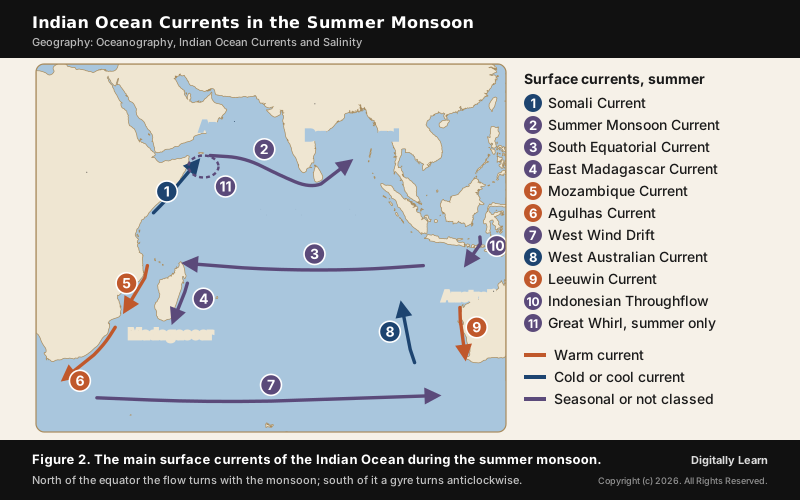
Indian Ocean currents differ from those of other oceans because Asia closes the basin in the north. North of the equator they reverse with the monsoon, the monsoon drift: westward from January to March, eastward from April to November. South of the equator an anticlockwise gyre of the South Equatorial, Agulhas and West Australian Currents turns. Evaporation makes the Arabian Sea salty, above 36 PSU, while rivers and rain keep the Bay of Bengal near 33.
The Indian Ocean: A Basin Closed in the North
Indian Ocean Basin: Extent, Depth and the Warm Pool
The Indian Ocean is the third-largest of the world's oceanic divisions. It covers about 70.56 million square kilometres, roughly 20 per cent of the water area of the Earth's surface, and is bounded by Asia to the north, Africa to the west and Australia to the east. Its marginal seas include the Arabian Sea, the Bay of Bengal, the Andaman Sea and the Laccadive Sea. Geologically it is the youngest ocean, formed as the Tethys Ocean broke up, and its average depth is 3,741 metres.
It is also the warmest ocean, and it forms the core of the Tropical Warm Pool, whose exchange of heat with the atmosphere affects climate across the region and the world. The reason lies in its shape. Asia closes the ocean in the north, which blocks the export of heat and prevents the ventilation of the Indian Ocean thermocline. Asia also drives the strongest monsoon on Earth, and that monsoon sets the pattern of the currents described below.
Forces Behind Ocean Currents and Warm and Cold Currents
Forces That Influence Ocean Currents: Heating, Wind, Gravity and Coriolis Force
Ocean currents are like rivers within the ocean: a regular volume of water moving along a definite path and in a definite direction. Two kinds of force act on them. Primary forces start the water moving, and secondary forces influence how the current then flows.
- Heating by solar energy: Warmed water expands, so near the equator the ocean surface stands about 8 cm higher than in the middle latitudes. Water tends to flow down this very slight slope.
- Wind: Wind blowing over the surface pushes the water, and friction between air and water carries the movement along.
- Gravity: Gravity pulls the piled-up water down the slope and creates differences in level.
- Coriolis force: Because the Earth rotates, moving water is deflected to the right in the Northern Hemisphere and to the left in the Southern Hemisphere. Large circular currents called gyres form in every ocean basin as a result.
Differences in density decide the vertical movement. Water that is saltier or colder is denser and tends to sink, while lighter water rises; cold water sinking at the poles moves slowly towards the equator, and warm surface water moves out from the equator to replace it. Surface currents make up about 10 per cent of the ocean's water, in the upper 400 metres; deep currents move the other 90 per cent. Currents are strongest at the surface, where they may exceed five knots, and generally slower than 0.5 knots at depth.
Warm and Cold Currents and Their Effect on Regional Climates
Currents are also classed by temperature. A cold current brings cold water into warmer areas and is usually found on the west coasts of continents in the low and middle latitudes of both hemispheres. A warm current brings warm water into colder areas and usually flows along the east coasts of continents in the low and middle latitudes. These currents shape the climate of the coasts beside them.
- West coasts beside cool water: In tropical and subtropical latitudes, away from the equator, these coasts have relatively low temperatures with narrow daily and annual ranges. Fog is common, but the land is generally arid.
- West coasts beside warm water: In the middle and higher latitudes warm water gives a marine climate of cool summers and relatively mild winters.
- East coasts beside warm currents: In tropical and subtropical latitudes they have warm and rainy climates.
| Current | Where it flows | Type |
|---|---|---|
| Somali Current | North along Somalia and Oman in summer, south in winter | Cold boundary current |
| Agulhas Current | South along the east coast of Africa, 27° S to 40° S | Warm (east coast, low and middle latitudes) |
| Mozambique Current | South through the Mozambique Channel | Warm |
| Leeuwin Current | South near the west coast of Australia | Warm |
| West Australian Current | North off Western Australia | Cool |
| South Equatorial Current | West between the equator and about 20° S | Westward drift of the gyre |
| West Wind Drift | East around Antarctica | Circumpolar drift |
Monsoon Drift: Indian Ocean Currents That Reverse with the Seasons
Why North Indian Ocean Currents Reverse: Land Mass and Monsoon Winds
In the tropical Atlantic and Pacific the surface winds north of the equator blow from the northeast all year, and the currents below them flow west all year. The Indian Ocean differs because a continental land mass forms a complete northern boundary at low latitudes. Land heats and cools faster than water, so the pressure over Asia changes with the seasons, and the winds over the ocean change with it.
- Winter: The cool Asian land mass holds a broad area of high pressure, while pressure is lower over the warmer ocean. This reinforces the northeasterly winds, which blow from October until April.
- Summer: The Indian subcontinent heats strongly and creates low pressure to the north. Strong winds then blow from the southwest over the Arabian Sea and along the Somali coast, and from May until October south and west winds prevail.
The water does not move straight downwind. Because of the Coriolis effect, surface flow in the Northern Hemisphere is turned to the right of the wind, so southwest winds produce eastward currents and northeast winds produce westward currents. This reversal is called the monsoon drift. Even at the equator the pattern differs from other oceans: there are no continuous equatorial easterlies, and because the winds on the equator reverse twice a year, the surface current there can flow either east or west.
Southwest and Northeast Monsoon Currents: Paths and Timing
The seasonally reversing currents that pass south of India are called the Winter Monsoon Current and the Summer Monsoon Current, or the Northeast Monsoon Current and the Southwest Monsoon Current. Mariners knew of them for nearly a thousand years, but a detailed understanding came only after the International Indian Ocean Expedition of the 1960s.
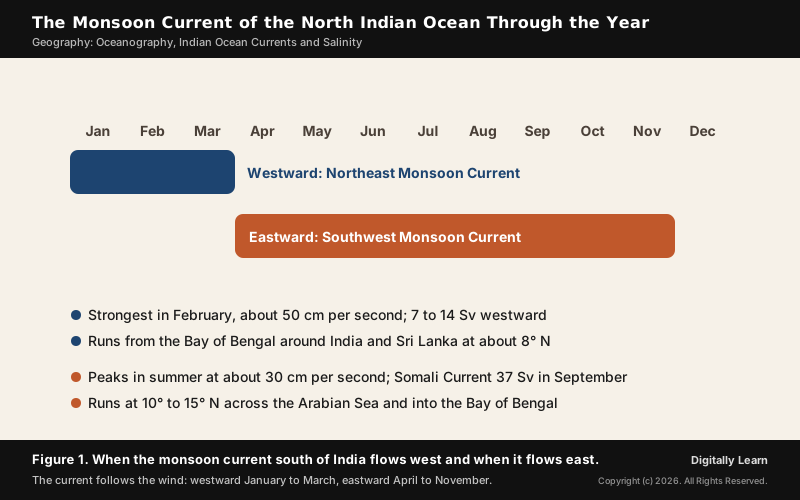
- Northeast Monsoon Current: It runs from the Bay of Bengal around India and Sri Lanka and across the Arabian Sea at about 8° N, then southwest along the Somali coast to the equator. It flows west only from January to March, is strongest in February at about 50 cm per second, and carries an estimated 7 to 14 Sv.
- Southwest Monsoon Current: It lies between 10° and 15° N in the Arabian Sea, bends around India and Sri Lanka, and enters the Bay of Bengal. It flows east from April to November and peaks in summer at about 30 cm per second.
- Great Whirl: A gyre near 10° N and 55° E, off the Horn of Africa, present only in the summer season.
South of the equator the picture is steadier. The westward South Equatorial Current is well developed only south of the equator in the Indian Ocean, and the eastward equatorial counter-current, which in the Atlantic and Pacific runs at about 3° to 10° N, tends to switch hemispheres with the season in this basin.
Somali Current: Western Boundary Current and Upwelling
The Somali Current is a cold boundary current along the coasts of Somalia and Oman, often compared with the Gulf Stream of the Atlantic. It is the only major upwelling system on the western boundary of an ocean, and the monsoon governs it. From mid-May the southwest monsoon drives it northeastwards at about 2.0 metres per second, rising to 3.5 metres per second and more in June. It travels about 1,500 km and, near Cape Guardafui at 6° to 10° N, turns east to join the monsoon current. In mid-September 1995 it was measured carrying 37 Sv.
The upwelling along this coast follows from the wind. A narrow low-level wind, the Somali or Findlater Jet, blows across the ocean parallel to the coasts of Somalia and Oman. The water is pushed to the right of the wind, away from the coast, and cold water rises from below to replace it. Open-ocean upwelling under the jet adds to the coastal upwelling, and by August and September the upwelled water near the northern Somali coast can be colder than 17 °C.
In autumn the current weakens. In early December it reverses, first south of 5° N and by January up to 10° N, and through the northern winter it flows south at 0.7 to 1.0 metres per second.
The Southern Indian Ocean Gyre and Links to Other Oceans
South Equatorial, Agulhas and West Australian Currents of the Southern Gyre
Two large gyres dominate the flow of the Indian Ocean: one north of the equator turning clockwise and one south of it turning anticlockwise. The southern one is the Subtropical Anticyclonic Gyre.
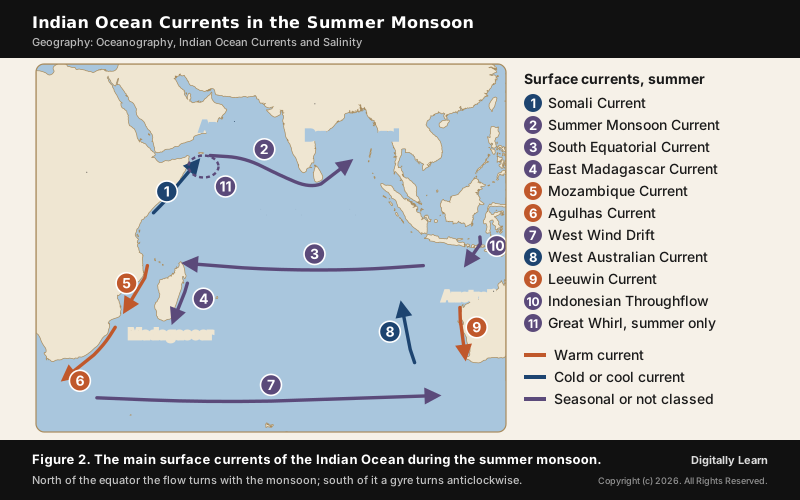
- South Equatorial Current: Flows west between the equator and about 20° S. It is the westward limb of the gyre, driven by the trade winds.
- East Madagascar and Mozambique Currents: The East Madagascar Current flows south from 20° S along the east side of Madagascar, and warm surface water flows south through the Mozambique Channel, though often as a train of large eddies rather than a steady stream. Both feed the Agulhas Current.
- Agulhas Current: The western boundary current of the southwest Indian Ocean, flowing south along the east coast of Africa from 27° S to 40° S. It is narrow, swift and strong; with an estimated net transport of about 70 Sv it may be the largest western boundary current in the world, against 34 Sv for the Gulf Stream.
- West Wind Drift: The Antarctic Circumpolar Current flows from west to east around Antarctica, south of the gyre.
- West Australian and Leeuwin Currents: The cool West Australian Current flows north off Western Australia, while the warm Leeuwin Current flows south close to the same coast, an unusual pair running in opposite directions.
Indonesian Throughflow and Deep Water Entering the Indian Ocean
The Indian Ocean has a unique equatorial connection to the Pacific. Through the Indonesian Throughflow, warm and relatively fresh water moves from the Pacific into the Indian Ocean; it is a main upper branch of the global heat and salt conveyor belt. The sea surface of the far western Pacific stands higher on average than the adjacent Indian Ocean, and the difference drives water downhill through the Makassar Strait. About 15 per cent leaves through the narrow Lombok Strait, 300 metres deep and about 35 km wide, and about 85 per cent through the Timor and Ombai passages.
Water also leaves and enters in other ways. As much as 15 Sv of Indian Ocean water leaks past the tip of Africa into the South Atlantic where the Agulhas Current turns back on itself. At depth, about 11 Sv of deep water flows in, mostly Circumpolar Deep Water; North Atlantic Deep Water reaches the Indian Ocean south of Africa at 2,000 to 3,000 metres, and Antarctic Bottom Water lies deeper still. How these deep waters form is explained in sea surface temperature and water masses.
Salinity of the Indian Ocean: Arabian Sea Salinity and the Bay of Bengal
Why the Arabian Sea Is More Saline Than the Bay of Bengal
Arabian Sea salinity is far higher than that of the Bay of Bengal, though India's two seas lie at the same latitudes. Surface salinity is highest in the Arabian Sea, above 36 PSU, because evaporation there exceeds precipitation. It is lowest in the Bay of Bengal, about 33 PSU, because of river runoff and rain. In between, salinity drops below 34 in the southeast Arabian Sea, and the Indonesian Throughflow and rain keep it near 34 along the west coast of Sumatra.
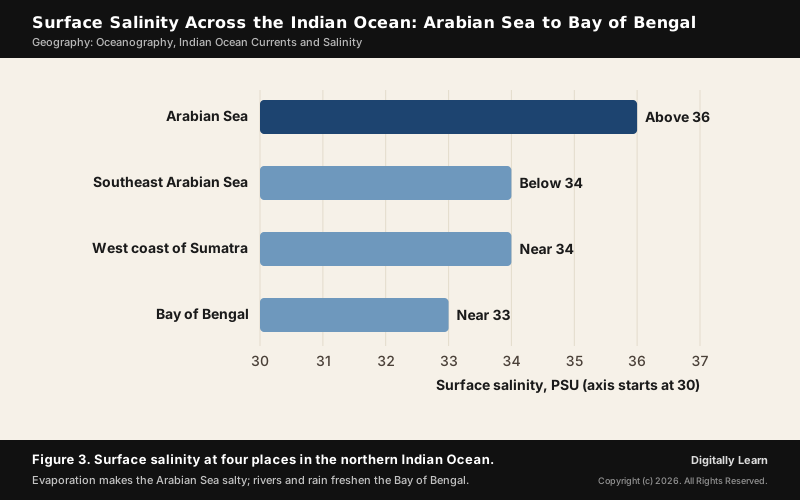
The rivers explain the difference. The Ganga, Brahmaputra, Mahanadi, Godavari, Krishna and Kaveri all drain into the Bay of Bengal, which contributes more than half of the runoff water entering the Indian Ocean, about 2,950 cubic kilometres a year. The Arabian Sea receives less fresh water and loses more to evaporation, so it stays salty. The world pattern of salinity behind these numbers is set out in ocean salinity: definition and distribution.
The monsoon currents do not leave the two seas separate. From June to September the eastward summer current carries saltier Arabian Sea water into the Bay of Bengal. From January to April the flow reverses, and the East India Coastal Current carries water from the bay westwards into the Arabian Sea. The bay's fresh runoff also travels south across the equator, mixes with the fresher water of the Indonesian Throughflow, and joins the South Equatorial Current in the southern tropical Indian Ocean.
Salinity in the north Indian Ocean therefore varies with the seasons as well as with place. How the salinity of these seas interacts with the monsoon, El Niño and the Indian Ocean Dipole is explained in the Indian Ocean Dipole and monsoon, and the sea with the highest salinity in the world is the subject of the highest salinity sea.
Indian Ocean Currents, Fisheries and Navigation
Upwelling, Phytoplankton and the Fishing Grounds of the Indian Ocean
Currents shape where the fish are. Where warm and cold currents mix, the water gains oxygen and plankton grow, and plankton are the primary food of fish; the best fishing grounds of the world lie mainly in these mixing zones. In the Indian Ocean, monsoon upwelling adds to this. Strong monsoon winds drive coastal and open-ocean upwelling, which lifts nutrients into the sunlit upper layer, and in summer the western Indian Ocean hosts one of the largest concentrations of phytoplankton blooms among the tropical oceans.
- Where upwelling occurs: Near the Horn of Africa and the Arabian Peninsula in the Northern Hemisphere, and north of the trade winds in the Southern Hemisphere.
- What it supports: The Arabian Sea is counted among the most biologically productive regions of the planet, and the Indian Ocean has the second-largest share of the most valuable tuna catch.
- The cost of productivity: The Arabian Sea also has one of the world’s three largest oxygen minimum zones, with the lowest oxygen levels in the world in the Gulf of Oman.
INCOIS Potential Fishing Zone Advisories: Using Currents and SST
India turns this science into daily advice. The Indian National Centre for Ocean Information Services (INCOIS), an autonomous body set up in 1998 under the Ministry of Earth Sciences in Hyderabad, issues Potential Fishing Zone advisories. About 7 million people along India's coastline of more than 8,100 km depend on fishing, and searching for shoals costs them time and money.
- How the zones are found: Satellites measure sea surface temperature and chlorophyll; fronts, eddies, rings and upwelling areas seen in that data mark where fish gather.
- How the advice reaches fishers: Advisories go out daily for 586 fish landing centres, divided into 14 coastal sectors from Gujarat to the Nicobar Islands, as maps and text in each sector’s own language, with wind speed and direction so that fishers can follow a shifting zone.
- When it pauses: The service runs all year except during the fishing ban and in cyclones, high waves or tsunamis.
Ocean Currents and Navigation: Monsoon Sailing and Modern Shipping
The Indian Ocean's relatively calm waters opened its shores to trade earlier than those of the Atlantic or the Pacific, and the powerful monsoons set the rhythm of sailing. Ships could sail west early in the season, wait a few months, and return eastwards, and western sailors used the same monsoon to cross the ocean, as the Periplus of the Erythraean Sea describes for the trade of about 1 CE between the Horn of Africa and India.
In the sailing-ship era, knowledge of winds and currents was even more essential than it is now, and the ocean remains crucial to world trade today, above all for oil and other hydrocarbons. Currents still matter at sea. Travelling with a surface current cuts fuel costs, which is why knowledge of currents remains essential to shipping. They can also be dangerous: off the southeast coast of South Africa, along the Agulhas Current and on the main shipping route between the Middle East and Europe, rogue waves can exceed 30 metres, and some 30 large ships were severely damaged or sunk there between 1981 and 1991.
Previous Year UPSC-CSE Questions
Previous Year UPSC-CSE Questions By the end you will be able to draft model answers for the following UPSC questions. Each question carries a collapsible framework showing how to approach it in the exam.
- UPSC Mains 2022 GS-IWhat are the forces that influence ocean currents? Describe their role in fishing industry of the world.
Answer outline: how to structure the answer
What the question asks, the main arguments, relevant examples and the direction of the conclusion. This is not a full model answer.
Introduction: Define an ocean current as a regular volume of water moving along a definite path, set going by primary forces and shaped by secondary ones.
Body (sub-themes to develop):
- Primary forces: solar heating (the ocean about 8 cm higher at the equator), wind and friction, gravity, and the Coriolis force turning flow right in the north and left in the south, which builds the gyres.
- Density: colder and saltier water sinks; cold water spreads from the poles at depth and warm water moves out from the equator at the surface.
- Fishing through mixing: where warm and cold currents meet, oxygen and plankton increase, making the best fishing grounds of the world.
- Fishing through upwelling: the monsoon and the Somali Current lift nutrients in the western Indian Ocean; the Arabian Sea is among the most productive seas and the Indian Ocean has the second-largest share of the valuable tuna catch.
- Use today: India's INCOIS reads sea surface temperature and chlorophyll to issue daily fishing-zone advice.
Conclusion: Conclude that the same forces that move water also move nutrients, so the map of currents is largely the map of the world's fisheries.
- UPSC Mains 2015 GS-IExplain the factors responsible for the origin of ocean currents. How do they influence regional climates, fishing and navigation?
Answer outline: how to structure the answer
What the question asks, the main arguments, relevant examples and the direction of the conclusion. This is not a full model answer.
Introduction: State that currents originate in solar heating, wind, gravity and the Coriolis force, with density driving their vertical movement.
Body (sub-themes to develop):
- Regional climates: cool currents give west coasts in the tropics low temperatures, fog and aridity; warm water gives higher-latitude west coasts mild marine climates; warm currents make tropical east coasts warm and rainy.
- Fishing: mixing zones and upwelling, as off Somalia and Oman in the summer monsoon, make the richest grounds.
- Navigation: ships once sailed west early in the monsoon and returned east months later; travelling with a current saves fuel, while waves along the Agulhas Current have damaged large ships.
Conclusion: Conclude that currents link the ocean to the climate, food and trade of the lands around it, nowhere more clearly than in the monsoon-driven Indian Ocean.
- UPSC Prelims 1997 Prelims-GSWhich one of the following factors is responsible for the change in the regular direction of the ocean currents in the Indian Ocean?
How to approach this Prelims question
Approach: Step 1: the question asks what changes the direction of the currents. Step 2: currents in the north Indian Ocean follow the monsoon winds, flowing east from April to November and west from January to March. Step 3: that seasonal reversal is the monsoon drift, option (b).
Trap to watch: Option (a) names the shape that makes the monsoon possible, but the factor that actually turns the currents is the monsoon drift itself.
Key facts to recall:
- (a) Half an ocean: wrong. The closed north explains why the monsoon is strong, but the shape does not itself reverse a current.
- (b) Monsoon drift: right. The currents reverse as the monsoon winds reverse.
- (c) Land-locked ocean: wrong. The Indian Ocean is closed only in the north and opens to the south.
- (d) Greater variation in salinity: wrong. Surface currents follow the wind; salinity differences do not turn them round each season.
Answer signal: Monsoon drift: option (b), the official answer, because the monsoon winds reverse the currents north of the equator each season.
- UPSC Prelims 2012 Prelims-GSConsider the following factors :
- Rotation of the Earth
- Air pressure and wind
- Density of ocean water
- Revolution of the Earth
Which of the above factors influence the ocean currents?
How to approach this Prelims question
Approach: Step 1: rotation deflects moving water through the Coriolis force, so 1 counts. Step 2: wind pushes the surface water, and wind follows pressure, so 2 counts. Step 3: density makes cold and salty water sink, so 3 counts. Step 4: revolution is not among the forces that move water, so 4 does not. Answer 1, 2 and 3.
Trap to watch: Revolution sounds as relevant as rotation, but only rotation produces the Coriolis force.
Key facts to recall:
- (a) 1 and 2 only: wrong. It leaves out density, which drives the vertical movement of currents.
- (b) 1, 2 and 3: right. Rotation, pressure and wind, and density all influence currents.
- (c) 1 and 4: wrong. Revolution is not a force on currents, and wind and density are missing.
- (d) 2, 3 and 4: wrong. It includes revolution and leaves out rotation.
Answer signal: 1, 2 and 3: option (b), the official answer, because rotation, pressure and wind, and density influence ocean currents while revolution does not.
Sources
- NCERT: Fundamentals of Physical Geography (Class XI), Chapter 13, Movements of Ocean Water
- Wikipedia: Indian Ocean
- Wikipedia: Indian Monsoon Current
- Wikipedia: Somali Current
- Wikipedia: South Equatorial Current
- Wikipedia: Equatorial Counter Current
- Wikipedia: East Madagascar Current
- Wikipedia: Mozambique Current
- Wikipedia: Agulhas Current
- Wikipedia: Antarctic Circumpolar Current
- Wikipedia: West Australian Current
- Wikipedia: Leeuwin Current
- Wikipedia: Indonesian Throughflow
- Wikipedia: Arabian Sea
- Wikipedia: Bay of Bengal
- Wikipedia: Ocean current
- Wikipedia: Indian National Centre for Ocean Information Services
- INCOIS: Potential Fishing Zone Advisory
- NOAA National Ocean Service: What is upwelling?
- NOAA National Ocean Service: Currents tutorial, the Coriolis effect
- The Hindu (Delhi), 17 August 2026: MSC Elsa 3 sinking caused no significant impact on Lakshadweep islands: study
- UPSC: Civil Services Examination question papers
Editorial Disclaimer
This article draws on the NCERT textbooks and the other sources listed on this page.