


Overview
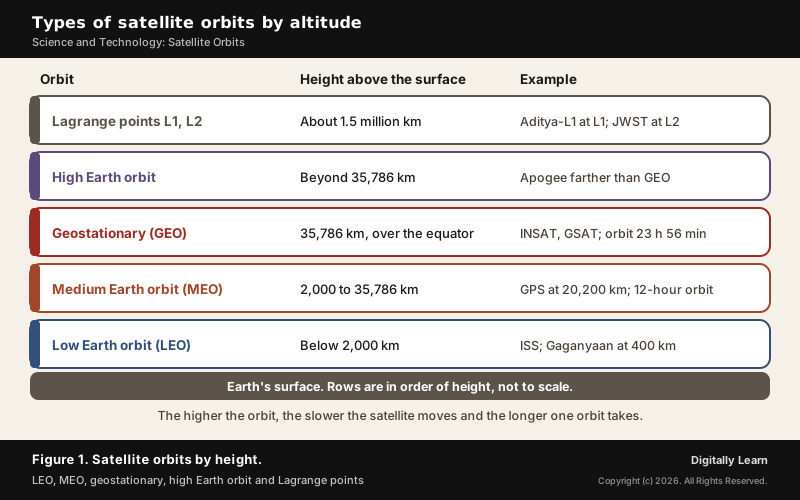
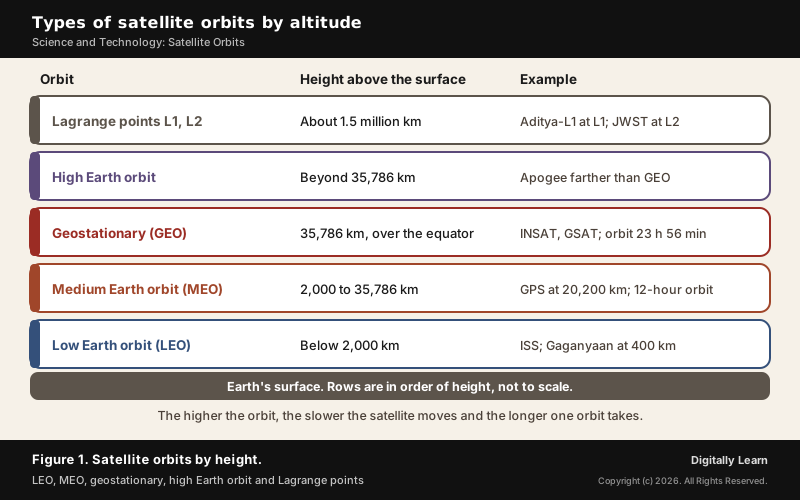
The types of satellite orbits are sorted in two ways. By height there are low Earth orbit (up to 2,000 km), medium Earth orbit and high Earth orbit, with the geostationary orbit at 35,786 km. By path there are equatorial, polar, sun-synchronous, highly elliptical and transfer orbits, and the Lagrange points far beyond. Each suits a different job: communication, weather, imaging, navigation or science.
Orbit Basics: Gravity, Orbital Velocity and Orbital Elements
What Is an Orbit and Why a Satellite Does Not Fall
An orbit is the curved path of an object moving under an attracting force; for a satellite, that force is the Earth's gravity. Earth satellites revolve around the Earth much as planets revolve around the Sun, so Kepler's laws apply to them too, and their orbits are circular or elliptical. The Moon is the Earth's only natural satellite; since 1957 many countries, India among them, have launched artificial satellites for telecommunication, geophysics and meteorology.
A satellite does not fall down because it is falling all the time. Isaac Newton imagined a stone thrown from the top of a high mountain, with no air to resist it. Thrown slowly, it falls back to the Earth; thrown at the orbital speed for that height, it keeps circling the Earth and returns to the mountain. In a circular orbit the gravitational force supplies exactly the centripetal force the satellite needs to keep turning.
- Orbital velocity: About 7.8 km per second in low Earth orbit; about 3.07 km per second at geostationary height.
- Escape speed: About 11.2 km per second from the Earth’s surface; a satellite’s total energy stays negative, which is why it cannot fly off.
- Weightlessness: An astronaut floats not because gravity is weak up there, but because the astronaut and the satellite are both in free fall towards the Earth.
Altitude, Eccentricity and Inclination of an Orbit
Three things fix a satellite's path and what it can see: its height, the shape of its orbit and its tilt. Height matters first because it sets the speed. The pull of gravity grows stronger closer to the Earth, so a low satellite moves fast and a high one moves slowly. NASA's Aqua satellite takes about 99 minutes at about 705 km; a weather satellite about 36,000 km up takes 23 hours, 56 minutes and 4 seconds.
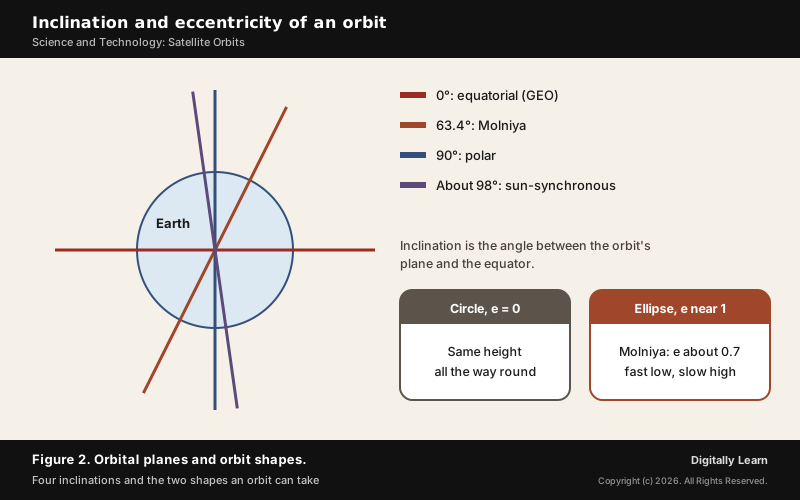
- Eccentricity: The shape of the orbit, 0 for a circle, close to (but less than) 1 for a long ellipse. The point nearest the Earth is the perigee; the farthest is the apogee.
- Inclination: The angle between the orbit’s plane and the equator; 0° runs directly above the equator, 90° passes over the poles, and 180° runs above the equator against the Earth’s spin.
- A strange result: To speed up, an operator fires the thrusters against the direction of motion. The satellite drops to a lower orbit, where it moves faster.
Orbits Classified by Altitude: LEO, MEO and High Earth Orbit
Low Earth Orbit (LEO): Imaging, Space Stations and Constellations
Low Earth orbit is the region below about 2,000 km, where the inner Van Allen radiation belt begins. By definition a LEO satellite goes round in 128 minutes or less, and most artificial objects in space are here. A LEO satellite travels at about 7.8 km per second: the International Space Station, 370 to 460 km up, circles the Earth every 93 minutes, 15.5 times a day.
- Imaging: Earth observation satellites use LEO because being closer lets them see the surface more clearly.
- People in space: Every space station so far has flown in LEO. India’s Gaganyaan crew module is designed to carry three people at 400 km for up to seven days.
- Telescopes: The Hubble Space Telescope orbits at about 540 km.
- Constellations: Satellite internet systems such as Starlink use large groups of LEO satellites working together.
LEO has two costs. Below about 300 km, drag from the thin upper atmosphere makes an orbit decay quickly. And the region is crowded: collisions at orbital speed create more fragments, a chain reaction called the Kessler syndrome, discussed below. The Gaganyaan human spaceflight mission will fly in this region.
Medium Earth Orbit (MEO): GPS, GLONASS, Galileo and BeiDou
Medium Earth orbit spans the wide band between LEO and the geostationary height, 2,000 to 35,786 km. Its best-known use is navigation. The semi-synchronous orbit, about 20,200 km up, takes 12 hours per orbit, so the satellite passes over the same two points on the equator every day. That regular, predictable path is the one the American GPS uses. The band also holds the Van Allen belts, whose charged particles can damage electronics that are not shielded.
| System | Owner | Height |
|---|---|---|
| GPS | United States | About 20,200 km |
| GLONASS | Russia | 19,100 km |
| Galileo | European Union | 23,222 km |
| BeiDou | China | 21,528 km |
High Earth orbit is any orbit whose farthest point lies beyond the geosynchronous height of 35,786 km. Low orbit starts just above the top of the atmosphere; high orbit begins about one tenth of the way to the Moon. The most valuable high orbit is the geosynchronous one, where a satellite keeps pace with the turning Earth.
Geostationary and Geosynchronous Orbits: Conditions and Uses
Conditions for a Geostationary Orbit
A geostationary orbit is a circular orbit 35,786 km above the equator, 42,164 km from the Earth's centre, running from west to east. The satellite takes one sidereal day, 23 hours 56 minutes and 4 seconds, to go round, exactly the time the Earth takes to turn once, so from the ground it seems to hang over one spot.
- The orbit is geosynchronous: Its period equals one rotation of the Earth.
- The orbit is circular: Eccentricity zero.
- The orbit lies in the plane of the equator: Inclination zero.
- It runs in the direction of the Earth’s rotation, at about 35,786 km, moving at about 3.07 km per second.
Geostationary vs Geosynchronous Orbit: The Difference
Every geostationary orbit is geosynchronous, but not every geosynchronous orbit is geostationary. Geosynchronous means only that the period matches one rotation of the Earth. If the orbit is tilted, the satellite drifts north and south of the equator during the day; if it is elliptical, it drifts east and west. Together the two drifts trace a figure-8 in the sky, called an analemma.
| Feature | GEO | Any GSO |
|---|---|---|
| Period | One sidereal day | One sidereal day |
| Inclination | Zero (over the equator) | Any |
| Shape | Circular | Circular or elliptical |
| Seen from the ground | Fixed in the sky | Traces a figure-8 |
| Ground antenna | Fixed dish | Must track the satellite |
India uses both. NavIC keeps three satellites in geostationary orbit and four in inclined geosynchronous orbit, a mix explained in the NavIC section below. The Tundra orbit is another geosynchronous orbit, eccentric and tilted, that lets a satellite spend most of its day over one high-latitude region.
Uses and Limits of Geostationary Satellites
A geostationary satellite is valuable because it never moves in the sky. For weather it gives a constant view of the same area, sending images of clouds, water vapour and wind every few minutes. For communication it lets a dish on the ground point permanently at one spot in the sky, with no need to turn and track, for telephone, television and radio.
- India’s INSAT system, commissioned in 1983, is a series of multipurpose geostationary satellites for telecommunication, broadcasting, meteorology and search and rescue. Its weather images support cyclone forecasting.
- Delay: A signal takes about 240 milliseconds to go up and back, a problem for voice calls and other time-sensitive uses.
- Poles: Parked over the equator, these satellites see far-northern and far-southern places only at the edge of view.
- Crowding: Satellites must be spaced apart to avoid radio interference, so orbital slots are limited. The International Telecommunication Union allocates slots and frequencies under its Radio Regulations.
- Sovereignty claims: In the 1976 Bogota Declaration, eight equatorial countries claimed the geostationary orbit above their territory; the claims were not accepted.
Polar and Sun-Synchronous Orbits for Earth Observation
Polar Orbit: Pole-to-Pole Coverage of the Whole Earth
A polar orbit passes above or nearly above both poles on each revolution, with an inclination of about 80 to 90 degrees. Many Earth-observing satellites fly nearly polar low orbits, going round in about 99 minutes. The Earth turns underneath while the satellite travels north and south, so each pass covers a new strip beside the last. In 24 hours a polar satellite sees most of the Earth twice, once in daylight and once in darkness.
- Uses of polar orbits: Mapping, reconnaissance and some weather satellites; the Iridium constellation uses polar orbits for telephone links.
- Launch cost: A polar launch gets no boost from the Earth’s rotation, so it needs a bigger rocket than an equatorial launch to the same height.
- Contrast: A low inclination lets a satellite concentrate on a band of the Earth; NASA’s rainfall satellite TRMM used 35 degrees to watch the tropics.
Sun-Synchronous Orbit: Same Local Time, Same Lighting
A sun-synchronous orbit is a special near-polar orbit whose plane turns once a year, keeping step with the Earth's journey round the Sun. The result is that the satellite crosses the equator at the same local solar time on every pass. NASA's Terra satellite, for example, crosses the equator at about 10:30 in the morning in Brazil and, about 99 minutes later, at about 10:30 in Ecuador or Colombia.
- Height and tilt: Usually about 600 to 800 km, with periods of 96 to 100 minutes and an inclination of about 98 degrees, slightly retrograde.
- Why it matters: The angle of sunlight stays nearly the same, so images from different years can be compared without shadows creating false changes. Without such an orbit, tracking change over time, including climate change, would be very difficult.
- Dawn-dusk variant: A satellite can ride the line between day and night so its solar panels always see the Sun, which suits radar satellites.
The PSLV was built for this orbit: it was developed to put India's Indian Remote Sensing satellites into sun-synchronous orbits. NISAR, the NASA-ISRO radar satellite launched by a GSLV on 30 July 2025, flies a dawn-to-dusk sun-synchronous orbit 747 km up at an inclination of 98.4°, crossing the equator at 6 am and 6 pm; it was the GSLV's first mission to such an orbit. It covers the land and ice of the Earth every 12 days.
Difference Between Geostationary and Polar Satellites
| Feature | GEO | Polar, SSO |
|---|---|---|
| Height | 35,786 km | Low Earth orbit (SSO about 600 to 800 km) |
| Path | Over the equator, west to east | Pole to pole |
| One orbit | 23 h 56 min | About 96 to 100 min |
| View | Same area, all the time | Whole Earth, strip by strip |
| Detail | Coarse, very wide view | Fine, close-up view |
| Best for | Weather watch, TV, telephone | Mapping, resources, change |
| Indian example | INSAT, GSAT | IRS, Cartosat, NISAR |
The two kinds work as a pair. A geostationary weather satellite watches a cyclone every few minutes but from far away; a polar satellite sees the same storm in far finer detail but only when it passes overhead. Remote sensing needs both.
Put simply, the geostationary satellite trades detail for constancy, and the polar satellite trades constancy for detail and global coverage. A question that asks for continuous watch over one area points to the first; one that asks for mapping the whole Earth points to the second.
Transfer Orbits, Molniya Orbit, Lagrange Points and Graveyard Orbit
Geostationary Transfer Orbit (GTO) and Orbit Raising
A rocket rarely carries a satellite all the way to 35,786 km. It leaves it in a geostationary transfer orbit, a long ellipse whose perigee is as low as LEO and whose apogee is as high as the geostationary orbit. At the apogee the satellite fires its own thrusters to make the orbit circular, the 'apogee kick'. The same burn is used to remove any tilt left by a launch site away from the equator. Launch vehicles are often rated by how much they can put into GTO.
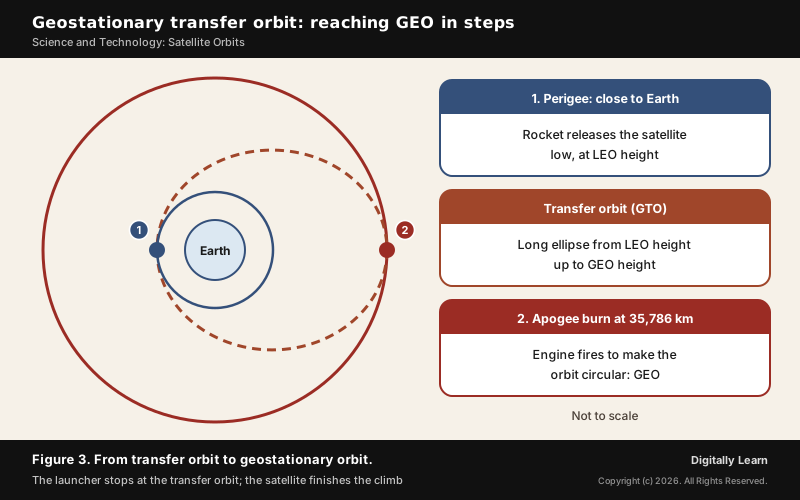
- Launchers: The PSLV can put small satellites into GTO. The GSLV was designed for it: its third stage uses a cryogenic engine (liquid oxygen and liquid hydrogen) for the thrust needed to inject a satellite into GTO.
- Orbit raising: Aditya-L1 was lifted in steps by engine burns near the Earth: from 245 km by 22,459 km to 256 km by 121,973 km, before it left for L1.
Highly Elliptical Orbits: Molniya and Tundra
A geostationary satellite serves the far north poorly, so the Soviet Union devised the Molniya orbit. It combines a high inclination of 63.4° with a high eccentricity of about 0.72 and a period of 12 hours, half a sidereal day. Near the Earth the satellite races; far away it slows, so it spends about two-thirds of each orbit over one hemisphere. In practice it hangs over Russia or Canada for most of its orbit, and Russian communication satellites have used it since the mid-1960s. The related Tundra orbit does the same with a full one-day period.
- Why 63.4 degrees: At this tilt the orbit is a ‘frozen orbit’, which reduces the need for station-keeping, the small engine burns that hold a satellite on its path.
- Two main uses: Highly elliptical orbits serve as transfer orbits and as good orbits for communication with, or surveillance of, the polar regions.
- Hohmann transfer: Proposed by the German scientist Walter Hohmann in 1925, it links a lower and a higher circular orbit with one elliptical orbit, the idea behind the GTO above.
Lagrange Points and Halo Orbits: Aditya-L1 and JWST
Every pair of large bodies, such as the Sun and the Earth, has five Lagrange points, L1 to L5, where their pulls balance so that a spacecraft keeps the same position relative to both. L1 lies between the Sun and the Earth; L2 lies behind the Earth; L3 is on the far side of the Sun; L4 and L5 sit 60° ahead of and behind the Earth on its orbit. L1 is about 1.5 million km from the Earth towards the Sun, 0.01 au, or about 1 per cent of the Earth-Sun distance; L2 is about the same distance on the far side.
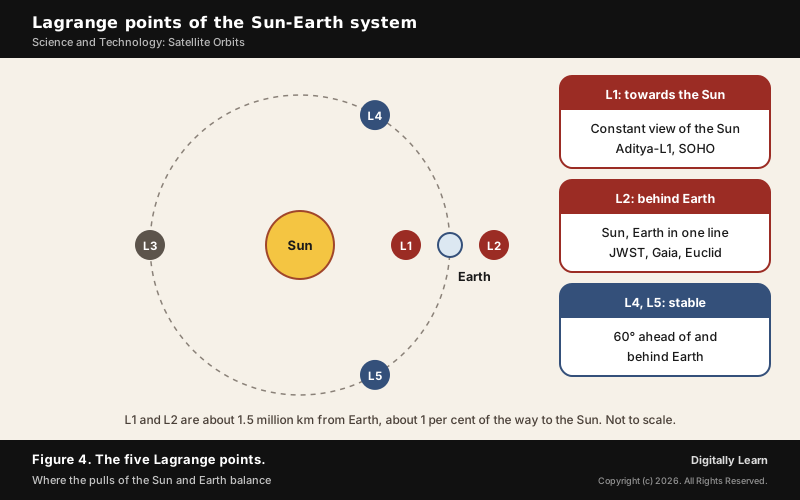
- Stability: Only L4 and L5 are stable; a craft at L1, L2 or L3 needs regular small corrections, like a ball balanced on a hilltop.
- L1: A constant view of the Sun. Aditya-L1, India’s first mission to study the Sun, launched by PSLV-C57 on 2 September 2023, entered a halo orbit round L1 on 6 January 2024.
- L2: The Sun and Earth stay in one line behind the craft, so one shield blocks both. The James Webb Space Telescope works here.
- Halo orbit: A craft at L1 or L2 does not sit on the point; it circles it in a halo orbit, a periodic looping path that is not flat.
Graveyard Orbit, FOBS and Space Debris
Satellites that finish their work must be moved out of the way. A retired geostationary satellite is pushed into a graveyard orbit above the geostationary belt, about 300 km higher under US rules, so it cannot collide with working satellites. Large networks in LEO instead use orbits that decay into the atmosphere. Where neither happens, space debris builds up: around 34,000 pieces larger than 10 cm were estimated to be in orbit in January 2019.
- Kessler syndrome: Proposed by NASA scientists Donald Kessler and Burton Cour-Palais in 1978, it is a chain of collisions in LEO, each creating more debris.
- Mission Shakti: On 27 March 2019 India shot down one of its own LEO satellites with a ground-based missile; about 270 new pieces of debris were tracked soon after.
- Fractional Orbital Bombardment System (FOBS): A warhead is put into low orbit and brought down on its target by a retrograde burn before it completes a full orbit. The Soviet Union built one in the 1960s, and China tested a FOBS with a hypersonic glide vehicle in August 2021.
- Outer Space Treaty, 1967: Article IV bars placing nuclear weapons or other weapons of mass destruction in orbit around the Earth.
Choosing an Orbit: Indian Satellites and NavIC
Which Orbit for Which Mission
The mission decides the orbit. A satellite that must stare at one region goes high over the equator; one that must photograph the whole Earth in the same light goes low and near-polar; one that must watch the Sun goes far out to L1. India's satellites show every choice.
| Mission | Orbit | Indian example |
|---|---|---|
| Telephone, TV, weather | Geostationary | INSAT, GSAT |
| Regional navigation | GEO plus inclined GSO | NavIC |
| Mapping and resources | Sun-synchronous polar | IRS, Cartosat |
| Radar imaging | Dawn-dusk sun-synchronous | NISAR |
| Astronomy | Low, near-equatorial (650 km) | AstroSat |
| Human spaceflight | Low Earth orbit (400 km) | Gaganyaan |
| Solar science | Halo orbit around L1 | Aditya-L1 |
AstroSat, launched on a PSLV-XL on 28 September 2015, is India's first dedicated multi-wavelength space telescope; it was planned for a 650 km near-equatorial orbit. A satellite launched into a low inclination can use the Earth's rotation to help boost it into orbit.
NavIC: India's Regional Navigation Constellation
The Indian Regional Navigation Satellite System, called NavIC, gives position and time over India and a region extending about 1,500 km beyond its borders. It was built partly because foreign navigation systems are not guaranteed in a crisis: in 1999 the United States denied India GPS data for the Kargil region. The government approved the project in May 2006, and IRNSS-1A was launched on 1 July 2013.
- Seven satellites: Three in geostationary orbit at 32.5° E, 83° E and 131.5° E, and four in inclined geosynchronous orbit, two crossing the equator at 55° E and two at 111.75° E.
- Why two kinds of orbit: Both kinds keep every satellite over the Indian region, so they stay in view there; a global system needs many more because its satellites circle the whole Earth.
- Two services: A Standard Positioning Service open to all users, and an encrypted Restricted Service for authorised users such as the military. GPS likewise has a civilian Standard Positioning Service and a military Precise Positioning Service.
- Accuracy: Better than 20 m in the primary service area.
- Uses of NavIC: Land, air and sea navigation, disaster management, vehicle tracking, mobile phones, precise timing and mapping. NavIC trackers are compulsory on commercial vehicles.
Previous Year UPSC-CSE Questions
Previous Year UPSC-CSE Questions By the end you will be able to draft model answers for the following UPSC questions. Each question carries a collapsible framework showing how to approach it in the exam.
- UPSC Mains 2015 GS-IIIWhat do you understand by 'Standard Positioning Systems' and 'Precision Positioning Systems' in the GPS era? Discuss the advantages India perceives from its ambitious IRNSS programme employing just seven satellites.
Answer outline: how to structure the answer
What the question asks, the main arguments, relevant examples and the direction of the conclusion. This is not a full model answer.
Introduction: GPS offers an open Standard Positioning Service and an encrypted Precise Positioning Service for authorised users; NavIC mirrors this with SPS and a Restricted Service.
Body (sub-themes to develop):
- Services: open civilian positioning versus encrypted service for the military and other authorised users.
- Seven satellites suffice: three geostationary and four inclined geosynchronous, all always over the Indian region.
- Strategic autonomy: foreign systems can be denied in a crisis, as with GPS over Kargil in 1999.
- Civil gains: transport, disaster management, fisheries, vehicle tracking, timing for networks and mapping.
Conclusion: Conclude that a small regional constellation gives assured, sovereign navigation if the fleet is kept up.
- UPSC Mains 2018 GS-IWhy is Indian Regional Navigational Satellite System (IRNSS) needed? How does it help in navigation?
Answer outline: how to structure the answer
What the question asks, the main arguments, relevant examples and the direction of the conclusion. This is not a full model answer.
Introduction: NavIC is India's regional navigation satellite system covering India and about 1,500 km around it.
Body (sub-themes to develop):
- Need: independence from foreign systems in hostile situations; the Kargil GPS denial of 1999.
- How: signals from several satellites always in view over India give position and time; accuracy better than 20 m.
- Uses: land, air and sea navigation, disaster management, fleet tracking, mobile phones, timing.
Conclusion: Conclude that the system must be kept at full strength with the NVS series to deliver its promise.
- UPSC Prelims 2011 Prelims-GSSatellites used for telecommunication relay are kept in a geostationary orbit. A satellite is said to be in such an orbit when:
- The orbit is geosynchronous.
- The orbit is circular.
- The orbit lies in the plane of the Earth’s equator.
- The orbit is at an altitude of 22,236 km.
Select the correct answer using the codes given below:
How to approach this Prelims question
Approach: A geostationary orbit is geosynchronous, taking one sidereal day (1), circular (2) and in the plane of the equator (3). Its height is 35,786 km, which is 22,236 miles, so a height of 22,236 km is wrong (4).
Trap to watch: 22,236 is the height in miles; in kilometres it is 35,786.
Key facts to recall:
- (a) 1, 2 and 3 only: right. Geosynchronous, circular and equatorial.
- (b) 1, 3 and 4 only: wrong. The height is 22,236 miles, not km, and condition 2 is left out.
- (c) 2 and 4 only: wrong. Condition 4 is wrong, and 1 and 3 are left out.
- (d) 1, 2, 3 and 4: wrong. Condition 4 gives the mile figure in kilometres.
Answer signal: Option (a): conditions 1, 2 and 3.
- UPSC Prelims 2011 Prelims-GSAn artificial satellite orbiting around the Earth does not fall down. This is so because the attraction of Earth
How to approach this Prelims question
Approach: In a circular orbit the Earth's gravity supplies exactly the centripetal force the satellite needs to keep turning; the satellite is in free fall around the Earth.
Trap to watch: Gravity does not provide the speed; the launch did. It provides the acceleration towards the centre.
Key facts to recall:
- (a) Gravity does not exist at such distance: wrong. Gravity keeps the satellite in orbit.
- (b) It is neutralised by the moon: wrong. The moon plays no such part.
- (c) It provides the necessary speed: wrong. Gravity supplies acceleration, not the speed itself.
- (d) It provides the necessary acceleration: right. Gravity supplies the centripetal acceleration.
Answer signal: Option (d): gravity provides the acceleration for its motion.
- UPSC Prelims 2018 Prelims-GSWith reference to the Indian Regional Navigation Satellite System (IRNSS), consider the following statements:
- IRNSS has three satellites in geostationary and four satellites in geosynchronous orbits.
- IRNSS covers entire India and about 5500 sq. km beyond its borders.
- India will have its own satellite navigation system with full global coverage by the middle of 2019.
Which of the statements given above is/are correct?
How to approach this Prelims question
Approach: IRNSS has three satellites in geostationary orbit and four in inclined geosynchronous orbits (1 is right). It covers India and a region about 1,500 km beyond its borders, not 5,500 sq km (2 is wrong). It is a regional system, not a global one (3 is wrong).
Trap to watch: Coverage is about 1,500 km, not '5,500 sq km'; NavIC is regional, not global.
Key facts to recall:
- (a) 1 only: right. Three geostationary and four geosynchronous satellites.
- (b) 1 and 2 only: wrong. The coverage extends about 1,500 km beyond India.
- (c) 2 and 3 only: wrong. Both statements are wrong.
- (d) None: wrong. Statement 1 is correct.
Answer signal: Option (a): only statement 1 is correct.
- UPSC Prelims 2022 Prelims-GSWhich one of the following statements best reflects the idea behind the 'Fractional Orbital Bombardment System' often talked about in media?
How to approach this Prelims question
Approach: A Fractional Orbital Bombardment System puts a warhead into low orbit and brings it down on its target before a full orbit is complete.
Trap to watch: It is not an asteroid defence or a planetary landing; it is a weapon delivery path through orbit.
Key facts to recall:
- (a) A missile to destroy an approaching asteroid: wrong. That is planetary defence.
- (b) A spacecraft landing on another planet: wrong. FOBS targets the Earth.
- (c) A missile put into orbit that deorbits over a target: right. That is FOBS.
- (d) A spacecraft matching a comet's speed: wrong. That describes a comet mission.
Answer signal: Option (c): a missile put into orbit that deorbits over a target.
Sources and Further Reading
- NCERT: Physics Part I (Class XI), Chapter 7, Gravitation
- NASA Earth Observatory: Catalog of Earth Satellite Orbits
- ISRO: Indian Regional Navigation Satellite System (NavIC)
- ISRO: Aditya-L1
- NASA Jet Propulsion Laboratory: NISAR quick facts
- Wikipedia: Geostationary orbit
- Wikipedia: Geosynchronous orbit
- Wikipedia: Low Earth orbit
- Wikipedia: Medium Earth orbit
- Wikipedia: Sun-synchronous orbit
- Wikipedia: Polar orbit
- Wikipedia: Geostationary transfer orbit
- Wikipedia: Molniya orbit
- Wikipedia: Lagrange point
- Wikipedia: Graveyard orbit
- Wikipedia: Indian Regional Navigation Satellite System
- Wikipedia: Space debris
- Wikipedia: Fractional Orbital Bombardment System
- Wikipedia: Orbit
- Wikipedia: Apsis
- Wikipedia: Halo orbit
- Wikipedia: Highly elliptical orbit
- Wikipedia: International Space Station
- UPSC: Previous year question papers
Editorial Disclaimer
This article explains satellite orbits from the NCERT Physics textbook, NASA and ISRO material and the other sources listed below. Figures are rounded as the sources give them.


