Overview
The DM Act 2005 architecture, response systems, and Build Back Better
How India manages earthquake risk: the four-tier NDMA-SDMA-DDMA structure, the BIS code family, NDRF response and early warning, and reconstruction from Bhuj 2001 to Nepal 2015.
Previous Year UPSC-CSE Questions By the end you will be able to draft model answers for the following UPSC questions. Each question carries a collapsible framework showing how to approach it in the exam.
- UPSC Mains 2024 GS-IIIWhat is disaster resilience? How is it determined? Describe various elements of a resilience framework. Also mention the global targets of Sendai Framework for Disaster Risk Reduction (2015-2030).
How to structure the answer in the exam
Introduction: Disaster resilience is the capacity of a community or system to resist, absorb, adapt to, and recover from a hazard event in a timely manner. It is determined by the interplay of hazard exposure, social and physical vulnerability, coping capacity at the moment of impact, and longer-term adaptive capacity.
Body (sub-themes to develop):
- Elements of a resilience framework: risk assessment (hazard mapping, vulnerability surveys), governance (statutory authorities, funded plans), infrastructure (code-compliant construction, retrofitting), response capability (NDRF, SDRF, civil defence), and recovery practice (Build Back Better).
- India's institutional architecture: Disaster Management Act 2005, NDMA-SDMA-DDMA hierarchy, NDRF 16 battalions, National Disaster Management Plan 2016 (revised 2019).
- Sendai Framework four priorities: understanding risk; strengthening governance; investing in DRR; enhancing preparedness for Build Back Better.
- Seven Sendai global targets: (1) substantially reduce global disaster mortality by 2030; (2) substantially reduce numbers of affected people; (3) reduce economic loss in relation to GDP; (4) substantially reduce damage to critical infrastructure and disruption of basic services including health and educational facilities; (5) substantially increase the number of countries with national and local DRR strategies by 2020; (6) substantially enhance international cooperation to developing countries; (7) substantially increase availability of and access to multi-hazard early-warning systems.
- Indian implementation evidence: NDMP 2016 maps to Sendai four priorities; CDRI Coalition since 2019 with 41 member countries; G20 DRR Working Group institutionalised under India's 2023 presidency.
Conclusion: India's disaster-resilience framework is comprehensive in statute and increasingly operational in practice. The Sendai Framework provides the global benchmarking architecture; India's NDMP 2016 and the Disaster Management (Amendment) Bill 2024 align national implementation with Sendai targets and Build Back Better practice.
- UPSC Mains 2020 GS-IIIndian constitution exhibits centralizing tendencies to maintain unity and integrity of the nation. Elucidate in the perspective of the Epidemic Diseases Act, 1897; The Disaster Management Act, 2005 and recently passed Farm Acts.
How to structure the answer in the exam
Introduction: The Indian Constitution exhibits centralizing tendencies through Union-list dominance, residuary powers vested in the Centre, Article 352-360 emergency provisions, and concurrent-list legislative supremacy under Article 254. Three recent statutes illustrate this centralizing pattern in operation.
Body (sub-themes to develop):
- Epidemic Diseases Act 1897: pre-Constitution colonial statute, retained as Union law for inter-state disease control; invoked during 2020 COVID-19 to authorise central health-ministry guidelines binding on states.
- Disaster Management Act 2005: enacted under Entry 23 of the Concurrent List (social security and social insurance), creates the NDMA-SDMA-DDMA hierarchy with Centre as policy apex; the National Disaster Management Plan is binding on all states; NDRF is a Union-armed force deployed nationwide.
- Farm Acts 2020: enacted under Entry 33 of the Concurrent List (trade and commerce in foodstuffs); states argued agriculture is a State-list subject and the Acts impinged on state legislative competence. Eventually repealed in 2021 after extended protests.
- Centralizing tendencies as unity-and-integrity drivers: harmonised standards across states; rapid central response; national-scale risk-pooling; institutional consistency.
- Federalism implications: states' room for variation reduced; cooperative-federalism balance under strain; inter-governmental tensions during crisis events; ongoing constitutional question on the meaning of unity and integrity in a federal polity.
Conclusion: The Indian constitution's centralizing tendencies are a deliberate design choice for unity and integrity, but their operation requires constant calibration with cooperative-federalism principles. The Disaster Management Act 2005 has worked because operational coordination is universally required; the Farm Acts faced resistance because economic-policy autonomy is a sensitive federalism domain. The constitutional balance is therefore context-specific.
- UPSC Mains 2018 GS-IIIDescribe various measures taken in India for Disaster Risk Reduction (DRR) before and after signing 'Sendai Framework for DRR (2015- 2030)'. How is this framework different from 'Hyogo Framework for Action, 2005'?
How to structure the answer in the exam
Introduction: India has built its disaster risk reduction architecture in two distinct phases: a pre-Sendai phase (2005-2015) establishing the statutory framework and response capability, and a post-Sendai phase (2015 onwards) aligning national implementation with the Sendai four priorities and seven global targets.
Body (sub-themes to develop):
- Pre-Sendai measures (2005-2015): Disaster Management Act 2005, NDMA constituted 2005, NDRF established 2006 (eight battalions initially), NDMA Earthquake Management Guidelines 2007, BIS IS 1893 (2002 then 2016 revisions), GSDMA post-Bhuj reconstruction model, post-Kashmir 2005 PRS programme.
- Post-Sendai measures (2015 onwards): National Disaster Management Plan 2016 (revised 2019, Sendai-mapped), Coalition for Disaster Resilient Infrastructure (CDRI) launched September 2019, National Disaster Mitigation Fund operationalised 2021, BhooKamp app launched 2021, G20 DRR Working Group institutionalised under India's 2023 presidency, Mission Mausam 2024.
- Sendai vs Hyogo: scope: Sendai expanded from disaster management (emergency response) to disaster risk reduction (proactive risk-reduction agenda).
- Sendai vs Hyogo: priorities: Hyogo had five priorities; Sendai consolidated to four priorities (understanding risk, governance, investment, preparedness for Build Back Better).
- Sendai vs Hyogo: targets: Sendai introduced seven global outcome targets (mortality, affected populations, economic loss, infrastructure damage, national DRR strategies, international cooperation, early-warning access). Hyogo had no such quantified targets.
- Sendai vs Hyogo: actors: Sendai explicitly engages local authorities, private sector, and community organisations; Hyogo was primarily inter-governmental.
Conclusion: India's transition from Hyogo to Sendai is not just a name change but an institutional and operational upgrade: the National Disaster Management Plan 2016 maps to Sendai's four priorities and seven targets, CDRI demonstrates India's international leadership, and the upcoming Disaster Management (Amendment) Bill further aligns the 2005 statute with current Sendai requirements.
Earthquake disaster management in India operates through a four-tier statutory architecture established by the Disaster Management Act 2005. The National Disaster Management Authority (NDMA) sets policy at the apex; State Disaster Management Authorities (SDMA) coordinate at state level; District Disaster Management Authorities (DDMA) operate at the field level; the National Disaster Response Force (NDRF) and State Disaster Response Forces (SDRF) provide deployed response. The framework is supported by sector-specific guidelines (NDMA Earthquake Management Guidelines 2007), the BIS earthquake-resistant construction code family, and India's implementation of the Sendai Framework for Disaster Risk Reduction (2015-2030). Build Back Better practice from the 2001 Bhuj reconstruction through 2005 Kashmir, 2011 Sikkim, and 2015 Nepal events provides the operational record.
Background and Historical Context
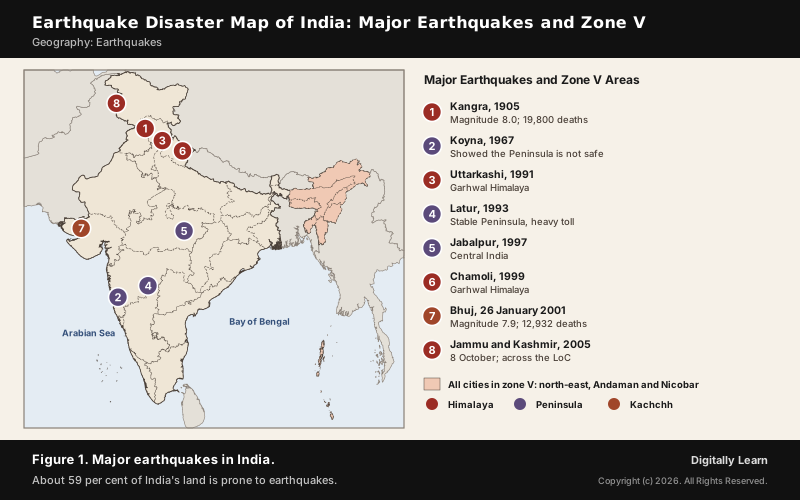
Earthquake disaster management is the policy frontier where the science (Part 1) and the spatial hazard map (Part 2) translate into institutional capacity and saved lives. India's seismic exposure of approximately 59 per cent of land area in moderate-to-high hazard zones creates a continuous policy load: every Zone IV and V district needs evacuation plans, every multi-storey construction needs BIS-compliant design, every state government needs a response force pre-positioned. UPSC Mains GS-III repeatedly anchors on NDMA framework, Disaster Management Act 2005, Sendai Framework targets, and DRR measures.
India's disaster-management architecture was transformed after the 1999 Odisha super-cyclone and the 2001 Bhuj earthquake. The 1999 event killed approximately 10,000 people and exposed deep gaps in central-state response coordination. The 2001 Bhuj earthquake reinforced the diagnosis: India needed a permanent statutory framework, a dedicated response force, and codified building standards. The Disaster Management Act 2005 created that architecture; the NDMA was constituted in 2005 with the Prime Minister as ex-officio Chairperson; the NDRF was raised in 2006 as a dedicated multi-disaster response force.
Part 1 of this series covered the science foundation: plate tectonics, fault mechanics, seismic waves, magnitude and intensity. Part 2 mapped that science onto India: the BIS IS 1893 four-zone classification, the historical earthquake record, the seismic-gap hypothesis, and city-level microzonation. This final part closes the series with the policy stack: the statutory framework, NDMA Guidelines, the BIS construction codes, the response systems, Build Back Better practice, and the agenda from CDRI to the Disaster Management Amendment Bill.
Statutory Framework: The Disaster Management Act 2005 and Sendai Implementation
From ad hoc relief to a permanent four-tier authority
The Disaster Management Act 2005 is the foundational statute for India's disaster-management architecture. Parliament passed the Act in December 2005, drawing on the High Powered Committee on Disaster Management report and the institutional lessons of the 1999 Odisha super-cyclone and the 2001 Bhuj earthquake. It replaced ad hoc relief coordination with a permanent statutory framework spanning policy, planning, response, and recovery.
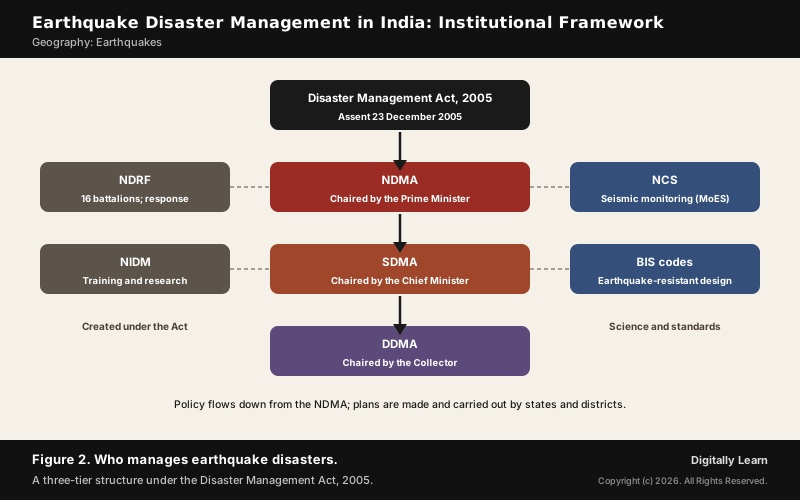
The Act creates a four-tier hierarchy. The National Disaster Management Authority (NDMA), chaired ex-officio by the Prime Minister, lays down national policies, plans, and guidelines. The State Disaster Management Authority (SDMA), chaired by the Chief Minister, coordinates state-level implementation. The District Disaster Management Authority (DDMA), chaired by the District Collector, is the operational unit for district preparedness and response.
The Act also establishes the National Disaster Response Force (NDRF) as a specialised force for disaster response and the National Institute of Disaster Management (NIDM) for training and capacity building. States raise State Disaster Response Forces (SDRF) on the same model. National and state disaster-mitigation funds (NDMF and SDMF), with the corresponding response funds, are also created by the Act.
The 2005 Act marks the shift from reactive relief to proactive risk reduction. Before it, response was coordinated case by case through the relief machinery and ex-gratia payments made after the event. The Act made preparedness, mitigation, and recovery permanent statutory duties and created dedicated mitigation funds, so money for risk reduction no longer competed with the annual relief budget.
The seven targets and four priorities India reports against
The Sendai Framework for Disaster Risk Reduction 2015-2030 was adopted at the Third UN World Conference on Disaster Risk Reduction in Sendai, Japan, in March 2015. It succeeds the Hyogo Framework for Action 2005-2015 and widens the scope from emergency response to comprehensive risk reduction, with seven global targets and four priorities for action.
The four Sendai priorities are understanding disaster risk; strengthening disaster-risk governance; investing in disaster risk reduction for resilience; and enhancing preparedness for effective response and to Build Back Better in recovery. The seven global targets address mortality, affected populations, economic loss, infrastructure damage, national and local DRR strategies, international cooperation, and early-warning access.
India was a key drafter of the Sendai Framework and is a major implementer. India's National Disaster Management Plan 2016 (revised 2019) maps directly onto the Sendai four priorities and seven targets. The plan is all-hazard, covering earthquakes, floods, cyclones, droughts, landslides, urban floods, biological emergencies, and industrial accidents.
Anchoring the national plan to the Sendai priorities gives India a common language with international partners and a measurable yardstick. The seven targets convert disaster policy into trackable numbers: reductions in mortality, in people affected, and in economic and infrastructure loss, alongside the spread of risk-reduction strategies and early-warning access, against which state performance can be benchmarked.
NDMA Earthquake Management Guidelines 2007: Pillars and Action Plan
Six pillars and a twelve-point action plan
What is the significance of the NDMA Earthquake Management Guidelines 2007? The Guidelines translate the abstract statutory architecture of the Disaster Management Act 2005 into earthquake-specific action. They define institutional responsibilities, technical standards, training requirements, and coordination protocols. Every state earthquake-management plan derives from them, every NDRF earthquake-response procedure traces to them, and every BIS construction-code revision is informed by them.
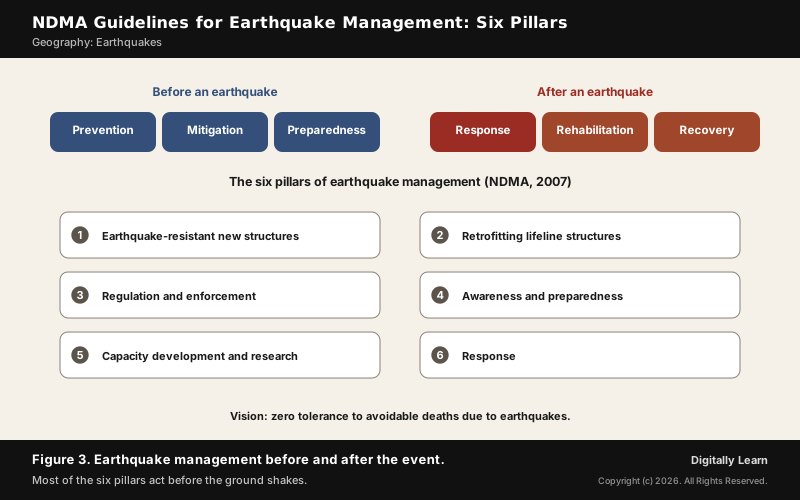
The Guidelines rest on six pillars that together span the full disaster-management cycle:
- Hazard, vulnerability and risk assessment: microzonation, building-stock surveys, and seismic-history compilation.
- Education, training and capacity building: NIDM courses, NDRF training, and community-awareness programmes.
- Regulatory framework and building codes: BIS IS 1893 and the associated IS 13920, IS 4326, and IS 13828 codes for new construction in Zones III, IV, and V.
- Structural retrofitting of existing critical buildings: hospitals, schools, and government offices first.
- Emergency response and search-and-rescue through NDRF battalions and state SDRF.
- Research, development and documentation through ISR, IIT centres, and ICAR earthquake-engineering programmes.
The Guidelines also set out a twelve-point action plan covering legislative measures, retrofitting of lifeline structures, public-awareness campaigns, training of professionals, R&D investment, and institutional strengthening. Reviews against the plan feed the NDMA Vision Plans and the National Disaster Management Plan updates.
Three outcomes follow. First, every state prepares an earthquake-specific disaster-management plan tuned to its own zones and building stock. Second, NDRF and SDRF battalions train against standardised search-and-rescue procedures derived from the Guidelines. Third, the Guidelines drive periodic revision of the BIS codes and set retrofitting priorities for the higher zones.
Earthquake-Resistant Construction: the BIS Code Family and Retrofitting
IS 1893 and the codes for concrete and masonry
India's earthquake-resistant construction rests on a coordinated family of Bureau of Indian Standards codes. Three features set the BIS framework apart: it is mandatory under municipal building bye-laws, it is technology-specific (separate codes for steel, reinforced concrete, and masonry), and it is performance-graded by seismic zone.
- IS 1893 (Criteria for Earthquake Resistant Design of Structures): the umbrella code defining seismic zones, response spectra, and design loads. Part 1 covers buildings; Parts 2 to 4 cover tanks, bridges, and industrial structures.
- IS 13920 (Ductile Detailing of Reinforced Concrete Structures): ductile-detailing rules for RC frames and shear walls, mandatory in Zones III to V, specifying reinforcement layout and joint detailing for ductile failure.
- IS 4326 (Earthquake-Resistant Design and Construction of Buildings, Code of Practice): design-and-construction practice, with emphasis on masonry and composite construction.
- IS 13828 (Improving Earthquake Resistance of Low-Strength Masonry Buildings): guidelines for the traditional masonry common in rural and semi-urban India, central to retrofitting the pre-code stock.
Earthquake resistance is not a single property one rule can specify, so the Bureau splits the task. IS 1893 fixes the demand, how much shaking a structure in a given zone must withstand, while the material codes fix the supply of resistance: how concrete is detailed for ductility, how masonry is tied, and how low-strength construction is made safer.
Strengthening the pre-code building stock
Retrofitting existing buildings is India's most cost-effective seismic intervention, because the stock of pre-code construction is so large. Three techniques are common:
- Column jacketing: wrapping existing concrete columns in new concrete and reinforcement to raise axial and lateral capacity.
- Masonry strengthening: through-stones, surface mesh, ferrocement plaster, and tie-bars that bind walls and prevent corner separation.
- Base isolation: rubber bearings or sliding interfaces that decouple the structure from ground motion, used for hospitals and high-value buildings.
Major programmes include the post-Bhuj GSDMA reconstruction, the post-Kashmir bilateral exchange, and the ongoing retrofitting of schools and hospitals in Zone V districts led by NIDM, guided by IS 13935, the BIS code for repair and seismic strengthening. The CDRI, led by India since 2019, carries this knowledge exchange to other countries.
The hard problem is not the new building but the existing one. Most of India's stock predates mandatory codes or was built informally outside any code, so even perfect enforcement on new construction leaves the legacy stock exposed. Retrofitting critical buildings first, hospitals, schools, and emergency facilities, protects what a community most depends on after an earthquake.
Response Systems: NDRF Deployment and the Warning Chain
NDRF, SDRF, and community first responders
India's earthquake response has three operational tiers that produce observable field outcomes during every major event:
- National Disaster Response Force (NDRF): 16 battalions as of 2024, about 14,000 trained personnel, pre-positioned across the country with urban search-and-rescue, CBRN, swift-water rescue, and medical-first-responder capability.
- State Disaster Response Forces (SDRF): state-level forces on the NDRF model; well-developed in Uttar Pradesh, Maharashtra, Gujarat, Odisha, Tamil Nadu, Karnataka, and Kerala, while smaller states rely more on NDRF deployment.
- Civil Defence and community first responders: the tier covering the gap between the event and the arrival of external forces, with Civil Defence units in about 40 cities and Sendai-aligned community training.
The decisive window after an earthquake is the first 24 to 72 hours, when trapped survivors can still be reached alive. No single national force can cover a country of India's size within that window, so the three-tier design, NDRF for specialised rescue, SDRF for state reach, and community first responders, is built around the geography of response time.
From post-event alerts to P-wave warning
The BhooKamp mobile app, launched by the Ministry of Earth Sciences in July 2021, delivers earthquake alerts to citizen smartphones for events at or above M3.5 within or near India. It draws on the National Center for Seismology bulletin pipeline, with alerts typically issued within seven to ten minutes of the event.
The National Earthquake Early Warning System (NEEWS) is under build-out. Unlike BhooKamp's post-event notification, NEEWS uses P-wave detection at near-source stations to warn distant areas before the slower S-waves arrive. The lead time scales with distance, tens of seconds for sites a few hundred kilometres away. The Himalayan-front pilot covers Uttarakhand and Himachal Pradesh, with national rollout part of Mission Mausam.
Early warning is a race between data and seismic waves. The fast, low-energy P-wave arrives first and triggers near-source sensors; the electronic alert then travels at the speed of light, while the destructive S-wave and surface waves still have hundreds of kilometres to cross. For a distant city this gap yields seconds to tens of seconds, enough to halt trains, shut gas lines, and move clear of hazards.
Build Back Better: Reconstruction from Bhuj 2001 to Nepal 2015
What owner-driven reconstruction achieved
Build Back Better is the Sendai-codified principle that post-disaster reconstruction should not merely restore pre-disaster conditions but improve resilience, accessibility, and inclusion. India's record spans four major events of the last quarter-century, each carrying a different lesson.
| Event (year) | Programme | Scale | What it established |
|---|---|---|---|
| Bhuj, Gujarat (2001) | GSDMA owner-driven reconstruction | over 400,000 houses, 2001-2010 | The institutional template for later reconstructions |
| Kashmir (2005) | Prime Minister's Reconstruction Programme | ~24,000 crore; over 300,000 houses | A large-scale, state-led rebuilding model |
| Sikkim (2011) | Community-based reconstruction | Vernacular-style retrofitting | NDMA guidance for community-led recovery |
| Nepal (2015) | NDRF Operation Maitri (trans-border) | ~5,000 evacuated; ~1,000 crore relief | India's trans-border response capability |
Bhuj 2001 (GSDMA model): the post-Bhuj reconstruction is India's most extensive Build Back Better effort. Over 400,000 houses were rebuilt under the GSDMA owner-driven programme between 2001 and 2010, enforcing IS 1893 and IS 13920 compliance and introducing retrofitting for the surviving stock. The GSDMA model became the template for later Indian reconstructions.
Kashmir 2005 (Prime Minister's Reconstruction Programme): the reconstruction ran under the PRS programme with a budget of about 24,000 crore rupees. It rebuilt over 300,000 houses, several thousand schools, and more than a thousand health facilities across the affected districts of Jammu and Kashmir.
Sikkim 2011 (community-based rebuilding): a smaller event that pioneered community-based reconstruction with vernacular-style retrofitting. The Sikkim experience informed NDMA's later guidance on community-led recovery.
Nepal 2015 (Operation Maitri): India's NDRF deployed within 24 hours of the April 2015 Gorkha earthquake. Operation Maitri evacuated about 5,000 Indian citizens and provided search-and-rescue support across several districts of Nepal, while India contributed roughly 1,000 crore rupees in relief and reconstruction.
Across Bhuj, Kashmir, Sikkim, and Nepal, three features recur. Reconstruction was treated as an opportunity to raise the building standard, not merely to restore the status quo. Owner-driven rebuilding, with technical support and staged funding, scaled better than fully contractor-driven models. And each event left an institutional template that shortened the response time of the next reconstruction.
CDRI, the G20 Disaster-Risk Agenda, and the Amendment Bill
Global leadership and the 2026 policy frontier
India's earthquake-disaster-management frontier rests on three institutional pillars. The Coalition for Disaster Resilient Infrastructure (CDRI) was launched by the Prime Minister at the UN Climate Action Summit in September 2019. CDRI is a multi-stakeholder partnership with 41 member countries and 7 international organisations as of 2024, with its secretariat in New Delhi, promoting infrastructure-resilience design and knowledge exchange.
India's G20 presidency in 2023 established the Disaster Risk Reduction Working Group as a permanent G20 work-stream, bringing DRR into the global economic-governance agenda. The New Delhi outcomes set a five-priority agenda: early-warning systems, resilient infrastructure, DRR financing, ecosystem-based DRR, and recovery and reconstruction. India's NDMA coordinates the follow-through.
The Disaster Management (Amendment) Bill is under parliamentary consideration. It aligns the 2005 Act more tightly with Sendai requirements, adds provisions for the urban disaster-management challenge, clarifies the role of state mitigation funds, and frames ex-gratia compensation and insurance integration. The National Disaster Mitigation Fund, operationalised in 2021, channels central allocations to state mitigation projects.
The closing research frontier is compound climate-disaster risk: Himalayan earthquakes increasingly intersect with Glacial Lake Outburst Floods, monsoon-triggered landslides, and ENSO-modulated rainfall, which the Mission Mausam framework (announced September 2024) addresses by integrating atmospheric and seismic monitoring. This article closes the three-part series: Part 1 set out the science, Part 2 mapped India's exposure, and this part the policy and response architecture.
Prelims MCQ practice
Each question below tests one specific concept on the topic. Click to reveal the answer and a full option-wise explanation.
Q1. Consider the following statements about the Disaster Management Act 2005:
- The Prime Minister is the ex-officio Chairperson of the National Disaster Management Authority (NDMA).
- The Chief Minister is the Chairperson of the State Disaster Management Authority (SDMA).
- The District Collector or District Magistrate is the Chairperson of the District Disaster Management Authority (DDMA).
Which of the statements given above is/are correct?
- 1 only
- 1 and 2 only
- 1 and 3 only
- 1, 2 and 3
Show answer and explanation
Answer: 1, 2 and 3
Explanation.
All three statements are correct per the Disaster Management Act 2005. The PM chairs NDMA at the apex; the CM chairs SDMA at the state level; the District Collector or District Magistrate chairs DDMA at the district level. The four-tier hierarchy NDMA-SDMA-DDMA is the foundational architecture for India's disaster management. The correct answer is (d) 1, 2 and 3.
Q2. Consider the following Sendai Framework for DRR 2015-2030 priorities:
- Understanding disaster risk
- Strengthening disaster risk governance
- Investing in disaster risk reduction for resilience
- Maintaining offensive military capability for disaster response
Which of the above are official Sendai Framework priorities?
- 1 and 2 only
- 1, 2 and 3 only
- 1, 3 and 4 only
- 1, 2, 3 and 4
Show answer and explanation
Answer: 1, 2 and 3 only
Explanation.
Statements 1, 2, and 3 are correct Sendai Framework priorities. The fourth official priority is 'Enhancing disaster preparedness for effective response and to Build Back Better' (not statement 4 as worded). Maintaining offensive military capability is not a Sendai priority. The correct answer is (b) 1, 2 and 3 only.
Q3. Consider the following statements about the National Disaster Response Force (NDRF):
- It was raised in 2006 under the Disaster Management Act 2005.
- As of 2024, it operates 16 battalions with approximately 14,000 personnel.
- It is exclusively focused on earthquake response and is not deployed for floods or cyclones.
Which of the statements given above is/are correct?
- 1 only
- 1 and 2 only
- 2 and 3 only
- 1, 2 and 3
Show answer and explanation
Answer: 1 and 2 only
Explanation.
Statements 1 and 2 are correct. NDRF was raised in 2006 (with eight battalions initially, expanded to 16 by 2024) and has approximately 14,000 personnel. Statement 3 is INCORRECT: NDRF is a multi-disaster response force covering earthquakes, floods, cyclones, landslides, CBRN events, and urban collapse rescue; it has been deployed extensively for cyclones (Phailin 2013, Hudhud 2014, Fani 2019, Amphan 2020) and floods (Kerala 2018, Bihar 2019). The correct answer is (b) 1 and 2 only.
Q4. Match the BIS code with its purpose:
- IS 1893: Criteria for Earthquake Resistant Design of Structures
- IS 13920: Ductile Detailing of Reinforced Concrete Structures
- IS 4326: Earthquake-Resistant Design and Construction of Buildings
- IS 13828: Improving Earthquake Resistance of Low-Strength Masonry Buildings
Which of the above matchings are correct?
- 1 only
- 1 and 2 only
- 1, 2 and 3 only
- 1, 2, 3 and 4
Show answer and explanation
Answer: 1, 2, 3 and 4
Explanation.
All four matchings are correct per the BIS earthquake-resistant code family. IS 1893 is the umbrella code defining zones and design loads; IS 13920 specifies ductile-detailing requirements for reinforced concrete; IS 4326 covers general building construction; IS 13828 covers traditional and low-strength masonry. Together they constitute India's mandatory seismic-design framework for new construction in Zones III, IV, and V. The correct answer is (d) 1, 2, 3 and 4.
Q5. Consider the following statements about the Coalition for Disaster Resilient Infrastructure (CDRI):
- It was launched by India at the UN Climate Action Summit in September 2019.
- It is a multi-stakeholder partnership with member countries and international organisations.
- Its secretariat is located in Geneva, Switzerland.
Which of the statements given above is/are correct?
- 1 only
- 1 and 2 only
- 2 and 3 only
- 1, 2 and 3
Show answer and explanation
Answer: 1 and 2 only
Explanation.
Statements 1 and 2 are correct. CDRI was launched by Prime Minister Narendra Modi at the UN Climate Action Summit in New York in September 2019; it is a multi-stakeholder partnership with 41 member countries and 7 international organisations as of 2024. Statement 3 is INCORRECT: the CDRI secretariat is in NEW DELHI, India, not Geneva. The correct answer is (b) 1 and 2 only.
Q6. Consider the following statements comparing the Sendai Framework with the Hyogo Framework for Action:
- The Sendai Framework expanded scope from disaster management (response) to disaster risk reduction (proactive).
- The Sendai Framework introduced seven global outcome targets that the Hyogo Framework lacked.
- The Sendai Framework reduced the number of priorities from five (Hyogo) to four (Sendai).
Which of the statements given above is/are correct?
- 1 only
- 1 and 2 only
- 1, 2 and 3
- 2 and 3 only
Show answer and explanation
Answer: 1, 2 and 3
Explanation.
All three statements are correct. Sendai expanded scope from response to proactive risk reduction; introduced seven global outcome targets (mortality, affected populations, economic loss, infrastructure damage, national DRR strategies, international cooperation, early-warning access) absent in Hyogo; and consolidated Hyogo's five priorities into four. The correct answer is (c) 1, 2 and 3.
Sources and references
- National Disaster Management Authority (NDMA)
- NDMA Earthquake Management Guidelines
- Ministry of Home Affairs: National Disaster Response Force
- Ministry of Earth Sciences
- Bureau of Indian Standards: IS 1893 and earthquake codes
- National Institute of Disaster Management (NIDM)
- India Code: Disaster Management Act 2005
- Press Information Bureau: CDRI launch UN Climate Action Summit 2019
- Press Information Bureau: BhooKamp app launch 2021
- Wikipedia: Disaster Management Act 2005
- Wikipedia: National Disaster Management Authority (India)
- Wikipedia: National Disaster Response Force
- Wikipedia: Sendai Framework for Disaster Risk Reduction
- Wikipedia: Hyogo Framework for Action
- Wikipedia: Coalition for Disaster Resilient Infrastructure
Disclaimer and notes
This article is compiled from the reference materials listed in the Sources section. It is an explainer for UPSC preparation and is not a substitute for primary documents (NCERTs, GoI ministry releases, IMD bulletins, RBI / CEA / MoEFCC publications, and Standing-Committee reports).