


Overview
A Feedstock Supply-Chain Crisis
Gulf LPG disruption forced propylene diversion, choking India's pharma-grade solvent output
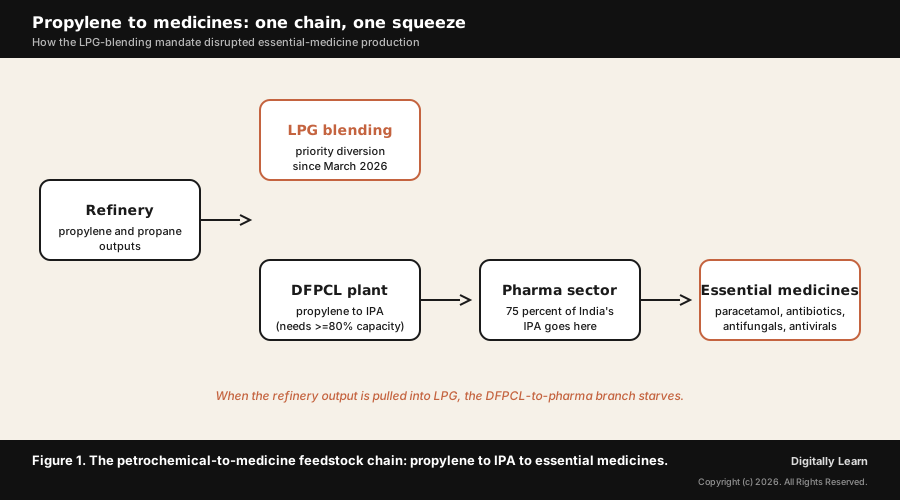
Isopropyl alcohol (IPA) is a pharmacopoeia-grade solvent produced from propylene, a petrochemical feedstock that is also used in liquefied-petroleum-gas (LPG) blending. In March 2026, the Government of India redirected propylene and propane towards domestic LPG supply to cushion households after the 28 February 2026 West Asia war disrupted cooking-gas imports. The diversion choked IPA production at Deepak Fertilisers and Petrochemicals Corporation Limited (DFPCL), which supplies 75 percent of India's pharma-grade IPA, triggering a near-crisis in essential-medicine manufacturing. On 1 April 2026, the Centre announced emergency reallocation of refinery inputs and launched an 11-chemical audit through the Department of Chemicals and Petrochemicals.
Why this is in the news on 9 April 2026
From a cooking-gas squeeze to an essential-medicines alarm
Trigger event: A government push to divert petrochemical feedstocks for domestic LPG (liquefied petroleum gas) supply, in the wake of the 28 February 2026 West Asia war that squeezed cooking-gas imports, triggered a near-crisis in India's pharmaceutical sector in March 2026.
Definition: The diversion choked the production of isopropyl alcohol (IPA), a pharmacopoeia-grade solvent used in essential medicines and life-saving drugs. The entire requirement of IPA is met by domestic producers; DFPCL alone services about 75 percent of pharma-grade IPA demand. The plant must operate at a minimum 80 percent capacity to convert propylene into the high-purity solvent that meets pharmacopoeia specifications.
Three steps describe the April playbook:
- (i) Industry alert. Through the first half of March 2026, India’s leading pharma companies (including Serum Institute of India, Sun Pharma, Zydus Lifesciences, Hetero Labs, Aurobindo Pharma, and Glenmark Pharmaceuticals) sent urgent representations to the Prime Minister’s Office, the petroleum ministry, and DFPCL, warning that not exempting feedstock would force them to shut India’s essential medicine supply chain.
- (ii) DFPCL representation, 26 March 2026. The company presented the crisis to a Joint Working Group on petrochemicals comprising officials from the Department of Chemicals and Petrochemicals and the petroleum ministry. It warned that 75 percent of IPA consumed in India goes to the pharma sector and committed to dedicate 100 percent of restored IPA production exclusively to pharma.
- (iii) Government response, 1 April 2026. The Centre announced emergency measures allowing reallocation of a ‘certain minimum’ quantum of critical refinery inputs (propylene, propane) to DFPCL and other suppliers for pharma, food, and petrochemicals, while continuing priority on LPG supply. The Department of Chemicals and Petrochemicals launched an audit of 11 key chemicals.
Why a feedstock squeeze became a public-health event
Cooking-gas import dependence, supplier concentration, and the petrochemical-pharma link
Why it matters: The April crisis was the surface expression of three concentrated dependencies that India's industrial chemistry sector carries quietly in normal times: an import-dependent cooking-gas economy, a single-supplier feedstock for a critical pharma solvent, and a petrochemical chain that pivots on one or two molecules to feed dozens of medicines.
The cooking-gas dependency: India is the world's second-largest LPG importer; about 340 million consumers rely on LPG cylinders, and the country's annual demand of about 33 million tonnes sees roughly 60 to 65 percent imported, of which the bulk comes from Gulf monarchies (Qatar, UAE, Saudi Arabia, Kuwait). When the West Asia war squeezed supply, the cooking-gas system was the first to feel pain.
The pharma feedstock concentration: Of the chemicals subject to the audit, ethanol, acetone, aniline, and para-aminophenol (the precursor for paracetamol) sit at the foundation of antibiotics, analgesics, antifungals, and tablet formulations. Industry voices argued that when 11 chemicals carry this much weight, any single supply disruption "isn't a business problem, it's a public health event". India accounts for about 20 percent of the world's generic medicines and 60 percent of its vaccines, so a domestic hiccup is a global health-supply concern.
Significance for India's supply-chain resilience doctrine
Concentrated geographies, single-input choke, and the audit response
What is the significance of this near-crisis: Industry observers framed the April episode as "a mirror held up to a structural vulnerability India has known about but not urgently acted on, the near-complete dependence on petrochemical and natural gas feedstocks that run through concentrated geographies". Three policy threads are now active.
- (i) Single-input vulnerability is now mapped. The 11-chemical audit (ethanol, acetone, aniline, para-aminophenol and others) asks companies to share current stock levels, indicate criticality, and suggest alternative sourcing or substitutes. India is moving from incident response to a structural inventory.
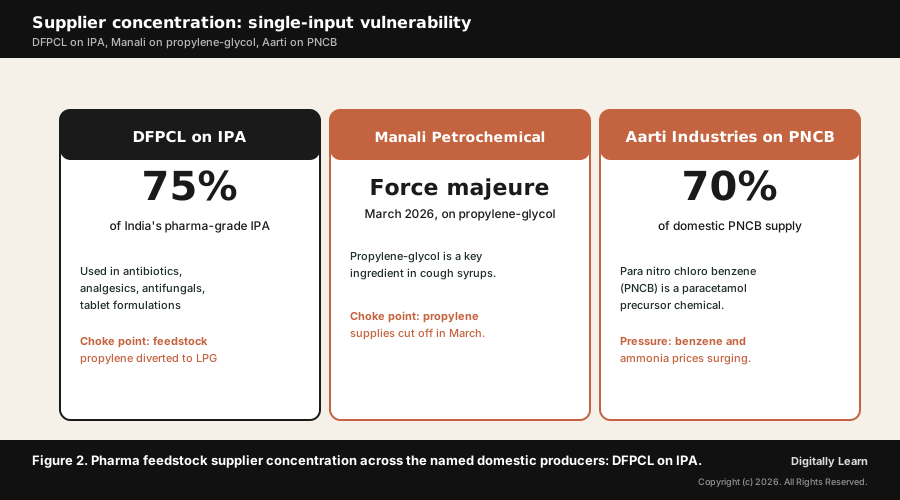
- (ii) Supplier concentration is a manageable but real risk. The fact that DFPCL alone services 75 percent of pharma-grade IPA demand means even a domestic-only supply chain is single-supplier-fragile. Diversifying refinery participation in pharma feedstock is now a policy item.
- (iii) The pharma sector’s global footprint raises the stakes. India accounts for roughly 20 percent of the world’s generic medicines and 60 percent of the world’s vaccines. Industry voices noted that the halt in propylene and IPA production could make it impossible to manufacture critical drugs such as those used for diabetes and epilepsy. Manali Petrochemical declared force majeure on 12 March 2026 on propylene-glycol, a cough-syrup ingredient, after Chennai Petroleum Corporation halted its propylene supply under a government order prioritising LPG. Aarti Industries, which manufactures 70 percent of the domestic supply of para nitro chloro benzene (PNCB) used extensively in paracetamol production, flagged surging input prices for benzene and ammonia. The supplier-concentration risk extends well beyond IPA.
Distinguishing features of the April playbook
Four government responses to the supply squeeze
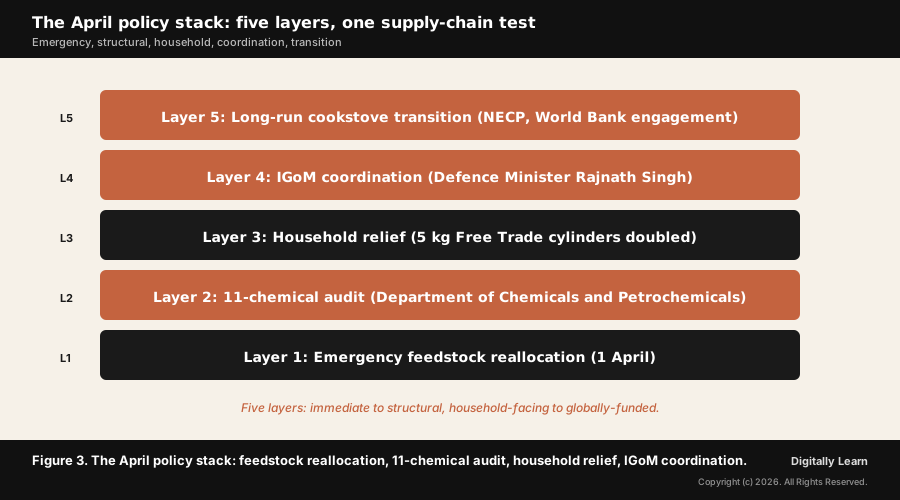
Toolkit architecture: The Centre's response combined emergency reallocation, regulatory audit, household relief, and institutional coordination. The table below maps each tool to the action and the date.
| Response measure | Action | Date / scale |
|---|---|---|
| Emergency feedstock reallocation | Centre permitted reallocation of 'certain minimum' propylene and propane to DFPCL and other suppliers for pharma, food, distribution, and petrochemicals | 1 April 2026 |
| 11-chemical audit | Department of Chemicals and Petrochemicals launched an audit of petrochemical / crude-oil derivatives used in essential medicines (ethanol, acetone, aniline, para-aminophenol among others) | Initiated end-March / early-April 2026 |
| Household relief on 5 kg LPG cylinders | Supply of 5 kg Free Trade LPG cylinders doubled beyond the 20 percent priority-segment allocation, targeting vulnerable communities including migrant labourers | 7 April 2026 |
| IGoM monitoring (multi-ministry) | Informal Empowered Group of Ministers, headed by Defence Minister Rajnath Singh, set up to monitor the West Asia situation; reviews LPG / petrol / diesel availability | Standing since West Asia war began |
| Strait of Hormuz vessel evacuation | 8 LPG vessels carrying about 340 thousand metric tonnes (about 11 days of India's import requirement) transited the strait under monitoring | Cumulative through early April 2026 |
Distinguishing features: Five features separate this cycle from earlier disruptions and bear directly on Mains framing of cross-sectoral crisis response:
- (i) Whole-of-government coordination. The Informal Empowered Group of Ministers chaired by the Defence Minister plus the Department of Chemicals and Petrochemicals, petroleum ministry, health ministry, and Drug Controller General of India aligned in real time, not in committee form. The coordination ran from supply-line monitoring (LPG vessels through Hormuz) down to the pharma feedstock floor (IPA reallocation to DFPCL).
- (ii) Information first. The 11-chemical audit gathers data before any regulatory directive; the Centre mapped vulnerability before mandating action. This audit-then-act sequence is the structural opposite of the production-cap improvisations seen in earlier supply shocks.
- (iii) Supplier-concentration mapping as the diagnostic. The crisis turned on three named producers carrying disproportionate domestic shares: DFPCL at 75 percent of pharma-grade IPA, Aarti Industries at 70 percent of PNCB supply for paracetamol, and Manali Petrochemical concentrating cough-syrup propylene-glycol. Single-supplier exposure, not aggregate import dependence, became the operative variable.
- (iv) Adjacency to the longer LPG transition. The National Efficient Cooking Programme push on electric induction stoves runs alongside the audit response (World Bank and Asian Development Bank engagement under discussion), fast-tracking the clean-cooking transition that would have otherwise unfolded over several years.
- (v) Household relief layered onto industrial reallocation. The 5 kg Free Trade LPG cylinder doubling on 7 April 2026 for vulnerable communities ran in parallel with the propylene-and-propane reallocation to DFPCL on 1 April 2026; relief at the consumer end did not crowd out emergency feedstock action at the industrial end.
Observable outcomes the playbook is producing
Stabilised production, audited stockpile, accelerated cookstove rollout
Observable outcomes: The April playbook is producing five trackable outcomes that aspirants should keep in working memory. Each maps to a different layer of the response, from feedstock floor to maritime supply line to longer-run transition.
- (a) Pharma production stabilised. Zydus Lifesciences confirmed IPA sourcing restored; DFPCL committed to dedicate 100 percent of restored IPA production to the pharma sector until the priority allocation lifts. The Joint Working Group continues to monitor downstream cascade risk into the medicines pricing line.
- (b) Maritime supply line de-risked. 8 LPG vessels carrying about 340 TMT (about 11 days of India’s import requirement) transited the Strait of Hormuz successfully under IGoM monitoring; the convoy-style routing buys time for the audit-and-substitution work to proceed without spot-market panic.
- (c) Cooking-gas prices revised, household relief layered in. Domestic 14.2 kg cylinder hiked 60 rupees in early March 2026 (to 965 rupees); commercial 19 kg cylinder hiked 144 rupees in March and a further 200 rupees on 1 April; the 5 kg Free Trade LPG cylinder allocation doubled on 7 April 2026 to shield vulnerable communities from the broader price increase.
- (d) Substitution audit operational. The 11-chemical audit (ethanol, acetone, aniline, para-aminophenol, and seven others) is collecting plant-by-plant feedstock data; future regulatory directives will be substitution-mapped rather than supply-side improvised, building institutional muscle for the next cycle.
- (e) NECP reset. Energy Efficiency Services Ltd tenders cover 100,000 and 500,000 and 200,000 induction-cookstove units; the PM Surya Ghar Muft Bijli Yojana linkage is under exploration for discom-data-led adopter identification, and World Bank and Asian Development Bank are in discussions on zero-interest loans.
Contemporary linkages
How the LPG cycle threads into India's macro file
Contemporary linkages: The LPG-pharma cycle is one part of a multi-front 2026 macro response that aspirants should connect.
- (i) Strait of Hormuz disruption. India imports about 60 percent of its LPG, and roughly 90 percent of those imports normally transit Hormuz; the March 2026 maritime squeeze that stranded India-flagged LPG carriers in the strait made the disruption physical, not just price-based. For the chokepoint detail, see the sibling Strait of Hormuz briefing on this site.
- (ii) RBI’s April forex tightening. The oil-price shock that motivated the LPG-blending diversion is the same shock that pushed the rupee to a record low of 95.1250 per US dollar on 30 March 2026 and triggered the RBI’s net-open-position cap on banks. See the RBI forex-lens briefing.
- (iii) Clean-cooking-transition acceleration. The crisis is fast-tracking the National Efficient Cooking Programme; EESL is in discussion with World Bank and Asian Development Bank on zero-interest induction-stove loans, while the PM Surya Ghar Muft Bijli Yojana (Prelims 2025 Q70 territory) gives a household-discom data layer for adoption.
UPSC Relevance
Where this fits in the UPSC-CSE syllabus
Where it fits: This topic spans General Studies Paper III: Indian Economy (supply-chain management, infrastructure and industry, energy security) and General Studies Paper III: Issues relating to Health (public health systems, drug pricing, essential medicines). It also touches General Studies Paper II: Governance through the IGoM multi-ministry coordination mechanism.
For Prelims, the high-yield facts cluster around the actors, the dates, and the policy levers:
- DFPCL: services 75 percent of India’s pharma-grade IPA demand; plant minimum operating capacity 80 percent. Presented the crisis on 26 March 2026 to the Joint Working Group on petrochemicals (Department of Chemicals and Petrochemicals plus petroleum ministry).
- 11-chemical audit: ethanol, acetone, aniline, para-aminophenol; led by the Department of Chemicals and Petrochemicals. The audit is data-first: the Centre maps vulnerability before mandating action, separating this cycle from earlier supply-side improvisation.
- Indian pharma: $50 billion market; third-largest globally by volume; 20 percent of world generics, 60 percent of world vaccines. A domestic supply hiccup is a global health-supply concern.
- Manali Petrochemical: declared force majeure on 12 March 2026 on propylene-glycol, a cough-syrup ingredient, after Chennai Petroleum Corporation cut off its propylene supply. Demonstrates how the IPA disruption rippled into a second feedstock chain.
- Aarti Industries: manufactures 70 percent of the domestic supply of para nitro chloro benzene (PNCB), a paracetamol precursor; flagged benzene and ammonia price pressure during the same window.
- LPG dependence: 340 million consumers; 33 million tonnes annual demand; 60-65 percent imported (mostly from Gulf monarchies via Hormuz; about 90 percent of imports come from West Asia).
- IGoM: chaired by Defence Minister Rajnath Singh; standing since the 28 February 2026 West Asia war; reviews LPG, petrol, and diesel availability under West-Asia-shock conditions.
- 8 LPG vessels carrying about 340 TMT (about 11 days of India’s import requirement) transited the Strait of Hormuz under the IGoM monitoring window; 5 kg Free Trade LPG cylinder supply was doubled beyond the 20 percent priority-segment allocation on 7 April 2026.
- Cylinder pricing: domestic 14.2 kg cylinder priced at 965 rupees after a 60-rupee hike in March 2026; 19 kg commercial cylinder hiked 144 rupees in March and a further 200 rupees on 1 April 2026 (a price rise, not a relief cut).
- NECP: run by Energy Efficiency Services Ltd; tenders ramped to 100,000 and 500,000 and 200,000 induction cookstoves; World Bank and Asian Development Bank engagement on zero-interest loans currently in discussion.
- PNGRB regulates only downstream petroleum activities (refining-storage-distribution; marketing-sale of products), not upstream production (UPSC Prelims 2025 Q60: answer ‘Only two’). Upstream is regulated by the Directorate General of Hydrocarbons.
For Mains, three framings recur. First, India as the world's pharmacy under a supply-chain stress test: the 2024 GS-II question on the West fostering India as a China-alternative is re-examined in field conditions; the LPG-pharma cycle exposes a single-input vulnerability India must close to be credible as a generics-and-vaccines hub. Second, governance design for cross-sectoral crises: IGoM coordination, audit-before-directive sequencing, and household relief layered onto industrial reallocation describe a template for multi-ministry shocks transmitted through a single feedstock chain. Third, energy-transition acceleration as a resilience strategy: the NECP push on induction cookstoves with multilateral financing reframes the clean-cooking transition not as a discretionary climate move but as an import-dependence-reduction lever that lightens the same maritime supply line the IGoM had to monitor through Hormuz.
- Common Prelims trap. PNGRB regulates the downstream (refining-storage-distribution, marketing-sale), not the upstream production. Prelims 2025 Q60 answer is ‘Only two’. Upstream is regulated by the Directorate General of Hydrocarbons under the petroleum ministry, a frequently confused regulatory perimeter.
- Common Mains trap. Treating the April crisis as a temporary supply shock misses the doctrinal point. The recommended framing is structural: single-input vulnerability, supplier concentration at named producers (DFPCL on IPA, Aarti on PNCB, Manali on propylene-glycol), and the absence of substitute-mapping before the crisis. Aspirants should centre the answer on the 11-chemical audit as the structural response, not the 1 April reallocation alone.
- Cross-cutting trap. Pradhan Mantri Ujjwala Yojana (LPG cylinders for poor households, run by the petroleum ministry) and the National Efficient Cooking Programme (induction cookstoves, run by EESL under the power ministry) are complementary policy levers, not substitutes; do not collapse them into a single scheme or attribute both to the same ministry.
- Direction-of-change trap. The 19 kg commercial LPG cylinder was hiked (144 rupees in March, a further 200 rupees on 1 April 2026), not reduced. ‘Government stepped in for relief’ should not be read as a price cut on commercial cylinders; the relief was 5 kg cylinder allocation doubling for vulnerable communities and propylene-and-propane reallocation for pharma, not a commercial price reduction.
Previous Year UPSC-CSE Questions By the end you will be able to draft model answers for the following UPSC questions. Each question carries a collapsible framework showing how to approach it in the exam.
- UPSC Prelims 2025Consider the following activities:
- Production of crude oil
- Refining, storage and distribution of petroleum
- Marketing and sale of petroleum products
- Production of natural gas
How many of the above activities are regulated by the Petroleum and Natural Gas Regulatory Board in our country?
How to approach this Prelims question
Approach: Separate downstream petroleum activities from upstream production; only downstream is under PNGRB.
Trap to watch: All four sound plausible because each is in the petroleum value chain; the trap is to assume PNGRB covers production. Upstream is regulated by the Directorate General of Hydrocarbons under the petroleum ministry.
Key facts to recall:
- PNGRB Act, 2006 established the Petroleum and Natural Gas Regulatory Board.
- PNGRB regulates downstream activities: refining-storage-distribution of petroleum, and marketing-sale of petroleum products.
- Upstream activities (production of crude oil, production of natural gas) are regulated by the Directorate General of Hydrocarbons under the petroleum ministry, not PNGRB.
Answer signal: Only two activities (II and III) are PNGRB-regulated; option (b) is the answer.
- UPSC Mains 2024 GS-IIThe West is fostering India as an alternative to reduce dependence on China's supply chain and as a strategic ally to counter China's political and economic dominance. Explain this statement with examples.
How to structure the answer in the exam
Introduction: One-line statement on the China-supply-chain question and India's positioning, with the April 2026 LPG-pharma cycle as a topical opening reference.
Body (sub-themes to develop):
- The China-supply-chain question: Western dependence on Chinese active pharmaceutical ingredients, electronics, rare earths, and solar PV components; the post-COVID and post-Russia-Ukraine reassessment of single-source supply.
- India-as-alternative examples: $50 billion pharma industry (third-largest globally by volume, 20 percent of global generics, 60 percent of global vaccines), Production-Linked Incentive schemes for pharma APIs and electronics, Quad supply-chain initiatives.
- Structural conditions for credibility: closing single-input vulnerabilities like the IPA-solvent dependence exposed in April 2026, broadening supplier participation beyond DFPCL alone, accelerating clean-cooking and electric-vehicle transitions to reduce import-energy exposure.
Conclusion: Two-line synthesis arguing that India's credibility as a China-alternative supply-chain rests on simultaneous scale, diversification, and resilience, not on scale alone.
Sources and Further Reading
- LiveMint: Govt steps in after LPG diversion triggers near-crisis in pharma supply chain (4 April 2026)
- Business Standard: Govt permits C3, C4 allocation for pharma, chemicals and food sectors (1-2 April 2026)
- LiveMint: Govt plans push for electric stoves to reduce LPG dependence (7 April 2026)
- LiveMint: LPG cylinder price on April 9 (IGoM review, 8 LPG vessels transited Hormuz)
- Ministry of Petroleum and Natural Gas: LPG supply policy and Ujjwala scheme
- Petroleum and Natural Gas Regulatory Board: downstream regulation perimeter
- Department of Chemicals and Petrochemicals: industry policy
- Press Information Bureau: petroleum ministry press releases
- Wikipedia: Indian pharmaceutical industry (scale and global footprint)
Editorial Disclaimer
This article is compiled from the reference materials listed in the Sources section. It is an explainer for UPSC preparation and is not a substitute for primary documents (NCERTs, GoI ministry releases, IMD bulletins, RBI / CEA / MoEFCC publications, and Standing-Committee reports).


