

Overview
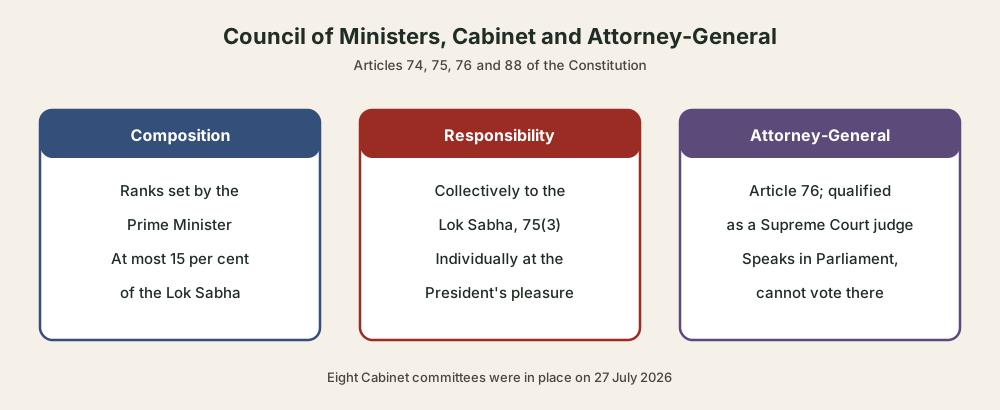
The Union Council of Ministers, headed by the Prime Minister, aids and advises the President under Article 74 and is collectively responsible to the Lok Sabha under Article 75(3). Its inner core, the Cabinet, takes the main decisions, and the Attorney-General under Article 76 is the Government's chief legal adviser.
Union Council of Ministers: Composition, Ranks and Size
Council of Ministers Under Articles 74 and 75
The Union Council of Ministers, with the Prime Minister at its head, aids and advises the President under Article 74(1). Under Article 75, the President appoints the other Ministers on the Prime Minister's advice, they hold office during the President's pleasure, and the Council is collectively responsible to the House of the People.
The Council matters because it is the body through which the executive power of the Union is actually exercised, while its collective responsibility to the Lok Sabha keeps the government answerable to the elected House.
The significance of the Council of Ministers lies in three features:
- Collective government: The Council governs as an executive committee of Parliament, not as a set of individual departments.
- Answerability: A Council that loses the Lok Sabha’s confidence must resign as a whole.
- Inner core: The Cabinet, a smaller body of senior Ministers, takes the main decisions through its committees.
The Prime Minister's own office is explained in Prime Minister of India: Appointment, Powers, Role and Relationship With the President, and the President's side of the advice relationship in Powers of the President of India: Executive, Legislative, Assent and Veto.
Ranks of Ministers: Cabinet, Minister of State and Deputy Minister
The Constitution does not divide Ministers into ranks. The Prime Minister allocates ranks and portfolios: depending on seniority and political importance, a Minister becomes a Cabinet Minister, a Minister of State or a Deputy Minister. In practice, a Minister of State with independent charge runs a Ministry or Department without reporting to a Cabinet Minister, while a Minister of State assists one.
The only constitutional reference to Cabinet rank is in Article 352(3), substituted by the 44th Amendment. The President may proclaim an Emergency only when the decision of the Union Cabinet, defined there as the Council of the Prime Minister and the other Ministers of Cabinet rank appointed under Article 75, has been communicated in writing.
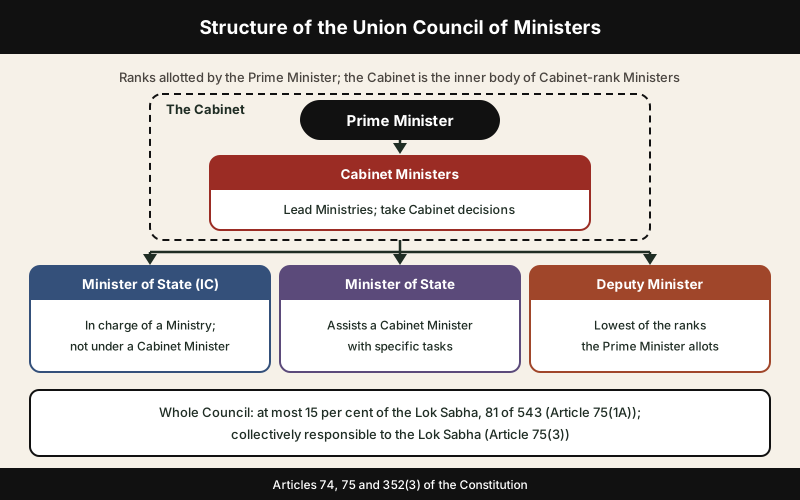
| Rank | Role | Basis |
|---|---|---|
| Prime Minister | Head of the Council of Ministers | Article 74(1) |
| Cabinet Minister | Member of the Cabinet; leads a Ministry | Rank allotted by the Prime Minister; Cabinet rank named in Article 352(3) |
| Minister of State (independent charge) | Runs a Ministry or Department, not under a Cabinet Minister | Rank allotted by the Prime Minister |
| Minister of State | Assists a Cabinet Minister with specific responsibilities | Rank allotted by the Prime Minister |
| Deputy Minister | Lowest of the ranks | Rank allotted by the Prime Minister |
Fifteen Per Cent Cap and Defection Bar Under the 91st Amendment
Before the 91st Amendment Act, 2003, the size of the Council was set by the needs of the time, which produced very large Councils. When no party had a clear majority, there was a temptation to win the support of members by offering them ministerial positions, and the same happened in many States.
The amendment inserted Article 75(1A), in force from 1 January 2004: the total number of Ministers, including the Prime Minister, may not exceed fifteen per cent of the total membership of the House of the People, so a Lok Sabha of 543 allows at most 81 Ministers. Article 164(1A) applies the same cap to the States, with a floor of twelve Ministers including the Chief Minister.
The amendment also tied the Council to the anti-defection law. Under Article 75(1B), a member disqualified for defection under paragraph 2 of the Tenth Schedule cannot be appointed a Minister until the term of the seat would have ended or the member is elected again, and Article 361B bars such a member from any remunerative political post for the same period.
Parliamentary Secretaries and Posts Outside the Council
In several Commonwealth parliamentary systems, India among them, it has been customary to appoint parliamentary secretaries from the ruling party in Parliament to assist Ministers with their work, and their role has varied from one head of government to another.
The Constitution does not create the office, and a parliamentary secretary is not one of the ranks of Minister listed above. Article 361B nevertheless reaches such posts indirectly: a member disqualified for defection may hold no remunerative political post until the term ends or the member is re-elected.
Union Cabinet: Decision-Making Core of the Council
Cabinet Versus Council of Ministers
The Council of Ministers is the larger body of all ranks. The Union Cabinet is a smaller subset of it, made up of the Prime Minister and the Ministers of Cabinet rank, who hold the important portfolios, and it is the supreme decision-making body of the government.
The Transaction of Business Rules list in their Second Schedule the cases that need the Cabinet's approval, and the Cabinet Secretariat, which functions directly under the Prime Minister, provides secretarial assistance to the Cabinet and its committees. The Cabinet also decides the substance and timing of Bills, and no major Bill is introduced in Parliament without its approval.
| Feature | Council of Ministers | Cabinet |
|---|---|---|
| Constitutional basis | Articles 74 and 75 | Named only in Article 352(3) |
| Composition | Ministers of every rank | Prime Minister and Cabinet Ministers |
| Size | At most fifteen per cent of the Lok Sabha | A subset of the Council |
| Function | Aids and advises the President; collectively responsible | Takes the main decisions; approves Second Schedule cases |
Cabinet Committees and Their Composition in 2026
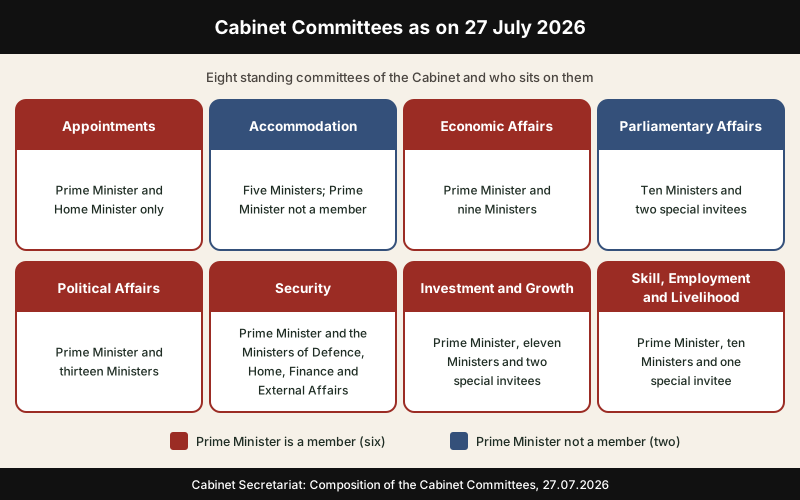
Much Cabinet business is decided in standing committees. The First Schedule to the Transaction of Business Rules lists the cases that need a committee's approval, and the Cabinet Secretariat convenes committee meetings on the Prime Minister's orders. As on 27 July 2026 there were eight Cabinet committees:
- Appointments Committee of the Cabinet: The Prime Minister and the Minister of Home Affairs.
- Cabinet Committee on Security: The Prime Minister and the Ministers of Defence, Home Affairs, Finance and External Affairs.
- Cabinet Committees on Economic Affairs, Political Affairs, Investment and Growth, and Skill, Employment and Livelihood: larger committees that include the Prime Minister.
- Cabinet Committees on Accommodation and on Parliamentary Affairs: The two committees that do not include the Prime Minister.
Some committees also have special invitees, Ministers of State who attend without being members, such as the two Ministers of State for Parliamentary Affairs on the Cabinet Committee on Parliamentary Affairs. The composition changes whenever the Council is reshuffled, so the Cabinet Secretariat's current list is the authority.
Size of the Cabinet and the Efficacy of Government
The size of the Council has two pulls. A larger Council can give specialised attention to more Ministries and represent more regions and coalition partners; in coalition periods the Prime Minister's freedom to choose Ministers and decide their ranks has itself been restricted. A smaller Council is easier to coordinate and keeps collective responsibility real.
The Constitution now fixes only an upper limit, the fifteen per cent cap, and leaves the rest to the Prime Minister. Within that limit the committee system lets a small group decide each class of business, such as the five-member Cabinet Committee on Security, so efficacy depends less on the total number of Ministers than on how business is divided among them.
Collective and Individual Responsibility of Ministers
Collective Responsibility to the Lok Sabha
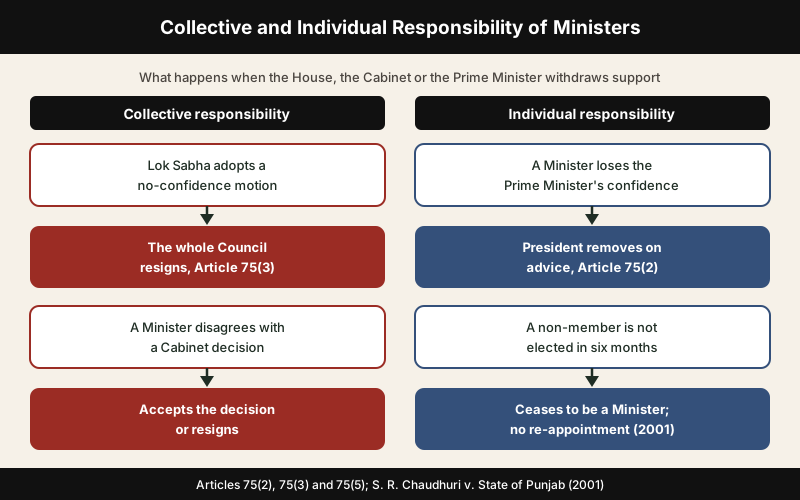
Article 75(3) makes the Council collectively responsible to the House of the People, not to the Rajya Sabha, although members of either House may be Ministers. A Ministry that loses the Lok Sabha's confidence must resign, because it is in effect an executive committee of Parliament that governs on its behalf.
Collective responsibility expresses the most important principle of a parliamentary executive: the executive is routinely under the control and supervision of the legislature. A vote of no confidence even against a single Minister leads to the resignation of the whole Council, and a motion of no confidence can be moved only in the Lok Sabha, where at least 50 members must support it before the Speaker grants leave.
Cabinet Solidarity and Cabinet Secrecy
Collective responsibility rests on the solidarity of the Cabinet. A Minister who does not agree with a policy or decision of the Cabinet must either accept it or resign, and every Minister is bound to pursue a policy for which there is collective responsibility.
Secrecy protects that solidarity. Each Minister takes an oath of secrecy in the form set out in the Third Schedule, promising not to reveal any matter that comes before the Minister except as the duties require, and under Article 74(2) no court may inquire whether, or what, advice the Ministers tendered to the President.
Individual Responsibility and the Pleasure of the President
Under Article 75(2) each Minister holds office during the pleasure of the President, which in practice means the Prime Minister's confidence, because the Prime Minister controls the selection and dismissal of Ministers. A Minister leaves office on resignation, on dismissal by the President, on ceasing to be eligible for Parliament, or when the Prime Minister resigns or dies.
Individual responsibility thus runs to the Prime Minister, while collective responsibility runs to the House. The death, dismissal or resignation of a single Minister only creates a vacancy, whereas the Prime Minister's exit dissolves the whole Council.
Qualifications, Tenure and Rights of Ministers
Six-Month Rule and the Bar on Re-Appointment (2001)
Under Article 75(5), a Minister who for six consecutive months is not a member of either House ceases to be a Minister at the end of that period, and Article 164(4) says the same for the States. The rule lets a non-member be appointed, but only for a period of grace in which to win a seat.
In S. R. Chaudhuri v. State of Punjab, decided on 17 August 2001, the Supreme Court dealt with Tej Parkash Singh, who was re-appointed a Minister in Punjab without being elected. The Court held that the framers never contemplated a non-legislator being appointed again and again for six months each time, which would strike at the root of parliamentary democracy, and called the re-appointment improper, undemocratic, invalid and unconstitutional.
Oaths, Salaries and Membership of Either House
Before entering office, every Minister takes the oaths of office and secrecy administered by the President under Article 75(4). Salaries and allowances are fixed by Parliament by law under Article 75(6), through the Salaries and Allowances of Ministers Act, 1952.
The Constitution does not require Cabinet Ministers to sit in the Lok Sabha. A Minister may be a member of either House, or of neither for six months, and the Council's collective responsibility to the Lok Sabha does not depend on where individual Ministers sit.
Right to Speak in Both Houses Under Article 88
Under Article 88, every Minister and the Attorney-General may speak in and take part in the proceedings of either House, a joint sitting, and any committee of Parliament of which the Minister is named a member. The article gives no right to vote, so a Minister votes only in the House to which the Minister belongs.
Article 105(4) extends the privileges of members, such as freedom of speech in Parliament, to every person who has the right to speak in a House or its committees, so Ministers and the Attorney-General speak with the same protection as members.
Parliamentary Control Over the Council of Ministers
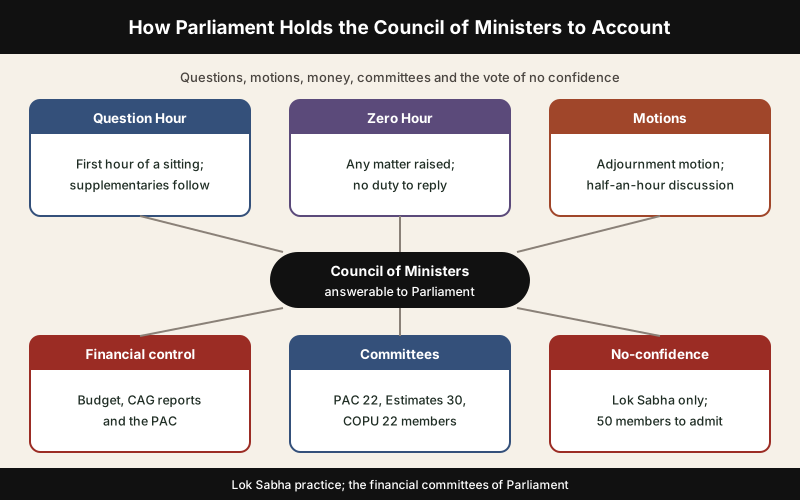
Question Hour, Supplementary Questions and Zero Hour
Question Hour, the first hour of a sitting, is held every day during a session, and Ministers must answer members' questions on any aspect of administration. Starred questions receive oral answers, which may be followed by supplementary questions; non-starred questions receive written answers, with no supplementaries.
In Zero Hour members may raise any matter they think important, though Ministers are not bound to reply. The half-an-hour discussion on matters of public importance and the adjournment motion are further instruments through which the House examines the executive.
Financial Control and the Financial Committees
Before granting money, the Lok Sabha can discuss why the government needs it, and it can inquire into misuse of funds on the basis of the Comptroller and Auditor General's reports and the Public Accounts Committee. Through financial control, the legislature controls the policy of the government.
Three financial committees carry this scrutiny into detail. Their members are elected every year by proportional representation from the members of each House:
| Committee | Members | Drawn from |
|---|---|---|
| Public Accounts Committee | Not more than 22 | 15 from the Lok Sabha, up to 7 from the Rajya Sabha |
| Estimates Committee | 30 | Lok Sabha only |
| Committee on Public Undertakings | 22 | 15 from the Lok Sabha, up to 7 from the Rajya Sabha |
No-Confidence Motion and Its Limits
The no-confidence motion is the most powerful weapon Parliament has to enforce executive accountability. Yet while a government keeps the support of its party or coalition in the Lok Sabha, the House's power to dismiss it exists more in form than in fact.
After 1989 several governments did resign because they lost the support of coalition partners, which showed that Parliament can control the executive effectively when majorities are narrow. The history of these votes is traced in the article on the Prime Minister, and Figure 4 sets out the instruments of control together.
Attorney-General for India Under Article 76
Appointment, Qualifications and Tenure of the Attorney-General
Under Article 76(1), the President appoints as Attorney-General a person qualified to be appointed a Judge of the Supreme Court: a citizen of India who has been a High Court judge for five years, an advocate of a High Court for ten years, or a distinguished jurist in the President's opinion. The appointment is made on the advice of the Union Cabinet, and the Constitution does not require the Attorney-General to be a member of Parliament.
Under Article 76(4), the Attorney-General holds office during the pleasure of the President and receives such remuneration as the President determines. There is no fixed term and no impeachment; by custom the Attorney-General resigns when a new government takes office, though the Constitution does not require it.
M. C. Setalvad was the first Attorney-General, from 28 January 1950 to 1 March 1963. R. Venkataramani became the sixteenth Attorney-General on 1 October 2022, succeeding K. K. Venugopal.
Duties, Right of Audience and Rights in Parliament
Article 76(2) lays three duties on the Attorney-General:
- Advice: To advise the Government of India on legal matters referred by the President.
- Other legal duties: To perform such duties of a legal character as the President assigns.
- Statutory functions: To discharge the functions conferred by the Constitution or any other law.
Under Article 76(3) the Attorney-General has a right of audience in all courts in India. The Attorney-General appears for the Government of India in the Supreme Court in cases that concern it, and represents it in any reference by the President under Article 143.
Article 88 gives the Attorney-General the right to speak in, and otherwise to take part in the proceedings of, either House, a joint sitting and any committee of Parliament of which the Attorney-General is named a member. A committee drawn from the Lok Sabha alone, such as the Estimates Committee, is itself a committee of Parliament, so the right reaches it too. The article confers no right to vote, in the House or in a committee.
The office carries no executive authority, which rests with the Law Minister. The Attorney-General is not a government servant and may practise privately, but may not appear against the Government, defend an accused in a criminal case, or become a company director without the Government's consent. References reach the Attorney-General only through the Law Ministry, on legal matters of real importance.
Solicitor General, Additional Solicitors General and the Advocate-General
The Solicitor General, the second-highest law officer, assists the Attorney-General and is in turn assisted by Additional Solicitors General. Unlike the Attorney-General's office, these posts are neither constitutional nor statutory: their conditions are set by the Law Officers (Conditions of Service) Rules, 1987, made under the proviso to Article 309, and the Appointments Committee of the Cabinet approves the appointment.
Article 88 names only Ministers and the Attorney-General, so the Solicitor General has no right to take part in the proceedings of Parliament. In the States, Article 165 provides for an Advocate-General, appointed by the Governor from persons qualified to be High Court judges and holding office during the Governor's pleasure.
| Feature | Attorney-General | Solicitor General | Advocate-General |
|---|---|---|---|
| Basis | Article 76 | Law Officers Rules, 1987 | Article 165 |
| Appointed by | President | Appointments Committee of the Cabinet | Governor |
| Qualification | Fit to be a Supreme Court judge | Not laid down in the Constitution | Fit to be a High Court judge |
| Rights in the legislature | Speak and take part in Parliament, no vote (Article 88) | None | Speak in the State legislature (Article 177) |
| Tenure and pay | Pleasure of the President; pay fixed by the President | Conditions under the Law Officers Rules, 1987 | Pleasure of the Governor; pay fixed by the Governor |
Assessment of the Council of Ministers and the Attorney-General
Distinguishing Features, Observable Outcomes and Current Debates
Three features distinguish the Council of Ministers from the President, in whose name it acts:
- Collective answerability: The Council rises and falls together in the Lok Sabha.
- Graded membership: Ranks allotted by the Prime Minister, with the Cabinet as the deciding core.
- A legal limit on size: The fifteen per cent cap and the defection bar of the 91st Amendment.
Three observable outcomes follow:
- Decisions in committees: Eight Cabinet committees in 2026 carried much of the Cabinet’s business.
- Bounded patronage: The cap and Articles 75(1B) and 361B limit the use of office to reward or win defectors.
- Judicial policing: The 2001 ruling closed the route of repeated six-month appointments.
The current debate concerns the dominance of the Cabinet over Parliament, taken up in the article on the Prime Minister, and the neutrality of the Attorney-General: as the government's appointee the Attorney-General acts as its advocate, yet holds a constitutional office whose opinions are open to public scrutiny.
UPSC Relevance and Previous-Year Questions on the Council of Ministers
Where the Council of Ministers Fits in the UPSC-CSE Syllabus
This topic belongs to General Studies Paper II, under the structure and functioning of the Executive and Parliament. The linked questions from the preliminary examination test precise textual points:
- Size: The 91st Amendment and the fifteen per cent cap; the Constitution does not rank Ministers.
- Responsibility: Collective responsibility runs only to the Lok Sabha.
- Membership: Cabinet Ministers may come from either House; the Cabinet Secretariat works under the Prime Minister.
- Control: Question Hour, supplementary questions and adjournment motions.
- Law officers: The Attorney-General’s qualifications, tenure and rights, and the Solicitor General’s lack of them.
The linked questions from the main examination ask how the size of the cabinet bears on the efficacy of government, and what the Attorney-General's role as chief legal adviser involves. The sub-sections on size and committees, and the section on the Attorney-General, supply the material.
Previous Year UPSC-CSE Questions By the end you will be able to draft model answers for the following UPSC questions. Each question carries a collapsible framework showing how to approach it in the exam.
- UPSC Prelims 2022 GS-IConsider the following statements:
- The Constitution of India classifies the ministers into four ranks viz. Cabinet Minister, Minister of State with Independent Charge, Minister of State and Deputy Minister.
- The total number of ministers in the Union Government, including the Prime Minister, shall not exceed 15 percent of the total number of members in the Lok Sabha.
Which of the statements given above is/are correct?
How to approach this Prelims question
Approach: Separate what the Constitution says (the cap) from what practice supplies (the ranks).
Trap to watch: The four ranks are real in practice, which makes statement 1 sound constitutional.
Key facts to recall:
- Ranks: allotted by the Prime Minister.
- Article 75(1A): fifteen per cent, including the Prime Minister.
- Cabinet rank named only in Article 352(3).
Answer signal: Only statement 2 is correct, so option (b) is the answer.
- UPSC Prelims 2009 GSWhich one of the following Constitutional Amendments states that the total number of Ministers, including the Prime Minister, in the Council of Ministers shall not exceed fifteen percent of the total number of members of the House of the People ?
How to approach this Prelims question
Approach: Link the cap to the amendment that also tightened the anti-defection law.
Trap to watch: Neighbouring amendment numbers are offered as distractors.
Key facts to recall:
- 91st Amendment, 2003.
- Article 75(1A) and Article 164(1A).
- Also Articles 75(1B) and 361B.
Answer signal: The 91st Amendment inserted the cap, so option (b) is the answer.
- UPSC Prelims 2007 GSWhich of the Constitution Amendment Acts seeks that the size of the Council of Ministers at the Centre and in a State must not exceed 15 percent of the total number in the Lok Sabha and the total number of members of the Legislative Assembly of that State, respectively?
How to approach this Prelims question
Approach: Recall that one amendment capped both the Union and the State Councils.
Trap to watch: Other amendments of the 2000s are offered as distractors.
Key facts to recall:
- Article 75(1A): Union.
- Article 164(1A): States, minimum twelve.
- In force from 1 January 2004.
Answer signal: The 91st Amendment is the answer, option (a).
- UPSC Prelims 2007 GSConsider the following Assertion (A) and Reason (R):
- Assertion (A): The Council of Ministers in the Union of India is collectively responsible both to the Lok Sabha and the Rajya Sabha.
- Reason (R): The members of both the Lok Sabha and the Rajya Sabha are eligible to be the Ministers of the Union.
Select the correct answer using the code given below.
How to approach this Prelims question
Approach: Test the assertion against the words 'House of the People' and the reason against Article 75(5) and Article 88.
Trap to watch: Eligibility from both Houses tempts the reader to extend responsibility to both.
Key facts to recall:
- Article 75(3): House of the People.
- No-confidence motions: Lok Sabha only.
- Ministers from either House.
Answer signal: The assertion is false and the reason true, so option (d) is the answer.
- UPSC Prelims 2009 GSWith reference to Union Government, consider the following statements :
- The Constitution of India provides that all Cabinet Ministers shall be compulsorily the sitting members of Lok Sabha only.
- The Union Cabinet Secretariat operates under the direction of the Ministry of Parliamentary Affairs.
Which of the statements given above is/are correct ?
How to approach this Prelims question
Approach: Check statement 1 against Article 75(5) and statement 2 against the Cabinet Secretariat's own description.
Trap to watch: The Cabinet Committee on Parliamentary Affairs may suggest a link between the Secretariat and that Ministry.
Key facts to recall:
- Ministers: either House.
- Cabinet Secretariat: directly under the Prime Minister.
- Parliamentary Affairs: a Ministry and a Cabinet committee, not the Secretariat's master.
Answer signal: Neither statement is correct, so option (d) is the answer.
- UPSC Prelims 2017 GS-IOut of the following statements, choose the one that brings out the principle underlying the Cabinet form of Government:
How to approach this Prelims question
Approach: Pick the option that names accountability to the people's representatives.
Trap to watch: Options (a), (b) and (d) describe side effects or motives, not the principle.
Key facts to recall:
- Article 75(3).
- Executive committee of Parliament.
- Solidarity of the Cabinet.
Answer signal: Collective responsibility is the principle, so option (c) is the answer.
- UPSC Prelims 2017 GS-IThe Parliament of India exercises control over the functions of the Council of Ministers through
- Adjournment motion
- Question hour
- Supplementary questions
Select the correct answer using the code given below:
How to approach this Prelims question
Approach: Treat each item as a device through which Ministers must answer to the House.
Trap to watch: Supplementary questions look like a detail of Question Hour, but they are a device in their own right.
Key facts to recall:
- Question Hour: first hour, every day.
- Starred questions: oral answers and supplementaries.
- Adjournment motion and half-an-hour discussion.
Answer signal: All three are instruments of control, so option (d) is the answer.
- UPSC Prelims 2013 GS-IConsider the following statements. The Attorney-General of India can:
- Take part in the proceedings of the Lok Sabha
- Be a member of a committee of the Lok Sabha
- Speak in the Lok Sabha
- Vote in the Lok Sabha
Which of the statements given above is/are correct?
How to approach this Prelims question
Approach: Read each statement against the words of Article 88.
Trap to watch: Committee membership sounds like a right reserved for members of the House, but Article 88 names any committee of Parliament of which the Attorney-General is named a member.
Key facts to recall:
- Speak and take part: yes, in either House.
- Committee: may be named a member.
- Vote: no, under Article 88.
Answer signal: Statements 1, 2 and 3 are correct and statement 4 is not, so option (d) is the answer.
- UPSC Prelims 2022 GS-IConsider the following statements:
- Attorney General of India and Solicitor General of India are the only officers of the Government who are allowed to participate in the meetings of the Parliament of India.
- According to the Constitution of India, the Attorney General of India submits his resignation when the Government which appointed him resigns.
Which of the statements given above is/are correct?
How to approach this Prelims question
Approach: Check statement 1 against the names in Article 88 and statement 2 against Article 76(4).
Trap to watch: The customary resignation makes statement 2 sound constitutional.
Key facts to recall:
- Article 88: Ministers and the Attorney-General.
- Solicitor General: neither constitutional nor statutory.
- Article 76(4): pleasure of the President.
Answer signal: Both statements are incorrect, so option (d) is the answer.
- UPSC Prelims 2000 GSConsider the following statements about the Attorney General of India:
- He is appointed by the President of India.
- He must have the same qualifications as are required for a Judge of the Supreme Court.
- He must be a member of either House of Parliament.
- He can be removed by impeachment by Parliament.
Which of these statements are correct?
How to approach this Prelims question
Approach: Read Articles 76(1) and 76(4) and ask what they do not say.
Trap to watch: The right to speak in Parliament under Article 88 suggests membership, and Supreme Court qualifications suggest impeachment.
Key facts to recall:
- Article 76(1): President; Supreme Court qualifications.
- No membership of Parliament required.
- Article 76(4): pleasure of the President.
Answer signal: Statements I and II are correct, so option (a) is the answer.
- UPSC Mains 2014 GS-IIThe size of the cabinet should be as big as governmental work justifies and as big as the Prime Minister can manage as a team. How far is the efficacy of a government then inversely related to the size of the cabinet? Discuss.
How to structure the answer in the exam
Introduction: The 91st Amendment capped the Union Council of Ministers at fifteen per cent of the Lok Sabha after very large Councils had been used to win support.
Body (sub-themes to develop):
- The case for a larger Council: more Ministries and specialised attention; representation of regions and coalition partners.
- The case for a smaller Council: coordination, collective responsibility and cost; the pre-2003 experience of large Councils.
- The committee system: eight Cabinet committees in 2026, such as the five-member Cabinet Committee on Security, decide in small groups.
- The Prime Minister as manager: ranks and portfolios allotted by the Prime Minister; coalition limits on that choice.
Conclusion: Efficacy is not simply inverse to size: within the constitutional cap, a well-organised Council working through small committees can be both representative and effective.
- UPSC Mains 2019 GS-II“The Attorney-General is the chief legal adviser and lawyer of the Government of India.” Discuss.
How to structure the answer in the exam
Introduction: Article 76 creates the Attorney-General for India, appointed by the President from persons qualified to be Supreme Court judges and holding office at the President's pleasure.
Body (sub-themes to develop):
- Adviser: advice on legal matters referred by the President; other legal duties; statutory functions (Article 76(2)).
- Lawyer: right of audience in all courts (Article 76(3)); appears for the Government in the Supreme Court; represents it in Article 143 references.
- Parliament: may speak and take part, cannot vote (Article 88); privileges under Article 105(4).
- Limits: no executive authority; not a government servant; restrictions on private briefs; consulted through the Law Ministry.
- Support and counterparts: Solicitor General and Additional Solicitors General; Advocate-General under Article 165.
Conclusion: The Attorney-General is the Government's chief legal adviser and advocate, but the office's constitutional status requires independent advice, a tension that the custom of resigning with the government sharpens.
Prelims MCQ practice
Each question below tests one specific concept on the topic. Click to reveal the answer and a full option-wise explanation.
Q1. With reference to the size of Councils of Ministers, consider the following statements:
- The Union Council of Ministers, excluding the Prime Minister, may not exceed fifteen per cent of the Lok Sabha.
- A State Council of Ministers, including the Chief Minister, must have at least twelve Ministers.
- A member disqualified for defection may not be appointed a Minister until the term of the seat ends or the member is re-elected.
Which of the statements given above are correct?
- 1 and 2 only
- 2 and 3 only
- 1 and 3 only
- 1, 2 and 3
Show answer and explanation
Answer: 2 and 3 only
Explanation.
Correct: b (2 and 3 only). Statement 1 is incorrect: the cap in Article 75(1A) includes the Prime Minister. Statement 2 is correct under Article 164(1A), and statement 3 under Article 75(1B).
Q2. With reference to the Union Cabinet, consider the following statements:
- The word 'Cabinet' does not appear anywhere in the Constitution.
- The Cabinet consists of the Prime Minister and the Ministers of Cabinet rank.
- Cases that need the Cabinet's approval are listed in the Transaction of Business Rules.
How many of the statements given above are correct?
- Only one
- Only two
- All three
- None
Show answer and explanation
Answer: Only two
Explanation.
Correct: b (Only two). Statement 1 is incorrect: Article 352(3) refers to the Union Cabinet. Statements 2 and 3 are correct; the cases are in the Second Schedule to the Transaction of Business Rules.
Q3. With reference to the Cabinet committees as on 27 July 2026, consider the following pairs:
- Appointments Committee of the Cabinet : Prime Minister and Home Minister
- Cabinet Committee on Security : includes the Minister of External Affairs
- Cabinet Committee on Parliamentary Affairs : chaired by the Prime Minister
How many of the pairs given above are correctly matched?
- Only one
- Only two
- All three
- None
Show answer and explanation
Answer: Only two
Explanation.
Correct: b (Only two). Pairs 1 and 2 are correct. Pair 3 is incorrect: the Prime Minister is not a member of the Cabinet Committee on Parliamentary Affairs.
Q4. With reference to the responsibility of Ministers, consider the following statements:
- The Council of Ministers is collectively responsible to both Houses of Parliament.
- A Minister who disagrees with a Cabinet decision must accept it or resign.
- A non-member who fails to win a seat in six months may be re-appointed for another six months.
Which of the statements given above is/are correct?
- 1 only
- 2 only
- 2 and 3 only
- 1, 2 and 3
Show answer and explanation
Answer: 2 only
Explanation.
Correct: b (2 only). Statement 1 is incorrect: responsibility is to the House of the People only. Statement 2 is correct. Statement 3 is incorrect: in S. R. Chaudhuri v. State of Punjab (2001) the Supreme Court held such re-appointment unconstitutional.
Q5. With reference to the Attorney-General for India, consider the following statements:
- The Attorney-General has a right of audience in all courts in India.
- The Attorney-General may vote in either House of Parliament.
- The Attorney-General holds office for a fixed term of five years.
Which of the statements given above is/are correct?
- 1 only
- 1 and 2 only
- 2 and 3 only
- 1, 2 and 3
Show answer and explanation
Answer: 1 only
Explanation.
Correct: a (1 only). Statement 1 is correct under Article 76(3). Statement 2 is incorrect: Article 88 gives no vote. Statement 3 is incorrect: under Article 76(4) the Attorney-General serves at the President's pleasure, with no fixed term.
Q6. Consider the following pairs of law officers and the basis of their office:
- Attorney-General for India : Article 76
- Solicitor General of India : Article 165
- Advocate-General for a State : Article 165
How many of the pairs given above are correctly matched?
- Only one
- Only two
- All three
- None
Show answer and explanation
Answer: Only two
Explanation.
Correct: b (Only two). Pairs 1 and 3 are correct. Pair 2 is incorrect: the Solicitor General's post is neither constitutional nor statutory; its conditions are set by the Law Officers (Conditions of Service) Rules, 1987.
Sources and Further Reading
- Legislative Department, Ministry of Law and Justice: The Constitution of India
- Cabinet Secretariat: Composition of the Cabinet Committees (as on 27.07.2026)
- Cabinet Secretariat: Functions
- Supreme Court of India: S. R. Chaudhuri v. State of Punjab (17 August 2001)
- NCERT: Indian Constitution at Work, Class 11, Chapter 4, Executive
- NCERT: Indian Constitution at Work, Class 11, Chapter 5, Legislature
- Press Information Bureau: Election to the Office of the Vice-President of India, 2025 (1 August 2025), for the 543 elected members of the Lok Sabha
- Wikipedia: Union Council of Ministers
- Wikipedia: Attorney General for India
- Wikipedia: Solicitor General of India
- Wikipedia: Parliamentary secretary
- Wikipedia: Public Accounts Committee (India)
- Wikipedia: Estimates Committee (India)
- Wikipedia: Committee on Public Undertakings
- Wikipedia: Question Hour
- Wikipedia: Motion of no confidence
- Wikipedia: Prime Minister of India
Editorial Disclaimer
This article is for UPSC preparation and explains the Council of Ministers and the Attorney-General. The composition of Cabinet committees follows the Cabinet Secretariat's published list, which changes when the Council is reshuffled, and the official text of the Constitution governs any question of law.


