

Overview
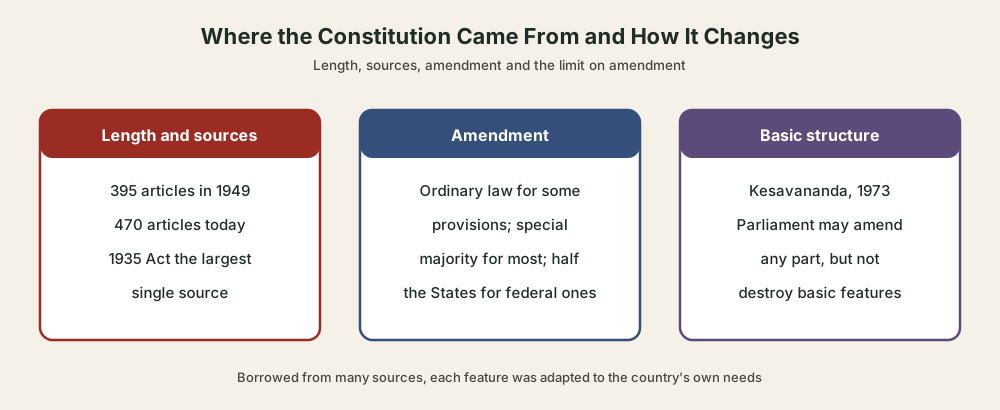
The salient features of the Indian Constitution are the characteristics that define its design. This article covers four of them: its unusual length and twelve Schedules, its borrowing from many sources adapted to Indian needs, an amendment procedure under Article 368 that is partly rigid and partly flexible, and the basic structure that limits amendment.
Salient Features of the Indian Constitution: Meaning and Purpose
Features That Define the Constitution's Character
The salient features of the Indian Constitution are the distinguishing characteristics of its design: a very long written text, a parliamentary system, a federation with a strong Centre, an integrated judiciary, justiciable rights beside non-justiciable directives, and an amendment procedure that is neither wholly rigid nor wholly flexible.
These features matter because they decide how power is organised and how it is limited. Dr B. R. Ambedkar told the Constituent Assembly that the form of government and the form of the Constitution are the two crucial matters every constitution has to deal with, and the salient features are the answers the framers gave.
The significance of these features lies in three broad choices. This article examines the sources of the text, its amending procedure and the basic structure that limits change; the form of government and the federal design are examined in the companion article:
- Form of government: A parliamentary executive, chosen because it gives more responsibility even at some cost to stability.
- Form of the Constitution: A federal dual polity with a single citizenship, able to work as a unitary system in an emergency.
- Limits on change: Amendment under Article 368, judicial review of laws, and since 1973 the basic structure doctrine.
Ambedkar's Two Questions: Form of Government and Form of Constitution
Introducing the Draft Constitution on 4 November 1948, Ambedkar said that a student handed a constitution would ask two questions: what form of government it envisages, and what form the Constitution itself takes. His answers were a parliamentary system rather than the presidential system of the United States, and a federal Constitution of an unusually flexible kind.
He also noted that the draft, then of 315 articles and 8 Schedules, was so bulky that no other country's constitution could be found to match it, and that its salient and special features had to be explained and the criticisms of it answered.
The political reasoning behind these choices is told in Salient Features of the Indian Constitution: Why They Were Chosen, and the federal, parliamentary and judicial features are set out in Federal Features of the Indian Constitution. This article covers the length of the text, its sources, its amending procedure and the limits on amendment.
Lengthiest Written Constitution: Articles, Parts and Schedules
From 395 Articles in 1950 to 470 Articles Today
At its adoption the Constitution had 395 articles in 22 Parts and 8 Schedules. Published accounts describe the amended Constitution as having 470 articles grouped into 25 Parts, with 12 Schedules and five appendices, after 106 amendments, the latest assented to on 28 September 2023.
| Stage | Articles | Schedules | Parts |
|---|---|---|---|
| Draft prepared by the Constitutional Adviser | 243 | 13 | Not stated |
| Draft Constitution presented in 1948 | 315 | 8 | Not stated |
| Constitution as adopted in 1949 | 395 | 8 | 22 |
| Constitution as amended (106 amendments) | 470 | 12 | 25 |
Published accounts call it the longest written national constitution in the world. At about 145,000 words, it is second among active constitutions only to that of Alabama, which is the constitution of a single state of the United States rather than of a nation.
Why the Constitution Is So Long: Administrative Detail and Diversity
Ambedkar gave the main reason himself. Many provisions taken from the Government of India Act, 1935 dealt with details of administration, which he agreed should ideally have no place in a constitution; they were kept because constitutional morality, in his words, is not a natural sentiment and has to be cultivated.
Since the people had yet to learn it, he argued, it was wiser not to trust the legislature to prescribe the forms of administration, because a constitution can be perverted without changing its form simply by changing the form of the administration.
The text has also grown because it spells out government powers in detail, so that amendments are often needed for matters that other democracies settle by ordinary law. Later additions include Parts IX and IXA on local government, the Eleventh and Twelfth Schedules, and special provisions for particular States in Articles 371 to 371J.
The Twelve Schedules of the Constitution and Their Subjects
The Constitution was adopted with eight Schedules, and four more have been added since. Each Schedule holds detail that the articles refer to, from the list of States to the rules on defection, and the table sets out what each now contains:
| Schedule | Subject (current heading) | Origin |
|---|---|---|
| First | The States and the Union territories | In the Constitution as adopted |
| Second | Provisions as to the President, the Governors, presiding officers, judges and the Comptroller and Auditor-General | In the Constitution as adopted |
| Third | Forms of oaths or affirmations | In the Constitution as adopted |
| Fourth | Allocation of seats in the Council of States | In the Constitution as adopted |
| Fifth | Administration and control of Scheduled Areas and Scheduled Tribes | In the Constitution as adopted |
| Sixth | Administration of tribal areas in Assam, Meghalaya, Tripura and Mizoram | In the Constitution as adopted |
| Seventh | Union List, State List and Concurrent List | In the Constitution as adopted |
| Eighth | Languages | In the Constitution as adopted |
| Ninth | Validation of certain Acts and Regulations (Article 31B) | First Amendment, in force from 18 June 1951 |
| Tenth | Disqualification on ground of defection | 52nd Amendment, in force from 1 March 1985 |
| Eleventh | Powers, authority and responsibilities of Panchayats (Article 243G) | 73rd Amendment, in force from 24 April 1993 |
| Twelfth | Powers, authority and responsibilities of Municipalities (Article 243W) | 74th Amendment, in force from 1 June 1993 |
The Ninth Schedule was added by the First Amendment, in force from 18 June 1951, during the prime ministership of Jawaharlal Nehru, who held office from 15 August 1947 to 27 May 1964. Laws placed in it are protected by Article 31B, and later amendments, starting with the Fourth in 1955, added further entries.
The last three Schedules came from later reforms. The Tenth, on defection, was added in 1985, and the Eleventh and Twelfth list the matters on which States may endow Panchayats and Municipalities with powers under the 73rd and 74th Amendments.
Borrowed Provisions: Sources of the Indian Constitution
Government of India Act, 1935: The Largest Single Source
Published accounts of the Constitution's sources say it was drawn mainly from the Government of India Act, 1935. Ambedkar recorded that the Constituent Assembly had directed that in certain matters the provisions of the 1935 Act should be followed, and he conceded that the provisions taken from it related mostly to details of administration.
The federal scheme is the clearest example. The Act's federal, provincial and concurrent lists reappear as the Union, State and Concurrent Lists of the Seventh Schedule, and the judges of the Federal Court became judges of the Supreme Court under Article 374, as explained in Constituent Assembly of India.
Foreign Constitutions: A Source-by-Source Table
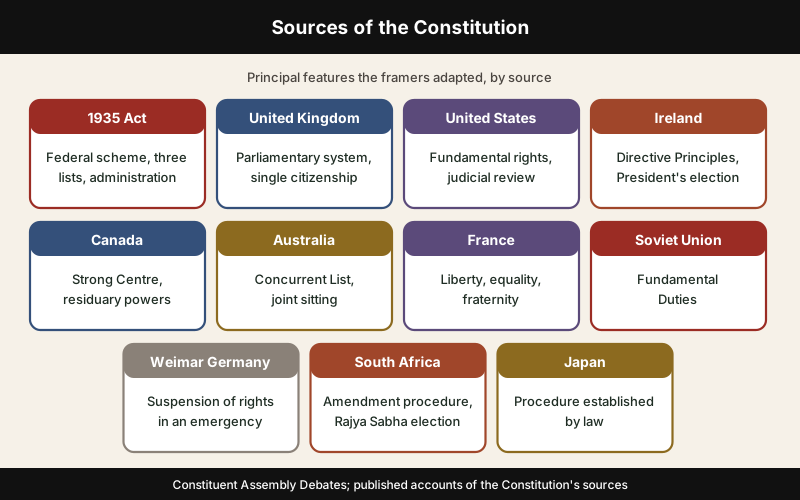
The framers drew on several foreign constitutions. The table lists the features published accounts attribute to each source; the features from Britain, the United States, Ireland, France and Canada are also set out in the standard textbook account of the Constitution's origins.
| Country or Act | Features adapted |
|---|---|
| Government of India Act, 1935 | Federal scheme and the three Lists; public service commissions; the Federal Court's continuity into the Supreme Court; details of administration |
| United Kingdom | Parliamentary government; nominal head of State; Prime Minister; cabinet system; more powerful lower house; single citizenship; rule of law; Speaker; legislative procedure; prerogative writs; parliamentary privilege; first past the post |
| United States | Fundamental Rights; written constitution; federal structure; impeachment of the President; Vice-President; Supreme Court; removal of judges; judicial review; independence of the judiciary; equal protection |
| Ireland | Directive Principles of State Policy; nomination of members to the Rajya Sabha by the President; method of election of the President |
| Canada | Quasi-federal system with a strong Centre; distribution of powers; residuary powers with the Centre; appointment of Governors by the Centre; advisory jurisdiction of the Supreme Court |
| Australia | Concurrent List; freedom of trade between States; joint sitting of Parliament; power to implement treaties |
| France | Liberty, equality and fraternity in the Preamble; the ideal of a republic |
| Soviet Union | Fundamental Duties in Article 51A; the ideals of social, economic and political justice |
| Weimar Germany | Suspension of Fundamental Rights during an emergency |
| South Africa | Procedure for amending the Constitution; election of members of the Rajya Sabha |
| Japan | Procedure established by law |
The table shows that no single model dominates. Britain supplied the machinery of government, the United States the guarantees against government, Ireland the goals for government and Canada the balance between Union and States, while the 1935 Act supplied much of the administrative frame into which all of them were fitted.
Less Obvious Borrowings: Australia, the Soviet Union, Germany and Japan
Ambedkar explained the Australian influence in detail. To make federalism less rigid, Australia gave its Parliament large concurrent powers; the draft followed this plan more extensively, with 37 concurrent subjects against Australia's 39 and exclusive Union powers over 91 matters against about 3 in Australia.
The Fundamental Duties, attributed to the Soviet model, were added only in 1976 by the 42nd Amendment. The power to suspend the enforcement of rights during an emergency, attributed to Weimar Germany, is in Article 359, and Article 21's phrase procedure established by law is attributed to Japan.
Borrowing Without Imitation: Adapting Ideas to Indian Conditions
Borrowing was not slavish imitation. Each provision had to be defended as suited to Indian problems and aspirations, and Ambedkar argued that the only new things possible in a constitution framed so late in history were the variations made to remove faults and to accommodate it to the needs of the country.
The federal design shows the method at work. India's dual polity resembles that of the United States, with a Union and States each sovereign in its field, but it rejected dual citizenship and gave the States no right to frame their own constitutions, so that Union and States work within a single frame.
Rigid and Flexible: Amendment Under Article 368
Why the Framers Wanted a Constitution Both Rigid and Flexible
The framers wanted a balance. A flexible constitution is open to change and a rigid one resists it; the Indian Constitution combines both, so that it can be amended when required while being protected from unnecessary and frequent changes.
Ambedkar linked this to federalism. A federal constitution, being written, tends to be rigid and legalistic, so the draft eliminated elaborate procedures such as a convention or a referendum and made most provisions amendable by Parliament alone, which is why he called India a flexible federation.
Three Ways to Change the Constitution: Simple, Special and Ratified
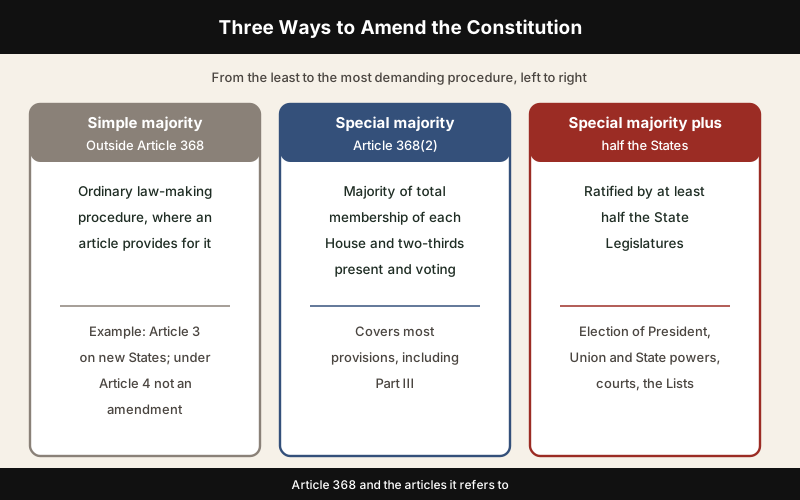
There are three methods of changing the Constitution, applying to different sets of provisions. Some articles can be changed by a simple majority like ordinary law, while Article 368 prescribes two more demanding procedures for everything else:
| Method | What it requires | What it covers |
|---|---|---|
| Simple majority (outside Article 368) | Ordinary law-making procedure, where an article provides for it | For example, laws under Article 3 forming new States or altering boundaries; Article 4 says such laws are not amendments for the purposes of Article 368 |
| Special majority (Article 368(2)) | In each House, a majority of the total membership and two-thirds of the members present and voting | Most provisions, including the Fundamental Rights in Part III |
| Special majority plus ratification | The special majority, and ratification by the Legislatures of at least half of the States | Articles 54, 55, 73, 162, 241 and 279A; the Union judiciary, the High Courts and legislative relations; any List in the Seventh Schedule; representation of States in Parliament; Article 368 itself |
An amendment can be initiated only by introducing a Bill in either House of Parliament, never in a State Legislature. Once passed, it goes to the President, who shall give assent and cannot return it for reconsideration, and no referendum is required for ratification.
Limits on the Amending Power: Articles 13 and 368
The scope of the amending power has itself been amended. The 24th Amendment, in force from 5 November 1971, described the power as constituent power and added that nothing in Article 13, which voids laws abridging Fundamental Rights, applies to amendments made under Article 368.
The 42nd Amendment later added clauses barring any challenge to amendments and declaring no limit on the constituent power. The official text records that this section was declared invalid by the Supreme Court in Minerva Mills, which is where the basic structure limit, explained below, takes effect.
Provisions Changed by Ordinary Law Outside Article 368
Several articles let Parliament change the effect of the Constitution by an ordinary law, and each says expressly that such a law shall not be deemed an amendment for the purposes of Article 368. The procedure is the ordinary one, although some need a prior resolution or consultation:
| Provision | What the law may do | Clause excluding Article 368 |
|---|---|---|
| Articles 2 and 3 | Admit or establish new States; form States and alter their areas, boundaries or names | Article 4(2) |
| Article 169 | Abolish or create a State Legislative Council, after a resolution of the State Assembly passed by a special majority | Article 169(3) |
| Article 239A | Create a legislature or a Council of Ministers for Puducherry | Article 239A(2) |
| Article 239AA | Give effect to or supplement the provisions for the National Capital Territory of Delhi | Article 239AA(7)(b) |
| Articles 243M and 243ZC | Extend Parts IX and IXA to Scheduled Areas and tribal areas | Articles 243M(4)(b) and 243ZC(3) |
| Article 244A | Form an autonomous State comprising certain tribal areas in Assam | Article 244A(4) |
| Article 312 | Create an all-India judicial service | Article 312(4) |
| Fifth and Sixth Schedules | Amend the Schedules on Scheduled Areas and tribal areas | Paragraph 7(2) and paragraph 21(2) |
The distinction matters in practice. Reorganising States needs only an ordinary Act of Parliament, while changing any of the Lists of the Seventh Schedule needs a special majority in both Houses and ratification by at least half of the State Legislatures.
Ratification in Practice: The Kihoto Hollohon Ruling on the Tenth Schedule
The ratification requirement has been enforced by the courts. The Tenth Schedule, added by the 52nd Amendment in 1985, contained a paragraph 7 declaring that no court shall have any jurisdiction in any matter connected with the disqualification of a member under the Schedule.
Ambedkar had placed the powers of the courts in the group of provisions needing ratification by the States. The official text records that paragraph 7 was declared invalid for want of ratification under the proviso to Article 368(2), by the majority opinion in Kihoto Hollohon v Zachilhu, reported in 1993.
Basic Structure Doctrine: The Limit on Amendment
From Shankari Prasad to Kesavananda Bharati, 1951 to 1973
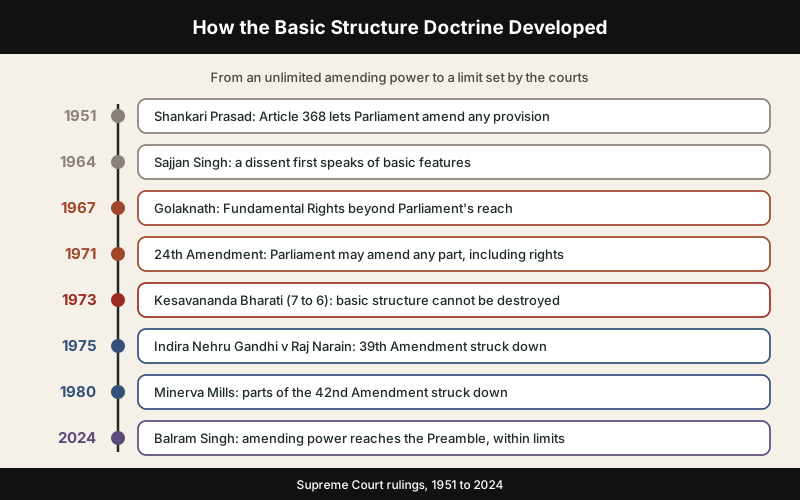
The Supreme Court first read the amending power broadly. In Shankari Prasad (1951) it held unanimously that the terms of Article 368 were perfectly general and allowed Parliament to amend the Constitution without any exception. In Sajjan Singh, a dissent by Justice Mudholkar first spoke in 1964 of the Constitution's basic features.
The Court then reversed course. In Golaknath (1967) it gave the Fundamental Rights a transcendental position beyond Parliament's reach; Parliament answered with the 24th Amendment of 1971. In Kesavananda Bharati, decided on 24 April 1973 by a margin of 7 to 6, the Court held that Parliament's wide power did not extend to destroying the basic structure.
| Case or event | Year | Holding or effect |
|---|---|---|
| Shankari Prasad Singh Deo v Union of India | 1951 | Article 368 empowers Parliament to amend any provision, without exception |
| Sajjan Singh v State of Rajasthan | 1964 | A dissent first raises the idea of basic features |
| Golaknath v State of Punjab | 1967 | Fundamental Rights beyond the reach of Parliament's amending power |
| 24th Amendment | 1971 | Parliament may amend any part of the Constitution, including the Fundamental Rights |
| Kesavananda Bharati v State of Kerala | 1973 | Parliament may amend any part but not destroy the basic structure (7 to 6) |
| Indira Nehru Gandhi v Raj Narain | 1975 | The 39th Amendment struck down using the doctrine |
| Minerva Mills v Union of India | 1980 | Parts of the 42nd Amendment, including clauses of Article 368, struck down |
| Dr Balram Singh v Union of India | 2024 | The amending power extends to the Preamble, subject to the basic structure |
Applying the Doctrine: Indira Gandhi, Minerva Mills and After
The doctrine soon decided real disputes. In Indira Nehru Gandhi v Raj Narain and Minerva Mills, Constitution Benches used it to strike down the 39th Amendment and parts of the 42nd Amendment; on 31 July 1980 the Court declared sections 4 and 55 of the 42nd Amendment unconstitutional.
The Constitution does not list the basic structure; the courts identify its elements case by case. Secularism, for instance, has been described as a basic feature since Kesavananda and S. R. Bommai, and in 2024 the Court held that the power to amend the Preamble is subject to the same limit.
Minerva Mills also answered whether Parliament could lift the limit itself. Chief Justice Chandrachud wrote that since the Constitution had conferred a limited amending power, Parliament cannot enlarge that very power into an absolute power, and that a limited amending power is itself one of the basic features of the Constitution.
Features the Courts Have Held Part of the Basic Structure
The Constitution does not list its basic features. In Indira Nehru Gandhi v Raj Narain and in Minerva Mills, the Court observed that whether a feature is basic will be decided in each case that comes before it, and published accounts count at least twenty features described as basic or essential, including:
- Supremacy of the Constitution and the rule of law.
- Judicial review, including Articles 32 and 226, and the independence of the judiciary.
- Federalism, including the financial liberty of the States under Articles 282 and 293.
- The sovereign, democratic and republican structure, and the parliamentary system of government.
- Free and fair elections, and the unity and integrity of the nation.
- Freedom and dignity of the individual, and the essence of the other Fundamental Rights.
- The balance between the Fundamental Rights and the Directive Principles.
- Limitations on the amending power conferred by Article 368.
The list explains why the limit works in both directions. Parliament may amend any provision, but not in a way that destroys one of these features, and because a limited amending power is itself on the list, the limit cannot be amended away.
Criticisms of the Constitution and the Replies
A Borrowed Constitution and a Copy of the 1935 Act
Ambedkar recorded the main charge himself: that there was nothing new in the draft, that about half of it had been copied from the Government of India Act, 1935, and that the rest had been borrowed from other constitutions, leaving very little that could claim originality.
His reply was direct. There was nothing to be ashamed of in borrowing, which involves no plagiarism, and nobody holds patent rights in the fundamental ideas of a constitution; the charge of a blind copy, he said, rested on an inadequate study of what the draft had changed to suit the country.
Too Bulky, Too Centralised and Without a Village Base
Three further criticisms recur, and the constitutional record gives an answer to each:
| Criticism | Reply |
|---|---|
| Too bulky, with administrative detail that belongs in ordinary law | Ambedkar: the detail was kept because constitutional morality had yet to be cultivated, and the form of administration can otherwise pervert the Constitution |
| Copied from the 1935 Act and foreign constitutions | Borrowing involves no plagiarism; the variations adapt the ideas to the country's needs |
| Not built on the ancient polity or on village panchayats | Ambedkar preferred the individual as the unit; Parts IX and IXA later gave local bodies constitutional status |
| Too centralised, weakening the States | The Constitution is federal in normal times; its unitary powers are designed for emergencies and national needs |
Ambedkar was sharpest on the village. He called it a sink of localism, a den of ignorance, narrow-mindedness and communalism, and welcomed the draft's choice of the individual as its unit, a view later balanced by the local government amendments of 1992.
Outcomes Since 1950: Amendments, Judicial Guardianship and Local Government
The design has produced three observable outcomes:
- Adaptability: The Constitution has absorbed 106 amendments without being replaced, the latest in 2023 providing for the reservation of seats for women in the House of the People, from a date yet to be notified.
- Judicial guardianship: The basic structure doctrine has been used to strike down amendments, from the 39th in 1975 to parts of the 42nd in 1980.
- Deeper democracy: Panchayats and Municipalities have been constitutional institutions since 1993.
These outcomes keep the features in current debate. The 2024 ruling on the Preamble and the reservation of seats for women in Article 330A both show the amending power at work within the limits the courts have set.
Public awareness of the features is also cultivated deliberately. Since the Government decided in 2015 to observe 26 November, the day of adoption, as Constitution Day, the founding choices have had a day of their own; schools were asked to read out the Preamble on the first one.
UPSC Relevance and Previous-Year Questions
Where These Features Fit in the UPSC-CSE Syllabus
This topic belongs to General Studies Paper II, under the historical underpinnings, evolution, amendments and basic structure of the Constitution, and to the polity section of the preliminary examination. The linked questions from that examination test precise points:
- When the Ninth Schedule was added, and under which Prime Minister.
- Which feature came from which source, and the 1935 Act’s distribution of powers.
- How an amendment is initiated and when ratification by the States is required.
The linked question from the main examination asks whether Parliament can expand its amending power to destroy the basic structure. The sections on amendment and on the basic structure supply the answer, including the Minerva Mills holding on a limited amending power.
Previous Year UPSC-CSE Questions By the end you will be able to draft model answers for the following UPSC questions. Each question carries a collapsible framework showing how to approach it in the exam.
- UPSC Prelims 2019 GS-IThe Ninth Schedule was introduced in the Constitution of India during the prime ministership of
How to approach this Prelims question
Approach: Date the amendment that created the Schedule, then identify the Prime Minister in office.
Trap to watch: Entries were added to the Schedule by later amendments, starting with the Fourth in 1955, but the Schedule itself was created in 1951.
Key facts to recall:
- Ninth Schedule: First Amendment, in force 18 June 1951.
- Protected by Article 31B.
- Nehru was Prime Minister from 1947 to 1964.
Answer signal: The Schedule dates from 1951, under Nehru, so option (a) is the answer.
- UPSC Prelims 2013 GS-IConsider the following statements:
- An amendment to the Constitution of India can be initiated by an introduction of a Bill in the Lok Sabha only.
- If such an amendment seeks to make changes in the federal character of the Constitution, the amendment also requires to be ratified by the legislatures of all the States of India.
Which of the statements given above is/are correct?
How to approach this Prelims question
Approach: Check each statement against the exact words of Article 368(2).
Trap to watch: Both statements overstate: either House can initiate, and half the States suffice.
Key facts to recall:
- Initiation in either House.
- Special majority in each House.
- Ratification by at least half the States for federal provisions.
Answer signal: Both statements are incorrect, so option (d) is the answer.
- UPSC Prelims 2012 GS-IThe distribution of powers between the Centre and the States in the Indian Constitution is based on the scheme provided in the:
How to approach this Prelims question
Approach: Recall which Act first divided powers into three lists.
Trap to watch: The 1919 Act introduced dyarchy in the provinces, not the three-list federal scheme.
Key facts to recall:
- 1935 Act: federal, provincial and concurrent lists.
- Seventh Schedule: Union, State and Concurrent Lists.
- Article 246 applies the Lists.
Answer signal: The scheme comes from the 1935 Act, so option (c) is the answer.
- UPSC Prelims 2003 GSMatch List I (Item in the Indian Constitution) with List II (Country from which it was derived) and select the correct answer using the codes given below the list. List II: 1) Australia, 2) Canada, 3) Ireland, 4) United Kingdom, 5) USA.
- A. Directive Principles of State Policy
- B. Fundamental Rights
- C. Concurrent List in Union-State Relations
- D. India as a Union of States with greater powers to the Union
Codes: A B C D
How to approach this Prelims question
Approach: Fix the two surest pairs first, Directive Principles with Ireland and the Concurrent List with Australia, then check the codes.
Trap to watch: The United Kingdom gave the parliamentary system, not the Fundamental Rights.
Key facts to recall:
- Ireland: Directive Principles.
- United States: Fundamental Rights.
- Australia: Concurrent List; Canada: strong Centre.
Answer signal: A-3, B-5, C-1, D-2, so option (d) is the answer.
- UPSC Mains 2019 GS-IIParliament’s power to amend the Constitution is a limited power and it cannot be enlarged into absolute power.” In the light of this statement explain whether Parliament under Article 368 of the Constitution can destroy the Basic Structure of the Constitution by expanding its amending power?
How to structure the answer in the exam
Introduction: Article 368 gives Parliament constituent power to amend the Constitution, but since Kesavananda Bharati (1973) that power cannot be used to destroy the basic structure.
Body (sub-themes to develop):
- Early view: Shankari Prasad (1951) read Article 368 as without exception.
- Golaknath (1967) and the 24th Amendment (1971).
- Kesavananda (7 to 6): wide power, but not to destroy basic elements; the judiciary decides what is basic.
- 42nd Amendment clauses (4) and (5) of Article 368, declared invalid in Minerva Mills (1980): a limited power cannot be made absolute.
- Later application, including the 2024 ruling that the Preamble is amendable within the basic structure.
Conclusion: Parliament cannot expand its amending power to destroy the basic structure, because the limit on that power is itself part of the basic structure, as Minerva Mills held.
Prelims MCQ practice
Each question below tests one specific concept on the topic. Click to reveal the answer and a full option-wise explanation.
Q1. Consider the following pairs of features of the Constitution and the sources to which they are attributed:
- Directive Principles of State Policy : Ireland
- Concurrent List : Australia
- Procedure established by law : United States
- Suspension of Fundamental Rights during an emergency : Weimar Germany
How many of the pairs given above are correctly matched?
- Only one pair
- Only two pairs
- Only three pairs
- All four pairs
Show answer and explanation
Answer: Only three pairs
Explanation.
Correct: c (Only three pairs). Pairs 1, 2 and 4 are correctly matched. Pair 3 is incorrect: procedure established by law, the phrase in Article 21, is attributed to Japan; the United States is the source attributed for judicial review and the Fundamental Rights.
Q2. With reference to Article 368 of the Constitution, consider the following statements:
- A Bill to amend the Constitution may be introduced in either House of Parliament.
- An amendment that changes any of the Lists in the Seventh Schedule must be ratified by the Legislatures of at least half of the States.
- The President may return a Constitution Amendment Bill to Parliament for reconsideration.
Which of the statements given above are correct?
- 1 and 2 only
- 2 and 3 only
- 1 and 3 only
- 1, 2 and 3
Show answer and explanation
Answer: 1 and 2 only
Explanation.
Correct: a (1 and 2 only). Statement 1 is correct: a Bill may be introduced in either House. Statement 2 is correct: the Lists in the Seventh Schedule are among the provisions that need ratification by at least half of the States. Statement 3 is incorrect: under Article 368(2) the President shall give assent to the Bill.
Q3. With reference to the basic structure doctrine, consider the following statements:
- The Constitution contains a list of the features that form its basic structure.
- Kesavananda Bharati v State of Kerala was decided by a majority of seven to six.
- In Golaknath, the Supreme Court held that Fundamental Rights are beyond the reach of Parliament's amending power.
How many of the statements given above are correct?
- Only one
- Only two
- All three
- None
Show answer and explanation
Answer: Only two
Explanation.
Correct: b (Only two). Statement 1 is incorrect: the Constitution does not list the basic structure; the courts identify its elements. Statements 2 and 3 are correct: Kesavananda was decided 7 to 6 in 1973, and Golaknath (1967) placed Fundamental Rights beyond the amending power.
Q4. Consider the following pairs of Schedules of the Constitution and their subjects:
- Fourth Schedule : Allocation of seats in the Council of States
- Ninth Schedule : Validation of certain Acts and Regulations
- Tenth Schedule : Disqualification on ground of defection
- Eleventh Schedule : Powers of Municipalities
How many of the pairs given above are correctly matched?
- Only one pair
- Only two pairs
- Only three pairs
- All four pairs
Show answer and explanation
Answer: Only three pairs
Explanation.
Correct: c (Only three pairs). Pairs 1, 2 and 3 are correctly matched. Pair 4 is incorrect: the Eleventh Schedule lists the powers of Panchayats (Article 243G); the Twelfth lists those of Municipalities (Article 243W).
Q5. Which of the following can Parliament do by a law that is not deemed an amendment of the Constitution for the purposes of Article 368?
- Form a new State and alter the boundaries of existing States
- Abolish the Legislative Council of a State, after a resolution of its Assembly
- Change an entry in the State List of the Seventh Schedule
Select the correct answer using the code given below:
- 1 only
- 1 and 2 only
- 2 and 3 only
- 1, 2 and 3
Show answer and explanation
Answer: 1 and 2 only
Explanation.
Correct: b (1 and 2 only). Article 4(2) and Article 169(3) say that laws on new States and on Legislative Councils are not amendments for the purposes of Article 368. Changing any List in the Seventh Schedule needs a special majority and ratification by at least half of the State Legislatures under the proviso to Article 368(2).
Q6. Consider the following statements:
- The Tenth Schedule was added to the Constitution by the 52nd Amendment.
- Paragraph 7 of the Tenth Schedule was declared invalid for want of ratification by the State Legislatures.
- The Ninth Schedule was added to the Constitution by the 42nd Amendment.
Which of the statements given above are correct?
- 1 and 2 only
- 2 and 3 only
- 1 and 3 only
- 1, 2 and 3
Show answer and explanation
Answer: 1 and 2 only
Explanation.
Correct: a (1 and 2 only). Statement 1 is correct: the 52nd Amendment added the Tenth Schedule from 1 March 1985. Statement 2 is correct: the majority in Kihoto Hollohon held paragraph 7 invalid for want of ratification under the proviso to Article 368(2). Statement 3 is incorrect: the Ninth Schedule was added by the First Amendment in 1951.
Sources and Further Reading
- Legislative Department, Ministry of Law and Justice: The Constitution of India
- Lok Sabha Secretariat: Constituent Assembly Debates, Official Report, Volume VII (4 November 1948)
- Lok Sabha Secretariat: Constituent Assembly Debates, Official Report, Volume XI (25 November 1949)
- NCERT: Indian Constitution at Work, Class 11, Chapter 1, Constitution: Why and How?
- NCERT: Indian Constitution at Work, Class 11, Chapter 9, Constitution as a Living Document
- Supreme Court of India: Dr Balram Singh v Union of India, order of 25 November 2024 (2024 INSC 893)
- Press Information Bureau: 26th November to be observed as Constitution Day (23 November 2015)
- Wikipedia: Constitution of India
- Wikipedia: Basic structure doctrine
- Wikipedia: Amendment of the Constitution of India
- Wikipedia: Government of India Act 1935
- Wikipedia: Jawaharlal Nehru
Editorial Disclaimer
This article is for UPSC preparation and explains the salient features of the Constitution. Attributions of features to foreign sources follow published accounts, and the official text of the Constitution governs any question of law.


