


Overview
Science and technology in India drive development by turning research into food, energy, health, security and jobs. The work is carried out by specialised bodies, from CSIR and ISRO to DRDO and the Department of Atomic Energy, guided by national policies since 1958 and, since 2024, funded through the Anusandhan National Research Foundation. Spending on research, 0.6 to 0.7 per cent of GDP, remains the main weakness.
Why Science Drives Development: Scientific Temper and Policy
Role of Science and Technology in India's Development
The role of science and technology in development is to turn knowledge into capacity: seeds that yield more, nuclear fuel that lasts, satellites that support disaster management and weapons that keep the country secure. For a large country with limited resources, doing this at home also reduces dependence on imports, which is why scientific and technological development is treated as part of national development.
The idea has a constitutional anchor. Jawaharlal Nehru popularised the phrase "scientific temper" from 1946, and the Forty-second Amendment of 1976 added Article 51A(h), which makes it a fundamental duty of every citizen to develop scientific temper, humanism and the spirit of inquiry and reform.
Science Policies of India: From the 1958 Resolution to STIP 2020
Four national policies have guided the development of science and technology in India, each widening the goal from science itself to innovation for the people.
| Policy | Year | Main idea |
|---|---|---|
| Scientific Policy Resolution | 1958 | Foster, promote and sustain the cultivation of science and research in all its aspects |
| Technology Policy Statement | 1983 | Technological competence and self-reliance |
| Science and Technology Policy | 2003 | Benefits of S&T to the forefront; investment in R&D |
| Science, Technology and Innovation Policy | 2013 | Science, technology and innovation for the people |
A fifth policy, the Science, Technology and Innovation Policy 2020, was released as a draft for public consultation. It is built on principles of being decentralised, evidence-informed, bottom-up, experts-driven and inclusive. Alongside it, sector policies have opened research to private players: the Geospatial Policy 2022, the Space Policy 2023 and the BioE3 Policy 2024 (Biotechnology for Economy, Environment and Employment).
Institutions of Science and Technology in India
Who Runs Indian Science: CSIR, DAE, DRDO, ISRO, DST and DBT
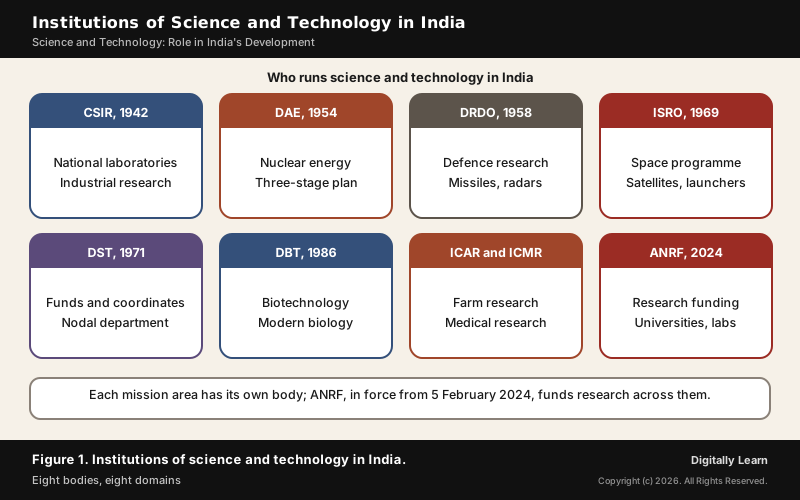
India runs science through specialised bodies, each owning a domain. The Council of Scientific and Industrial Research (CSIR), set up in 1942 and now among the largest publicly funded R&D organisations; the Department of Science and Technology, created in May 1971, is the nodal department that organises, coordinates and funds research.
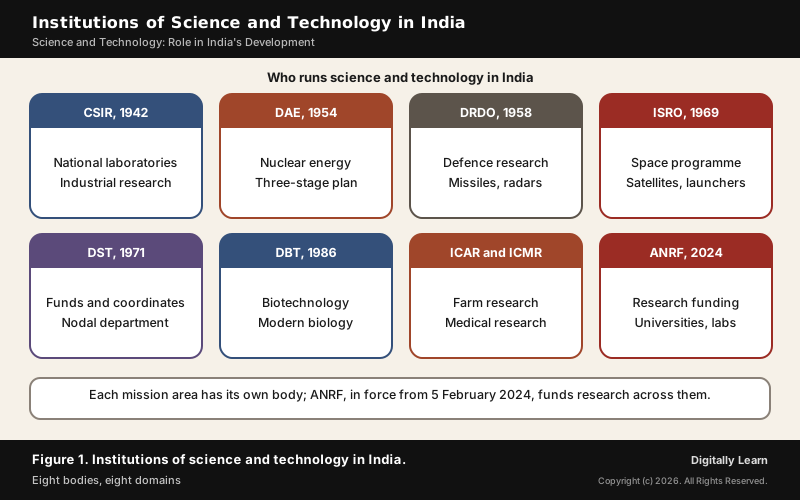
| Body | Set up | Domain |
|---|---|---|
| Council of Scientific and Industrial Research (CSIR) | 1942 | Industrial and applied research |
| Department of Atomic Energy (DAE) | 1954 | Nuclear power, radiation technology |
| Defence Research and Development Organisation (DRDO) | 1958 | Military research |
| Indian Space Research Organisation (ISRO) | 1969 (INCOSPAR 1962) | Space |
| Department of Science and Technology (DST) | 1971 | Nodal department, research funding |
| Department of Biotechnology (DBT) | 1986 | Biotechnology and modern biology |
| Indian Council of Agricultural Research (ICAR) | Autonomous body | Agricultural research and education |
| Indian Council of Medical Research (ICMR) | Apex medical body | Biomedical research |
CSIR began building national laboratories at once: in 1943, on the proposal of Shanti Swarup Bhatnagar, it approved five, including the National Chemical Laboratory and the National Physical Laboratory. By 2013 it ran 37 laboratories and institutes with over 14,000 staff.
ICAR is the largest network of agricultural research and education institutes in the world, and ICMR is the apex body for biomedical research. The Atal Innovation Mission, begun in 2016 under NITI Aayog, promotes innovation and entrepreneurship, including Atal Tinkering Laboratories in schools.
Anusandhan National Research Foundation and the RDI Fund
The Anusandhan National Research Foundation (ANRF) was created by the ANRF Act, 2023, and its provisions came into force on 5 February 2024. It is the apex body for strategic direction of research, meant to seed, grow and promote R&D and a research culture across universities, colleges, research institutions and laboratories.
- Funding: A budget provision of Rs 14,000 crore from the Central Government, with more to be raised from non-government sources.
- Structure: A Governing Board gives strategic direction; an Executive Council implements the Act.
- Old board merged: The Science and Engineering Research Board Act, 2008 was repealed and its research fund passed to ANRF.
Private research needed its own push. The Cabinet approved the Research, Development and Innovation (RDI) Scheme on 1 July 2025 with a corpus of Rs 1 lakh crore over six years, to give long-term loans at low or nil interest for research in strategic and sunrise sectors, with Rs 20,000 crore allocated for 2025-26. A Special Purpose Fund inside ANRF holds the money and passes it to second-level fund managers.
Space Technology and India's Development
ISRO Achievements and Space Applications for Development
India's space programme began with the Indian National Committee for Space Research (INCOSPAR), set up in 1962 on the advice of Vikram Sarabhai, and renamed ISRO in 1969. Its record is one of doing hard things at the first attempt.
| Mission | Year | Why it matters |
|---|---|---|
| Mars Orbiter Mission (Mangalyaan) | Launched 5 November 2013; Mars orbit 24 September 2014 | First Asian nation to reach Mars orbit; succeeded on its first attempt |
| Chandrayaan-3 | Landed 23 August 2023 | First soft landing near the lunar south pole; fourth nation to land on the Moon |
| Aditya-L1 | Launched 2 September 2023 | India's first solar probe |
| Gaganyaan | First integrated air drop test 24 August 2025 | Human spaceflight programme |
The launch vehicles made this possible. The PSLV carried Mangalyaan to space in 2013, and ISRO has since become one of the few agencies to carry out an in-space docking with its own technology.
The value of space for a developing country lies in its applications. ISRO maintains a constellation of imaging, communication and remote sensing satellites, and the Indian Remote Sensing Programme is the largest collection of civilian remote sensing satellites in operation.
- Communication: The Indian National Satellite System provides communication satellites.
- Earth observation: The Indian Remote Sensing Programme provides remote sensing services.
- Navigation: NavIC (IRNSS) and GAGAN; NavIC was built after India was refused GPS help during the Kargil War.
- Public services: Space technology supports disaster management, telemedicine and navigation.
Space is also opening to private players. The Space Policy 2023 is among the policy frameworks that provide for greater private participation, and DRDO laboratories are adapting defence systems, from crew healthcare to parachutes, for the Gaganyaan crew module.
Nuclear Energy, Defence and Agricultural Science
India's Three-Stage Nuclear Programme and the Fast Breeder Reactor
The Department of Atomic Energy was set up in 1954 with Homi Bhabha as its secretary. In the 1950s Bhabha designed a three-stage programme around India's resources: the country has only about 1 to 2 per cent of the world's uranium but about 25 per cent of its known thorium.
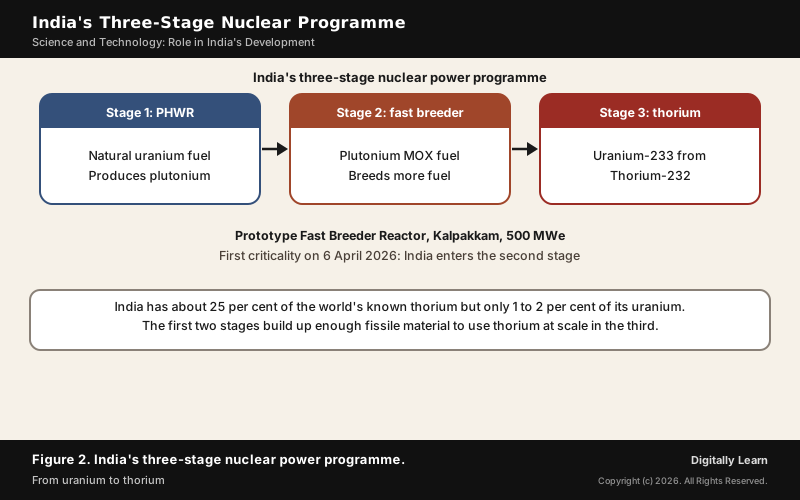
- Stage 1: Pressurised heavy water reactors run on natural uranium.
- Stage 2: Fast breeder reactors run on plutonium; fast neutrons turn uranium-238 into plutonium-239, so the reactor makes more fuel than it uses.
- Stage 3: Thorium-232 is turned into uranium-233 to fuel reactors on India’s thorium.
The second stage has now begun. The indigenously designed 500 MWe Prototype Fast Breeder Reactor at Kalpakkam attained first criticality on 6 April 2026. Designed by the Indira Gandhi Centre for Atomic Research and built by BHAVINI, it uses uranium-plutonium mixed oxide fuel with a blanket of uranium-238, and is designed to use thorium in the blanket later.
That is why the breeder matters. Fast breeder technology is the bridge between today's fleet of pressurised heavy water reactors and future thorium reactors, and Indian nuclear scientists estimate that India's economically extractable thorium could produce 500 GWe for at least four centuries.
Defence Research and Self-Reliance: DRDO and iDEX
Defence technology is the second strategic pillar. The Defence Research and Development Organisation was formed in 1958 by merging older defence technical establishments, and works under the Ministry of Defence. With a network of 52 laboratories covering aeronautics, armaments, electronics, land combat engineering, life sciences, materials, missiles and naval systems, it is India's largest and most diverse research organisation.
Its best-known effort, the Integrated Guided Missile Development Programme, ran from the early 1980s to 2007 and developed the Agni, Prithvi, Akash, Trishul and Nag missiles. Today programmes such as Innovations for Defence Excellence (iDEX) bring startups into defence innovation, part of the effort to reduce dependence on imported technology.
Green Revolution and Biotechnology: Science for Food and Health
The clearest example of science changing Indian lives is the Green Revolution, which began in the 1960s with high-yielding varieties of crops and fertilisers. It was first introduced in Punjab in 1966-67 and raised food grain production, especially in Punjab, Haryana and western Uttar Pradesh.
- Architect: M. S. Swaminathan, called the father of the Green Revolution in India and director-general of ICAR.
- Global link: Part of the wider Green Revolution begun by Norman Borlaug.
- Key advances: High-yielding and rust-resistant varieties of wheat.
The spread came in two phases. From the mid-1960s to the mid-1970s HYV seeds were used mainly in affluent states such as Punjab, Andhra Pradesh and Tamil Nadu, and mostly for wheat; from the mid-1970s to the mid-1980s the technology reached more states and more crops. It enabled India to achieve self-sufficiency in food grains, though it carried the risk of widening the gap between big and small farmers, which government loans and subsidies helped contain.
Health and biology followed. The Department of Biotechnology, set up in 1986 under the Ministry of Science and Technology, handles development and commercialisation in modern biology, and the BioE3 Policy of 2024 provides for wider private participation in biotechnology.
Digital Technology, National Missions and Innovation
Digital Public Infrastructure and National Technology Missions
India's digital public infrastructure, known as India Stack, gained momentum after 2014 through Aadhaar, UPI, DigiLocker, CoWIN, UMANG and GeM. These platforms changed how services are delivered: digital identity, instant payments, online documents, health and governance services.
The model now travels abroad. India has signed agreements with 23 countries on cooperation in digital public infrastructure, and UPI works in countries such as Singapore, the United Arab Emirates, France and Nepal. Digital adoption on this scale also created the user base for startups and digital enterprise.
UPI shows the scale. Developed by the National Payments Corporation of India and launched in 2016, it handled 241.62 billion transactions in 2025-26. Technology development in India's frontier fields now runs through dedicated missions with their own budgets:
| Mission | Approved | Outlay |
|---|---|---|
| National Quantum Mission | April 2023 | Rs 6,003.65 crore |
| India Semiconductor Mission | Semicon India programme | Rs 76,000 crore incentive framework |
| IndiaAI Mission | 2024 | Over Rs 10,300 crore |
| National Mission on Interdisciplinary Cyber-Physical Systems | DST | Rs 3,660 crore |
- Quantum: Four areas: quantum computing, quantum communication, quantum sensing and metrology, and quantum materials and devices.
- Semiconductors: By August 2025, ten manufacturing and packaging projects worth about Rs 1.60 lakh crore were approved in six states.
- Artificial intelligence: Indigenous AI computing and wider access to high-end GPUs, plus research, startups and skilling.
- Chip design: Semiconductor schemes give fiscal support of 50 per cent of project cost for fabs and packaging units, and about one lakh people have used the shared national chip design (EDA) infrastructure.
Innovation and Startups: Global Innovation Index and Startup India
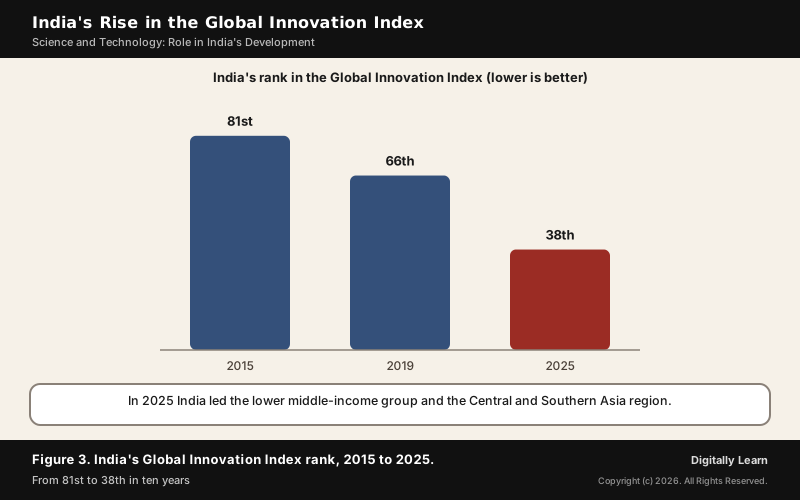
The contribution of India in science and technology now shows in global rankings. Its rank in the Global Innovation Index rose from 81st in 2015 to 66th in 2019 and 38th in 2025, first among lower middle-income countries and first in Central and Southern Asia; Bengaluru, Delhi and Mumbai are among the world's top 50 innovation clusters.
- Intellectual property: In 2024 India ranked 4th in trademarks, 6th in patents and 7th in industrial designs in global filings; patent applications nearly doubled between FY20 and FY25.
- Publications: India is 3rd in the world in research publications.
- Startups: DPIIT-recognised startups grew from about 500 at the launch of Startup India in 2016 to over 2 lakh in 2025.
Entrepreneurship is part of the story. The World Intellectual Property Organization ranks India 12th for its entrepreneurship policies and culture, and between FY20 and FY25 trademark registrations grew 1.5 times while registered designs grew 2.5 times.
Challenges for Science and Technology in India
Low R&D Spending and the Research Gap
Spending is the main weakness. India's Gross Expenditure on Research and Development (GERD) is 0.6 to 0.7 per cent of GDP; DST's R&D Statistics 2022-23 put it at 0.66, 0.66 and 0.64 per cent in 2018-19, 2019-20 and 2020-21, a share that has stayed in a narrow band.
- Researchers: 255 per million people in 2017, up from 218 in 2015 and 110 in 2000; the number has doubled since 2000, but remains low.
- Who spends: Growth in R&D spending has been driven mainly by the government sector; industry, higher education and the states also spend.
- Strength to build on: India is 3rd in research publications and in science and engineering PhDs.
The responses target exactly these gaps: a larger ANRF to fund university research, the RDI Fund to draw private money, national missions for frontier fields, and programmes such as NIDHI and BIRAC to carry ideas from the laboratory to the market.
University Research and the Way Forward
University research is where the reforms aim. The 2014 Mains question put the charge plainly: a science career looks less attractive than business, engineering or administration. ANRF was set up to seed and promote research across universities and colleges as well as research institutions and laboratories.
- Fund research, not only teaching: Competitive grants through ANRF for universities and colleges.
- Bring in industry: Low-cost long-term finance through the RDI Fund for private R&D.
- Collaborate: More than 2,000 foreign collaborations were supported in 2022-23 to 2024-25.
- Commercialise: Move technology from national laboratories to industry through incubation and technology transfer.
Previous Year UPSC-CSE Questions
Previous Year UPSC-CSE Questions By the end you will be able to draft model answers for the following UPSC questions. Each question carries a collapsible framework showing how to approach it in the exam.
- UPSC Mains 2016 GS-IIIDiscuss India’s achievements in the field of Space Science and Technology. How the application of this technology has helped India in its socio-economic development?
Answer outline: how to structure the answer
What the question asks, the main arguments, relevant examples and the direction of the conclusion. This is not a full model answer.
Introduction: From INCOSPAR in 1962 to ISRO in 1969, India built a space programme meant for development first.
Body (sub-themes to develop):
- Achievements: Mangalyaan (first attempt, first Asian nation), Chandrayaan-3 south pole landing, Aditya-L1, Gaganyaan tests.
- Communication: INSAT for broadcasting and connectivity.
- Earth observation: remote sensing for crops, water and planning.
- Navigation and services: NavIC and GAGAN, disaster management, telemedicine.
Conclusion: Conclude that India's space record is strongest where prestige and public service are the same satellites.
- UPSC Mains 2017 GS-IIIGive an account of the growth and development of nuclear science and technology in India. What is the advantage of fast breeder reactor programme in India?
Answer outline: how to structure the answer
What the question asks, the main arguments, relevant examples and the direction of the conclusion. This is not a full model answer.
Introduction: India's nuclear programme was designed by Homi Bhabha around scarce uranium and abundant thorium.
Body (sub-themes to develop):
- Growth: DAE 1954; three stages from PHWRs to fast breeders to thorium.
- Resources: 1 to 2 per cent of world uranium, about 25 per cent of known thorium.
- Fast breeder advantage: converts U-238 to Pu-239, makes more fuel than it consumes, will breed U-233 from thorium.
- Milestone: 500 MWe PFBR at Kalpakkam reached first criticality on 6 April 2026.
Conclusion: Conclude that the breeder is the bridge that turns India's thorium into long-term energy security.
- UPSC Mains 2014 GS-IIIScientific research in Indian universities is declining, because a career in science is not as attractive as are business professions, engineering or administration, and the universities are becoming consumer-oriented. Critically comment.
Answer outline: how to structure the answer
What the question asks, the main arguments, relevant examples and the direction of the conclusion. This is not a full model answer.
Introduction: India spends 0.6 to 0.7 per cent of GDP on R&D, and universities compete for a small pool.
Body (sub-themes to develop):
- Agree in part: science careers compete poorly with business, engineering, administration.
- Structural causes: low GERD (0.6 to 0.7 per cent of GDP), few researchers (255 per million in 2017).
- Counter-evidence: 3rd in publications and in S&E PhDs.
- Reforms: ANRF for universities, RDI Fund for private R&D, missions, foreign collaborations.
Conclusion: Conclude that the decline is a funding and incentive problem, which ANRF is meant to address.
- UPSC Prelims 2019 Prelims-GSAtal Innovation Mission is set up under the
How to approach this Prelims question
Approach: Recall the parent body of AIM.
Trap to watch: It is not under the Department of Science and Technology despite its innovation role.
Key facts to recall:
- (a) Department of Science and Technology: wrong. Despite its innovation role, the mission does not sit under the DST.
- (b) Ministry of Labour and Employment: wrong. The mission promotes innovation and entrepreneurship, not labour matters, and is not under this ministry.
- (c) NITI Aayog: right. The Atal Innovation Mission was begun in 2016 under NITI Aayog and runs Atal Tinkering Laboratories in schools.
- (d) Ministry of Skill Development and Entrepreneurship: wrong. The mission is housed in NITI Aayog, not in this ministry.
Answer signal: The Atal Innovation Mission is under NITI Aayog, so the answer is option (c).
Sources and Further Reading
- NCERT: Indian Economic Development (Class XI), Indian Economy 1950-1990 (the Green Revolution)
- DST: Science, Technology and Innovation Policy 2020, background note
- PIB: Parliament question, R&D expenditure (5 February 2026)
- PIB: Parliament question, data on R&D spending (31 July 2025)
- PIB: Economic Survey 2025-26, innovation and the Global Innovation Index (29 January 2026)
- PIB: Cabinet approves the RDI Scheme (1 July 2025)
- PIB: Parliament question, National Research Foundation Act (11 December 2024)
- PIB: Prototype Fast Breeder Reactor attains first criticality (7 April 2026)
- PIB: India's emerging technology ecosystem (22 June 2026)
- PIB: India's R&D expenditure and publications on the rise (1 May 2020)
- PIB: Draft 5th Science, Technology and Innovation Policy
- Wikipedia: Indian Space Research Organisation
- Wikipedia: India's three-stage nuclear power programme
- Wikipedia: Green Revolution in India
- Wikipedia: Scientific temper
- Wikipedia: Defence Research and Development Organisation
- Wikipedia: Atal Innovation Mission
- UPSC: Previous year question papers
Editorial Disclaimer
This article explains the role of science and technology in India's development for UPSC preparation, drawing on official institutions and standard references. Figures and dates reflect the cited authorities.


