


Overview
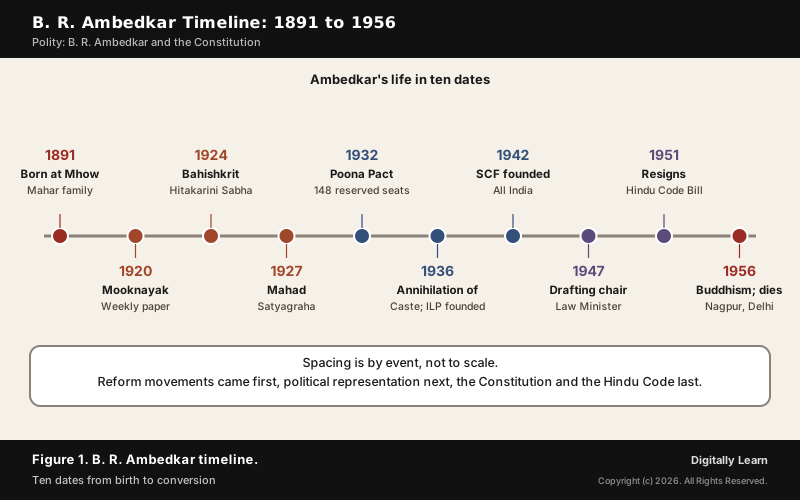
B. R. Ambedkar (1891 to 1956) is known as the father of Indian Constitution. As chairman of the Drafting Committee from 29 August 1947 and as independent India's first Law Minister, he piloted the Draft Constitution through the Constituent Assembly. Before that he led the fight against untouchability, from the Mahad Satyagraha of 1927 to the Poona Pact of 1932.
Ambedkar's Early Life, Education and the Experience of Caste
Early Life at Mhow and Education at Columbia and LSE
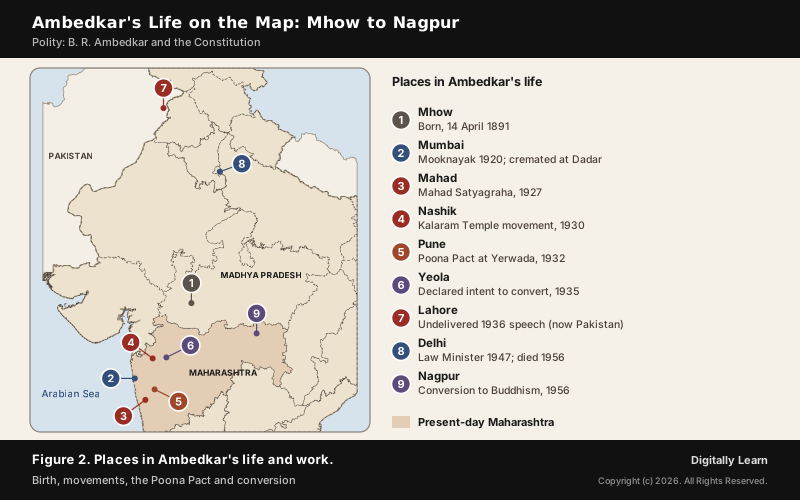
Bhimrao Ramji Ambedkar was born on 14 April 1891 at Mhow, a military cantonment now officially named Dr Ambedkar Nagar in Madhya Pradesh. His father, Ramji Maloji Sakpal, served in the British Indian Army. The family belonged to the Mahar caste, which was treated as untouchable and faced social and economic discrimination, and that experience shaped everything he later did.
Education was his way out. In 1908 he entered Elphinstone College, Bombay, by his own account the first from his caste to do so. A Baroda State scholarship from Sayajirao Gaekwad III took him in 1913 to Columbia University in New York, where he came under the influence of John Dewey and his philosophy of pragmatism. In October 1916 he joined Gray's Inn for the Bar and the London School of Economics.
- Doctorates: Economics doctorates from the London School of Economics (1923) and Columbia (1927), rare for any Indian student of the 1920s.
- Thesis: The Problem of the Rupee: Its Origin and Its Solution (1923) examined why the rupee fell in value.
- Career: He worked first as an economist, professor and lawyer before turning to politics.
- Honorific: He is called Babasaheb, meaning “Respected Father”.
Ambedkar as Social Reformer: Movements Against Untouchability
Mooknayak, Bahishkrit Hitakarini Sabha and Mahad Satyagraha 1927
Ambedkar began with the press. In 1920 he started the weekly Mooknayak (Leader of the Silent) in Bombay with the help of Shahu of Kolhapur, and later ran Bahishkrit Bharat and Equality Janta to defend Dalit rights. He had already testified before the Southborough Committee, which was preparing the Government of India Act 1919, and argued there for separate electorates and reservations for the untouchables.
On 20 July 1924 he founded the Bahishkrit Hitakarini Sabha in Bombay to raise the educational standards of the untouchables and address their social and political problems. Its motto, "educate, organize and agitate", became the watchword of his movement; he later gave it to his followers as "educate, agitate, organise!"
The Mahad Satyagraha, also called the Chavdar Tale Satyagraha, was led by Ambedkar on 20 March 1927 to let untouchables use water from a public tank at Mahad, now in Raigad district, Maharashtra. The Bombay Legislative Council had resolved in August 1923 that the depressed classes could use places built and maintained by the government, and the Mahad municipality adopted this in January 1924, but caste Hindus blocked it. Ambedkar drank from the Chavdar tank and thousands followed him.
- Manusmriti Dahan: On 25 December 1927 his followers burnt the Manusmriti, a Hindu law book, as a protest; the day is remembered as Manusmriti Dahan Din.
- Women’s dignity: At Mahad he asked Dalit women to give up the customs that marked them as untouchable.
- Social Empowerment Day: 20 March is observed as Social Empowerment Day in India.
Kalaram Temple Entry Movement and the Yeola Declaration
Temple entry came next. In 1930 Ambedkar launched the Kalaram Temple movement at Nashik after three months of preparation; about 15,000 volunteers joined one of the largest processions the town had seen, but the temple gates were shut against them. In 1935, at the Yeola conference near Nashik, he announced his intention to leave Hinduism, a promise he kept 21 years later.
The two campaigns show the limits Ambedkar met. At Mahad, the 1923 resolution opening public places had stayed on paper until mass action tested it. At Kalaram, the temple stayed shut even to a disciplined procession of thousands, and within five years he announced his intention to seek conversion. Temple entry remained a national issue: after the Poona Pact, 8 January 1933 was observed as Temple Entry Day.

Annihilation of Caste: Ambedkar's Undelivered 1936 Speech
Ambedkar wrote Annihilation of Caste as a speech for the 1936 annual conference of the Jat-Pat Todak Mandal, a Lahore society of Hindu reformers working to break up the caste system. The organisers found parts of it objectionable and asked for cuts; Ambedkar replied that he "would not change a comma", and the conference was cancelled. He published 1,500 copies at his own expense on 15 May 1936.
Its argument is that social reform must come before political and religious reform. Ambedkar held that a socialist revolution could not succeed in India while the caste system survived, and he rejected the usual defences of caste: division of labour, purity of blood and historical legitimacy.
- Target: “The enemy, you must grapple with, is not the people who observe Caste, but the Shastras which teach them this religion of Caste.”
- Remedy: Inter-caste dining and marriage are not enough; the religious notions on which caste is founded must be destroyed.
- Division of labourers: Caste is not a division of labour but a division of labourers, forced rather than chosen.
- Public life: “Caste has killed public spirit” and made public opinion impossible.
- Chaturvarnya: “There cannot be a more degrading system of social organization than the Chaturvarnya.”
The essay also rebuked Gandhi, who answered in July 1936 with articles titled "A Vindication of Caste" in his weekly Harijan, arguing that Ambedkar had chosen the wrong interpretations of the Shastras. Since then the speech has been read as a manifesto for the abolition of caste.
Poona Pact 1932, Ambedkar's Parties and Gandhi versus Ambedkar
Round Table Conferences, Communal Award and Poona Pact 1932
At the Round Table Conferences in London, Ambedkar pressed for separate electorates for the depressed classes. At the Second Round Table Conference of 1931, which ended inconclusively, he challenged the claim of Gandhi and the Congress to speak for the lowest castes. On 16 August 1932 the British Prime Minister Ramsay MacDonald announced the Communal Award, extending separate electorates to the depressed classes.
Gandhi, imprisoned in Yerwada Central Jail in Poona, began a fast unto death against the Award, fearing that separate electorates would divide the Hindu community. The deadlock ended with the Poona Pact, signed on 24 September 1932 at Yerwada by 23 representatives, including Madan Mohan Malaviya for the Hindus and Ambedkar for the depressed classes. Gandhi himself did not sign; his son Devdas Gandhi did. The site's page on the Round Table Conferences covers the pact in the wider national movement.
| Point | Communal Award (August 1932) | Poona Pact (24 September 1932) |
|---|---|---|
| Electorate | Separate electorate for the depressed classes | Joint electorate with reserved seats |
| Seats | 71 seats | 148 seats in provincial legislatures |
| Outcome | Gandhi's fast unto death | Fast ended; reservation within joint electorates |
Gandhi wrote that separate electorates would "vivisect and disrupt" Hinduism; Ambedkar replied that upper-caste reformers could not represent the depressed classes, who needed their own leaders. The pact met both concerns through a two-stage election.
- Primary election: Depressed-class voters on the general roll of a constituency chose a panel of four candidates for each reserved seat.
- Final election: The general electorate then chose among those four, so the seat stayed within joint electorates.
- Central Legislature: 18 per cent of the general seats for British India were reserved for the depressed classes.
- Duration: The primary elections were to end after ten years unless ended earlier by mutual agreement.
- Services and education: No disability in local body elections or public appointments, fair representation to be sought, and part of each province’s education grant earmarked for the depressed classes.
Independent Labour Party and Scheduled Castes Federation
In 1936 Ambedkar founded the Independent Labour Party, active mainly in the Bombay and Central Provinces. In the 1937 Bombay election it contested 13 reserved and 4 general seats and won 11 and 3. In 1942 the party was merged with the Madras Scheduled Castes Federation to form the All India Scheduled Castes Federation, led by N. Sivaraj and Ambedkar.
In the Bombay Legislative Assembly he took up the khoti system of the Konkan, where khots, government revenue collectors, exploited farmers and tenants. In 1937 he tabled a bill to abolish it by creating a direct relationship between the government and the farmers.
- Viceroy’s Executive Council: In the same years he served on the Defence Advisory Committee and as labour member of the Viceroy’s Executive Council.
- Republican Party: He planned to replace the Federation with the Republican Party of India, but died before it was formed; his followers met at Nagpur on 1 October 1957 to establish it.
- Pakistan: In 1940 he published Pakistan or The Partition of India, answering the Muslim League’s Lahore resolution.
Gandhi and Ambedkar: Divergent Approaches, Common Goal
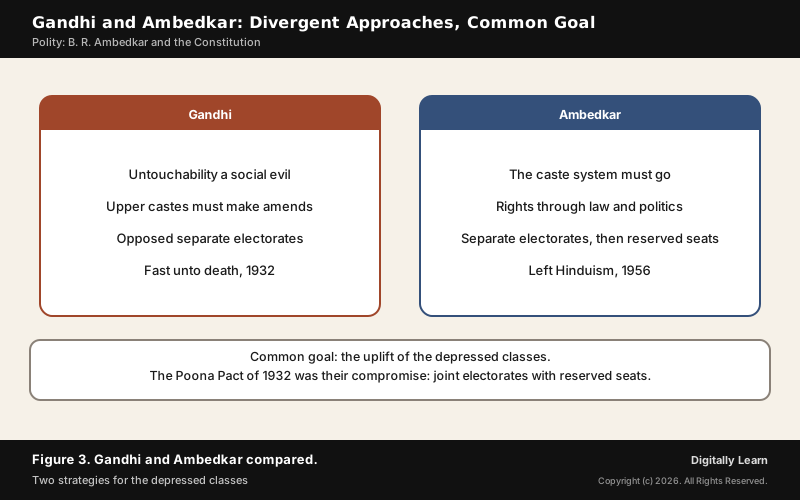
Gandhi and Ambedkar wanted the same end, the uplift of the depressed classes, but by different routes. Gandhi treated untouchability as a social evil that Indians had to remove to be worthy of freedom; he told upper castes that they must serve the untouchables and make amends. He opposed separate electorates because he believed they would permanently segregate the depressed classes from other Hindus.
Ambedkar answered Gandhi's opposition to separate electorates bluntly: "Here is a class which is undoubtedly not in a position to sustain itself in the struggle for existence." The religion to which the depressed classes were tied, he argued, branded them as lepers instead of giving them an honourable place, so they needed political safeguards of their own.
For his part, Ambedkar held that the caste system itself, and the scriptures behind it, had to go. He looked to political representation, law and education rather than a change of heart, and in the end left Hinduism. The Poona Pact shows both sides of the relationship: sharp conflict, then a compromise that gave reserved seats inside joint electorates.
Ambedkar's Role in Indian Constitution: Drafting Committee to Constitutional Morality
Who Is the Architect of Indian Constitution? The Drafting Committee
B. R. Ambedkar is the architect of the Indian Constitution. A political opponent of the Congress under British rule, he joined the Union Cabinet at Independence as law minister on the advice of Gandhi. The Drafting Committee, the most important committee of the Constituent Assembly, was set up on 29 August 1947 with Ambedkar as chairman, to prepare a draft of the new Constitution.
His own seat in the Assembly changed during its life. He was first elected in July 1946 from the Bengal Legislative Assembly, but Partition ended the membership of many Bengal members, including his. The Bombay Legislative Congress Party then chose him to fill the vacancy left by the resignation of M. R. Jayakar, so he was elected first from Bengal and then from Bombay.
| Member | Note |
|---|---|
| B. R. Ambedkar | Chairman |
| N. Gopalaswamy Ayyangar | Member |
| Alladi Krishnaswamy Ayyar | Lawyer from Madras |
| K. M. Munshi | Lawyer from Gujarat |
| Syed Mohammad Saadullah | Member |
| N. Madhava Rau | Replaced B. L. Mitter |
| T. T. Krishnamachari | Replaced D. P. Khaitan, who died in 1948 |
The committee sat for 141 days. The Constitutional Adviser B. N. Rau prepared the first rough draft of 243 articles and 13 Schedules for it to work on; the final Constitution had 395 articles and 8 Schedules. Ambedkar introduced the draft in the Assembly on 4 November 1948 and guided it through about 7,635 amendments tabled, of which 2,473 were moved.
Guiding the draft through the Assembly took three years in all, and the printed record of the discussions fills eleven bulky volumes. The Assembly met for 165 days over eleven sessions, 114 of them on the Draft Constitution. Ambedkar also praised the Chief Draughtsman, S. N. Mukherjee, for putting intricate proposals in the simplest legal form.
Why Ambedkar Is Called Father of Indian Constitution and Modern Manu
Ambedkar is called the father of Indian Constitution because, as the then Law Minister, he piloted the Draft Constitution through the Assembly and answered for it on the floor, known for logical and persuasive argument. He is also called the chief architect of the Constitution and the Modern Manu, the lawgiver of the new Republic.
He gave the credit to others as well. In his closing speech he said the credit belonged partly to B. N. Rau, who prepared the rough draft, and to the members of the Drafting Committee. The Constitution was adopted on 26 November 1949 and came into force on 26 January 1950.
Ambedkar's Constitutional Ideas: Rights, Remedies and a Strong Centre
- Article 32: He called the right to constitutional remedies “the very soul of the Constitution and the very heart of it”, an article without which the Constitution would be a nullity.
- Directive Principles: He described them as “novel features” of the Constitution.
- Strong Centre: He wanted “a strong and united Centre”, much stronger than under the Government of India Act 1935.
- Depressed classes: After the Partition violence he no longer argued for separate electorates; the Assembly recommended abolishing untouchability and reserving seats in legislatures and government jobs.
He also answered the charge that the draft copied other constitutions. The fundamentals of a constitution, he said, were long settled, so all constitutions must look similar in their main provisions; the only new things could be variations made to remove their faults and to suit the needs of the country.
These choices show how he joined his reform work to the Constitution. Rights would mean little without a remedy, so the remedy itself became a fundamental right. The abolition of untouchability and reservation carried the Poona Pact's logic into the Republic, and those who argued for a strong Centre pointed to the riots and violence of Partition.
Constitutional Morality: Ambedkar's Speech of 4 November 1948
Introducing the Draft Constitution on 4 November 1948, Ambedkar explained why it carried details of administration that many constitutions leave to the legislature. He took the idea of constitutional morality from Grote, the historian of Greece: "a paramount reverence for the forms of the Constitution", obedience to authority acting within those forms, open speech, action subject only to definite legal control, and confidence that the forms are as sacred to one's opponents as to oneself.
- Not natural: “Constitutional morality is not a natural sentiment. It has to be cultivated.” Indians, he said, had yet to learn it.
- Top-dressing: Democracy in India was “only a top-dressing on an Indian soil, which is essentially undemocratic”.
- Administration matters: The form of administration is closely tied to the form of the Constitution, and a Constitution can be perverted without changing its form, merely by changing the form of administration.
- His conclusion: It was wiser not to trust the legislature to prescribe forms of administration, which justified writing them into the Constitution.
Upholding constitutional morality therefore means more than obeying the text. Those in power respect the Constitution's forms and procedures, citizens criticise authority openly but within the law, and every side trusts that the same rules bind its opponents. The idea runs straight into his closing warning of 1949 against methods outside the Constitution.
Grammar of Anarchy: Ambedkar's Speech of 25 November 1949
In his closing speech to the Constituent Assembly on 25 November 1949, Ambedkar warned that a good Constitution can turn out bad if those who work it are a bad lot. To keep democracy in fact and not only in form, he named three things India must do.
- Constitutional methods only: Abandon bloody revolution and also “civil disobedience, non-cooperation and satyagraha”; where constitutional methods are open, these are “nothing but the Grammar of Anarchy”.
- No hero-worship: Heed John Stuart Mill and not lay liberties at the feet of even a great man; in politics, Bhakti or hero-worship is “a sure road to degradation and to eventual dictatorship”.
- Social democracy: Make political democracy a social democracy, a way of life built on liberty, equality and fraternity together.
He then described the contradiction of 26 January 1950: in politics India would recognise "one man one vote and one vote one value", but in social and economic life it would still deny one man one value. Unless that contradiction was removed, he warned, those who suffered from inequality would blow up the structure of political democracy.
First Law Minister of India, Hindu Code Bill and Buddhism
First Law Minister of India and the Hindu Code Bill
On independence on 15 August 1947, Jawaharlal Nehru invited Ambedkar to serve as the Dominion of India's Law Minister, making him the first law minister of India. His great project in office was the Hindu Code Bill, which sought to codify and reform Hindu personal law.
The Code had a long history. A Hindu Law Committee reported in 1941 that the time had come for a Hindu Code, and the committee, revived in 1944 under B. N. Rau, prepared the first draft. The Ministry of Law revised it in 1948, and a select committee chaired by Ambedkar made important changes; its version defined who was a Hindu and did away with caste in the law.
- Reforms proposed: A daughter’s succession to her father’s estate alongside the son, the end of the bar on inter-caste marriage, and the introduction of divorce.
- Opposition: The motion to begin discussion was debated for over fifty hours, and discussion was then postponed for over a year.
- Resignation: On 27 September 1951 Ambedkar resigned from Nehru’s cabinet after the bill was defeated in Parliament.
- Four Acts: Nehru split the Code into four bills, passed from 1955 to 1958 as the Hindu Marriage Act, Hindu Succession Act, Hindu Minority and Guardianship Act, and Hindu Adoptions and Maintenance Act.
Out of office he stayed in public life. He lost the Bombay North seat in the first general election of 1952 to his former assistant Narayan Sadoba Kajrolkar, then became a member of the Rajya Sabha.
Ambedkar and Buddhism: Nagpur Conversion of 1956
Ambedkar converted to Buddhism at a public ceremony in Nagpur on 14 October 1956, taking the Three Refuges and Five Precepts from a Buddhist monk, and then converted his followers. He prescribed 22 vows for the new converts. Around 365,000 followers converted at the same ceremony, and on 16 October 1956 more than 300,000 more at Chandrapur. These mass conversions launched the Dalit Buddhist movement.
His reading of Buddhism came to be called Navayana, a socially engaged form that rejected Hinduism and the caste system. He finished The Buddha and His Dhamma in 1956 and died in his sleep at his home in Delhi on 6 December 1956, three days after completing it. His cremation at Dadar Chowpatty in Bombay on 7 December drew half a million mourners.
Legacy: Bharat Ratna, Constitution Day and Major Writings
B. R. Ambedkar's contribution was honoured late: he was awarded the Bharat Ratna, India's highest civilian honour, posthumously in 1990. In 2015, his 125th birth anniversary year, the Government of India declared 26 November Constitution Day by a gazette notification of 19 November 2015.
Each year on his birth and death anniversaries, and on Dhamma Chakra Pravartan Din (14 October) at Nagpur, at least half a million people gather to pay homage to him. His writings remain central to debates on caste; Riddles in Hinduism, written in 1954 and 1955, was published after his death.
| Work | Year | Theme |
|---|---|---|
| The Problem of the Rupee | 1923 | Doctoral thesis on the fall of the rupee |
| Annihilation of Caste | 1936 | Undelivered Lahore speech against caste |
| Pakistan or The Partition of India | 1940 | Answer to the Lahore resolution |
| Who Were the Shudras? | 1946 | Origin of the Shudras |
| The Buddha and His Dhamma | 1956 | His reading of Buddhism, published after his death |
Previous Year UPSC-CSE Questions
Previous Year UPSC-CSE Questions By the end you will be able to draft model answers for the following UPSC questions. Each question carries a collapsible framework showing how to approach it in the exam.
- UPSC Mains 2015 GS-IMahatma Gandhi and Dr. B.R. Ambedkar, despite having divergent approaches and strategies, had a common goal of amelioration of the downtrodden. Elucidate.
Answer outline: how to structure the answer
What the question asks, the main arguments, relevant examples and the direction of the conclusion. This is not a full model answer.
Introduction: Gandhi and Ambedkar both worked for the uplift of the depressed classes, but differed on the cause of untouchability and the cure.
Body (sub-themes to develop):
- Gandhi: untouchability a social evil; upper castes must make amends; opposed separate electorates.
- Ambedkar: caste rooted in the Shastras; rights through representation, law and education; Annihilation of Caste.
- Conflict and compromise: Communal Award, Gandhi's fast, Poona Pact of 1932 with 148 reserved seats.
- Convergence: abolition of untouchability and reservation in the Constitution.
Conclusion: Conclude that the two strategies, moral reform and legal rights, together shaped the Constitution's promise of equality.
- UPSC Mains 2026 GS-IVDr. B. R. Ambedkar had cautioned that employing civil disobedience within a constitutional democracy equates to endorsing 'anarchy'. How should modern democracies navigate the ethical dilemmas posed by civil disobedience movements that aim to promote social justice against policies that may raise genuine concerns?
Answer outline: how to structure the answer
What the question asks, the main arguments, relevant examples and the direction of the conclusion. This is not a full model answer.
Introduction: On 25 November 1949 Ambedkar called civil disobedience, non-cooperation and satyagraha the Grammar of Anarchy where constitutional methods are open.
Body (sub-themes to develop):
- His reasoning: unconstitutional methods were justified only when no constitutional way existed.
- Tension: movements for social justice versus the rule of law and genuine policy concerns.
- Navigation: dialogue, peaceful protest within the law, judicial remedies (Article 32), free press.
- Ethical tests: non-violence, proportionality, openness to deliberation.
Conclusion: Conclude that democracies keep constitutional channels open and responsive, so dissent need not turn to anarchy.
- UPSC Mains 2019 GS-IVWhat is meant by the term ‘constitutional morality’? How does one uphold constitutional morality?
Answer outline: how to structure the answer
What the question asks, the main arguments, relevant examples and the direction of the conclusion. This is not a full model answer.
Introduction: On 4 November 1948 Ambedkar described constitutional morality, after Grote, as a paramount reverence for the forms of the Constitution.
Body (sub-themes to develop):
- Meaning: reverence for constitutional forms, obedience within them, open speech under legal control.
- Why it must be cultivated: 'not a natural sentiment'; democracy a top-dressing on undemocratic soil.
- Upholding it: due process, respect for limits of office, open criticism within the law.
- Link to the 1949 warning against unconstitutional methods.
Conclusion: Conclude that constitutional morality is learned through practice by office-holders and citizens alike.
- UPSC Mains 2025 GS-IV"Constitutional morality is not a natural sentiment but a product of civil education and adherance of the rule of law." Examine the significance of constitutional morality for public servant highlighting the role in promoting good governance and ensuring accountability in public administration.
Answer outline: how to structure the answer
What the question asks, the main arguments, relevant examples and the direction of the conclusion. This is not a full model answer.
Introduction: Ambedkar told the Constituent Assembly that constitutional morality is not a natural sentiment and has to be cultivated.
Body (sub-themes to develop):
- Meaning after Grote: reverence for constitutional forms and procedures.
- Public servants: due process, acting within the limits of authority, impartiality.
- Good governance: rule-based, transparent decisions that opponents can trust.
- Accountability: open criticism within the law and answerability for public acts.
Conclusion: Conclude that civil education and daily adherence to the rule of law build the morality the Constitution needs.
- UPSC Prelims 1996 Prelims-GSB. R. Ambedkar was elected to the Constituent Assembly from
How to approach this Prelims question
Approach: Ambedkar was first elected in July 1946 from the Bengal Legislative Assembly, but Partition ended that membership. He was then elected from Bombay, in the vacancy left by M. R. Jayakar's resignation, and sat for Bombay when the Constitution was made.
Trap to watch: He was first elected from Bengal in 1946, but lost that seat at Partition; West Bengal as a province did not exist in 1946.
Key facts to recall:
- (a) West Bengal: wrong. He was first elected from undivided Bengal, and lost that seat at Partition.
- (b) The Bombay Presidency: right. He filled M. R. Jayakar's vacancy from Bombay.
- (c) The then Madhya Bharat: wrong. He was never elected from there.
- (d) Punjab: wrong. He was never elected from Punjab.
Answer signal: Option (b): the Bombay Presidency.
- UPSC Prelims 1997 Prelims-GSThe Poona Pact which was signed between the British Government and Mahatma Gandhi in 1932 provided for
How to approach this Prelims question
Approach: The Poona Pact of 24 September 1932 replaced the separate electorates of the Communal Award for the depressed classes with a joint electorate and reserved seats.
Trap to watch: Separate electorates were what the Communal Award gave; the pact replaced them.
Key facts to recall:
- (a) Dominion status: wrong. The pact dealt only with representation of the depressed classes.
- (b) Separate electorates for Muslims: wrong. The pact did not deal with Muslim representation.
- (c) Separate electorate for the Harijans: wrong. That is what the pact replaced.
- (d) Joint electorate with reservation for Harijans: right. Seats were reserved within a joint electorate.
Answer signal: Option (d): a joint electorate with reserved seats.
- UPSC Prelims 2012 Prelims-GSWhich of the following parties were established by Dr. B. R. Ambedkar?
- The Peasants and Workers Party of India
- All India Scheduled Castes Federation
- The Independent Labour Party
How to approach this Prelims question
Approach: Ambedkar founded the Independent Labour Party in 1936, and in 1942 it merged into the All India Scheduled Castes Federation that he led. The Peasants and Workers Party was not his.
Trap to watch: The Peasants and Workers Party of India was not his.
Key facts to recall:
- (a) 1 and 2 only: wrong. Ambedkar did not found the Peasants and Workers Party.
- (b) 2 and 3 only: right. The Independent Labour Party and the Scheduled Castes Federation.
- (c) 1 and 3 only: wrong. The Peasants and Workers Party was not his.
- (d) 1, 2 and 3: wrong. The Peasants and Workers Party was not his.
Answer signal: Option (b): parties 2 and 3.
- UPSC Prelims 2023 Prelims-GSConsider the following statements in respect of the Constitution Day:
- Statement-I: The Constitution Day is celebrated on 26th November every year to promote constitutional values among citizens.
- Statement-II: On 26th November, 1949, the Constituent Assembly of India set up a Drafting Committee under the Chairmanship of Dr. B. R. Ambedkar to prepare a Draft Constitution of India.
Which one of the following is correct in respect of the above statements?
How to approach this Prelims question
Approach: Constitution Day on 26 November promotes constitutional values, so Statement I is correct. The Drafting Committee was set up on 29 August 1947; 26 November 1949 is the day the Constitution was adopted, so Statement II is incorrect.
Trap to watch: 26 November 1949 is the adoption date, not the date the Drafting Committee was set up.
Key facts to recall:
- (a) Both correct, II explains I: wrong. Statement II is incorrect.
- (b) Both correct, II does not explain I: wrong. Statement II is incorrect.
- (c) I correct, II incorrect: right. The committee was set up in August 1947.
- (d) I incorrect, II correct: wrong. Statement I is correct and Statement II is not.
Answer signal: Option (c): Statement I is correct and Statement II is incorrect.
- UPSC Prelims 2002 Prelims-GSWhich one of the following rights was described by Dr B. R. Ambedkar as the heart and soul of the Constitution?
How to approach this Prelims question
Approach: Ambedkar called Article 32, the right to constitutional remedies, "the very soul of the Constitution and the very heart of it".
Trap to watch: The right to equality is basic, but Article 32 is the remedy he singled out.
Key facts to recall:
- (a) Right to freedom of religion: wrong. He did not describe it so.
- (b) Right to property: wrong. He did not describe it so.
- (c) Right to equality: wrong. He did not describe it so.
- (d) Right to constitutional remedies: right. Article 32 is the heart and soul in his words.
Answer signal: Option (d): the right to constitutional remedies.
Sources and Further Reading
- NCERT: Themes in Indian History Part III (Class XII), Mahatma Gandhi and the Nationalist Movement; Framing the Constitution
- Constituent Assembly Debates, 4 November 1948 (Lok Sabha Secretariat)
- Constituent Assembly Debates, 25 November 1949 (Lok Sabha Secretariat)
- Lok Sabha Secretariat: Eminent Parliamentarians Series, Dr B. R. Ambedkar
- Supreme Court of India: Dr B. R. Ambedkar's closing speech, 25 November 1949
- Museums of India (Ministry of Culture): Submission of the draft of the Indian Constitution
- Wikipedia: B. R. Ambedkar
- Wikipedia: Poona Pact
- Wikipedia: Communal Award
- Wikipedia: Mahad Satyagraha
- Wikipedia: Annihilation of Caste
- Wikipedia: Bahishkrit Hitakarini Sabha
- Wikipedia: Independent Labour Party (India)
- Wikipedia: Hindu code bills
- Wikipedia: Constituent Assembly of India
- Wikipedia: Dalit Buddhist movement
- Wikipedia: Constitution Day (India)
- UPSC: Previous year question papers
Editorial Disclaimer
This article explains the life and contributions of Dr B.R. Ambedkar for UPSC preparation, drawing on standard references and official sources. Dates and facts reflect the cited authorities.


