


Overview
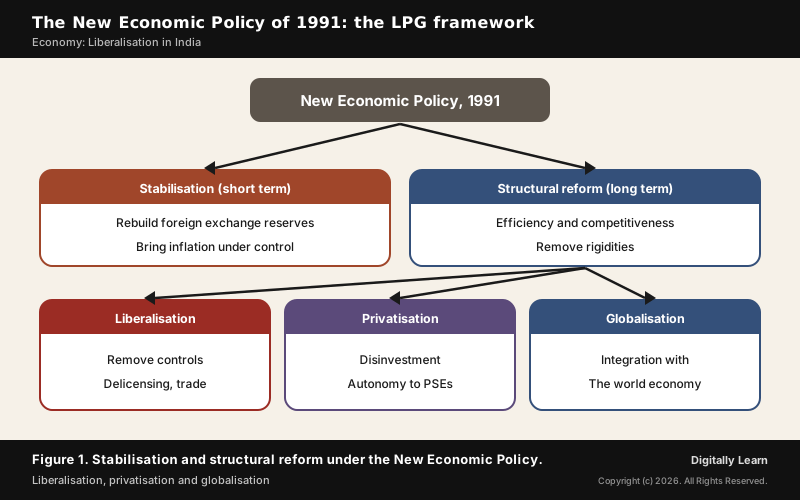
Liberalisation in India means removing the rules and controls that restricted economic activity, such as industrial licensing, import quotas and fixed exchange rates, so that markets and private enterprise play a larger role. Some steps were taken in the 1980s, but the reforms of 1991, adopted after a balance of payments crisis under the New Economic Policy, were far more comprehensive, and with privatisation and globalisation they form the LPG reforms.
Liberalisation in India: Meaning and Background
What Is Liberalisation? Meaning and the LPG Framework
After independence India followed a mixed economy. Some scholars argue that the many rules and laws meant to control and regulate the economy ended up hampering growth. Liberalisation was introduced to put an end to these restrictions and open various sectors of the economy.
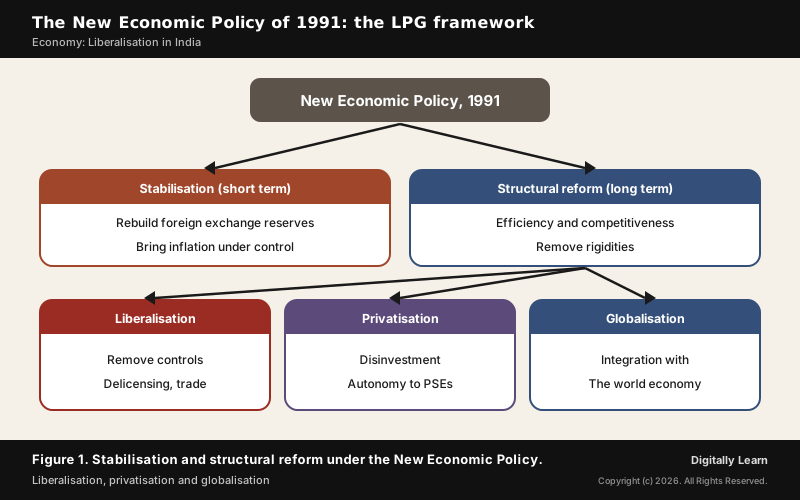
- Two groups of measures: Stabilisation measures are short term, to correct the balance of payments and control inflation; structural reforms are long term, to raise efficiency and international competitiveness by removing rigidities.
- Three heads: The structural reforms fall under liberalisation, privatisation and globalisation.
- Earlier steps: A few liberalisation measures came in the 1980s in industrial licensing, export-import policy, technology, fiscal policy and foreign investment; the 1991 reforms were more comprehensive.
Why India Liberalised in 1991: The Balance of Payments Crisis
The crisis grew from the management of the economy in the 1980s. Government spending ran far ahead of revenue, imports grew much faster than exports, and prices of essential goods rose sharply. By 1991 foreign exchange reserves had fallen to a level not sufficient for even a fortnight of imports, and India could not repay its borrowings from abroad.
- External shocks: The dissolution of the Soviet Union, a major trading partner, and the rise in oil prices during the Gulf War of 1990-91 added to the strain; the country had to airlift gold to secure emergency loans, pledging part of its gold reserves as collateral.
- The bailout: India approached the World Bank and the IMF and received $7 billion as a loan, on condition that it liberalise, reduce the role of government and remove trade restrictions.
- The turn: The government of P. V. Narasimha Rao, with Manmohan Singh as finance minister, announced the reforms; in his budget speech of 24 July 1991 Singh said that India was now wide awake.
- Immediate steps: The rupee was devalued by about 19 per cent against the US dollar, and GDP grew only about 1.1 per cent in 1991.
Key Measures of Liberalisation in India
Liberalisation Measures: Industry, Finance, Tax and Trade
Before 1991, industrial licensing meant every entrepreneur needed government permission to start or close a firm or to decide how much to produce; many industries were closed to the private sector, some goods were reserved for small-scale industry, and prices and distribution were controlled.
- Delicensing: Licensing was abolished for almost all product categories except alcohol, cigarettes, hazardous chemicals, industrial explosives, electronics, aerospace, and drugs and pharmaceuticals.
- Public sector reservation: Only a part of atomic energy generation and some core activities in railway transport stay reserved for the public sector.
- Small-scale and prices: Many goods reserved for small-scale industry were dereserved, and in most industries the market now sets prices.
- Financial sector: The Reserve Bank of India’s role shifted from regulator to facilitator; private Indian and foreign banks were allowed, foreign investment in banks was raised to around 74 per cent, and foreign institutional investors could invest in Indian markets.
Tax reforms changed fiscal policy. Income tax rates were cut continuously after 1991, because high rates were felt to encourage evasion; corporation tax was gradually reduced; procedures were simplified; and a constitutional amendment in 2016 enabled the Goods and Services Tax, aimed at one nation, one tax and one market.
| Area | Before 1991 | After the reforms |
|---|---|---|
| Exchange rate | Fixed by the government | Rupee devalued in 1991; now mostly set by market demand and supply |
| Imports | Quantitative restrictions, high tariffs, import licences | Quotas removed (fully from April 2001), tariffs cut, licensing mostly abolished |
| Exports | Export duties | Export duties removed |
| Foreign investment | Tightly controlled | Most sectors open to 100 per cent FDI through the automatic route |
Trade liberalisation aimed to raise the international competitiveness of Indian industry and bring in foreign investment and technology. The earlier regime of quotas and high tariffs had protected domestic industry but reduced efficiency and slowed manufacturing growth.
Privatisation, Disinvestment and Globalisation
Privatisation means shedding government ownership or management of an enterprise, either by withdrawal from ownership and management or by outright sale. Selling part of the equity of public sector enterprises to the public is called disinvestment; its purpose was mainly to improve financial discipline and facilitate modernisation.
- Autonomy, not only sale: Profitable enterprises were given status as Maharatnas, Navratnas and Miniratnas, with greater financial, managerial and operational autonomy; the government later decided to keep them in the public sector and help them grow globally.
- Disinvestment receipts: In 1991-92 the target was Rs 2,500 crore, and the government raised Rs 3,040 crore more than the target; in 2022-23 about Rs 46,000 crore was mobilised.
- Globalisation: Integration of the economy with the world economy; outsourcing grew as low wages and skilled workers made India a destination for services such as call centres.
- The WTO: Founded in 1995 as the successor to GATT (1948, 23 countries); India removed quantitative restrictions and cut tariffs to keep its WTO commitments.
Second Generation Reforms from 2000-01
As the reforms of the early 1990s were not taking place as desired, the government launched a second generation of reforms in 2000-01, deeper and needing more political will.
- Factor market reforms: Dismantling the Administered Price Mechanism for products such as petroleum, sugar, fertilisers and drugs.
- Public sector reforms: Greater autonomy, access to capital markets, international tie-ups and strategic disinvestment.
- Government as facilitator: Administrative reform to move the state’s role from controller to facilitator.
- Legal reforms: Removing outdated laws and reforming labour and company laws, with new laws for areas such as cyber law.
- Critical areas and States: Infrastructure, agriculture, education and health; the States were given a leading role, and fiscal consolidation got a legal commitment through the FRBM Act.
Effects of Liberalisation on the Indian Economy
Effects of Liberalisation: Growth, Investment, Reserves and Indian Firms
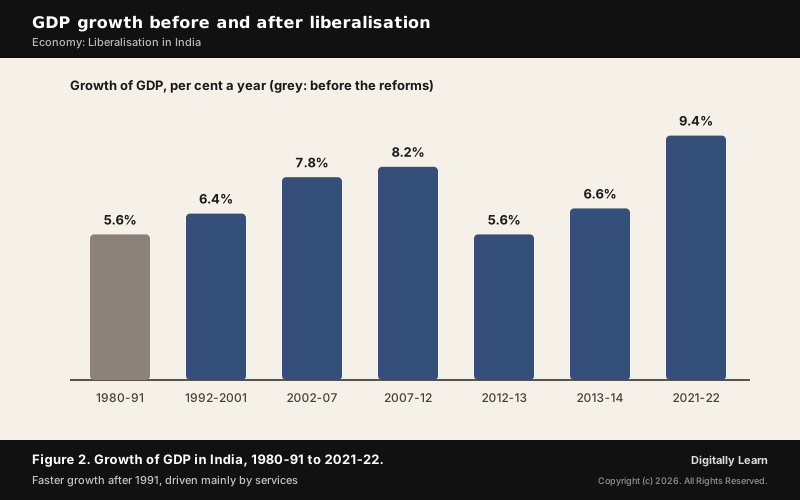
After 1991 India saw rapid GDP growth for two decades: growth rose from 5.6 per cent in 1980-91 to 9.4 per cent in 2021-22. Growth was driven mainly by services, while agriculture's growth declined and industry fluctuated.
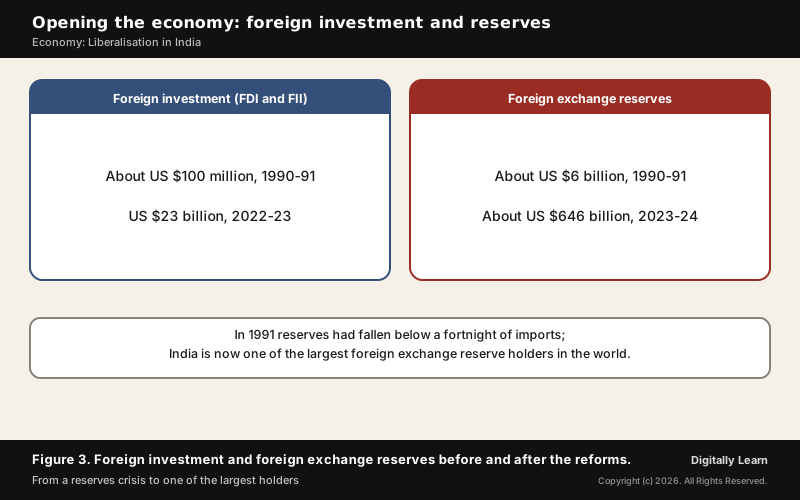
- Foreign investment: FDI and FII rose from about US $100 million in 1990-91 to US $23 billion in 2022-23.
- Reserves: Foreign exchange reserves rose from about US $6 billion in 1990-91 to about US $646 billion in 2023-24, making India one of the largest holders.
- Exports: India became a successful exporter of auto parts, pharmaceuticals, engineering goods, IT software and textiles, and rising prices were kept under control.
Liberalisation exposed Indian firms to foreign competition and also let them go abroad. Several became global companies.
- Going global: ONGC Videsh has projects in 16 countries; Tata Steel operates in 26 countries and sells in 50; HCL Technologies has offices in 31 countries; Dr Reddy’s Laboratories grew from a small supplier to a firm with plants and research centres worldwide.
- Under pressure at home: Cheaper imports replaced demand for some domestic goods, and domestic manufacturers faced competition while power and other infrastructure stayed inadequate.
- Unequal access abroad: Developed countries kept non-tariff barriers; the USA kept quotas on textile imports from India and China even after India removed its own.
Criticism of Liberalisation: Agriculture, Jobs and Public Expenditure
The reforms have been widely criticised for not solving basic problems in agriculture, industry, infrastructure and fiscal management, and scholars point out that reform-led growth has not created enough jobs.
- Agriculture: Public investment in irrigation, power, roads and research fell; partial removal of the fertiliser subsidy raised costs for small farmers; import duties were cut and export-oriented policy shifted land to cash crops.
- Industry: Industrial growth slowed because of cheaper imports and inadequate infrastructure investment.
- Disinvestment: Critics say PSE assets were undervalued, and proceeds were used to cover revenue shortfalls rather than to build social infrastructure.
- Public expenditure: The reforms limited public spending, especially on social sectors; tax cuts did not raise revenue; tariff cuts reduced customs revenue; and tax incentives for foreign investors narrowed the tax base.
Previous Year UPSC-CSE Questions
Previous Year UPSC-CSE Questions By the end you will be able to draft model answers for the following UPSC questions. Each question carries a collapsible framework showing how to approach it in the exam.
- UPSC Mains 2013 GS-IIIExamine the impact of liberalization on companies owned by Indians. Is it competing with the MNCs satisfactorily?
How to structure the answer in the exam
Introduction: Liberalisation exposed Indian firms to foreign competition and let them expand abroad.
Body (sub-themes to develop):
- Gains: delicensing, access to foreign capital and technology; ONGC Videsh, Tata Steel, HCL, Dr Reddy's abroad.
- Pressures: cheaper imports replaced domestic demand; inadequate power and infrastructure.
- Barriers: non-tariff barriers in developed markets, such as US textile quotas.
Conclusion: Conclude that large firms compete well, while smaller manufacturers need infrastructure and fair market access.
- UPSC Mains 2016 GS-IIHas the Indian governmental system responded adequately to the demands of Liberalization, Privatization and Globalization started in 1991? What can the government do to be responsive to this important change?
How to structure the answer in the exam
Introduction: LPG required the state to change from controlling the economy to facilitating it.
Body (sub-themes to develop):
- Response: RBI from regulator to facilitator; delicensing; second generation reforms from 2000-01.
- Gaps: incomplete factor market reforms; slow legal and administrative reform; agriculture neglected.
- Way forward: administrative reform, labour and company law reform, States' role, FRBM discipline.
Conclusion: Conclude that the response is real but unfinished, and depends on political will.
- UPSC Mains 2019 GS-IIIThe public expenditure management is a challenge to the Government of India in the context of budget-making during the post- liberalization period. Clarify it.
How to structure the answer in the exam
Introduction: After 1991 budgets had to reconcile lower tax rates with rising development needs.
Body (sub-themes to develop):
- Revenue: income and corporation tax cuts did not raise revenue; tariff cuts cut customs duty; incentives narrowed the base.
- Spending: limits on public expenditure squeezed social sectors; disinvestment used to cover shortfalls.
- Response: GST in 2016, fiscal consolidation through the FRBM Act.
Conclusion: Conclude that better tax compliance and outcome-based spending ease the challenge.
- UPSC Prelims 2000 Prelims-GSEconomic liberalisation in India started with
How to approach this Prelims question
Approach: Pick the first and central step of 1991.
Trap to watch: Rupee convertibility and tax cuts came later or were partial.
Key facts to recall:
- Licensing abolished except a few categories
- Public sector reservation cut to atomic energy and railways
- Small-scale reservation relaxed
Answer signal: Changes in industrial licensing policy: option (a).
- UPSC Prelims 2011 Prelims-GSWhy is the Government of India disinvesting its equity in the Central Public Sector Enterprises (CPSEs)?
- The Government intends to use the revenue earned from the disinvestment mainly to pay back the external debt.
- The Government no longer intends to retain the management control of the CPSEs.
Which of the statements given above is/are correct?
How to approach this Prelims question
Approach: Test each statement against the stated purpose.
Trap to watch: Disinvestment proceeds are not earmarked mainly for repaying external debt.
Key facts to recall:
- Purpose: financial discipline, modernisation
- Maharatna, Navratna, Miniratna autonomy
- Government retains leading PSEs
Answer signal: Neither 1 nor 2: option (d).
Sources and Further Reading
- NCERT: Indian Economic Development (Class XI), Chapter 3, Liberalisation, Privatisation and Globalisation: An Appraisal
- PIB: India's FDI journey hits $1 trillion (12 December 2024)
- PIB: India records USD 81.04 billion FDI inflow in FY 2024-25
- World Bank: GDP growth (annual %), India
- Wikipedia: Economic liberalisation in India
- Wikipedia: 1991 Indian economic crisis
- Wikipedia: Licence Raj
- UPSC: Previous year question papers
Editorial Disclaimer
This article explains liberalisation in India from the NCERT economics textbook, government releases and the other sources listed below.


