


Overview
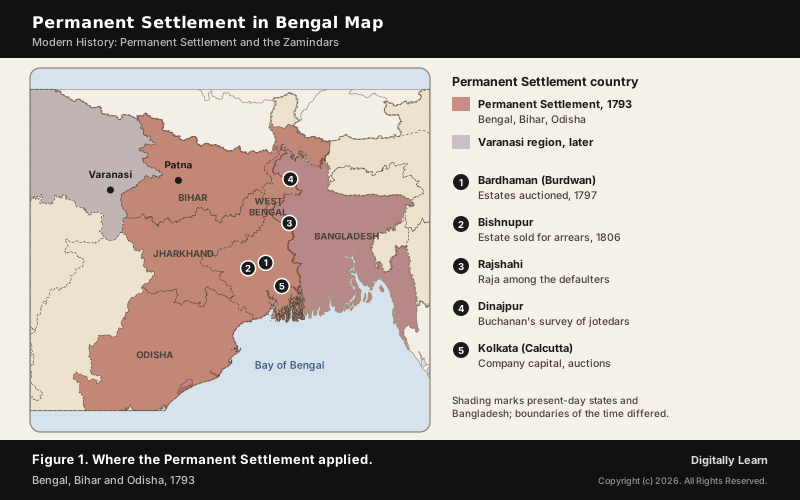
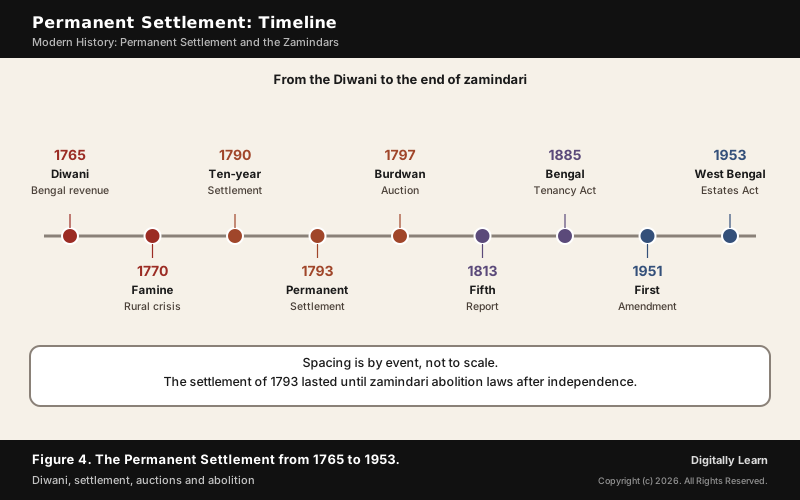
The Permanent Settlement of 1793 was the land revenue system under which the East India Company fixed, for ever, the revenue that each zamindar of Bengal had to pay. It was introduced by Lord Cornwallis. The high fixed demand and the rule that revenue must be paid by sunset ruined many old zamindar families, whose estates were auctioned, and opened the way for new landlords, rich peasants called jotedars, and layers of rent-receiving intermediaries.
Permanent Settlement of Bengal, 1793: Meaning and Aims
What Is the Permanent Settlement? Who Introduced It
The Permanent Settlement was introduced by Lord Cornwallis, the Governor-General, in 1793. Under it the rajas and taluqdars of Bengal were recognised as zamindars. They collected rent from the peasants and paid the Company a revenue that was fixed permanently, never to be increased.
- Legal form: It was enacted under Regulation I of 1793 and formed part of a larger body of legislation later called the Cornwallis Code.
- Regions covered: It was introduced first in Bengal and Bihar, and later in Varanasi and the northern districts of Madras.
- The shares: The state’s demand was fixed at 89 per cent of the rent, and the zamindar kept 11 per cent.
- Estate as unit: A zamindar often held many villages, sometimes as many as 400, which the Company treated as one revenue estate.
One point needs care. NCERT describes the zamindar under this definition as not a landowner in the village but a revenue collector of the state. Other accounts stress that the settlement gave former landholders proprietary rights, making them the owners in practice. Both views appear in exam material.
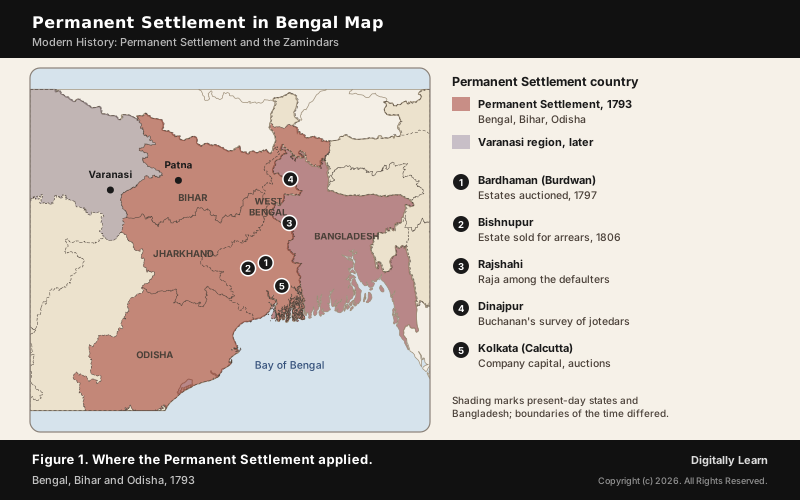
Why the Company Fixed the Revenue for Ever
The settlement grew out of a crisis. After the Company became Diwan of Bengal, it tried to raise as much revenue as it could. By the 1770s the rural economy was in crisis, and in 1770 a famine killed ten million people in Bengal, about one-third of the population.
- Failed experiments: Warren Hastings introduced five-yearly inspections and temporary tax farmers, many of whom absconded with the revenue.
- Reform from London: In 1784 Prime Minister William Pitt the Younger directed the Calcutta administration to change the system, and in 1786 Cornwallis was sent out to reform it.
- Debate and trial: Cornwallis and Sir John Shore debated the idea between 1786 and 1790; a ten-year settlement of 1790 was made permanent in 1793.
Officials hoped that a fixed demand would give the Company a regular flow of revenue, while zamindars, sure that the state would not take away their profits, would invest in improving the land. They expected a class of yeomen farmers and rich landowners to emerge who would also be loyal to the Company.
Ruin of the Old Zamindars Under the Permanent Settlement
Zamindars Before and After 1793: From Revenue Holders to Landlords
Under the Mughals, zamindars were not proprietors. The emperor was considered the supreme owner of the land, and zamindars held only the right to collect revenue from peasants. The Permanent Settlement changed their position and, at the same time, curbed their power.
- Troops disbanded: The zamindars’ armed forces were removed.
- Customs abolished: They lost the customs duties they had levied.
- Courts supervised: Their cutcheries (courts) came under a Collector appointed by the Company, and they lost the power to organise local justice and police.
Over time the Collector's office became a rival centre of authority. When one raja failed to pay, a Company official was sent with instructions to destroy all the influence and authority of the raja and his officers.
Sunset Law and the Auction of Zamindari Estates
In the early decades after 1793, zamindars regularly failed to pay, and unpaid balances piled up. There were four main reasons.
- High demand: The initial demand was set very high, because the Company could never raise it later when prices rose.
- Low prices: It was imposed in the 1790s, when agricultural prices were depressed and ryots found it hard to pay.
- The Sunset Law: The revenue was invariable, whatever the harvest; if payment did not come in by sunset of the specified date, the zamindari was liable to be auctioned.
- Limited power: The settlement at first limited the zamindar’s power to collect rent from the ryot.
The results were dramatic. Over 75 per cent of the zamindaris changed hands after the Permanent Settlement, and by 1815 half the total land in Bengal had passed into new hands. In Burdwan alone there were over 30,000 pending suits for arrears of rent in 1798. Old houses fell: the once powerful rulers of Bishnupur were reduced to mere zamindars, and in 1806 their estate was sold for arrears of land revenue and bought by the Maharaja of Burdwan.
The Burdwan Auction of 1797 and How Zamindars Survived
Burdwan Auction: Fictitious Sales and Benami Purchases
In 1797 a number of estates held by the Raja of Burdwan were sold at a public auction, because he had built up huge arrears. The Collector then found that many buyers were the raja's own servants and agents. Over 95 per cent of the sale was fictitious, and the raja stayed in control.
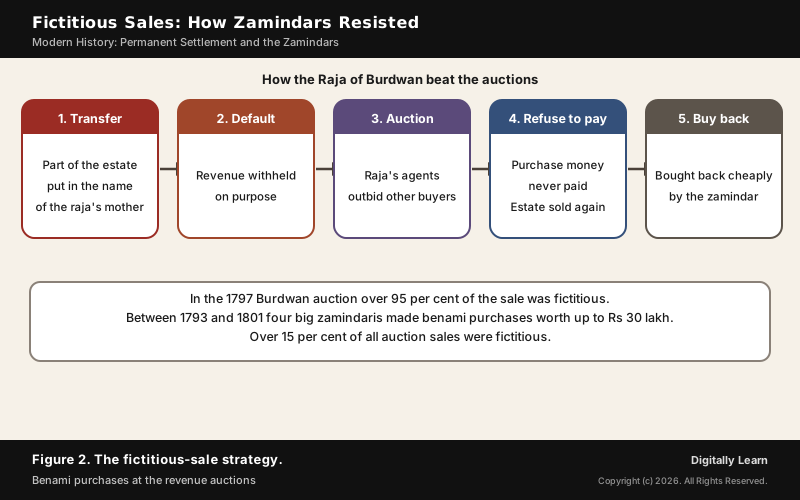
The trick was repeated on a large scale. Between 1793 and 1801, four big zamindaris of Bengal, including Burdwan, made benami purchases worth as much as Rs 30 lakh, and over 15 per cent of all auction sales were fictitious. When outsiders did buy an estate, the former zamindar's lathyals, his strongmen, sometimes attacked their agents, and ryots who saw themselves as the zamindar's proja (subjects) resisted the newcomers.
The Fifth Report of 1813: Evidence and Exaggeration
Much of what we know comes from the Fifth Report, submitted to the British Parliament in 1813. It ran to 1,002 pages, over 800 of them appendices of petitions, collectors' reports and revenue tables. It named some of the oldest families among the defaulters, including the rajas of Nuddea (Nadia), Rajeshaye (Rajshahi) and Bishenpore (Bishnupur).
The report must be read with care. Written by critics of the Company's maladministration, it exaggerated the collapse of traditional zamindari power and overestimated how much land zamindars lost. Once the price depression ended early in the nineteenth century, surviving zamindars consolidated their power. They finally collapsed only in the Great Depression of the 1930s, when the jotedars took control.
Jotedars, New Landlords and Absentee Landlordism
Jotedars: Rich Peasants Who Challenged the Zamindars
While many zamindars were in crisis, a group of rich peasants, the jotedars, consolidated their position. Francis Buchanan's survey of Dinajpur district in North Bengal describes them. By the early nineteenth century some held several thousand acres and controlled local trade and moneylending.
- Sharecropping: Much of their land was worked by sharecroppers (adhiyars or bargadars), who handed over half the produce after the harvest.
- Village power: Unlike zamindars, who often lived in towns, jotedars lived in the villages and directly controlled many poor villagers.
- Resistance: They resisted higher revenue demands, obstructed zamindari officials and delayed payments.
- Buyers at auctions: When zamindars’ estates were auctioned, jotedars were often among the purchasers.
- Other names: Elsewhere in Bengal such men were called haoladars, gantidars or mandals.
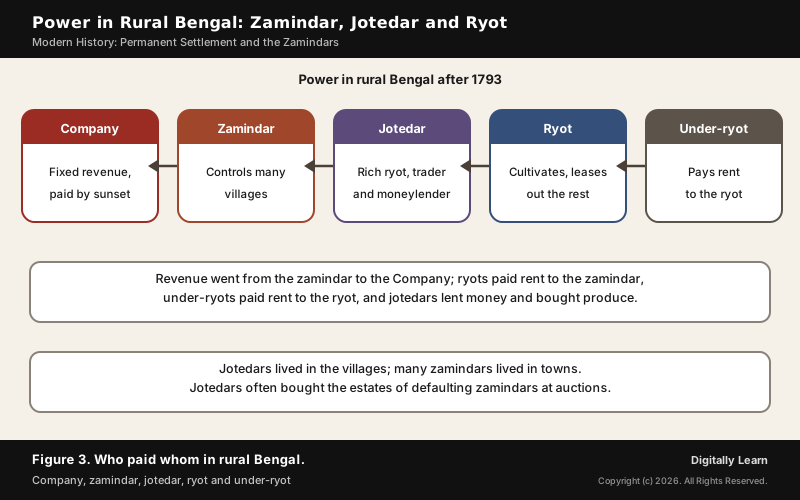
Jotedars kept their hold for a long time. Many later took the legal status of ryot to benefit from the Bengal Tenancy Act of 1885, and they remained in control of village land and economy.
New Landlords, Sub-infeudation and Absentee Landlordism
The auctions created a market in land that had not existed before. Many buyers were Indian officials in the Company's government, who knew which lands were under-assessed. The landed class changed from lineages and local chiefs to civil servants, merchants and bankers.
- Absentee landlords: Many new landlords managed their estates through agents and had little attachment to the land.
- Sub-infeudation: New zamindars with no other outlet for investment turned to land-grabbing and sub-infeudation, which multiplied the intermediaries to be paid.
- Layers of rent: The gap between the rent collected and the revenue paid could support scores of layers of intermediaries between the state and the cultivator.
- No improvement: Zamindars with no ties to their tenants had no reason to invest in agriculture.
Officials saw the political gain. In 1829 Lord Bentinck noted that the settlement had created a vast body of rich landed proprietors deeply interested in the continuance of British rule. Ten years earlier, Governor-General Hastings had said it subjected almost the whole of the lower classes to most grievous oppression.
Effects of the Permanent Settlement and the End of the Zamindari System
Effects on the Peasant, the Company and Agriculture
For the cultivator the system was oppressive. His rent was high and his right to the land insecure; he borrowed from the moneylender to pay, and was evicted if he failed. Zamindars were required to give pattas (land deeds) to farmers, but this was often neglected because no one supervised them.
- For the Company: When prices rose and cultivation spread after about 1800, the zamindars’ income grew but the Company gained nothing, because its demand was fixed.
- For agriculture: Zamindars preferred to lease land to tenants for rent rather than invest, so productivity stayed low.
- Cash crops and famine: Landlords pushed tenants towards cash crops such as indigo and cotton, a cause of many famines of the nineteenth century.
- Under-tenants: In 1806 H. T. Colebrook wrote that under-tenants, crushed by excessive rent and usurious loans, could never escape debt.
| Feature | Permanent Settlement | Ryotwari | Mahalwari |
|---|---|---|---|
| Introduced | 1793, Lord Cornwallis | Madras, Thomas Munro, 1820 | 1822, Holt Mackenzie |
| Settled with | Zamindar | Individual ryot | Village (mahal) |
| Revenue | Fixed for ever | Revised periodically | Revised periodically |
| Main area | Bengal, Bihar, Odisha | Madras, Bombay | North-Western Provinces, Punjab |
Abolition of Zamindari and Land Reforms After Independence
At independence, intermediaries such as zamindars and jagirdars collected rent from the actual tillers without improving the farms, and low productivity forced India to import food. Land reform aimed to make the tillers owners, on the idea that ownership gives the incentive to invest.
- Bills by 1949: Zamindari abolition bills were introduced in Uttar Pradesh, Madhya Pradesh, Bihar, Madras, Assam and Bombay; the Uttar Pradesh committee chaired by G. B. Pant was the first model.
- Constitutional shield: When courts, such as the Patna High Court, upheld zamindars’ challenges, the First Amendment of 1951 and the Fourth Amendment of 1955 protected the laws. Article 31A saves laws providing for the acquisition by the State of any estate.
- Outcome: By the end of the 1950s intermediaries were abolished, about 20 million (200 lakh) former tenants became owners and came into direct contact with the government.
- West Bengal: The West Bengal Estates Acquisition Act of 1953 abolished the zamindari system, set a ceiling on holdings and protected tenants and bargadars.
The reform had gaps. Former zamindars kept large areas by claiming personal cultivation and evicted tenants, landlords delayed ceiling laws in the courts, and sharecroppers and landless labourers gained little. Land reforms succeeded in Kerala and West Bengal, whose governments were committed to land to the tiller. Earlier, the Floud Commission of 1938 had recommended replacing zamindari in Bengal with a ryotwari system.
Previous Year UPSC-CSE Questions
Previous Year UPSC-CSE Questions By the end you will be able to draft model answers for the following UPSC questions. Each question carries a collapsible framework showing how to approach it in the exam.
- UPSC Mains 2013 GS-IIIEstablish the relationship between land reform, agriculture productivity, and elimination of poverty in the Indian Economy. Discuss the difficulty in designing and implementation of agriculture-friendly land reforms in India.
Answer outline: how to structure the answer
What the question asks, the main arguments, relevant examples and the direction of the conclusion. This is not a full model answer.
Introduction: At independence, intermediaries such as zamindars collected rent without improving the land, keeping productivity low.
Body (sub-themes to develop):
- Ownership gives tillers the incentive to invest; tenants lacked it.
- Abolition made about 20 million tenants owners; ceilings aimed at equity.
- Difficulties: personal-cultivation loopholes, evictions, court challenges, weak land records.
- Success in Kerala and West Bengal where governments were committed.
Conclusion: Conclude that land reform raises productivity and reduces poverty only when implemented with commitment and good records.
- UPSC Prelims 2024 Prelims-GSWith reference to revenue collection by Cornwallis, consider the following statements:
- Under the Ryotwari Settlement of revenue collection, the peasants were exempted from revenue payment in case of bad harvests or natural calamities.
- Under the Permanent Settlement in Bengal, if the Zamindar failed to pay his revenues to the state, on or before the fixed date, he would be removed from his Zamindari.
Which of the statements given above is/are correct?
How to approach this Prelims question
Approach: Step 1: statement 1 concerns the Ryotwari settlement, which was not part of Cornwallis's revenue collection: it was introduced in Madras by Thomas Munro in 1820; it is not counted correct. Step 2: statement 2: under the Permanent Settlement a zamindar who failed to pay by the fixed date (the sunset law) lost his zamindari, which was auctioned; correct. Step 3: UPSC dropped this question from its official key; on the facts, only statement 2 is correct.
Trap to watch: Ryotwari gave no exemption from revenue in bad harvests.
Key facts to recall:
- (a) 1 only: wrong. Ryotwari was Thomas Munro's settlement in Madras (1820), not part of Cornwallis's revenue collection.
- (b) 2 only: correct on the facts. Failure to pay by the fixed date cost the zamindar his zamindari; UPSC dropped the question from its key.
- (c) Both 1 and 2: wrong. Statement 1 is wrong.
- (d) Neither 1 nor 2: wrong. Statement 2 is correct.
Answer signal: UPSC dropped this question from its official key. On the facts, only statement 2 is correct: option (b).
- UPSC Prelims 2001 Prelims-GSUnder the Permanent Settlement, 1793, the zamindars were required to issue pattas to the farmers which were not issued by many of the zamindars. The reason was
How to approach this Prelims question
Approach: Step 1: the regulations of 1793 required zamindars to issue pattas to the cultivators. Step 2: no official machinery supervised them, so many never did.
Trap to watch: It was not the farmers' lack of interest.
Key facts to recall:
- (a) The zamindars were trusted by the farmers: wrong. Pattas were required precisely because cultivators needed protection from the zamindars.
- (b) There was no official check upon the zamindars: correct. Nothing made them comply.
- (c) It was the responsibility of the British Government: wrong. The duty to issue pattas lay on the zamindars.
- (d) The farmers were not interested in getting pattas: wrong. The pattas protected the farmers; it was the zamindars who held back.
Answer signal: There was no official check upon the zamindars: option (b).
- UPSC Prelims 2000 Prelims-GSMatch List I with List II and select the correct answer using the codes given below the Lists: List I – Land system
- I. Land allotted to big feudal landlords
- II. Land allotted to revenue farmers or rent collectors
- III. Land allotted to each peasant with the right to sublet, mortgage, transfer, gift or sell
- IV. Revenue settlements made at village level List II A) Jagirdari System B) Ryotwari System C) Mahalwari System D) Zamindari System Codes:
How to approach this Prelims question
Approach: Step 1: land allotted to big feudal landlords: jagirdari (I-A). Step 2: land allotted to revenue farmers or rent collectors: zamindari (II-D). Step 3: land allotted to each peasant with full rights: ryotwari (III-B). Step 4: settlement at village level: mahalwari (IV-C).
Trap to watch: Zamindari was with revenue farmers or rent collectors; Mahalwari was the village.
Key facts to recall:
- (a) I-A, II-C, III-B, IV-D: wrong. It swaps zamindari and mahalwari.
- (b) I-A, II-D, III-B, IV-C: correct. Jagirdari, zamindari, ryotwari, mahalwari.
- (c) I-C, II-D, III-A, IV-B: wrong. It gives the feudal landlords to mahalwari and the village to ryotwari.
- (d) I-B, II-A, III-C, IV-D: wrong. Every pair is wrong.
Answer signal: I-A, II-D, III-B, IV-C: option (b).
- UPSC Prelims 2019 Prelims-GSWith reference to Mughal India, what is/are the difference/differences between Jagirdar and Zamindar?
- Jagirdars were holders of land assignments in lieu of judicial and police duties, whereas Zamindars were holders of revenue rights without obligation to perform any duty other than revenue collection.
- Land assignments to Jagirdars were hereditary and revenue rights of Zamindars were not hereditary. Select the correct answer using the code given below:
How to approach this Prelims question
Approach: Step 1: statement 1: zamindars were not free of every duty other than revenue collection; their rights also served military purposes; wrong. Step 2: statement 2: it reverses the facts: zamindars' rights were typically hereditary, while jagir assignments were not; wrong. Neither difference holds.
Trap to watch: Zamindars' holdings were typically hereditary, and their tax rights also served military purposes.
Key facts to recall:
- (a) 1 only: wrong. Zamindars had duties beyond collecting revenue.
- (b) 2 only: wrong. Zamindars' rights, not jagirs, were the hereditary ones.
- (c) Both 1 and 2: wrong. Both statements are wrong.
- (d) Neither 1 nor 2: correct. Neither difference offered holds.
Answer signal: Neither 1 nor 2: option (d).
Sources and Further Reading
- NCERT: Themes in Indian History Part III (Class XII), Colonialism and the Countryside
- NCERT: Our Pasts III (Class VIII), Ruling the Countryside
- NCERT: Indian Economic Development (Class XI), Indian Economy 1950 to 1990
- Legislative Department: The Constitution of India (Article 31A)
- Government of West Bengal: Land and Land Reforms Department
- Bankura District, Government of West Bengal: History
- Wikipedia: Permanent Settlement
- Wikipedia: Zamindar
- Wikipedia: Jotedar
- Wikipedia: Bardhaman Raj
- UPSC: Previous year question papers
Editorial Disclaimer
This article explains the Permanent Settlement and its effects for UPSC preparation. Dates, figures and attributions reflect the cited sources.


