


Overview
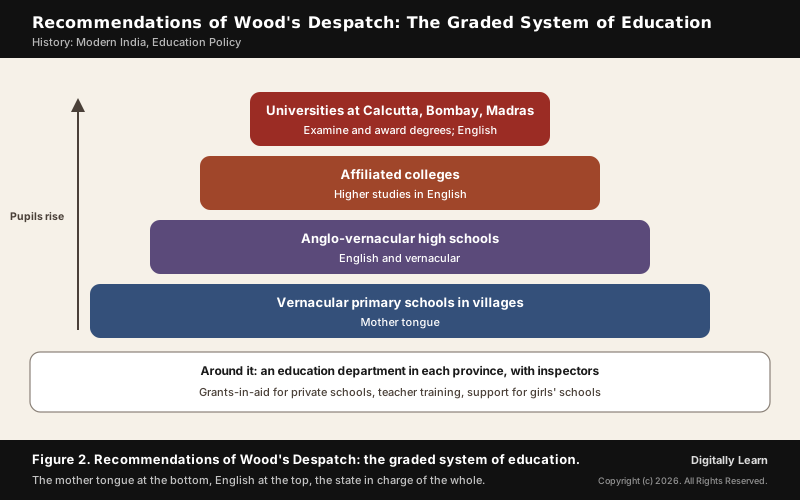
Wood's Despatch of 1854 was the educational despatch that the Court of Directors of the East India Company sent to the Governor-General, Lord Dalhousie, under the name of Sir Charles Wood, President of the Board of Control. Called the Magna Carta of English Education in India, it was the first comprehensive plan for education in India: a graded system from village schools to universities, an education department in every province, grants-in-aid for private schools, and the universities of Calcutta, Bombay and Madras, set up in 1857.
Education Policy Before Wood's Despatch (1781 to 1853)
Orientalist Beginnings: Calcutta Madrasa, Benaras Sanskrit College, Fort William
For its first decades in power the East India Company, a trading concern, took little interest in educating Indians. Its early institutions were set up by Orientalists, officials who respected ancient Indian learning and believed that British rule should rest on it. William Jones, a judge who arrived in Calcutta in 1783, studied Sanskrit with pandits and founded the Asiatic Society on 15 January 1784.
| College | Founded by | Purpose |
|---|---|---|
| Calcutta Madrasa, 1781 | Warren Hastings | Arabic, Persian, Islamic law |
| Sanskrit College, Benaras, 1791 | Jonathan Duncan | Hindu law and philosophy |
| Fort William College, 1800 | Richard Wellesley | Train Company civil servants |
The madrasa and the Sanskrit college had a practical purpose: they supplied qualified Indians to help administer law in the Company's courts. Fort William College taught the Company's own civil servants the languages and customs of India and was closed in 1802. The Orientalists held that Indians should be taught what they already knew and valued, so that the rulers could win their respect.
Charter Act of 1813 and the Orientalist-Anglicist Controversy
The Charter Act of 1813 made the first public commitment to education. It directed the Company to spend one lakh rupees a year on reviving literature, encouraging learned Indians and promoting knowledge of the sciences. The money was not released until 1823, because officials could not agree on how it should be spent, and the same Act allowed Christian missionaries to enter India.
- Indian initiative: Educated Bengalis founded the Hindu College in Calcutta in 1817, with Raja Rammohan Roy’s efforts helping it win a government grant, to teach Western humanities and sciences in English.
- Missionaries: Barred from Company territory before 1813, they worked from Danish Serampore, where a press opened in 1800 and a college in 1818.
- Orientalist view: Within the General Committee of Public Instruction, they wanted Western subjects taught for jobs but the main spending on traditional Indian learning.
- Anglicist view: They wanted the whole grant spent on modern Western studies, though they were divided over whether to teach in English or in Indian languages.
James Mill was among the critics of the Orientalists. Education, he argued, should teach what was useful and practical, the scientific and technical advances of the West, and not what Indians already valued. By the 1830s the attack on the Orientalists had grown sharper, and the dispute was settled in favour of the Anglicists.
Macaulay's Minute of 1835 and the Downward Filtration Theory
Thomas Babington Macaulay wrote his minute on Indian education on 2 February 1835. He saw India as a country to be civilised, declared that a single shelf of a good European library was worth the whole native literature of India and Arabia, and urged that public money stop going to Oriental learning. English, he argued, would open Western science, philosophy and literature to Indians.
- English Education Act, 1835: On Lord William Bentinck’s decision, English became the medium of higher education, and support for the Calcutta Madrasa and the Benaras Sanskrit College was stopped.
- Few schools, not many: The government opened a few English schools and colleges instead of a large number of elementary schools, neglecting mass education.
- Downward filtration: A small upper and middle class would be educated in English, and knowledge was expected to filter down from them to the masses.
Before 1854 a report and a scheme pointed another way. William Adam, a Scottish missionary, reported in 1835, 1836 and 1838 that Bengal and Bihar had over one lakh village pathshalas teaching more than 20 lakh children. James Thomason, lieutenant-governor of the North-Western Provinces from 1843 to 1853, built a scheme of village schools in the Indian languages, and in 1853 Lord Dalhousie wrote a minute in favour of vernacular education.
Impact of Macaulay's Minute on Colonial Education and Administration
Macaulay's minute shaped both the classroom and the state. In education, English became the medium of higher learning, English textbooks began to be produced for schools, and the Oriental colleges lost state support; mass education was left aside in favour of a small English-educated class.
- Language of government: The reforms of 1835 made English the official language of the Company’s administration.
- Civil service: Macaulay’s report of 1854 to a select committee of the British Parliament replaced patronage with a permanent civil service recruited by merit; a Civil Service Commission was set up in London in 1854 and competitive examinations began in 1855.
- A new class: The aim was a small English-educated class to act as interpreters between the rulers and the millions they governed.
- An unintended result: Modern education gave nationalists the literature of the physical and social sciences and sharpened their analysis of colonial rule.
What Is Wood's Despatch? The Charles Wood Despatch of 1854
Wood's Despatch: Date, Author and Why It Is Called the Magna Carta
Charles Wood was a British Whig politician who served as President of the Board of Control from 1852 to 1855, and later as Secretary of State for India from 1859 to 1866. The despatch is named after him, and is sometimes called the Charles Wood despatch; it reached India in the last years of Lord Dalhousie's rule, alongside his railway, telegraph and postal reforms.
The despatch is called the Magna Carta of English Education in India because it was the first comprehensive plan for education in the country. Where earlier decisions dealt with one question at a time, the grant of 1813 or the medium of 1835, the despatch laid down a whole system, from the village school to the university, and made the government responsible for it.
Aims of Wood's Despatch: European Knowledge, Trade and Trusted Officials
The despatch declared that the education to be extended in India was European knowledge: the improved arts, philosophy and literature of Europe. It marked the final triumph of those who opposed Oriental learning, and it argued for European learning on practical grounds.
- Economic aim: European learning would help Indians see the advantages of expanding trade and developing the country’s resources, and would change their tastes so that they bought goods made in Britain.
- Moral aim: It would make Indians truthful and honest, and so supply the Company with civil servants it could trust.
- Mass education: It asked the government to take responsibility for educating the masses, setting aside the downward filtration theory, at least on paper.
Wood's Despatch Recommendations
Education Departments, Grants-in-Aid and the Graded System
The despatch made education a government department. Every province was to have an education department to run its schools and extend government control over all matters of education, with inspectors to supervise them.
- Department of Public Instruction: An education department in every province; the first directorates were set up in 1855.
- Grants-in-aid: Affiliated private schools were to receive government grants, to encourage private enterprise in education.
- Government schools: At least one government school in every district.
- Secular education: Education in government institutions was to be secular.
The heart of the despatch was a graded system of education, a ladder from the village to the university. It also settled the question of language by giving each level its own medium of instruction.
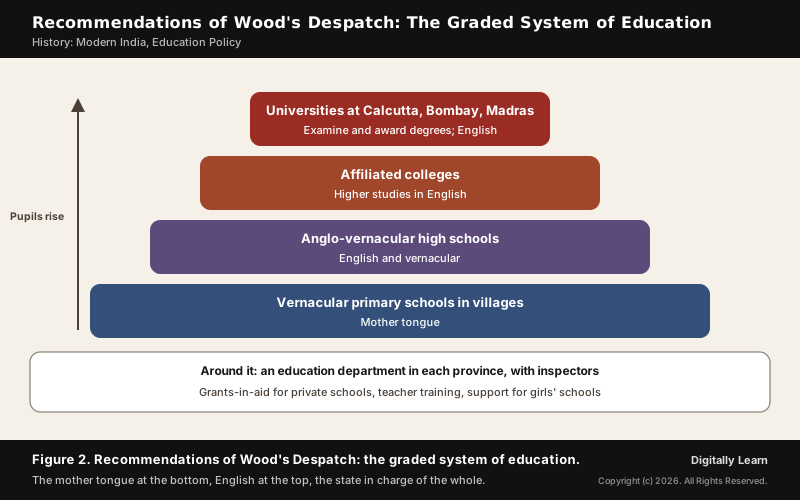
- Vernacular primary schools in the villages, taught in the mother tongue.
- Anglo-vernacular high schools, taught in both English and the Indian languages.
- Affiliated colleges at the district level, teaching higher studies in English.
- Affiliating universities in the presidency towns of Calcutta, Bombay and Madras, modelled on the University of London.
Female Education, Teacher Training and Vocational Education
The despatch also asked the government to support female education, vocational education and the training of teachers, three areas earlier policy had ignored. Normal schools, training schools for teachers, were to be set up, and vernacular schools were to be improved and supervised.
- Girls’ schools: The Calcutta Female School, founded in 1849 by John Elliot Drinkwater Bethune, was the first fruit of a movement for women’s education; with Bethune’s efforts girls’ schools came under grants-in-aid and inspection.
- Vidyasagar: Ishwar Chandra Vidyasagar was secretary of the Hindu Female School, later known as the Bethune School.
- Technical education: The engineering college at Roorkee, founded by James Thomason in 1847 to train surveyors for the Ganges Canal, and the Poona College of Engineering of 1858 grew within the new system; an agriculture institute was later set up at Pusa in Bihar.
Implementation of Wood's Despatch: Universities of 1857 and New Schools
Universities of Calcutta, Bombay and Madras (1857)
The best-known result of the despatch came in 1857. While the sepoys rose in revolt at Meerut and Delhi, universities were being set up at Calcutta, Bombay and Madras; the University of Calcutta was established on 24 January 1857. They were modelled on the University of London and at first were examining bodies: they held examinations and awarded degrees, while teaching was done in affiliated colleges.
- First graduates: Bankim Chandra Chattopadhyay and Joddu Nath Bose became the first graduates of the University of Calcutta in 1858.
- First women graduates: Kadambini Ganguly and Chandramukhi Basu graduated in 1882.
- More universities: The University of the Punjab followed in 1882 and the University of Allahabad in 1887.
- Colleges: The Hindu College of 1817 was renamed Presidency College in 1855 and became a leading college of the University of Calcutta.

Vernacular Schools and Pathshalas After 1854
Before 1854 the Company cared mainly about higher education and left the village pathshalas alone. These were flexible: no fixed fee, no printed books, no separate building or classes, and no annual examinations; teaching was oral, and classes stopped at harvest time so that peasant children could work and still study.
- Government pandits: Each was put in charge of four or five schools, to visit them and improve the teaching.
- New rules: Gurus had to submit reports and follow a timetable; teaching was based on textbooks and tested by annual examinations; pupils paid a regular fee and attended regular classes.
- Grants: Pathshalas that accepted the rules received government grants; those that refused received none, and found it hard to compete.
The new system had a cost for the poor. Regular attendance was now required even at harvest time, when the children of poor families had to work in the fields, and their absence came to be seen as indiscipline. Between 1854 and 1871 the number of vernacular schools still rose more than five-fold.
Significance and Limitations of Wood's Despatch
Wood's Despatch vs Macaulay Minute: Why 1854 Was a Turning Point
Wood's Despatch ushered in a new era in British educational policy. Its ideals and methods dominated the field for about five decades, which saw the rapid westernisation of Indian education, and the structure it created, from the education department to the affiliating university, outlived Company rule.
| Point | Macaulay's Minute, 1835 | Wood's Despatch, 1854 |
|---|---|---|
| Scope | Higher education only | School to university |
| Medium | English | Vernacular below, English above |
| Masses | Filtration from an elite | State takes responsibility |
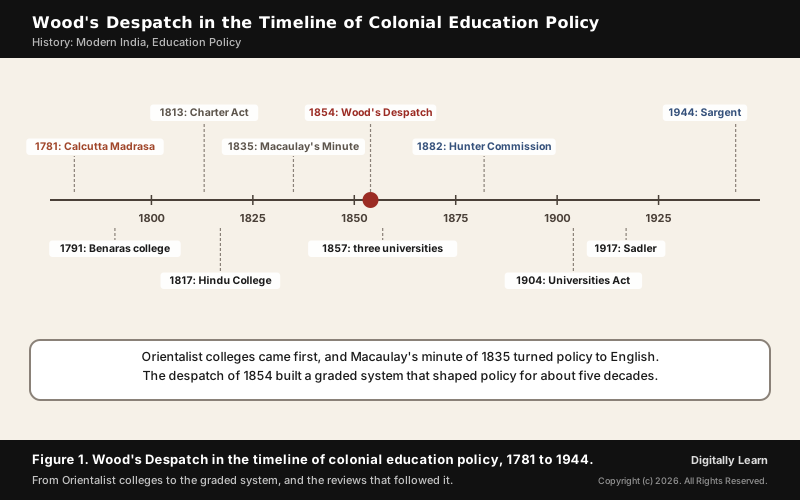
Later policy reviewed the despatch rather than replacing it. The Hunter Commission of 1882 was appointed to review progress since the despatch of 1854 and asked for more attention to primary education in the vernacular; the Raleigh Commission led to the Indian Universities Act of 1904; the Sadler Commission of 1917 to 1919 examined the universities; and the Sargent report of 1944 planned post-war education. The press and education together are covered in education and the press under colonial rule.
Limitations and the Colonial Motive Behind Wood's Despatch
The despatch served colonial ends as much as Indian ones. It hoped to create a demand for British goods and a supply of trusted clerks, and the content, structure and curricula of the new education served colonial interests. Mass education remained a promise on paper.
- Cities over villages: Western education was confined mainly to the towns, and the villages gained little from it.
- Language barrier: Because higher education was in English, most people showed little interest in it.
- Pathshalas squeezed: The rules that came with grants pushed out flexible village schools that had suited poor children.
- Narrow reach: At independence India had only 17 universities and 636 colleges, with about 2.38 lakh students and a literacy rate of 14 per cent.
Indian thinkers answered with their own ideas. Mahatma Gandhi argued that colonial education created a sense of inferiority and wanted teaching in Indian languages with a useful craft at its centre; Rabindranath Tagore founded Santiniketan in 1901 as a school in a rural setting, where the child could be free and creative. The national education of the Swadeshi years is covered in the Partition of Bengal and the Swadeshi movement.
Previous Year UPSC-CSE Questions
Previous Year UPSC-CSE Questions By the end you will be able to draft model answers for the following UPSC questions. Each question carries a collapsible framework showing how to approach it in the exam.
- UPSC Mains 2026 GS-IDiscuss the impact of Macaulay's Minute on colonial administration and education in India.
Answer outline: how to structure the answer
What the question asks, the main arguments, relevant examples and the direction of the conclusion. This is not a full model answer.
Introduction: Introduce Macaulay's minute of 2 February 1835 as the decision that settled the Orientalist-Anglicist dispute in favour of English.
Body (sub-themes to develop):
- Education: English medium in higher education; Oriental colleges lose support; English textbooks.
- Downward filtration: a small English-educated class; mass education neglected.
- Administration: English as the official language; clerks and officials trained in English.
- Civil service: Macaulay's report of 1854; competitive examinations from 1855.
- Unintended result: modern education equipped the nationalists; Wood's Despatch of 1854 widened the base.
Conclusion: Conclude that the minute created an English-educated class that served the empire and later led the national movement against it.
- UPSC Prelims 2018 Prelims-GSRegarding Wood's Dispatch, which of the following statements are true?
- Grants-in-Aid system was introduced.
- Establishment of universities was recommended.
- English as a medium of instruction at all levels of education was recommended.
Select the correct answer using the code given below:
How to approach this Prelims question
Approach: Step 1: statement 1: the despatch introduced grants-in-aid for private schools that accepted inspection; correct. Step 2: statement 2: it recommended universities, which were set up at Calcutta, Bombay and Madras in 1857; correct. Step 3: statement 3: it kept the Indian languages as the medium at school level, with English for higher education; wrong.
Trap to watch: English was the medium only at the higher levels; the vernaculars were used below.
Key facts to recall:
- (a) 1 and 2 only: correct. Grants-in-aid and universities were both in the despatch.
- (b) 2 and 3 only: wrong. Statement 3 is wrong: the vernaculars were the medium at school level.
- (c) 1 and 3 only: wrong. English was not recommended for every level, and statement 2 is also correct.
- (d) 1, 2 and 3: wrong. Statement 3 is wrong.
Answer signal: 1 and 2 only, option (a).
- UPSC Prelims 2003 Prelims-GSThe aim of education as stated by the Wood’s Despatch of 1854 was
How to approach this Prelims question
Approach: Step 1: the despatch declared that the education it wished to see was one that would diffuse European knowledge, the arts, philosophy and literature of Europe. Step 2: the other options name aims the despatch did not state.
Trap to watch: Employment and English literacy were effects discussed later, not the stated aim.
Key facts to recall:
- (a) Creating employment for Indians: wrong. Jobs were a result the despatch expected, not its stated aim.
- (b) The spread of western culture in India: correct. Diffusing European knowledge was the declared aim.
- (c) Literacy through the English medium: wrong. The despatch kept the Indian languages at school level.
- (d) Scientific research and rationalism in traditional education: wrong. It aimed to spread European knowledge, not to reform traditional learning through research.
Answer signal: The spread of western culture in India, option (b).
- UPSC Prelims 1997 Prelims-GSWhat is the correct chronological sequence of the following?
- I. Wood's Education Despatch
- II. Macaulay's Minute on Education
- III. The Sargeant Education Report
- IV. Indian Education (Hunter Commission)
How to approach this Prelims question
Approach: Step 1: date each landmark: Macaulay's Minute 1835, Wood's Despatch 1854, the Hunter Commission 1882, the Sargent report 1944. Step 2: the order is II, I, IV, III.
Trap to watch: Macaulay's minute came before Wood's despatch, not after.
Key facts to recall:
- (a) II, I, IV, III: correct. 1835, 1854, 1882, 1944.
- (b) II, I, III, IV: wrong. It puts the Sargent report (1944) before the Hunter Commission (1882).
- (c) I, II, IV, III: wrong. Macaulay's Minute (1835) came before Wood's Despatch (1854).
- (d) IV, III, I, II: wrong. It reverses the order, starting with the latest reviews.
Answer signal: II, I, IV, III, option (a).
- UPSC Prelims 1996 Prelims-GSConsider the following landmarks in Indian education: I) Hindu College, Calcutta II) University of Calcutta III) Adam’s Report IV) Wood’s Despatch The correct chronological order of these landmarks is
How to approach this Prelims question
Approach: Step 1: date each landmark: the Hindu College 1817, Adam's reports 1835 to 1838, Wood's Despatch 1854, the University of Calcutta 1857. Step 2: the order is I, III, IV, II.
Trap to watch: Adam's reports came before the despatch; the university came after it.
Key facts to recall:
- (a) I, III, IV, II: correct. 1817, 1835 to 1838, 1854, 1857.
- (b) I, IV, III, II: wrong. Adam's reports came before the despatch.
- (c) III, I, IV, II: wrong. The Hindu College (1817) came before Adam's reports.
- (d) III, II, IV, I: wrong. The university of 1857 followed the despatch, and the Hindu College was the earliest.
Answer signal: I, III, IV, II, option (a).
- UPSC Prelims 2018 Prelims-GSWhich of the following led to the introduction of English Education in India?
- Charter Act of 1813
- General Committee of Public Instruction, 1823
- Orientalist and Anglicist Controversy
Select the correct answer using the code given below:
How to approach this Prelims question
Approach: Step 1: the Charter Act of 1813 committed one lakh rupees a year to education, opening the way. Step 2: the General Committee of Public Instruction of 1823 managed those funds. Step 3: the Orientalist-Anglicist controversy was settled in favour of English in 1835. All three led to English education.
Trap to watch: All three steps contributed; none alone introduced English education.
Key facts to recall:
- (a) 1 and 2 only: wrong. The Orientalist-Anglicist controversy also led to it.
- (b) 2 only: wrong. The Charter Act of 1813 and the controversy also played a part.
- (c) 1 and 3 only: wrong. The General Committee of 1823 also played a part.
- (d) 1, 2 and 3: correct. All three steps led to the introduction of English education.
Answer signal: 1, 2 and 3, option (d).
- UPSC Prelims 2018 Prelims-GSWith reference to educational institutions during colonial rule in India, consider the following pairs: Institution – Founder
- Sanskrit College at Benaras – William Jones
- Calcutta Madarsa – Warren Hastings
- Fort William College – Arthur Wellesley
Which of the pairs given above is/are correct?
How to approach this Prelims question
Approach: Step 1: pair 1: the Sanskrit College at Benaras was founded by Jonathan Duncan in 1791, not William Jones; wrong. Step 2: pair 2: Warren Hastings founded the Calcutta Madrasa in 1781; correct. Step 3: pair 3: Fort William College was founded by Richard Wellesley in 1800, not Arthur; wrong.
Trap to watch: William Jones founded the Asiatic Society, not the Benaras college; Fort William was founded by the Governor-General Richard Wellesley, not his brother Arthur.
Key facts to recall:
- (a) 1 and 2: wrong. Pair 1 is wrong: the Benaras college was Jonathan Duncan's.
- (b) 2 only: correct. Only the Calcutta Madrasa and Warren Hastings are correctly paired.
- (c) 1 and 3: wrong. Both pairs name the wrong founder.
- (d) 3 only: wrong. Fort William College was founded by the Governor-General Richard Wellesley, not Arthur.
Answer signal: 2 only, option (b).
- UPSC Prelims 2021 Prelims-GSWho among the following was associated as Secretary with Hindu Female School which later came to be known as Bethune Female School?
How to approach this Prelims question
Approach: Step 1: the Calcutta Female School of 1849, later the Bethune School, was the first fruit of the movement for women's education. Step 2: Ishwar Chandra Vidyasagar was its secretary. Step 3: the other three belong to other movements and other decades.
Trap to watch: Bethune founded the school; Vidyasagar was its secretary.
Key facts to recall:
- (a) Annie Besant: wrong. She came later and is known for the Central Hindu College (1898) and the Home Rule League.
- (b) Debendranath Tagore: wrong. He led the Tattvabodhini Sabha and the Brahmo Samaj, not the girls' school.
- (c) Ishwar Chandra Vidyasagar: correct. He was secretary of the Hindu Female School, later the Bethune School.
- (d) Sarojini Naidu: wrong. She belongs to the Gandhian era and led the salt raid at Dharasana in 1930.
Answer signal: Ishwar Chandra Vidyasagar, option (c).
Sources
- NCERT: Our Pasts III (Class VIII), Civilising the Native, Educating the Nation
- PIB: All India Services, Towards Building New India (civil service history)
- PIB: India's Higher Education from Tradition to Transformation
- Orissa Review (Govt of Odisha), April 2005: T. E. Ravenshaw and education in Orissa
- Wikipedia: Wood's despatch
- Wikipedia: Charles Wood, 1st Viscount Halifax
- Wikipedia: Thomas Babington Macaulay
- Wikipedia: Macaulayism
- Wikipedia: English Education Act 1835
- Wikipedia: Charter Act 1813
- Wikipedia: Asiatic Society
- Wikipedia: Fort William College
- Wikipedia: Presidency University, Kolkata
- Wikipedia: Serampore College
- Wikipedia: University of Calcutta
- Wikipedia: University of Mumbai
- Wikipedia: University of Madras
- Wikipedia: Bethune College
- Wikipedia: Ishwar Chandra Vidyasagar
- Wikipedia: IIT Roorkee
- Wikipedia: Lord Dalhousie
- Wikipedia: Indian Universities Act 1904
- Wikipedia: Sargent Scheme
- Wikipedia: Richard Wellesley, 1st Marquess Wellesley
- UPSC: Civil Services Examination question papers
Editorial Disclaimer
This article draws on the NCERT history textbooks and the other sources listed on this page.


