


Overview
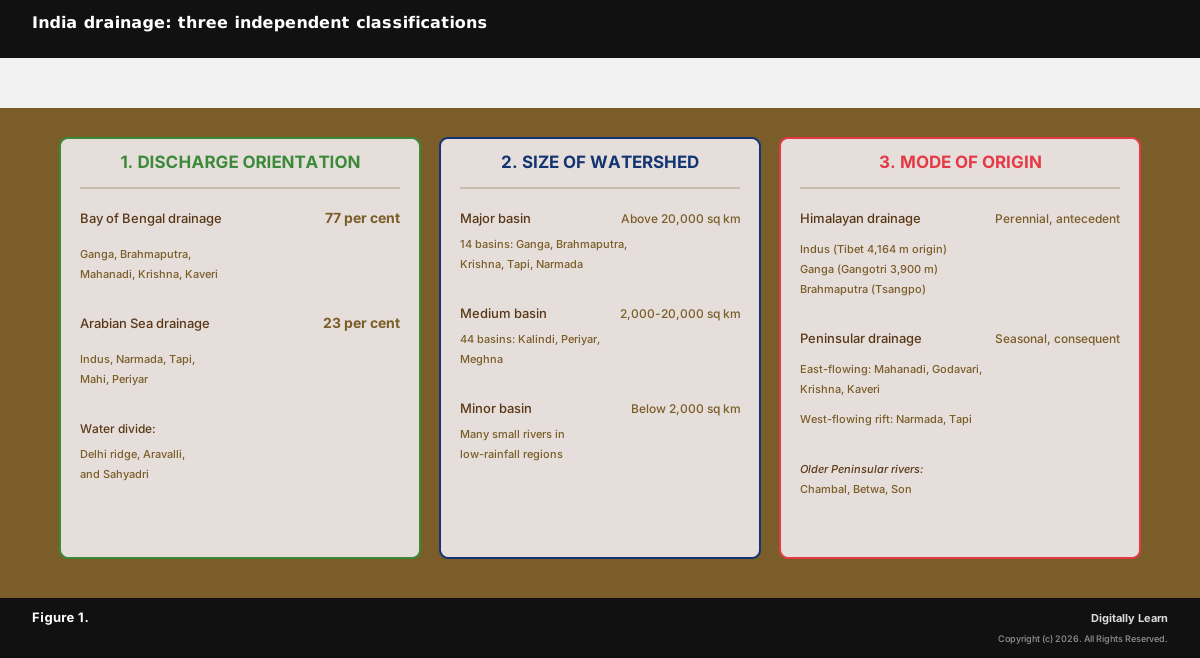
A drainage system is the flow of water through well-defined channels and the network those channels form across a landscape. The drainage pattern of a region is the outcome of its geological time period, the nature and structure of rocks, topography, slope, and the amount and periodicity of water flow. Indian drainage is classified on three independent bases: by discharge orientation into Arabian Sea drainage (23 per cent of area) and Bay of Bengal drainage (77 per cent), separated by the Delhi ridge, the Aravalli, and the Sahyadri water divide; by size of watershed into 14 major basins above 20,000 square kilometres, 44 medium basins from 2,000 to 20,000, and several minor basins below 2,000; and by mode of origin into Himalayan drainage (Indus, Ganga, Brahmaputra) and Peninsular drainage (east-flowing Mahanadi, Godavari, Krishna, Kaveri and west-flowing Narmada and Tapi).
Background and Historical Context
India's drainage architecture sustains the agriculture, hydropower, navigation, and urban-water economy of 1.4 billion people. The Ganga-Brahmaputra-Meghna system covers approximately 34 per cent of India's land area and contributes nearly 59 per cent of national runoff. The federal politics of inter-state water sharing, the international stakes of the Indus Waters Treaty 1960, and the 14-year-long Ken-Betwa interlinking debate all derive from this drainage geography. UPSC has examined drainage and river-system topics in Prelims 2014, 2017, 2019, 2023, 2024 and in Mains GS-I geomorphology nearly every cycle.
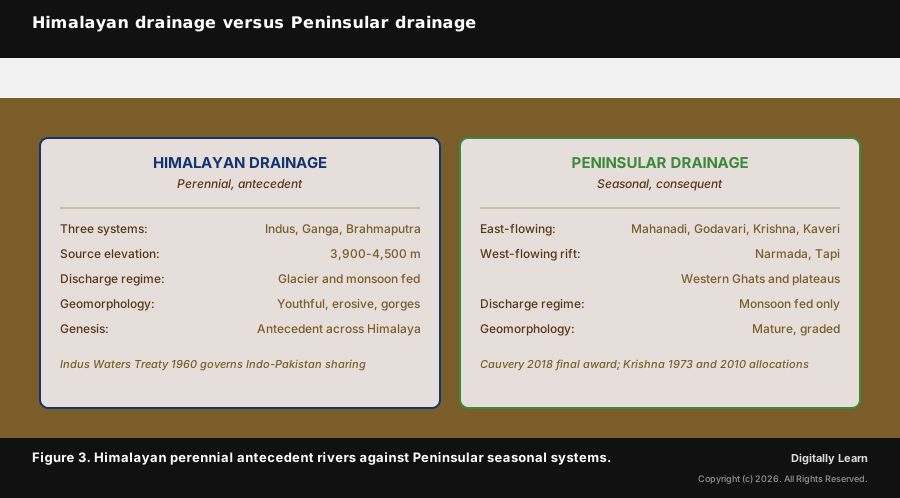
What is the significance of India's drainage organisation? Three structural features distinguish it. First, the Himalayan-Peninsular contrast: Himalayan rivers are antecedent (older than the rising Himalayas), perennial (glacier plus monsoon-fed), youthful, and erosive; Peninsular rivers are consequent on the Deccan tilt, seasonal, mature, and graded. Second, the east-flowing versus west-flowing peninsular contrast: most peninsular rivers (Mahanadi, Godavari, Krishna, Kaveri) flow east into the Bay of Bengal across the gently-tilted Deccan plateau, while the Narmada and Tapi flow west into the Arabian Sea through fault-controlled rift valleys between the Vindhya and Satpura ranges. Third, the lithology-pattern correspondence: dendritic patterns dominate the homogeneous Peninsular gneisses and the northern plains; trellis patterns mark the folded Himalayan foothills with alternating hard and soft rock bands; radial patterns radiate from individual dome features such as the Amarkantak plateau; centripetal patterns develop in closed interior basins.
The National Perspective Plan for inter-basin water transfer, originally formulated in 1980 and operationalised through the National Water Development Agency, envisages 30 river-interlinking projects of which the Ken-Betwa Link received cabinet approval in December 2021 and is currently under execution through the Daudhan dam and a 231.5-kilometre canal. The Cauvery Water Disputes Tribunal final award notified 2018 governs monthly water releases between Karnataka and Tamil Nadu under continuing Supreme Court supervision. The Mahanadi tribunal between Chhattisgarh and Odisha was constituted in 2018 and continues hearings. Beyond inter-state disputes, the watershed-development programmes including DPAP, DDP, NWDPRA, PMKSY Watershed Development Component, and the Atal Bhujal Yojana operationalise drainage-basin management at the meso and micro scale across drought-prone and dryland districts.
Drainage System, Pattern, and Basin: The Vocabulary
What a river drains and how the network organises
The flow of water through well-defined channels is termed drainage, and the network of such channels constitutes a drainage system. The drainage pattern of a region is determined by the geological time period of channel formation, the nature and structure of underlying rocks, the topography and slope of the land surface, and the amount and periodicity of water flow. Where channels are ill-defined or choked, large-scale flooding becomes a recurring phenomenon.
- Catchment area: The specific area from which a river collects its water.
- Drainage basin: An area drained by a river together with its tributaries; covers a larger area than a watershed.
- Watershed: The boundary line separating one drainage basin from another, and also a unit of smaller scale (catchments of small rivulets and rills).
- Macro-meso-micro planning units: River basins and watersheds are accepted as the most appropriate planning regions because activity in one part directly affects the others.
- Major basin: Catchment area above 20,000 square kilometres; India has 14 such basins (Ganga, Brahmaputra, Krishna, Tapi, Narmada, Mahi, Pennar, Sabarmati, Barak and others).
- Medium basin: Catchment between 2,000 and 20,000 square kilometres; India has 44 such basins (Kalindi, Periyar, Meghna and others).
- Minor basin: Catchment below 2,000 square kilometres; a large number of small rivers especially in low-rainfall regions.
Drainage Pattern Geometry: Eight Forms and Their Geological Signatures
Four primary patterns and four supplementary patterns
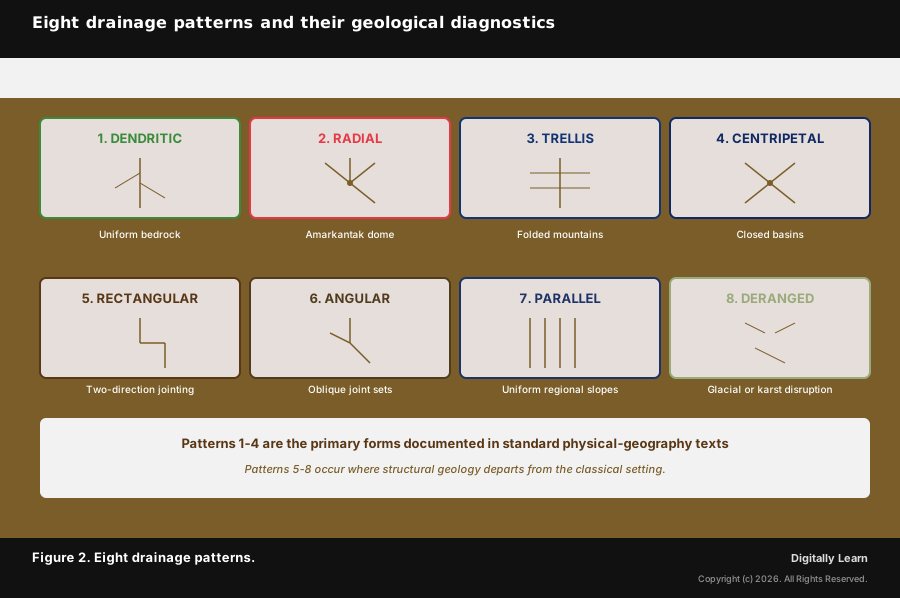
Geomorphologists distinguish four primary drainage patterns that recur across India's varied terrain. Four additional supplementary patterns arise where structural geology departs from these classical forms. Each pattern is diagnostic of the underlying lithology, joint and fault networks, and tectonic history.
- Dendritic: Tree-branch pattern; the most common form; develops on impervious uniform bedrock where erosion is controlled mainly by slope; typical of the rivers of the northern plain.
- Radial: Streams radiate outward from a central high point; develops on volcanic cones and structural domes; the rivers originating from the Amarkantak range present the classic Indian example.
- Trellis: Primary tributaries flow parallel to each other and secondary tributaries join them at right angles; forms in folded mountain belts with alternating hard and soft rock bands; common in the Himalayan foothills and the Eastern Ghats.
- Centripetal: Streams discharge their waters from all directions into a lake or depression; develops in interior closed basins such as parts of the Loktak depression and the Sambhar Lake catchment.
- Rectangular: Streams follow straight segments with right-angle bends; develops where bedrock has two near-perpendicular joint or fault sets; observed across the jointed Deccan basalt.
- Angular: Streams meet at angles other than right angles; reflects oblique joint or fault systems; observed in parts of the Aravalli range.
- Parallel: Streams run swift and straight in the same direction with few tributaries; develops on uniform regional slopes with elongate resistant rock bands; observed on the western slopes of the Western Ghats.
- Deranged: No coherent pattern; observed in glacially-disturbed or recently-uplifted landscapes; some parts of the Chota Nagpur plateau and karstic limestone areas of Meghalaya.
Three Classifications of Indian Drainage
Discharge, size, and origin: three independent organising principles
Indian drainage is classified on three independent bases. On the basis of discharge orientation, the country is divided into Arabian Sea drainage and Bay of Bengal drainage, separated by the water divide formed by the Delhi ridge, the Aravalli, and the Sahyadri. Approximately 77 per cent of the drainage area, including the Ganga, Brahmaputra, Mahanadi, and Krishna, is oriented towards the Bay of Bengal. About 23 per cent, comprising the Indus, Narmada, Tapi, Mahi, and Periyar systems, discharges into the Arabian Sea. On the basis of size of watershed, drainage basins fall into 14 major basins above 20,000 square kilometres, 44 medium basins between 2,000 and 20,000, and many minor basins below 2,000.
On the basis of mode of origin, nature, and characteristics, Indian drainage is divided into Himalayan and Peninsular systems. The Himalayan drainage consists of the Indus, Ganga, and Brahmaputra river basins, fed by both snow-melt and precipitation and therefore perennial. The Peninsular drainage consists of the east-flowing Mahanadi, Godavari, Krishna, Kaveri and the west-flowing Narmada and Tapi, all monsoon-fed and seasonal. The Chambal, Betwa, and Son, though they originate in the Peninsular plateau, are older than the Himalayan rivers and complicate the simple two-way split.
| Basis | Class | Coverage | Examples |
|---|---|---|---|
| Discharge orientation | Bay of Bengal drainage | ~77 per cent of India | Ganga, Brahmaputra, Mahanadi, Krishna |
| Discharge orientation | Arabian Sea drainage | ~23 per cent of India | Indus, Narmada, Tapi, Mahi, Periyar |
| Size of watershed | Major basin (above 20,000 sq km) | 14 basins | Ganga, Brahmaputra, Krishna, Tapi, Narmada, Mahi, Pennar |
| Size of watershed | Medium basin (2,000-20,000 sq km) | 44 basins | Kalindi, Periyar, Meghna |
| Size of watershed | Minor basin (below 2,000 sq km) | many | Various small rivers in low-rainfall regions |
| Mode of origin | Himalayan drainage (perennial, antecedent) | 3 systems | Indus, Ganga, Brahmaputra |
| Mode of origin | Peninsular drainage (seasonal, consequent) | many basins | Mahanadi, Godavari, Krishna, Kaveri, Narmada, Tapi |
The Himalayan Drainage: Indus, Ganga, Brahmaputra
Evolution from the Indo-Brahma proto-river and the three modern systems
The Himalayan drainage system has evolved through a long geological history. Geologists believe a mighty proto-river named the Shiwalik or Indo-Brahma traversed the entire longitudinal extent of the Himalaya from Assam to Punjab and onwards to Sind during the Miocene period some 5-24 million years ago, finally discharging into the Gulf of Sind. In due course this proto-river was dismembered into three systems: the Indus and its five tributaries in the western part; the Ganga and its Himalayan tributaries in the central part; and the Brahmaputra in Assam with its Himalayan tributaries in the eastern part. The dismemberment is attributed to the Pleistocene upheaval in the western Himalayas, including the uplift of the Potwar Plateau (Delhi Ridge), which acted as the water divide between the Indus and Ganga drainage.
- Indus System: Total basin area approximately 11.65 lakh square kilometres (of which 3.21 lakh in India); total length 2,880 kilometres (1,114 km in India); originates from a glacier near Bokhar Chu in Tibet at 4,164 metres in the Kailash range; receives the Jhelum, Chenab, Ravi, Beas, Satluj (collectively the Panjnad).
- Indus Waters Treaty 1960: India entitled to the eastern rivers Ravi, Beas, and Satluj; Pakistan entitled to the western rivers Indus, Jhelum, and Chenab; World Bank brokered.
- Ganga System: Rises in the Gangotri glacier near Gaumukh at 3,900 metres in Uttarakhand; called Bhagirathi until it meets the Alaknanda at Devprayag; total length 2,525 kilometres; major tributaries include the Yamuna, Ghaghara, Gandak, Kosi, Son.
- Kosi: Known as the ‘sorrow of Bihar’ for frequently changing course; brings huge quantities of sediment that block its channel and force re-routing.
- Brahmaputra System: Rises from the Chemayungdung glacier of the Kailash range near Mansarovar Lake in Tibet, where it is known as the Tsangpo; enters India in Arunachal Pradesh as the Dihang; receives the Dibang and Lohit at Pasighat to become the Brahmaputra; major Assam tributaries include the Subansiri, Manas, Sankosh.
- Glacier-river pairings: Gangotri glacier feeds the Ganga (as Bhagirathi); Bandarpunch glacier feeds the Yamuna; Bara Shigri glacier feeds the Chenab system; Siachen glacier feeds the Nubra (tributary of the Shyok-Indus); Zemu glacier feeds the Teesta.
The Peninsular Drainage: East-Flowing and West-Flowing Systems
Mahanadi, Godavari, Krishna, Kaveri eastward; Narmada and Tapi westward
The Peninsular drainage is older than the Himalayan, having evolved on the stable Deccan plateau. Major east-flowing rivers rise on the Western Ghats and drain into the Bay of Bengal across the gently-tilted Deccan plateau. The west-flowing Narmada and Tapi, by contrast, occupy fault-controlled rift valleys between the Vindhya and Satpura ranges and discharge into the Arabian Sea without forming deltas. Most peninsular rivers are seasonal, depending on monsoon rainfall, and exhibit graded mature profiles with broad shallow valleys.
- Mahanadi: Rises in the Bastar hills of Chhattisgarh; flows through Odisha to the Bay of Bengal; basin shared between Chhattisgarh and Odisha; subject of the Mahanadi tribunal constituted 2018.
- Godavari: Largest river basin originating and terminating within India; rises at Trimbakeshwar in the Maharashtra Western Ghats; drains Maharashtra, Telangana, Andhra Pradesh, Chhattisgarh, Madhya Pradesh, Odisha, Karnataka, Puducherry.
- Krishna: Rises at Mahabaleshwar in the Western Ghats; drains Maharashtra, Karnataka, Telangana, Andhra Pradesh; subject of the Krishna Water Disputes Tribunal allocations of 1973 and 2010.
- Kaveri: Rises at Talakaveri in the Brahmagiri hills of Karnataka; flows through Karnataka and Tamil Nadu to the Bay of Bengal at Poompuhar; Cauvery Water Disputes Tribunal final award notified 2018.
- Narmada: Rises at Amarkantak in Madhya Pradesh; flows west through Madhya Pradesh, Maharashtra, Gujarat to the Gulf of Khambhat; fault-controlled rift valley between Vindhya and Satpura.
- Tapi: Rises at Multai in Madhya Pradesh; flows west through Maharashtra and Gujarat to the Arabian Sea near Surat; second-largest west-flowing peninsular system.
- Coastal and inland-drainage rivers: West-coast Mandovi, Sharavati, Periyar are short and steep; east-coast Penna and Vaigai drain the rain-shadow Deccan; the Luni and streams feeding Sambhar Lake terminate in inland closed basins without reaching the ocean.
Watershed Management and Drainage-Basin Programmes
From DPAP to PMKSY-WDC and Atal Bhujal Yojana
Watershed management treats the drainage basin as the integrated unit for soil, water, and biomass conservation. India's watershed programmes have evolved across five decades to address rainfed-area productivity, drought mitigation, and groundwater recharge. The early programmes focused on dryland and desert districts; recent programmes integrate watershed planning with broader rural development.
- Drought Prone Area Programme (DPAP): Launched 1973-74; focuses on drought-prone districts; soil and water conservation through contour bunding, check dams, percolation tanks.
- Desert Development Programme (DDP): Launched 1977-78; restricted to hot and cold desert districts; combats desertification through afforestation and sand-dune stabilisation.
- National Watershed Development Project for Rainfed Areas (NWDPRA): Launched 1990-91; rainfed area development with watershed-plus approach.
- PMKSY Watershed Development Component (WDC): Restructured 2021 as part of Pradhan Mantri Krishi Sinchayee Yojana; integrated watershed planning across drought-prone and rainfed districts.
- Atal Bhujal Yojana: Launched 2020 with World Bank assistance; covers 8,213 water-stressed gram panchayats across seven states (Gujarat, Haryana, Karnataka, Madhya Pradesh, Maharashtra, Rajasthan, Uttar Pradesh); community-led groundwater management.
River Interlinking and Inter-State Water Disputes
National Perspective Plan, Ken-Betwa, and the federal politics of drainage
The National Perspective Plan for water resources development, formulated in 1980 and operationalised through the National Water Development Agency, envisages 30 river-interlinking projects in two components: 14 links under the Himalayan component and 16 under the Peninsular component. The plan aims to transfer water from surplus basins (Brahmaputra, Mahanadi) to deficit basins (Krishna, Kaveri), addressing droughts in the south while mitigating floods in the north-east. The Ken-Betwa Link Project received cabinet approval in December 2021 as the first project under the plan; it transfers water from the Ken river in Madhya Pradesh to the Betwa river in Uttar Pradesh through the Daudhan dam and a 231.5-kilometre canal.
Inter-state river water disputes are adjudicated under the Inter-State River Water Disputes Act 1956. The Cauvery Water Disputes Tribunal between Karnataka and Tamil Nadu, constituted in 1990 and reconstituted multiple times, issued its final award in 2007 with the Supreme Court further allocating monthly water releases in 2018. The Krishna tribunal allocated waters among Maharashtra, Karnataka, Telangana, and Andhra Pradesh through awards in 1973 and 2010. The Mahanadi tribunal between Chhattisgarh and Odisha was constituted in 2018 and continues hearings. Critics of interlinking, including ecologist Madhav Gadgil and civil-society organisations, raise four objections: displacement of indigenous communities; ecological damage to river-system connectivity (the Ken-Betwa project requires submerging approximately 9,000 hectares of Panna Tiger Reserve); cost overruns; and federal-political contention over surplus-deficit basin classification.
Previous Year UPSC-CSE Questions
Previous Year Questions By the end of this article you will be able to draft model answers for the following UPSC questions. Each question carries a collapsible framework showing how to approach it in the exam.
- UPSC Prelims 2023 General Studies: Consider the following statements:
- Jhelum River passes through Wular Lake.
- Krishna River directly feeds Kolleru Lake.
- Meandering of Gandak River formed Kanwar Lake.
How many of the statements given above are correct?
How to approach this Prelims question
Approach: Three-statement evaluation testing river-lake associations across north and south India.
Trap to watch: Aspirants may accept Statement 2 because Kolleru lies in the Krishna-Godavari delta region. The trap is that Kolleru's feeder streams are small tributaries, not the Krishna directly.
Key facts to recall:
- Wular Lake: Jammu and Kashmir; one of the largest freshwater lakes in the Indian subcontinent; Jhelum flows through it.
- Kolleru Lake: Andhra Pradesh; fed by Budameru and Tammileru, NOT directly by Krishna.
- Kanwar Lake (Kabar Tal): Bihar; oxbow lake formed by Burhi Gandak meandering, not Gandak.
- All three: Ramsar sites with different feeder mechanisms.
Answer signal: Only one
- UPSC Prelims 2019 General Studies: Consider the following pairs:
- Bandarpunch : Yamuna
- Bara Shigri : Chenab
- Milam : Mandakini
- Siachen : Nubra
- Zemu : Manas
Which of the pairs given above are correctly matched?
How to approach this Prelims question
Approach: Five-pair matching testing glacier-river associations across the Indian Himalayan range.
Trap to watch: Aspirants may accept Pair 3 because Mandakini sounds like an Uttarakhand river. The trap is that Milam glacier feeds the Goriganga, not the Mandakini.
Key facts to recall:
- Bandarpunch glacier: Uttarakhand; feeds Yamuna headwaters.
- Bara Shigri: Himachal Pradesh; feeds Chenab system.
- Milam glacier: Uttarakhand; feeds Goriganga (tributary of Sharda-Kali), not Mandakini.
- Siachen glacier: Eastern Karakoram; feeds Nubra (tributary of Shyok-Indus).
- Zemu glacier: Sikkim; feeds Teesta, not Manas.
Answer signal: 1, 2 and 4
- UPSC Mains 2020 GS-I: The interlinking of rivers can provide viable solutions to the multi-dimensional inter-related problems of droughts, floods, and interrupted navigation. Critically examine.
How to structure the answer in the exam
Introduction: Open by defining river interlinking as inter-basin water transfer formalised through the National Perspective Plan 1980 envisaging 30 links (14 Himalayan, 16 Peninsular). The Ken-Betwa Link is the first project under execution following December 2021 cabinet approval.
Body (sub-themes to develop):
- Drought mitigation in south India: Kaveri, Krishna, Penna deficit basins receive surplus from Mahanadi and Godavari via Peninsular component.
- Flood mitigation in Indo-Gangetic and Brahmaputra plains: Surplus routed to deficit Peninsular basins via Himalayan component.
- Inland navigation: National Waterways 1, 2, and 4 get year-round depth assurance.
- Irrigation expansion: Approximately 35 million hectares of additional irrigated land at full plan execution.
- Hydropower co-benefits: Cascade dams along link canals add an estimated 34,000 megawatts.
- Ecological cost: Submergence of forested catchments; 9,000 hectares of Panna Tiger Reserve under Ken-Betwa; severance of migratory fish routes; downstream sediment loss.
- Indigenous community displacement: Tribal communities in submergence zones; rehabilitation challenges.
- Federal politics: Donor-state legislatures (Odisha for Mahanadi, Assam for Brahmaputra) have resisted surplus-classification of their rivers.
- Alternative pathways: Watershed development, drip-irrigation expansion under PMKSY, groundwater recharge under Atal Bhujal Yojana, demand-side water management.
Conclusion: Conclude by noting that river interlinking is a high-cost high-impact strategy whose viability depends on whether benefits can be delivered without disproportionate ecological and social damage. The Ken-Betwa execution is a test case; lessons from it should inform whether the National Perspective Plan should proceed in full, scale back to selective links, or pivot toward watershed-management alternatives.
Sources and Further Reading
- NCERT Class 11 India Physical Environment, Chapter 3 Drainage System (pp. 21-31)
- Wikipedia – Drainage system (geomorphology)
- Wikipedia – List of rivers of India
- Wikipedia – Ganges
- Wikipedia – Brahmaputra River
- Wikipedia – Indus River
- Wikipedia – Indus Waters Treaty
- Wikipedia – Interlinking of rivers in India
- Wikipedia – Atal Bhujal Yojana
- Ministry of Jal Shakti – Department of Water Resources
Disclaimer
This article is prepared for UPSC preparation by Digitally Learn's editorial team based on the NCERT Class 11 textbook India: Physical Environment (Chapter 3, Drainage System), Ministry of Jal Shakti documents, National Water Development Agency publications, Central Water Commission river-basin atlases, and Wikipedia entries for cross-verification of latest figures. Numerical values reflect the most recent assessed sources at the time of writing (May 2026).


