


Overview
The Islamabad Round
First US-Iran nuclear-pact talks since the 2018 JCPOA exit stalled in Islamabad over the moratorium gap.
Through April 2026, the United States and Iran moved through two rounds of nuclear-pact negotiations in Islamabad, mediated by Pakistan, against the backdrop of a US naval blockade of Iranian ports and a still-restricted Strait of Hormuz, echoing the 2013 Joint Comprehensive Plan of Action arc but with a sharper kinetic edge.
Islamabad talks, the moratorium gap and the blockade backdrop
Two rounds of talks, a 15-year gap and a tightening blockade
Trigger event: On 20 April 2026, the first round of US-Iran nuclear talks in Islamabad, mediated by Pakistan, ended without an agreement. US Vice-President J D Vance led the American delegation, opposite Iranian Parliament Speaker Mohammad Baqer Qalibaf.
Definition: The Joint Comprehensive Plan of Action (JCPOA), signed in 2015 between Iran and the P5 Plus 1 grouping, capped Iran's uranium enrichment in return for sanctions relief. The United States withdrew from the JCPOA in 2018. The April 2026 Islamabad track is the first formal nuclear-pact negotiation since that withdrawal.
- 13 April 2026: US imposes naval blockade on Iranian ports; CENTCOM reports 90 per cent of Iran’s sea trade halted in 48 hours.
- 16 April 2026: Pakistan Army Chief Field Marshal Asim Munir in Tehran; PM Shehbaz Sharif in Riyadh.
- 20 April 2026: First Islamabad round between US and Iran ends without outcome.
- 20 April 2026: Trump claims Iran has agreed to an unlimited halt of its nuclear programme; rejects 20-year framing in favour of indefinite suspension.
- 24 April 2026: Israel-Lebanon ceasefire extended by three weeks after the first direct Israeli-Lebanese diplomatic talks in over three decades.
- 27 April 2026: Trump scraps the Witkoff and Kushner mission to Islamabad; Iran FM Araqchi continues diplomacy through Oman.
The Hegseth maritime posture set the rhetorical backdrop. US Defence Secretary Pete Hegseth told reporters the United States had established total maritime dominance and was monitoring every movement of Iran's remaining military assets. Hegseth said US forces were using less than 10 per cent of naval power to enforce the blockade and were tracking dual-use infrastructure for potential strikes.
India energy, freedom-of-navigation and the Modi-Macron call
India exposures and the diplomatic posture in April 2026
Why it matters: India's exposure runs along three rails: energy security through the Strait of Hormuz, an estimated nine million migrants in the Gulf, and remittance inflows. Any nuclear-pact outcome reshapes all three.
Prime Minister Narendra Modi recorded the policy posture publicly in a phone call with French President Emmanuel Macron. Both sides agreed on the need to urgently restore safety and freedom of navigation in the Strait of Hormuz, and to continue close cooperation to advance peace and stability in the region.
Brent crude moved sharply on every signal. Prices climbed about 30 per cent from the war's start, then plunged over 10 per cent below 89 dollars a barrel on 20 April when Trump hinted at a near-finalised deal. By late April crude was back near 96 dollars on stalled-talks anxiety.
Sanctions exposure sits alongside energy and migration. Treasury Secretary Scott Bessent described preparations for secondary sanctions as the financial equivalent of the kinetic campaign. Letters were sent to banks in China, Hong Kong, the UAE and Oman warning of secondary sanctions for handling Iranian money or oil; Indian banks and refiners must read this advisory carefully.
Remittance volatility risk matters at the household level. With nine million migrants across the Gulf, a deterioration in regional stability translates directly into reduced inflows; remittances above USD 50 billion annually are a meaningful share of the household-savings base in Kerala, Tamil Nadu and other source states.
What the diplomacy signals for the non-proliferation order
JCPOA echo, P5 Plus 1 framework and the 20 billion dollar question
What is the significance of this Islamabad round: The April 2026 talks repeat the architecture of the 2015 JCPOA: nuclear restrictions in exchange for sanctions relief. But the kinetic edge is different. Talks are mediated by Pakistan, not the P5 Plus 1 group, while a US naval blockade frames the conversation.
In policy terms: One reported proposal involved the US releasing 20 billion dollars in frozen Iranian funds in exchange for Tehran surrendering its enriched-uranium stockpile. Trump denied the framing. The proposal echoes the 2013-2015 JCPOA bargain of sanctions relief for enrichment caps.
- Negotiating principals: US VP J D Vance and Iranian Parliament Speaker Mohammad Baqer Qalibaf at the table; Pakistan Army Chief Field Marshal Asim Munir and PM Shehbaz Sharif as mediators.
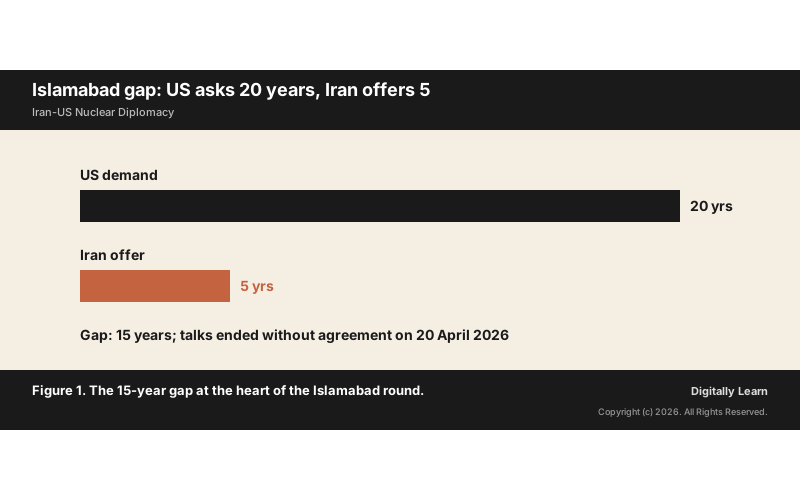
- Sticking points: the 15-year moratorium gap and the disposition of Iran’s enriched-uranium stockpile.
- Side tracks: a regional security framework free of outside interference, proposed by Iran FM Abbas Araqchi during travel between Pakistan and Oman.
- Linked breakthroughs: first direct Israeli-Lebanese talks in three decades, hosted by US Secretary of State Marco Rubio.
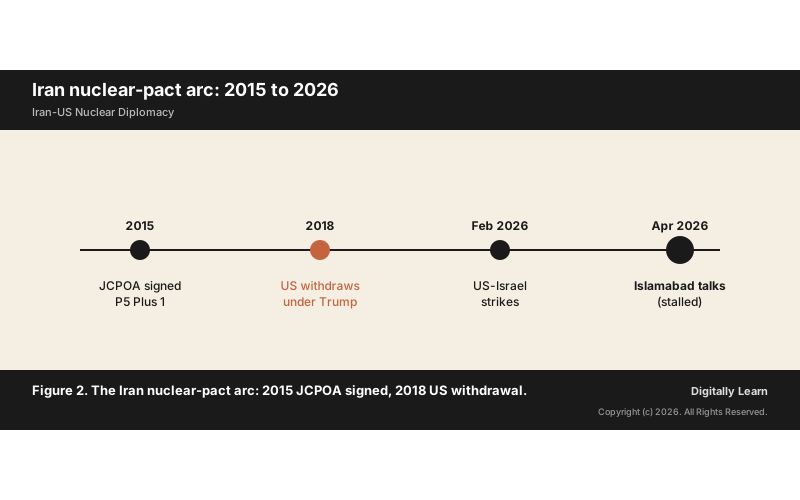
The IAEA frame matters independently of the bilateral US-Iran track. The 2015 JCPOA had committed Iran to an enrichment cap of about 3.67 per cent for civilian use under continuous IAEA verification. The 2026 Islamabad conversation must rebuild that verification architecture from a much weaker baseline, with Iran's stockpile and centrifuge cascade currently outside any inspector access.
A regional security framework is the wider proposal. Iran FM Abbas Araqchi, during travel between Pakistan and Oman, called for a regional security framework free of outside interference. Such a framework would shift the Gulf security architecture from a US-led security guarantee toward a multilateral one with Pakistan, Oman and possibly Russia and China as parties.
What sets the April 2026 round apart from the 2015 JCPOA
Three architectural features of the Islamabad track
Distinguishing features: Three features separate the April 2026 Islamabad round from the 2013-2015 JCPOA arc.
- (i) Kinetic backdrop. Talks proceed under a US naval blockade of Iranian ports and active military pressure, whereas the JCPOA was negotiated under sanctions but not active hostilities; CENTCOM reported 90 per cent of Iran’s sea trade halted in 48 hours.
- (ii) Pakistan as mediator. Islamabad replaces the P5 Plus 1 framework of the JCPOA; Pakistan Army Chief Field Marshal Asim Munir and PM Shehbaz Sharif drive the process, raising distinct questions of legitimacy and bandwidth.
- (iii) Bundled tracks. The nuclear-pact track sits alongside the Israel-Lebanon ceasefire and the Hormuz freedom-of-navigation question; the JCPOA was a single-issue bargain whereas the 2026 conversation is multi-vector.
| Negotiating dimension | 2015 JCPOA | April 2026 Islamabad track |
|---|---|---|
| Mediation framework | P5 Plus 1 (US, UK, France, Russia, China, Germany) | Pakistan bilateral mediation |
| Backdrop | Sanctions pressure, no active military strikes | US naval blockade, US-Israel strikes since 28 February |
| Enrichment cap proposed | About 15 years (3.67 per cent enrichment cap) | 20 years (US) versus 5 years (Iran offer) |
| Sanctions relief tabled | Lifting of nuclear-linked sanctions | 20 billion dollars in frozen funds (reportedly proposed; denied) |
| Linked diplomacy | Single-issue nuclear track | Israel-Lebanon ceasefire, Hormuz freedom of navigation |
The 20 billion dollar bargain is a JCPOA echo. The 2015 deal involved sanctions relief in exchange for verifiable enrichment caps. The 2026 proposal under discussion would release USD 20 billion in frozen Iranian funds in exchange for Tehran surrendering its enriched-uranium stockpile, before any longer-term moratorium is agreed. Trump publicly denied the framing, but the architecture mirrors the 2013-2015 deal sequence.
Israel's posture is the third vector: Israeli Defence Minister Israel Katz said Israel was awaiting a US green light for further military action. Such bundling of nuclear-pact diplomacy with active military planning is qualitatively new; the JCPOA negotiations of 2013-2015 proceeded without any concurrent kinetic threat being publicly tabled by allied governments.
Outcomes the April 2026 cycle is producing
Four trackable consequences across diplomatic, energy and security channels
Observable outcomes: The April 2026 cycle has produced four trackable consequences across diplomatic, maritime, energy and humanitarian channels.
- (a) Talks stalled on the moratorium gap. The Islamabad round ended without outcome; the Witkoff and Kushner mission was scrapped on 27 April; Iran FM Araqchi continues regional diplomacy through Oman.
- (b) Israel-Lebanon ceasefire breakthrough. Trump announced a 3-week extension on 24 April following the first direct Israeli-Lebanese diplomatic talks in over three decades.
- (c) US blockade tightened. US Central Command reports 33 vessels redirected since the blockade began; the M/T Majestic X was boarded in the Indian Ocean.
- (d) Oil markets oscillating. Brent moved between 89 dollars and 96 dollars per barrel through the cycle; the IEA Executive Director warned of about six weeks of European jet fuel remaining.
The Pakistan mediation question is itself a trackable outcome. Pakistan's emergence as US-Iran mediator has been read by critics, including the family of former PM Imran Khan, as image-burnishing while domestic civil-liberty concerns persist. Saudi Crown Prince Mohammed bin Salman has separately praised the Pakistan Army Chief's constructive role in the peace process.
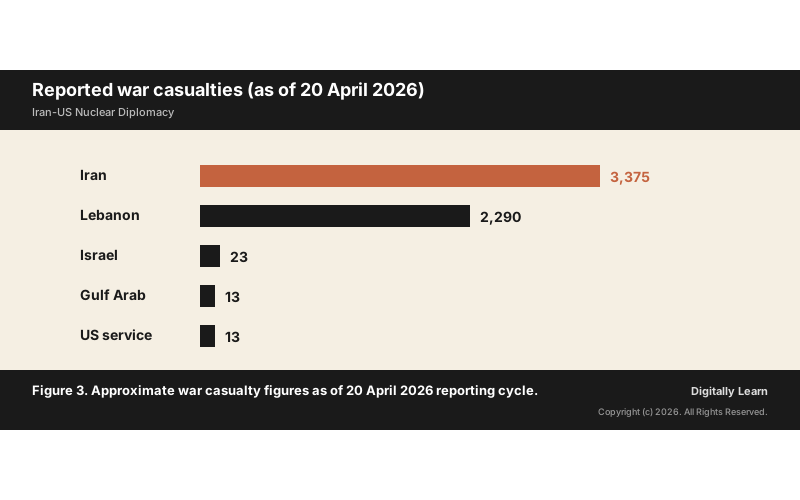
Casualty totals continue to climb through the cycle. Iran state media reported 3,375 killed as of 20 April 2026, with 2,875 men, 496 women and 383 children among the dead. Lebanon recorded more than 2,290 dead; Israel 23; the wider Gulf 13; and 13 US service members. These are press-reported figures, not independently audited counts.
Connections to the active West Asia arc
Connecting the nuclear-pact track to recent briefings
Contemporary linkages: The Islamabad nuclear-pact track is the latest node in an active West Asia arc; earlier briefings have traced the macro slowdown, the Hormuz closure and reopening, the OPEC restructuring and the LPG-pharma supply-chain stress.
- West Asia war and India economic slowdown, May 2026: the macro channels of supply-shock transmission.
- Iran closes the Strait of Hormuz, April 2026: the chokepoint stakes that set the table for the blockade.
- Strait of Hormuz reopens with Jag Vikram, April 2026: the post-ceasefire transit cycle and the toll dispute.
- UAE exits OPEC, April 2026: the cartel restructuring that sits alongside the nuclear-pact conversation.
UPSC Relevance
GS Paper II focus areas for the nuclear-diplomacy track
Where it fits: The Islamabad nuclear-pact track sits at the intersection of GS Paper II on International Relations (bilateral and multilateral negotiations) and GS Paper III on Energy Security and Internal Security, specifically maritime law and the freedom-of-navigation question.
For Prelims, the high-yield facts cluster around JCPOA composition (P5 Plus 1), the IAEA safeguards framework, India's founding membership of the IAEA, the Nuclear Non-Proliferation Treaty and the principal sticking points of the 2015 deal.
- JCPOA: signed July 2015 between Iran and the P5 Plus 1 group (US, UK, France, Russia, China, Germany).
- US withdrawal: announced May 2018 under the first Trump administration.
- IAEA: International Atomic Energy Agency, founded 1957, headquartered in Vienna.
- NPT: Treaty on the Non-Proliferation of Nuclear Weapons, entered into force 1970; Iran is a state-party.
- India: not an NPT signatory; has IAEA safeguards on civilian reactors that use imported uranium.
For Mains, two framings recur. First, the US-Iran nuclear-pact question (the GS-II 2018 prompt): how does the controversy affect India's national interest and how should New Delhi respond. Second, the India energy-security question: how should India hedge through the Strait of Hormuz with Russia, Africa and the United States as supply partners.
Strategic autonomy is the operative Mains framing. India's posture combines bilateral engagement with both Tehran and Washington, supply diversification toward Russia, the United States and African producers, strategic petroleum reserve readiness, and a clear public position on freedom of navigation in the Strait of Hormuz. The Modi-Macron call publicly recorded the navigation pillar of that posture.
The non-proliferation thread tests India's separation plan. The 2008 India safeguards agreement is the operating reference for IAEA verification of civilian reactors using imported uranium. Any new framework that follows from the Islamabad track must coexist with India's selective-safeguards architecture; the Mains question of how India navigates between NPT non-signatory status and IAEA cooperation remains live.
Past-year questions linked to this briefing
Prelims 2020 IAEA safeguards and Mains 2018 US-Iran nuclear-pact links
How this links to PYQs: The Islamabad track activates two past questions: a Prelims 2020 Q55 on IAEA safeguards in Indian reactors, and a Mains 2018 GS-II Q20 on the US-Iran Nuclear Pact controversy and India's national interest. The 2018 prompt maps almost exactly onto the 2026 development.
Previous Year UPSC-CSE Questions By the end you will be able to draft model answers for the following UPSC questions. Each question carries a collapsible framework showing how to approach it in the exam.
- UPSC Prelims 2020In India, why are some nuclear reactors kept under “IAEA Safeguards” while others are not?
How to approach this Prelims question
Approach: Recall the trigger for IAEA safeguards: imported nuclear material from supplier states under the Indo-US civil nuclear agreement and similar deals brings reactors under safeguards.
Trap to watch: Confusing the criterion with fuel type (uranium vs thorium) or ownership model.
Key facts to recall:
- IAEA safeguards on India apply to civilian reactors using imported uranium under the 2008 separation plan.
- Reactors using domestic-sourced uranium fall outside IAEA safeguards.
- India is not an NPT signatory but operates a separation plan for civilian and military programmes.
Answer signal: Option (b) is the answer.
- UPSC Mains 2018 GS-IIIn what ways would the ongoing US-Iran Nuclear Pact Controversy affect the national interest of India? How should India respond to its situation?
How to structure the answer in the exam
Introduction: India's relationship with West Asia spans energy, migration, remittances and strategic autonomy. The US-Iran nuclear-pact controversy reshapes every channel simultaneously.
Body (sub-themes to develop):
- Energy security: Strait of Hormuz dependence; oil-price transmission to inflation and growth.
- Migrant safety and remittances: nine million Indians in the Gulf and over 50 billion dollars in annual remittances.
- Strategic autonomy: India's non-alignment with respect to the JCPOA framework; bilateral engagement with both Tehran and Washington.
- Sanctions exposure: secondary sanctions risk for Indian banks and refiners.
- 2026 inflection: Modi-Macron call on Hormuz freedom of navigation; Islamabad round under Pakistan mediation.
Conclusion: India's response must combine diplomatic engagement on both sides, supply diversification, and a hard read on its strategic-autonomy thresholds in a multi-vector West Asia.
Sources and Further Reading
- Indian Express: Iran-US-Israel war live, US naval blockade and Hormuz dominance (15 April 2026)
- LiveMint: Trump claims unlimited halt to Iran nuclear programme (20 April 2026)
- LiveMint: Do recent clashes in the Strait of Hormuz put Iran-US negotiations at risk (20 April 2026)
- LiveMint: Trump announces 3-week Israel-Lebanon ceasefire extension (24 April 2026)
- LiveMint: Trump says Iran can still call US for talks, rules out nuclear weapons (27 April 2026)
- International Atomic Energy Agency: Iran and IAEA
- Ministry of External Affairs, Government of India: India and West Asia
- International Maritime Organization: UNCLOS and freedom of navigation
- Wikipedia: Joint Comprehensive Plan of Action
Editorial Disclaimer
This article is compiled from the reference materials listed in the Sources section. It is an explainer for UPSC preparation and is not a substitute for primary documents (NCERTs, GoI ministry releases, IMD bulletins, RBI / CEA / MoEFCC publications, and Standing-Committee reports).


