


Overview
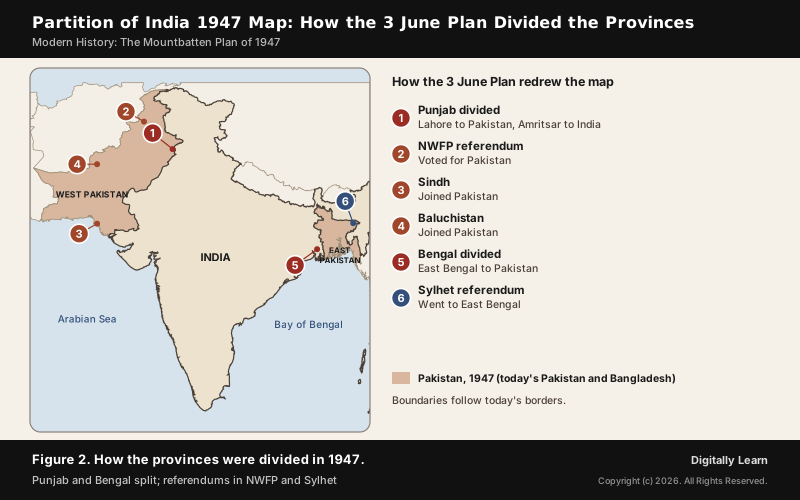
The Mountbatten Plan, or 3 June Plan, was announced by Lord Mountbatten, the last Viceroy, on 3 June 1947. It settled the terms of freedom with partition: Punjab and Bengal would vote on division, referendums would decide NWFP and Sylhet, and power would pass to two dominions, India and Pakistan, on 15 August 1947. The Indian Independence Act of 18 July 1947 gave it the force of law.
The 3 June Plan: Meaning and Background
What Is the Mountbatten Plan? Date and Meaning
The Mountbatten Plan was formally proposed on 3 June 1947, which is why it is also called the 3 June Plan. It was the plan for freedom with partition: British India would be divided into two dominions, India and Pakistan, and power would be transferred on 15 August 1947. The Congress Working Committee accepted it on 3 June 1947.
The formula of freedom with partition was already widely accepted before Mountbatten arrived. His own formula was to divide India but retain maximum unity: the Muslim League's demand was conceded to the extent that Pakistan would be created, while the Congress position on unity was used to make Pakistan as small as possible.
Why Partition Came: Separate Electorates, 1937 and the Pakistan Resolution
Partition was the end of a longer story. Some scholars see it as the culmination of communal politics that grew from the early twentieth century: separate electorates for Muslims, created by the colonial government in 1909 and expanded in 1919, let politicians gather a following with sectarian slogans.
- Elections of 1937: The Congress won an absolute majority in five of eleven provinces and formed governments in seven. The Muslim League polled only 4.4 per cent of the Muslim vote.
- The United Provinces: The League wanted a joint government with the Congress, which had a majority and rejected the offer; some scholars argue this convinced the League that Muslims would struggle for power in a united India.
- The name Pakistan: Coined by Choudhry Rehmat Ali, a Punjabi Muslim student at Cambridge, in pamphlets of 1933 and 1935.
- Pakistan Resolution, 23 March 1940: The League demanded a measure of autonomy for the Muslim-majority areas; the resolution never mentioned partition or Pakistan.
The demand hardened only in the 1940s. Even so, League support in 1937 was still weak in Bengal, the NWFP and the Punjab, three of the provinces from which Pakistan was carved ten years later.
Cabinet Mission, Direct Action and the Interim Government
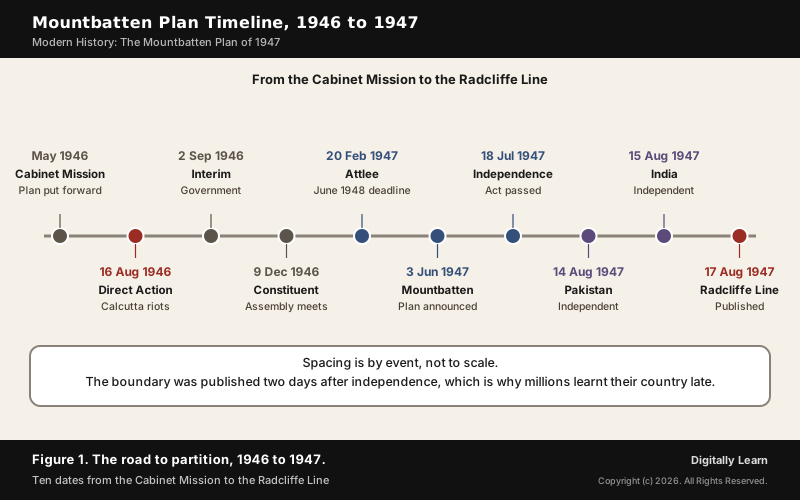
The Cabinet Mission of 1946 was the last attempt to keep India united. Its plan, announced on 16 May 1946, rejected a full Pakistan and proposed grouping provinces into three sections, with a common centre for defence, communications and external affairs. The League accepted it on 6 June and the Congress on 24 June 1946.
- Direct Action: The League withdrew its acceptance and called for direct action from 16 August 1946. In Calcutta more than 4,000 people died within 72 hours, and riots spread to Noakhali, Bihar and Garhmukteshwar.
- Interim Government: A Congress-led Interim Government headed by Nehru was sworn in on 2 September 1946; the League joined on 26 October 1946 but obstructed its work.
- Constituent Assembly: It first met on 9 December 1946; the League stayed away.
By early 1947 the communal riots and the unworkable Congress-League coalition had pushed many towards the previously unthinkable partition. The strongest demand now came from Hindu and Sikh groups in Bengal and Punjab, who feared that compulsory grouping would place them in Pakistan.
Attlee's Statement, Mountbatten's Task and the Balkan Plan
Attlee's Statement of 20 February 1947 and Mountbatten's Instructions
On 20 February 1947, British Prime Minister Clement Attlee announced that power would be transferred by 30 June 1948, even if Indian leaders had not agreed on a constitution, and that Mountbatten would replace Wavell as Viceroy. The statement hinted at partition and even at power passing to separate provinces.
- Why a fixed date: The government hoped a deadline would shock the parties into agreement, avert a constitutional crisis and show British sincerity; British authority was also in irreversible decline.
- Mountbatten’s instructions: To avoid partition and preserve a united India, while adapting to events to secure a prompt British withdrawal.
- Wider powers: He was informally given more power to decide on the spot than his predecessors, and the British government had firmly decided to quit.
Two Indian responses show how the choice had narrowed. Gandhi asked Mountbatten to invite Jinnah to form a new central government, but Mountbatten never conveyed the proposal to Jinnah. In April 1947 the Congress President, J. B. Kripalani, wrote that rather than have a battle, the Congress would let the League have Pakistan provided Bengal and Punjab were partitioned fairly.
Balkan Plan (Dickie Bird Plan): Why It Was Dropped
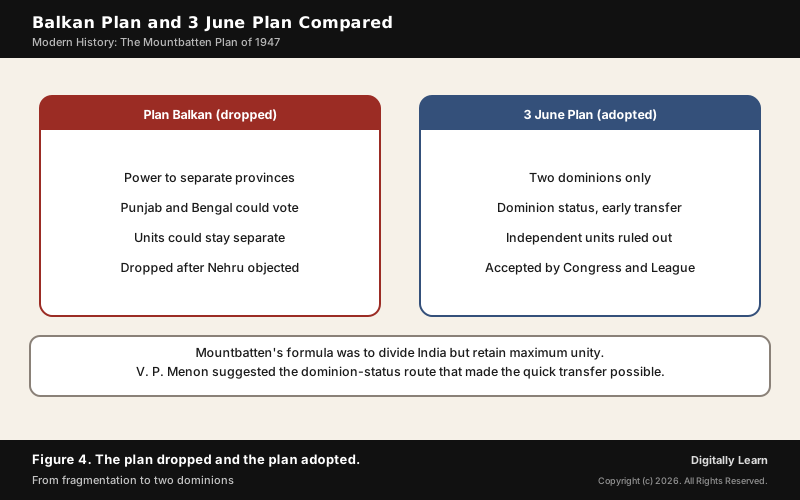
Between March and May 1947, Mountbatten decided the Cabinet Mission plan was dead and drew up an alternative, known as Plan Balkan. It would have transferred power to separate provinces, or to a confederation if one was formed, with Punjab and Bengal able to vote on partition. The units so formed, and the princely states freed by the lapse of paramountcy, could join India or Pakistan or stay separate.
The plan risked breaking India into many pieces, and it was quickly abandoned after Nehru reacted violently to it. It is also called the Dickie Bird Plan, after Mountbatten's nickname, Dickie; a UPSC Mains paper once asked candidates to review it under that name.
Provisions of the Mountbatten Plan and Why It Was Accepted
Main Provisions of the 3 June Plan and Why the Congress Accepted
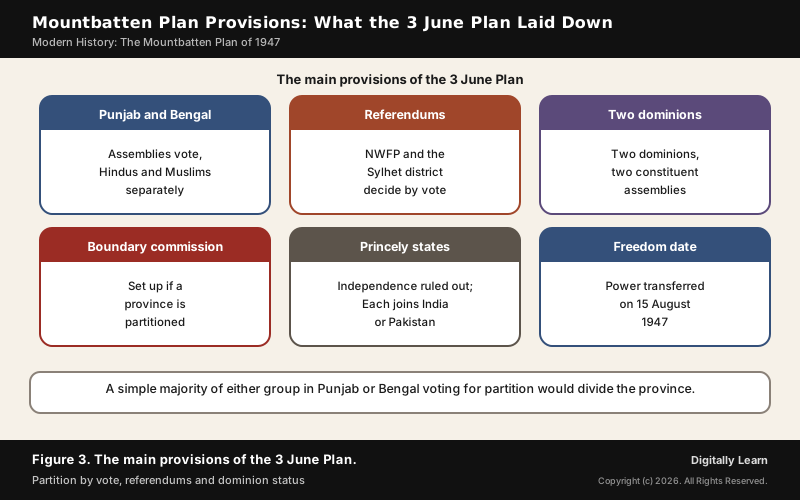
- Partition of Punjab and Bengal: Their legislative assemblies would meet in two groups, one for the Muslim-majority districts and one for the rest (often described as Hindus and Muslims), to vote on partition; if a simple majority of either group voted for it, the province would be divided.
- Two dominions: In case of partition, two dominions and two constituent assemblies would be created.
- Sindh: Would take its own decision.
- Referendums: In NWFP and the Sylhet district of Assam, a referendum would decide their future.
- Princely states and Bengal: Independence was ruled out for the princely states, which would join India or Pakistan, and for Bengal.
- Boundary commission: Would be set up if partition was to be effected.
- Freedom date: Power would be transferred on 15 August 1947.
The princely states were handled separately. In July 1947 Vallabhbhai Patel took charge of the new States Department, and by 15 August 1947 every state except Kashmir, Hyderabad and Junagarh had signed an Instrument of Accession, giving the centre defence, external affairs and communications.
The Congress had never accepted the two-nation theory, and was forced against its will to accept partition. It agreed because the communal riots and the deadlock in the Interim Government left no workable alternative, and because the alternative risked a battle.
- Peaceful, quick transfer: Dominion status ensured a peaceful and very quick transfer of power.
- Authority to act: It was more important for the Congress to take power and check the explosive situation.
- Continuity: It allowed continuity in the bureaucracy and the army.
- For Britain: Dominion status offered a chance to keep India in the Commonwealth, even if temporarily.
The early date, 15 August 1947, served Britain too: it secured Congress agreement to dominion status and let the British escape responsibility for the communal situation.
Indian Independence Act 1947 and the Radcliffe Line
Indian Independence Act 1947: Main Features
The House of Commons passed the Independence Bill on 15 July 1947 and the House of Lords the next day; it received royal assent on 18 July 1947. The Act gave the Mountbatten Plan legal effect.
- India and Pakistan as dominions: India and Pakistan from 15 August 1947.
- Governors-General: One for each dominion, representing the Crown.
- Constituent Assemblies: Given full legislative authority in each dominion.
- Princely states: British suzerainty ended from 15 August 1947; the states could join either dominion.
- Emperor of India: The British monarch would stop using the title.
- Transition: Until new constitutions, the Government of India Act, 1935 would govern both dominions.
- Repeal: Article 395 of the Constitution of India later repealed the Indian Independence Act, 1947, together with the Government of India Act, 1935.
Under the Act, Pakistan became independent on 14 August and India on 15 August 1947. Jinnah became the first Governor-General of Pakistan, while India asked Mountbatten to stay on as its Governor-General.
Provincial Votes, Referendums and the Radcliffe Line
The plan was put into effect without delay. The legislative assemblies of Bengal and Punjab voted to partition both provinces: East Bengal and West Punjab joined Pakistan, while West Bengal and East Punjab stayed with India. Baluchistan and Sindh joined Pakistan.
Bengal shows how the rule worked. On 20 June 1947 the members of the Bengal Legislative Assembly met in two groups, one for the Muslim-majority districts and one for the rest, and also jointly. The joint sitting voted 126 to 90 to join a new and separate Constituent Assembly, and the Muslim-majority group voted 106 to 35 against partition. The other group voted for partition, and since one group had chosen it, the province was divided.
| Area | How decided | Result |
|---|---|---|
| Punjab | Assembly vote | Divided: West Punjab to Pakistan, East Punjab to India |
| Bengal | Assembly vote | Divided: East Bengal to Pakistan, West Bengal to India |
| NWFP | Referendum, July 1947 | Pakistan; 99 per cent of votes cast |
| Sylhet | Referendum | East Bengal; Karimganj went to India |
The NWFP referendum was boycotted by Khan Abdul Ghaffar Khan and the Khudai Khidmatgars, because it offered no choice of independence or of joining Afghanistan; only about half the eligible voters took part.
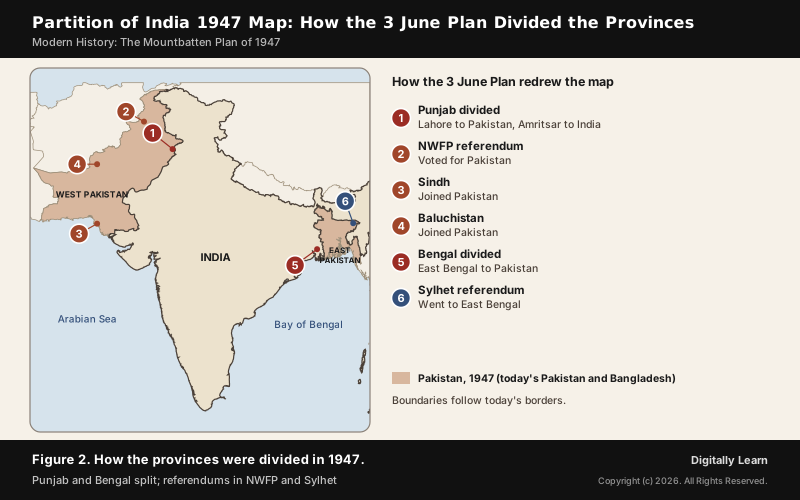
Two boundary commissions, one each for Punjab and Bengal, drew the new borders. Their joint chairman was Sir Cyril Radcliffe, who had never visited India. He arrived on 8 July 1947 and was given just five weeks to decide on a border.
- Delayed award: The award was ready by 12 August 1947, but Mountbatten made it public only after 15 August, so that responsibility would not fall on the British.
- Published late: The line was published on 17 August 1947, two days after independence.
- Consequence: Two nations became independent before there was a defined boundary between them.
Partition's Human Cost and the Role of British Power
Problems of Early Withdrawal and the Human Cost of Partition
The breakneck speed of events caused anomalies in the partition details and failed to prevent the Punjab massacre. There were no transitional institutions to handle partition problems, and Mountbatten's hope of being common Governor-General of both dominions failed when Jinnah took the post in Pakistan.
Figures for the cost differ between sources, because no accurate count was possible. NCERT gives scholarly estimates of 200,000 to 500,000 deaths and about 15 million people who had to cross the new frontiers; other estimates run to 12 to 20 million displaced and up to two million dead, with about one million the figure most scholars accept.
- Violence against women: Innumerable women were raped and abducted.
- Gandhi’s mission: He moved from the villages of Noakhali in East Bengal to Bihar and the riot-torn slums of Calcutta and Delhi to stop the killing.
- Holocaust: Contemporary observers and scholars have used the word for the killings, rape, arson and loot of Partition.
India now marks these losses every year. In 2021 the Government of India declared 14 August Partition Horrors Remembrance Day, to remind present and future generations of the pain and suffering of the people during partition.
How British Imperial Power Complicated the Transfer of Power
British decisions shaped the way power was transferred in the 1940s. Temporary British patronage of the Muslim League conflicted with their long-standing wish for Indian unity. Wavell had allowed Jinnah to wreck the Shimla Conference of 1945, and later brought the League into the Interim Government without its giving up direct action.
- Fixed deadline: Attlee’s statement of 20 February 1947 hinted at partition and even at power to separate provinces.
- Speed: Mountbatten brought the date forward to 15 August 1947, leaving no transitional structures.
- Boundary: The Radcliffe award was held back until after independence.
- The princely states question: Paramountcy lapsed, and the states were left to choose which dominion to join.
Previous Year UPSC-CSE Questions
Previous Year UPSC-CSE Questions By the end you will be able to draft model answers for the following UPSC questions. Each question carries a collapsible framework showing how to approach it in the exam.
- UPSC Mains 2019 GS-IAssess the role of British imperial power in complicating the process of transfer of power during the 1940s.
Answer outline: how to structure the answer
What the question asks, the main arguments, relevant examples and the direction of the conclusion. This is not a full model answer.
Introduction: British decisions in the 1940s shaped not only when power was transferred but how.
Body (sub-themes to develop):
- Patronage of the League; Wavell at Shimla 1945; League let into the Interim Government.
- Attlee's statement of 20 February 1947 with its hint of provincial transfer.
- Mountbatten's early date and no transitional institutions.
- Radcliffe award held back until after 15 August; paramountcy lapsed.
Conclusion: Conclude that Britain secured a lawful transfer but left the violence and the boundaries to Indians and Pakistanis.
- UPSC Prelims 1998 Prelims-GSLord Mountbatten came to India as Viceroy with specific instructions to
How to approach this Prelims question
Approach: Recall his brief, not what happened later.
Trap to watch: He ended up dividing India, but that was not his instruction.
Key facts to recall:
- (a) Balkanize the sub-continent: wrong. His instructions were the opposite: to preserve a united India if possible.
- (b) Keep India united if possible: right. Mountbatten was told to preserve a united India, and to adapt for a prompt withdrawal if he could not.
- (c) Accept Jinnah's demand for Pakistan: wrong. Accepting Pakistan was not part of his instructions.
- (d) Persuade the Congress to accept partition: wrong. His brief was unity first, not partition.
Answer signal: Mountbatten's instructions were to keep India united if possible, so the answer is option (b).
- UPSC Prelims 1998 Prelims-GSThe Indian National Congress agreed in 1947 to the partition of the country mainly because
How to approach this Prelims question
Approach: Find the Congress's real reason.
Trap to watch: The Congress never accepted the two-nation theory.
Key facts to recall:
- (a) Two-nation theory acceptable: wrong. The Congress never accepted the two-nation theory.
- (b) Imposed by the British: wrong. The Congress agreed to partition itself, as Kripalani's words show.
- (c) To avoid large-scale communal riots: right. After the riots from August 1946, Kripalani said the Congress chose partition rather than have a battle.
- (d) Otherwise no freedom: wrong. Independence was already promised; the deciding fear was communal violence.
Answer signal: The Congress agreed to avoid large-scale communal riots, so the answer is option (c).
- UPSC Prelims 2000 Prelims-GSAs an alternative to the partition of India, Gandhiji suggested to Mountbatten that he
How to approach this Prelims question
Approach: Recall Gandhi's last-ditch alternative to partition.
Trap to watch: Not a joint Nehru-Jinnah government.
Key facts to recall:
- (a) Postpone independence: wrong. Gandhi did not ask for independence to be delayed.
- (b) Invite Jinnah to form the government: right. Gandhi's alternative to partition was to invite Jinnah to form a new central government.
- (c) Invite Nehru and Jinnah together: wrong. Gandhi proposed Jinnah alone.
- (d) Invite the army to take over: wrong. No such proposal was made.
Answer signal: Gandhi suggested inviting Jinnah to form the government, so the answer is option (b).
- UPSC Prelims 2002 Prelims-GSThe President of the Indian National Congress at the time of the partition of India was
How to approach this Prelims question
Approach: Recall the Congress President in 1947.
Trap to watch: Nehru was head of the Interim Government, not Congress President.
Key facts to recall:
- (a) C. Rajagopalachari: wrong. He was not Congress President at partition.
- (b) J. B. Kripalani: right. Kripalani was Congress President at the time of partition.
- (c) Jawaharlal Nehru: wrong. Nehru led the Interim Government; the Congress President was Kripalani.
- (d) Maulana Abul Kalam Azad: wrong. Kripalani, not Azad, was Congress President at partition.
Answer signal: J. B. Kripalani was Congress President at partition, so the answer is option (b).
- UPSC Prelims 2014 Prelims-GSThe Radcliffe Committee was appointed to
How to approach this Prelims question
Approach: Recall what the commissions did.
Trap to watch: It did not give effect to the Independence Bill; it drew the boundaries.
Key facts to recall:
- (a) Solve the problem of minorities: wrong. The committee drew a boundary; minorities were not its task.
- (b) Give effect to the Independence Bill: wrong. Its work was the boundary, not the Bill.
- (c) Delimit the boundaries between India and Pakistan: right. Radcliffe chaired the boundary commissions, and the line was published on 17 August 1947.
- (d) Enquire into the East Bengal riots: wrong. It was not an inquiry into riots.
Answer signal: The Radcliffe Committee delimited the India-Pakistan boundaries, so the answer is option (c).
- UPSC Prelims 2002 Prelims-GSThe last opportunity to avoid the partition of India was lost with the rejection of
How to approach this Prelims question
Approach: Pick the last unity plan before partition.
Trap to watch: The Cripps Mission and the Wavell Plan came earlier.
Key facts to recall:
- (a) Cripps Mission: wrong. It was an earlier proposal; the last chance came with the Cabinet Mission.
- (b) Rajagopalachari Formula: wrong. It too came before the Cabinet Mission plan.
- (c) Cabinet Mission: right. With the rejection of the Cabinet Mission plan of 16 May 1946, the last chance of a united India went.
- (d) Wavell Plan: wrong. It came before the Cabinet Mission plan, which was the last chance.
Answer signal: The last chance was lost with the rejection of the Cabinet Mission plan, so the answer is option (c).
Sources and Further Reading
- NCERT: Themes in Indian History Part III (Class XII), Understanding Partition
- Wikipedia: Partition of India
- Wikipedia: Indian Independence Act 1947
- Wikipedia: Radcliffe Line
- Wikipedia: Louis Mountbatten, 1st Earl Mountbatten of Burma
- Wikipedia: 1946 Cabinet Mission to India
- Wikipedia: Direct Action Day
- Wikipedia: 1947 Sylhet referendum
- Wikipedia: 1947 North-West Frontier Province referendum
- West Bengal Legislative Assembly: Bengal Legislative Assembly Proceedings on Partition of Bengal, 20 June 1947
- Legislative Department: The Constitution of India (Article 395)
- PIB: 14 August declared Partition Horrors Remembrance Day (2021)
- UPSC: Previous year question papers
Editorial Disclaimer
This article explains the Mountbatten Plan for UPSC preparation. Dates, names and provisions reflect the cited sources.


