


Overview
The Bardoli Satyagraha was a no-tax campaign by the peasants of Bardoli taluka in Surat district, then in the Bombay Presidency and now in Gujarat, against an increase in land revenue. It was led by Vallabhbhai Patel, began in February 1928 and ended in August 1928, when the government restored the peasants' lands and a judicial inquiry, the Maxwell-Broomfield inquiry, cut the increase to 6.03 per cent. The people of Bardoli gave Patel the title Sardar.
Bardoli Satyagraha 1928 at a Glance
What Was the Bardoli Satyagraha and Who Led It
The Bardoli Satyagraha was led by Vallabhbhai Patel in 1928. The peasants of Bardoli taluka refused to pay an increased land revenue, stayed non-violent through months of seizures and auctions, and won. The key facts are few and are asked often:
| Question | Answer |
|---|---|
| When | February to August 1928 |
| Where | Bardoli taluka, Surat district, Bombay Presidency (now Gujarat) |
| Led by | Vallabhbhai Patel, with Gandhi's blessing |
| Against | An increase in land revenue after the 1926 revision |
| Method | Refusal to pay revenue, social boycott, strict non-violence |
| Outcome | Lands restored; the Maxwell-Broomfield inquiry cut the increase to 6.03 per cent |
| Legacy | Patel became 'Sardar'; the method fed the Civil Disobedience Movement of 1930 |
Where Is Bardoli: Surat District in South Gujarat
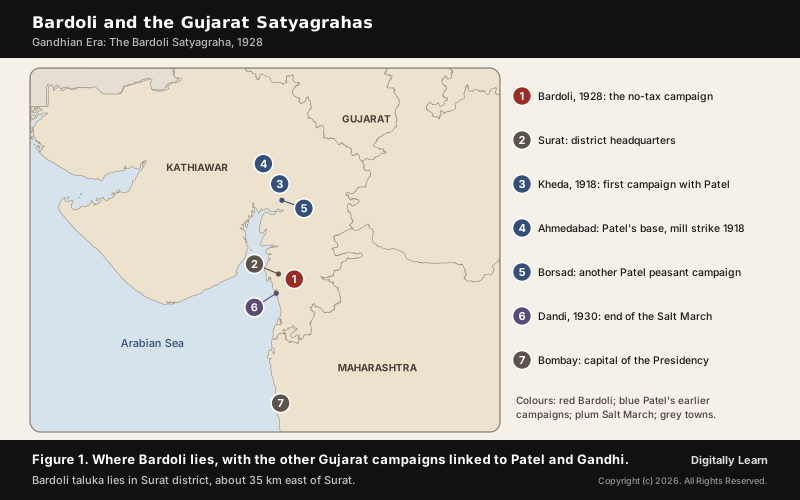
Bardoli is a town in southern Gujarat on the banks of the Mindhola river, about 35 km east of Surat. In 1928 the taluka lay in Surat district of the Bombay Presidency, whose government in Bombay fixed its land revenue. Its cultivators were mostly Kunbi-Patidar landowning peasants, with lower-caste labourers working their fields.
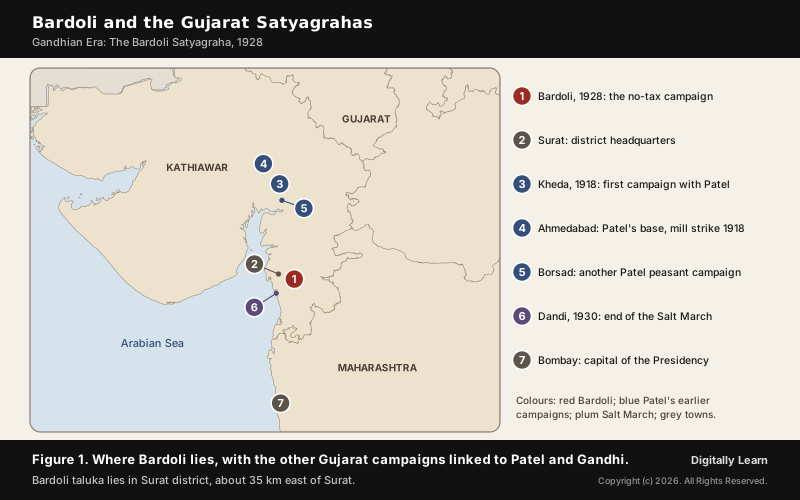
The map shows why Bardoli belongs to a larger story. Kheda and Borsad in central Gujarat had seen earlier peasant campaigns with Patel, Ahmedabad was his base, and two years after Bardoli the Salt March ended at Dandi, on the coast south of Surat.
Causes of the Bardoli Satyagraha: The Land Revenue Hike
The 1926 Revenue Revision and Why Patel Agreed to Lead
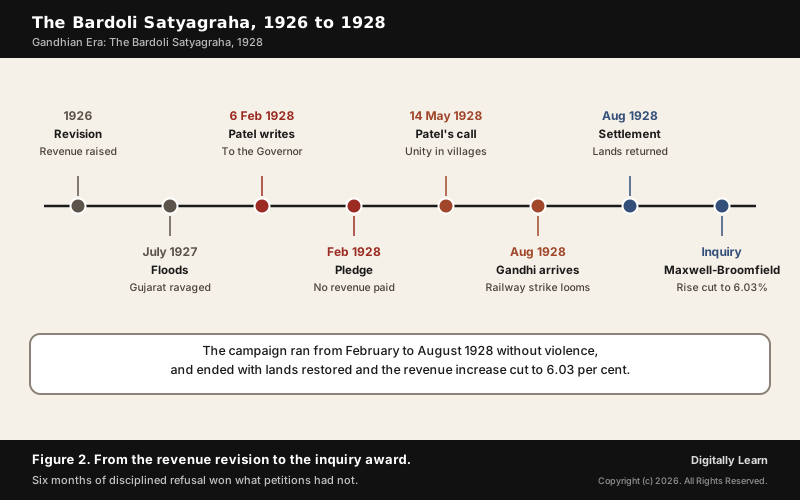
The trouble began with a revision of the land revenue in 1926. The resettlement proposed a rise of about 30 per cent; the increase the Bombay government finally demanded was about 22 per cent. Bardoli's peasants said even that was more than their land could bear:
- Hard seasons: Floods ravaged Gujarat after the heavy rains of July 1927, and many cultivators barely had enough to pay the old rate and feed themselves.
- An unjust assessment: A Bardoli Inquiry Committee set up by Congress leaders found the hike unjustified.
- No hearing: Petitions from local groups were ignored, and the government refused to cancel or reduce the increase.
Local workers, among them Narhari Parikh, Ravi Shankar Vyas and Mohanlal Pandya, and the Mehta brothers turned to the most respected leader in Gujarat, Vallabhbhai Patel.
Patel had guided the peasants of Kheda in 1918 alongside Gandhi, had led flood relief across Gujarat in 1927, and had served as president of the Ahmedabad municipality. He did not accept at once. He told the peasants' delegation plainly what a revenue strike would mean: seized property and land, prison, perhaps ruin. He would lead them only if every village agreed. The villagers replied that they were ready for the worst.
Patel then consulted Gandhi, who asked what Patel himself thought and, when Patel spoke confidently of the prospects, gave his blessing. They agreed that neither the Congress nor Gandhi would take part directly: the struggle would belong to the people of Bardoli.
How Patel Organised the Bardoli Satyagraha
The Pledge, the Camps and the Chain of Command
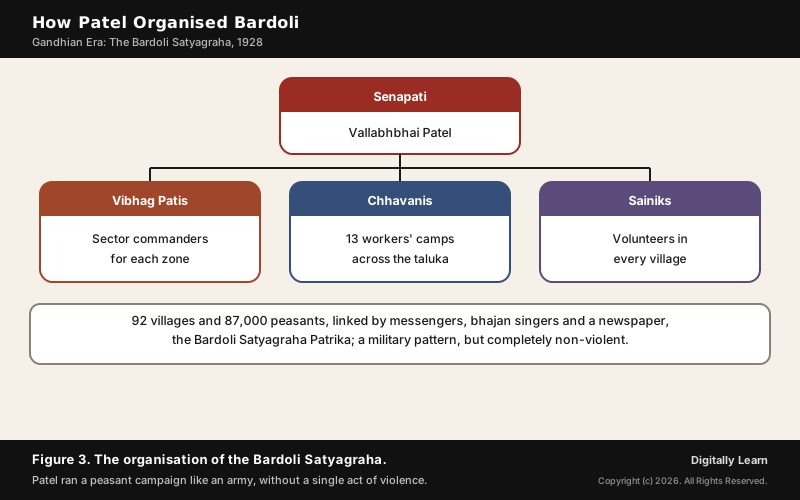
On 6 February 1928 Patel wrote to the Governor of Bombay asking for the revenue to be reduced; the Governor ignored him and announced the date of collection. The peasants then resolved to refuse payment of the revised assessment until the government appointed an independent tribunal or accepted the old amount as full payment. Patel organised the campaign like an army that never used force:
- Command: Patel was the Senapati; under him were sector commanders, the Vibhag Patis, and under them volunteers, the sainiks.
- Camps: Thirteen chhavanis, workers’ camps, covered the taluka.
- Reach: The campaign covered 92 villages and 87,000 peasants.
- Information: Mounted messengers, bhajan singers and printers kept the villages informed, and the Bardoli Satyagraha Patrika carried news to the wider public.
- Watch: Volunteers in each village sounded a bugle when officials approached, and informers near the government reported its movements.
Non-Violence, Social Boycott and the Government's Repression
Patel's first instruction was complete non-violence: no one was to answer any provocation. The peasants kept their cattle locked indoors so that collectors could not seize them, hid their valuables with relatives outside the taluka, and received money and supplies from sympathisers across Gujarat. Patel refused to let supporters elsewhere start sympathetic protests; Bardoli was to fight alone.
- Social boycott: Those who paid the revenue or bought seized land faced a complete boycott; relatives cut ties, and no one would rent their fields or work as their labourers.
- Women: Special attention was given to mobilising women. Mithuben Petit moved from village to village to rouse them.
- Holding firm: Only one village is recorded as paying the tax.
The government declared it would crush the movement. Revenue officials, helped by bands of Pathans brought from the north-west, entered houses and seized property and cattle. Houses and land were put up for auction, but when officials arrived the villages were empty, and almost no one in Gujarat would buy; the few buyers were some rich men from Bombay.
The repression turned opinion against the government. K. M. Munshi and Lalji Naranji resigned from the Bombay Legislative Council in support, and other Indian members resigned their offices too. By August 1928 tension was high, with the prospect of a railway strike in Bombay, and Gandhi came to Bardoli to stand by in case of an emergency. The government began to look for a way out.
Outcome of the Bardoli Satyagraha: The Maxwell-Broomfield Inquiry
The August 1928 Settlement and the 6.03 Per Cent Award
In August 1928 an agreement was brokered through a Parsi member of the Bombay government. Its terms met the peasants' main demands:
- Confiscated lands and property were to be restored.
- Village officials who had resigned in protest were reinstated.
- The increase was set aside pending an inquiry, and the Maxwell-Broomfield inquiry, after a detailed survey, found that the increase should be only 6.03 per cent.
Patel kept working until every peasant got back what had been taken. Where buyers refused to return seized land, wealthy sympathisers from Bombay bought it back and handed it to the original owners. The victory had limits: the deeper problems of the peasants were left untouched, and bonded labour continued in the area.
| Measure | Before | After |
|---|---|---|
| Revenue increase | About 22 per cent demanded | 6.03 per cent after the inquiry |
| Seized lands | Confiscated and auctioned | Restored to owners |
| Village officials | Resigned in protest | Reinstated |
Significance of the Bardoli Satyagraha
How Patel Became Sardar and What Bardoli Meant for the National Movement
Bardoli made Vallabhbhai Patel a national leader, and it gave him the name by which he is still known. The people of Bardoli began to call him Sardar, meaning chief or leader: accounts credit the women of Bardoli, and a farmer of Nanifalod, Kuverji Durlabh Patel, told an open meeting, "Patel, you are our Sardar."
He wore the title with humility. At the Calcutta Congress in December 1928 he was reluctant even to stand up among the Gujarat delegates and had to be pressed to come to the dais. Three years later, in 1931, he presided over the Karachi session of the Congress.
Bardoli came in 1928, the year of the protests against the Simon Commission, and Gandhi blessed it without taking part. Its success helped revive the national struggle: the Congress declared Purna Swaraj as its goal at Lahore in 1929, and in 1930 Gandhi began the Civil Disobedience Movement with the Salt March.
| Aspect | Champaran (1917) | Kheda (1918) | Bardoli (1928) |
|---|---|---|---|
| Grievance | Forced indigo cultivation | Revenue despite crop failure | Revenue increase after revision |
| Leader on the ground | Gandhi | Gandhi, with Patel | Patel |
| Method | Inquiry and defiance | Withholding revenue | Organised refusal to pay |
| Result | Tinkathia abolished | Revenue only from those able to pay | Increase cut to 6.03 per cent; lands restored |
Bardoli Satyagraha in UPSC Previous Year Questions
What UPSC Has Asked About Bardoli and Patel
UPSC's objective questions on Bardoli test the leader, and questions on Patel link him to Kheda as well. The traps are Gandhi, who blessed Bardoli but did not lead it, and Vithalbhai Patel, Vallabhbhai's elder brother.
| Year | What the question asked | The point being tested |
|---|---|---|
| 2003 | The leader of the Bardoli Satyagraha (1928) | Sardar Vallabhbhai Patel |
| 2005 | Pairs of campaigns and the people associated with them | Patel with Kheda; Rajendra Prasad with Champaran |
The 2019 GS Paper I question on the many voices that strengthened the Gandhian phase can use Bardoli as evidence of peasant, women's and local leadership inside the national movement.
Previous Year UPSC-CSE Questions
Previous Year UPSC-CSE Questions By the end you will be able to draft model answers for the following UPSC questions. Each question carries a collapsible framework showing how to approach it in the exam.
- UPSC Mains 2019 GS-IMany voices had strengthened and enriched the nationalist movement during the Gandhian phase. Elaborate.
Answer outline: how to structure the answer
What the question asks, the main arguments, relevant examples and the direction of the conclusion. This is not a full model answer.
Introduction: Open with the Gandhian phase as the moment the national movement became a mass movement.
Body (sub-themes to develop):
- Peasants: Champaran, Kheda and Bardoli, where the peasants of 92 villages refused revenue.
- Women: Bardoli's women, Mithuben Petit, and later the Salt March.
- Workers and local organisers: Ahmedabad 1918; the Mehta brothers and Bardoli's volunteers.
- Regional leaders: Patel in Gujarat, becoming 'Sardar' at Bardoli.
Conclusion: Conclude that these voices gave the movement its reach and its staying power.
- UPSC Prelims 2003 Prelims-GSThe leader of the Bardoli Satyagraha (1928) was
How to approach this Prelims question
Approach: Separate who led Bardoli from who blessed it.
Trap to watch: Gandhi blessed the campaign but stayed out; Vithalbhai Patel was Vallabhbhai's brother.
Key facts to recall:
- (a) Sardar Vallabhbhai Patel: right. Patel led Bardoli from February to August 1928 and earned the title 'Sardar' there.
- (b) Mahatma Gandhi: wrong. Bardoli followed Gandhi's pattern, but Patel, not Gandhi, led it.
- (c) Vithalbhai J Patel: wrong. He was Vallabhbhai's elder brother, not the leader of Bardoli.
- (d) Mahadev Desai: wrong. Vallabhbhai Patel, not Mahadev Desai, led the campaign.
Answer signal: Vallabhbhai Patel led the Bardoli Satyagraha, so the answer is option (a).
- UPSC Prelims 2005 Prelims-GSWhich one of the following pairs are correctly matched? Movement / Satyagraha : Person Actively Associated With
- Champaran : Rajendra Prasad
- Ahmedabad Mill Workers : Morarji Desai
- Kheda : Vallabhbhai Patel
Select the correct answer using the codes given below:
How to approach this Prelims question
Approach: Place each person in the campaign he actually worked in.
Trap to watch: Pair 2 is wrong: the 1918 Ahmedabad mill strike was Gandhi's own intervention for the workers.
Key facts to recall:
- (a) 1 and 2: wrong. Pair 2 is wrong: the Ahmedabad mill strike of 1918 was Gandhi's, with Anasuya Sarabhai, not Morarji Desai's.
- (b) 2 and 3: wrong. Pair 2 is wrong.
- (c) 1 and 3: right. Rajendra Prasad worked with Gandhi at Champaran, and Patel first worked with him at Kheda in 1918.
- (d) 1, 2 and 3: wrong. Pair 2 is wrong.
Answer signal: Pairs 1 and 3 are correct, so the answer is option (c).
Sources
- NCERT: Themes in Indian History Part III (Class XII), Mahatma Gandhi and the Nationalist Movement
- Press Information Bureau: Sardar Patel, Organiser par Excellence
- Press Information Bureau: Sardar Vallabhbhai Patel, The Man Who United the Nation (e-book)
- Press Information Bureau: Quotations of Sardar Patel (Rashtriya Ekta Diwas)
- Wikipedia: Bardoli Satyagraha
- Wikipedia: Vallabhbhai Patel
- Wikipedia: Bardoli
- Wikipedia: Kheda Satyagraha
- Wikipedia: Mithuben Petit
- Wikipedia: K. M. Munshi
- UPSC: Civil Services Examination question papers
Editorial Disclaimer
This article is for UPSC and State PCS preparation. Verify dates and interpretations against NCERT and standard reference histories before relying on them.


