


Overview
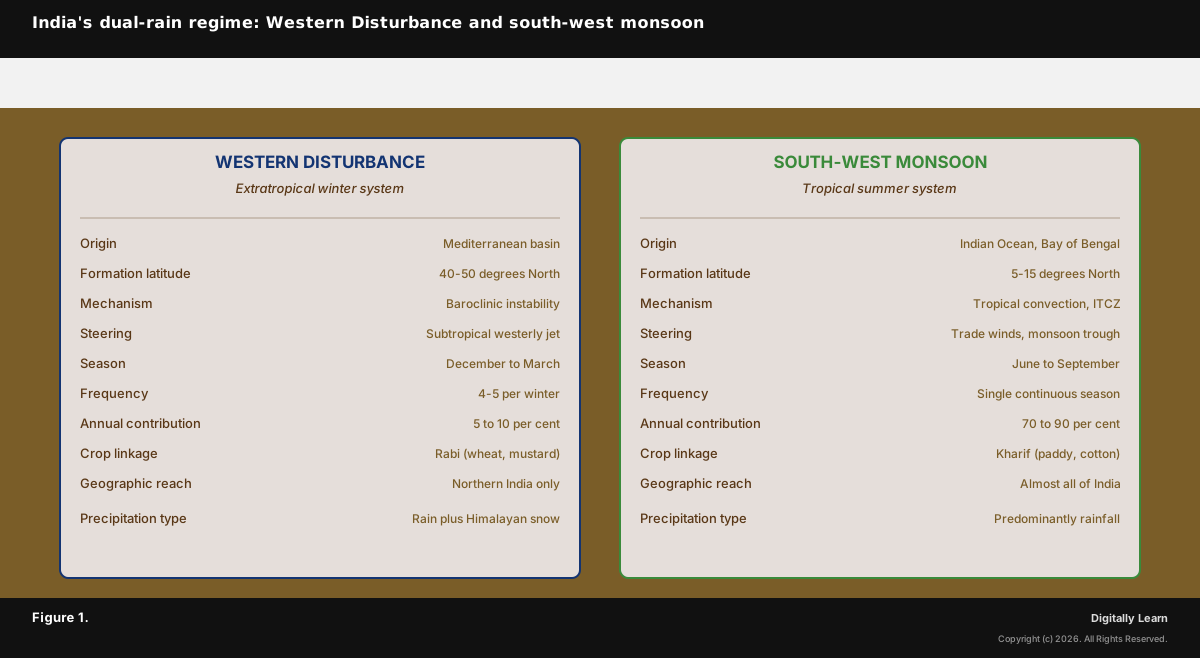
A Western Disturbance (WD) is an extratropical synoptic-scale low-pressure system that originates over the Mediterranean basin and travels eastward, embedded in the subtropical westerly jet stream, eventually crossing Iran, Afghanistan, and Pakistan to reach the north-western Indian subcontinent. WDs draw moisture from the Mediterranean Sea, Caspian Sea, and Black Sea and deliver this moisture as winter rainfall and Himalayan snowfall across Jammu and Kashmir, Ladakh, Himachal Pradesh, Uttarakhand, Punjab, Haryana, Delhi, north-western Uttar Pradesh, and northern Rajasthan. An average of four to five Western Disturbances reach the Indian subcontinent each winter (December to March), providing the dominant precipitation for rabi-season agriculture and the principal source of fresh snow accumulation on Himalayan glaciers. WDs are mid-latitude weather systems and are conceptually distinct from the tropical south-west summer monsoon.
Background and Historical Context
Western Disturbances supply approximately 5 to 10 per cent of India's annual precipitation but virtually all of the winter precipitation across the Indo-Gangetic plains and the Western Himalayas. This supports the rabi cropping season: wheat, mustard, gram, and barley sown in October-November and harvested in March-April depend on WD rainfall for the critical grain-filling stage. WD snowfall on the Himalayan cryosphere provides the mass-balance input that sustains the Indus, Ganga, and Brahmaputra summer flows. UPSC has examined Western Disturbance and jet-stream topics in Prelims 2001 and 2020 and in Mains GS-I climatology papers.
What is the significance of Western Disturbances for India? Three structural features distinguish them from the south-west monsoon. WDs are extratropical, meaning they form in the mid-latitudes rather than in the tropics; their physics involves baroclinic instability along the temperature gradient between polar and sub-tropical air masses, contrasting with the convective monsoon mechanism. WDs are moisture-poor compared with the monsoon but deliver precipitation as snow at higher elevations; this snow accumulation drives delayed glacier melt that sustains perennial Himalayan river flow. WDs are steered by the subtropical westerly jet stream, which shifts southward over the Himalayas in winter to approximately 25 to 30 degrees North; the jet steers WDs along this latitudinal band, making the northern Indian plains the regional precipitation target.
The 2024-2025 winter season exhibited unusually delayed and weak WD activity in early winter followed by intensified late-winter and spring WDs, a pattern that India Meteorological Department documents have linked to changes in the subtropical jet stream behaviour under climate change. WD-driven extreme events include the Uttarakhand cloudburst of June 2013 and the Jammu and Kashmir floods of September 2014, both attributed to anomalous WD interaction with monsoon systems. The Himalayan glacier mass-balance crisis documented in the ICIMOD Hindu Kush Himalaya Assessment 2019 is partly driven by declining winter snow accumulation as WD intensity and frequency shift; this links Western Disturbances directly to the climate-change discussion examined in Biodiversity Part 3 of this site's Himalayan hotspot entry.
What is a Western Disturbance: The Extratropical Synoptic System
Mid-latitude origin, baroclinic instability, eastward propagation
A Western Disturbance is a synoptic-scale low-pressure system that forms in the mid-latitudes over the Mediterranean basin and propagates eastward across the temperate belt. The system is extratropical, meaning it forms outside the tropics, with formation physics driven by baroclinic instability along the polar front where cold polar air meets warmer subtropical air. This contrasts with tropical cyclones such as Bay of Bengal cyclones, which form within the warm tropical ocean and derive energy from latent heat release through deep convection.
The Western Disturbance is embedded in the subtropical westerly jet stream, the high-altitude band of fast-flowing air that circles the Earth at approximately 200 hectopascal pressure level (about 12 kilometres altitude) in the subtropical zone. The jet steers the system from west to east at typical speeds of 10 to 25 kilometres per hour. As the system encounters the Himalayan barrier, orographic lifting forces moist air upward, condensing into rainfall on the lower slopes and snowfall above the freezing line at approximately 2,500 to 3,000 metres in mid-winter.
Origin and Trajectory: From the Mediterranean to the Himalayas
Mediterranean genesis and the eastward path across Iran and Afghanistan
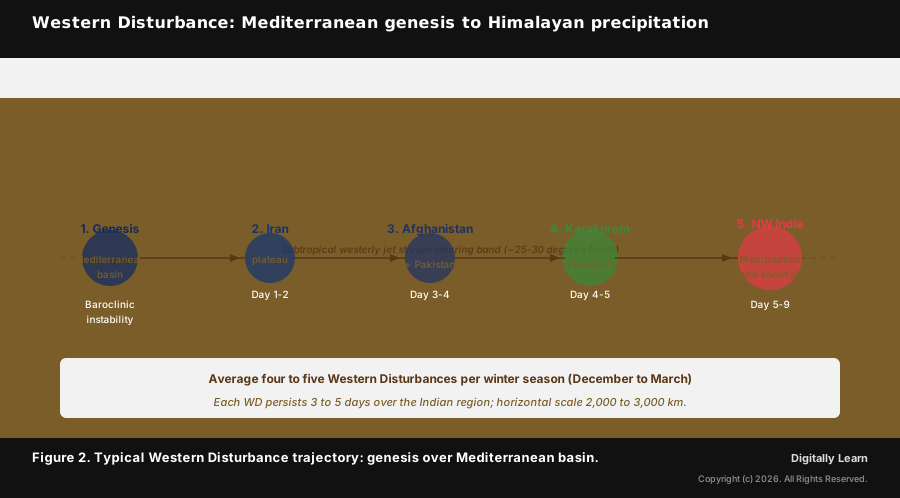
Western Disturbances originate over the Mediterranean Sea, Caspian Sea, and Black Sea, with the Mediterranean as the dominant moisture source. The system genesis is associated with the polar front advancing southward in winter and interacting with sub-tropical anti-cyclones. Once formed, the disturbance travels eastward, typically crossing Turkey, Iran, Afghanistan, and Pakistan over approximately 4 to 6 days before reaching north-western India. Each WD has a typical horizontal scale of 2,000 to 3,000 kilometres at its peak intensity and persists for 3 to 5 days over the Indian region.
- Genesis: Mediterranean basin; baroclinic instability along the polar front in winter.
- Moisture pickup: Mediterranean Sea (primary), Caspian Sea, Black Sea.
- Trajectory: Eastward across Turkey, Iran, Afghanistan, Pakistan; embedded in subtropical westerly jet stream.
- Arrival: Crosses into north-western India through the Hindu Kush and the Karakoram passes.
- Affected region: Jammu and Kashmir, Ladakh, Himachal Pradesh, Uttarakhand, Punjab, Haryana, Delhi, north-western Uttar Pradesh, northern Rajasthan.
- Duration over India: Approximately 3 to 5 days per disturbance.
- Frequency: An average of four to five Western Disturbances per winter season (December to March).
Mechanism: Subtropical Jet Stream Steering and Orographic Lifting
Jet stream as conveyor, Himalayan barrier as precipitation amplifier
The Western Disturbance system depends on two atmospheric mechanisms working in concert. The subtropical westerly jet stream provides the eastward steering current that transports the embedded low-pressure system from the Mediterranean to the Indian subcontinent. The jet stream is a narrow band of high-speed winds at approximately 200 hectopascal pressure level (around 12 kilometres altitude) flowing west to east. In winter, the jet shifts southward over the Himalayas to approximately 25 to 30 degrees North; in summer, the jet retreats northward to approximately 45 degrees North as the south-west monsoon trough establishes. This seasonal jet shift is the principal reason Western Disturbances are confined to the winter months.
The Himalayan orographic barrier is the precipitation amplifier. As the eastward-moving WD encounters the rising Himalayan terrain, moist air is forced upward, cools adiabatically, condenses, and releases its moisture as rainfall below approximately 2,500 metres and snowfall above the freezing line. The snowfall accumulation on the Himalayan cryosphere is the principal mass-balance input that sustains the perennial flow of the Indus, Ganga, and Brahmaputra during the subsequent summer melt season.
| Parameter | Western Disturbance | South-west Monsoon |
|---|---|---|
| Origin region | Mediterranean, Caspian, Black Sea | Indian Ocean, Bay of Bengal, Arabian Sea |
| Formation latitude | Mid-latitude (40-50 degrees N) | Tropical (5-15 degrees N) |
| Formation physics | Baroclinic instability | Tropical convection and ITCZ |
| Steering mechanism | Subtropical westerly jet stream | Easterly trade winds and monsoon trough |
| Season | December to March (winter) | June to September (summer) |
| Affected region | Northern India and Himalayas | Almost all of India |
| Precipitation type | Rainfall plus Himalayan snowfall | Predominantly rainfall |
| Annual contribution | 5 to 10 per cent of India total | 70 to 90 per cent of India total |
| Crop linkage | Rabi (wheat, mustard, gram, barley) | Kharif (paddy, maize, soybean, cotton) |
Contribution: Rabi Rainfall and Himalayan Snowfall
Five to ten per cent of India total; the lifeline of the rabi season
Western Disturbances supply approximately 5 to 10 per cent of India's annual precipitation but a much larger fraction of the winter precipitation across northern India. In the Western Himalayas, WDs supply over 60 per cent of annual precipitation; in the Indo-Gangetic plains across Punjab, Haryana, and western Uttar Pradesh, WDs supply approximately 15 to 20 per cent of annual rainfall concentrated entirely in the winter months. The precipitation comes during the critical grain-filling phase of rabi crops sown in October-November, making WD rainfall load-bearing for India's wheat, mustard, gram, and barley harvest each March-April.
- Rabi cropping season: October sowing through March-April harvest; WD rainfall supplies the critical grain-filling stage.
- Wheat belt: Punjab, Haryana, Uttar Pradesh, Bihar; WD precipitation supports the world’s second-largest wheat production after China.
- Mustard and oilseed belt: Rajasthan, Haryana, Punjab; depends on WD precipitation for vegetative growth.
- Himalayan snowfall: WD snowfall above 2,500-3,000 metres sustains glacier mass balance; principal input for Indus, Ganga, Brahmaputra perennial flow.
- Cherry, apple, walnut orchards: Jammu and Kashmir, Himachal Pradesh, Uttarakhand; WD-driven chilling hours and winter snow cover are agronomic preconditions.
- Saffron cultivation: Pampore-Pulwama belt of Kashmir; specific microclimate requires WD-driven winter moisture.
Extreme Events: 2013 Uttarakhand, 2014 Kashmir, 2025 Anomaly
When WDs interact catastrophically with monsoon and topography
Western Disturbances generally bring beneficial precipitation, but anomalous WD activity can drive catastrophic events. The Uttarakhand cloudburst of 16-17 June 2013, which killed over 4,000 people across Kedarnath and adjacent valleys, resulted from an anomalous mid-June Western Disturbance interacting with an early south-west monsoon onset; the dual rainfall systems delivered approximately 340 millimetres in 24 hours over already-saturated slopes. The Jammu and Kashmir floods of September 2014 were similarly driven by an anomalous late-monsoon WD penetration that delivered exceptionally heavy rainfall over the Jhelum catchment. In winter 2024-2025, IMD documents reported unusually delayed early-winter WD activity followed by intensified late-winter and spring storms, a pattern consistent with subtropical jet stream changes under climate warming.
Climate Change Linkages: Jet Stream Shifts and Glacier Mass Balance
Why WD frequency and intensity are changing under warming
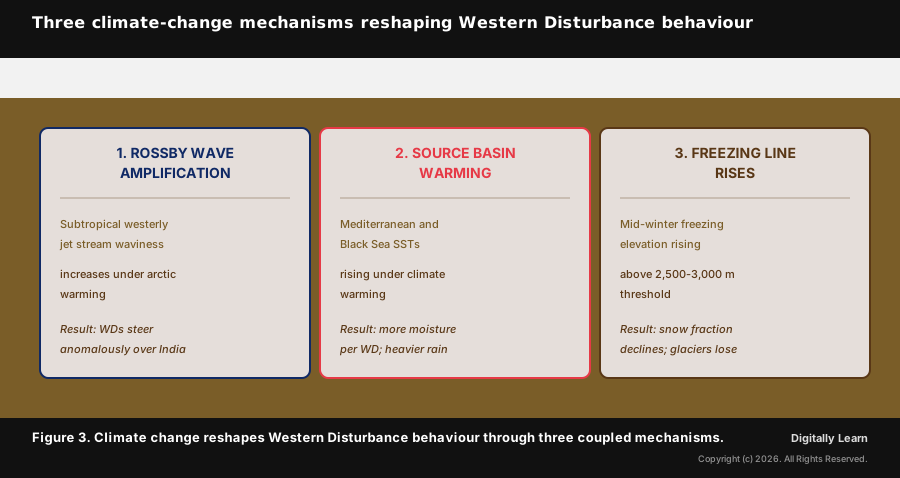
Climate change is reshaping Western Disturbance behaviour through three coupled mechanisms.
- Subtropical jet waviness: Subtropical jet stream waviness (Rossby wave amplification) is increasing under arctic warming, generating more meridional jet meanders that steer WDs anomalously over the Indian region
- Mediterranean SST warming: The warming Mediterranean and Black Sea source basins increase moisture available for WD precipitation, intensifying extreme rainfall events
- Arctic amplification: Rising freezing-line elevation in the Himalayas means a higher proportion of WD precipitation falls as rain rather than snow, reducing the mass-balance input to Himalayan glaciers
The Hindu Kush Himalaya Assessment 2019 projects negative mass balance of approximately 0.4 metres of water equivalent per year on average Himalayan glaciers, with WD precipitation-type shifts contributing alongside summer ablation increases. Anomalous late-winter and spring WD activity observed in 2024-2025 has been provisionally linked to these jet-stream changes by IMD numerical weather prediction studies.
Previous Year UPSC-CSE Questions
Previous Year Questions By the end of this article you will be able to draft model answers for the following UPSC questions. Each question carries a collapsible framework showing how to approach it in the exam.
- UPSC Prelims 2015 General Studies: Consider the following statements: 1. The winds which blow between 30 degrees North and 60 degrees South latitudes throughout the year are known as westerlies. 2. The moist air masses that cause winter rains in North-Western region of India are part of westerlies. Which of the statements given above is/are correct?
How to approach this Prelims question
Approach: Statement 1 has a geographical trap: westerlies operate between 30 and 60 degrees latitude in EACH hemisphere, not in a 30N to 60S band crossing the equator. Statement 2 is correct: Western Disturbances are the moist air masses that the subtropical westerly jet steers from the Mediterranean to NW India, causing winter rains for the rabi season.
Trap to watch: Statement 1 looks geographical-numeric but the latitudinal range is wrong. Statement 2 names the actual mechanism for NW India winter precipitation.
Key facts to recall:
- Westerlies blow between 30 and 60 degrees in both hemispheres
- Subtropical westerly jet steers Western Disturbances from the Mediterranean to NW India
- Western Disturbances supply the bulk of winter precipitation that sustains the rabi season
Answer signal: Only statement 2 correct; option 2 only.
- UPSC Prelims 2001 General Studies: Assertion (A): Anti-cyclonic conditions are formed in winter season when atmospheric pressure is high and air temperatures are low. Reason (R): Winter rainfall in Northern India causes development of anticyclonic conditions with low temperatures.
How to approach this Prelims question
Approach: Two-statement Assertion-Reason format testing the relationship between anti-cyclonic winter conditions and Western Disturbance rainfall events.
Trap to watch: Aspirants may accept the Reason because winter rainfall is a real phenomenon in northern India. The trap is the reversed causal direction: WD rainfall BREAKS anti-cyclonic conditions, it does not create them.
Key facts to recall:
- Winter anti-cyclones: Form when cold dense air subsides; high pressure dominates.
- WD arrival: BREAKS anti-cyclonic conditions; brings cyclonic low-pressure rainfall.
- Causal direction: Anti-cyclones are the baseline; WDs are episodic interruptions.
- Northern India winter: Alternates between calm anti-cyclonic spells and active WD episodes.
Answer signal: A is true, but R is false
- UPSC Mains 2017 GS-I: What characteristics can be assigned to a monsoon climate that succeeds in feeding more than 50 percent of the world population residing in Monsoon Asia?
How to structure the answer in the exam
Introduction: Open by defining monsoon climate as the seasonal reversal of wind direction driven by differential heating of land and sea, producing distinct wet and dry seasons. Monsoon Asia covers India, Bangladesh, Pakistan, Myanmar, Thailand, Vietnam, Cambodia, Laos, Indonesia, Philippines, and southern China; these regions house more than half the world population and depend on monsoon-derived agriculture for food security.
Body (sub-themes to develop):
- Seasonal wind reversal: South-west summer monsoon (June to September) brings moisture-laden Arabian Sea and Bay of Bengal winds; north-east winter monsoon brings continental dry winds.
- Concentrated wet season: Approximately 70 to 90 per cent of annual rainfall delivered in June-September enables kharif paddy, maize, soybean, and cotton.
- Supplementary winter precipitation: Western Disturbances deliver 5 to 10 per cent of annual rainfall to northern India in December-March, enabling rabi wheat, mustard, gram, and barley.
- Inter-tropical convergence zone migration: The ITCZ shifts northward in summer, establishing the monsoon trough; in winter the ITCZ retreats south, allowing the subtropical jet to steer WDs into India.
- El-Nino and La-Nina influence: ENSO modulates monsoon inter-annual variability; El-Nino years typically reduce monsoon strength while La-Nina years intensify it.
- Orographic uplift: Himalayas trap monsoon moisture in northern India; Western Ghats produce the wettest peninsular landscapes; these mountain barriers concentrate rainfall on windward slopes.
Conclusion: Conclude by noting that monsoon climate is the foundation of South and South-east Asian agricultural civilisations and the precondition for the population densities of Monsoon Asia. Climate change is altering monsoon timing, intensity, and reliability, raising long-term food-security concerns. Adaptation requires irrigation expansion under PMKSY, crop diversification, climate-smart agriculture, and integrated Western Disturbance and monsoon forecasting under IMD's numerical weather prediction programme.
Sources and Further Reading
- NCERT Class 11 India: Physical Environment, Chapter 4 – Climate
- India Meteorological Department – Northern Regional Office
- Indian Institute of Tropical Meteorology, Pune
- Ministry of Earth Sciences – Mission Mausam
- National Disaster Management Authority
- Indian Space Research Organisation – Bhuvan
- National Centre for Medium Range Weather Forecasting
- Geological Survey of India
- Wikipedia – Western disturbance
- Wikipedia – Jet stream
- Wikipedia – Rossby wave
Disclaimer
This article is prepared for UPSC preparation by Digitally Learn's editorial team. It covers the Western Disturbance synoptic mechanism, Mediterranean origin, subtropical westerly jet steering, winter rainfall over the Indo-Gangetic plain, snowfall in the Himalayas, and the cold-wave and flood hazards that follow based on NCERT Class 11 Geography, IMD Northern Regional Office, IITM Pune, IIT Delhi atmospheric sciences, NDMA cold-wave guidelines, and ECMWF forecasting sources. Key concepts and major winter-weather patterns are cross-verified with standard reference sources like IMD.


