


Overview
Time zones are bands of the Earth that keep one standard clock, set as an offset from Coordinated Universal Time (UTC). Because the Earth turns 360 degrees in 24 hours, every 15 degrees of longitude is one hour and every degree four minutes, so places to the east see the Sun first. The International Date Line, near the 180 degree meridian in the Pacific, is where the calendar date changes: crossing it westward adds a day and crossing it eastward subtracts one. India keeps one clock, Indian Standard Time, set at 82 degrees 30 minutes east, 5 hours 30 minutes ahead of GMT.
Time Zones Explained: Longitude, Local Time and Standard Time
What Is a Time Zone?
A time zone is a region that keeps one standard clock instead of each town keeping its own sun time. The need comes from the Earth's rotation: the Earth turns eastward, anticlockwise when seen from above the North Pole, so the Sun rises first in the east and noon arrives at each meridian of longitude in turn.
- Local time: The time by the Sun at a place, with noon when the Sun is highest. It changes continuously with longitude, so two towns a few degrees apart keep different local times.
- Standard time: The local time of one central meridian, adopted for a whole country or region. NCERT puts it simply: the local time of the central meridian becomes the standard time for the country.
- Time zone: The band that keeps that standard time. In principle each is 15 degrees of longitude wide, one hour, but in practice its edges follow national and provincial borders.
That answers a question students often search for: the lines separating time zones are, in principle, identical with meridians of longitude spaced 15 degrees apart, though real boundaries bend to follow borders. The standard meridian of a place is fixed by agreement: NCERT notes a general understanding among countries to choose standard meridians in multiples of 7 degrees 30 minutes of longitude.
How to Calculate Time from Longitude
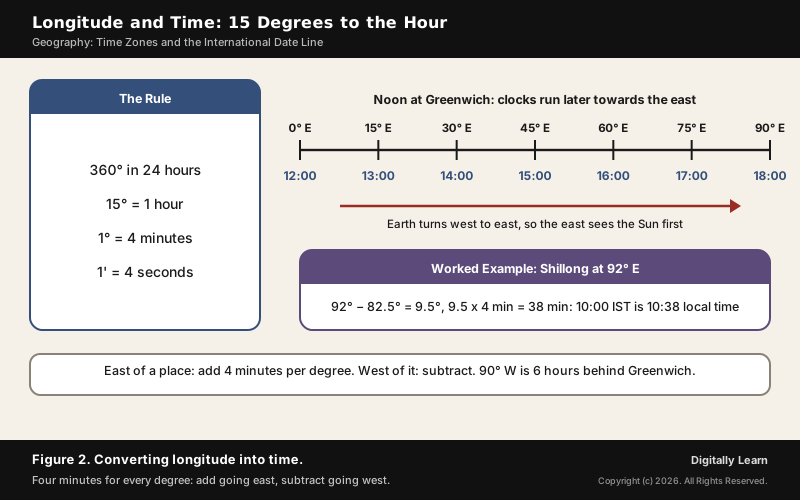
The arithmetic follows from one fact: the Earth turns 360 degrees in 24 hours. Four steps turn any longitude question into a sum:
- Difference in longitude: Find it between the two places, adding the two values if one is east and the other west of Greenwich.
- Convert into time: Use 4 minutes per degree (15 degrees is one hour, and 1 minute of arc is 4 seconds of time).
- Add or subtract: A place to the east is ahead, so add; a place to the west is behind, so subtract.
- Check the date: Adjust it if the answer passes midnight or crosses the International Date Line.
Prime Meridian, GMT and UTC: The Global Framework of Time
Prime Meridian, the 1884 Conference and the Longitude Problem
Longitude needs a starting line. The Prime Meridian, 0 degrees, passes through Greenwich in London, and longitudes are counted up to 180 degrees east and west of it. It was chosen at the International Meridian Conference held in Washington in October 1884, which fixed a single zero meridian for the world's maps and clocks. The resolution fixing the meridian at Greenwich passed by 22 votes to 1, with San Domingo (now the Dominican Republic) against and France and Brazil abstaining.
The mean solar time on that meridian became Greenwich Mean Time (GMT), the reference that standard times were once quoted against. Setting local clocks was outside the conference's remit, so each country adopted standard time in its own law and at its own pace, which is why many time zones follow political borders rather than neat 15-degree bands. Delegates such as Sandford Fleming proposed that all nations adopt standard time, but others objected that it lay outside the conference's purview, and the proposal was never put to a vote.
The meridian mattered because longitude and time are the same problem. A navigator who knows the time at a reference meridian can work out his longitude from local noon, four minutes for every degree, but only with a clock that keeps time at sea. In 1714 the British government offered a longitude prize, and John Harrison solved the problem with his marine chronometer, completing the small, precise H4 in 1761.
What Is UTC? Coordinated Universal Time and Atomic Clocks
Coordinated Universal Time (UTC) is the world's reference time today, and every time zone is defined as an offset from it, from UTC minus 12 to UTC plus 14. The UTC time zone itself, offset zero, is the band that includes Greenwich. UTC is not tied to one observatory. It is built from International Atomic Time (TAI), a weighted average of hundreds of atomic clocks worldwide. Its second is set by transitions in atoms of caesium, and NASA notes that a caesium clock is accurate to one second in 1,400,000 years, far steadier than the Earth itself, whose rotation is gradually slowing.
- Adopted: UTC was first adopted as a standard in 1963, and the abbreviation UTC became official in 1967.
- Leap seconds: Because the Earth’s rotation is irregular, a leap second is inserted to keep UTC within 0.9 seconds of the Earth’s rotation. Since 1972, 27 have been added, the last on 31 December 2016, so UTC now differs from TAI by 37 seconds.
- The end of the leap second: On 18 November 2022 the General Conference on Weights and Measures passed Resolution 4, directing that the maximum permitted difference between UT1 and UTC be increased in, or before, 2035, which in practice abolishes the leap second.
World Time Zones: Map, Offsets and Countries
World Time Zone Map: How the Zones Are Drawn
The world time zone map shows about 24 zones of one hour each, but hardly any follows a clean 15-degree band. Borders, islands and national choices bend the lines, and some countries use offsets of half or even three quarters of an hour so that clock time stays close to sun time.
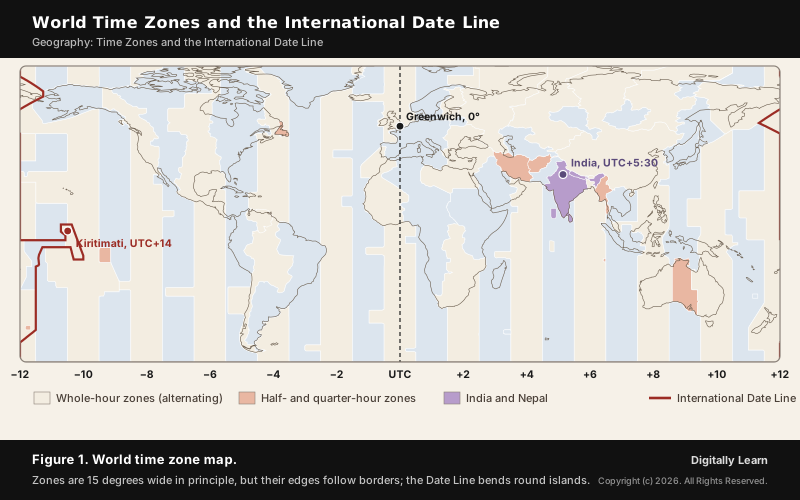
- Range of offsets: From UTC minus 12 to UTC plus 14; Kiribati’s Line Islands have the latest time on Earth.
- Half-hour zones: India (UTC plus 5:30), Iran, Afghanistan, Myanmar and central Australia.
- Three-quarter-hour zones: Nepal at UTC plus 5:45 is one of only three zones with a 45-minute offset; New Zealand’s Chatham Islands keep UTC plus 12:45.
- One clock for a vast country: China spans five geographical time zones but officially observes only UTC plus 8, the largest country in the world to keep one time zone.
Countries with the Most Time Zones
Counting a country's time zones depends on whether its overseas territories are included, and most lists do include them. That is why small European states can outnumber vast continental ones:
| Country | Time zones | Why so many |
|---|---|---|
| France | 12 | Overseas territories from the Pacific to the Indian Ocean |
| Russia | 11 | The widest continuous east-west span, Kaliningrad to Kamchatka |
| United States | 11 | Nine standard zones by law, plus Pacific territories |
| United Kingdom | 9 | Overseas territories such as the Falklands and Pitcairn |
| Australia | 9 | Mainland zones plus external territories |
| New Zealand | 5 | Main islands, Chatham, Tokelau, Niue and the Cook Islands |
| Brazil | 4 | UTC minus 2 to UTC minus 5 |
| China, India | 1 each | One national clock by choice |
Denmark is the case that needs care. Wikipedia's page on time in Denmark counts six time zones across the Danish Realm, that is metropolitan Denmark, the Faroe Islands and Greenland, while its country list counts four distinct offsets. UPSC's official answer to the 2025 question treats Denmark as having more than four, giving four countries out of five; Brazil, with exactly four zones, is the one that does not qualify. And how many time zones in Russia? Eleven, from Kaliningrad to Kamchatka.
The International Date Line
What Is the International Date Line? Rules for Crossing It
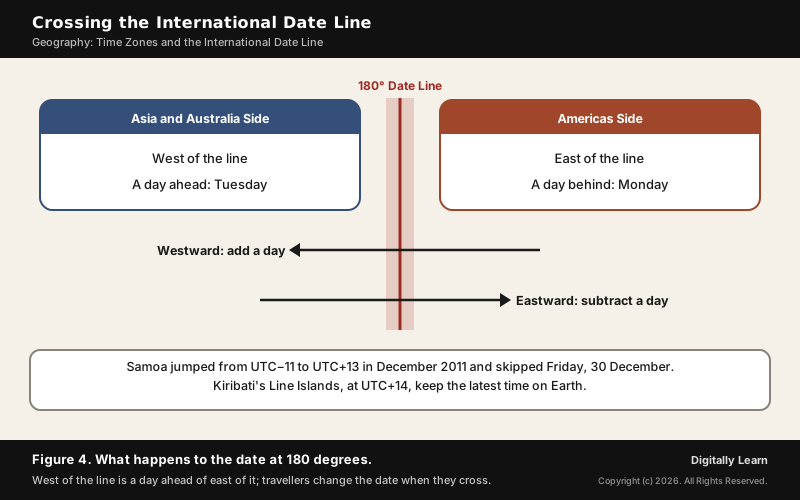
The International Date Line is the line where the calendar date changes. It runs roughly along the 180 degree meridian, down the middle of the Pacific, and it passes through the Bering Strait between the Diomede Islands, which makes the Bering Strait the strait nearest to it.
- Crossing westward (from the Americas towards Asia): add a day, so Monday becomes Tuesday.
- Crossing eastward (from Asia towards the Americas): subtract a day, so Tuesday becomes Monday.
- Why it exists: Going round the world east, a traveller gains an hour in each zone, 24 hours in all; the line is where that extra day is given back.
Why the International Date Line Is Not Straight
The International Date Line is not straight because it is drawn round island nations so that each keeps a single date, and because it rests on national laws rather than an international treaty. It is a de facto line, and its course in open ocean is a convention drawn by cartographers.
- Kiribati: Its easternmost islands, the Line Islands south of Hawaii, were brought into the same day as its western islands, which puts them at UTC plus 14, the most advanced time on Earth.
- Samoa: At the end of December 2011, Samoa moved from UTC minus 11 to UTC plus 13 and skipped Friday, 30 December, jumping forward by a whole day.
- The Philippines: For more than three centuries the Philippines kept the date of the Americas; Monday, 30 December 1844 was followed directly by Wednesday, 1 January 1845 when it switched sides.
- First daylight of a new day: At the equinoxes it falls on uninhabited Millennium Island in Kiribati, the easternmost land west of the line.
Indian Standard Time and Time Zones in India
What Is Indian Standard Time? The 82 Degrees 30 Minutes East Meridian
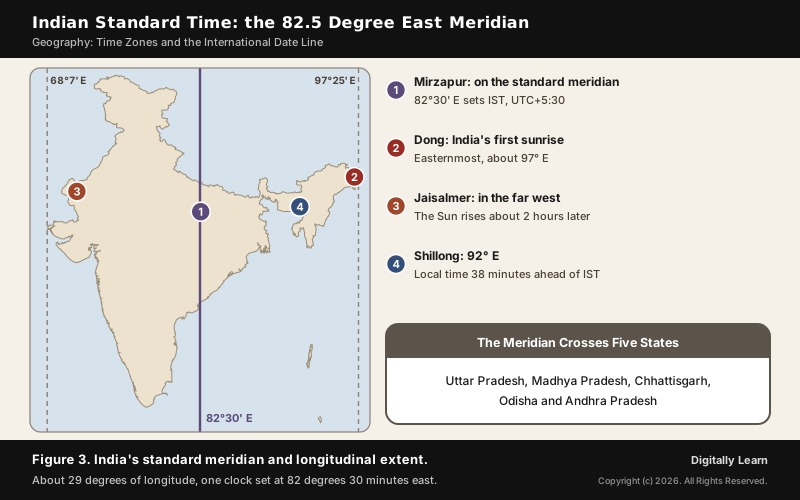
Indian Standard Time (IST) is the single time zone of India, UTC plus 5:30. It is the local time of the standard meridian at 82 degrees 30 minutes east, which passes near Vindhyachal in Mirzapur district of Uttar Pradesh. The meridian was chosen because it lies centrally between western India, whose local time is about UTC plus 5, and the north-east, about UTC plus 6, and because 82 degrees 30 minutes is a multiple of 7 degrees 30 minutes.
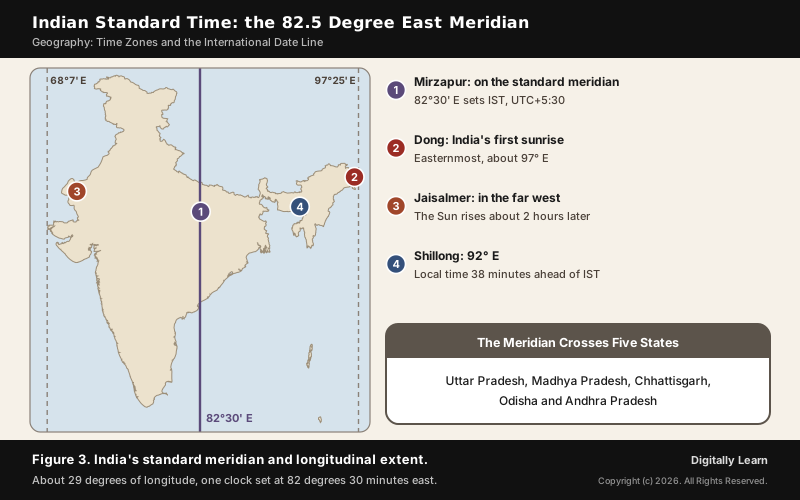
- States on the meridian: Traced on the state boundary map, the line of Indian Standard Time passes through five states: Uttar Pradesh, Madhya Pradesh, Chhattisgarh, Odisha and Andhra Pradesh.
- History: IST was adopted on 1 January 1906, replacing Madras (railway) time; Calcutta and Bombay kept their own local times until 1948 and 1955. The observatory was moved from Chennai to Shankargarh Fort in Allahabad district to sit close to UTC plus 5:30.
- Who keeps it: CSIR-National Physical Laboratory in New Delhi, India’s national measurement institute, realises IST on a bank of atomic clocks, five caesium clocks and two active hydrogen masers, kept traceable to UTC within 2.9 nanoseconds.
Should India Have Two Time Zones? The Debate
India stretches from 68 degrees 7 minutes to 97 degrees 25 minutes east, nearly 30 degrees of longitude, so the Sun rises in the north-east about two hours earlier than at Jaisalmer, yet every clock shows the same time. Dong in Arunachal Pradesh sees India's first sunrise. The mismatch has fuelled a long debate:
- Late 1980s: Researchers proposed two or three zones to save energy; the proposal was not adopted.
- 2001 to 2004: A committee under the Ministry of Science and Technology examined multiple zones and daylight saving and recommended no change, noting that the meridian was chosen with reference to a central station.
- Chaibagan time: Under the Plantations Labour Act, 1951, Assam’s tea gardens keep ‘tea garden time’, one hour ahead of IST, though IST remains the only official time.
- 2014 and 2017: Assam’s Chief Minister campaigned for a north-eastern zone, and the Department of Science and Technology was reported to be studying two zones, including an Eastern India Time at UTC plus 6.
One Nation, One Time: Legal Metrology (Indian Standard Time) Rules, 2026
India has now given IST legal force as the country's single time reference. The Legal Metrology (Indian Standard Time) Rules, 2026 were notified by the Department of Consumer Affairs on 27 August 2026 and published in the Official Gazette on 29 August 2026, and they come into force 180 days after publication. They set out how IST is generated, maintained, disseminated and used.
- Why precise time matters: Telecommunications, financial transactions and digital payments, power grids, transport, data centres and government systems all depend on accurate time stamps.
- Regional time centres: CSIR-NPL, ISRO and the Department of Legal Metrology have set up secondary time scales at five Regional Reference Standard Laboratories, in Ahmedabad, Bengaluru, Bhubaneswar, Faridabad and Guwahati.
- Satellite link: NPL provides IST traceability to ISRO’s timing centres for NavIC, and all NavIC satellite clocks are synchronised to IST within a few nanoseconds.
Daylight Saving Time
Daylight Saving Time: What It Is and Why India Does Not Use It
Daylight saving time (DST) moves clocks forward by an hour in spring and summer to give more evening daylight. The first local use was in Port Arthur and Fort William, Ontario, in 1908, and the first nationwide use was by the German and Austro-Hungarian Empires on 30 April 1916; Britain adopted British Summer Time the same year after William Willett's campaign.
India does not observe daylight saving time. Near the tropics the length of day changes little through the year, so moving the clock gains little; India used it only briefly during the war with China in 1962 and the wars with Pakistan in 1965 and 1971.
- Why latitude matters: North and south of the tropics, summer days are much longer than winter days, and the effect grows away from the equator; near the equator the variation is small, so DST is of little use.
- Where it is used: Europe observes summer time from the last Sunday in March to the last Sunday in October, a rule uniform since 1996.
- Where it has been dropped: Russia moved its clocks to standard time on 26 October 2014, intending to stay there permanently. In the United States, bills to make daylight saving time permanent were filed repeatedly between 2018 and 2024 without success.
Time Zones and the Date Line in UPSC Previous Year Questions
UPSC Questions on Time Zones, IST and the Date Line
UPSC tests this topic through calculation more than definition. Every question below is answered by the 4-minutes-per-degree rule, the direction of crossing the Date Line, or knowing where IST is set.
| Year | What was asked | The point tested |
|---|---|---|
| 1995 | Order Japan, Iraq, Greece, Cuba, Costa Rica by time ahead of GMT | East is ahead: +9, +3, +2, minus 5, minus 6 |
| 1997 | IST at noon on the Date Line if Earth's rotation reversed | Reversed rotation puts the west ahead: 18:30 |
| 1998 | Noon at Greenwich, 6 a.m. elsewhere: which longitude? | Six hours behind is 90 degrees west |
| 1999 | Local time at Shillong, 92 degrees east, at 10 a.m. IST | 9.5 degrees times 4 minutes: 10:38 |
| 1999 | Ship crossing 180 degrees eastward at 23:30 | Subtract a day: 00:30 on the same date |
| 2000 | First sunrise of the millennium in India | The easternmost meridian, 92 degrees 30 minutes east |
| 2008 | Strait nearest the Date Line | The Bering Strait |
| 2025 | How many of five countries have more than four zones | Four: all but Brazil (official key) |
Previous Year UPSC-CSE Questions
Previous Year UPSC-CSE Questions By the end you will be able to draft model answers for the following UPSC questions. Each question carries a collapsible framework showing how to approach it in the exam.
- UPSC Prelims 1995 Prelims-GSThe standard time of the following countries is ahead or behind Greenwich Mean Time depending on whether they are east or west of the longitude passing through Greenwich:
- Cuba
- Greece
- Iraq
- Costa Rica
- Japan
Which one of the following sequential orders gives the correct arrangement of the countries according to their standard time from ahead to behind GMT?
How to approach this Prelims question
Approach: Place each country east or west of Greenwich and recall its offset.
Trap to watch: Cuba and Costa Rica are both behind GMT; Costa Rica (minus 6) is further behind than Cuba (minus 5).
Key facts to recall:
- Japan UTC plus 9, Iraq plus 3, Greece plus 2
- Cuba UTC minus 5, Costa Rica minus 6
Answer signal: V, III, II, I, IV: option (a).
- UPSC Prelims 1997 Prelims-GSIf the earth's direction of rotation is reversed, what would be the IST when it is noon at the International Date Line?
How to approach this Prelims question
Approach: Reverse the rule: with the spin reversed, the west is ahead.
Trap to watch: Do not apply the normal rule; that gives 05:30 or 06:30.
Key facts to recall:
- India at 82.5 E is 97.5 degrees west of 180
- 97.5 x 4 minutes = 6 h 30 min
Answer signal: 18:30 hrs, option (c).
- UPSC Prelims 1998 Prelims-GSWhen there is noon at the G.M.T. meridian, people at another place of the Earth are taking their 6 o’clock morning tea. The longitude of the place is
How to approach this Prelims question
Approach: Convert the time difference into degrees at 15 per hour.
Trap to watch: A place behind Greenwich lies to the west, not the east.
Key facts to recall:
- 6 hours x 15 = 90 degrees
Answer signal: 90 degrees west, option (d).
- UPSC Prelims 1999 Prelims-GSIf it is 10.00 a.m. I.S.T., then what would be the local time at Shillong on 92°E longitude?
How to approach this Prelims question
Approach: Measure Shillong's longitude from the IST meridian, not from Greenwich.
Trap to watch: Shillong is east of 82.5 E, so its local time is ahead of IST, not behind.
Key facts to recall:
- 92 – 82.5 = 9.5 degrees
- 9.5 x 4 = 38 minutes
Answer signal: 10.38 a.m., option (b).
- UPSC Prelims 1999 Prelims-GSA ship sailing from the eastern extremity of the Aleutian Islands to Dutch Harbour crosses the 180° meridian at 23.30 hrs on January 1, 1999. What time and date will be recorded by the captain of the ship in his diary after one hour journey from the point of crossing of the meridian?
How to approach this Prelims question
Approach: Add the hour, then apply the crossing rule for the direction of travel.
Trap to watch: The ship sails east towards Dutch Harbour, so a day is subtracted, not added.
Key facts to recall:
- Crossing eastward subtracts a day
Answer signal: January 1, 0030 hrs, option (a).
- UPSC Prelims 2000 Prelims-GSAlong which one of the following meridians did India experience the first light of the sunrise of the new millennium?
How to approach this Prelims question
Approach: The first sunrise comes on the easternmost meridian offered within India.
Trap to watch: 82 degrees 30 minutes east is the standard meridian, not the easternmost; the west longitudes lie outside India.
Key facts to recall:
- The Earth turns eastward, so the east sees the Sun first
- Dong in Arunachal Pradesh sees India's first sunrise
Answer signal: 92 degrees 30 minutes east, option (d).
- UPSC Prelims 2008 Prelims-GSWhich one of the following straits is nearest to the International Date Line?
How to approach this Prelims question
Approach: Recall where the Date Line leaves the Arctic and enters the Pacific.
Trap to watch: The other straits are far from 180 degrees.
Key facts to recall:
- The Date Line passes through the Bering Strait between the Diomede Islands
Answer signal: Bering Strait, option (b).
- UPSC Prelims 2025 Prelims-GSConsider the following countries:
- United Kingdom
- Denmark
- New Zealand
- Australia
- Brazil
How many of the above countries have more than four time zones?
How to approach this Prelims question
Approach: Count zones including overseas territories, as UPSC does.
Trap to watch: Brazil has exactly four zones, which is not more than four.
Key facts to recall:
- UK 9, Australia 9, New Zealand 5 with its realm
- Danish Realm counted as more than four (six by Wikipedia's Time in Denmark)
Answer signal: Only four, option (b), matching UPSC's official key.
Sources and Further Reading
- Wikipedia: Time zone
- Wikipedia: International Date Line
- Wikipedia: Indian Standard Time
- Wikipedia: Prime meridian
- Wikipedia: Coordinated Universal Time
- Wikipedia: Greenwich Mean Time
- Wikipedia: International Meridian Conference
- Wikipedia: Leap second
- Wikipedia: Daylight saving time
- Wikipedia: List of time zones by country
- Wikipedia: Time in Denmark
- Wikipedia: Time in China
- Wikipedia: Time in Nepal
- Wikipedia: Kiribati
- Wikipedia: Samoa
- Wikipedia: Marine chronometer
- Wikipedia: Earth%27s rotation
- Wikipedia: Dong, Arunachal Pradesh
- PIB: Legal Metrology (Indian Standard Time) Rules, 2026 notified
- PIB: Draft Legal Metrology (Indian Standard Time) Rules
- CSIR-NPL: Indian Standard Time Metrology (PIB flyer)
- NASA: Why the day gets an extra second
- UPSC: Civil Services (Preliminary) Examination 2025 answer key, General Studies Paper I
- NCERT: Contemporary India I (Class IX), India: Size and Location
- NCERT: The Earth Our Habitat (Class VI), Globe: Latitudes and Longitudes
- NCERT: India Physical Environment (Class XI), India: Location
Editorial Disclaimer
This article explains time zones and the International Date Line for UPSC preparation, drawing on standard geographical and timekeeping sources. Figures and offsets reflect the cited authorities. Readers should consult the linked sources for the precise legal boundaries of individual time zones.


