


Overview
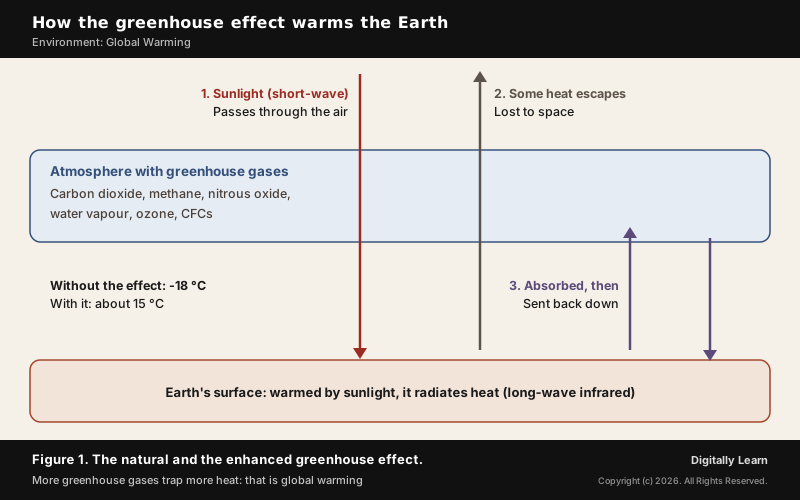
Global warming is the long-term rise in the average temperature of the Earth's surface and lower atmosphere, driven mainly by human activities that add greenhouse gases such as carbon dioxide and methane to the air. These gases strengthen the natural greenhouse effect, trapping more of the heat the Earth radiates, so the planet warms and the wider climate changes.
What Is Global Warming? Meaning and Definition
Global Warming Meaning: Definition and Difference From Climate Change
Put simply, global warming is the rise in the Earth's average surface temperature caused by an increasing concentration of greenhouse gases in the atmosphere. The modern rise is driven by human activities, especially burning fossil fuels (coal, oil and natural gas) since the Industrial Revolution. Climate change is the wider term: it covers global warming and all its effects on rainfall, ice, sea level, storms and ecosystems.
Change in climate is itself a natural and continuous process. Geological records show glacial and inter-glacial periods; the last major glacial peak was about 18,000 years ago; Europe passed through a Little Ice Age from 1550 to about 1850. What is new is the speed of today's warming and its cause.
- Astronomical causes: Changes in solar output linked to sunspots, and the Milankovitch cycles in the Earth’s orbit, wobble and axial tilt, which alter the insolation it receives.
- Volcanism: Eruptions throw aerosols into the atmosphere that reduce sunlight reaching the surface, so the Earth cools for some years.
- Human causes: The most important anthropogenic effect is the rising concentration of greenhouse gases, which causes global warming.
Greenhouse Effect and Greenhouse Gases
How the Greenhouse Effect Works: Short-Wave In, Long-Wave Trapped
The atmosphere is largely transparent to incoming short-wave solar radiation, which heats the Earth's surface. The warmed surface then radiates energy in long-wave form, and this terrestrial radiation heats the atmosphere from below: gases such as carbon dioxide absorb it, so the atmosphere is heated indirectly by the Earth's radiation rather than directly by the sun. The gases that absorb long-wave radiation are called greenhouse gases.
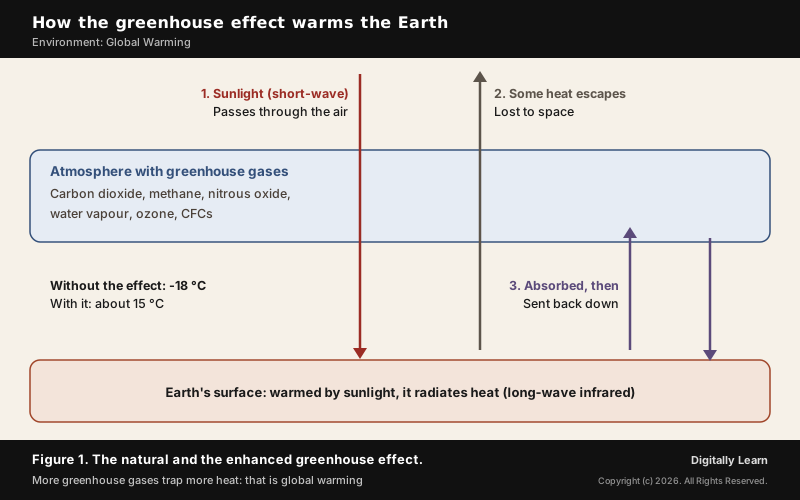
The name comes from a glass greenhouse: glass lets short-wave sunlight in but is opaque to outgoing long-wave radiation, so the inside stays warmer. A car parked in the sun with its windows closed works the same way. The natural greenhouse effect is essential to life: without it the Earth's surface would average about -18 °C instead of about 15 °C. How the Earth balances incoming and outgoing heat is explained in the heat budget of the Earth.
Main Greenhouse Gases: Carbon Dioxide, Methane, Nitrous Oxide and F-Gases
Human-caused greenhouse gas emissions in 2019 were equivalent to 59 billion tonnes of carbon dioxide. Of these, 75 per cent was carbon dioxide, 18 per cent methane, 4 per cent nitrous oxide and 2 per cent fluorinated gases. By 2022 the concentrations of carbon dioxide and methane had risen by about 50 per cent and 164 per cent since 1750.
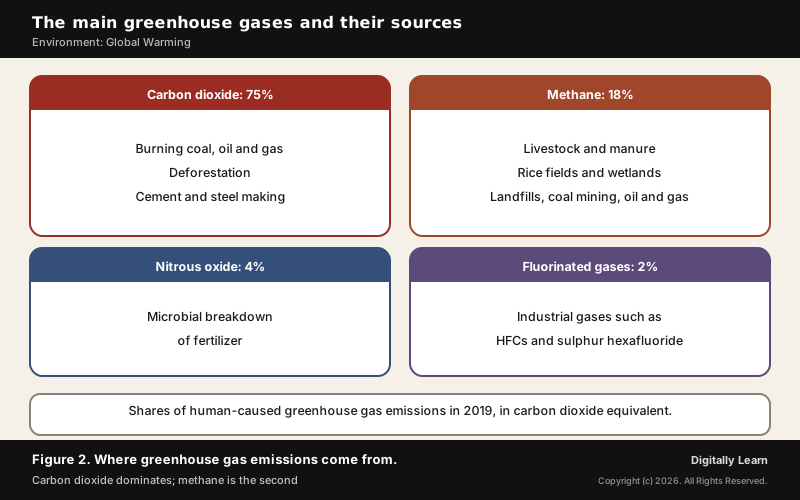
| Gas | Main human sources | Warming power (GWP over 100 years) |
|---|---|---|
| Carbon dioxide | Burning coal, oil and gas; deforestation; cement, steel and fertilizer making | 1 (the reference gas) |
| Methane | Livestock, manure, rice cultivation, wetlands, landfills, coal mining, oil and gas | 27.9 |
| Nitrous oxide | Microbial decomposition of fertilizer | 273 |
| CFCs and HFCs | Refrigerants and industrial gases | Very high; CFCs also destroy stratospheric ozone |
The effect of a gas depends on how much its concentration rises, how long it stays in the atmosphere and which wavelengths it absorbs. Methane is far more potent than carbon dioxide molecule for molecule but stays only about 12 years; carbon dioxide persists much longer, which is why warming is hard to reverse. Water vapour is a major natural greenhouse gas, but its amount changes with temperature, so it acts as a feedback that amplifies warming rather than a separate cause.
Causes of Global Warming
Causes of Global Warming: Fossil Fuels, Deforestation and Agriculture
Burning fossil fuels is the largest cause of global warming. Carbon dioxide emissions come mainly from burning coal, oil and gas to provide energy for transport, manufacturing, heating and electricity. Further carbon dioxide comes from industrial processes: the chemical reactions that make cement, steel, aluminium and fertilizer release it directly.
- Electricity and heat: Power and heat from coal, oil and gas; coal is the main source of India’s emissions.
- Transport: Petrol and diesel vehicles, shipping and aviation; air travel and cement are among the hardest sectors to decarbonise.
- Industry: Energy use plus process emissions from cement, steel, aluminium and fertilizer.
- Fossil fuel extraction: Coal mining and oil and gas operations also leak methane.
Forests and oceans are the sinks for carbon dioxide: forests use it to grow, and land processes remove about 29 per cent of annual emissions while the ocean has absorbed 20 to 30 per cent. Deforestation is the main land-use contributor to global warming, because destroyed trees release their carbon and the sink that would have absorbed more is lost.
- Livestock: Cattle and other ruminants produce methane during digestion, and manure adds more.
- Rice paddies: Flooded fields create anaerobic conditions in which microbes produce methane.
- Fertilizers: Nitrous oxide comes largely from the microbial breakdown of nitrogen fertilizer.
- Waste: Landfills and wastewater release methane as organic matter decays.
- Industrial gases: CFCs, HFCs and sulphur hexafluoride from refrigeration and industry are powerful greenhouse gases.
Effects of Global Warming on Climate, Oceans and India
Rising Temperatures, Heatwaves and Changing Weather
Surface temperatures are rising at around 0.2 °C per decade. The decade 2016 to 2025 averaged 1.26 °C above the pre-industrial baseline of 1850 to 1900, and 2024 was the warmest year on record at about 1.60 °C. Land has warmed almost twice as fast as the global average, because oceans lose more heat by evaporation.
- Heatwaves: In May 2022 a severe heatwave hit India and Pakistan, with temperatures reaching 51 °C; climate change makes such heatwaves 100 times more likely.
- Ice loss: Arctic sea ice has shrunk and thinned for decades; if warming reaches between 1.7 °C and 2.3 °C, the Greenland ice sheet would keep melting until it disappears.
- Himalayan glaciers: Warming on the Tibetan Plateau is making Himalayan glaciers retreat, threatening the flow of the Ganga, Brahmaputra and Yamuna (glaciers of India).
- Weather extremes: Floods, droughts and odd climatic changes such as the El Nino effect are expected to grow (ENSO and its impacts on India).
Sea Level Rise: Causes and Impact on India and Island Nations
The sea rises for two reasons: melting glaciers and ice sheets add water, and warming water expands through thermal expansion. Between 1993 and 2018, melting ice accounted for 44 per cent of the rise and thermal expansion for 42 per cent. Between 1901 and 2018 the global average sea level rose by 15 to 25 cm, and the rate reached 4.62 mm a year in the decade 2013 to 2022.
- Projections: Even with very deep cuts, sea level could rise by about 60 to 130 cm from the 19th century to 2100; with high emissions it could rise by up to 1.9 m by 2100.
- India’s coasts: Between 1990 and 2016 India lost 235 square kilometres of land to coastal erosion; low-lying islands in the Sundarbans have already been submerged, and Mumbai and Kolkata face the highest flood risks.
- Islands and neighbours: Rising seas could inundate large parts of coastal areas and islands, and northeastern States worry that a submerged Bangladesh could create a refugee crisis.
Effects of Global Warming on Agriculture, Food Security and Health
Warming reaches people through food, water and health. Crop yields have kept rising for 50 years because of better farming, but climate change has already slowed the rate of yield growth, and land suitable for a given crop is shifting to higher latitudes and altitudes. Fisheries have suffered in many regions, and with 2 °C of warming global livestock numbers could fall by 7 to 10 per cent by 2050.
- India’s vulnerable sectors: Agriculture, water, natural ecosystems, biodiversity and health; a national assessment in November 2010 warned of lower yields in rainfed crops, stress on livestock, lower milk productivity, more flooding, stronger cyclones and the spread of malaria.
- Health: Temperature extremes increase illness and death, and climate change affects the transmission of diseases such as dengue and malaria.
- Heat and humidity: About 30 per cent of the world’s people already live where extreme heat and humidity are linked to excess deaths.
Warming Oceans, Coral Bleaching and Ocean Acidification
Reef-building corals depend on a symbiotic relationship with zooxanthellae, algae-like organisms living in their tissues that supply nutrients through photosynthesis and give corals their colour. When the water becomes too warm, corals expel them and turn white: this is coral bleaching, and prolonged bleaching kills the coral.
- 1998 event: A 1998 bleaching event linked to warmer seas killed more than 70 per cent of corals off Lakshadweep and the Andamans; up to 90 per cent of coral cover was lost in the Maldives, Sri Lanka and the Seychelles in 1997 and 1998.
- 2014 to 2016: The longest recorded global bleaching killed coral on an unprecedented scale; in 2016 bleaching killed 29 to 50 per cent of the coral on the Great Barrier Reef.
- Ocean acidification: Higher carbon dioxide levels make more of it dissolve in seawater, turning oceans more acidic, which harms corals and shell-forming life; with ocean heating and sea level rise it will continue for centuries.
Control Measures: Mitigation, Adaptation and Global Agreements
Control Measures for Global Warming: Mitigation and Adaptation
Control measures work in two ways. Mitigation cuts the emissions that cause warming or removes carbon dioxide from the air. Adaptation is the process of adjustment to current or expected changes in climate and its effects; without mitigation, adaptation cannot avert severe, widespread and irreversible impacts.
- Clean energy: Wind, solar, hydro and nuclear power do not produce significant carbon pollution and can replace fossil fuels in transport, heating and industry.
- Energy efficiency: Using less energy for the same output, from buildings to factories.
- Forests and sinks: Reducing deforestation and planting trees remove carbon dioxide from the air.
- Carbon capture: Carbon capture and storage (CCS) captures carbon dioxide from large point sources such as cement factories and stores it away.
- Carbon markets: Tradable emission permits and credits put a price on carbon.
- Lifestyles and population: Cutting fossil fuel use, and slowing the growth of population, also reduce emissions.
How India is building solar capacity is covered in solar power and energy storage in India. Methane locked in ocean-floor ice is another risk that warming could release, explained in natural gas hydrates in India.
UNFCCC and the Kyoto Protocol, 1997
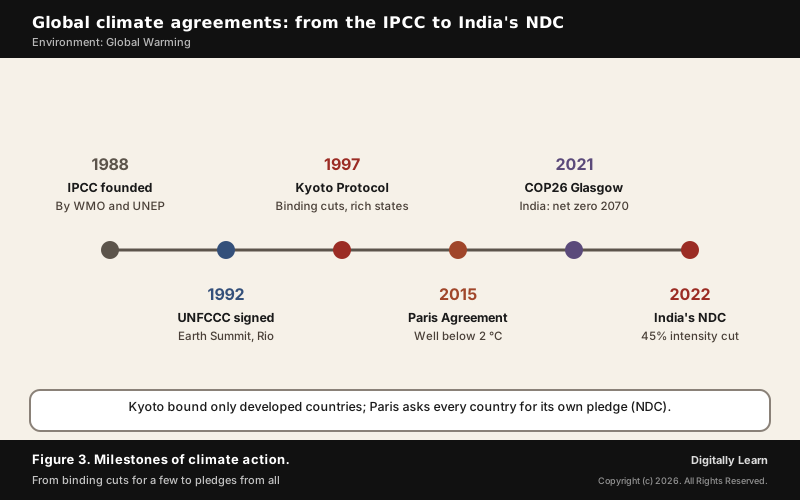
The IPCC was set up in 1988 by the World Meteorological Organization and the United Nations Environment Programme to give governments scientific information on climate. The UNFCCC was signed in 1992 at the Earth Summit and entered into force in 1994. It established the principle of common but differentiated responsibilities: all countries share responsibility, but developed countries lead because of their greater historical emissions.
- Adoption and force: The Kyoto Protocol was adopted on 11 December 1997 and entered into force on 16 February 2005.
- Binding targets: It bound 35 industrialised countries to cut emissions by 2012 to 5 per cent below 1990 levels; developing countries had no binding targets.
- Three flexibility mechanisms: International Emissions Trading, the Clean Development Mechanism (CDM) and Joint Implementation.
- CDM: Annex I countries could buy Certified Emission Reduction units from emission-cutting projects in developing (non-Annex I) countries.
- Doha Amendment: A second commitment period to 2020 was agreed in 2012 and entered into force on 31 December 2020.
Paris Agreement, 2015 and COP26 Glasgow, 2021
The Paris Agreement was adopted at COP21 on 12 December 2015 and entered into force on 4 November 2016. Its goal is to hold the rise in global temperature to well below 2 °C above pre-industrial levels and to pursue efforts to limit it to 1.5 °C. Unlike Kyoto, every country sets its own pledge, the Nationally Determined Contribution (NDC), and a new NDC is due every five years, each more ambitious than the last.
- Finance: Developed countries reaffirmed the commitment to mobilise $100 billion a year in climate finance by 2020 for mitigation and adaptation in developing countries.
- COP26 outcome: The Glasgow Climate Pact of 13 November 2021 was the first climate deal to plan explicitly to reduce unabated coal power, with the wording ‘phase down’ rather than ‘phase out’, and a call to phase out inefficient fossil fuel subsidies.
- 1.5 °C focus: The Pact recognised that limiting warming to 1.5 °C needs rapid, deep and sustained cuts in global emissions.
| Feature | Kyoto Protocol (1997) | Paris Agreement (2015) |
|---|---|---|
| Who must cut | Only developed (Annex I) countries, with binding targets | Every country, through its own NDC |
| Target | 5 per cent below 1990 levels by 2012 for industrialised countries | Warming well below 2 °C, aiming for 1.5 °C |
| Approach | Targets set from the top | Pledges set by each country, raised every five years |
India and Global Warming: Commitments and National Action
India's National Action Plan on Climate Change: Eight Missions
India's greenhouse gas emissions are the third largest in the world, about 6.6 per cent of the global total in 2019, and the main source is coal. Yet per capita emissions are low, at 1.85 tonnes a year, and India has contributed about 4.62 per cent of historical carbon dioxide since 1851. India announced its National Action Plan on Climate Change (NAPCC) in June 2008 with eight national missions:
- National Solar Mission
- National Mission for Enhanced Energy Efficiency
- National Mission on Sustainable Habitat
- National Water Mission
- National Mission for Sustaining the Himalayan Eco-system
- National Mission for a Green India
- National Mission on Sustainable Agriculture
- National Mission on Strategic Knowledge for Climate Change
The National Solar Mission is the largest: its target was scaled up fivefold, from 20,000 MW to 100,000 MW by 2022. The sustainable agriculture mission devises adaptation and mitigation strategies for food security and promotes dryland farming with drought- and pest-resistant crop varieties. States were asked to revise their State Action Plans on Climate Change in line with India's NDC commitments, and an Apex Committee for Implementation of the Paris Agreement reviews the missions.
India's NDC, Panchamrit at COP26 and the 2022 Update
India submitted its first NDC to the UNFCCC on 2 October 2015. Its three quantitative targets up to 2030 were: 40 per cent of installed electric power capacity from non-fossil sources; a 33 to 35 per cent cut in the emissions intensity of GDP compared with 2005; and an additional carbon sink of 2.5 to 3 billion tonnes of carbon dioxide equivalent through forest and tree cover.
- 1. Non-fossil capacity: 500 GW by 2030.
- 2. Renewables: 50 per cent of India’s energy requirements from renewable energy by 2030.
- 3. Emissions: A cut of one billion tonnes in total projected carbon emissions till 2030.
- 4. Carbon intensity: A 45 per cent reduction in the carbon intensity of the economy by 2030.
- 5. Net zero: Net zero emissions by 2070.
These Panchamrit (five nectar elements) were announced at COP26 in Glasgow, where India also proposed LiFE, Lifestyle for Environment. The 2022 update translated the Panchamrit into enhanced targets: a 45 per cent cut in the emissions intensity of GDP by 2030 from the 2005 level, and about 50 per cent of cumulative electric power capacity from non-fossil sources by 2030, as a step towards net zero by 2070.
| Target | First NDC (2015) | Updated NDC (2022) |
|---|---|---|
| Emissions intensity of GDP, by 2030 from 2005 | 33 to 35 per cent cut | 45 per cent cut |
| Non-fossil share of power capacity by 2030 | 40 per cent | About 50 per cent |
| Long-term goal | Not stated | Net zero by 2070; LiFE movement |
Previous Year UPSC-CSE Questions
Previous Year UPSC-CSE Questions By the end you will be able to draft model answers for the following UPSC questions. Each question carries a collapsible framework showing how to approach it in the exam.
- UPSC Mains 2022 GS-IIIDiscuss global warming and mention its effects on the global climate. Explain the control measures to bring down the level of greenhouse gases which cause global warming, in the light of the Kyoto Protocol, 1997.
How to structure the answer in the exam
Introduction: Global warming is the rise in the Earth's average temperature caused by human emissions of greenhouse gases.
Body (sub-themes to develop):
- Mechanism: greenhouse gases absorb long-wave radiation; carbon dioxide is 75 per cent of emissions.
- Effects: 1.26 °C of warming, heatwaves, glacier retreat, sea level rise, coral bleaching.
- Control: mitigation and adaptation; Kyoto's binding cuts for industrialised countries and its three flexibility mechanisms, including the CDM.
- Beyond Kyoto: the Paris Agreement and national pledges.
Conclusion: Conclude that Kyoto set the principle of binding cuts, and Paris widened action to every country.
- UPSC Mains 2019 GS-IAssess the impact of global warming on the coral life system with examples.
How to structure the answer in the exam
Introduction: Corals live in symbiosis with zooxanthellae that are expelled when the sea warms.
Body (sub-themes to develop):
- Bleaching mechanism and why prolonged bleaching kills coral.
- Examples: Lakshadweep and the Andamans 1998; Maldives and Sri Lanka; Great Barrier Reef 2016.
- Acidification adds a second stress on shell-forming life.
Conclusion: Conclude that coral loss threatens fisheries and coasts in the Indian Ocean.
- UPSC Mains 2023 GS-IIIThe Intergovernmental Panel on Climate Change (IPCC) has predicted a global sea level rise of about one metre by AD 2100. What would be its impact in India and the other countries in the Indian Ocean region?
How to structure the answer in the exam
Introduction: Sea level rises through melting ice and thermal expansion; the rise is accelerating.
Body (sub-themes to develop):
- India: coastal erosion of 235 square kilometres, flood risk in Mumbai and Kolkata, the Sundarbans.
- Indian Ocean: island nations and low-lying Bangladesh; displacement and migration.
- Ecology: coral reefs and mangroves under stress.
Conclusion: Conclude with adaptation: coastal defences, planning and regional cooperation.
- UPSC Mains 2025 GS-IIIWrite a review on India's climate commitments under the Paris Agreement (2015) and mention how these have been further strengthened in COP26 (2021). In this direction, how has the first Nationally Determined Contribution intended by India been updated in 2022?
How to structure the answer in the exam
Introduction: Under the Paris Agreement every country sets an NDC and raises it every five years.
Body (sub-themes to develop):
- First NDC (2015): 33 to 35 per cent intensity cut, 40 per cent non-fossil capacity, 2.5 to 3 billion tonnes sink.
- COP26 Panchamrit: 500 GW, 50 per cent renewables, one billion tonnes, 45 per cent intensity, net zero 2070.
- 2022 update: 45 per cent intensity cut and about 50 per cent non-fossil capacity; LiFE.
Conclusion: Conclude that India raised ambition while keeping to common but differentiated responsibilities.
- UPSC Mains 2021 GS-IIIDescribe the major outcomes of the 26th Session of the Conference of the Parties (COP) to the United Nations Framework Convention on Climate Change (UNFCCC). What are the commitments made by India in this conference?
How to structure the answer in the exam
Introduction: COP26 at Glasgow in 2021 produced the Glasgow Climate Pact.
Body (sub-themes to develop):
- Outcomes: first explicit plan to phase down unabated coal; phase out inefficient fossil fuel subsidies; focus on 1.5 °C.
- India: the five Panchamrit targets, including net zero by 2070.
- India's LiFE proposal.
Conclusion: Conclude that India linked higher ambition to climate finance and equity.
- UPSC Mains 2023 GS-IDiscuss the consequences of climate change on the food security in tropical countries.
How to structure the answer in the exam
Introduction: Tropical countries depend heavily on rainfed farming, so warming hits their food supply first.
Body (sub-themes to develop):
- Availability: slower yield growth, lower rainfed yields, fewer livestock, damaged fisheries.
- Access and stability: floods, droughts and heat shocks disrupt supply and incomes.
- Nutrition and health: heat stress and disease.
Conclusion: Conclude with adaptation: climate-resilient crops, dryland farming and water management.
- UPSC Prelims 2005 Prelims-GSConsider the following statements :
- Kyoto Protocol came into force in the year 2005
- Kyoto Protocol deals primarily with the depletion of the Ozone layer.
- Methane as a greenhouse gas is more harmful than carbon dioxide
Which of the statements given above is/are correct?
How to approach this Prelims question
Approach: Check each statement against Kyoto and the gases table.
Trap to watch: Kyoto deals with greenhouse gases; the ozone layer is the Montreal Protocol.
Key facts to recall:
- Kyoto in force 16 February 2005
- Methane GWP far above carbon dioxide
Answer signal: 1 and 3: option (b).
- UPSC Prelims 2008 Prelims-GSConsider the following:
- Rice fields
- Coal mining
- Domestic animals
- Wetlands
Which of the above are sources of methane, a major greenhouse gas?
How to approach this Prelims question
Approach: Match each item to the methane sources listed.
Trap to watch: Wetlands are a natural source, but still a source.
Key facts to recall:
- Methane: livestock, manure, rice, wetlands, landfills, coal mining, oil and gas
Answer signal: All four: option (d).
- UPSC Prelims 2008 Prelims-GSConsider the following statements:
- Clean Development Mechanism (CDM) in respect of carbon credits is one of the Kyoto Protocol Mechanisms.
- Under the CDM, the projects handled pertain only to the Annex-I countries.
Which of the statements given above is/are correct?
How to approach this Prelims question
Approach: Recall where CDM projects are located.
Trap to watch: CDM projects are in developing countries, not Annex I countries.
Key facts to recall:
- CDM is one of Kyoto's three flexibility mechanisms
- Certified Emission Reductions
Answer signal: 1 only: option (a).
- UPSC Prelims 2016 Prelims-GSWith reference to the Agreement at the UNFCCC Meeting in Paris in 2015, which of the following statements is/are correct?
- The Agreement was signed by all the member countries of the UN and it will go into effect in 2017.
- The Agreement aims to limit the greenhouse gas emissions so that the rise in average global temperature by the end of this century does not exceed 2 °C or even 1·5 °C above pre-industrial levels.
- Developed countries acknowledged their historical responsibility in global warming and committed to donate $1000 billion a year from 2020 to help developing countries to cope with climate change.
Select the correct answer using the code given below. to cope with climate change. Select the correct answer using the code given below.
How to approach this Prelims question
Approach: Test each statement's number and date.
Trap to watch: The finance figure is $100 billion a year, not $1000 billion; the Agreement took effect in 2016.
Key facts to recall:
- Well below 2 °C, pursue 1.5 °C
- In force 4 November 2016
- $100 billion a year
Answer signal: 2 only: option (b).
- UPSC Prelims 2024 Prelims-GSConsider the following statements:
- Statement-I: The atmosphere is heated more by incoming solar radiation than by terrestrial radiation.
- Statement-II: Carbon dioxide and other greenhouse gases in the atmosphere are good absorbers of long wave radiation.
Which one of the following is correct in respect of the above statements?
How to approach this Prelims question
Approach: Check which radiation heats the atmosphere more.
Trap to watch: Statement I reverses the truth: terrestrial radiation heats the atmosphere more.
Key facts to recall:
- Atmosphere largely transparent to short-wave radiation
- Greenhouse gases absorb long-wave radiation
Answer signal: Statement I incorrect, Statement II correct: option (d).
Sources and Further Reading
- NCERT: Fundamentals of Physical Geography (Class XI), Chapter 12, World Climate and Climate Change
- NCERT: Fundamentals of Physical Geography (Class XI), Chapter 9, Solar Radiation, Heat Balance and Temperature
- NCERT: Biology (Class XII), Chapter 16, Environmental Issues
- PIB: Cabinet approves India's Updated Nationally Determined Contribution (3 August 2022)
- PIB: National Statement by the Prime Minister at COP26, Glasgow (1 November 2021)
- PIB: Progress in Eight Missions on Climate Change (28 July 2022)
- IPCC: Sixth Assessment Report, Synthesis Report (2023)
- UNFCCC: The Paris Agreement
- UNFCCC: What is the Kyoto Protocol?
- Wikipedia: Climate change
- Wikipedia: Greenhouse effect
- Wikipedia: Global warming potential
- Wikipedia: Kyoto Protocol
- Wikipedia: Paris Agreement
- Wikipedia: 2021 United Nations Climate Change Conference
- Wikipedia: Sea level rise
- Wikipedia: Coral bleaching
- Wikipedia: Climate change in India
- Wikipedia: United Nations Framework Convention on Climate Change
- UPSC: Previous year question papers
Editorial Disclaimer
This article explains global warming from the NCERT textbooks, official Government of India releases and the climate-science sources listed below. Climate figures are updated by the IPCC and the WMO from time to time.


