

Overview
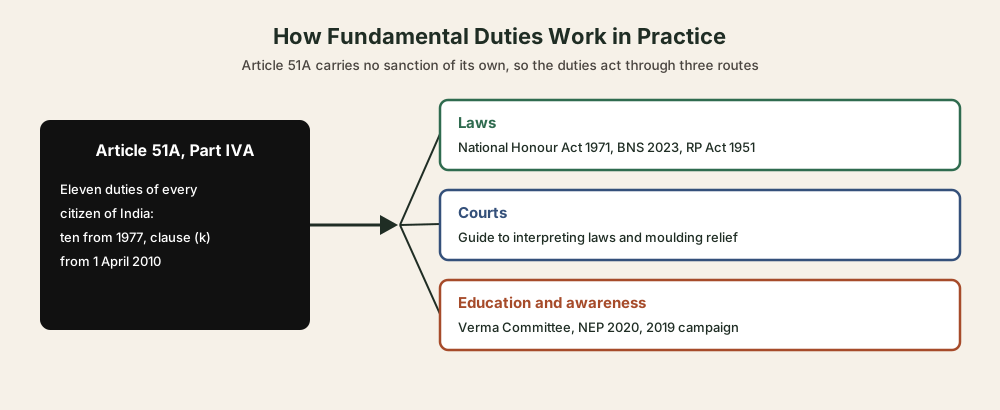
Fundamental Duties are the eleven duties that Article 51A, the sole Article of Part IVA of the Constitution, places on every citizen of India. Ten were inserted by the Constitution (Forty-second Amendment) Act, 1976 with effect from 3 January 1977, following the Swaran Singh Committee's recommendation, and clause (k), which makes parents and guardians responsible for giving a child aged six to fourteen the chance to be educated, was added by the Eighty-sixth Amendment Act, 2002. No legal sanction is provided for their non-performance, but courts use them as a guide to interpretation and several are given effect by separate laws.
Origin of Fundamental Duties: Swaran Singh Committee and 42nd Amendment
Fundamental Duties in Part IVA: Meaning and Constitutional Place
Fundamental Duties are the obligations that Article 51A, the only Article in Part IVA of the Constitution, places on citizens. The Article opens with the words "It shall be the duty of every citizen of India" and lists eleven duties in clauses (a) to (k), from respect for the Constitution to a parent's duty to provide opportunities for a child's education.
The duties matter because, in the words of the National Commission to Review the Working of the Constitution, no democratic polity can ever succeed where citizens are not willing to be active participants in governance by assuming responsibilities and discharging citizenship duties. Their significance also lies in judicial use: the Supreme Court has held that they provide a valuable guide and aid to interpretation of constitutional and legal issues.
Three distinctive features set Part IVA apart from the rest of the Constitution:
- The duties are addressed to every citizen of India, and Article 51A does not expressly cast any duty on the State.
- No legal sanction is provided for violation or non-performance, and there is neither a specific provision for enforceability nor any specific prohibition, as the Commission’s consultation paper notes.
- Courts use the duties as a guide to interpretation, and some of them have been incorporated in separate laws.
Swaran Singh Committee and the Forty-second Amendment, 1976
The duties were not part of the Constitution when it was first adopted. According to the Commission's consultation paper of 6 July 2001, the Swaran Singh Committee, appointed by the Congress Party for a review of the Constitution, recommended that certain Fundamental Duties and obligations which every citizen owed the nation should be included in the Constitution.
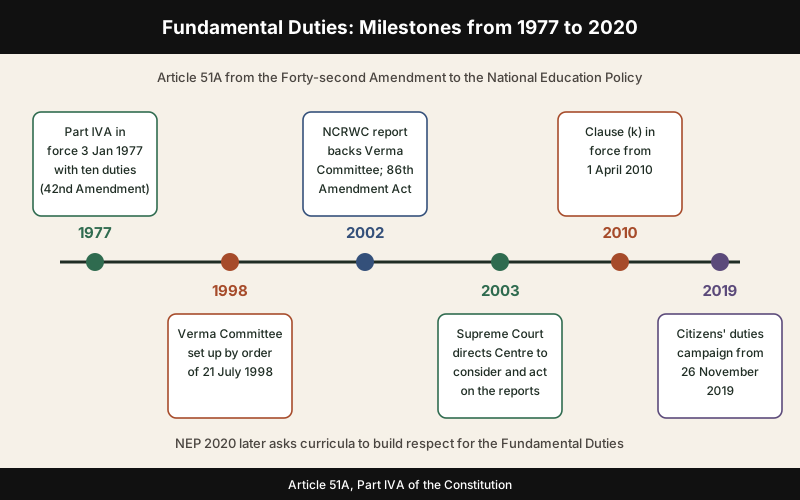
The Constitution (Forty-second Amendment) Act, 1976 gave effect to that recommendation. Its section 11 inserted Part IVA with ten duties, clauses (a) to (j), with effect from 3 January 1977, and its section 10 inserted Article 48A, the Directive Principle on protecting the environment, from the same date.
| Date | Milestone |
|---|---|
| 1976 | Swaran Singh Committee recommends including Fundamental Duties; the Forty-second Amendment Act is passed |
| 3 January 1977 | Part IVA with ten duties, clauses (a) to (j), comes into force |
| 1978 | The Forty-fourth Amendment leaves Article 51A undisturbed |
| 21 July 1998 | Government order sets up the Justice J.S. Verma Committee |
| October 1999 | The Verma Committee submits its report |
| 6 July 2001 | The NCRWC releases its consultation paper on effectuation of Fundamental Duties |
| 31 March 2002 | The NCRWC submits its final report, endorsing the Verma Committee |
| 2002 | The Constitution (Eighty-sixth Amendment) Act adds clause (k) |
| 31 July 2003 | The Supreme Court directs the Centre to consider and implement the recommendations |
| 1 April 2010 | Clause (k) and Article 21A come into force |
| November 2015 | Government decides to observe 26 November as Constitution Day |
| 26 November 2019 to 26 November 2020 | Nagrik Kartavya Palan Abhiyan on Fundamental Duties |
The Commission's final report explains how the Article survived. Article 51A was part of a large number of changes brought about during the Emergency, but when the new Parliament later restored the pre-Emergency position in most cases, it emerged unscathed because all parties considered it an unexceptionable charter of principles. The consultation paper adds that the Forty-fourth Amendment, 1978 did not disturb it.
Fundamental Duties and Article 29(1) of the Universal Declaration of Human Rights
The Commission's final report notes that the constitutions of some countries contain provisions on Fundamental Duties. It says that their inclusion brings the Indian Constitution in line with Article 29(1) of the Universal Declaration of Human Rights, under which everyone has duties to the community in which alone the free and full development of the personality is possible.
The report draws a practical lesson from that provision: the exercise of fundamental rights entails duties to the community, which ensures the free and full development of human personality.
The Eleven Fundamental Duties Under Article 51A, Clause by Clause
Constitution, National Symbols and Freedom Struggle Ideals: Clauses (a) and (b)
Clause (a) makes it the duty of every citizen to abide by the Constitution and respect its ideals and institutions, the National Flag and the National Anthem. Clause (b) requires every citizen to cherish and follow the noble ideals which inspired our national struggle for freedom.
The Commission's consultation paper explains these terms. It finds the ideals of the Constitution summed up in the Preamble, names the Executive, the Legislature and the Judiciary as its principal institutions, and suggests that the noble ideals of the freedom struggle may be explained to include:
- Putting an end to foreign rule.
- Ushering in a Government of the people, by the people and for the people.
- Securing to all citizens justice, liberty and equality, and promoting among them all fraternity and unity.
Courts have treated clause (b) as a duty of the citizen, not a right against the State. In West Bengal Head Masters' Association v. Union of India (1983), a Division Bench of the Calcutta High Court held that Article 51A(b) imposes a duty on citizens and not on the State, so a student cannot claim to be taught Indian history in a particular class in order to perform that duty.
Sovereignty, Unity, Integrity and National Service: Clauses (c) and (d)
Clause (c) requires every citizen to uphold and protect the sovereignty, unity and integrity of India, and clause (d) to defend the country and render national service when called upon to do so.
The same values appear elsewhere in the Constitution in different forms:
- The Preamble speaks of fraternity assuring the unity and integrity of the Nation, words substituted by the Forty-second Amendment for unity of the Nation.
- Article 19(2) allows reasonable restrictions on the freedom of speech and expression in the interests of the sovereignty and integrity of India.
- Article 23(2) allows the State to impose compulsory service for public purposes, without discrimination on grounds only of religion, race, caste or class.
The consultation paper reads clause (d) as a duty contingent on citizens being called upon to defend the country and render national service. It reads clause (c), by necessary implication, as a duty not to do anything derogatory of upholding or protecting the sovereignty, unity or integrity of India.
Harmony, Dignity of Women and Composite Culture: Clauses (e) and (f)
Clause (e) requires every citizen to promote harmony and the spirit of common brotherhood amongst all the people of India transcending religious, linguistic and regional or sectional diversities, and to renounce practices derogatory to the dignity of women. Clause (f) asks citizens to value and preserve the rich heritage of our composite culture.
The Commission's final report reads clause (e) as making clear that attacks on minority communities or minority opinions are frowned upon. It describes composite culture in clause (f) as culture drawn from many strands, and says that the clause means we may not break each other's places of worship, set fire to religious texts or obstruct those who exercise their right under Article 25.
The consultation paper connects both clauses to existing law. It says that the passing of the Commission of Sati (Prevention) Act, 1987 emphasises the importance of clause (e), and it describes the guidelines against sexual harassment at the workplace laid down in Vishaka v. State of Rajasthan (1997) as effective measures for renouncing practices derogatory to the dignity of women.
Clause (f) has a counterpart among the Directive Principles. Under Article 49, it is the obligation of the State to protect every monument or place or object of artistic or historic interest declared by or under law made by Parliament to be of national importance.
Environment, Scientific Temper, Public Property and Excellence: Clauses (g) to (j)
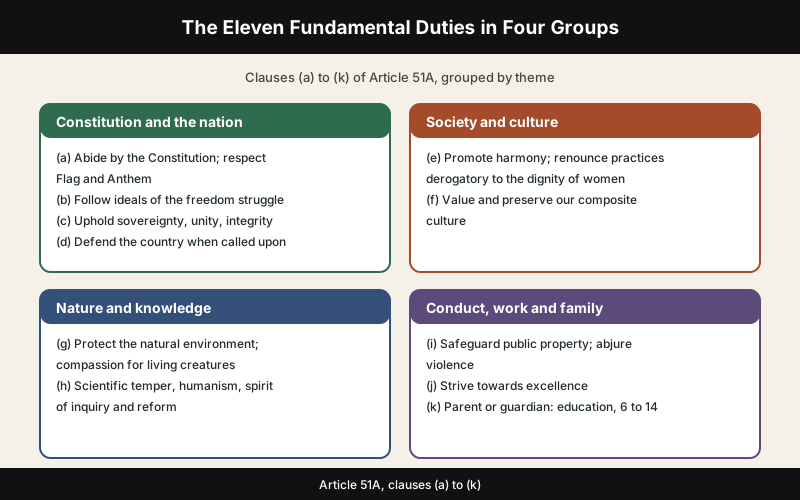
Four clauses deal with the citizen's conduct towards nature, knowledge, public property and work:
- Clause (g): to protect and improve the natural environment including forests, lakes, rivers and wild life, and to have compassion for living creatures.
- Clause (h): to develop the scientific temper, humanism and the spirit of inquiry and reform.
- Clause (i): to safeguard public property and to abjure violence.
- Clause (j): to strive towards excellence in all spheres of individual and collective activity so that the nation constantly rises to higher levels of endeavour and achievement.
Clause (g) mirrors Article 48A, under which the State shall endeavour to protect and improve the environment and to safeguard the forests and wild life of the country. The consultation paper describes scientific temper as an outlook founded on organised knowledge and experience, based on reason and rationality in contradistinction to superstition or blind faith.
The consultation paper also sorts the ten original clauses by the action they demand. Five are positive duties and the other five are negative duties; clauses (b), (d), (f), (h) and (j) require citizens to perform the duties actively.
The Eleventh Duty: Clause (k) and the Eighty-sixth Amendment, 2002
Clause (k) makes it the duty of every citizen who is a parent or guardian to provide opportunities for education to his child or, as the case may be, ward between the age of six and fourteen years. It was inserted by section 4 of the Constitution (Eighty-sixth Amendment) Act, 2002, with effect from 1 April 2010.
The same Amendment made related changes elsewhere, with effect from the same date:
- Section 2 inserted Article 21A, under which the State shall provide free and compulsory education to all children of the age of six to fourteen years in such manner as the State may, by law, determine.
- Section 3 substituted Article 45, under which the State shall endeavour to provide early childhood care and education for all children until they complete the age of six years.
Clause (k) therefore places a duty on the parent or guardian in the same age band, six to fourteen years, for which Article 21A makes free and compulsory education a right that the State must provide.
| Clause | Duty in brief | Related provision or ruling |
|---|---|---|
| (a) | Abide by the Constitution; respect its ideals, institutions, the National Flag and the National Anthem | Prevention of Insults to National Honour Act, 1971 |
| (b) | Cherish and follow the noble ideals of the national struggle for freedom | Ideals also reflected in clauses (e), (f), (h) and (j), per the consultation paper |
| (c) | Uphold and protect the sovereignty, unity and integrity of India | Article 19(2); the Preamble |
| (d) | Defend the country and render national service when called upon | Article 23(2) |
| (e) | Promote harmony and common brotherhood; renounce practices derogatory to the dignity of women | Commission of Sati (Prevention) Act, 1987 |
| (f) | Value and preserve the rich heritage of our composite culture | Article 49 |
| (g) | Protect and improve the natural environment; have compassion for living creatures | Article 48A |
| (h) | Develop scientific temper, humanism and the spirit of inquiry and reform | Explained in the consultation paper as reason and rationality |
| (i) | Safeguard public property and abjure violence | Named in the consultation paper for comprehensive legislation |
| (j) | Strive towards excellence in all spheres of activity | Mohan Kumar Singhania v. Union of India (1992) |
| (k) | Parent or guardian to provide opportunities for education, six to fourteen years | Article 21A |
Justice J.S. Verma Committee on Operationalising Fundamental Duties
Appointment and Terms of Reference of the Verma Committee
The Government of India set up a committee chaired by Justice J.S. Verma, former Chief Justice of India, by Order No. 16-23/98 dated 21 July 1998. Its task was to work out a strategy and methodology for operationalising a countrywide programme for teaching Fundamental Duties in every educational institution as a measure of in-service training.
The Committee worked to four terms of reference:
- To develop a package for teaching Fundamental Duties at primary, secondary, senior secondary and university levels.
- To decide the activities to form part of curricular and co-curricular activities.
- To review the existing programme implemented by the NCERT under the National Curricular Framework and identify additional inputs.
- To develop programme packages for training citizens through non-formal education, adult education and the media.
The Committee submitted its report in October 1999. Its strategy rested on the maxim that the onus of discharging Fundamental Duties is on every citizen, and it observed that duties are observed as a result of the social system, the influence of role models or punitive provisions of law.
Verma Committee Recommendations on Awareness, Schools and Teacher Education
For general awareness among citizens, the Committee made the following recommendations:
- Advocacy and sensitisation programmes.
- Display of the Preamble and the clauses of Article 51A on government publications, diaries, calendars and at public places.
- Radio and video spots on Fundamental Duties on All India Radio and Doordarshan.
- Observance of 3 January as Fundamental Duties Day.
- An autonomous body to act like an ombudsman on citizenship values.
- Small booklets on Fundamental Duties in easy language for non-formal and adult education.
For schools and teacher education, the Committee recommended the following measures:
- Printing the Preamble and the clauses of Article 51A in all school textbooks and publications of the NCERT and State textbook bureaus.
- Anecdotal talks on each clause at morning assemblies, with seminars, debates and competitions as regular co-curricular activities.
- Elimination of gender bias and sex-stereotyping from school and college textbooks.
- A sensitisation module on Fundamental Duties in all teacher education programmes, and a Fundamental Duties Week in teacher education institutions.
- Compulsory NCC in all pre-service teacher education institutions.
- Renaming the UGC’s Human Rights Education Initiative as the Human Rights and Fundamental Duties Education Initiative.
The Committee also stressed that citizenship values should be understood as a combination of rights and duties, and that the discourse on Fundamental Duties cannot be divorced from Fundamental Rights.
Verma Committee on Legislators, Civil Servants, Judiciary, Business and Media
The Committee extended its recommendations to public life, noting that every holder of a public office has, added to the duties of a citizen, the additional duties imposed by virtue of the office:
- Legislators: special programmes at parliamentary and State assembly levels, orientation of new members, and candidates eschewing the arousal of sectarian passions.
- Civil servants: a module on Fundamental Duties in training institutions, greater access to information, and personal responsibility of senior officers for rooting out corruption.
- Administration of justice: a Judicial Academy for the continuing education of judges on constitutional values and Fundamental Duties, and a shared responsibility of Bar Councils and Bar Associations.
- Business and industry: internalising basic values and making ethical codes indispensable ingredients of business ethos.
- Media: transmitting messages on Fundamental Duties and avoiding the glorification of violence and terrorist activities.
On enforcement, the Committee combined law with society. It said that suitable legislation may be necessary wherever needed to require obedience of obligations, that any legislative vacuum should be filled if existing laws are inadequate, and that enforceability is better achieved by combining legal sanctions with social sanctions and exemplar role models.
NCRWC Recommendations and the Supreme Court's 2003 Direction
The National Commission to Review the Working of the Constitution, chaired by former Chief Justice M. N. Venkatachaliah, examined public responses to its consultation paper together with the Verma Committee report. In its final report of 31 March 2002, it found itself in full agreement with the Verma Committee and recommended:
- Sensitising the people and creating a general awareness of Fundamental Duties on the lines recommended by the Verma Committee.
- Jealously guarding the right to freedom of religion and other freedoms, and respecting the rights of minorities and fellow citizens.
- Reform of the whole process of education and freeing it from governmental or political control.
- Including in Article 51A the duty to vote at elections, actively participate in the democratic process of governance and pay taxes.
- Adding duties to foster family values and responsible parenthood in the education and well-being of children, and a duty of industrial organisations to provide education to the children of their employees.
The Supreme Court acted on these reports in Ranganath Mishra v. Union of India, decided on 31 July 2003 by Chief Justice V. N. Khare and Justices K. G. Balakrishnan and S. B. Sinha. A letter from the petitioner, a former Chief Justice of India, seeking directions to educate citizens in their Fundamental Duties had been treated as a writ petition.
The Court directed the Central Government to consider the recommendations of the Commission and the Verma Committee in right earnestness and to take appropriate steps for their implementation as expeditiously as possible. An earlier order placing the correctness of Bijoe Emmanuel v. State of Kerala before a Constitution Bench had been recalled on 21 November 2001, and the three judges did not go into the other questions raised.
Laws That Give Effect to Fundamental Duties
Prevention of Insults to National Honour Act, 1971 and Electoral Disqualification
The Commission's final report notes that some Fundamental Duties have been incorporated in separate laws, and that disrespect to the National Flag and the National Anthem is punishable by law. The statement of objects of the Prevention of Insults to National Honour Act, 1971 restricted its scope to overt acts of insult to the national symbols by burning, trampling, defiling or mutilating in public.
The Act, as amended in 2003 and 2005, has three core provisions:
- Section 2 punishes burning, mutilating, defacing, defiling, destroying, trampling upon or otherwise showing disrespect to the Indian National Flag or the Constitution in a public place or within public view, with imprisonment up to three years, fine or both.
- Comments disapproving of or criticising the Constitution or the Flag, with a view to amendment or alteration by lawful means, do not constitute an offence under section 2.
- Section 3 punishes intentionally preventing the singing of the National Anthem or disturbing an assembly engaged in such singing, and section 3A prescribes imprisonment of not less than one year for a second or subsequent conviction under section 2 or section 3.
A conviction has electoral consequences. Under section 8(1) of the Representation of the People Act, 1951, a person convicted under section 2 or section 3 of the 1971 Act is disqualified for six years from conviction if sentenced only to fine, and, if sentenced to imprisonment, from conviction until six years after release.
Criminal Law on Harmony and Religion: IPC Provisions and BNS Equivalents
The Verma Committee's list of existing legal provisions, summarised in the consultation paper, cited sections of the Indian Penal Code that punish acts against harmony and religion. The IPC has since been replaced by the Bharatiya Nyaya Sanhita, 2023, which came into force on 1 July 2024 except for section 106(2), so the corresponding offences now sit in the BNS.
| Offence | IPC section cited | BNS, 2023 section |
|---|---|---|
| Promoting enmity between different groups on grounds of religion, race, place of birth, residence, language and similar grounds | 153A | 196 |
| Imputations and assertions prejudicial to national integration | 153B | 197 |
| Injuring or defiling a place of worship with intent to insult the religion of any class | 295 | 298 |
| Deliberate and malicious acts intended to outrage religious feelings | 295A | 299 |
| Disturbing a religious assembly | 296 | 300 |
| Trespassing on burial places | 297 | 301 |
| Uttering words with deliberate intent to wound religious feelings | 298 | 302 |
| Statements conducing to public mischief | 505 | 353 |
The correspondence follows the National Crime Records Bureau section table, and the section headings in the two codes describe the same offences. The consultation paper tied sections 153A, 153B and 505(2) to clause (c), the duty to uphold and protect the unity and integrity of India.
Election Law, National Symbols, Civil Rights and Unlawful Associations
Election law treats certain appeals as corrupt practices. Under section 123(3) of the Representation of the People Act, 1951, a corrupt practice includes an appeal by a candidate or his agent, or by any other person with the consent of the candidate or election agent, to vote or refrain from voting on the ground of religion, race, caste, community or language.
The same clause covers the use of religious symbols or national symbols such as the national flag or the national emblem for furthering a candidate's prospects, and section 123(3A) covers promoting feelings of enmity or hatred between classes of citizens on those grounds.
Under section 8A of the same Act, the case of every person found guilty of a corrupt practice is submitted to the President to decide whether and for what period the person shall be disqualified, a period that in no case exceeds six years.
The Verma Committee's list of existing legal provisions, as summarised in the consultation paper, also included:
- The Emblems and Names (Prevention of Improper Use) Act, 1950, enacted among other things to prevent improper use of the National Flag and the National Anthem.
- The Flag Code of India, which embodies the instructions on the correct display of the National Flag.
- The Unlawful Activities (Prevention) Act, 1967, under which a communal organisation can be declared an unlawful association.
- The Protection of Civil Rights Act, 1955, earlier the Untouchability (Offences) Act, 1955.
For clause (g), the consultation paper treats the Environment (Protection) Act, 1986 as an important step, observing that the range of its provisions shows that the duty to protect and improve the natural environment has been spelt out quite elaborately in law.
Enforceability of Fundamental Duties and Supreme Court Rulings
Non-Justiciable Duties as an Aid to Constitutional Interpretation
The Commission's consultation paper states that no legal sanction is provided for violation or non-performance of Fundamental Duties, and that there is neither a specific provision for enforceability nor any specific prohibition. It adds that the Fundamental Rights, the Directive Principles and the Fundamental Duties form a compendium and have to be read together.
In AIIMS Students' Union v. AIIMS, decided on 24 August 2001 by a three-judge Bench, the Supreme Court held that Fundamental Duties, though not enforceable by a writ of the court, provide a valuable guide and aid to interpretation of constitutional and legal issues. It observed that the duties in Part IVA are prefixed by the same word, fundamental, that the founding fathers prefixed to the rights in Part III.
A seven-judge Bench later summarised two further propositions from that judgment:
- In case of doubt, the people’s wish as expressed through Article 51A can serve as a guide not only for resolving an issue but also for constructing or moulding the relief to be given by the courts.
- The State is, in a sense, all the citizens placed together, so although Article 51A does not expressly cast any fundamental duty on the State, the duty of every citizen is, collectively speaking, the duty of the State.
National Anthem Cases: Bijoe Emmanuel and Shyam Narayan Chouksey
In Bijoe Emmanuel v. State of Kerala, decided on 11 August 1986, three children of a Jehovah's Witness family had been expelled from school for not singing the National Anthem, although they stood up when it was sung. The judgment, delivered by Justice O. Chinnappa Reddy and dealing with Articles 19(1)(a) and 25(1), reversed the Kerala High Court, which had upheld the expulsion, and held that the children could not be compelled to sing.
The Court observed that there is no provision of law which obliges anyone to sing the National Anthem, that proper respect is shown by standing up when it is sung, and that standing respectfully without singing neither prevents the singing nor disturbs an assembly engaged in it so as to be an offence under section 3 of the 1971 Act.
The question returned in Shyam Narayan Chouksey v. Union of India, where the petitioner relied on Article 51A(a). On 30 November 2016, the Supreme Court directed as an interim measure that all cinema halls shall play the National Anthem before the feature film starts and that all present in the hall are obliged to stand up to show respect.
On 9 January 2018, a Bench of Chief Justice Dipak Misra and Justices A. M. Khanwilkar and D. Y. Chandrachud disposed of the petition with these directions:
- Playing the National Anthem before feature films in cinema halls is not mandatory, but optional or directory.
- The Inter-Ministerial Committee constituted by the Union Government on 5 December 2017 shall make its recommendations uninfluenced by the interim directions.
- Citizens or persons are bound to show respect as required under executive orders relating to the National Anthem and the prevailing law whenever it is played or sung on specified occasions.
The Court added that the prescription of the place or occasion for the National Anthem has to be made by the executive keeping in view the concept of fundamental duties provided under the Constitution and the law.
Environment and Compassion for Living Creatures: Clause (g) in Court
Clause (g) has been read with Article 48A in a line of environmental cases:
- Rural Litigation and Entitlement Kendra v. State of Uttar Pradesh (1986): a complete ban and closing of mining operations in the Mussoorie hills was held sustainable by deriving support from Article 51A(g), the Court holding that preserving the environment is a task which not only Governments but also every citizen must undertake.
- M.C. Mehta v. Union of India, decided on 12 January 1988 by Justices E. S. Venkataramiah and K. N. Singh: relying on clause (g), the Court held that it was the duty of the Central Government to direct all educational institutions to teach at least one hour a week of lessons on protecting and improving the natural environment in the first ten classes.
- M.C. Mehta v. Union of India, decided on 14 March 1991: the Court held that the protection of environment as a State obligation in the Directive Principles and as a citizen’s duty in Article 51A indicates constitutional recognition of the importance of environment.
A seven-judge Bench decided State of Gujarat v. Mirzapur Moti Kureshi Kassab Jamat on 26 October 2005. Chief Justice R. C. Lahoti, writing for six judges with Justice A. K. Mathur dissenting, upheld the Bombay Animal Preservation (Gujarat Amendment) Act, 1994, which put a total ban on the slaughter of bulls and bullocks irrespective of age.
The majority held that Article 51A(g), by enjoining every citizen to have compassion for living creatures, embraces in its wider fold the cattle spoken of in Article 48. It also held that one object of inserting Article 51A was to ensure that the spirit and message of Articles 48 and 48A is honoured as a fundamental duty of every citizen.
Excellence in Public Service: Clause (j) in Court
Clause (j) has been used to support measures that raise standards in public service:
- Mohan Kumar Singhania v. Union of India (1992): a governmental decision to give utmost importance to the training programme of Indian Administrative Service selectees was upheld as in consonance with Article 51A(j).
- State of Uttar Pradesh v. Yamuna Shanker Misra (1997): the object of writing confidential reports and recording remarks in character rolls was interpreted with support from Article 51A(j).
- AIIMS Students’ Union v. AIIMS (2001): in assessing the reasonability of a reservation, one factor is whether it would stall or accelerate the goal of excellence, which cannot be compromised in its entirety.
High Courts have also relied on the clause. The consultation paper records that in Dr. Dasarathi v. State of Andhra Pradesh (1985), the Andhra Pradesh High Court, referring to Article 51A(j), said that the State may promote excellence only through the methods which the Constitution permits, and that rewarding sycophancy only helps to retard the growth of efficiency and excellence.
| Case and year | Clause | Point decided |
|---|---|---|
| West Bengal Head Masters' Association v. Union of India (1983), Calcutta High Court | (b) | The duty is on citizens, not the State |
| Bijoe Emmanuel v. State of Kerala (1986) | (a) | No law obliges anyone to sing the National Anthem; standing up shows proper respect |
| Rural Litigation and Entitlement Kendra v. State of Uttar Pradesh (1986) | (g) | Closure of mining in the Mussoorie hills sustained |
| M.C. Mehta v. Union of India (1988) | (g) | One hour a week of environment lessons in the first ten classes |
| Mohan Kumar Singhania v. Union of India (1992) | (j) | IAS training rules upheld |
| AIIMS Students' Union v. AIIMS (2001) | General; (h) and (j) | Duties guide interpretation though not enforceable by writ |
| Ranganath Mishra v. Union of India (2003) | General | Centre directed to consider and implement Verma Committee and NCRWC recommendations |
| State of Gujarat v. Mirzapur Moti Kureshi Kassab Jamat (2005) | (g) | Compassion for living creatures embraces the cattle in Article 48 |
| Shyam Narayan Chouksey v. Union of India (2018) | (a) | Anthem in cinema halls optional or directory, not mandatory |
Fundamental Duties Compared With Fundamental Rights and Directive Principles
Rights, Directives and Duties: Enforceability, Addressees and Commencement
The three Parts differ in enforceability. Article 32 guarantees the right to move the Supreme Court for the enforcement of the rights in Part III, and Article 37 declares that the Directive Principles shall not be enforceable by any court but are nevertheless fundamental in the governance of the country, while Part IVA has neither a provision for enforceability nor a prohibition.
| Feature | Fundamental Rights (Part III) | Directive Principles (Part IV) | Fundamental Duties (Part IVA) |
|---|---|---|---|
| Articles | 12 to 35 | 36 to 51 | 51A |
| Enforceability | Right to move the Supreme Court guaranteed by Article 32 | Not enforceable by any court under Article 37, but fundamental in governance | No provision for enforceability; used by courts as a guide to interpretation |
| Addressed to | The State, which must not infringe them | The State, which shall apply the principles in making laws | Every citizen of India |
| In the Constitution since | 26 January 1950 | 26 January 1950 | 3 January 1977; clause (k) from 1 April 2010 |
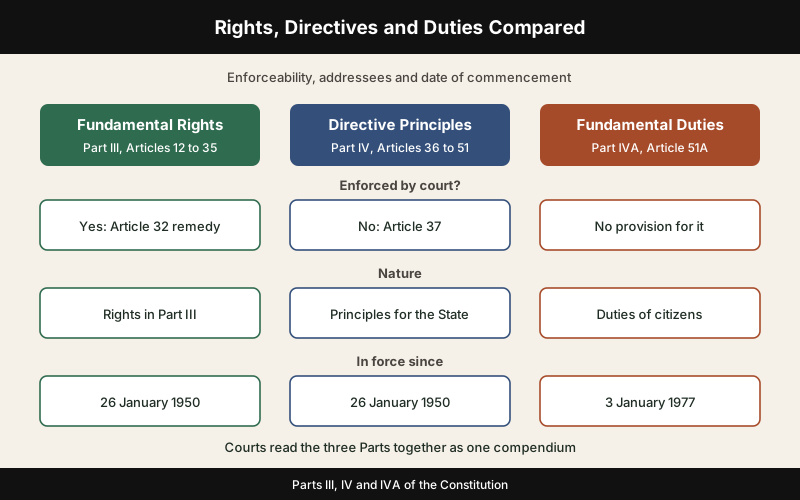
The comparison does not isolate the Parts. The consultation paper describes them as a compendium to be read together, and in AIIMS Students' Union the Supreme Court noted that the duties in Part IVA carry the same prefix, fundamental, as the rights in Part III.
Correlation of Rights and Duties in Court Judgments and Commission Reports
Courts linked rights and duties even before Part IVA existed. In Chandra Bhavan Boarding and Lodging v. State of Mysore (1969), quoted in the consultation paper, the Supreme Court said that it is a fallacy to think that under our Constitution there are only rights and no duties, and that the provisions of Part IV enable the legislatures and the Government to impose various duties on citizens.
The Commission's final report states the relationship precisely: every right implies a corresponding duty, but every duty does not imply a corresponding right. It adds that awareness of citizenship duties is as important as awareness of rights.
The consultation paper also records reasons why the framers did not enact Fundamental Duties in 1950: the values were practised as a way of life, the duties were spelt out by the Preamble, and the rights in Part III had inbuilt obligations. It adds that, with degradation of values in public life over time, the nation felt the need to incorporate them.
Directive Principles and Matching Duties on Environment, Heritage and Education
Several duties are paired with a Directive Principle that places a matching task on the State:
- Article 48A asks the State to endeavour to protect and improve the environment; Article 51A(g) asks every citizen to protect and improve the natural environment.
- Article 49 obliges the State to protect monuments and places and objects of national importance; Article 51A(f) asks every citizen to value and preserve the rich heritage of our composite culture.
- Article 45 asks the State to endeavour to provide early childhood care and education until the age of six, and Article 21A makes education from six to fourteen a right; Article 51A(k) asks parents and guardians to provide opportunities for that education.
Some ideals that look similar belong only to the State. Article 46 directs the State to protect the weaker sections, in particular the Scheduled Castes and the Scheduled Tribes, from social injustice, and Article 51 directs the State to endeavour to promote international peace and security; neither appears among the duties in Article 51A.
Significance, Debates and Recent Developments on Fundamental Duties
Significance of Fundamental Duties and the Enforcement Debate
The design of Part IVA produces three observable outcomes:
- Parliament has incorporated some duties in separate laws, while the consultation paper treats clauses (b), (d), (f), (h) and (j) as exhortations of basic human values to be developed through the education system.
- Courts use the duties to interpret laws and mould relief, and to support measures such as environmental education and higher standards in public service.
- Governments have promoted the duties through education and awareness campaigns, the route recommended by the Verma Committee and the Commission.
The consultation paper itself records two views on enforcement, which answer the same questions differently:
| Question | View favouring legal enforcement | View favouring awareness |
|---|---|---|
| Can the duties be enforced? | It is no longer correct to say they are not enforceable; they have an element of compulsion regarding compliance (para 4.1.6) | They were not intended to be legally enforced by one citizen against the other, and are like the Ten Commandments (para 4.5.10) |
| What should the State do? | Enact suitable legislation wherever necessary, with legal sanctions (para 4.1.6) | Aim not so much to give teeth to the duties as to spread awareness of them among the people (para 4.5.10) |
| Which clauses suit which route? | Comprehensive legislation is needed for clauses (a), (c), (e), (g) and (i) (para 4.1.7) | The remaining five clauses, exhortations of basic human values, are to be developed through the education system (para 4.1.7) |
The same sources record practical limits. The consultation paper said that more than 99 per cent of citizens did not even know of the existence of Article 51A, and the Commission's final report said that much more than Article 51A will be needed to treat all human beings equally, to respect each religion, to confine it to the private sphere and not to make it a bone of contention between different communities.
Recent Developments: Constitution Day, Citizens' Duties Campaign and NEP 2020
Recent official initiatives link the duties to Constitution Day. In November 2015, the Government decided to observe 26 November, the day in 1949 on which the Constitution was adopted, as Constitution Day.
Marking the 70th year of the Constitution's adoption, the Government ran the Nagrik Kartavya Palan Abhiyan from 26 November 2019 to 26 November 2020 to create mass awareness about the Fundamental Duties. Its activities included:
- The kartavya.ugc.ac.in portal, launched on 26 November 2019 for essay competitions, quizzes, debates and poster making.
- A plan for eleven rounds of National Essay Competitions, each on one Fundamental Duty.
- Talks and seminars on Fundamental Duties in schools and colleges by resource persons listed by bodies such as NALSA and the Bar Councils, with the Department of Justice as the nodal department.
The National Education Policy 2020 carries the duties into the curriculum. It envisages that curriculum and pedagogy develop among students a deep sense of respect towards the Fundamental Duties and Constitutional values, lists Fundamental Duties among the values to be learnt, and says that all B.Ed. programmes will emphasise the practice of the Fundamental Duties in Article 51A.
Where Fundamental Duties Fit in the UPSC-CSE Syllabus
This topic belongs to General Studies Paper II: the Indian Constitution, its historical underpinnings and significant provisions, and to the polity section of the Prelims paper.
The Prelims questions linked with this article test precise rules:
- Which obligations appear in Article 51A, as against Directive Principles or proposals never adopted, such as a duty to vote.
- The part of the Constitution that contains the words uphold and protect the sovereignty, unity and integrity of India.
- Whether the duties are enforced through a legislative process or are correlative to legal duties, and how rights relate to duties.
- Whether anyone can be compelled to sing the National Anthem.
The sections above teach every point these questions require, from the text of each clause to the laws and judgments that give the duties effect.
Previous Year UPSC-CSE Questions By the end you will be able to draft model answers for the following UPSC questions. Each question carries a collapsible framework showing how to approach it in the exam.
- UPSC Prelims 2017 GS-IWhich of the following statements is/are true of the Fundamental Duties of an Indian citizen?
- A legislative process has been provided to enforce these duties.
- They are correlative to legal duties.
Select the correct answer using the code given below:
How to approach this Prelims question
Approach: Ask whether the Constitution itself provides a mechanism to enforce Article 51A, and whether every duty corresponds to a legal duty.
Trap to watch: Laws such as the Prevention of Insults to National Honour Act give effect to some duties, which tempts the candidate to treat all duties as legally enforced.
Key facts to recall:
- No legal sanction is provided for violation or non-performance of Fundamental Duties.
- Only some duties have been incorporated in separate laws.
- Courts use the duties as a guide to interpretation, not as writ-enforceable rights.
Answer signal: Neither statement is correct, so option (d) is the answer.
- UPSC Prelims 2012 GS-IWhich of the following is/are among the Fundamental Duties of citizens laid down in the Indian Constitution?
- To preserve the rich heritage of our composite culture
- To protect the weaker sections from social injustice
- To develop the scientific temper and spirit of inquiry
- To strive towards excellence in all spheres of individual and collective activity
Select the correct answer using the codes given below:
How to approach this Prelims question
Approach: Match each item against the text of Article 51A clauses (a) to (k).
Trap to watch: Protecting the weaker sections from social injustice is the language of Article 46, a Directive Principle addressed to the State.
Key facts to recall:
- Clause (f): value and preserve the rich heritage of our composite culture.
- Clause (h): develop the scientific temper, humanism and the spirit of inquiry and reform.
- Clause (j): strive towards excellence in all spheres of individual and collective activity.
Answer signal: Items 1, 3 and 4 are duties, so option (c) is the answer.
- UPSC Prelims 2011 GS-IUnder the Constitution of India, which one of the following is not a fundamental duty?
How to approach this Prelims question
Approach: Check each option against the clauses of Article 51A.
Trap to watch: The Commission recommended adding a duty to vote, which makes the option sound familiar, but it was never inserted.
Key facts to recall:
- Clause (a): abide by the Constitution and respect its ideals and institutions.
- Clause (h): develop the scientific temper.
- Clause (i): safeguard public property and abjure violence.
- The NCRWC recommended including the duty to vote at elections and to pay taxes.
Answer signal: Voting in public elections is not a Fundamental Duty, so option (a) is the answer.
- UPSC Prelims 2015 GS-I“To uphold and protect the Sovereignty, Unity and Integrity of India” is a provision made in the
How to approach this Prelims question
Approach: Recall the exact wording of clause (c) and compare it with the Preamble and Article 19(2).
Trap to watch: The Preamble also mentions unity and integrity, but not the duty to uphold and protect them.
Key facts to recall:
- Article 51A(c): to uphold and protect the sovereignty, unity and integrity of India.
- The Preamble speaks of fraternity assuring the unity and integrity of the Nation.
- Article 19(2) permits restrictions in the interests of the sovereignty and integrity of India.
Answer signal: The phrase is a Fundamental Duty, so option (d) is the answer.
- UPSC Prelims 2017 GS-IIn the context of India, which one of the following is the correct relationship between Rights and Duties?
How to approach this Prelims question
Approach: Eliminate options that separate rights from duties or rank one above the other.
Trap to watch: Options that set rights against duties sound plausible but contradict the Commission's view that every right implies a corresponding duty.
Key facts to recall:
- Every right implies a corresponding duty (NCRWC final report).
- It is a fallacy to think that under the Constitution there are only rights and no duties (Chandra Bhavan, 1969).
- The Verma Committee called citizenship values a combination of rights and duties.
Answer signal: Rights are correlative with duties, so option (a) is the answer.
- UPSC Prelims 1996 GS-IConsider the following statements: No one can be compelled to sing the National Anthem since
- It will be violative of the Right to freedom of speech and expression.
- It will be violative of the Right to freedom of conscience and practise and propagation of religion.
- There is no legal provision obliging any one to sing the National Anthem.
Of these statements
How to approach this Prelims question
Approach: Recall the Articles the judgment dealt with and the Court's observation on the absence of any law.
Trap to watch: Clause (a) of Article 51A asks citizens to respect the National Anthem, but respect is shown by standing up, not by being compelled to sing.
Key facts to recall:
- Bijoe Emmanuel (1986) dealt with Articles 19(1)(a) and 25(1).
- No provision of law obliges anyone to sing the National Anthem.
- Standing up respectfully is proper respect and is not an offence under section 3 of the 1971 Act.
Answer signal: All three statements are correct, so option (c) is the answer.
Prelims MCQ practice
Each question below tests one specific concept on the topic. Click to reveal the answer and a full option-wise explanation.
Q1. Consider the following:
- To value and preserve the rich heritage of our composite culture
- To pay taxes
- To safeguard public property
- To protect the weaker sections from social injustice
How many of the above are Fundamental Duties under Article 51A of the Constitution of India?
- Only one
- Only two
- Only three
- All four
Show answer and explanation
Answer: Only two
Explanation.
Correct: b (Only two). Items 1 and 3 are clauses (f) and (i) of Article 51A. The National Commission to Review the Working of the Constitution proposed a tax-paying duty, which has not been inserted, and protecting the weaker sections from social injustice is a direction to the State under Article 46.
Q2. With reference to clause (k) of Article 51A of the Constitution of India, consider the following statements:
- It was inserted by the Constitution (Eighty-sixth Amendment) Act, 2002 and came into force on 1 April 2010.
- It places on the State the duty to provide free and compulsory education to all children aged six to fourteen years.
Which of the statements given above is/are correct?
- 1 only
- 2 only
- Both 1 and 2
- Neither 1 nor 2
Show answer and explanation
Answer: 1 only
Explanation.
Correct: a (1 only). Statement 1 is correct: section 4 of the Eighty-sixth Amendment Act inserted clause (k) with effect from 1 April 2010. Statement 2 is incorrect: clause (k) binds parents and guardians, not the State, to give their children or wards the chance of an education; the State's obligation to provide free and compulsory education is in Article 21A.
Q3. Consider the following statements:
- The Prevention of Insults to National Honour Act, 1971 punishes intentionally preventing the singing of the National Anthem.
- In Bijoe Emmanuel v. State of Kerala, the Supreme Court held that a person who stands up respectfully but does not join the singing shows disrespect to the National Anthem.
- In 2018, the Supreme Court made the playing of the National Anthem before feature films in cinema halls optional or directory rather than mandatory.
Which of the statements given above are correct?
- 1 only
- 1 and 3 only
- 2 and 3 only
- 1, 2 and 3
Show answer and explanation
Answer: 1 and 3 only
Explanation.
Correct: b (1 and 3 only). Statement 1 is correct under section 3 of the 1971 Act. Statement 2 is incorrect: the Court observed that proper respect is shown by standing up and that it is not right to say that disrespect is shown by not joining in the singing. Statement 3 is correct: on 9 January 2018 the Court modified its interim order of 30 November 2016.
Q4. With reference to the Justice J.S. Verma Committee on Fundamental Duties, consider the following statements:
- It was set up by a Government order dated 21 July 1998.
- It recommended that 3 January be observed as Fundamental Duties Day.
- It submitted its report in October 2001.
Which of the statements given above are correct?
- 1 only
- 1 and 2 only
- 2 and 3 only
- 1, 2 and 3
Show answer and explanation
Answer: 1 and 2 only
Explanation.
Correct: b (1 and 2 only). Statements 1 and 2 are correct. Statement 3 is incorrect: the Committee reported in October 1999, not 2001.
Q5. Consider the following statements:
- In M.C. Mehta v. Union of India (1988), the Supreme Court relied on Article 51A(g) to hold that the Central Government should direct educational institutions to teach at least one hour a week of lessons on the natural environment in the first ten classes.
- In State of Gujarat v. Mirzapur Moti Kureshi Kassab Jamat (2005), the seven-judge Bench was unanimous in upholding the ban on the slaughter of bulls and bullocks.
Which of the statements given above is/are correct?
- 1 only
- 2 only
- Both 1 and 2
- Neither 1 nor 2
Show answer and explanation
Answer: 1 only
Explanation.
Correct: a (1 only). Statement 1 is correct. Statement 2 is incorrect: Chief Justice R. C. Lahoti wrote for six judges, and Justice A. K. Mathur dissented.
Q6. Consider the following pairs of offences under the Indian Penal Code and the corresponding sections of the Bharatiya Nyaya Sanhita, 2023:
- Section 153A of the IPC : Section 196 of the BNS
- Section 153B of the IPC : Section 197 of the BNS
- Section 295A of the IPC : Section 299 of the BNS
- Section 505 of the IPC : Section 356 of the BNS
How many of the above pairs are correctly matched?
- Only one pair
- Only two pairs
- Only three pairs
- All four pairs
Show answer and explanation
Answer: Only three pairs
Explanation.
Correct: c (Only three pairs). Pairs 1, 2 and 3 are correct. Pair 4 is incorrect: statements conducing to public mischief, section 505 of the IPC, correspond to section 353 of the BNS.
Sources and Further Reading
- Legislative Department, Ministry of Law and Justice: The Constitution of India
- Department of Legal Affairs: NCRWC consultation paper on Effectuation of Fundamental Duties of Citizens (6 July 2001)
- Ministry of Law and Justice: NCRWC Report, Volume I, Chapter 3 (Fundamental Rights, Directive Principles and Fundamental Duties)
- Supreme Court of India: Ranganath Mishra v. Union of India, order of 31 July 2003
- Supreme Court of India: M.C. Mehta v. Union of India, judgment of 12 January 1988
- Supreme Court of India: M.C. Mehta v. Union of India, judgment of 14 March 1991
- Supreme Court of India: Shyam Narayan Chouksey v. Union of India, judgment of 9 January 2018
- Digital Supreme Court Reports: AIIMS Students' Union v. AIIMS, [2001] Supp. 2 SCR 79
- Digital Supreme Court Reports: State of Gujarat v. Mirzapur Moti Kureshi Kassab Jamat, [2005] Supp. 4 SCR 582
- Digital Supreme Court Reports: Bijoe Emmanuel v. State of Kerala (1986 INSC 167)
- Ministry of Home Affairs: The Prevention of Insults to National Honour Act, 1971
- India Code: The Representation of the People Act, 1951
- India Code: The Bharatiya Nyaya Sanhita, 2023
- National Crime Records Bureau: Corresponding section table of the Bharatiya Nyaya Sanhita, 2023
- Press Information Bureau: 26th November to be observed as Constitution Day (23 November 2015)
- Press Information Bureau: Nagrik Kartavya Palan Abhiyan and Constitution Day (26 November 2019)
- Press Information Bureau: Yearlong activities on Constitution Day and Citizens' Duties (6 December 2019)
- Press Information Bureau: Round-up of activities on Constitution Day and Fundamental Duties (29 January 2020)
- Ministry of Education: National Education Policy 2020
- Wikipedia: Fundamental Rights, Directive Principles and Fundamental Duties of India
- Wikipedia: Jana Gana Mana
- Wikipedia: List of Supreme Court cases involving Jehovah's Witnesses
- Wikipedia: National Commission to review the working of the Constitution
Editorial Disclaimer
This article is for UPSC preparation and explains the constitutional and statutory position on Fundamental Duties. Laws and official orders change from time to time, so the current official text governs any individual case.


