

Overview
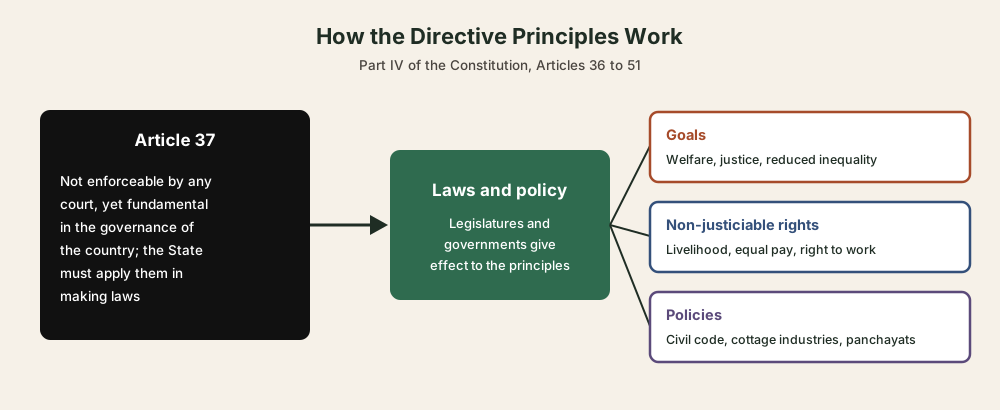
Directive Principles of State Policy are the principles in Part IV of the Constitution, Articles 36 to 51, that direct the State in making laws and policy. Under Article 37 no court can enforce them, yet they remain basic to how the country is governed, and the State must apply them when it makes laws. They set goals of social, economic and political justice, name rights such as equal pay for men and women doing equal work and an adequate livelihood for every citizen, and prescribe policies such as a uniform civil code, village panchayats and protection of the environment.
Directive Principles of State Policy: Meaning and Constitutional Place
Part IV as Instructions to the State for Governance
Directive Principles of State Policy are the directions in Part IV of the Constitution, Articles 36 to 51, that tell the State what ends its laws and policies should pursue. Article 36 gives "the State" in Part IV the same meaning as in Part III, where it includes the Union and State Governments and legislatures and all local or other authorities.
The principles matter because they record the social and economic goals of the Constitution. Article 38(1) asks the State to promote the welfare of the people by securing a social order in which justice, social, economic and political, informs all the institutions of national life. In Minerva Mills (1980), the Supreme Court described Parts III and IV together as the conscience of the Constitution.
The significance of Part IV lies in three features of its design:
- It sets goals and directions rather than enforceable rights, since its provisions cannot be enforced by any court.
- It binds the lawmaker, because Article 37 makes it the duty of the State to apply the principles in making laws.
- It has grown by amendment: the latest addition, Article 43B on co-operative societies, took effect on 15 February 2012.
Justice Sudhanshu Dhulia wrote in 2024 that the purpose of the principles is the welfare of the people and of the community, and that the provisions of Part IV are directions to the State to bring legislation which would make the welfare State a reality.
Article 37: Not Enforceable by Courts Yet Fundamental in Governance
Article 37 states the legal character of the whole Part. Its provisions "shall not be enforceable by any court, but the principles therein laid down are nevertheless fundamental in the governance of the country and it shall be the duty of the State to apply these principles in making laws".
The framers chose this design deliberately. They did not want future governments to be bound to particular policy decisions, so the guidelines were made non-justiciable: a citizen cannot ask a court to order a government to implement one. They expected the moral force of the principles, and the people holding governments responsible, to secure their implementation.
The contrast with Part III is exact. Under Article 13(2), a law that takes away or abridges a Fundamental Right is void to the extent of the contravention, and Article 32 guarantees the right to move the Supreme Court to enforce Part III. Fundamental Rights restrain the government from doing certain things, while Directive Principles exhort it to do certain things.
The choice was debated. Professor K. T. Shah sought to make the principles enforceable in the Constituent Assembly, but the suggestion was turned down, and draft Article 29 became Article 37. In State of West Bengal v. Subodh Gopal Bose, the Supreme Court held that although the principles are not justiciable, courts have a duty to interpret the Constitution and the laws in furtherance of them.
Origins: The Irish Model and the Instrument of Instructions
Introducing the Draft Constitution on 4 November 1948, Dr B. R. Ambedkar called the Directive Principles a novel feature and said that the only other constitution embodying such principles was that of Ireland. Article 45 of the Irish Constitution likewise provides that the application of its Principles of Social Policy shall not be cognizable by any court.
Ambedkar compared the principles to the Instrument of Instructions issued to the Governor-General and the Governors of the colonies under the Government of India Act, 1935, the difference being that the Directive Principles are instructions to the Legislature and the Executive.
He also answered the charge that the principles were mere pious declarations. He admitted that they have no legal force but denied that they have no binding force at all, because future governments, though not answerable in a court of law, would be answerable before the electorate.
Responding on 19 November 1948 to an amendment to draft article 30, which corresponds to the present Article 38, he said that alongside parliamentary democracy the Constitution sought to establish economic democracy as an ideal.
Articles 36 to 51: Each Directive Principle Explained
Part IV at a Glance: Articles 36 to 51
Part IV contains twenty articles, from Article 36 to Article 51, including four inserted later by amendment. The table lists each with its official heading and the core of what it asks of the State.
| Article | Official heading | Core direction |
|---|---|---|
| 36 | Definition | "The State" has the same meaning as in Part III |
| 37 | Application of the principles contained in this Part | Not enforceable by any court; fundamental in governance; duty to apply in making laws |
| 38 | State to secure a social order for the promotion of welfare of the people | Social order informed by justice; minimise inequalities in income and eliminate inequalities in status, facilities and opportunities |
| 39 | Certain principles of policy to be followed by the State | Livelihood, distribution of material resources, no concentration of wealth to the common detriment, equal pay, protection of workers and children |
| 39A | Equal justice and free legal aid | Free legal aid so that no citizen is denied justice for economic or other disabilities |
| 40 | Organisation of village panchayats | Village panchayats as units of self-government |
| 41 | Right to work, to education and to public assistance in certain cases | Within the limits of economic capacity and development |
| 42 | Provision for just and humane conditions of work and maternity relief | Just and humane conditions of work; maternity relief |
| 43 | Living wage, etc., for workers | Living wage, decent standard of life, leisure; cottage industries in rural areas |
| 43A | Participation of workers in management of industries | Participation of workers in management |
| 43B | Promotion of co-operative societies | Voluntary formation, autonomous functioning, democratic control, professional management |
| 44 | Uniform civil code for the citizens | Endeavour to secure a uniform civil code throughout India |
| 45 | Provision for early childhood care and education to children below the age of six years | Early childhood care and education until age six |
| 46 | Promotion of educational and economic interests of Scheduled Castes, Scheduled Tribes and other weaker sections | Special care for weaker sections; protection from social injustice and exploitation |
| 47 | Duty of the State to raise the level of nutrition and the standard of living and to improve public health | Nutrition and public health as primary duties; prohibition of intoxicating drinks and harmful drugs except for medicinal purposes |
| 48 | Organisation of agriculture and animal husbandry | Modern, scientific agriculture; preserve breeds; prohibit slaughter of cows, calves and other milch and draught cattle |
| 48A | Protection and improvement of environment and safeguarding of forests and wild life | Protect and improve the environment; safeguard forests and wild life |
| 49 | Protection of monuments and places and objects of national importance | Protect monuments declared by or under law made by Parliament to be of national importance |
| 50 | Separation of judiciary from executive | Separate the judiciary from the executive in the public services of the State |
| 51 | Promotion of international peace and security | Peace, just relations, respect for international law, arbitration |
The table shows that the principles are written in different terms. Some use "shall", as in Article 40, which says the State shall take steps to organise village panchayats, while many others say only that the State shall endeavour or strive, as in Articles 43B, 44, 45 and 48A.
Articles 38 and 39: Social Order, Livelihood, Resources and Equal Pay
Article 38(1) asks the State to strive to promote the welfare of the people by securing a social order in which social, economic and political justice informs all the institutions of national life. Article 38(2) adds that the State shall strive to minimise inequalities in income and endeavour to eliminate inequalities in status, facilities and opportunities, among individuals and among groups living in different areas or engaged in different vocations.
Article 39 directs the policy of the State towards securing six objectives:
- (a) Citizens, men and women equally, have the right to an adequate means of livelihood.
- (b) The ownership and control of the material resources of the community are so distributed as best to subserve the common good.
- (c) The operation of the economic system does not result in the concentration of wealth and means of production to the common detriment.
- (d) There is equal pay for equal work for both men and women.
- (e) The health and strength of workers and the tender age of children are not abused, and citizens are not forced by economic necessity into avocations unsuited to their age or strength.
- (f) Children are given opportunities and facilities to develop in a healthy manner and in conditions of freedom and dignity, and childhood and youth are protected against exploitation and against moral and material abandonment.
Clauses (b) and (c) have a special legal position, because Article 31C was written to protect laws giving effect to them, as the section on Fundamental Rights explains. Concentration of wealth and means of production to the common detriment therefore runs against a Directive Principle, Article 39(c), rather than against a Fundamental Right.
Articles 39A to 43B: Legal Aid, Panchayats, Work and Co-operatives
The next group of principles deals with justice, local self-government and the conditions of work:
- Article 39A: the State shall secure that the legal system promotes justice on a basis of equal opportunity and shall, in particular, provide free legal aid, by suitable legislation or schemes or in any other way, so that no citizen is denied justice because of economic or other disabilities.
- Article 40: the State shall take steps to organise village panchayats and endow them with the powers and authority necessary to function as units of self-government.
- Article 41: the State shall, within the limits of its economic capacity and development, make effective provision for securing the right to work, to education and to public assistance in cases of unemployment, old age, sickness and disablement, and in other cases of undeserved want.
- Article 42: the State shall make provision for securing just and humane conditions of work and for maternity relief.
- Article 43: the State shall endeavour to secure to all workers work, a living wage, conditions ensuring a decent standard of life and full enjoyment of leisure and social and cultural opportunities, and in particular to promote cottage industries on an individual or co-operative basis in rural areas.
- Article 43A: the State shall take steps to secure the participation of workers in the management of undertakings, establishments or other organisations engaged in any industry.
- Article 43B: the State shall endeavour to promote the voluntary formation, autonomous functioning, democratic control and professional management of co-operative societies.
The qualifiers in these articles matter for exact recall. Article 41 operates only within the limits of economic capacity and development, and Article 43 covers workers "agricultural, industrial or otherwise", while its promotion of cottage industries is tied to rural areas.
Articles 44 to 48A: Civil Code, Children, Weaker Sections, Health and Environment
Article 46 is the principle most directly addressed to particular groups. It asks the State to promote with special care the educational and economic interests of the weaker sections of the people, and in particular of the Scheduled Castes and Scheduled Tribes, and to protect them from social injustice and all forms of exploitation.
The other principles in this group address family law, children, health, agriculture and the environment:
- Article 44: the State shall endeavour to secure for the citizens a uniform civil code throughout the territory of India.
- Article 45: the State shall endeavour to provide early childhood care and education for all children until they complete the age of six years.
- Article 47: the State shall regard raising the level of nutrition and the standard of living and improving public health as among its primary duties and, in particular, shall endeavour to bring about prohibition of the consumption, except for medicinal purposes, of intoxicating drinks and of drugs injurious to health.
- Article 48: the State shall endeavour to organise agriculture and animal husbandry on modern and scientific lines and, in particular, take steps for preserving and improving the breeds, and prohibiting the slaughter, of cows and calves and other milch and draught cattle.
- Article 48A: the State shall endeavour to protect and improve the environment and to safeguard the forests and wild life of the country.
Articles 49 to 51: Monuments, Separation of Judiciary and International Peace
Article 49 makes it an obligation of the State to protect every monument, place or object of artistic or historic interest declared by or under law made by Parliament to be of national importance from spoliation, disfigurement, destruction, removal, disposal or export.
Article 50 directs that the State shall take steps to separate the judiciary from the executive in the public services of the State. The principle of separating the judiciary from the executive therefore rests on Article 50 in Part IV.
Article 51 sets out India's constitutional outlook on foreign relations. The State shall endeavour to:
- (a) promote international peace and security;
- (b) maintain just and honourable relations between nations;
- (c) foster respect for international law and treaty obligations in the dealings of organised peoples with one another; and
- (d) encourage settlement of international disputes by arbitration.
Goals, Non-Justiciable Rights and Policies: Grouping the Principles
A useful way to read Part IV is to group its contents by what they ask of the State. The principles set out three kinds of content:
- Goals and objectives that society should adopt, such as the welfare of the people, social, economic and political justice, and the promotion of international peace.
- Rights that individuals should enjoy apart from the Fundamental Rights, such as an adequate livelihood, equal pay for equal work, and the right to work.
- Policies that the government should adopt, such as a uniform civil code, prohibition of the consumption of alcoholic liquor, and the promotion of village panchayats.
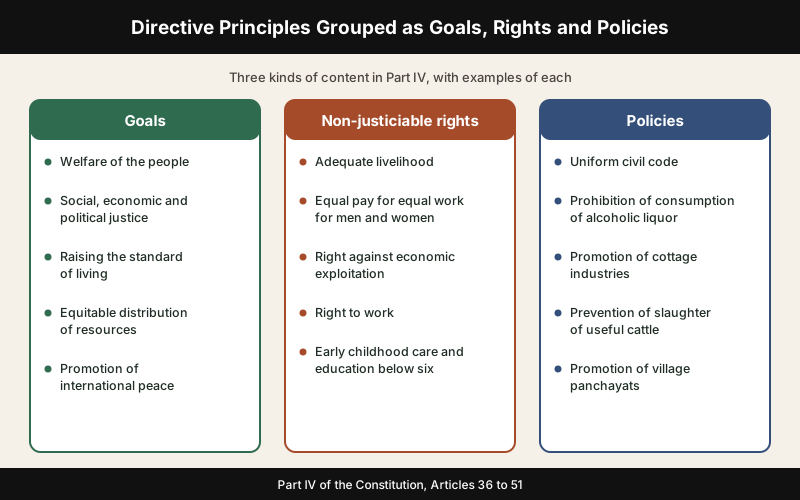
This grouping is a study aid rather than a classification made by the Constitution, which lists the principles article by article without dividing them into categories. The grouping does not change the legal character of any principle, since every one of them is covered by Article 37.
Principles Added by the 42nd, 44th, 86th and 97th Amendments
Timeline of Amendments That Changed Part IV
Part IV has been changed by constitutional amendment several times, and the official text records each change with its date of effect:
| Amending Act | Change to Part IV | In force from |
|---|---|---|
| Constitution (Seventh Amendment) Act, 1956 | Article 49: "declared by or under law made by Parliament" substituted for "declared by Parliament by law" | 1 November 1956 |
| Constitution (Forty-second Amendment) Act, 1976 | Clause (f) of Article 39 substituted; Articles 39A, 43A and 48A inserted | 3 January 1977 |
| Constitution (Forty-fourth Amendment) Act, 1978 | Article 38 renumbered as clause (1); clause (2) inserted | 20 June 1979 |
| Constitution (Eighty-sixth Amendment) Act, 2002 | Article 45 substituted | 1 April 2010 |
| Constitution (Ninety-seventh Amendment) Act, 2011 | Article 43B inserted | 15 February 2012 |
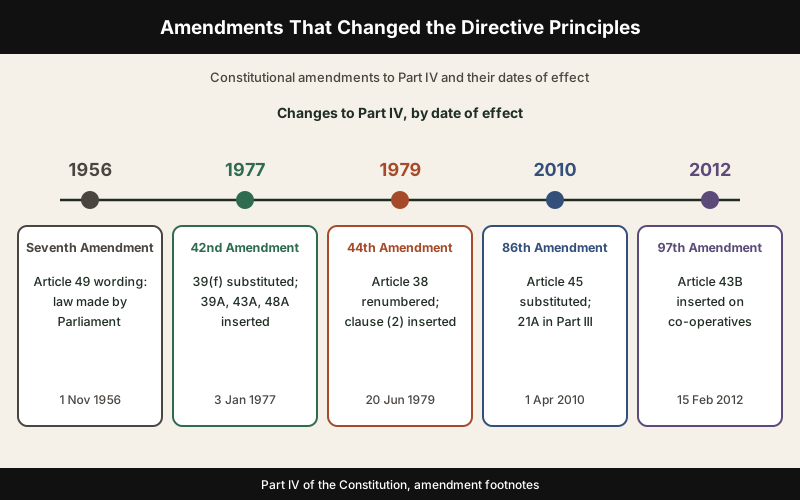
The table dates each change from when it took effect, which is later than the year in the name of the amending Act for the 42nd, 44th, 86th and 97th Amendments. The 42nd Amendment made the largest set of changes.
42nd Amendment, 1976: Children, Legal Aid, Workers and Environment
The Constitution (Forty-second Amendment) Act, 1976, in force from 3 January 1977, made four changes to Part IV:
- Substituted clause (f) of Article 39, on healthy development of children and protection of childhood and youth against exploitation and abandonment.
- Inserted Article 39A on equal justice and free legal aid.
- Inserted Article 43A on the participation of workers in the management of industries.
- Inserted Article 48A on protecting and improving the environment and safeguarding forests and wild life.
Among the principles on work, the 42nd Amendment therefore added participation of workers in management, while equal pay for equal work, the right to work and the living wage were in the original text of Articles 39, 41 and 43.
The same amendment also inserted Part IVA on Fundamental Duties, and it tried to extend the protection of Article 31C to laws giving effect to any principle in Part IV, an extension the Supreme Court later declared invalid.
44th, 86th and 97th Amendments: Inequalities, Early Childhood and Co-operatives
The Constitution (Forty-fourth Amendment) Act, 1978, in force from 20 June 1979, renumbered Article 38 as clause (1) and inserted clause (2) on minimising inequalities in income and eliminating inequalities in status, facilities and opportunities.
The Constitution (Eighty-sixth Amendment) Act, 2002, in force from 1 April 2010, inserted Article 21A in Part III, under which the State shall provide free and compulsory education to all children of six to fourteen years as the State may by law determine. It also substituted Article 45, which now deals with early childhood care and education for children until they complete six years.
The Constitution (Ninety-seventh Amendment) Act, 2011, in force from 15 February 2012, inserted Article 43B, under which the State shall endeavour to promote the voluntary formation, autonomous functioning, democratic control and professional management of co-operative societies.
Directives Outside Part IV of the Constitution
Articles 335, 350A and 351: Services, Mother Tongue and Hindi
Some directions to the State appear outside Part IV, in other Parts of the Constitution:
- Article 335 (Part XVI): the claims of the members of the Scheduled Castes and Scheduled Tribes shall be taken into consideration, consistently with the maintenance of efficiency of administration, in making appointments to services and posts of the Union or a State.
- Article 350A (Part XVII): it shall be the endeavour of every State and every local authority to provide adequate facilities for instruction in the mother-tongue at the primary stage to children of linguistic minority groups.
- Article 351 (Part XVII): it shall be the duty of the Union to promote the spread of the Hindi language and to develop it so that it may serve as a medium of expression for all the elements of the composite culture of India.
Article 351 is the only one of the three whose heading calls it a directive: "Directive for development of the Hindi language". Article 350A also allows the President to issue directions to any State for securing mother-tongue facilities, and it was inserted by the Seventh Amendment with effect from 1 November 1956.
Fundamental Rights and Directive Principles: From Conflict to Harmony
Why Conflict Arose: Land Reform and the Right to Property
Fundamental Rights mainly protect the rights of individuals, while Directive Principles aim at the well-being of the entire society, and the two can conflict when a government acts on a principle. The problem arose when governments sought to abolish the zamindari system, and the laws were opposed as violating the right to property.
Governments amended the Constitution to give effect to the principles, and a long legal battle followed. The government argued that rights could be abridged for giving effect to the Directive Principles, while the court held that Fundamental Rights were so important that they could not be limited even for that purpose. The 44th Amendment, in force from 20 June 1979, moved the right to property out of Part III into Article 300A.
Champakam Dorairajan, 1951, and the First Amendment
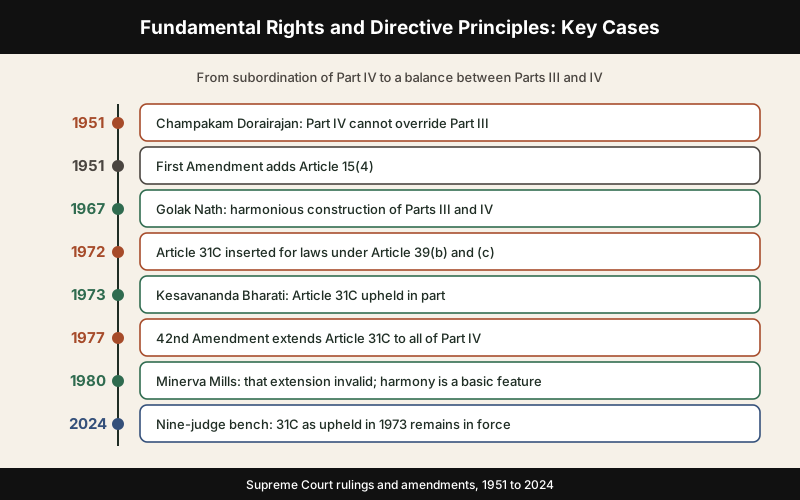
In State of Madras v. Champakam Dorairajan (1951), the Supreme Court held that the Directive Principles, which Article 37 makes unenforceable, cannot override the provisions of Part III, which are enforceable by writs under Article 32. It called the chapter on Fundamental Rights sacrosanct.
The case concerned a Madras Government Order of 1927 that provided caste-based reservation in government jobs and college seats, which the Court held violated Article 29(2). The Constitution (First Amendment) Act, 1951, in force from 18 June 1951, then added Article 15(4), enabling special provision for socially and educationally backward classes and for the Scheduled Castes and Scheduled Tribes.
The Court's approach later moved towards harmonious construction. In Mohd Hanif Qureshi v. State of Bihar, it held that attempts must be made to interpret the principles and the rights harmoniously, while still treating the rights as constraints, and the nine-judge bench of 2024 described Golak Nath (1967) as marking the start of that era.
Article 31C: Kesavananda Bharati, 1973, and Minerva Mills, 1980
Article 31C was written to protect laws giving effect to the principles in Article 39(b) and (c) from challenge under certain Fundamental Rights. Its history runs through five steps:
- The Constitution (Twenty-fifth Amendment) Act, 1971 inserted Article 31C with effect from 20 April 1972, so that a law giving effect to the policy of securing the principles in Article 39(b) or (c) would not be void for inconsistency with Article 14, Article 19 or Article 31, and a law declaring that purpose could not be questioned in court for failing to give effect to it.
- In Kesavananda Bharati v. State of Kerala, decided on 24 April 1973, the Supreme Court upheld Article 31C in part and struck down the words barring courts from questioning such a declaration.
- The Constitution (Forty-second Amendment) Act, 1976, in force from 3 January 1977, extended the protection to laws giving effect to all or any of the principles in Part IV.
- The Constitution (Forty-fourth Amendment) Act, 1978, in force from 20 June 1979, replaced “article 14, article 19 or article 31” with “article 14 or article 19”.
- In Minerva Mills v. Union of India, decided on 31 July 1980, the Court by a 4:1 majority declared section 4 of the 42nd Amendment, the extension to all of Part IV, invalid.
In Minerva Mills, Chief Justice Y. V. Chandrachud called Parts III and IV two wheels of a chariot, one no less important than the other. The Court held that to give absolute primacy to one over the other disturbs the harmony of the Constitution, and that this harmony and balance between Fundamental Rights and Directive Principles is an essential feature of the basic structure.
Property Owners Association, 2024: Article 39(b) and Article 31C Revisited
On 5 November 2024, in Property Owners Association v. State of Maharashtra, a nine-judge bench answered a reference on Articles 31C and 39(b). Chief Justice D. Y. Chandrachud wrote for seven judges, Justice B. V. Nagarathna wrote a separate opinion concurring on certain issues, and Justice Sudhanshu Dhulia disagreed on the meaning of Article 39(b).
The conclusions of the opinion of the Chief Justice include four answers on Article 31C and Article 39(b):
- Article 31C, to the extent it was upheld in Kesavananda Bharati, remains in force; Justice Dhulia expressly agreed that the unamended Article 31C, to that extent, survives.
- The phrase “material resources of the community” in Article 39(b) may in theory include privately owned resources, but not every resource owned by an individual can be treated as one merely because it meets material needs.
- Whether a resource falls within Article 39(b) is a context-specific inquiry, guided by factors such as the nature of the resource, its impact on the well-being of the community, its scarcity, and the consequences of its concentration in private hands.
- Distribution has a wide meaning and may include vesting the resource in the State or nationalisation, and in a specific case the court must determine whether the distribution subserves the common good.
The majority held that Sanjeev Coke erred in relying on Justice Krishna Iyer's minority view in Ranganatha Reddy, and it said the Court must not endorse a particular economic ideology while interpreting the Constitution. Justice Dhulia recorded his strong disapproval of the remarks on Justice Krishna Iyer's approach, which he described as based on humanist principles of fairness and equity.
Part III and Part IV: Enforcement, Effect and Purpose Compared
The two Parts differ in legal force but share the same definition of the State through Article 36. The table sets out the main differences recorded in the constitutional text and in the rulings above.
| Point of comparison | Fundamental Rights (Part III) | Directive Principles (Part IV) |
|---|---|---|
| Articles | Articles 12 to 35 | Articles 36 to 51 |
| Enforcement | Right to move the Supreme Court guaranteed by Article 32 | Not enforceable by any court under Article 37 |
| Effect on laws | A law abridging a right is void to that extent under Article 13(2) | The State has a duty to apply the principles in making laws |
| Nature | Restrain the government from doing certain things | Exhort the government to do certain things |
| Main concern | Mainly protect the rights of individuals | Aim at the well-being of the entire society |
| Relationship | Minerva Mills (1980): harmony and balance with Part IV is an essential feature of the basic structure | Minerva Mills (1980): harmony and balance with Part III is an essential feature of the basic structure |
For the same reason, the Directive Principles do not operate as limitations on legislative or executive functions in the way Fundamental Rights do. They impose on the State a duty to apply them in making laws, but that duty cannot be enforced by any court.
How Governments Have Given Effect to Directive Principles
Land Reform, Labour Laws, Panchayats and Education in Practice
Governments have tried from time to time to give effect to the Directive Principles through legislation and programmes. The record includes nine kinds of action:
- Laws abolishing the zamindari system.
- Nationalisation of banks.
- Numerous factory laws.
- Fixing of minimum wages.
- Promotion of cottage and small industries.
- Provisions for reservation for the uplift of the Scheduled Castes and Scheduled Tribes.
- The right to education.
- Formation of panchayati raj institutions all over the country.
- A partial right to work under the employment guarantee programme, and the mid-day meal scheme.
Two of these items are now reflected in the constitutional text. The 73rd Amendment, in force from 24 April 1993, requires Panchayats at the village, intermediate and district levels in every State, although the intermediate level need not be constituted in a State with a population not exceeding twenty lakhs, and the 86th Amendment made education for children of six to fourteen a Fundamental Right.
Observable Outcomes of the Design of Part IV
The design of Part IV has produced three observable outcomes:
- The principles guide interpretation: in State of West Bengal v. Subodh Gopal Bose, the Supreme Court held that courts have a duty to interpret the Constitution and the laws in furtherance of the Directive Principles, though the principles themselves are not justiciable.
- Parliament has changed Part IV by amendment, with changes taking effect in 1956, 1977, 1979, 2010 and 2012.
- The relationship with Fundamental Rights has returned to the Supreme Court repeatedly, from Champakam Dorairajan in 1951 to the nine-judge bench in 2024.
Ambedkar's expectation in 1948 was that governments would respect the principles because they are answerable for them before the electorate, even though they are not answerable for a breach in a court of law.
Uniform Civil Code Under Article 44: Debate and Developments
Article 44 and India's Systems of Personal Law
Article 44 provides that the State shall endeavour to secure for the citizens a uniform civil code throughout the territory of India. Like the rest of Part IV, it cannot be enforced by any court, and it is addressed to citizens rather than to all persons.
India's family law has developed through separate systems. After independence, the Hindu code bills codified and reformed the personal laws of Hindus, Buddhists, Jains and Sikhs but did not apply to Christians, Jews, Muslims and Parsis, and Goa continues to follow the Goa Civil Code, originally the Portuguese Civil Code, after its annexation in 1961. The debate on a uniform code became a major political question after the Shah Bano case of 1985.
Law Commission Consultations: 2016 Reference, 2018 Paper and 2023 Notice
The Law Commission of India has examined the subject in two rounds of consultation:
- 17 June 2016: the Ministry of Law and Justice referred to the Law Commission the task of examining matters in relation to a uniform civil code.
- 7 October 2016: the 21st Law Commission issued an appeal with a questionnaire, followed by public appeals and notices of 19 March, 27 March and 10 April 2018.
- 31 August 2018: the 21st Law Commission issued its Consultation Paper on Reform of Family Law.
- 14 June 2023: the 22nd Law Commission, noting that more than three years had passed since that paper and the various court orders on the subject, decided to deliberate afresh and invited views from the public and recognised religious organisations within 30 days.
The 2018 paper dealt with laws that are discriminatory rather than providing a uniform civil code, which it said was neither necessary nor desirable at this stage. It urged the legislature to consider first guaranteeing equality within communities between men and women rather than equality between communities, and it warned that the urge for uniformity should not itself become a threat to the territorial integrity of the nation.
Uttarakhand Uniform Civil Code, 2024: A State Code in Force
The Uniform Civil Code, Uttarakhand, 2024 came into effect on 27 January 2025. The Chief Minister announced that Uttarakhand was the first State in independent India where such a law had come into effect, and described its aim as bringing uniformity in laws on personal civil matters that discriminate on the basis of caste, religion and sex.
The Uniform Civil Code Rules, Uttarakhand, 2025 provide for the registration of marriages, divorce and nullity of marriage, and of live-in relationships. Pursuant to section 2 of the Code, the Rules do not apply to members of any Scheduled Tribes or to persons whose customary rights are protected under Part XXI of the Constitution.
Customary Law Protections in Nagaland, Mizoram and Sixth Schedule Areas
The Constitution itself protects customary law in parts of the North East, which bears on any national code. Three provisions are relevant:
- Article 371A(1)(a): no Act of Parliament in respect of matters including the religious or social practices of the Nagas, and Naga customary law and procedure, shall apply to Nagaland unless its Legislative Assembly by resolution so decides.
- Article 371G(a): no Act of Parliament in respect of matters including the religious or social practices of the Mizos, and Mizo customary law and procedure, shall apply to Mizoram unless its Legislative Assembly by resolution so decides.
- Sixth Schedule, paragraph 3(1): District and Regional Councils have power to make laws on matters including the inheritance of property, marriage and divorce, and social customs.
Article 25 adds a further element. It guarantees to all persons freedom of conscience and the right to profess, practise and propagate religion, subject to public order, morality and health, but it does not prevent the State from making laws providing for social welfare and reform.
Factors in the Uniform Civil Code Debate
Official sources point to several factors that bear on the debate on enacting a uniform civil code for the whole country:
- Diversity and plurality: the 2018 Law Commission paper sought to preserve the diversity and plurality of the nation’s cultural and social fabric while addressing discrimination.
- Choice of approach: the same paper preferred removing discrimination within each system of personal law to uniformity across communities.
- Constitutional protections for customary law: Articles 371A and 371G and the Sixth Schedule preserve the customary laws of certain communities, and Uttarakhand’s Rules exclude the Scheduled Tribes.
- Religious freedom and reform: Article 25 protects the freedom of religion while allowing laws for social welfare and reform.
- Continuing consultation: the Law Commission has sought public views twice, in 2016 to 2018 and again in 2023.
Article 44 remains a directive to the State. Marriage and divorce, and wills, intestacy and succession, are matters in item 5 of the Concurrent List, on which both Parliament and the State Legislatures may make laws, and Uttarakhand has legislated on them.
Evaluation of Directive Principles: Criticism, Defence and Recent Developments
Criticism and Defence of the Directive Principles
The Directive Principles have been debated since the Constituent Assembly. The main criticisms, and the replies to them, fall on two questions:
- Legal force, the criticism: the principles were called mere pious declarations without binding force, and Professor K. T. Shah’s proposal to make them enforceable was turned down.
- Legal force, the reply: Ambedkar accepted that they have no legal force but argued that governments remain answerable for them before the electorate, and in Subodh Gopal Bose the Supreme Court held that courts must interpret the Constitution and the laws in furtherance of the principles.
- Conflict with rights, the criticism: when governments acted on the principles, as in abolishing zamindari, the laws collided with the right to property, and the government argued that rights could be abridged for the principles.
- Conflict with rights, the reply: in Minerva Mills the Supreme Court held that the harmony and balance between Parts III and IV is an essential feature of the basic structure.
The 2024 opinions show the debate continuing. The Chief Justice's opinion said the Court must not endorse a particular economic ideology when reading Article 39(b), while Justice Dhulia, dissenting on Article 39(b), wrote that, since the principles are fundamental in governance, courts should best apply restraint unless their implementation destroys the core principles of the Constitution.
Recent Developments: Article 39(b) Ruling, Uttarakhand Code and Law Commission
Three recent developments connect the Directive Principles to current affairs:
- 14 June 2023: the 22nd Law Commission invited fresh views on a uniform civil code, after the 21st Law Commission’s paper of 2018.
- 5 November 2024: the nine-judge bench in Property Owners Association held that Article 31C, as upheld in 1973, remains in force, and that not every privately owned resource is a material resource of the community under Article 39(b).
- 27 January 2025: the Uniform Civil Code, Uttarakhand, 2024 came into effect, with its Rules excluding members of the Scheduled Tribes.
Each development turns on the text of a specific article, Article 39(b) or Article 44, and each is explained earlier in this article alongside the provision it concerns, so the recent ruling or law can be read with the text it applies.
UPSC Relevance and Previous-Year Questions
Where Directive Principles Fit in the UPSC-CSE Syllabus
This topic belongs to General Studies Paper II, under the Indian Constitution, its historical underpinnings and significant provisions, and to the polity section of the Prelims paper. The Prelims questions linked with this article test precise points:
- The legal character of Part IV under Article 37, and whether the principles limit legislative or executive functions.
- The ideals the principles express, such as socio-economic democracy and the welfare state, and their link to the Instrument of Instructions of 1935.
- The content of individual articles, such as Article 39(c) on concentration of wealth and Article 43A added by the 42nd Amendment.
The Mains question linked with this article asks about the factors that inhibit a uniform civil code under Article 44. The sections above teach every point these questions require.
Previous Year UPSC-CSE Questions By the end you will be able to draft model answers for the following UPSC questions. Each question carries a collapsible framework showing how to approach it in the exam.
- UPSC Prelims 2020 GS-IWith reference to the provisions contained in Part IV of the Constitution of India, which of the following statements is/are correct?
- They shall be enforceable by courts.
- They shall not be enforceable by any court.
- The principles laid down in this part are to influence the making of laws by the State.
Select the correct answer using the code given below:
How to approach this Prelims question
Approach: Recall the two halves of Article 37: the provisions are not enforceable by any court, and the State has a duty to apply the principles in making laws.
Trap to watch: Statements 1 and 2 contradict each other, so at most one of them can be correct.
Key facts to recall:
- Article 37: the provisions of Part IV shall not be enforceable by any court.
- The principles are fundamental in the governance of the country.
- It is the duty of the State to apply the principles in making laws.
Answer signal: Statements 2 and 3 are correct, so option (d) is the answer.
- UPSC Prelims 2020 GS-IWhich part of the Constitution of India declares the ideal of Welfare State ?
How to approach this Prelims question
Approach: Match the ideal to the Part that directs the State to promote the welfare of the people, which is Part IV.
Trap to watch: Other options also carry social ideals, so the answer turns on which Part directs the State to promote the welfare of the people.
Key facts to recall:
- Article 38(1): the State shall strive to promote the welfare of the people.
- Part IV directions aim at making the welfare State a reality.
Answer signal: The Directive Principles declare the ideal, so option (a) is the answer.
- UPSC Prelims 2017 GS-IWhich principle among the following was added to the Directive Principles of State Policy by the 42nd Amendment to the Constitution?
How to approach this Prelims question
Approach: Recall the four changes of the 42nd Amendment to Part IV: clause (f) of Article 39 substituted, and Articles 39A, 43A and 48A inserted.
Trap to watch: All four options are genuine Directive Principles, so the question tests the date of insertion, not whether the principle exists.
Key facts to recall:
- Articles 39A, 43A and 48A were inserted by the 42nd Amendment, in force from 3 January 1977.
- Articles 39(d), 41 and 43 have no amendment footnote, so they are part of the original text.
Answer signal: Participation of workers in management is Article 43A, so option (b) is the answer.
- UPSC Prelims 2017 GS-IWith reference to the Constitution of India, the Directive Principles of State Policy constitute limitations upon
- legislative function.
- executive function.
Which of the above statements is/are correct?
How to approach this Prelims question
Approach: Contrast the two Parts: Fundamental Rights restrain the government, while Directive Principles exhort it and cannot be enforced by any court.
Trap to watch: The word limitations describes Fundamental Rights under Article 13, not Directive Principles.
Key facts to recall:
- Article 13(2): a law abridging a Fundamental Right is void to that extent.
- Article 37: Part IV is not enforceable by any court.
- Ambedkar described the principles as instructions to the Legislature and the Executive.
Answer signal: Neither statement is correct, so option (d) is the answer.
- UPSC Prelims 2015 GS-IConsider the following statements regarding the Directive Principles of State Policy:
- The Principles spell out the socio-economic democracy in the country.
- The provisions contained in these Principles are not enforceable by any court.
Which of the statements given above is/are correct?
How to approach this Prelims question
Approach: Treat statement 2 as a direct recall of Article 37, and test statement 1 against Article 38 and Ambedkar's account of economic democracy.
Trap to watch: Non-enforceability does not make the principles unimportant: Article 37 also calls them fundamental in governance.
Key facts to recall:
- Article 38(1): social, economic and political justice to inform all institutions of national life.
- Ambedkar: the Constitution sought economic democracy as an ideal alongside parliamentary democracy.
- Article 37: not enforceable by any court.
Answer signal: Both statements are correct, so option (c) is the answer.
- UPSC Prelims 2021 GS-IUnder the Indian Constitution, concentration of wealth violates
How to approach this Prelims question
Approach: Recall the clauses of Article 39 and identify clause (c) on concentration of wealth.
Trap to watch: The Right to Equality concerns equal treatment by the State, not the distribution of wealth in the economy.
Key facts to recall:
- Article 39(c): no concentration of wealth and means of production to the common detriment.
- Article 39(b): distribution of the material resources of the community to subserve the common good.
Answer signal: Article 39(c) is a Directive Principle, so option (b) is the answer.
- UPSC Prelims 2010 GS-IThe “Instrument of Instructions” contained in the Government of India Act 1935 have been incorporated in the Constitution of India in the year 1950 as
How to approach this Prelims question
Approach: Link the Instrument of Instructions to the Part that is framed as instructions to the Legislature and the Executive.
Trap to watch: The 1935 Act also shaped executive powers and the conduct of business, but the comparison Ambedkar drew was with the Directive Principles.
Key facts to recall:
- Ambedkar, 4 November 1948: the Directive Principles are like the Instrument of Instructions.
- The only difference is that they are instructions to the Legislature and the Executive.
Answer signal: The Instrument of Instructions corresponds to the Directive Principles, so option (b) is the answer.
- UPSC Mains 2015 GS-IIDiscuss the possible factors that inhibit India from enacting for its citizens a uniform civil code as provided for in the Directive Principles of State Policy.
How to structure the answer in the exam
Introduction: Article 44 directs the State to endeavour to secure for the citizens a uniform civil code throughout the territory of India, but as a Directive Principle it cannot be enforced by any court.
Body (sub-themes to develop):
- Non-justiciability: under Article 37 the principle is fundamental in governance but not enforceable, leaving action to the legislature.
- Separate systems of personal law: codified Hindu law applying to Hindus, Buddhists, Jains and Sikhs, other community laws, and the Goa Civil Code.
- Constitutional protection of customary law in Nagaland and Mizoram under Articles 371A and 371G, and in Sixth Schedule areas.
- Freedom of religion under Article 25, together with the State's power to legislate for social welfare and reform.
- The 2018 Law Commission view that a uniform code was neither necessary nor desirable at that stage, and its preference for equality within communities.
- Continuing consultation: the 22nd Law Commission sought fresh views in 2023.
Conclusion: Article 44 remains a directive to the State; the Uttarakhand code, in force from 27 January 2025 and excluding the Scheduled Tribes, shows how a State Legislature has used its concurrent power over marriage, divorce and succession.
Prelims MCQ practice
Each question below tests one specific concept on the topic. Click to reveal the answer and a full option-wise explanation.
Q1. With reference to Part IV of the Constitution of India, consider the following statements:
- Article 37 makes it the duty of the State to apply the Directive Principles in making laws.
- A citizen can move the Supreme Court under Article 32 to compel the State to implement Article 41.
- Article 36 gives the term 'the State' in Part IV the same meaning as in Part III.
Which of the statements given above are correct?
- 1 and 3 only
- 1 and 2 only
- 2 and 3 only
- 1, 2 and 3
Show answer and explanation
Answer: 1 and 3 only
Explanation.
Correct: a (1 and 3 only). Statement 1 is correct: Article 37 makes it the duty of the State to apply the principles in making laws. Statement 2 is incorrect: Article 32 guarantees recourse to the Supreme Court to enforce the rights in Part III, and Article 37 provides that Part IV shall not be enforceable by any court. Statement 3 is correct: Article 36 adopts the meaning of the State given in Part III.
Q2. Consider the following provisions of the Constitution of India:
- Article 39A
- Article 43B
- Article 48A
- Clause (2) of Article 38
How many of the above were inserted by the Constitution (Forty-second Amendment) Act, 1976?
- Only one
- Only two
- Only three
- All four
Show answer and explanation
Answer: Only two
Explanation.
Correct: b (Only two). Articles 39A and 48A were inserted by the 42nd Amendment with effect from 3 January 1977. Article 43B was inserted by the 97th Amendment with effect from 15 February 2012, and clause (2) of Article 38 by the 44th Amendment with effect from 20 June 1979.
Q3. With reference to Article 31C of the Constitution of India, consider the following statements:
- It was inserted by the Constitution (Forty-second Amendment) Act, 1976.
- In Minerva Mills, the Supreme Court declared invalid the amendment that extended Article 31C to laws giving effect to any principle in Part IV.
- In 2024, a nine-judge bench held that Article 31C, to the extent it was upheld in Kesavananda Bharati, remains in force.
Which of the statements given above are correct?
- 1 and 2 only
- 1 and 3 only
- 1, 2 and 3
- 2 and 3 only
Show answer and explanation
Answer: 2 and 3 only
Explanation.
Correct: d (2 and 3 only). Statement 1 is incorrect: Article 31C was inserted by the 25th Amendment with effect from 20 April 1972; the 42nd Amendment only extended it. Statement 2 is correct: section 4 of the 42nd Amendment, which made that extension, was declared invalid in Minerva Mills. Statement 3 is correct: this was the first conclusion of the Chief Justice's opinion in Property Owners Association on 5 November 2024.
Q4. With reference to the judgment of the Supreme Court in Property Owners Association v. State of Maharashtra (2024), consider the following statements about Article 39(b):
- Every resource owned by an individual that meets material needs is a material resource of the community.
- Distribution under Article 39(b) may include the vesting of a resource in the State or its nationalisation.
Which of the statements given above is/are correct?
- 1 only
- 2 only
- Both 1 and 2
- Neither 1 nor 2
Show answer and explanation
Answer: 2 only
Explanation.
Correct: b (2 only). Statement 1 is incorrect: the Chief Justice's opinion held that the phrase may in theory include privately owned resources, but not every resource owned by an individual can be treated as a material resource of the community merely because it meets material needs. Statement 2 is correct: the opinion held that distribution has a wide meaning and may include vesting in the State or nationalisation.
Q5. Consider the following statements regarding a uniform civil code:
- Article 44 directs the State to endeavour to secure a uniform civil code for all persons residing in India.
- The 21st Law Commission's consultation paper of 2018 described a uniform civil code as neither necessary nor desirable at that stage.
- The Uniform Civil Code Rules, Uttarakhand, 2025 do not apply to members of any Scheduled Tribes.
Which of the statements given above are correct?
- 1 and 2 only
- 1 and 3 only
- 2 and 3 only
- 1, 2 and 3
Show answer and explanation
Answer: 2 and 3 only
Explanation.
Correct: c (2 and 3 only). Statement 1 is incorrect: Article 44 speaks of securing a uniform civil code for the citizens throughout the territory of India, not for all persons. Statement 2 is correct: the paper of 31 August 2018 used those words. Statement 3 is correct: the Rules, pursuant to section 2 of the Code, do not apply to members of any Scheduled Tribes or to persons whose customary rights are protected under Part XXI.
Q6. Consider the following provisions of the Constitution of India:
- Article 335
- Article 350A
- Article 351
- Article 46
How many of the above are placed outside Part IV of the Constitution?
- Only one
- Only two
- Only three
- All four
Show answer and explanation
Answer: Only three
Explanation.
Correct: c (Only three). Article 335 is in Part XVI, and Articles 350A and 351 are in Part XVII. Article 46, which concerns the education and economic welfare of the weaker sections, in particular the Scheduled Castes and Scheduled Tribes, is in Part IV.
Sources and Further Reading
- Legislative Department, Ministry of Law and Justice: The Constitution of India
- Supreme Court of India: Property Owners Association v. State of Maharashtra, judgment of 5 November 2024 (2024 INSC 835)
- NCERT: Indian Constitution at Work, Class 11, Chapter 2, Rights in the Indian Constitution
- Law Commission of India: Consultation Paper on Reform of Family Law, 31 August 2018
- Law Commission of India: Public Notice on Uniform Civil Code, 14 June 2023
- Press Information Bureau: Law Commission solicits views on Uniform Civil Code, 14 June 2023
- Government of Uttarakhand: The Uniform Civil Code Rules, Uttarakhand, 2025
- DD News: Uttarakhand becomes first state to implement Uniform Civil Code
- Wikipedia: State of Madras v. Champakam Dorairajan
- Wikipedia: Minerva Mills v. Union of India
- Wikipedia: Kesavananda Bharati v. State of Kerala
- Wikipedia: Uniform Civil Code
Editorial Disclaimer
This article is for UPSC preparation and explains the constitutional position on the Directive Principles of State Policy. Constitutional amendments and court rulings can change that position, so the current official text governs any question of law.


