

Overview
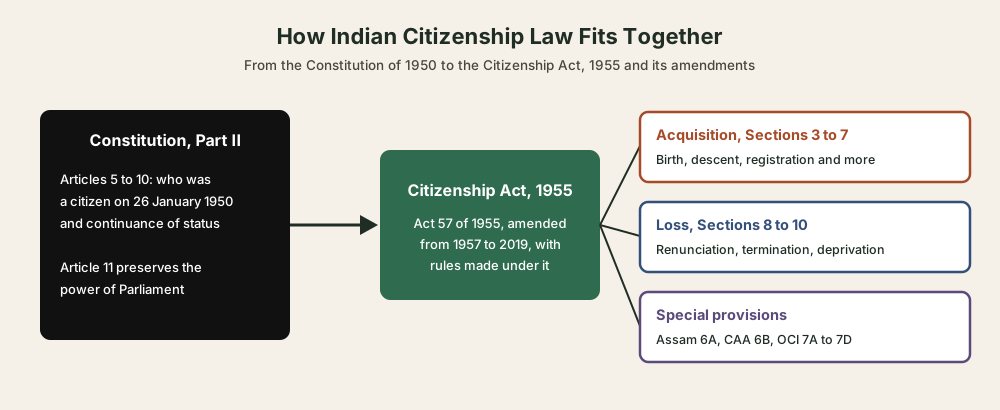
Citizenship in India is the status of full legal membership of the Indian state, carrying the rights and duties that the Constitution and the law attach to it. Part II of the Constitution, Articles 5 to 11, settled who was a citizen when the Constitution commenced on 26 January 1950, and every later question is governed by laws made by Parliament, which alone legislates on citizenship under item 17 of the Union List. That law is the Citizenship Act, 1955, which provides five ways of acquiring citizenship and three ways of losing it and has been amended repeatedly, most notably in 1985 for the Assam Accord, in 2003 for illegal migrants and overseas citizenship, and in 2019 for six named communities from Afghanistan, Bangladesh and Pakistan. India follows the principle of single citizenship for the whole Union.
Citizenship and Nationality in the Indian Constitutional Scheme
Citizenship as Full Legal Membership of the Indian State
Citizenship is the legal bond of full membership between a person and the Indian state, the status that carries the complete set of civil and political rights and the matching duties. The Constitution deals with it in Part II, Articles 5 to 11, and Parliament regulates it through the Citizenship Act, 1955.
The subject matters because citizenship decides who may vote, who may hold the highest offices, and who may claim rights that the Constitution reserves for citizens alone. Its significance for the Republic lies in defining the political community whose members govern themselves under the Constitution.
The constitutional framework has three distinctive features that shape every later question on the subject:
- The Constitution settled citizenship only as it stood when it commenced on 26 January 1950.
- All later questions are left to Parliament, which alone may legislate on citizenship because the subject sits in the Union List.
- India has a single citizenship for the whole Union, not a separate citizenship for each State.
Single Citizenship in a Federal Union and Parliament's Exclusive Power
India is a Union of States with a divided legislative field, yet it has one citizenship for all its people. A person is a citizen of India, not a citizen of a particular State.
The legal basis is the division of legislative power. Item 17 of the Union List in the Seventh Schedule covers citizenship, naturalisation and aliens, and Article 246(1) gives Parliament exclusive power over matters in that List, so no State legislature can create a citizenship of its own. Article 11 then confirms that nothing in Part II takes away Parliament's power to make provision for the acquisition and termination of citizenship.
Article 5 speaks only of domicile in the territory of India. In Dr. Pradeep Jain v. Union of India (1984), the Supreme Court read this to mean that the Constitution recognises only one domicile, and in Dr. Tanvi Behl v. Shrey Goel (2025) it repeated that each citizen carries one single domicile, the Domicile of India.
Where public employment in a State or Union Territory needs a residence condition, Article 16(3) allows only Parliament, not a State Legislature, to prescribe it.
Citizens and Aliens: Which Fundamental Rights Each Can Claim
The Constitution divides the people in India into citizens and aliens. Some Fundamental Rights are guaranteed to every person, while others are written for citizens alone, as the table shows.
| Right | Article | Available to |
|---|---|---|
| Equality before the law and equal protection of the laws | Article 14 | Every person |
| Protection of life and personal liberty | Article 21 | Every person |
| Freedom of conscience and to profess, practise and propagate religion | Article 25 | All persons |
| Prohibition of discrimination on grounds of religion, race, caste, sex or place of birth | Article 15 | Citizens |
| Equality of opportunity in public employment | Article 16 | Citizens |
| Freedoms of speech, assembly, association, movement, residence and profession, trade or business | Article 19 | Citizens |
| Right of a section of citizens to conserve its language, script or culture | Article 29(1) | Citizens |
| Right of minorities to establish and administer educational institutions | Article 30(1) | All minorities, based on religion or language |
A foreign national living in India can therefore claim equality before the law, personal liberty and freedom of religion, but not the freedom to practise any profession or carry on any trade under Article 19(1)(g). An enemy alien is further excluded, by Article 22(3), from the safeguards that Article 22(1) and (2) give to a person who is arrested.
Articles 5 to 11: Citizenship at the Commencement of the Constitution
Article 5: Domicile, Birth and Five Years of Residence
Article 5 declared who was a citizen of India at the commencement of the Constitution on 26 January 1950. The seven Articles of Part II are summarised first, and each is then explained in turn.
| Article | What it provides |
|---|---|
| Article 5 | Citizenship at commencement: domicile in India plus birth in India, a parent born in India, or five years' ordinary residence |
| Article 6 | Migrants from Pakistan: residence since migration if before 19 July 1948; registration after six months' residence if on or after that date |
| Article 7 | Migrants to Pakistan after 1 March 1947 are not citizens, save returnees under a resettlement or permanent-return permit |
| Article 8 | Persons of Indian origin residing outside India as defined in 1935: registration by Indian diplomatic or consular representatives |
| Article 9 | Voluntary acquisition of foreign citizenship bars citizenship under Articles 5, 6 and 8 |
| Article 10 | Citizenship continues, subject to any law made by Parliament |
| Article 11 | Part II does not limit Parliament's power over acquisition, termination and all other matters of citizenship |
Under Article 5, the person had to have a domicile in the territory of India and satisfy any one of three further tests:
- Born in the territory of India, under clause (a).
- Either parent born in the territory of India, under clause (b).
- Ordinarily resident in the territory of India for not less than five years immediately preceding the commencement, under clause (c).
The third route matters later in the Act, because a person who is a citizen by virtue only of Article 5(c) is among those who can be deprived of citizenship under Section 10 of the Citizenship Act.
Articles 6 and 7: Migrants To and From Pakistan After Partition
Article 6 dealt with people who had migrated to India from the territory now included in Pakistan. Such a person was deemed a citizen if the person, a parent or a grandparent had been born in India as defined in the Government of India Act, 1935 as originally enacted.
The date of migration then decided the procedure, with 19 July 1948 as the dividing line:
- A person who migrated before 19 July 1948 needed only to have been ordinarily resident in India since migration.
- A person who migrated on or after 19 July 1948 had to be registered by an officer of the Government of the Dominion of India, on an application made before the commencement of the Constitution, after at least six months of residence immediately preceding the application.
Article 7 ran the other way. A person who had migrated from India to the territory now included in Pakistan after 1 March 1947 was not a citizen, unless the person had returned under a permit for resettlement or permanent return; such a returnee was treated for Article 6(b) as having migrated after 19 July 1948 and so had to be registered.
Article 8: Persons of Indian Origin Living Abroad
Article 8 covered a person who, or whose parent or grandparent, was born in India as defined in the Government of India Act, 1935 as originally enacted, and who was ordinarily residing in any country outside India as so defined. Such a person was deemed a citizen if registered by the diplomatic or consular representative of India in the country of residence.
The application could be made either before or after the commencement of the Constitution, in the form and manner prescribed by the Government of the Dominion of India or the Government of India.
Articles 9, 10 and 11: Foreign Citizenship, Continuance and Parliament's Power
Article 9 excluded dual status at the founding. No person could be a citizen under Article 5, or be deemed a citizen under Article 6 or Article 8, if the person had voluntarily acquired the citizenship of a foreign State.
- Article 10 guarantees that every person who is or is deemed to be a citizen under Part II continues to be a citizen, subject to any law made by Parliament.
- Article 11 provides that nothing in Part II derogates from Parliament’s power to make provision for the acquisition and termination of citizenship and all other matters relating to it.
The two Articles together explain why the Citizenship Act, 1955, not the Constitution, governs every question that has arisen since 26 January 1950, and why Parliament has been able to amend the rules repeatedly.
The Citizenship Act 1955: Five Modes of Acquiring Citizenship
Citizenship by Birth Under Section 3: Three Regimes by Date
The Citizenship Act, 1955 (Act 57 of 1955, dated 30 December 1955) is the law Parliament made on the subject. Its Section 3 governs citizenship by birth, and the rule that applies depends on the date on which the person was born in India.
- Born on or after 26 January 1950 but before 1 July 1987: a citizen by birth.
- Born on or after 1 July 1987 but before the commencement of the Citizenship (Amendment) Act, 2003, which took effect on 3 December 2004: a citizen if either parent was a citizen at the time of birth.
- Born on or after that commencement: a citizen if both parents are citizens, or if one parent is a citizen and the other is not an illegal migrant at the time of birth.
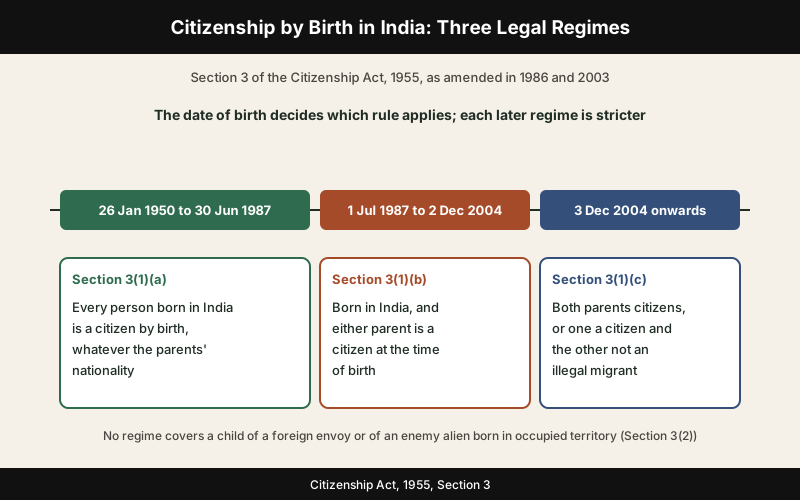
Two exceptions apply under every regime. A child is not a citizen by birth if a parent enjoys the immunity of a foreign envoy accredited to the President and is not a citizen, or if a parent is an enemy alien and the birth occurs in a place then under enemy occupation.
Citizenship by Descent Under Section 4 and the 1992 Change
Section 4 applies to a person born outside India. For a birth before 10 December 1992, citizenship by descent passed only if the father was a citizen; for a birth on or after that date, it passes if either parent is a citizen of India at the time of birth.
Where the parent is a citizen by descent only, the child becomes a citizen only if the birth is registered at an Indian consulate within one year, or later with the permission of the Central Government, or if the parent is in the service of a Government in India.
Since the 2003 amendment, two further conditions guard against dual nationality for citizens by descent:
- Registration of the birth at an Indian consulate is required in every case, and the parents must declare that the minor does not hold the passport of another country.
- Under Section 4(1A), a minor who is a citizen by descent and also a citizen of another country ceases to be a citizen of India unless the other citizenship is renounced within six months of attaining full age.
Citizenship by Registration Under Section 5: Seven Categories
Section 5 allows the Central Government to register as a citizen a person who is not an illegal migrant, is not already a citizen, and falls within one of seven categories.
- A person of Indian origin ordinarily resident in India for seven years before applying.
- A person of Indian origin ordinarily resident in any country or place outside undivided India.
- A person married to a citizen of India and ordinarily resident in India for seven years before applying.
- Minor children of persons who are citizens of India.
- A person of full age and capacity whose parents are registered as citizens under clause (a) or under Section 6(1).
- A person of full age and capacity who, or either of whose parents, was earlier a citizen of independent India, and who is ordinarily resident in India for twelve months immediately before applying.
- A person of full age and capacity registered as an Overseas Citizen of India Cardholder for five years and ordinarily resident in India for twelve months before applying.
For the seven-year categories, ordinary residence means residence throughout the twelve months immediately before the application and for at least six of the eight years before that. A person counts as of Indian origin if the person or either parent was born in undivided India or in a territory that became part of India after 15 August 1947, and every adult applicant must take the oath of allegiance in the Second Schedule.
Four further rules in Section 5 shape how registration works in practice:
- Under Section 5(1A), the Government may, in special circumstances recorded in writing, relax the twelve months in clauses (f) and (g), and the twelve months of ordinary residence in clause (i) of Explanation 1, by up to thirty days, which may be in different breaks.
- Under Section 5(3), a person who has renounced or been deprived of citizenship, or whose citizenship has terminated, may be registered again only by order of the Central Government.
- Under Section 5(4), the Government may register any minor if satisfied that special circumstances justify it.
- Under Section 5(6), the Government may, for reasons recorded in writing, exempt a person or a class of persons from the residence requirement in clause (c), which applies to spouses of citizens.
Citizenship by Naturalisation Under Section 6 and the Third Schedule
Section 6 lets a person of full age and capacity who is not an illegal migrant obtain a certificate of naturalisation if the Central Government is satisfied that the applicant meets the qualifications in the Third Schedule:
- Residence in India, or service under a Government in India, or partly one and partly the other, throughout the twelve months immediately before the application; the Government may relax this by up to thirty days in special circumstances.
- Residence or government service during the fourteen years before those twelve months for periods adding up to not less than eleven years.
- In the special circumstances of a particular case, the Government may count a continuous twelve months ending not more than six months before the application as the qualifying twelve months, and may count residence or service earlier than fifteen years before the application towards the aggregate.
- Good character, adequate knowledge of a language specified in the Eighth Schedule, and an intention to reside in India or to serve under a Government in India, an international organisation of which India is a member, or a body established in India.
- An undertaking to renounce any existing citizenship if the application succeeds, and no bar, in the applicant’s own country, on Indians becoming citizens there by naturalisation.
For persons belonging to the Hindu, Sikh, Buddhist, Jain, Parsi or Christian community in Afghanistan, Bangladesh or Pakistan, a proviso added in 2019 reads the eleven-year aggregate as not less than five years. The Central Government may also waive any or all of the conditions for an applicant who has rendered distinguished service to science, philosophy, art, literature, world peace or human progress generally.
Citizenship by Incorporation of Territory Under Section 7
Section 7 deals with territory that becomes part of India. The Central Government, by an order in the Official Gazette, specifies the persons who become citizens because of their connection with that territory, and the date from which they do so.
The question arose when territories joined India after independence. In Goa, Daman and Diu, for example, residents became Indian citizens on 20 December 1961 unless they had declared an intention to keep their existing nationality.
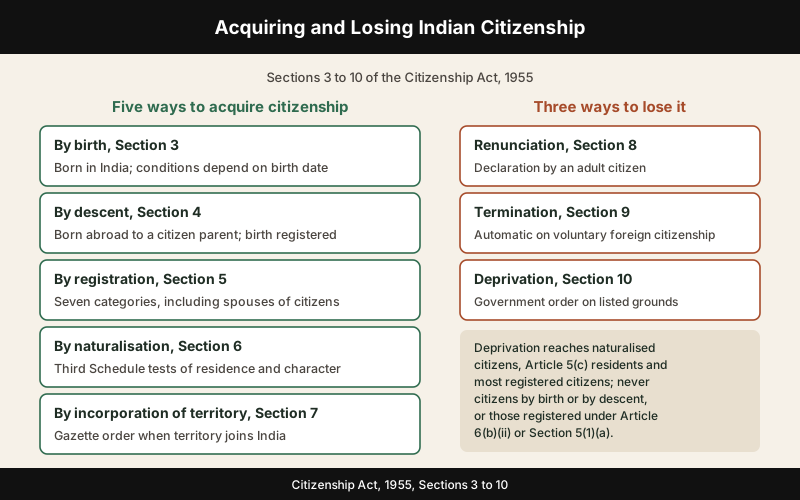
Read together, the five modes show a clear pattern. Birth and descent operate by force of law once their conditions are met, while registration, naturalisation and incorporation depend on an act of the Central Government; Section 10 allows deprivation only for naturalised citizens, Article 5(c) residents and most, not all, registered citizens.
Decisions, Revision and Offences Under Sections 14 to 17
The Act also governs how applications are decided and how decisions can be challenged, through four supplemental provisions that apply across the modes of acquisition:
- Section 14: the prescribed authority or the Central Government may grant or refuse an application for registration, naturalisation or OCI registration in its discretion, without assigning reasons, and the decision is final subject to Section 15.
- Section 15: a person aggrieved by an order of the prescribed authority or any officer or authority other than the Central Government may apply to the Central Government for revision within thirty days, and a late application may be entertained if the applicant was prevented by sufficient cause.
- Section 15A: a person aggrieved by an order of the Central Government itself may apply to it for review within thirty days of the order, with the same allowance for sufficient cause.
- Section 17: knowingly making a representation that is false in a material particular, to procure anything under the Act, is punishable with imprisonment up to five years, a fine up to fifty thousand rupees, or both.
Taken together, these provisions leave the grant of citizenship largely to executive discretion: an order of a subordinate authority goes to the Central Government in revision, and an order of the Central Government itself returns to it for review.
Loss of Citizenship: Renunciation, Termination and Deprivation
Renunciation Under Section 8 and the Position of Minor Children
Under Section 8, a citizen of full age and capacity may make a declaration renouncing Indian citizenship, and the person ceases to be a citizen when the declaration is registered. If the declaration is made during a war in which India is engaged, its registration is withheld until the Central Government directs otherwise.
Every minor child of a person who renounces also ceases to be a citizen. The child may, within one year of attaining full age, declare a wish to resume Indian citizenship and becomes a citizen again.
Termination Under Section 9 on Acquiring Foreign Citizenship
Section 9 makes loss automatic. A citizen who voluntarily acquires the citizenship of another country, by naturalisation, registration or otherwise, ceases to be a citizen of India upon that acquisition.
- The rule does not apply to a citizen who acquires another citizenship during a war in which India is engaged, until the Central Government directs.
- Any question on whether, when or how a citizen acquired foreign citizenship is decided by the authority prescribed under the rules, applying the prescribed rules of evidence.
Termination therefore differs from deprivation: it needs no order and applies to every citizen, including a citizen by birth, who voluntarily takes another country's citizenship.
Deprivation Under Section 10: Who Can Be Deprived and on What Grounds
Section 10(1) limits deprivation to three classes of citizens:
- Citizens by naturalisation.
- Citizens by virtue only of Article 5(c) of the Constitution.
- Citizens by registration, except those registered under Article 6(b)(ii) of the Constitution or under Section 5(1)(a) of the Act.
A citizen by birth or by descent cannot be deprived under this section. The grounds in Section 10(2) are:
- The registration or certificate of naturalisation was obtained by fraud, false representation or concealment of a material fact.
- The citizen has shown, by act or speech, disloyalty or disaffection towards the Constitution of India as by law established.
- The citizen unlawfully traded or communicated with an enemy, or took part in a business known to assist an enemy, during a war in which India was engaged.
- The citizen was sentenced in any country to imprisonment for not less than two years within five years after registration or naturalisation.
- The citizen has been ordinarily resident outside India for a continuous seven years without, at any time in that period, being a student abroad, serving a Government in India or an international organisation of which India is a member, or registering annually at an Indian consulate the intention to retain citizenship.
The first four grounds concern the conduct of the citizen, while the fifth concerns a long break in the connection with India, and the procedure that follows differs between the two.
Safeguards Against Deprivation: Public Good and the Committee of Inquiry
The power carries procedural protections, which are stronger for the conduct grounds than for the ground of long residence abroad:
- The Government must be satisfied that it is not conducive to the public good that the person should continue to be a citizen.
- Before making the order, it must give written notice of the ground and, for every ground other than long residence abroad, of the right to have the case referred to a Committee of Inquiry.
- Where the proposed order rests on a ground other than long residence abroad and the person applies, the Government must refer the case to a Committee of Inquiry, chaired by a person who has held judicial office for at least ten years, with two other members; in any other case it may do so.
- The Government is ordinarily guided by the Committee’s report in making its order.
- Section 16 does not allow the Government to delegate its powers under Section 10 to any officer or authority.
A naturalised or registered citizen can therefore lose citizenship only on the specific grounds the Act lists and through the procedure it lays down, although for long residence abroad a reference to the Committee is at the Government's discretion.
Amendments to the Citizenship Act from 1985 to 2019
The Amendment Timeline and What Each Change Did
The Act has been amended several times. Two lines of change stand out in the table below: the tightening of citizenship by birth in 1986 and 2003, and the overseas citizenship reforms of 2003 to 2015.
| Amending Act | Main change |
|---|---|
| Citizenship (Amendment) Act, 1985 (65 of 1985) | Inserted Section 6A for persons covered by the Assam Accord, with effect from 7 December 1985 |
| Citizenship (Amendment) Act, 1986 (51 of 1986) | Limited citizenship by birth to children with at least one citizen parent, for births from 1 July 1987 |
| Act 39 of 1992 | Citizenship by descent through either parent for births from 10 December 1992 |
| Citizenship (Amendment) Act, 2003 (6 of 2004) | Defined illegal migrant; stricter birth rule; overseas citizenship provisions; national identity cards and the National Register of Indian Citizens; in force from 3 December 2004 |
| Citizenship (Amendment) Act, 2005 (32 of 2005) | Omitted the Fourth Schedule with effect from 28 June 2005 |
| Act 1 of 2015 | Recast Sections 7A to 7D around the Overseas Citizen of India Cardholder, with effect from 6 January 2015 |
| Citizenship (Amendment) Act, 2019 (47 of 2019) | Proviso for six communities from three countries, Section 6B, the five-year naturalisation proviso, a new OCI cancellation ground in Section 7D(da) and a hearing before any cancellation; in force from 10 January 2020 |
The trend across these amendments is a steady move away from birth in the territory as a sufficient ground and towards parentage as the test. A child born in India today needs both parents to be citizens, or one citizen parent and another who is not an illegal migrant.
The 2003 Amendment: Illegal Migrants and National Identity Cards
The 2003 amendment introduced the term illegal migrant: a foreigner who entered India without a valid passport or other travel documents, or who entered with valid documents but remained beyond the permitted period. An illegal migrant cannot obtain citizenship by registration or naturalisation.
The same amendment added Section 14A, which gives the Central Government three powers:
- To compulsorily register every citizen of India and issue a national identity card.
- To maintain a National Register of Indian Citizens and establish a National Registration Authority for that purpose.
- To appoint officers and staff to assist the Registrar General of Citizen Registration.
From the commencement of the 2003 amendment, the Registrar General, India acts as the National Registration Authority and functions as the Registrar General of Citizen Registration. The procedure for compulsory registration is to be prescribed, and Section 18(2)(ia) empowers the Government to make rules on it.
The National Register of Citizens in Assam and the National Population Register
The procedure for registering citizens is laid down in the Citizenship (Registration of Citizens and Issue of National Identity Cards) Rules, 2003. In Assam, the update of the National Register of Citizens followed a Supreme Court order of 2013 and was governed by Rule 4A and its Schedule, framed around the cut-off of 24 March 1971 (midnight) drawn from the Assam Accord. A person left out of the Final NRC could appeal before the Foreigners Tribunals.
| Stage | Figure |
|---|---|
| Application forms received, May to 31 August 2015 | 3,30,27,661 persons |
| Complete Draft NRC, 30 July 2018 | 2,89,83,677 persons found eligible |
| Final NRC, 31 August 2019 | 3,11,21,004 persons found eligible |
| Persons left out of the Final NRC | 19,06,657 |
The National Population Register (NPR) is a separate exercise. According to the Press Information Bureau, it was prepared in 2010 under the Citizenship Act, 1955 and the Citizenship Rules, 2003, and was updated in 2015 by seeding it with Aadhaar.
On 24 December 2019, the Union Cabinet approved the Census of India 2021 at a cost of Rs 8,754.23 crore and the updating of the NPR at Rs 3,941.35 crore. The Census was to cover the entire population, and the NPR all the population except in Assam, with the NPR updated during the house-listing phase of April to September 2020.
That phase never began as planned. On 25 March 2020, because of the COVID-19 pandemic, the Ministry of Home Affairs postponed the first phase of Census 2021 and the updating of the NPR until further orders.
In June 2025 the Ministry announced that Population Census-2027 would be held in two phases, with two reference dates:
- 00:00 hours on 1 March 2027, the general reference date.
- 00:00 hours on 1 October 2026 for the Union Territory of Ladakh and the non-synchronous snow-bound areas of Jammu and Kashmir, Himachal Pradesh and Uttarakhand.
Section 6A, the Assam Accord and the 2024 Supreme Court Verdict
Assam Accord Cut-off Dates: 1 January 1966 and 25 March 1971
Section 6A, inserted in 1985 after the Assam Accord, applies only to Assam and only to persons of Indian origin who came from the specified territory, defined as the territories included in Bangladesh immediately before the commencement of the 1985 amendment. It sorts them by the date they arrived:
- Those who came before 1 January 1966, including those on the electoral rolls used for the 1967 general election, and who stayed ordinarily resident in Assam, are deemed citizens from 1 January 1966.
- Those who came on or after 1 January 1966 but before 25 March 1971, stayed ordinarily resident and were detected as foreigners by a tribunal under the Foreigners (Tribunals) Order, 1964, must register; they have the rights of a citizen but no place on electoral rolls for ten years from detection, after which they are citizens for all purposes.
- Those who came on or after 25 March 1971 fall outside Section 6A.
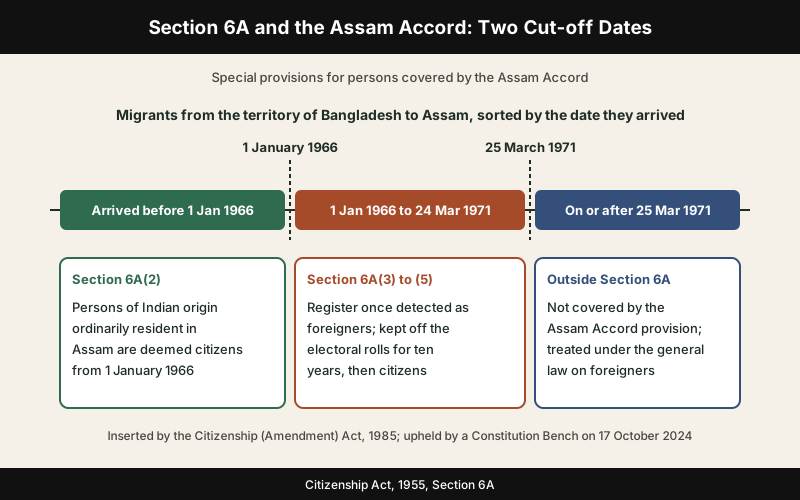
Section 6A(6) provided two separate ways to opt out, each within sixty days. A person covered by Section 6A(2) could declare, within sixty days from the commencement of the 1985 amendment, that he did not wish to be a citizen. A person covered by Section 6A(3) could declare that he did not wish to be governed by sub-sections (3) to (5), within sixty days from that commencement or from detection, whichever was later.
Under Section 6A(7), sub-sections (2) to (6) do not apply to a person who was already a citizen of India immediately before the 1985 amendment, or who had been expelled from India under the Foreigners Act, 1946 before that amendment.
Constitution Bench Verdict of October 2024 Upholding Section 6A
On 17 October 2024, in In Re: Section 6A of the Citizenship Act, 1955, a five-judge Constitution Bench of the Supreme Court upheld the validity of Section 6A by a 4:1 majority. Justice Surya Kant wrote for himself and Justices M. M. Sundresh and Manoj Misra, Chief Justice D. Y. Chandrachud wrote a concurring opinion, and Justice J. B. Pardiwala dissented.
- Justice Surya Kant’s opinion held that Section 6A does not infringe Articles 6, 7, 9, 14, 21, 29, 326 or 355, and directed that immigrants who entered Assam on or after 25 March 1971 are illegal immigrants outside its protection.
- The Chief Justice’s opinion traced Parliament’s power to legislate on citizenship to Article 246 read with item 17 of List I, described the Assam Accord as a political solution and Section 6A as a legislative solution to growing migration, and held that singling out Assam was justified by the magnitude and impact of migration into the State.
- Justice Pardiwala, applying what he called temporal reasonableness, would have held Section 6A invalid with prospective effect.
Justice Surya Kant's opinion, for three judges, recorded that about 97,714 cases were pending before the Foreigners Tribunals and that nearly 850 kilometres of border remained unfenced or inadequately monitored. It found the enforcement of Section 6A inadequate, held the machinery for detecting foreigners in Assam insufficient for time-bound implementation, and issued directions:
- The directions in Sarbananda Sonowal are to be given effect for deporting immigrants who entered Assam on or after 25 March 1971.
- The Immigrants (Expulsion from Assam) Act, 1950 is to be read into Section 6A and used to identify illegal immigrants.
- The matter is to be placed before the Chief Justice of India for a bench to monitor the implementation of the directions.
The Citizenship (Amendment) Act 2019 and the 2024 Rules
Beneficiaries, Countries and the 31 December 2014 Cut-off
The Citizenship (Amendment) Act, 2019 (Act 47 of 2019) received the President's assent on 12 December 2019 and came into force on 10 January 2020. It added a proviso to the definition of illegal migrant in Section 2(1)(b).
Under the proviso, a person belonging to the Hindu, Sikh, Buddhist, Jain, Parsi or Christian community from Afghanistan, Bangladesh or Pakistan, who entered India on or before 31 December 2014 and has been exempted under the Passport (Entry into India) Act, 1920 or the Foreigners Act, 1946 or orders made under them, is not treated as an illegal migrant for the purposes of the Act.
| Feature | Provision |
|---|---|
| Communities covered | Hindu, Sikh, Buddhist, Jain, Parsi and Christian |
| Countries | Afghanistan, Bangladesh and Pakistan |
| Cut-off date | Arrival in India on or before 31 December 2014 |
| Route to citizenship | Certificate of registration or naturalisation under Section 6B |
| Naturalisation residence | Aggregate of not less than five years in place of eleven, under the Third Schedule proviso |
| Areas excluded from Section 6B | Sixth Schedule tribal areas of Assam, Meghalaya, Mizoram and Tripura, and areas under the Inner Line |
| OCI cancellation | New ground in Section 7D(da) for violating the Act or any other law the Government specifies by notification, and a hearing before any cancellation order |
Section 6B, Exempted Areas and the Inner Line
Section 6B sets out how a person covered by the proviso becomes a citizen, in three steps:
- The Central Government, or an authority it specifies, may grant the person a certificate of registration or a certificate of naturalisation on application, subject to prescribed conditions.
- Subject to fulfilling the conditions of Section 5 or the qualifications in the Third Schedule, the person is deemed a citizen from the date of entry into India.
- Any proceeding pending against the person in respect of illegal migration or citizenship abates once citizenship is conferred.
Under the two provisos to Section 6B(3), a pending proceeding does not disqualify an application, and applying does not take away the rights and privileges the person held on the date the application was received.
Under Section 6B(4), the section does not apply to two kinds of area:
- The tribal areas of Assam, Meghalaya, Mizoram and Tripura included in the Sixth Schedule to the Constitution.
- The area covered by the Inner Line notified under the Bengal Eastern Frontier Regulation, 1873, which operates in Arunachal Pradesh, Nagaland and Mizoram; the Home Minister told Parliament on 11 December 2019 that Manipur had been brought under the Inner Line Permit regime by a Gazette notification that day.
The Acts named in the proviso have since been repealed. The Immigration and Foreigners Act, 2025 came into force on 1 September 2025, and its Section 36(1) repeals four laws:
- The Passport (Entry into India) Act, 1920.
- The Registration of Foreigners Act, 1939.
- The Foreigners Act, 1946.
- The Immigration (Carriers’ Liability) Act, 2000.
Under Section 36(2), anything done or any order made under the repealed Acts is, in so far as it is not inconsistent with the new Act, deemed to have been done under its corresponding provisions.
Rules of 2024, Empowered Committees and the First Certificates
The Government notified the Citizenship (Amendment) Rules, 2024 on 11 March 2024. The process runs through an online portal in two tiers:
- A District Level Committee, chaired by a Senior Superintendent or Superintendent of Post Offices, verifies documents and administers the oath of allegiance.
- A State Level Empowered Committee headed by the Director of Census Operations scrutinises the application and grants citizenship.
The first set of certificates under the rules was issued on 15 May 2024, when the Union Home Secretary handed certificates to applicants in New Delhi.
The Constitutional Debate Over the 2019 Amendment
The amendment has been controversial. The two positions are set out below on four common questions: equality, citizens already in India, other refugees, and Assam and the North East. The Government's position, as recorded by the Press Information Bureau when Parliament passed the Bill in December 2019, was:
- On equality: the Bill grants citizenship on reasonable grounds to refugees facing religious persecution in the three countries and does not violate Article 14; all minority communities persecuted on religious lines there are included, and Muslims are not included because, in the Government’s view, they do not face religious persecution in these Islamic countries. The partition of India on religious lines and the failure of the Nehru-Liaqat pact of 1950 were given as the reasons for the Bill.
- On citizens: the Bill is not against any minority in India and aims at granting rather than taking away citizenship.
- On other refugees: citizenship had been given in the past to refugees from countries such as Uganda and Sri Lanka, on a case to case basis, on reasonable qualifications to Article 14.
- On Assam and the North East: no provision of Article 371 would be violated, the linguistic, cultural and social identity of the people of the region would be preserved, and the Committee under Clause 6 of the Assam Accord, not constituted for over three decades, was urged to report early.
The objections of critics, as recorded in published accounts of the debate, were:
- On equality: the amendment drew allegations of discrimination based on religion, particularly for the exclusion of Muslims from the three countries, although certain Muslim groups such as the Ahmadis and the Hazaras have historically faced persecution there.
- On citizens: critics expressed concern that the law may be used, along with the National Register of Citizens, to render many Muslim citizens stateless if they cannot meet stringent birth or identity proof requirements.
- On other refugees: commentators questioned the exclusion of persecuted minorities from other regions, such as Tibetan Buddhist refugees, Tamil refugees from Sri Lanka and Rohingya Muslim refugees from Myanmar.
- On Assam and the North East: protesters maintained that the new provisions are against prior agreements such as the Assam Accord, and that they would cause a loss of political rights and culture.
The statute itself shows why dates matter in the Assam objection. Section 6A, which gives effect to the Assam Accord, leaves arrivals on or after 25 March 1971 outside its protection, while the 2019 proviso reaches arrivals up to 31 December 2014.
The dispute also reached the courts. At hearings of batches of petitions on 18 December 2019 and 22 January 2020, the Supreme Court declined to stay the Act, and Kerala separately became the first State to challenge it, by a suit under Article 131.
The 2025 Exemption Order and the Unchanged Cut-off Date
By an order dated 1 September 2025 under Section 33 of the Immigration and Foreigners Act, 2025, published in the Gazette of India on 2 September 2025, the Central Government made the Immigration and Foreigners (Exemption) Order, 2025.
It exempts members of the same six communities from Afghanistan, Bangladesh and Pakistan, who were compelled to seek shelter in India due to religious persecution or fear of it and entered India on or before 31 December 2024, from the requirement of a valid passport or travel document and a valid visa to come into, stay in and leave India.
The same Order also covers Tibetans who hold a Certificate of Registration and came, or come, into India on a special permit issued by the Embassy of India in Kathmandu, and, for their stay in and exit from India, registered Sri Lankan Tamil nationals who took shelter in India up to 9 January 2015.
The order concerns arrival and stay; it does not amend the Citizenship Act. The citizenship proviso in Section 2(1)(b) still refers to arrival on or before 31 December 2014, so the two dates answer different legal questions.
Overseas Citizen of India Cardholders, PIOs and Non-Resident Indians
Origin of Overseas Citizenship and Eligibility Under Section 7A
Overseas citizenship entered the Act through the 2003 amendment, which inserted Sections 7A to 7D with effect from 3 December 2004. The Ministry of External Affairs records that the OCI scheme was introduced by the amendment of August 2005 and launched at the Pravasi Bharatiya Divas convention of 2006 in Hyderabad, and the 2015 amendment recast it around the OCI Cardholder.
Under Section 7A(1)(a), the Central Government may register as an OCI Cardholder a person of full age and capacity who is a citizen of another country and falls in one of four categories:
- A person who was a citizen of India at the time of, or at any time after, the commencement of the Constitution.
- A person who was eligible to become a citizen of India at the commencement of the Constitution.
- A person who belonged to a territory that became part of India after 15 August 1947.
- A child, grandchild or great-grandchild of such a citizen.
The remaining clauses extend eligibility to family members, and a proviso sets one bar:
- Under clauses (b) and (c), a minor child of a person in clause (a), and a minor child whose parents are both citizens of India or one of whose parents is a citizen, are eligible.
- Under clause (d), a spouse of foreign origin of a citizen or of an OCI Cardholder qualifies after a registered marriage that has subsisted for two years, subject to prior security clearance.
- No person is eligible for registration under this sub-section if the person, or a parent, grandparent or great-grandparent, is or had been a citizen of Pakistan or Bangladesh, or of any other country the Government notifies.
Two further powers complete the section. Under Section 7A(2), the Government may notify the date from which existing PIO Cardholders are deemed OCI Cardholders, and under Section 7A(3) it may, if satisfied that special circumstances exist, register a person as an OCI Cardholder notwithstanding sub-section (1), after recording the circumstances in writing.
Rights Withheld from OCI Cardholders Under Section 7B
An OCI Cardholder is a foreign national, not a citizen. Section 7B(2) withholds the rights of citizens in the rows on public employment, the offices of President, Vice-President and Judges, voter registration and legislatures, and public services and posts other than those the Government specifies by special order. The last two rows come instead from the Ministry of Home Affairs notification of benefits.
| Matter | Citizen of India | OCI Cardholder |
|---|---|---|
| Nationality | Indian | Foreign; holds a foreign passport |
| Equality of opportunity in public employment, Article 16 | Available | Not available |
| Election as President or Vice-President, Articles 58 and 66 | Eligible if qualified | Not eligible |
| Appointment as a Judge of the Supreme Court or a High Court, Articles 124 and 217 | Eligible if qualified | Not eligible |
| Registration as a voter; membership of Parliament or a State Legislature | Available | Not available |
| Public services and posts of the Union or a State | Available | Not available, except posts the Government specifies |
| Visiting India | As of right | Lifelong visa for multiple visits |
| Agricultural land, farm house or plantation property | May acquire | Not permitted |
The table follows a consistent logic. Political rights, constitutional offices and public employment stay with citizens, while economic, educational and travel facilities are extended to cardholders through notifications.
Benefits and Special Permits for OCI Cardholders
The Ministry of Home Affairs lists the benefits of the card, which fall into three groups: facilities of travel and stay, parity with Indian nationals, and parity with Non-Resident Indians.
- A lifelong visa for multiple visits to India for any purpose.
- Exemption from registration with the Foreigners Regional Registration Officer for any length of stay, with a duty to report changes of address or occupation when normally resident in India.
- Parity with Indian nationals in domestic air fares and in entry fees at national parks, wildlife sanctuaries, national monuments, historical sites and museums.
- Parity with Non-Resident Indians in inter-country adoption and in all-India entrance tests for NRI or supernumerary seats.
- Parity with Non-Resident Indians in buying and selling immovable property other than agricultural land, farm houses or plantation property.
- Parity with Non-Resident Indians in pursuing the professions of doctor, dentist, nurse, pharmacist, advocate, architect and chartered accountant, as provided in the relevant statutes.
A cardholder still needs special permission or a Special Permit for four kinds of activity:
- Research.
- Missionary, tabligh, mountaineering or journalistic activities.
- Internships in foreign diplomatic missions or foreign government organisations in India, or employment in foreign diplomatic missions in India.
- Visits to places within protected, restricted or prohibited areas notified by the Government.
In economic, financial and educational fields not specified in the notification or covered by Reserve Bank of India notifications, a cardholder has the same rights and privileges as a foreigner.
Cardholders are, however, eligible for appointment as teaching faculty in the following institutions:
- The Indian Institutes of Technology (IITs) and National Institutes of Technology (NITs).
- The Indian Institutes of Management (IIMs).
- The Indian Institutes of Science Education and Research (IISERs) and the Indian Institute of Science (IISc).
- Central Universities.
- The new All India Institutes of Medical Sciences set up under the Pradhan Mantri Swasthya Suraksha Yojana.
Renunciation and Cancellation of OCI Registration
Under Section 7C, a cardholder of full age and capacity may renounce the card. The spouse of foreign origin who obtained the card through marriage to that person, and every minor child of that person registered as a cardholder, then also cease to be cardholders. Under Section 7D, the Government may cancel a registration on these grounds:
- The registration was obtained by fraud, false representation or concealment of a material fact.
- The cardholder has shown disaffection towards the Constitution as by law established.
- The cardholder unlawfully traded or communicated with an enemy, or took part in a business known to assist an enemy, during a war in which India was engaged.
- The cardholder was sentenced to imprisonment for not less than two years within five years of registration.
- The cardholder violated the Act or any other law specified by the Government in a Gazette notification, under clause (da).
- Cancellation is necessary in the interests of the sovereignty, integrity or security of India, friendly relations with a foreign country or the general public.
- For a spouse registered on the basis of marriage, the marriage has been dissolved, or the cardholder has married another person while it subsists.
The 2019 amendment inserted clause (da) and a proviso that no cancellation order may be passed unless the cardholder has been given a reasonable opportunity of being heard.
PIO Card Merger and the Status of Non-Resident Indians
The separate Person of Indian Origin card has been folded into the OCI system. By a Ministry of Home Affairs notification of 9 January 2015, PIO cardholders with valid cards were deemed OCI Cardholders, and the Ministry's OCI services now require all PIO cardholders to apply afresh for an OCI card.
A Non-Resident Indian is different from both. The Reserve Bank of India defines an NRI as a person resident outside India who is a citizen of India, whereas an OCI Cardholder holds the citizenship of another country.
The procedure itself has moved online. The Citizenship (Amendment) Rules, 2026, which amend the Citizenship Rules, 2009, made the following changes, as reported by Akashvani:
- OCI registration and renunciation applications are to be submitted electronically through the official portal.
- A person renouncing OCI status must surrender the original physical card to the nearest Indian Mission or Post or Foreigners Regional Registration Officer.
- The earlier requirement to submit documents in duplicate is removed.
- An electronic OCI (e-OCI) registration may be issued instead of a physical OCI card.
- OCI applicants must sign a consent form to opt into the Fast Track Immigration Programme, agreeing to the collection of their biometric information during registration.
- A minor child holding an Indian passport cannot, at any time, hold the passport of any other country.
Rights Reserved for Citizens and Proof of Citizenship
Constitutional Offices and the Franchise Reserved for Citizens
Beyond the Fundamental Rights in Table 1, the Constitution reserves the highest offices and the vote for citizens. None of these provisions requires citizenship by birth.
| Office or right | Article | Condition |
|---|---|---|
| President | Article 58 | Citizen of India, 35 years, qualified for the House of the People |
| Vice-President | Article 66(3) | Citizen of India, 35 years, qualified for the Council of States |
| Governor | Article 157 | Citizen of India, 35 years |
| Judge of the Supreme Court | Article 124(3) | Citizen of India with the prescribed judicial or legal standing |
| Member of Parliament | Article 84 | Citizen of India with the prescribed oath and age |
| Member of a State Legislature | Article 173 | Citizen of India with the prescribed oath and age |
| Vote at elections to the House of the People and State Assemblies | Article 326 | Citizen of India aged eighteen or more, not disqualified |
A naturalised citizen who meets the other conditions is therefore eligible to become President, because Article 58 asks only for citizenship, not citizenship by birth.
Freedom of Movement and Residence Under Article 19 and Its Limits
Article 19(1)(d) gives every citizen the right to move freely throughout the territory of India, and Article 19(1)(e) the right to reside and settle in any part of it. Together they give practical meaning to single citizenship: as a general rule, a citizen may move to and settle in any State, subject to the restrictions described below.
The rights are not absolute. Article 19(5) saves laws imposing reasonable restrictions on both freedoms either in the interests of the general public or for the protection of the interests of any Scheduled Tribe.
- As an analytical illustration of the general-public ground, the nationwide lockdown ordered by the Ministry of Home Affairs under Section 10(2)(l) of the Disaster Management Act, 2005, in force from 25 March 2020, restricted movement across the country to contain COVID-19.
- As an analytical illustration of the tribal ground, citizens of India need a permit to enter the areas notified under the Bengal Eastern Frontier Regulation, 1873, and the Government of Arunachal Pradesh describes the aim as protecting the culture and identity of indigenous tribes.
- The fit of the Inner Line with Article 19 is contested: the same Arunachal Pradesh page says the system in no way curtails a person’s freedom of movement, while others have alleged that it violates Articles 14, 15, 19 and 21.
Article 19(5) permits only reasonable restrictions, and only for the two purposes it names. The freedoms therefore balance national unity against the protection of Scheduled Tribes and the wider public interest.
Proof of Citizenship: Certificates and the Aadhaar Number
Where a doubt exists, Section 13 of the Citizenship Act lets the Central Government certify that a person is a citizen of India. Such a certificate is conclusive evidence of citizenship on its date, unless it is proved to have been obtained by fraud, false representation or concealment of a material fact.
An Aadhaar number does not prove citizenship. Section 9 of the Aadhaar Act, 2016 states that the Aadhaar number or its authentication shall not, by itself, confer any right of, or be proof of, citizenship or domicile. An Aadhaar number is also not permanent in every case, because Section 23(2)(g) empowers the Unique Identification Authority of India to omit and deactivate a number as its regulations specify.
Citizenship Law in the Republic: Constitutional Design and Recent Developments
Constitutional Design of a Single, Statute-Based Citizenship
The design of Indian citizenship produces three observable outcomes:
- A single national status applies across every State, with no State citizenship.
- Parliament can change the rules on citizenship by ordinary law, as the amendments from 1985 to 2019 show, without amending the Constitution.
- Particular regional questions, as in Assam and the North East, are handled through special provisions within the same Act.
The same flexibility has made citizenship law a field of constitutional contest. Section 6A was challenged as violating, among others, Articles 14, 21 and 29 and was upheld in 2024, while the 2019 amendment was challenged in petitions first heard in December 2019.
Recent Developments: CAA Rules, Section 6A Verdict and e-OCI Reform
Several recent developments complete the contemporary picture of citizenship law:
- The Citizenship (Amendment) Rules of March 2024 made the 2019 amendment operational, and the first certificates followed in May 2024.
- The Section 6A verdict of October 2024 upheld the Assam Accord cut-off dates by a 4:1 majority.
- The Immigration and Foreigners Act, 2025 replaced four older laws on foreigners, and its Exemption Order of September 2025 relaxed passport and visa requirements for members of six communities who entered India on or before 31 December 2024 after seeking shelter from religious persecution, without changing the citizenship cut-off.
- The Citizenship (Amendment) Rules, 2026 moved OCI registration and renunciation online, removed duplicate documents and introduced the electronic OCI.
Each of these developments connects a current event to a specific provision of the Act or its rules, and each is explained earlier in this article alongside the sections it changes, so that the law and its latest application can be read together.
UPSC Relevance and Previous-Year Questions
Where Citizenship Fits in the UPSC-CSE Syllabus
This topic belongs to General Studies Paper II: the Indian Constitution, its historical underpinnings and significant provisions, and to the polity section of the Prelims paper. The Prelims questions linked with this article test precise rules:
- Whether India has one citizenship and one domicile, and whether a naturalised citizen can become Head of State or be deprived of citizenship.
- Whether an Aadhaar number proves citizenship or domicile, and whether it can be deactivated.
- The Fundamental Rights that a foreign national living in India can claim.
The Mains question linked with this article tests the limits and balances of the framework, here the restrictions on freedom of movement and residence. The sections above teach every point these questions require.
Previous Year UPSC-CSE Questions By the end you will be able to draft model answers for the following UPSC questions. Each question carries a collapsible framework showing how to approach it in the exam.
- UPSC Prelims 2021 GS-IWith reference to India, consider the following statements:
- There is only one citizenship and one domicile.
- A citizen by birth only can become the Head of State.
- A foreigner once granted the citizenship cannot be deprived of it under any circumstances.
Which of the statements given above is/are correct?
How to approach this Prelims question
Approach: Test each statement against a specific provision: Article 5 and single citizenship, Article 58 for the President, and Section 10 of the Citizenship Act for deprivation.
Trap to watch: The words 'by birth only' and 'under any circumstances' are absolute claims that the Constitution and the Act do not support.
Key facts to recall:
- India has a single citizenship and one domicile of India for the whole Union.
- Article 58 requires the President to be a citizen of India, with no condition of citizenship by birth.
- Section 10 permits deprivation of naturalised citizens, Article 5(c) residents and most registered citizens on listed grounds; for grounds other than long residence abroad, the case must go to a Committee of Inquiry if the person applies.
Answer signal: Only statement 1 is correct, so option (a) is the answer.
- UPSC Prelims 2018 GS-IConsider the following statements:
- Aadhaar card can be used as a proof of citizenship or domicile.
- Once issued, Aadhaar number cannot be deactivated or omitted by the Issuing Authority.
Which of the statements given above is/are correct?
How to approach this Prelims question
Approach: Separate identity from nationality: Aadhaar proves identity on the basis of residence, and the Authority's statutory functions include omitting and deactivating numbers.
Trap to watch: Aadhaar's everyday use as an identity document tempts the candidate to treat it as proof of citizenship.
Key facts to recall:
- Section 9 of the Aadhaar Act, 2016: Aadhaar is not proof of citizenship or domicile.
- Section 23(2)(g): the Authority may omit and deactivate an Aadhaar number under regulations.
- Section 13 of the Citizenship Act provides a certificate of citizenship in case of doubt.
Answer signal: Both statements are incorrect, so option (d) is the answer.
- UPSC Prelims 1999 GS-IA British citizen staying in India cannot claim Right to
How to approach this Prelims question
Approach: Sort the four rights into those guaranteed to every person and those guaranteed to citizens; only one option falls in the second group.
Trap to watch: Freedom of religion is sometimes assumed to be a citizens' right, but Article 25 speaks of all persons.
Key facts to recall:
- Articles 14, 21 and 25 extend to every person, including foreigners.
- Article 19, including the freedom of profession and trade, is for citizens only.
Answer signal: Freedom of trade and profession is a citizens' right, so option (a) is the answer.
- UPSC Mains 2022 GS-II“Right of movement and residence throughout the territory of India are freely available to the Indian citizens, but these rights are not absolute.” Comment.
How to structure the answer in the exam
Introduction: Article 19(1)(d) and (e) guarantee every citizen the freedom to move throughout India and to reside and settle anywhere in it, giving practical form to single citizenship.
Body (sub-themes to develop):
- The rights belong to citizens only and support national unity by removing internal barriers.
- Article 19(5) allows reasonable restrictions in the interests of the general public; movement restrictions such as the nationwide lockdown ordered under the Disaster Management Act, 2005 from 25 March 2020 can be analysed under this ground.
- Article 19(5) also allows restrictions to protect the interests of Scheduled Tribes.
- The Inner Line Permit regime under the Bengal Eastern Frontier Regulation, 1873 can be analysed under the tribal ground, although its compatibility with Article 19 has been contested.
- Article 19(5) saves only reasonable restrictions, and only for the two purposes it names.
Conclusion: The freedoms are real and wide, but the Constitution deliberately tempers them to protect tribal communities and the wider public interest.
Prelims MCQ practice
Each question below tests one specific concept on the topic. Click to reveal the answer and a full option-wise explanation.
Q1. With reference to citizenship by birth under the Citizenship Act, 1955, consider the following statements:
- A person born in India on 15 August 1985 to parents who were both foreign nationals, neither of them a diplomat, is a citizen of India by birth.
- A person born in India in 2010 to one parent who is a citizen and another who is an illegal migrant is a citizen of India by birth.
Which of the statements given above is/are correct?
- 1 only
- 2 only
- Both 1 and 2
- Neither 1 nor 2
Show answer and explanation
Answer: 1 only
Explanation.
Correct: a (1 only). Statement 1 is correct: a birth in India before 1 July 1987 made the child a citizen whatever the nationality of the parents, unless a parent was a foreign envoy or an enemy alien. Statement 2 is incorrect: for births on or after 3 December 2004, a child with one citizen parent qualifies only if the other parent is not an illegal migrant.
Q2. Consider the following statements regarding naturalisation under the Third Schedule to the Citizenship Act, 1955:
- As a general rule, and apart from the relaxation made in 2019 for certain communities, an applicant must have resided in India or served a Government in India throughout the twelve months before applying and for an aggregate of eleven years in the fourteen years before that.
- For Hindu, Sikh, Buddhist, Jain, Parsi and Christian applicants from Afghanistan, Bangladesh or Pakistan, the eleven-year aggregate is read as five years.
- An applicant must have adequate knowledge of Hindi.
Which of the statements given above are correct?
- 2 and 3 only
- 1 and 2 only
- 1 and 3 only
- 1, 2 and 3
Show answer and explanation
Answer: 1 and 2 only
Explanation.
Correct: b (1 and 2 only). Statement 1 is correct as the general rule: the Third Schedule requires twelve months of residence or service immediately before the application and an aggregate of eleven years in the preceding fourteen, although the Government may relax the twelve months by up to thirty days, count earlier periods in special cases, and waive the conditions for distinguished service. Statement 2 is correct: the 2019 amendment reads the aggregate as five years for these communities. Statement 3 is incorrect: the requirement is adequate knowledge of any language specified in the Eighth Schedule, not Hindi in particular.
Q3. Consider the following:
- Registration as a voter
- Appointment as a Judge of a High Court
- Purchase of agricultural land
- Exemption from registration with the Foreigners Regional Registration Officer for any length of stay
How many of the above are available to an Overseas Citizen of India Cardholder?
- Only one
- Only two
- Only three
- All four
Show answer and explanation
Answer: Only one
Explanation.
Correct: a (Only one). Section 7B(2) of the Citizenship Act denies an OCI Cardholder registration as a voter and appointment as a High Court Judge under Article 217. The Ministry of Home Affairs excludes agricultural land, farm houses and plantation property from the property parity given to cardholders. Exemption from registration with the Foreigners Regional Registration Officer for any length of stay is one of the listed benefits, so only one item is available.
Q4. With reference to Section 6A of the Citizenship Act, 1955, consider the following statements:
- Persons of Indian origin who came to Assam from the territory of Bangladesh before 1 January 1966 and remained ordinarily resident there are deemed citizens from 1 January 1966.
- Persons of Indian origin who came from the specified territory on or after 1 January 1966 but before 25 March 1971, and who register after being detected as foreigners, cannot be enrolled on electoral rolls for ten years from detection.
- The section applies only to Assam.
Which of the statements given above are correct?
- 1 and 2 only
- 2 and 3 only
- 1 and 3 only
- 1, 2 and 3
Show answer and explanation
Answer: 1, 2 and 3
Explanation.
Correct: d (1, 2 and 3). Statement 1 is correct under Section 6A(2). Statement 2 is correct: a person registered under Section 6A(3) has the rights of a citizen for ten years from detection but cannot be enrolled as a voter during that period. Statement 3 is correct: the section defines Assam as the territory of the State before the 1985 amendment and deals only with migrants to it.
Q5. Consider the following statements about the loss of Indian citizenship:
- The Central Government may deprive a citizen by birth of citizenship if that citizen is sentenced abroad to two years' imprisonment.
- A citizen of India who voluntarily acquires the citizenship of another country ceases to be a citizen of India on that acquisition.
Which of the statements given above is/are correct?
- 1 only
- 2 only
- Both 1 and 2
- Neither 1 nor 2
Show answer and explanation
Answer: 2 only
Explanation.
Correct: b (2 only). Statement 1 is incorrect: Section 10 allows deprivation only of naturalised citizens, Article 5(c) residents and most registered citizens, so a citizen by birth is outside it, and the imprisonment ground covers a sentence within five years of registration or naturalisation. Statement 2 is correct: termination under Section 9 follows automatically on the voluntary acquisition of another citizenship, save during a war until the Government directs.
Q6. With reference to Part II of the Constitution of India, consider the following statements:
- A person who migrated from Pakistan to India on or after 19 July 1948 had to be registered, after at least six months of residence before applying.
- A person who migrated to Pakistan after 1 March 1947 was not a citizen of India unless the person returned under a permit for resettlement or permanent return.
- A person of Indian origin living abroad could apply for registration as a citizen under Article 8 only after the commencement of the Constitution.
Which of the statements given above are correct?
- 1 only
- 2 and 3 only
- 1 and 2 only
- 1, 2 and 3
Show answer and explanation
Answer: 1 and 2 only
Explanation.
Correct: c (1 and 2 only). Statement 1 is correct under Article 6(b)(ii) and its proviso. Statement 2 is correct under Article 7 and its proviso. Statement 3 is incorrect: Article 8 let a person apply for registration either before 26 January 1950 or after that date.
Sources and Further Reading
- Legislative Department, Ministry of Law and Justice: The Constitution of India (2024 edition)
- India Code: The Citizenship Act, 1955 (as on 15 April 2026)
- Ministry of Home Affairs: The Citizenship (Amendment) Act, 2019, Gazette of India
- Ministry of Home Affairs: Overseas Citizen of India Cardholder brochure
- Ministry of Home Affairs: OCI Services, frequently asked questions
- Ministry of External Affairs: Overseas Citizenship of India Scheme
- Press Information Bureau: First citizenship certificates under the Citizenship (Amendment) Rules, 2024
- Akashvani News: Supreme Court upholds Section 6A of the Citizenship Act
- Akashvani News: Citizenship (Amendment) Rules, 2026
- Unique Identification Authority of India: The Aadhaar Act, 2016 (as amended)
- Government of Arunachal Pradesh: Bengal Eastern Frontier Regulation, 1873 and the Inner Line Permit
- Wikipedia: Inner Line Permit
- Ministry of Home Affairs: The Immigration and Foreigners Act, 2025
- Office of the State Coordinator, NRC Assam: Publication of Final NRC, 31 August 2019
- Press Information Bureau: Cabinet approves Census of India 2021 and updation of the National Population Register
- Press Information Bureau: Parliament passes the Citizenship (Amendment) Bill, 2019
- Press Information Bureau: Orders prescribing lockdown for containment of COVID-19
- Reserve Bank of India: Accounts in India by non-residents, frequently asked questions
- Supreme Court of India: In Re: Section 6A of the Citizenship Act, 1955, judgment of 17 October 2024 (2024 INSC 789)
- Wikipedia: Citizenship (Amendment) Act, 2019
- Wikipedia: Indian nationality law
- Supreme Court of India: Dr. Tanvi Behl v. Shrey Goel, judgment of 29 January 2025 (2025 INSC 125)
- Ministry of Home Affairs: Rajya Sabha Unstarred Question No. 405, answered on 5 February 2020
- Gazette of India, S.O. 3997(E): Immigration and Foreigners (Exemption) Order, 2025 (Ministry of Home Affairs)
- Gazette of India, S.O. 3981(E): commencement of the Immigration and Foreigners Act, 2025 (Ministry of Home Affairs)
- Press Information Bureau: first phase of Census 2021 and updation of NPR postponed, 25 March 2020
- Press Information Bureau: Population Census-2027 to be conducted in two phases, 4 June 2025
Editorial Disclaimer
This article is for UPSC preparation and explains the constitutional and statutory position on citizenship. The Citizenship Act and its rules are amended from time to time, so the current official text governs any individual case.


