


Overview
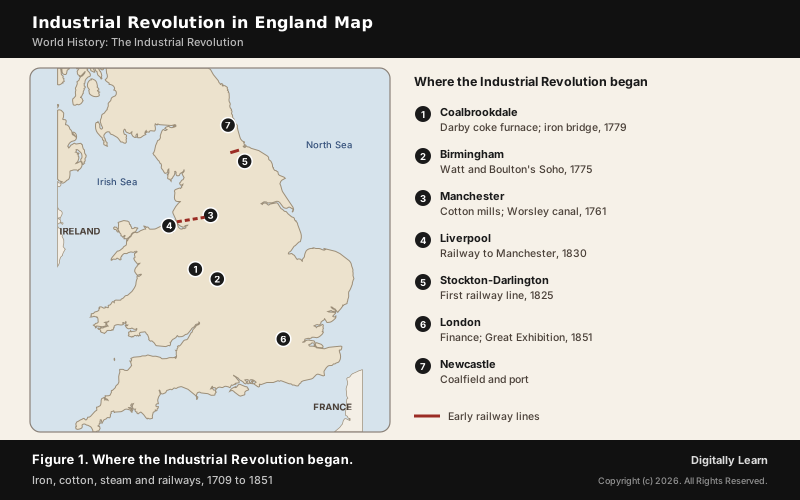
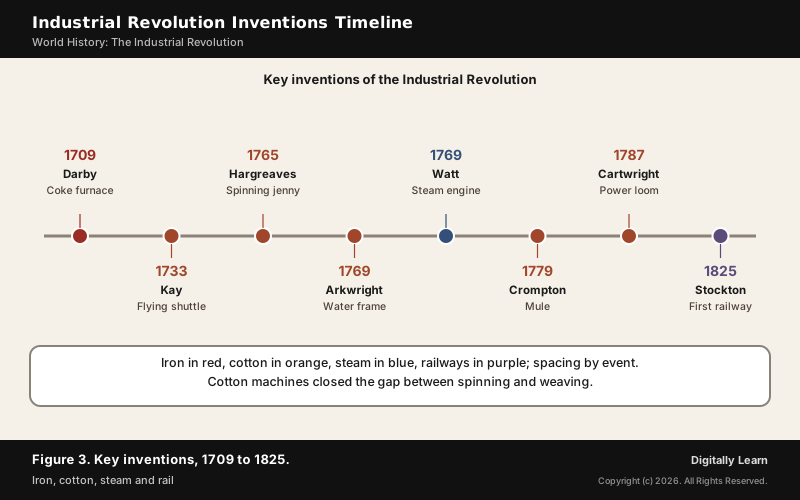
The Industrial Revolution in England was the transformation of industry and the economy in Britain between the 1780s and the 1850s, when machines, coal, iron and steam power made mass production possible for the first time. It began in Britain because of political stability, a wage-earning market, the agricultural revolution, banks, trade and colonies, and coal and iron found close together. It raised national wealth, but at first brought slums, child labour and short lives for workers, and it ruined India's handicraft exports.
What the Industrial Revolution Was: Meaning and Period
What Is the Industrial Revolution? Meaning, Period and the Term
The Industrial Revolution was the change from handicraft and handloom production to production by machines in factories. The transformation of industry and the economy in Britain between the 1780s and the 1850s is called the first industrial revolution. Similar changes later spread to other European countries and the USA.
- The term: Georges Michelet in France and Friedrich Engels in Germany used it first; the philosopher and economist Arnold Toynbee first used it in English, for the changes of 1760 to 1820.
- What drove it: New machinery in the cotton and iron industries, and steam, a new source of power, used on a wide scale.
- The second phase: After about 1850 new chemical and electrical industries grew, and Britain was overtaken by Germany and the USA.
Causes of the Industrial Revolution: Why It Began in England
Why the Industrial Revolution Started in England: Stability and Enclosures
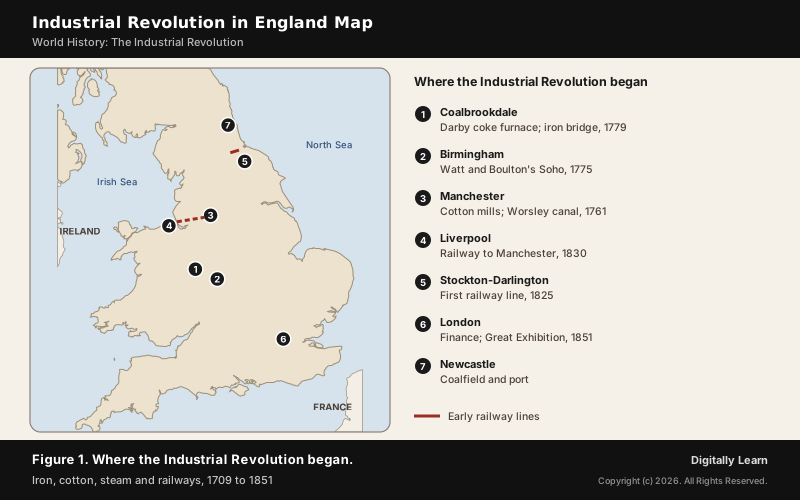
The Industrial Revolution began in England, and Britain was the first country to experience modern industrialisation. It had been politically stable since the seventeenth century, with England, Wales and Scotland unified under a monarchy. That gave the kingdom common laws, a single currency and a market not broken up by local taxes on goods.
- A money economy: By the end of the seventeenth century money was widely used, and many people were paid wages and salaries rather than goods, which widened the market.
- Agricultural revolution: Big landlords bought up small farms and enclosed the village common lands, creating large estates and raising food output.
- Labour for towns: Enclosure forced landless farmers and graziers to look for work elsewhere, and most went to nearby towns.
Towns, Trade, Banks, Rivers, and Coal and Iron
Britain also had the money, trade routes and raw materials to use that labour. Of the 19 European cities whose population doubled between 1750 and 1800, 11 were in Britain, and London was the hub of the country's markets.
- Global trade: The centre of world trade shifted to the Atlantic ports of Holland and Britain; London replaced Amsterdam as the main source of loans for international trade and was the centre of a triangular trade with Africa and the West Indies.
- Banks: The Bank of England was founded in 1694; by the 1820s there were more than 600 provincial banks, which financed large industries.
- Rivers and coast: By 1724 English rivers gave some 1,160 miles of navigable water, and most places were within 15 miles of a river.
- Coal and iron: Coal and iron ore were plentiful, often in the same basins and close to ports.
- Colonies: Raw cotton was imported and much of the cloth exported, so Britain kept control of both raw cotton and markets.
Invention sped up too. Of the 26,000 inventions recorded in the eighteenth century, more than half came between 1782 and 1800. Few inventors were trained scientists, but England had scientific journals, the Society of Arts (founded 1754), travelling lecturers and coffee houses that spread knowledge.
Industrial Revolution Inventions: Iron, Cotton, Steam and Railways
Iron and Cotton: From the Coke Furnace to the Power Loom
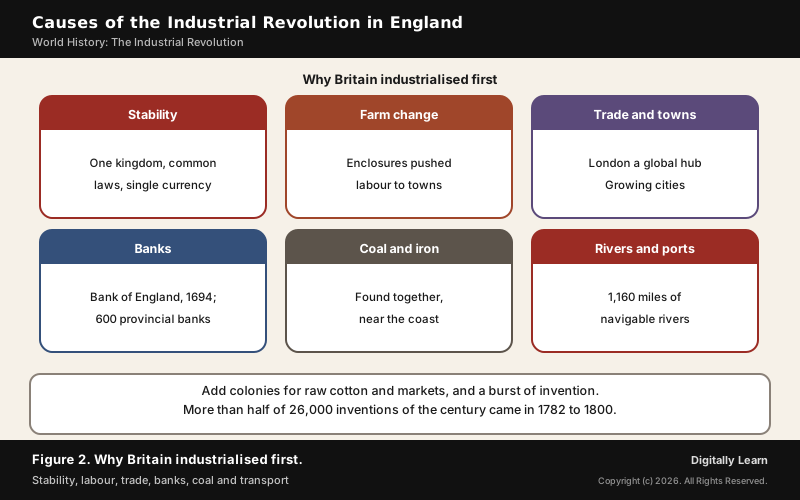
Iron had been smelted with charcoal, which was fragile, gave poor iron and was scarce because forests had been cut. In 1709 the first Abraham Darby built a blast furnace that used coke, derived from coal, and could reach high temperatures.
- Better iron: The second Darby made wrought iron from pig iron; Henry Cort designed the puddling furnace and the rolling mill.
- New uses: John Wilkinson made iron chairs, vats and pipes in the 1770s, and in 1779 the third Darby built the first iron bridge in the world, at Coalbrookdale.
- Scale: Iron output quadrupled between 1800 and 1830, and by 1848 Britain smelted more iron than the rest of the world put together.
Before the machines, about ten spinners were needed to keep one weaver supplied with yarn. A chain of inventions closed the gap between spinning and weaving, and production moved from homes to factories.
- Flying shuttle (1733): John Kay’s loom wove broader cloth faster.
- Spinning jenny (1765): James Hargreaves’s machine let one person spin several threads at once.
- Water frame (1769): Richard Arkwright’s machine made a stronger thread, allowing pure cotton cloth.
- Mule (1779): Samuel Crompton’s machine spun strong and fine yarn.
- Power loom (1787): Edmund Cartwright’s loom was easy to work and stopped when a thread broke.
Two places show the new industry at its birth, and both are now UNESCO World Heritage Sites. The Industrial Revolution had its eighteenth-century roots in the Ironbridge Gorge around Coalbrookdale. In the Derwent valley, Richard Arkwright built a water-powered spinning mill at Cromford in 1771, and its mills became the model for factories throughout the world.
Steam Power, Canals and Railways
Steam was the decisive new power. It was first used to pump water from mines: Thomas Savery built the Miner's Friend in 1698 and Thomas Newcomen an engine in 1712. James Watt's machine of 1769 turned the steam engine from a pump into a prime mover that could run factory machines.
- Soho Foundry: Backed by Matthew Boulton, Watt set it up in Birmingham in 1775; by 1840 British steam engines produced more than 70 per cent of all European horsepower.
- Canals: The Worsley Canal of 1761 carried coal to Manchester and halved its price there; more than 4,000 miles of canal followed over the next 60 years.
- Railways: The first railway line joined Stockton and Darlington in 1825, and the next joined Liverpool and Manchester in 1830; most of England was linked by rail by 1850.
Effects of the Industrial Revolution on Workers in England
Cities, Workers' Lives, Women and Children
Wealth grew dramatically, but so did the human cost. The number of English cities with over 50,000 people rose from two in 1750 to 29 in 1850, without enough housing, sanitation or clean water. Newcomers crowded into slums near the factories while the rich moved to the suburbs.
- Short lives: A survey of 1842 found the average lifespan of workers was 15 years in Birmingham, 17 in Manchester and 21 in Derby; half the children died before five.
- Disease: Polluted water and air spread cholera, typhoid and tuberculosis; more than 31,000 people died of cholera in 1832.
- Women and children: Industrialists preferred them because they would work for less; in the 1850s button trade, men earned 25 shillings a week, women 7 and children one.
- Child labour: About half of factory workers had started work before the age of ten, and children were used in mines to reach narrow coal faces.
Protests and Factory Laws: Luddites, Peterloo and the Ten Hours Act
Workers had neither the vote nor a legal way to protest. Parliament answered unrest with repression: the two Combination Acts of 1795 banned unauthorised public meetings of more than 50 people.
- Bread riots: From the 1790s the poor seized bread and sold it at a fair price.
- Luddism (1811 to 1817): Led by General Ned Ludd, it demanded a minimum wage, control over the labour of women and children, work for those displaced by machines, and the right to form trade unions.
- Peterloo (1819): 80,000 people met peacefully at St Peter’s Fields, Manchester, to claim democratic rights and were brutally suppressed.
- Repeal: The Combination Acts were repealed in 1824 to 1825.
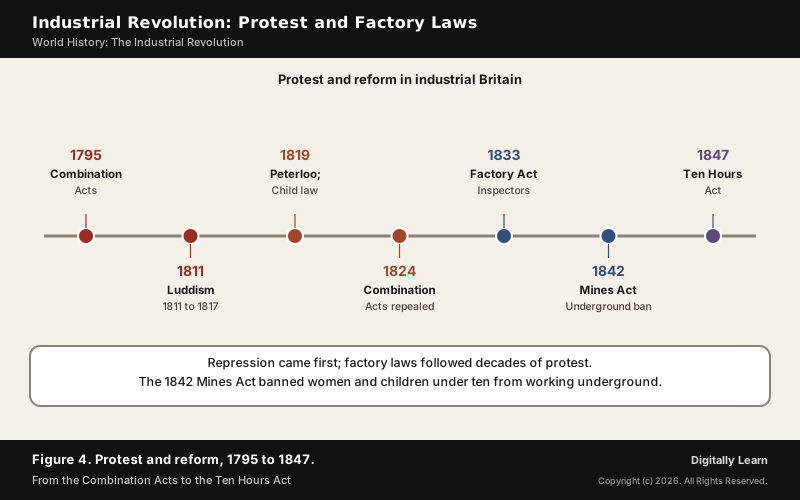
Laws followed slowly. An 1819 law barred children under nine from factories but could not be enforced; the 1833 Act added factory inspectors; the Mines and Collieries Act of 1842 banned women and children under ten from working underground; and the Ten Hours' Bill of 1847 limited the hours of women and young people and secured a 10-hour day for men.
Industrial Revolution and India: Impact Then, Comparison Now
Impact of the Industrial Revolution on India: Ruin of Handicrafts
Britain's gain was India's loss. England had long imported Indian cotton cloth; as its own mills grew, industrial groups pressed for import duties on cotton textiles so that Manchester goods faced no competition at home, and the Company was persuaded to sell British manufactures in India.
- Exports collapsed: Piece-goods were 33 per cent of India’s exports in 1811 to 1812 and no more than 3 per cent by 1850 to 1851.
- Imports flooded in: By 1850 cotton piece-goods were over 31 per cent of the value of India’s imports, and by the 1870s over 50 per cent.
- Double blow: Weavers lost their export market while the home market was glutted with cheap machine-made cloth.
- One-way free trade: After the Charter Act of 1813, cheap machine-made imports flooded the Indian market.
Quality of Life Then and in India Today
Comparing English workers then with Indian workers now works best on the same points: work, pay, health and protection. India's urban population stood at 377.16 million in the 2011 Census, and the problems of fast urban growth that hit Manchester and Birmingham still matter.
| Point | Industrial England, 1800s | India today |
|---|---|---|
| Child labour | Half of factory workers started before ten | Children below 14 barred from any work since 2016 |
| Hours and pay | Ten-hour day only from 1847 | Minimum wage for all; timely wages |
| Health | Lifespans of 15 to 21 years in 1842 | Free annual check-up for workers over 40 |
| Women | 7 shillings a week against men's 25 | May work night shifts with consent and safety |
| Voice and security | No vote or legal means of protest | Social security for gig and platform workers |
The four labour codes took effect on 21 November 2025, replacing 29 laws. They make appointment letters mandatory, require free annual health check-ups for workers over 40, and guarantee timely wages. The Child and Adolescent Labour Act also bars adolescents aged 14 to 18 from hazardous work. Laws alone did not protect English workers, since inspectors were few and easily bribed, and enforcement remains the test in India too.
Was It a Revolution? The Historians' Debate
Debate on the Term Industrial Revolution
Until the 1970s historians used the term for Britain's changes from the 1780s to the 1820s. It was then challenged on several grounds.
- Too gradual: Industrialisation carried existing processes to new levels rather than breaking with the past.
- Regional: Large parts of England stayed untouched by factories, and change centred on London, Manchester, Birmingham and Newcastle.
- Later growth: Productive investment and productivity grew steadily only after 1820.
- Wars: Britain was at war for 36 of the 60 years from 1760, so borrowed capital went to war rather than industry.
By 1851, when crowds visited the Great Exhibition at the Crystal Palace, half of Britain's people lived in towns. The historian A. E. Musson argued that the period 1850 to 1914 was when the Industrial Revolution really occurred on a massive scale.
Previous Year UPSC-CSE Questions
Previous Year UPSC-CSE Questions By the end you will be able to draft model answers for the following UPSC questions. Each question carries a collapsible framework showing how to approach it in the exam.
- UPSC Mains 2015 GS-IWhy did the Industrial Revolution first occur in England? Discuss the quality of life of the people there during the industrialization. How does it compare with that in India at present times?
How to structure the answer in the exam
Introduction: Britain between the 1780s and the 1850s became the first country to industrialise, at a heavy human cost.
Body (sub-themes to develop):
- Causes: stability and a unified market; enclosures; towns, banks and trade; colonies; coal and iron; inventions.
- Quality of life: slums, 15 to 21 year lifespans in 1842, cholera, women and child labour.
- Reform: protests, Combination Acts repealed, Factory Acts of 1833 and 1847.
- India today: child labour banned below 14, labour codes of 2025, fast urban growth, weak enforcement.
Conclusion: Conclude that India has the laws England lacked but, like England, must win on enforcement.
- UPSC Mains 2024 GS-IHow far was the Industrial Revolution in England responsible for the decline of handicrafts and cottage industries in India?
How to structure the answer in the exam
Introduction: Machine-made cloth from England's mills was the main blow to Indian handicrafts.
Body (sub-themes to develop):
- Machines cut costs: cheap Manchester goods.
- British import duties shut out Indian cloth; exports fell from 33 to 3 per cent.
- One-way free trade after 1813; imports over 50 per cent by the 1870s.
- Weavers lost both export and home markets.
Conclusion: Conclude that the Industrial Revolution acted through colonial trade policy.
- UPSC Prelims 2020 Prelims-GSWhich of the following statements correctly explains the impact of Industrial Revolution on India during the first half of the nineteenth century?
How to approach this Prelims question
Approach: Pick what actually happened before 1850.
Trap to watch: Railways and machine mills came mostly after 1850.
Key facts to recall:
- Piece-goods fell from 33 to 3 per cent of exports
Answer signal: Indian handicrafts were ruined: option (a).
Sources and Further Reading
- NCERT: Themes in World History (Class XI), The Industrial Revolution
- NCERT: India and the Contemporary World II (Class X), The Age of Industrialisation
- PIB: Government makes the four Labour Codes effective (2025)
- PIB: Children and adolescents prohibited to work in mines (2022)
- DD News: Four Labour Codes come into force, reforming 29 existing laws (2025)
- UNESCO World Heritage Centre: Ironbridge Gorge
- UNESCO World Heritage Centre: Derwent Valley Mills
- Wikipedia: Industrial Revolution
- Wikipedia: Luddite
- UPSC: Previous year question papers
Editorial Disclaimer
This article explains the Industrial Revolution in England for UPSC preparation. Dates, figures and attributions reflect the cited sources.


