


Overview
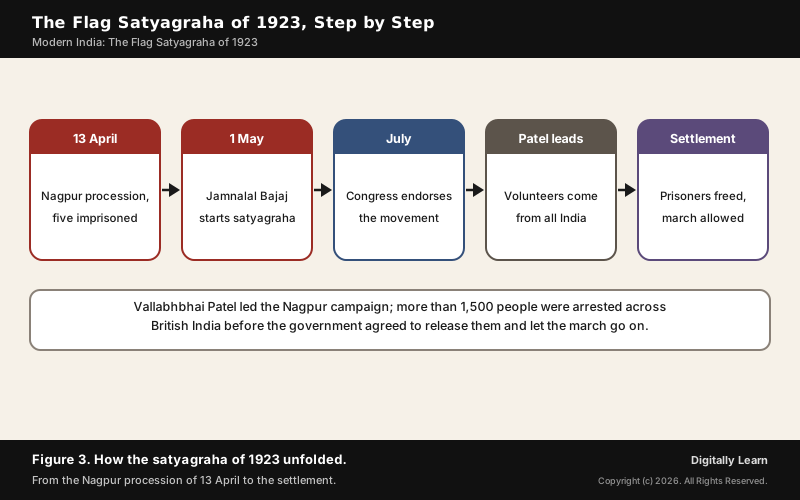
The Flag Satyagraha, or Jhanda Satyagraha, was a campaign of peaceful civil disobedience in 1923 for the right to hoist the nationalist Swaraj flag in public. It was centred on Nagpur and Jabalpur in the Central Provinces. Jamnalal Bajaj started it at Nagpur on 1 May 1923, the Congress endorsed it in July, and Vallabhbhai Patel led it to a settlement that freed the prisoners and let the flag march go on.
Flag Satyagraha of 1923 at a Glance
What Was the Flag Satyagraha and Who Started It
The Flag Satyagraha was started at Nagpur on 1 May 1923 by Jamnalal Bajaj, the secretary of the Nagpur Congress Committee, and was later led by Vallabhbhai Patel. Satyagrahis broke the orders that barred the nationalist flag from public places, marched with it, and offered themselves for arrest without resisting the police. The key facts are:
| Question | Answer |
|---|---|
| Also called | Jhanda Satyagraha (jhanda means flag) |
| When | Several months of 1923 |
| Where | Nagpur and Jabalpur, Central Provinces (now Maharashtra and Madhya Pradesh) |
| Started by | Jamnalal Bajaj at Nagpur, 1 May 1923 |
| Led by | Vallabhbhai Patel, at the Congress's request |
| Flag defended | The Swaraj flag: red, white and green with a spinning wheel |
| Arrests | Over 1,500 across British India |
| Outcome | Prisoners released; the march and public hoisting allowed |
Why the Flag Became a Battleground After Non-Cooperation
The satyagraha grew out of the gap left by the Non-Cooperation Movement. Gandhi called that movement off after the violence at Chauri Chaura in February 1922, and he was arrested in March 1922 and charged with sedition. Congress workers were left looking for a form of protest that stayed non-violent and could be carried on without him.
The flag offered one. Hoisting nationalist flags on private and public buildings had long been an act of defiance, and the Swaraj flag had been used at Congress meetings since 1921. Carrying the flag and holding it aloft during marches, in the words of the Class X NCERT text, 'became a symbol of defiance'. When the authorities barred the flag from public places, flying it became a direct test of the right to protest.
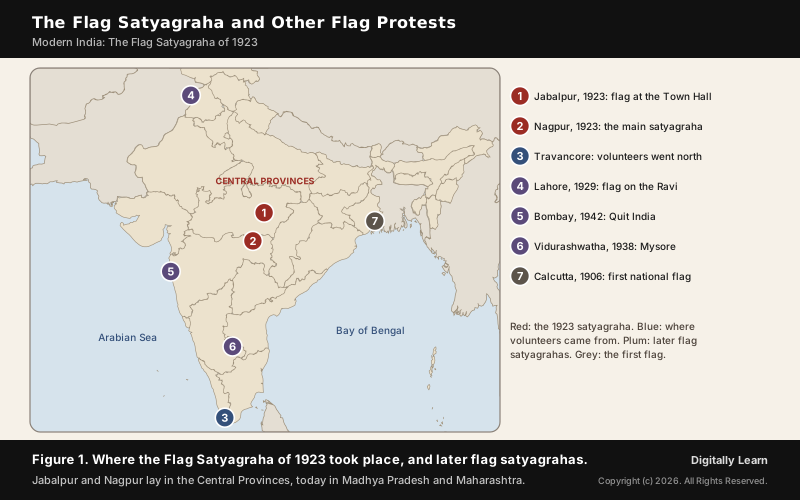
Jabalpur had a part from the start. According to the Ministry of Culture, the outline of the Jhanda Satyagraha was prepared in 1922 at a meeting in the Town Hall of Jabalpur, and satyagrahis later hoisted the flag on Victoria Town Hall at Jabalpur despite a heavy police presence.
Course of the Flag Satyagraha at Nagpur and Jabalpur
The Nagpur Procession, Bajaj's Satyagraha and the Congress Endorsement
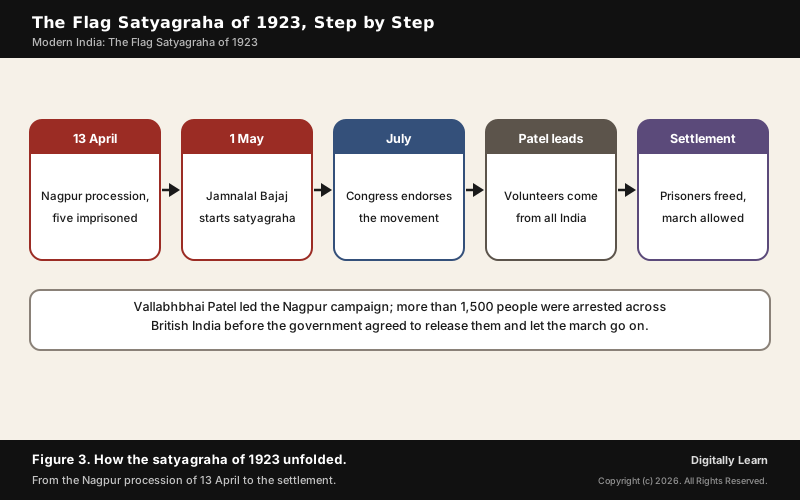
The spark came on 13 April 1923, the fourth anniversary of the Jallianwala Bagh massacre. Local Congress volunteers in Nagpur held a procession to mark the day and hoisted the Swaraj flag designed by Pingali Venkayya. The police confronted them, and five people were imprisoned. More than a hundred others continued the flag procession after a meeting.
On the first of May, Jamnalal Bajaj formally started the Flag Satyagraha, which drew national attention. Bajaj, who had chaired the reception committee of the Nagpur Congress session of 1920 and given up his British title of Rai Bahadur, was himself detained for defying the ban. The news of the flag being hoisted at Jabalpur and Nagpur spread quickly, and flags went up at several other places in the country.
The satyagraha exposed a division inside the Congress. The Gandhians were enthusiastic. The Swarajists, led by C. R. Das and Motilal Nehru, who argued for a return to council politics, called the movement inconsequential.
The party closed ranks at the All India Congress Committee meeting of July 1923, where, at the insistence of Jawaharlal Nehru and Sarojini Naidu, the flag movement was endorsed. From then on it was a Congress campaign, not a local protest, and volunteers were sent to the Central Provinces from other provinces.
Vallabhbhai Patel's Leadership and the Settlement
With Gandhi in prison, Congress members asked Vallabhbhai Patel to lead the satyagraha at Nagpur against the law banning the flag. He organised thousands of volunteers from all over the country to take part in processions that broke the ban. Organisers included Jamnalal Bajaj, C. Rajagopalachari, Rajendra Prasad and Vinoba Bhave, and volunteers came from as far south as the princely state of Travancore.
The numbers grew steadily. By the end of the movement over 1,500 people had been arrested across British India. The government then negotiated with Patel and other Congress leaders: all prisoners were released and the protesters were allowed to carry out their march unhindered and to hoist the flag in public.
Who Took Part: Women, Farmers, Students and Merchants
The satyagraha reached people who had rarely joined protests before. The newspaper Bombay Chronicle reported that it drew farmers, students, merchants, labourers and 'national servants'. It enthused women, who had until then seldom taken part in the independence movement, while Muslim participation stayed moderate.
The best-known woman satyagrahi was the Hindi poet Subhadra Kumari Chauhan of Jabalpur. She was the first woman satyagrahi to court arrest in Nagpur, and she was jailed for her part in protests against British rule in 1923 and again in 1942. Her poem 'Jhansi Ki Rani' is one of the most recited poems in Hindi literature.
Evolution of the Indian National Flag, 1906 to 1947
Early Nationalist Flags: Calcutta 1906, Madam Cama 1907 and Home Rule
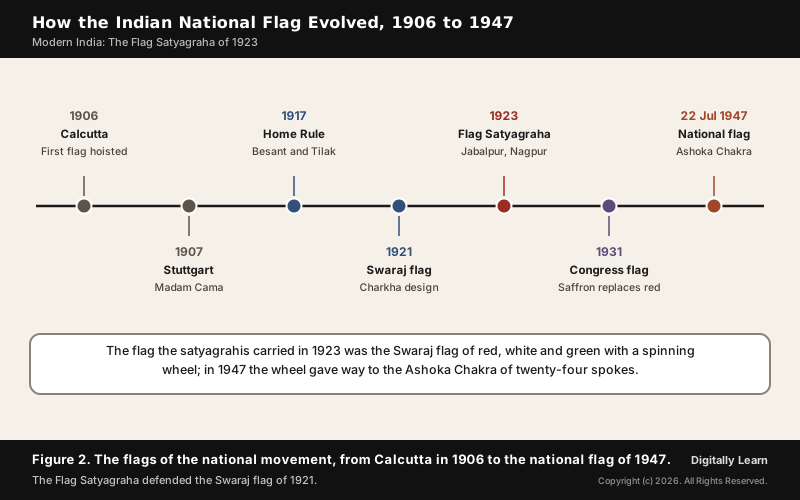
The first flag of the national movement was hoisted in 1906 at Parsee Bagan Square in Calcutta during the Swadeshi and Boycott struggle. The Class X NCERT text describes the Swadeshi tricolour of red, green and yellow, with eight lotuses for the eight provinces of British India and a crescent moon.
A slightly changed version was unfurled by Madam Bhikaji Cama on 22 August 1907 at the second International Socialist Congress in Stuttgart, Germany, the first time an Indian flag was hoisted abroad. Cama, born to a Parsi family in Bombay, had worked as private secretary to Dadabhai Naoroji and lived in exile in Paris.
In 1917 Annie Besant and Bal Gangadhar Tilak hoisted a flag for the Home Rule Movement, with the Union Jack in one corner, signifying self-rule within the Empire. A magistrate in Coimbatore banned its use, the first government action against a nationalist flag. Pingali Venkayya had meanwhile published 30 possible designs in 1916.
The Swaraj Flag of 1921: Pingali Venkayya and the Charkha
Gandhi raised the need for an Indian flag in his journal Young India in April 1921, proposing one with the charkha, or spinning wheel, at its centre; Lala Hansraj had suggested the idea. Gandhi asked Pingali Venkayya to design it, and Venkayya presented the design at Bezwada, now Vijayawada, in 1921.
The first design had two colours, red for the Hindus and green for the Muslims. On Gandhi's suggestion a white band was added for all other communities, making a tricolour of red, white and green. The spinning wheel stood for the Gandhian ideal of self-help. In 1929 Gandhi gave the colours a secular meaning: red for the sacrifices of the people, white for purity and green for hope.
From the Congress Flag of 1931 to the National Flag of 22 July 1947
After 1923 the flag became part of every major campaign. On 31 December 1929, at the close of the Lahore session that adopted Purna Swaraj, Jawaharlal Nehru hoisted the flag on the bank of the Ravi. On 26 January 1930 'Independence Day' was observed across the country with the national flag hoisted at different venues.
In 1931 the Congress passed a formal resolution adopting Venkayya's flag with one change: saffron replaced red. Saffron stood for courage, white for peace and green for fertility and growth. The flag was hoisted at the start of the Quit India movement at Gowalia Tank in Bombay on 7 August 1942.
Flag satyagrahas also reached the princely states. In Mysore in 1938 the Shivapur Dhwaja Satyagraha was led by T. Siddalingaiah, president of the Mysore Congress; at Vidurashwatha in Kolar district, police firing on 25 April 1938 killed 33 people and injured more than 100.
On 23 June 1947 the Constituent Assembly set up an ad hoc committee under Rajendra Prasad, with Maulana Abul Kalam Azad, Sarojini Naidu, C. Rajagopalachari, K. M. Munshi and B. R. Ambedkar, to choose a flag. On 14 July it recommended the Congress flag with suitable changes, so that it would carry no communal meaning.
The spinning wheel was replaced by the Ashoka Chakra from the Lion Capital of Ashoka. Sarvepalli Radhakrishnan explained the wheel as a symbol of dharma and law; Nehru called the change practical, since unlike the spinning wheel the chakra made the design symmetrical. Nehru moved the resolution on 22 July 1947 for a horizontal tricolour of saffron, white and dark green in equal proportion, and it was approved unanimously. The flag served the Dominion of India from 15 August 1947 and has served the Republic since 26 January 1950.
The National Flag Today: Flag Code and the Right to Fly It
Flag Code of India, 2002 and Its Amendments of 2021 and 2022
The rules the satyagrahis defied have given way to a code that encourages citizens to fly the flag. The Flag Code of India, 2002, which took effect on 26 January 2002, brings together the laws, conventions and instructions on displaying the flag. It works with two laws: the Emblems and Names (Prevention of Improper Use) Act, 1950 and the Prevention of Insults to National Honour Act, 1971. Its main rules are:
- Design: Saffron at the top, white in the middle and green at the bottom, with a navy blue Ashoka Chakra of 24 equally spaced spokes at the centre.
- Shape: Rectangular, with length and height in the ratio 3:2.
- Size: The code of 2002 listed nine standard sizes, from 6300 x 4200 mm down to 150 x 100 mm; the flag can now be of any size, provided the ratio is 3:2.
- Material: Hand-spun khadi only until an order of 30 December 2021 allowed polyester and machine-made flags.
- Timing: Since an order of 20 July 2022 a flag displayed in the open or on a citizen’s house may be flown day and night.
- Disposal: A damaged flag is destroyed as a whole in private; paper flags waved at events must not be thrown on the ground, as the Home Ministry reminded States in August 2025.
Right to Fly the National Flag: The Naveen Jindal Case
The right the satyagrahis claimed in 1923 was confirmed as a fundamental right in independent India. In 1992 the industrialist Naveen Jindal hoisted the flag at his factory in Raigarh; the local administration objected, because the flag code of the time restricted private citizens to specific occasions.
In 2004 the Supreme Court, in a bench headed by Chief Justice V. N. Khare, held that under Article 19(1)(a) of the Constitution citizens have the fundamental right to fly the national flag on their premises throughout the year, provided they do not undermine its dignity. The 2002 code had already opened the flag to unrestricted display consistent with its honour.
Significance of the Flag Satyagraha for the National Movement
How the Flag Satyagraha Shaped the Freedom Struggle
The Flag Satyagraha mattered well beyond Nagpur. Its main effects on the national movement were:
- Symbol: Defending the flag’s honour became part of the independence struggle; even detractors such as Motilal Nehru came to hail the Swaraj flag as a symbol of national unity.
- Continuity: It kept non-violent civil disobedience alive between the end of Non-Cooperation in 1922 and the Civil Disobedience Movement of 1930.
- Participation: Women, students, farmers and merchants took part, widening the social base of protest.
- Leadership: Patel emerged as the organiser of a campaign on an all-India scale.
- British response: The government took the flag far more seriously than before; the British Parliament discussed it and municipalities that did not prevent its display were threatened with the loss of their funds.
The movement also had limits. The Swarajists dismissed it, Muslim participation was moderate, and it won a local concession rather than a change of law. Its lasting gain was the flag itself: by the time the Congress adopted it formally in 1931, it was already the symbol of the independence movement. The Union Ministry of Culture marked the satyagraha at Jabalpur in 2021, ahead of its centenary in 2023.
Flag Satyagraha and the National Flag in UPSC Previous Year Questions
What UPSC Has Asked About the Flag and the Flag Movement
UPSC has not set a question naming the Flag Satyagraha itself, but it has tested the national flag and the people around it at both stages. The objective questions turn on exact facts, the place of Cama's flag, the spokes of the chakra and the rules of the Flag Code; the Mains question asks how different groups enriched the Gandhian phase, for which the satyagraha of 1923 is a ready example.
| Year | What the question asked | The point being tested |
|---|---|---|
| 2006 Prelims | Statements on Madam Bhikaji Cama | Stuttgart, not Paris; Naoroji; Parsi |
| 2008 Prelims | Spokes in the Dharmachakra of the flag | Twenty-four |
| 2019 Mains | Many voices in the Gandhian phase | Women and common people in protest |
| 2023 Prelims | Flag size and ratio under the Flag Code | 600 x 400 not listed; ratio 3:2 |
Previous Year UPSC-CSE Questions
Previous Year UPSC-CSE Questions By the end you will be able to draft model answers for the following UPSC questions. Each question carries a collapsible framework showing how to approach it in the exam.
- UPSC Mains 2019 GS-IMany voices had strengthened and enriched the nationalist movement during the Gandhian phase. Elaborate.
Answer outline: how to structure the answer
What the question asks, the main arguments, relevant examples and the direction of the conclusion. This is not a full model answer.
Introduction: Open with the Gandhian phase turning the Congress into a mass movement.
Body (sub-themes to develop):
- Women: Subhadra Kumari Chauhan at Nagpur in 1923; later the salt marches.
- Peasants, students, merchants and workers: the social base reported in 1923.
- Regional volunteers: Travancore to Nagpur; flag satyagrahas in the princely states.
- Political currents: Gandhians and Swarajists; the AICC endorsement of July 1923.
- Symbols: the Swaraj flag as a shared emblem across communities.
Conclusion: Conclude that these voices made the movement national in reach, not only in name.
- UPSC Prelims 2006 Prelims-GSConsider the following statements about Madam Bhikaji Cama :
- Madam Cama unfurled the National Flag at the International Socialist Conference in Paris in the year 1907.
- Madam Cama served as private secretary to Dadabhai Naoroji.
- Madam Cama was born to Parsi parents.
Which of the statements given above is/are correct?
How to approach this Prelims question
Approach: Step 1: statement 1: Madam Cama unfurled the flag on 22 August 1907 at the International Socialist Congress in Stuttgart, not Paris, though she lived in exile in Paris; wrong. Step 2: statement 2: she had worked as private secretary to Dadabhai Naoroji; correct. Step 3: statement 3: she was born to a Parsi family in Bombay; correct.
Trap to watch: Paris was where Cama lived; the flag was unfurled at the Stuttgart congress.
Key facts to recall:
- (a) 1, 2 and 3: wrong. Statement 1 is wrong: the flag was unfurled at Stuttgart, not Paris.
- (b) 2 and 3 only: correct. She was Naoroji's private secretary and was born to Parsi parents.
- (c) 1 and 2 only: wrong. Statement 1 is wrong, and statement 3 is also correct.
- (d) 3 only: wrong. Statement 2 is also correct: she worked as Naoroji's private secretary.
Answer signal: Statements 2 and 3 are correct, option (b).
- UPSC Prelims 2008 Prelims-GSWhat is the number of spokes in the Dharmachakra in the National Flag of India?
How to approach this Prelims question
Approach: Step 1: under the Flag Code the national flag carries a navy blue Ashoka Chakra at its centre. Step 2: the chakra has 24 equally spaced spokes.
Trap to watch: Do not confuse the chakra's spokes with other numbers on the flag.
Key facts to recall:
- (a) 16: wrong. The Ashoka Chakra has 24 spokes, not 16.
- (b) 18: wrong. The chakra has 24 spokes.
- (c) 22: wrong. The chakra has 24 spokes.
- (d) 24: correct. The navy blue Ashoka Chakra has 24 equally spaced spokes.
Answer signal: Twenty-four, option (d).
- UPSC Prelims 2023 Prelims-GSConsider the following statements in respect of the National Flag of India according to the Flag Code of India, 2002 :
- Statement-I : One of the standard sizes of the National Flag of India is 600 mm x 400 mm.
- Statement-II : The ratio of the length to the height (width) of the Flag shall be 3:2.
Which one of the following is correct in respect of the above statements?
How to approach this Prelims question
Approach: Step 1: Statement I: the Flag Code of 2002 listed nine standard sizes, from 6300 x 4200 mm down to 150 x 100 mm, and 600 x 400 mm is not one of them; incorrect. Step 2: Statement II: the length and height of the flag are in the ratio 3:2; correct.
Trap to watch: 600 x 400 mm keeps the 3:2 ratio but was not one of the nine standard sizes.
Key facts to recall:
- (a) Both correct and II explains I: wrong. Statement I is incorrect.
- (b) Both correct but II does not explain I: wrong. Statement I is incorrect: 600 x 400 mm is not a listed size.
- (c) Statement I correct, Statement II incorrect: wrong. It is the other way round.
- (d) Statement I incorrect, Statement II correct: correct. The size is not listed, and the ratio is 3:2.
Answer signal: Statement-I incorrect, Statement-II correct, option (d).
Sources
- NCERT: India and the Contemporary World II (Class X), Nationalism in India
- NCERT: Themes in Indian History Part III (Class XII)
- PIB (Ministry of Culture): Flag Satyagraha observed in Jabalpur, 2021
- PIB factsheet: Evolution of the Indian National Flag, 2022
- PIB: Frequently Asked Questions about the Indian National Flag
- Ministry of Home Affairs: Flag Code of India, 2002
- Ministry of Home Affairs: circular on the Flag Code, August 2025
- Wikipedia: Flag Satyagraha
- Wikipedia: Flag of India
- Wikipedia: Pingali Venkayya
- Wikipedia: Jamnalal Bajaj
- Wikipedia: Bhikaji Cama
- Wikipedia: Vallabhbhai Patel
- Wikipedia: Subhadra Kumari Chauhan
- Wikipedia: Flag code of India
- Wikipedia: Naveen Jindal
- UPSC: Civil Services Examination question papers
Editorial Disclaimer
This article is for UPSC and State PCS preparation. Verify dates and interpretations against NCERT and standard reference histories before relying on them.


