


Overview
The World Health Statistics is the annual flagship report of the World Health Organization, published since 2005, that tracks the world's progress on health-related Sustainable Development Goals. The 2026 edition, released in May 2026, finds that the world is off track to meet any health-related SDG by 2030. It records real gains, such as a 40 per cent fall in new HIV infections since 2010, alongside warning signs, chiefly rising premature deaths from noncommunicable diseases. Its message is that global health progress is uneven, slowing, and in some areas reversing.
Why the World Health Statistics report is in focus
WHO's annual health report card
The World Health Organization released the World Health Statistics 2026 in May 2026. Subtitled 'Monitoring health for the SDGs', it is the WHO's annual statistical report on the state of the world's health.
The report compiles health data from member states to track progress on the health-related Sustainable Development Goals. It has been published every year since 2005 and is a standard reference for global health trends.
The central message of the 2026 edition is sobering. Despite a decade of real gains, the world is off track to meet any health-related SDG by 2030, and progress is uneven, slowing, and in some areas reversing.
The headline findings of the report are:
- Off track: the world will miss every health-related SDG at the current pace.
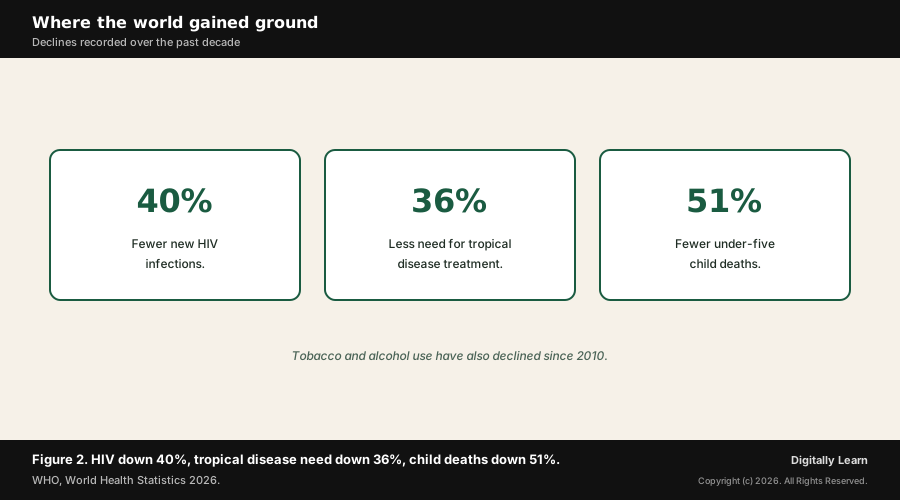
- Gains: new HIV infections fell 40% and under-five deaths fell 51%.
- Warning: premature deaths from noncommunicable diseases are rising.
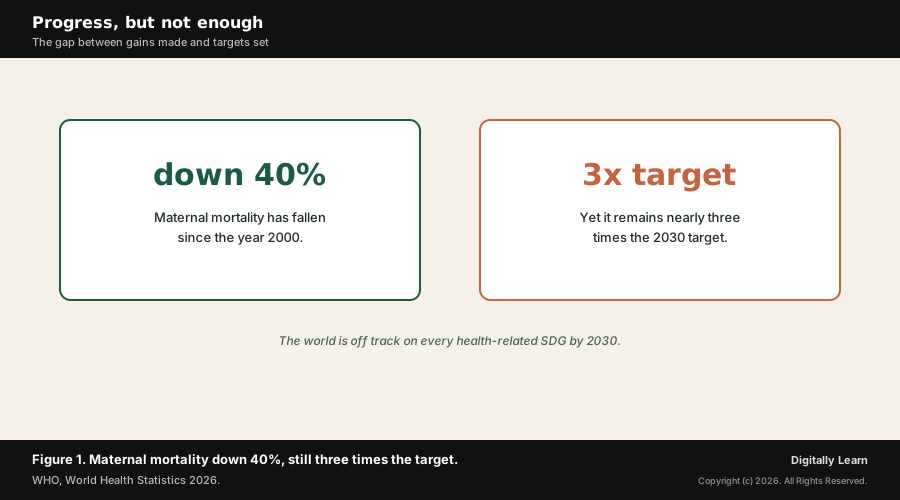
- Unfinished: maternal mortality fell 40% since 2000 but remains far above target.
Why the report matters
Gains at risk of reversal
The report is the world's shared scorecard on health. When it warns that gains face reversal, governments and funders learn where progress is stalling and where money and effort must now go.
Premature deaths from noncommunicable diseases such as heart disease, stroke, diabetes and cancer are rising. They now account for most deaths among people under the age of 70 worldwide.
It also matters because the unfinished agenda is large. Although maternal mortality fell about 40 per cent since 2000, it remains nearly three times the 2030 target, so the hardest gains still lie ahead.
What the report signifies
An NCD turn, real gains, and a stalling pace
Three threads carry the weight: the turn towards noncommunicable diseases, the gains that have been won, and the slowing pace of progress.
First, the NCD turn. The biggest health threat is no longer only infectious disease. Lifestyle and ageing now drive heart disease, diabetes and cancer, which together cause most early deaths.
Second, the real gains. New HIV infections fell about 40 per cent since 2010, the need for treatment against neglected tropical diseases fell 36 per cent, and tobacco and alcohol use both declined.
Third, the stalling pace. Progress on cutting premature NCD deaths has slowed sharply since 2015, and the world is off track to cut them by one-third by 2030 as the SDGs require.
Distinguishing features of the report
The report at a glance
The table sets the headline indicators side by side, so the mix of gains and warning signs in the report is visible at a glance.
| Indicator | Finding |
|---|---|
| New HIV infections (2010 to 2024) | Fell about 40% |
| Under-five mortality | Fell about 51% |
| Maternal mortality (since 2000) | Fell about 40%, still about 3x the 2030 target |
| Premature deaths from NCDs | Rising; most deaths among the under-70s |
| Air pollution (2021) | Contributed to about 6.6 million deaths |
Three features that define the report
Three elements set this report apart from a single data release:
- (i) An SDG scorecard. It measures the world against the health targets agreed for 2030, not against a single year.
- (ii) Both sides of the ledger. It records gains and reversals together, so the picture is balanced rather than alarmist.
- (iii) A risk-factor lens. It links deaths to drivers such as NCDs, air pollution and unsafe water, which points to prevention.
Observable outcomes
Three trackable outcomes
The report translates into three developments to watch in global and national health policy.
- (a) A shift to prevention. Rising NCD deaths push governments towards tackling tobacco, diet, alcohol and air pollution.
- (b) Renewed maternal and child focus. The unfinished agenda keeps pressure on safe births and child survival.
- (c) Stronger health systems. Meeting the targets needs wider coverage and better financing, not single disease programmes alone.
Global averages hide wide gaps. The poorest countries and communities carry the heaviest burden, so the headline numbers do not capture every region equally.
The SDGs, the Triple Billion and India
Health goals, WHO's targets and India's missions
The report tracks Sustainable Development Goal 3, which seeks good health and well-being for all, including targets on maternal deaths, child deaths and noncommunicable diseases.
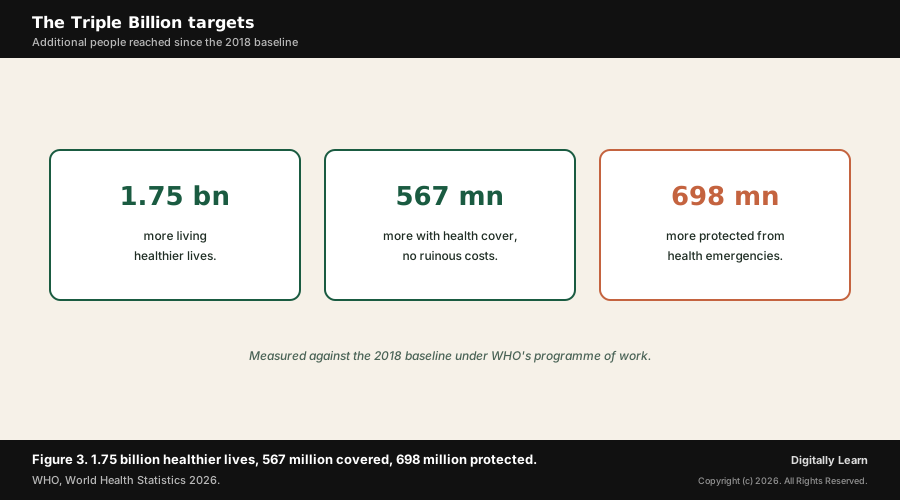
It also reports on WHO's Triple Billion targets, which measure how many more people enjoy better health, universal health coverage and protection from health emergencies compared with a 2018 baseline.
For India, the findings echo its own health priorities, the push against noncommunicable diseases, the drive for universal health coverage through Ayushman Bharat, and the long effort to cut maternal and child deaths.
UPSC relevance and exam focus
Where this fits in the UPSC-CSE syllabus
This topic maps to General Studies Paper II: issues relating to development and management of social sectors, health, and important international institutions.
For Prelims, hold the high-yield facts: the World Health Statistics is the WHO's annual report on health SDGs, the off-track headline, and the gain figures for HIV and child mortality.
For Mains, two framings recur: the rising burden of noncommunicable diseases and its remedies, and India's progress on health-related global goals.
Recurring linked concepts an aspirant should keep in working memory:
- WHO: the United Nations specialised agency for health.
- SDG 3: good health and well-being for all by 2030.
- Noncommunicable diseases: heart disease, stroke, diabetes and cancer.
- Triple Billion targets: WHO’s measure of people reached on health, coverage and emergencies.
The World Health Statistics is published by the WHO, not by the World Bank or the United Nations Development Programme. Mixing up the publishing agency is an easy error.
Do not present global health as steadily improving. The report's point is that gains are slowing and, for NCDs, at risk of reversal.
Previous Year UPSC-CSE Questions By the end you will be able to draft model answers for the following UPSC questions. Each question carries a collapsible framework showing how to approach it in the exam.
- UPSC Mains 2013 GS-IIIdentify the Millennium Development Goals (MDGs) that are related to health. Discuss the success of the actions taken by the Government for achieving the same.
How to structure the answer in the exam
Introduction: Open with the health goals among the MDGs and their continuation as SDG 3.
Body (sub-themes to develop):
- Health MDGs: child mortality, maternal health, and disease control.
- Government action: national health missions and disease programmes.
- Gains: falling child and maternal deaths.
- Gaps: the unfinished agenda the World Health Statistics records.
- The transition to the broader, NCD-inclusive SDG 3 framework.
Conclusion: Conclude that sustained financing and prevention are needed to carry the health goals to completion.
- UPSC Prelims 2016Consider the following statements:
- The Sustainable Development Goals were first proposed in 1972 by a global think tank called the 'Club of Rome'.
- The Sustainable Development Goals have to be achieved by 2030.
Which of the statements given above is/are correct?
How to approach this Prelims question
Approach: Test each statement about the origin and deadline of the Sustainable Development Goals.
Trap to watch: The SDGs were adopted in 2015, not proposed in 1972 by the Club of Rome; only the 2030 deadline is correct, giving '2 only'.
Key facts to recall:
- The SDGs were adopted by the United Nations in 2015.
- They are to be achieved by 2030.
- The Club of Rome's 1972 work was 'The Limits to Growth', not the SDGs.
Answer signal: Only the 2030-deadline statement holds. Correct answer: 2 only.
Sources and Further Reading
Editorial Disclaimer
This article is compiled from the reference materials listed in the Sources section. It is an explainer for UPSC preparation and is not a substitute for primary documents (NCERTs, GoI ministry releases, IMD bulletins, RBI / CEA / MoEFCC publications, and Standing-Committee reports).


