


Overview
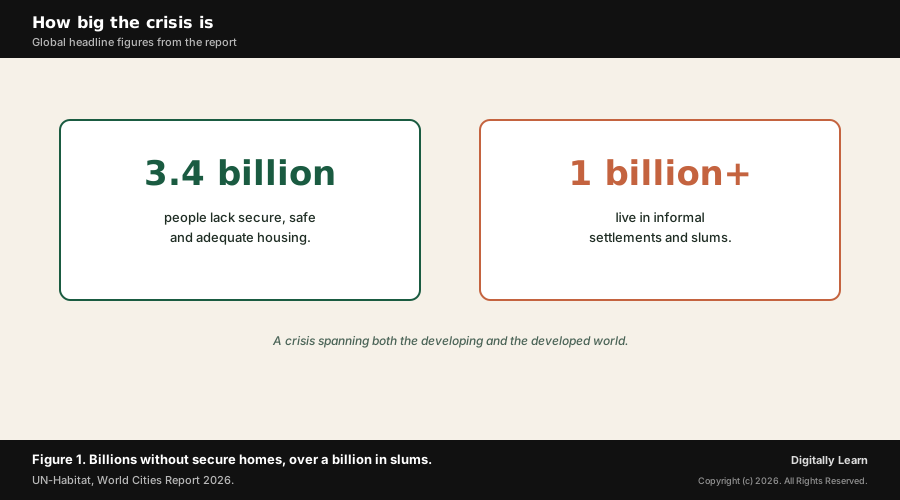
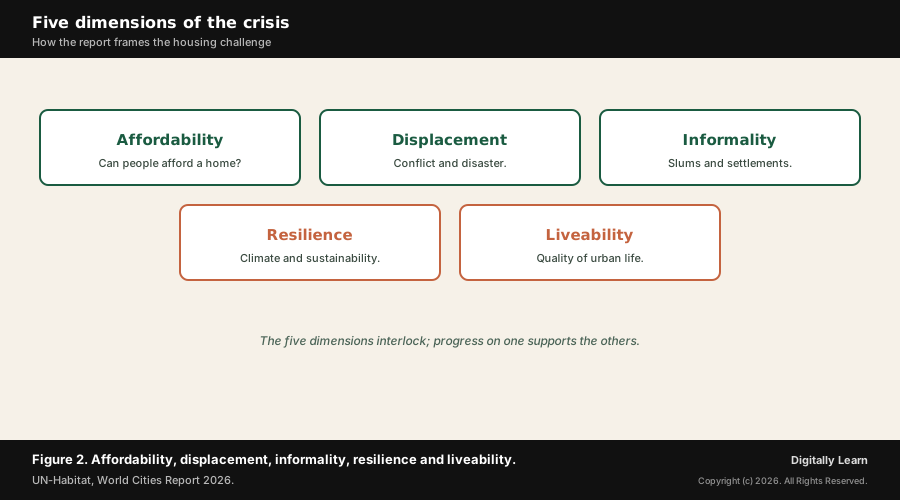
The World Cities Report is the flagship report of UN-Habitat, the United Nations programme for human settlements. Its 2026 edition, titled 'The Global Housing Crisis: Pathways to Action', was launched at the World Urban Forum in Baku in May 2026. It finds that about 3.4 billion people lack secure, safe and adequate housing, with over a billion in informal settlements and slums. The report frames the crisis through five dimensions, affordability, displacement, informality, resilience and liveability, and calls for housing to be treated as a social good.
Why the World Cities Report is in focus
A flagship report on the housing crisis
The development. UN-Habitat released its World Cities Report 2026, titled 'The Global Housing Crisis: Pathways to Action'. It was launched at the World Urban Forum in Baku in May 2026.
UN-Habitat is the United Nations programme for human settlements and sustainable urbanisation. Its World Cities Report is the flagship publication that tracks the state of the world's cities.
The 2026 edition centres on housing. It finds that about 3.4 billion people lack secure, safe and adequate housing, and that more than one billion live in informal settlements and slums.
The headline findings of the report are:
- Scale: about 3.4 billion people lack secure, safe and adequate housing.
- Slums: over one billion people live in informal settlements and slums.
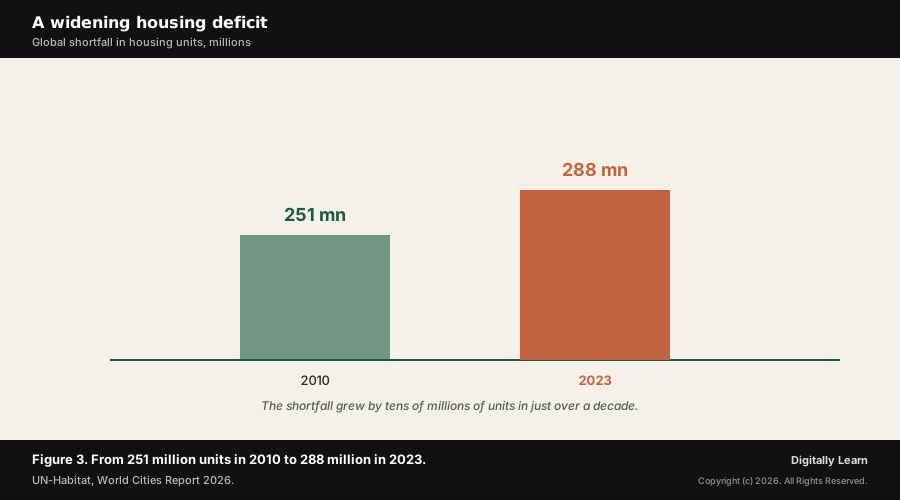
- Deficit: the global housing shortfall has widened over the past decade.
- Framing: the crisis is analysed through five interlocking dimensions.
Why the report matters
Housing as the heart of the urban agenda
Adequate housing underpins health, education and livelihoods. When billions lack secure homes, the costs fall on individuals and on the cities and economies they live in.
The crisis is global, not confined to poor countries. Even wealthy cities face soaring rents and shortages, so the report frames housing as a shared challenge across the income spectrum.
It also matters for India, which is urbanising fast and carries large slum populations. The report's diagnosis maps closely onto India's own affordability and informality challenges.
What the report signifies
A right, a widening deficit, and pathways
Three threads carry the weight: housing as a right, the widening of the deficit, and the pathways the report proposes.
First, housing as a right. The report urges that housing be treated as a social good and a human right, not merely a market commodity priced beyond the reach of the poor.
Second, the widening deficit. The global housing shortfall rose from 251 million units in 2010 to 288 million in 2023, with the gap most acute in Sub-Saharan Africa.
Third, the pathways. The report calls for affordable, well-located housing, stronger land governance, and planning reform towards compact, connected and climate-resilient cities.
Distinguishing features of the report
The report at a glance
The table sets out the key facts and figures, so the report's scope and headline data are visible at a glance.
| Feature | Detail |
|---|---|
| Publisher | UN-Habitat (flagship World Cities Report) |
| Title | The Global Housing Crisis: Pathways to Action |
| Launch | World Urban Forum, Baku, May 2026 |
| Lacking adequate housing | About 3.4 billion people |
| Housing deficit | 251 million units (2010) to 288 million (2023) |
Three features that define the report
Three elements set this report apart from a routine data release:
- (i) A single sharp theme. The whole report is built around the global housing crisis, not a broad survey of cities.
- (ii) Five interlocking dimensions. It analyses housing through affordability, displacement, informality, resilience and liveability.
- (iii) Pathways, not only diagnosis. It pairs the data with concrete policy actions for governments to take.
Observable outcomes
Three trackable outcomes
The report translates into three developments to watch in urban policy.
- (a) Policy uptake. Governments can use the report’s pathways to redesign housing and land-governance policy.
- (b) Affordable-housing push. The data strengthens the case for affordable, well-located public and rental housing.
- (c) Slum upgrading. The focus on informality supports renewed efforts to upgrade settlements rather than evict residents.
A report sets the agenda; delivery depends on finance and land. Whether housing supply actually rises is the real test of its pathways.
Housing, urbanisation and India
The SDGs, India's missions and the right to the city
The report speaks directly to Sustainable Development Goal 11, which seeks inclusive, safe, resilient and sustainable cities, including adequate housing for all.
It connects to India's urban missions, such as the housing-for-all programme and slum-upgrading efforts, which face the same affordability and informality pressures the report describes.
The report also revives the idea of the right to the city, the principle that all residents, including the poor and informal workers, have a claim to urban space and services.
UPSC relevance and exam focus
Where this fits in the UPSC-CSE syllabus
This topic maps to General Studies Paper I: urbanisation, their problems and remedies, and to General Studies Paper II: issues relating to development and the management of social sectors.
For Prelims, hold the high-yield facts: UN-Habitat as the UN body for human settlements, the World Cities Report as its flagship, the 2026 theme, and the headline housing figure.
For Mains, two framings recur: the drivers and remedies of urbanisation in developing countries, and housing as a right within inclusive urban development.
Recurring linked concepts an aspirant should keep in working memory:
- UN-Habitat: the United Nations programme for human settlements.
- SDG 11: sustainable cities and communities, including adequate housing.
- Informal settlements: slums and unplanned housing lacking secure tenure.
- Right to the city: the claim of all residents to urban space and services.
UN-Habitat, not the World Health Organization or the World Bank, publishes the World Cities Report. Attributing it to the wrong agency is an easy error.
Do not treat the housing crisis as a problem only of poor countries. The report stresses that affordability pressures are global, including in wealthy cities.
Previous Year UPSC-CSE Questions By the end you will be able to draft model answers for the following UPSC questions. Each question carries a collapsible framework showing how to approach it in the exam.
- UPSC Prelims 2023Consider the following infrastructure sectors:
- Affordable housing
- Mass rapid transport
- Health care
- Renewable energy
On how many of the above does UNOPS Sustainable Investments in Infrastructure and Innovation (S3i) initiative focus for its investments?
How to approach this Prelims question
Approach: Recall which infrastructure sectors the UNOPS S3i initiative invests in.
Trap to watch: The S3i initiative focuses on affordable housing, health and renewable energy; mass rapid transport is the one not in its core focus, giving 'Only three'.
Key facts to recall:
- S3i is the UNOPS investment initiative for sustainable infrastructure.
- Its focus sectors include affordable housing, health and renewable energy.
- Affordable housing links directly to the housing-crisis agenda.
Answer signal: Three of the four sectors are S3i focus areas. Correct answer: Only three.
- UPSC Mains 2024 GS-IWhy do large cities tend to attract more migrants than smaller towns? Discuss in the light of conditions in developing countries.
How to structure the answer in the exam
Introduction: Open with large cities as magnets for migrants because of agglomeration and opportunity.
Body (sub-themes to develop):
- Pull: jobs, higher wages, services, education and anonymity in large cities.
- Push: rural distress, fewer opportunities in small towns.
- Agglomeration economies that concentrate growth in big cities.
- Consequences: slums, informality and housing shortages.
- The World Cities Report's diagnosis of resulting housing pressures.
Conclusion: Conclude that balanced regional growth and affordable housing are needed to manage city-ward migration.
Sources and Further Reading
Editorial Disclaimer
This article is compiled from the reference materials listed in the Sources section. It is an explainer for UPSC preparation and is not a substitute for primary documents (NCERTs, GoI ministry releases, IMD bulletins, RBI / CEA / MoEFCC publications, and Standing-Committee reports).


