


Overview
Enhanced Strategic Partnership
What the May 2026 elevation changes for the Indo-Pacific
Vietnamese President To Lam undertook a three-day state visit to India from 5 to 7 May 2026, during which India and Vietnam elevated their bilateral relationship to an Enhanced Comprehensive Strategic Partnership, set a USD 25 billion trade target by 2030, and signed at least thirteen documents covering critical minerals, defence and digital payments.
The state visit, the elevation, and the document list
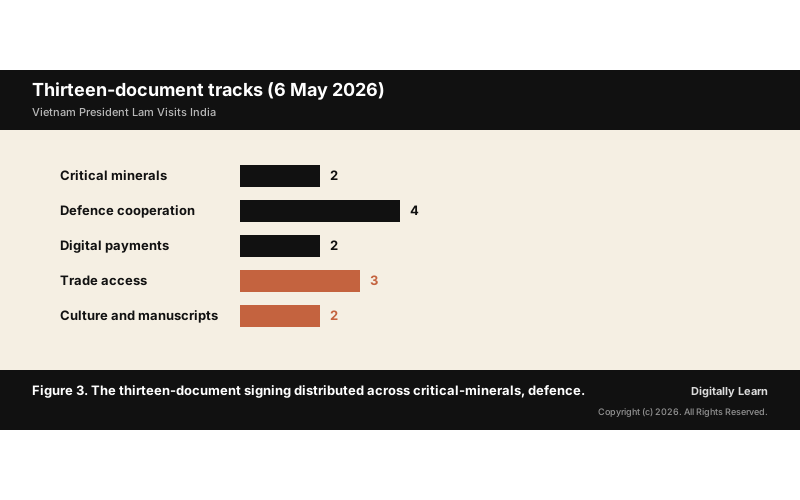
Hyderabad House talks and the thirteen documents signed
On 6 May 2026, Prime Minister Narendra Modi and Vietnamese President To Lam elevated bilateral ties to Enhanced Comprehensive Strategic Partnership at Hyderabad House. The leaders set a new bilateral trade target of USD 25 billion by 2030.
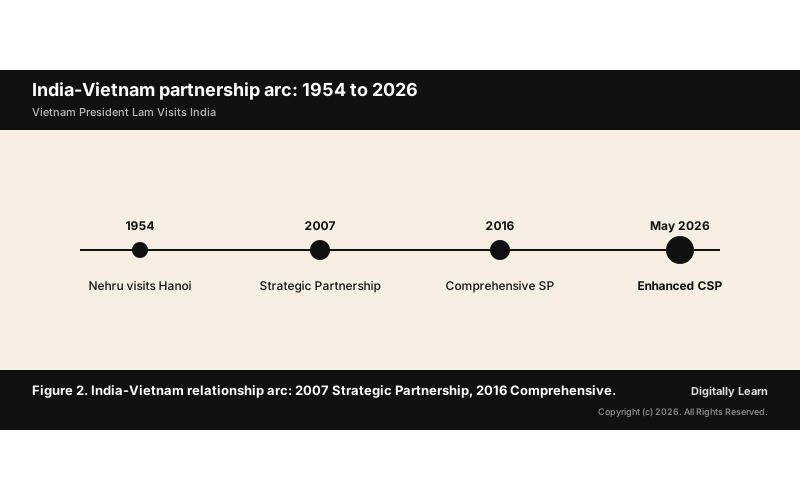
The Enhanced Comprehensive Strategic Partnership is a diplomatic upgrade above the Comprehensive Strategic Partnership tier signed in 2016. It signals deeper cooperation across defence, trade, technology and people-to-people channels. India's 2007 Strategic Partnership with Vietnam was India's first Strategic Partnership within the ASEAN region.
- 5 May 2026: Vietnamese President To Lam arrives in New Delhi on a maiden state visit.
- 6 May 2026: Ceremonial welcome at Rashtrapati Bhavan; bilateral talks at Hyderabad House.
- 6 May 2026: Both sides sign thirteen documents covering critical minerals, defence and digital payments.
- 6 May 2026: Vietnam joins India’s Indo-Pacific Oceans Initiative (IPOI).
- 7 May 2026: President Lam visits Bodh Gaya and Mumbai before departure.
The political pedigree of the visitor matters for reading the upgrade. To Lam was elected State President of Vietnam on 22 May 2024, then General Secretary of the Communist Party of Vietnam Central Committee on 3 August 2024. He was re-elected General Secretary on 23 January 2026 and re-elected State President on 7 April 2026 for a five-year term.
India's Vision MAHASAGAR framing arrived in the welcoming speech. Prime Minister Modi described Vietnam as a key pillar of India's Act East Policy and the Vision MAHASAGAR posture, signalling that the bilateral upgrade is to be read as part of the wider Indo-Pacific architecture rather than as a stand-alone gesture.
Trade, technology and the Indo-Pacific significance
Why the upgrade matters for India's Act East and Indo-Pacific posture
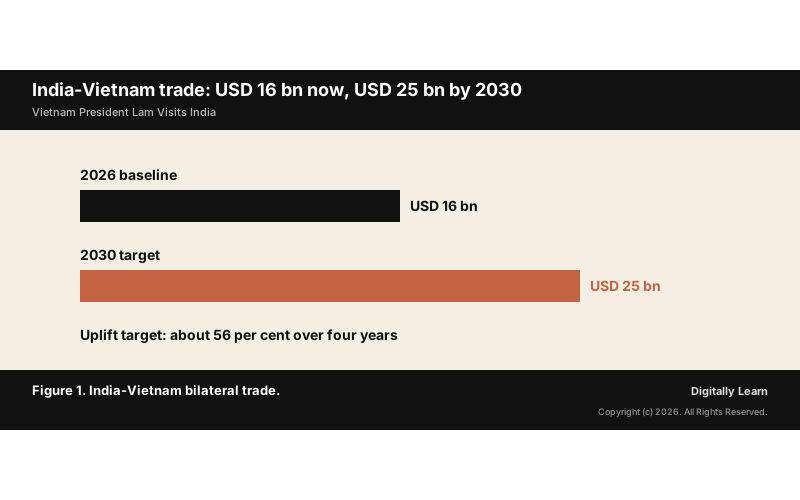
Why it matters: Vietnam is a key pillar of India's Act East Policy and the Indo-Pacific framework. The 6 May elevation aligns trade, defence and critical-minerals tracks under a single bilateral umbrella, with a USD 25 billion 2030 trade target up from about USD 16 billion today.
Vietnam is a manufacturing-and-supply-chain pillar: Vietnam has been one of the fastest growing economies of the past decade, with growth tied to integration into global supply chains and an export-led model. For India, the upgrade locks in deeper trade access in pharmaceuticals, agricultural products and digital payments through the new MoU between the Reserve Bank of India and the State Bank of Vietnam.
The Indo-Pacific dimension is concrete: Vietnam joined the Indo-Pacific Oceans Initiative formally during the visit, taking the partnership beyond bilateral channels into a regional maritime-cooperation framework. Both sides reaffirmed adherence to the United Nations Convention on the Law of the Sea as the comprehensive legal framework.
India's drug-authorities MoU deepens market access. The MoU between Indian and Vietnamese drug-regulatory authorities will enhance access for Indian pharmaceuticals in Vietnam. India is the world's third-largest pharma producer by volume and a major source of generic medicines for ASEAN states.
Agricultural and fisheries access widens: Indian grapes, pomegranates, fisheries products and animal products will see smoother export pathways into Vietnam under the visit's outcomes. In return, Indian consumers will get easier access to Vietnamese durian and pomelo, expanding the basket of regional fruit trade.
What the elevation signals for the Indo-Pacific architecture
South China Sea, UNCLOS and the China shadow
What is the significance of this Vietnam visit: The elevation lands during heightened regional tension on the South China Sea. India and Vietnam reaffirmed the importance of peace, stability and freedom of navigation, and called for full implementation of the Declaration on Conduct (DOC) and early conclusion of the Code of Conduct (COC) negotiations.
In policy terms, the elevation does several things at once. It deepens India's role as a defence-cooperation partner in Southeast Asia, locks in supply-chain cooperation on critical minerals and rare earths, and signals to Beijing that ASEAN partners are diversifying their security ties through Indian channels in addition to traditional US guarantees.
- Bilateral elevation: Strategic Partnership 2007, Comprehensive Strategic Partnership 2016, Enhanced Comprehensive Strategic Partnership 2026.
- Defence pillar: Mutual Logistics Support Agreement; MoU on Submarine Search and Rescue Cooperation; Letter of Intent on Defence Industrial Cooperation.
- Indo-Pacific framework: Vietnam joined the Indo-Pacific Oceans Initiative; both sides reaffirmed UNCLOS as the comprehensive maritime framework.
- South China Sea: DOC reaffirmed; early COC conclusion called for; non-militarisation and peaceful resolution emphasised.
The defence-industrial pillar evolves from credit to co-production. India had extended Lines of Credit to Vietnam to strengthen defence capabilities; the new Letter of Intent on Defence Industrial Cooperation opens the door to joint research, co-production of defence technologies and broader supplier-network ties.
The Ministry of Public Security cooperation is a quieter but important thread. Vietnam's Ministry of Public Security has confirmed plans to enhance work with India's National Security Council Secretariat. President Lam himself served as Deputy Minister and then Minister of Public Security between 2016 and 2024, grounding this institutional link.
What sets the 2026 elevation apart from earlier upgrades
Three architectural features of the Enhanced Strategic Partnership
Distinguishing features: Three architectural features separate the 2026 elevation from the 2016 Comprehensive Strategic Partnership signing.
- (i) Critical-minerals MoU. The 2026 visit added an MoU on radioactive and rare-earth minerals; the 2016 partnership did not include a critical-minerals chapter, reflecting a fast-evolving supply-chain priority.
- (ii) Defence-industrial cooperation. The Letter of Intent on Defence Industrial Cooperation moves the bilateral beyond Lines of Credit to co-production possibilities, taking India’s defence-export posture deeper into Southeast Asia.
- (iii) Digital payments interoperability. The Reserve Bank of India and the State Bank of Vietnam signed an MoU on cooperation in payment systems and digital-payments innovation, opening the door to UPI-style cross-border rails.
| Tier | Year | Trade target | Defence dimension |
|---|---|---|---|
| Strategic Partnership | 2007 | Pre-USD 5 bn | Initial defence dialogue |
| Comprehensive Strategic Partnership | 2016 | USD 15 bn aspiration | Defence Line of Credit framework |
| Enhanced Comprehensive Strategic Partnership | 2026 | USD 25 bn by 2030 | MLSA and Defence Industrial LoI and maritime SAR |
The 2026 upgrade rests on critical-supply-chain terms: India's rare-earth-minerals bilateral MoU with Vietnam matters because Vietnam holds significant rare-earth reserves and lies adjacent to the South China Sea export routes. The 2016 partnership pre-dated the critical-minerals scramble that has emerged after 2020.
The digital-payments rail is the third upgrade: The Reserve Bank of India and the State Bank of Vietnam MoU on payment systems and digital-payments innovation opens the door to UPI-style cross-border rails. India-Singapore and India-UAE links provide the operational template; the Vietnam rail would extend the framework deeper into mainland Southeast Asia.
Outcomes the May 2026 visit is producing
Four trackable consequences across trade, defence and minerals
Observable outcomes: The 6 May elevation has produced four trackable consequences across trade, defence-industrial, maritime and digital-payments tracks.
- (a) Thirteen documents signed on 6 May, including the headline MoU on radioactive and rare-earth minerals and the RBI-SBV digital-payments MoU.
- (b) Vietnam joined the Indo-Pacific Oceans Initiative, formally taking the bilateral cooperation into a regional maritime-cooperation framework.
- (c) Defence-cooperation roadmap clarified: progress on the implementation of the Mutual Logistics Support Agreement, the Submarine Search and Rescue MoU and the Letter of Intent on Defence Industrial Cooperation.
- (d) Pharmaceutical-and-agricultural-trade pipeline opened: MoU between drug authorities; access for Indian grapes, pomegranates, fisheries and animal products; Indian consumers to receive Vietnamese durian and pomelo.
Trade trajectory math is the headline number. With current bilateral trade of about USD 16 billion and a 2030 target of USD 25 billion, the implied compound growth is roughly 12 per cent annually over four years. That is achievable but contingent on supply-chain stability across the Indo-Pacific.
Symbolic acts matter too: President Lam's reference to Prime Minister Jawaharlal Nehru as the first foreign leader to visit Vietnam in 1954, just one week after the liberation of Hanoi, roots the 2026 elevation in a deep historical memory that pre-dates the formal Strategic Partnership tier of 2007.
Connections to India's Indo-Pacific and ASEAN engagement
Connecting the Vietnam visit to recent IR briefings
Contemporary linkages: The Vietnam visit sits inside a longer arc of India's Indo-Pacific engagement; recent CA briefings cover the Quadrilateral architecture, the ASEAN trade flows and the maritime-security domain across the Indian Ocean.
- Act East Policy: India’s foreign-policy framework re-centred around ASEAN engagement; Vietnam is a key pillar.
- Indo-Pacific Oceans Initiative: launched at the 2019 East Asia Summit; Vietnam’s formal joining in 2026 widens the membership base.
- Vision MAHASAGAR: Mutual and Holistic Advancement for Security and Growth Across Regions; named publicly in PM Modi’s welcoming remarks.
- Quadrilateral Security Dialogue: India, US, Japan, Australia; Vietnam is not a Quad member but shares its Indo-Pacific normative agenda.
The wider Indo-Pacific frame extends beyond the bilateral: India runs a Comprehensive Strategic Partnership with Australia, a Special Strategic and Global Partnership with Japan, and active bilateral channels with Indonesia and the Philippines. The Vietnam upgrade sits inside this dense Indo-Pacific lattice, complementing rather than replacing the Quadrilateral architecture.
BrahMos export precedent matters: India's defence-export posture turned a corner with the BrahMos supersonic cruise missile deal to the Philippines; the Vietnam Letter of Intent on Defence Industrial Cooperation opens the door to similar bilateral defence-equipment transfers, embedding India deeper into Southeast Asian defence supply chains.
UPSC Relevance
GS Paper II Indo-Pacific relevance for the Vietnam visit
The Vietnam state visit sits at the intersection of GS Paper II on International Relations (bilateral, regional and global groupings) and GS Paper III on Economy (trade, supply chains) and Security (maritime domain, defence cooperation).
For Prelims, the high-yield facts cluster around the partnership tier history, ASEAN composition, the Indo-Pacific Oceans Initiative pillars, UNCLOS framing of the South China Sea dispute, and the trade-target figures.
- ASEAN: founded 1967 in Bangkok; ten member states; Vietnam joined in 1995.
- IPOI: India’s Indo-Pacific Oceans Initiative launched at the 2019 East Asia Summit; seven pillars.
- UNCLOS: 1982 framework for maritime law; the comprehensive legal framework for ocean activity.
- South China Sea: DOC signed in 2002 between ASEAN and China; COC negotiations are ongoing.
For Mains, two framings recur. First, the India-ASEAN strategic partnership question: how does India's bilateral with Vietnam fit into the broader Act East architecture. Second, the Indo-Pacific strategic-autonomy question: how does India navigate between bilateral partnerships like Vietnam and the Quadrilateral framework while preserving non-alignment.
India-ASEAN trade architecture sits in the background. India is a Dialogue Partner of ASEAN since 1996 and a Strategic Partner since 2012; the ASEAN-India Trade in Goods Agreement entered into force in 2010 and is under review for upgrade. The bilateral upgrade with Vietnam reinforces this broader plurilateral track.
The Indo-Pacific strategic-autonomy question is the operative GS-II framing. India operates through the Quadrilateral with the US, Japan and Australia, while also building dense bilateral partnerships with Vietnam, Indonesia and Philippines. The Vietnam elevation shows how strategic autonomy is operationalised through complementary bilateral and plurilateral channels.
The South China Sea legal architecture is the third Mains theme. Candidates should be able to articulate the UNCLOS Part V framework on Exclusive Economic Zones, the 2016 Permanent Court of Arbitration ruling on the Philippines-China case, and the DOC and COC negotiation track. The Vietnam joint-statement language is a fresh reference point for all three.
Past-year questions linked to this briefing
Prelims 2022 Vietnam economy and Mains 2020 QUAD questions
The Vietnam visit activates two linked items: a Prelims 2022 Q67 on the Vietnam economic profile, and a Mains 2020 GS-II Q19 on the Quadrilateral Security Dialogue's evolution. Both fit the Indo-Pacific bilateral-and-regional architecture in this briefing.
The two prompts compound: A candidate fluent in both Vietnam economic profile and the Quadrilateral evolution can deploy a 2026 Mains answer that frames Indo-Pacific strategic autonomy in operational facts rather than abstractions.
Previous Year UPSC-CSE Questions By the end you will be able to draft model answers for the following UPSC questions. Each question carries a collapsible framework showing how to approach it in the exam.
- UPSC Prelims 2022Consider the following statements:
- Vietnam has been one of the fastest growing economies in the world in the recent years.
- Vietnam is led by a multi-party political system.
- Vietnam's economic growth is linked to its integration with global supply chains and focus on exports.
- For a long time Vietnam's low labour costs and stable exchange rates have attracted global manufacturers.
- Vietnam has the most productive e-service sector in the Indo-Pacific region.
Which of the statements given above are correct?
How to approach this Prelims question
Approach: Verify each statement against Vietnam's known economic profile and political system.
Trap to watch: Statement 2 on multi-party political system is the principal trap; Vietnam is a one-party state under the Communist Party of Vietnam.
Key facts to recall:
- Vietnam is a one-party state led by the Communist Party of Vietnam.
- Vietnam's growth has been export-led with global supply-chain integration.
- Vietnam has long been a low-labour-cost manufacturing destination.
- The most-productive-e-service claim is unsupported and is the secondary trap.
Answer signal: Statements 1, 3 and 4 are correct; option (c) is the answer.
- UPSC Mains 2020 GS-II‘Quadrilateral Security Dialogue (QUAD)’ is transforming itself into a trade bloc from a military alliance, in present times. Discuss.
How to structure the answer in the exam
Introduction: The Quadrilateral Security Dialogue is an informal grouping of India, the United States, Japan and Australia; its mandate now spans security, technology and supply-chain resilience.
Body (sub-themes to develop):
- Origin: post-2004 tsunami coordination; revived in 2017 after a decade of dormancy.
- Military versus trade evolution: maritime exercises versus chip and rare-earth supply chains; Vaccine Partnership; Critical and Emerging Tech working group.
- India's position: strategic autonomy preserved; Quad complemented by bilateral channels with Vietnam, Indonesia, Australia and Japan.
- China factor: oblique referencing in joint statements; preference for UNCLOS framework and DOC and COC negotiations on the South China Sea.
- 2026 link: Vietnam's joining of the Indo-Pacific Oceans Initiative extends the Quad architecture into a wider Indo-Pacific bilateral web.
Conclusion: The Quad is evolving into a multi-vector instrument that operates through formal four-nation tracks and a broader Indo-Pacific bilateral network; India's Vietnam upgrade is part of that wider architecture.
Sources and Further Reading
- Hindu International: Vietnam President Lam to visit India next week to fortify ties (30 April 2026)
- Hindu International: Vietnam President To Lam accorded ceremonial welcome at Rashtrapati Bhavan (6 May 2026)
- Indian Express: India and Vietnam elevate ties to Enhanced Comprehensive Strategic Partnership (6 May 2026)
- Ministry of External Affairs, Government of India
- ASEAN Secretariat
- International Maritime Organization: UNCLOS
- Wikipedia: India-Vietnam relations
Editorial Disclaimer
This article is compiled from the reference materials listed in the Sources section. It is an explainer for UPSC preparation and is not a substitute for primary documents (NCERTs, GoI ministry releases, IMD bulletins, RBI / CEA / MoEFCC publications, and Standing-Committee reports).


