


Overview
A Swedish Instrument for Shukrayaan
An ISRO-SNSA pact places a Swedish neutral-particle analyser aboard the Shukrayaan Venus orbiter
Shukrayaan (Sanskrit for 'Venus craft'), also called the Venus Orbiter Mission (VOM), is the Indian Space Research Organisation's (ISRO's) first interplanetary mission to Venus. The mission carries a comprehensive science payload to study Venus's atmosphere, ionosphere, surface, and solar-wind interaction. The Swedish contribution announced in May 2026 is the Venusian Neutrals Analyser (VNA) built by the Swedish Institute of Space Physics (IRF) at Kiruna.
Why this is in the news on 21 May 2026
The Gothenburg MoU and the Swedish instrument contribution
During Prime Minister Narendra Modi's visit to Gothenburg on the Sweden leg of the India-Nordic engagement in May 2026, ISRO and the Swedish National Space Agency (SNSA) signed a space-cooperation Memorandum of Understanding for ISRO's upcoming Shukrayaan Venus Orbiter Mission. The instrument under the agreement will be built by the Swedish Institute of Space Physics (IRF) at Kiruna.
Definition: Shukrayaan, also called the Venus Orbiter Mission (VOM), is ISRO's first interplanetary mission to Venus. The orbiter studies Venus's atmosphere, ionosphere, surface, and solar-wind interaction. The Swedish contribution is the Venusian Neutrals Analyser (VNA), integrated into the larger ISRO sensory payload VISWAS (Venus Ionospheric and Solar Wind particle AnalySer).
Three milestones define the May 2026 announcement:
- (i) MoU signing. The space-cooperation MoU on the Shukrayaan mission was signed between ISRO and the Swedish National Space Agency (SNSA) during the PM’s Gothenburg visit; Norway announced a parallel space-cooperation track on the same engagement.
- (ii) Swedish instrument contribution. The Swedish Institute of Space Physics (IRF) builds the Venusian Neutrals Analyser (VNA), a particle instrument that detects energetic neutral atoms (ENAs) and measures how the solar wind interacts with Venus’s upper atmosphere. The VNA flies inside the VISWAS payload alongside an Indian plasma analyser.
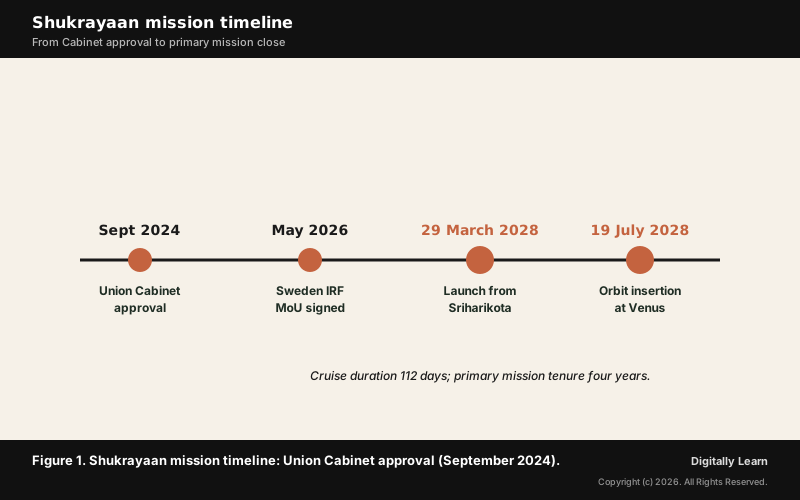
- (iii) Mission timeline. The Union Cabinet approved the Venus Orbiter Mission in September 2024. The current schedule is a launch on 29 March 2028, a 112-day cruise, and orbit insertion on 19 July 2028 into an elliptical orbit ranging from 500 km (closest) to 60,000 km (farthest) from the Venusian surface.
Why Shukrayaan and the Swedish partnership matter for Indian space cooperation
Indian interplanetary ladder and the IRF heritage
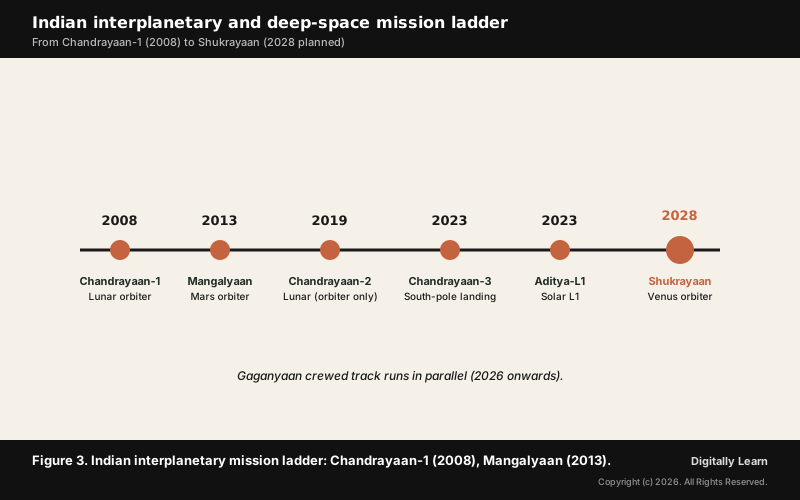
Why it matters: Shukrayaan extends the Indian interplanetary ladder beyond the Mars Orbiter Mission (Mangalyaan) of 2013-14 and the lunar series (Chandrayaan-1 2008, Chandrayaan-2 2019, Chandrayaan-3 2023). Venus is a structurally different target: dense atmosphere, sulphuric-acid cloud layers, and runaway-greenhouse surface conditions.
The Swedish IRF partnership matters because Kiruna's IRF carries a four-decade heritage in particle-analyser instruments for European Space Agency missions. The IRF built the ASPERA-3 for ESA Mars Express, the ASPERA-4 for ESA Venus Express, and the Particle Environment Package for ESA JUICE. The VNA on Shukrayaan inherits the ASPERA-4 Venus heritage directly.
Significance for Indian space cooperation strategy
What the Sweden partnership signals for Indian space cooperation
What is the significance of this issue: The Sweden-Shukrayaan partnership carries three significances for Indian space cooperation strategy:
- (i) Foreign-payload-on-Indian-mission signal. The VNA is the latest in the ISRO tradition of carrying foreign payloads on Indian interplanetary craft, following the Indo-Swedish SARA (built by IRF Kiruna) and the NASA Mini-SAR on Chandrayaan-1, and the NASA-developed Moon Mineralogy Mapper (M3) also on Chandrayaan-1. The pattern strengthens India’s position as a low-cost host platform for international space science.
- (ii) Northern-Europe space track. The Sweden IRF partnership and the parallel Norway space-cooperation announcement deepen India’s Northern-Europe space track. The track complements the Indo-French CNES partnership on Megha-Tropiques and Saral-AltiKa, and the Indo-German DLR partnerships, building a structured European space-cooperation portfolio for India.
- (iii) Venus-science niche. The Shukrayaan mission targets four science questions: surface processes (volcanism, tectonics), atmospheric circulation and super-rotation, ionosphere and solar-wind interaction, and astrobiology indicators (phosphine controversy). The Swedish VNA contributes specifically to the solar-wind-interaction question.
Distinguishing features of the Shukrayaan mission architecture
The three institutional and scientific pillars of the mission
Distinguishing features: Three institutional and scientific pillars define the mission architecture:
- (i) Spacecraft and launch. ISRO is the lead designer; the launch vehicle is the LVM3 from Satish Dhawan Space Centre, Sriharikota. The Union Cabinet cleared the mission for full development in September 2024.
- (ii) Orbit geometry. An elliptical orbit ranging from 500 km (periapsis) to 60,000 km (apoapsis) above Venus’s surface. The high apoapsis enables wide-field atmospheric and ionospheric observation; the low periapsis supports surface and lower-atmosphere studies. Primary mission tenure is approximately four years.
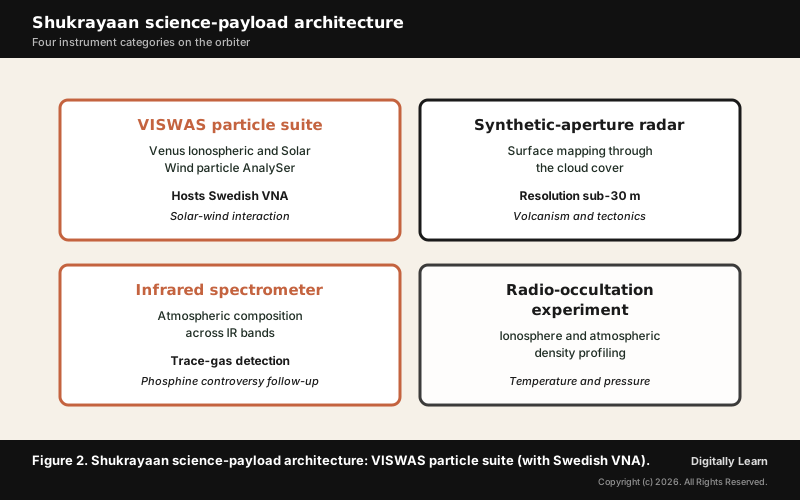
- (iii) Payload package. The science payload includes the VISWAS particle-and-fields suite (which carries the Swedish VNA), a synthetic-aperture radar (SAR) for surface mapping under the cloud cover, an infrared spectrometer for atmospheric composition, and a radio-occultation experiment for ionosphere profiling.
The Shukrayaan mission specifications and partnership at a glance
| Mission parameter | Detail | Significance |
|---|---|---|
| Mission name | Shukrayaan (Venus Orbiter Mission) | ISRO's first interplanetary mission to Venus |
| MoU date and venue | May 2026, Gothenburg, Sweden | Signed during PM Modi's Sweden visit |
| Signatories | ISRO and the Swedish National Space Agency (SNSA) | Government-to-government space-cooperation framework |
| Swedish instrument builder | Swedish Institute of Space Physics (IRF), Kiruna | Particle-analyser heritage from ESA Mars Express, Venus Express, JUICE |
| Swedish instrument | Venusian Neutrals Analyser (VNA) | Energetic neutral atom and solar-wind interaction measurement |
| Host payload package | VISWAS (Venus Ionospheric and Solar Wind particle AnalySer) | ISRO suite pairing the Swedish VNA with an Indian plasma analyser |
| Cabinet approval | September 2024 | Cleared the mission for full development |
| Launch date | 29 March 2028 (planned) | Launch from Satish Dhawan Space Centre, Sriharikota |
| Launch vehicle | LVM3 (planned) | Heaviest Indian operational launch vehicle |
| Cruise duration | 112 days | Hohmann transfer to Venus |
| Orbit insertion | 19 July 2028 (planned) | Elliptical Venus orbit |
| Orbit geometry | 500 km closest, 60,000 km farthest | Wide-field plus low-altitude coverage |
Observable outcomes to track through the mission cycle
What to watch from now to primary-mission close in 2032
Observable outcomes: Five outcomes frame the mission trajectory from May 2026 to primary-mission close in 2032:
- (a) Critical Design Review. Whether the mission clears CDR within the 2026-27 window to keep the 29 March 2028 launch on schedule.
- (b) VNA integration. Delivery of the Swedish IRF-built VNA to ISRO, integration into the VISWAS sensory package, and qualification testing for the orbiter environment.
- (c) Launch window discipline. Strict adherence to the Hohmann-transfer launch window of 29 March 2028; the next viable window slips by approximately 19 months if missed.
- (d) Orbit insertion. Successful capture into the planned elliptical orbit at 19 July 2028, mirroring the Mangalyaan orbit-insertion success of 24 September 2014.
- (e) Science returns. First-light data on Venus atmospheric super-rotation, phosphine detection or non-detection, surface volcanism mapping, and solar-wind-induced ionospheric escape rates.
Threads connecting Shukrayaan to wider Indian space-cooperation policy
How Shukrayaan connects to the Indian interplanetary ladder, foreign-payload cooperation, and the commercial-arm story
Contemporary linkages: Three threads connect the Shukrayaan announcement to wider Indian space-cooperation policy.
The first is the interplanetary-mission ladder thread. Chandrayaan-1 (2008), Mangalyaan (2013-14), Chandrayaan-2 (2019), Chandrayaan-3 (2023 lunar south-pole soft landing), Aditya-L1 (2023 solar mission), and now Shukrayaan together compose India's interplanetary ladder. The Venus mission is the eighth deep-space target for ISRO after the inner Solar System and the Sun-Earth L1 point.
The second is the foreign-payload-cooperation thread. ISRO's pattern of hosting foreign payloads on Indian deep-space craft creates a structured cooperation channel beyond MoUs. The Swedish VNA on Shukrayaan operationalises the Northern-Europe space track that the Sweden and Norway MoUs of May 2026 institutionalise.
The third is the commercial-arm thread. NewSpace India Limited (NSIL), the commercial arm of ISRO (established 2019), and Antrix Corporation, the original commercial arm (established 1992), together monetise Indian launch and satellite capacity. The deep-space-cooperation portfolio with Sweden, France (CNES), Germany (DLR), and Japan (JAXA) signals India's posture as a deep-space technology peer rather than a customer.
UPSC Relevance
Where the mission sits in the UPSC syllabus
UPSC context: Shukrayaan falls within General Studies Paper III under awareness in the fields of IT, Space, Computers, robotics, nano-technology, bio-technology, and achievements of Indians in science and technology; indigenization of technology and developing new technology. The cooperation dimension also touches General Studies Paper II under important International institutions, agencies and fora, their structure, mandate.
Prelims relevance: The Prelims surface includes Shukrayaan / Venus Orbiter Mission, the VISWAS payload, the Venusian Neutrals Analyser (VNA), the Swedish Institute of Space Physics (IRF) at Kiruna, the LVM3 launch vehicle, Satish Dhawan Space Centre, Sriharikota, the elliptical-orbit parameters (500 km, 60,000 km), the launch window of 29 March 2028, and the previous Indian missions: Chandrayaan-1 (2008), Mangalyaan (2013-14), Chandrayaan-2 (2019), Chandrayaan-3 (2023), and Aditya-L1 (2023).
Mains relevance: Two framings dominate the Mains-paper surface:
- (i) Space-achievements-and-socio-economic-development framing. India’s achievements in space science and how the application has helped socio-economic development. Shukrayaan extends the achievement portfolio into the interplanetary frontier; socio-economic returns flow through low-cost-deep-space hosting, commercial-arm revenues, and STEM talent absorption.
- (ii) Unmanned-vs-manned-mission framing. The unmanned-Chandrayaan-Mangalyaan track and the manned-Gaganyaan gap. Shukrayaan is firmly in the unmanned interplanetary track; Gaganyaan is the parallel crewed track that operationalises in the 2026-2028 window.
Mains practice question: A focused fifteen-mark question would read: The May 2026 Indo-Swedish partnership on the Shukrayaan Venus Orbiter Mission illustrates the foreign-payload-cooperation model of ISRO's deep-space programme. Examine its place in the Indian interplanetary mission ladder and discuss its significance for the Northern-Europe space-cooperation track.
- Past Mains linkage. 2016 GS-III: Discuss India’s achievements in the field of Space Science and Technology. How the application of this technology has helped India in its socio-economic development? Shukrayaan extends the achievement portfolio and the cooperation with Sweden supports the socio-economic-development discussion through commercial-arm revenues.
- Past Mains linkage. 2017 GS-III: India has achieved remarkable successes in unmanned space missions including the Chandrayaan and Mars Orbitter Mission, but has not ventured into manned space missions. What are the main obstacles to launching a manned space mission, both in terms of technology and logistics? Examine critically. Shukrayaan is the next unmanned milestone; Gaganyaan is the parallel manned-mission track that began answering this question after 2017.
- Related linkage. Prelims questions on Chandrayaan-3 and Aditya-L1 test the institutional surface that Shukrayaan sits within.
Previous Year UPSC-CSE Questions By the end you will be able to draft model answers for the following UPSC questions. Each question carries a collapsible framework showing how to approach it in the exam.
- UPSC Mains 2016 GS-IIIDiscuss India’s achievements in the field of Space Science and Technology. How the application of this technology has helped India in its socio- economic development?
How to structure the answer in the exam
Introduction: Open with ISRO's foundation in 1969 and the indigenous SLV-PSLV-LVM3 capability trajectory, name the deep-space ladder Chandrayaan-Mangalyaan-Aditya-L1-Shukrayaan, and frame the answer through achievements and socio-economic application buckets.
Body (sub-themes to develop):
- Launch-vehicle achievements: SLV-3 (1980), ASLV, PSLV (workhorse with over 60 successful launches), GSLV Mk II, LVM3 (heavy-lift); 100 per cent indigenous LVM3 design clears Shukrayaan and the manned Gaganyaan.
- Communication and earth-observation achievements: INSAT series for telecommunications and disaster warning; Cartosat, Resourcesat for resource mapping; Oceansat for marine; Saral-AltiKa for ocean altimetry.
- Navigation and deep-space achievements: NavIC regional navigation system; Chandrayaan-1 (water on Moon), Chandrayaan-3 (south-pole soft landing 2023), Mangalyaan (Mars first attempt success 2013-14), Aditya-L1 (Sun L1 2023).
- May 2026 Shukrayaan-with-Sweden update: ISRO's first interplanetary mission to Venus with Swedish IRF VNA payload; launch 29 March 2028; signals deep-space-peer status with European Space Agency partners.
- Socio-economic application channels: agriculture (crop forecasting, drought monitoring via Bhuvan), disaster management (early-warning for cyclones, floods, landslides), education (EduSat heritage and TV-broadcast networks), governance (satellite-based service delivery, JAM trinity-enabled DBT).
Conclusion: Conclude that ISRO's achievements span four technical buckets and four socio-economic channels, that the 2026 Indo-Swedish Shukrayaan partnership is the latest evidence of the deep-space-cooperation peer status, and that the next decade will see the Gaganyaan crewed milestone extend the achievement portfolio further.
The May 2026 Indo-Swedish Shukrayaan partnership is the latest deep-space achievement that the 2016 GS-III question's discussion must include. The body sub-theme on Shukrayaan-with-Sweden supplies the most-current evidence pillar.
- UPSC Mains 2017 GS-IIIIndia has achieved remarkable successes in unmanned space missions including the Chandrayaan and Mars Orbitter Mission, but has not ventured into manned space missions. What are the main obstacles to launching a manned space mission, both in terms of technology and logistics? Examine critically.
How to structure the answer in the exam
Introduction: Open with the 2017 unmanned-only achievement claim, name the 2018 Independence Day Gaganyaan announcement as the inflection point, and frame the critical examination through technology, logistics, and budgetary lenses.
Body (sub-themes to develop):
- Unmanned heritage: Chandrayaan-1 (2008), Mangalyaan (2013-14), Chandrayaan-2 (2019), Chandrayaan-3 south-pole soft landing (2023), Aditya-L1 (2023), Shukrayaan (planned 29 March 2028).
- Gaganyaan crewed track: announced August 2018; Crew Escape System (CES) tested 2018; Environmental Control and Life Support System (ECLSS) under development; LVM3 human-rated; Gaganyatri training in India and Russia; uncrewed test flights (G1, G2) in 2025-26; first crewed flight in 2027-28 window.
- Technology-gap analysis: re-entry capsule (heat-shield, ablation), in-orbit life support, abort-system safety, communication and tracking ground architecture for human spaceflight; partnership with Russian Roscosmos on Soyuz heritage and JAXA for component-supply.
- Logistics-gap analysis: Astronaut Training Facility at IISc Bengaluru; medical-monitoring infrastructure; integrated launch-pad upgrades at Sriharikota; cost ratio against unmanned missions roughly 30:1.
- Parallel unmanned interplanetary momentum: the May 2026 Indo-Swedish Shukrayaan partnership signals that the unmanned deep-space track continues to expand even as the crewed track operationalises; the two tracks are complementary, not substitutes.
Conclusion: Conclude that the 2017 unmanned-only frame is partially outdated by the 2018 Gaganyaan announcement and the 2027-28 crewed window, that technology and logistics gaps are closing through partnerships and indigenous development, and that the parallel unmanned track (Shukrayaan with Sweden) continues to expand.
The Shukrayaan announcement of May 2026 is the most recent evidence that the unmanned interplanetary track continues to expand while the manned Gaganyaan track operationalises. The body sub-theme on parallel unmanned momentum supplies the updated evidence the 2017 GS-III question needs.
Sources
- ISRO: Venus Orbiter Mission (Shukrayaan) page
- PIB readout: PM Modi visit to Sweden and Norway, India-Nordic Summit
- Swedish Institute of Space Physics (IRF), Kiruna: VNA development
- Department of Space: institutional materials on Indian space programme
- NewSpace India Limited (NSIL) corporate page
- Antrix Corporation Limited corporate page
- ESA: Venus Express mission (heritage for VNA via ASPERA-4)
- Wikipedia: Venus Orbiter Mission (Shukrayaan)
Editorial Disclaimer
This article is compiled from the reference materials listed in the Sources section. It is an explainer for UPSC preparation and is not a substitute for primary documents (NCERTs, GoI ministry releases, IMD bulletins, RBI / CEA / MoEFCC publications, and Standing-Committee reports).


