


Overview
Special Intensive Revision upheld
Special intensive revision (SIR) is a fresh, house-to-house verification of the electoral roll that the Election Commission may order under Section 21(3) of the Representation of the People Act, 1950. On 27 May 2026 the Supreme Court upheld Bihar's SIR and held that the Commission may make a limited enquiry into citizenship for the roll, without deciding anyone's citizenship.
Special Intensive Revision: The Supreme Court Verdict of 27 May 2026
Supreme Court Verdict on SIR: Four Questions and the Court's Answers
On 27 May 2026 a Bench of Chief Justice of India Surya Kant and Justice Joymalya Bagchi upheld the Election Commission's Special Intensive Revision (SIR) of Bihar's electoral roll, in a 124-page judgment written by the Chief Justice. The lead petition was filed by the Association for Democratic Reforms against the Election Commission of India, and eighteen other writ petitions were heard with it.
The Court framed four questions and answered each in the Commission's favour, while adding conditions on the most sensitive one, citizenship.
- Power under Section 21(3): The SIR is traceable to Section 21(3) of the Representation of the People Act, 1950, read with Article 324 of the Constitution, and does not conflict with the Act or the Registration of Electors Rules, 1960.
- Proportionality: The exercise had a legitimate purpose, the restoration of the accuracy, completeness and integrity of the roll, and its measures were not manifestly excessive.
- Procedure: A name on the roll carries a presumption of validity, but the presumption is rebuttable and does not bar an intensive revision; the notice-and-hearing safeguards of Rule 21A were preserved in substance; the list of documents rests on intelligible criteria.
- Citizenship: The Commission may undertake a limited enquiry into citizenship to satisfy itself about eligibility for the roll; this is not a determination of citizenship, and its consequences are electoral alone.
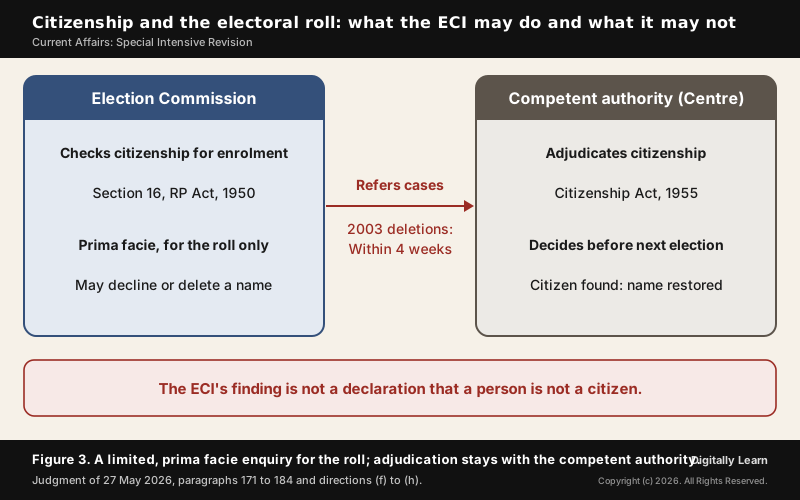
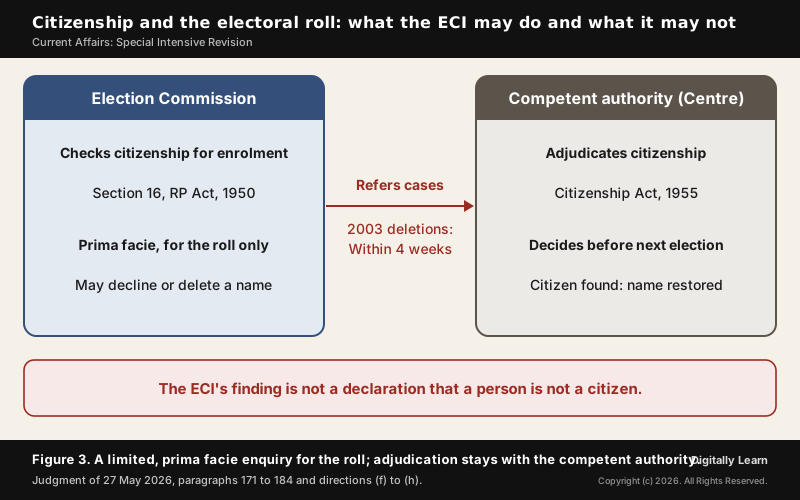
The Court then gave directions for people already deleted. Where the Commission removed names from the 2003 roll because it thought they were not citizens, it must refer those cases within four weeks to the competent authority under the Citizenship Act, 1955, which must decide after notice and hearing, preferably before the next Parliamentary, Assembly or local body election; anyone found to be a citizen goes back on the roll. People domiciled in Bihar whose names were wrongly deleted as absent, dead, shifted or duplicate may seek judicial review.
What Is Special Intensive Revision: Section 21 of the RP Act, 1950
Ordinary Revision, Intensive Revision and Special Revision Under Section 21
Section 21 of the Representation of the People Act, 1950 (RP Act) governs how electoral rolls are prepared and revised. Sub-section (1) provides for preparing the roll for each constituency by reference to a qualifying date, and sub-section (2) for revising it in the prescribed manner, ordinarily before each general election and each bye-election.
- Ordinary revision, Section 21(2): Done in the “prescribed manner” of Rule 25 of the Registration of Electors Rules, 1960, either intensively, where the roll is prepared afresh, or summarily, or partly both.
- Special revision, Section 21(3): “Notwithstanding anything contained in sub-section (2)”, the Commission may at any time, for reasons to be recorded, direct a special revision of the roll for any constituency or part of one “in such manner as it may think fit”; the existing roll stays in force until the revision is complete.
Section 21(3) entered the Act through the Representation of the People (Amendment) Act, 1956, which replaced the original Section 25. The Court read its phrases one by one: the non-obstante clause frees it from the ordinary regime, "at any time" removes limits of timing, "reasons to be recorded" keeps it open to judicial review, and "in such manner as it may think fit" gives the Commission wide procedural discretion. Because rules framed for Section 21(2) do not bind a revision under Section 21(3), the absence of separate rules did not take the power away.
The petitioners argued that "any constituency" allows only targeted revisions, not a statewide one. The Court held that, read with Section 13(2) of the General Clauses Act, 1897, "any" may mean "many" or "all": a problem that runs across a State, such as migration over two decades, can be met with a statewide revision.
Article 324 and Article 327: The ECI's Power over Electoral Rolls
Article 324 vests in the Election Commission the superintendence, direction and control of the preparation of electoral rolls and the conduct of elections to Parliament, State legislatures and the offices of President and Vice-President. Article 327 lets Parliament make law on elections, including the preparation of rolls, but "subject to the provisions of this Constitution".
The petitioners relied on Mohinder Singh Gill (1978), which said Article 324 operates in areas left unoccupied by legislation. The Court read that case as standing for a middle position: the Commission's constitutional power survives when Parliament legislates, but it cannot override an express statutory command. A.C. Jose, where the Commission had introduced voting machines against rules that required ballot papers, was confined to its facts, because here Parliament itself had given the power in Section 21(3).
Special Intensive Revision SIR 2026: The Bihar Exercise and Its Numbers
The Order of 24 June 2025: The 2003 Roll, Enumeration Forms and Eleven Documents
The Commission ordered the SIR for every Assembly constituency of Bihar on 24 June 2025, ahead of the Assembly election due later that year, and resolved to carry it to the whole country. Its recorded reasons were two: the roll had changed greatly since the last intensive revision in 2003 because of rapid urbanisation and migration, raising the risk of repeated and defective entries; and Article 326 obliges it to keep only citizens on the roll.
- Reference roll: The 2003 roll, with 1 January 2003 as the qualifying date, was treated as probative evidence of eligibility unless rebutted.
- Documents: Anyone not on the 2003 roll had to produce one of eleven listed documents; the Court later added Aadhaar as a twelfth document of identity.
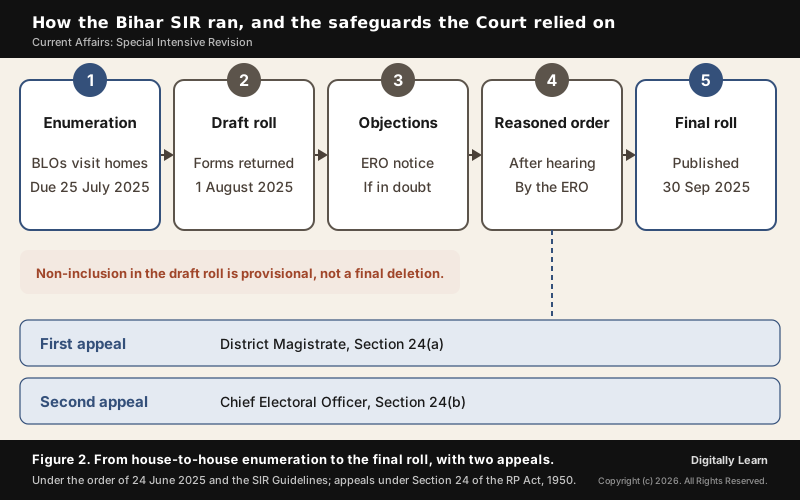
- Enumeration: Booth Level Officers visited every household with pre-filled forms, which had to be returned by 25 July 2025, physically or online.
- Scrutiny and appeal: Doubtful cases got a show-cause notice and a reasoned order; appeals lay to the District Magistrate and then to the Chief Electoral Officer under Section 24 of the RP Act.
Electoral Roll of Bihar: From 7.89 Crore to 7.42 Crore Electors
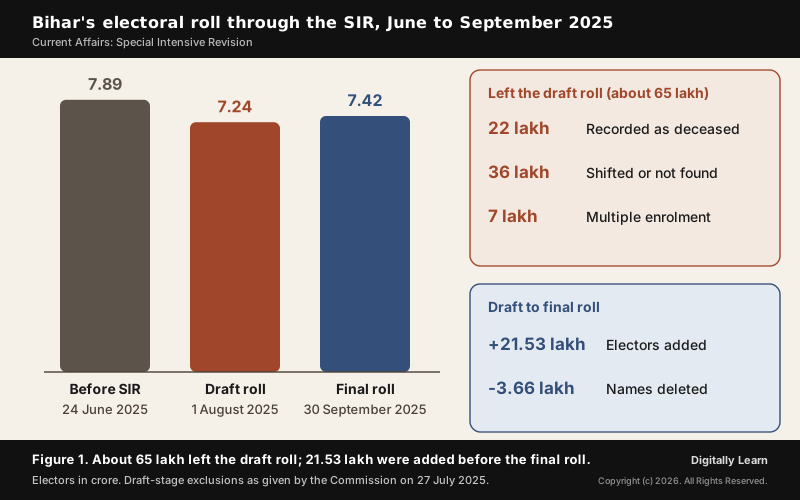
Bihar's roll had about 7.89 crore electors on 24 June 2025. The draft roll published on 1 August 2025 had about 7.24 crore, so nearly 65 lakh people were left out for not returning the form. The Commission's figures of 27 July put about 22 lakh as deceased, 36 lakh as permanently shifted or not found, and 7 lakh as enrolled at multiple places. After claims and objections, 21.53 lakh eligible electors were added and 3.66 lakh more names deleted, and the final roll of 30 September 2025 had 7.42 crore electors. The Assembly election followed in November, with results declared on 14 November 2025.
The Court supervised the process through interim orders while the case was pending.
- 10 July 2025: Asked the Commission to consider Aadhaar, the Electors Photo Identity Card and the ration card as valid proof.
- 14 August 2025: Ordered publication of the list of about 65 lakh excluded electors with reasons.
- 22 August 2025: Made twelve political parties respondents and told their Booth Level Agents to help voters file forms.
- 1 September 2025: Brought in para-legal volunteers through the legal services authorities.
- 8 September 2025: Directed that Aadhaar be accepted as the twelfth document of identity.
Proportionality, Presumption and Procedure: How the Court Tested the SIR
Four-Limb Proportionality Test Applied to the SIR
Because the SIR could affect the right to vote of millions, the Court tested it for proportionality in four steps.
- Legitimate purpose: Including all eligible electors and excluding the ineligible flows from Articles 325 and 326; the grounds the Commission cited, deaths, migration and multiple enrolment, are the very grounds for deletion in Rule 21A.
- Rational nexus: House-to-house enumeration and fresh forms are designed to catch outdated entries.
- Necessity: Following the demonetisation judgment, Vivek Narayan Sharma (2023), the Court left the choice of method to the expert body unless it is manifestly excessive; a systemic problem did not admit of piecemeal solutions.
- Balance: The right to vote is valuable but regulated; the burden was eased by the Court’s own interventions on documents, on transparency and on help for voters.
The Court did not demand perfection: errors in a large exercise do not make it unconstitutional, and individual exclusions can be corrected through claims, objections and appeals.
Presumption of Validity, Rule 21A and the Documents Regime
The petitioners relied on Lal Babu Hussein (1995), which held that a name already on the roll is presumed to have been entered after due verification and cannot be removed without notice of the doubt. The Court agreed that an entry carries a presumption of validity, but called it an evidentiary, rebuttable presumption. It confined Lal Babu Hussein to adjudication of individual objections and distinguished a systemic, inquisitorial revision, in which the Commission may ask electors to furnish material again.
On Rule 21A, which forbids deleting a name without notice and a hearing, the Court found the safeguards spread across the SIR's stages: non-inclusion in the draft roll is provisional, and deletion comes only after notice, enquiry, a reasoned order and the chance to appeal.
The Court also upheld the Commission's choice of documents, judging each by what it can prove.
| Document | What it can prove | Court's view |
|---|---|---|
| Aadhaar card | Identity only (Section 23(4), RP Act); not citizenship or domicile under the Aadhaar Act, 2016 | Accepted as the twelfth document, but not conclusive |
| Electors Photo Identity Card | Nothing independent: issued on the basis of the roll itself | Exclusion upheld: its use would be circular |
| Ration card | Not conclusive proof of citizenship, unlike a passport or birth certificate | Exclusion within the Commission's discretion |
Election Commission and Citizenship: The Limited Enquiry Allowed by the Court
Administrative Satisfaction Versus Adjudication of Citizenship
The petitioners argued that only the Centre can decide citizenship, citing Section 9(2) of the Citizenship Act and the allocation of the subject to the Ministry of Home Affairs. The Court held that Section 16 of the RP Act disqualifies non-citizens from registration, along with persons of unsound mind so declared by a court and those disqualified for corrupt practices, so citizenship is a condition precedent for enrolment, and the Commission cannot keep a valid roll without satisfying itself on it.
The Court drew a line between two things. Adjudication of citizenship, a conclusive determination of status, belongs only to the competent authority under the Citizenship Act. The Commission's task is an administrative satisfaction as to eligibility: a prima facie, contextual assessment made for electoral purposes, with due regard to the presumption in favour of those already on the roll, and open to judicial review.
- What the Commission may do: Decline enrolment or start deletion where the material does not inspire confidence.
- What its decision means: Only that it is not satisfied, for the roll, that the conditions are met; it is not a declaration that the person is not a citizen.
- What must follow: The case goes to the competent authority of the Centre, which must decide within a reasonable time and before the next election; any deletion stays subject to that outcome.
Right to Vote in India: A Constitutional Right Under Article 326
Articles 325 and 326, Adult Suffrage and the Sixty-First Amendment
Universal adult franchise means that all adult citizens are eligible to vote. Article 325 bars excluding anyone from the roll on grounds of religion, race, caste or sex, and Article 326 makes elections to the Lok Sabha and State Assemblies rest on adult suffrage. Until 1989 an adult meant a citizen above 21; the Sixty-First Amendment Act, 1989 lowered the age to 18.
The right to vote is not a fundamental right in Part III. In the Section 6A Citizenship Act case (2024), quoted in this judgment, the Supreme Court said the right had been upgraded by judicial construction from a mere statutory right to a constitutional right under Article 326, following Rajbala v. State of Haryana. It is not absolute: checks of identity, residence and eligibility are conditions that protect the franchise rather than deny it.
Criticism of the SIR Verdict and the Next Phases of Revision
Concerns: Deletions, Timelines and a Retrospective Validation
Critics argue that the verdict came after the exercise had become a settled fact in Bihar and in twelve other States and Union Territories in the second phase, and so validated it in hindsight.
- Scale of deletions: Across the exercise the rolls shrank by more than 10%, with nearly 6.5 crore deletions and an unexplained fall in the gender ratio of most States’ rolls, Tamil Nadu excepted.
- Reasoning in theory, not practice: Section 21(3) is an exceptional power that omits the “prescribed manner” safeguard, and asking enrolled electors to prove an entitlement they already hold weakens the presumption the Court said survives.
- Timelines: Opposition leaders called the schedule excessively constricted and pointed to the Court’s own interventions on deletion lists, reasons and Aadhaar.
- Restorations in appeal: In West Bengal, appellate tribunals had disposed of 6,581 appeals by 14 May 2026 and restored 4,043 electors, about 61%, with around 25 lakh appeals reportedly pending.
The second phase covered 51 crore voters in 12 States and Union Territories, including West Bengal, Tamil Nadu and Kerala, and the verdict will shape further rounds. Delhi's SIR, for instance, was to begin on 30 June 2026 with a draft roll on 5 August and the final roll on 7 October.
Special Intensive Revision UPSC: GS Paper II Links
Elections, the ECI and Citizenship in the GS Paper II Syllabus
The verdict belongs to General Studies Paper II: the salient features of the Representation of the People Act, appointment to and powers of constitutional bodies, and the Constitution's provisions on citizenship. State PCS papers ask about the same polity themes.
- Prelims facts: Verdict on 27 May 2026; Bench of CJI Surya Kant and Justice Joymalya Bagchi; Section 21(3) of the RP Act, 1950 read with Article 324; Bihar roll 7.89 crore before and 7.42 crore after; Aadhaar accepted only as a document of identity; the right to vote is a constitutional right under Article 326.
- Mains analysis: The balance between the Commission’s constitutional power and parliamentary law, proportionality, the presumption in favour of enrolled electors, and the line between administrative satisfaction and adjudication of citizenship.
Previous Year UPSC-CSE Questions By the end you will be able to draft model answers for the following UPSC questions. Each question carries a collapsible framework showing how to approach it in the exam.
- UPSC Mains 2026 GS-IIIs the right to vote a fundamental right? Discuss the position of the Election Commission of India while undertaking the revision of electoral rolls. Can it also examine the question of citizenship of voters?
Answer outline: how to structure the answer
What the question asks, the main arguments, relevant examples and the direction of the conclusion. This is not a full model answer.
Introduction: Introduce universal adult franchise under Article 326 and the SIR judgment of 27 May 2026 as the latest word on the Commission's role.
Body (sub-themes to develop):
- Right to vote: not a fundamental right in Part III; a constitutional right under Article 326 (Rajbala; the Section 6A case, 2024), regulated by the RP Act and subject to verification.
- ECI in roll revision: superintendence of rolls under Article 324; special revision under Section 21(3) at any time, for recorded reasons, in such manner as it thinks fit; bound by express statute (Mohinder Singh Gill; A.C. Jose); safeguards of notice, hearing and appeal under Rule 21A and Section 24.
- Citizenship: Section 16 makes citizenship a condition for enrolment, so the Commission may make a limited enquiry; it cannot adjudicate or declare anyone a non-citizen; doubtful cases go to the competent authority, to be decided before the next election.
Conclusion: Conclude that the franchise is protected both by accurate rolls and by fair procedure, and that the Commission's power is wide but bounded.
- UPSC Prelims 2017 Prelims-GSRight to vote and to be elected in India is a
How to approach this Prelims question
Approach: Step 1: The right to vote is not in Part III, so it is not a Fundamental Right. Step 2: Article 326 guarantees elections on the basis of adult suffrage, and the Supreme Court has held the right to vote to be a constitutional right, upgraded from a statutory one. Step 3: The answer is (c).
Trap to watch: Older writing calls it only a statutory or legal right; the Court's later view places it in the Constitution itself.
Key facts to recall:
- (a) Fundamental Right: wrong. The right to vote is not among the Fundamental Rights of Part III.
- (b) Natural Right: wrong. It is created and regulated by the Constitution and the RP Act, not by nature.
- (c) Constitutional Right: right. Article 326 guarantees adult suffrage, and the Court calls it a constitutional right.
- (d) Legal Right: wrong. The Court held it was upgraded from a mere statutory right to a constitutional right.
Answer signal: Constitutional Right: option (c), the official answer.
Sources
- Supreme Court of India: Association for Democratic Reforms v. Election Commission of India, W.P.(C) No. 640 of 2025, judgment of 27 May 2026
- Representation of the People Act, 1950 (as amended)
- NCERT: Indian Constitution at Work (Class XI), Chapter 3, Election and Representation
- Wikipedia: Aadhaar
- Wikipedia: Election Commission of India
- The Hindu, Delhi, 28 May 2026: SC upholds SIR, says it is EC's constitutional duty
- The Hindu, Delhi, 28 May 2026: reactions to the verdict, Delhi's SIR schedule, West Bengal appeals
- The Hindu, Delhi, 29 May 2026: Editorial, Validating flaws
- The Hindu, Delhi, 29 May 2026: What did the court rule on Bihar's SIR of electoral rolls?
- UPSC: Civil Services Examination question papers
Editorial Disclaimer
This article draws on the judgment of the Supreme Court and the other sources listed on this page.


