


Overview
Partly Revived
The Supreme Court lets pending Section 124A sedition cases proceed where the accused consents.
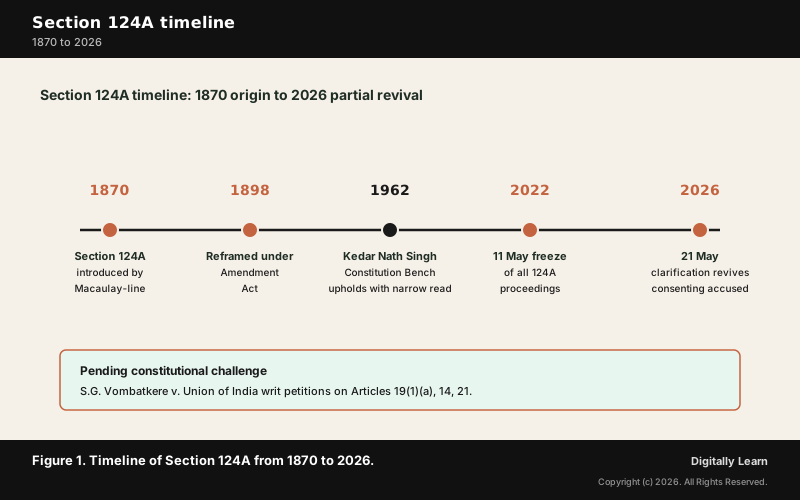
Section 124A of the Indian Penal Code, 1860 criminalised sedition with imprisonment up to life or three years. The provision was introduced into the IPC in 1870 and substantially redrafted by the 1898 amendment, predates the Constitution, and survived in functional successor form at Section 152 of the Bharatiya Nyaya Sanhita, 2023 following the IPC's repeal. The Supreme Court froze proceedings under Section 124A through an interim order on 11 May 2022; on 21 May 2026 the Court clarified that no impediment exists for courts to decide pending Section 124A matters on merits where the accused consents.
What the Supreme Court did on 21 May 2026
The clarification and the pre-existing freeze
The Supreme Court, in a clarification passed on 21 May 2026, stated that there would be no impediment for the courts to decide Section 124A matters on merits and in accordance with law, as reported by The Hindu. The clarification was passed in an unconnected case and addressed the procedural status of sedition trials frozen since the interim order of 11 May 2022.
On 11 May 2022, as reported in the cited news source, a three-judge Bench of the Supreme Court had frozen all proceedings under Section 124A of the Indian Penal Code. The same report records that the earlier Bench, of which Justice Surya Kant was a member, recognised the rampant misuse of the provision. According to that reporting, the court at that time agreed with the Union Government's affidavit position that Section 124A was a colonial-era provision out of step with the contemporary constitutional framework.
Definition: Section 124A of the Indian Penal Code, 1860 criminalised sedition with imprisonment up to life or a term of three years. The provision was introduced in 1870 and substantially redrafted by an 1898 amendment, predates the Constitution, and survives in functional successor form at Section 152 of the Bharatiya Nyaya Sanhita, 2023 following the repeal of the Indian Penal Code. The 1962 Constitution Bench judgment in Kedar Nath Singh v. State of Bihar upheld Section 124A but read it narrowly to require incitement to violence or public disorder.
Why the clarification matters for free speech
Free speech, equality, and liberty doctrine
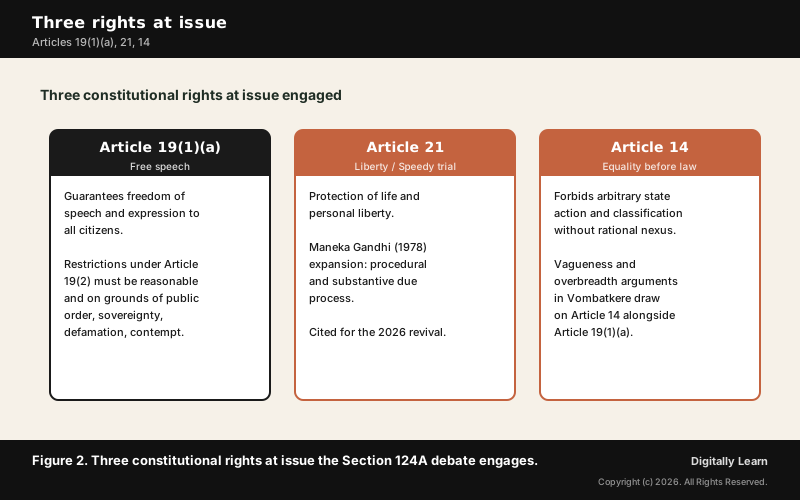
Why it matters: The clarification engages three constitutional rights at once: Article 19(1)(a) on freedom of speech and expression, Article 21 on personal liberty, and Article 14 on equality before law. The provision's chilling effect on free speech and its life-imprisonment ceiling have animated the constitutional challenge that remains pending.
The pending constitutional petitions are titled S.G. Vombatkere v. Union of India. These writ petitions challenge Section 124A for violating the foundational rights to free speech, personal liberty, life, and equality, as reported by The Hindu. The pendency of the Vombatkere petitions raises the question of whether lower courts should pronounce judgments on guilt when the constitutionality of the underlying provision is itself under judicial review.
Significance for the BNS criminal-law transition
What is the significance of this issue: The clarification sits at the intersection of three constitutional doctrines and one statutory transition. The first is the free-speech doctrine in Romesh Thappar v. State of Madras (1950) and subsequent judgments. The second is the colonial-law sunset jurisprudence reflected in I.R. Coelho v. State of Tamil Nadu, which holds that law must be in step with the march of time. The third is the speedy-trial doctrine under Article 21 that the 2026 clarification ostensibly serves.
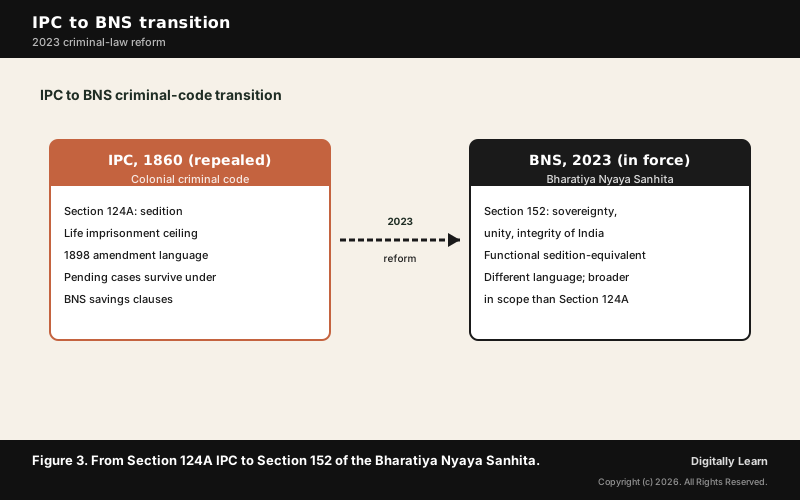
The statutory transition is the IPC-to-BNS shift. The Bharatiya Nyaya Sanhita, 2023 replaced the Indian Penal Code, 1860. BNS Section 152 covers acts endangering sovereignty, unity, and integrity of India, and is widely characterised as the functional successor to Section 124A, although its language departs from the colonial framing. Pending IPC-era sedition cases continue under the savings clauses of the BNS, which the 2026 clarification operationalises for consenting accused.
What the clarification says
What the new Supreme Court order changes about sedition prosecutions
Distinguishing features: Three structural features set the 21 May 2026 clarification apart from the 11 May 2022 freeze.
- (i) Scope of revival is limited: proceedings revive only where the accused person consents to merits-stage adjudication, preserving the original freeze for non-consenting accused.
- (ii) The rationale invoked is the speedy-trial right under Article 21, ensuring that accused persons who want closure can seek a verdict rather than remain in indefinite legal limbo.
- (iii) The constitutional challenge under S.G. Vombatkere v. Union of India remains independently pending, and the clarification does not resolve the underlying constitutionality of Section 124A.
| Point of comparison | 11 May 2022 Order | 21 May 2026 Clarification |
|---|---|---|
| Bench composition | Three-judge Bench (including Justice Surya Kant) | Order passed in an unconnected case |
| Proceedings status | Frozen across all Section 124A cases | Revived where the accused consents |
| Rationale invoked | Misuse, chilling effect, colonial-mindset critique | Article 21 speedy-trial right of consenting accused |
| Constitutionality question | Untouched; left for the Vombatkere line | Untouched; Vombatkere remains pending |
Concept link for UPSC examination preparation
Concept link: The clarification connects to UPSC preparation through General Studies Paper II (Constitution, Functioning of the Judiciary, Rights Issues) and General Studies Paper III (Internal Security insofar as sedition law touches public order). Aspirants preparing the topic should note Article 19(1)(a) and its reasonable-restriction grounds under Article 19(2), Article 21 (Maneka Gandhi expansion of substantive due process), and the Kedar Nath Singh narrowing read of the provision. The 22nd Law Commission Report on Section 124A (2023) recommended retention with a higher punishment ceiling and procedural safeguards, framing the policy debate.
What the outcome could change
Observable outcomes if pending cases now proceed
Observable outcomes: Three concrete shifts would follow operationalisation of the clarification.
- (a) Pending Section 124A trials with consenting accused move to merits-stage adjudication, potentially producing trial-court convictions, acquittals, or High Court appeals while the Vombatkere petition is still under review.
- (b) The interaction between IPC-era pending cases and BNS Section 152 going-forward cases creates a transitional jurisprudential layer that High Courts and the Supreme Court will need to resolve over the next several judicial cycles.
- (c) The Vombatkere bench faces fresh pressure to deliver the constitutional verdict, as continued lower-court trials may otherwise produce divergent outcomes on a provision whose constitutional status remains formally unsettled.
What the pendency of Vombatkere means in practice
The pending S.G. Vombatkere petitions challenge Section 124A on grounds of vagueness, overbreadth, and chilling effect on free expression. The Supreme Court has yet to deliver a final verdict on the constitutionality question. A finding of unconstitutionality would void all pending and concluded Section 124A convictions; a finding of constitutionality (likely with read-down conditions) would allow trials and convictions to continue.
BNS Section 152, the functional successor framework, would face a separate constitutional test if the Vombatkere reasoning extends to the new provision. Petitioners have already signalled that the substantive constitutional infirmities of Section 124A may also affect Section 152 because the underlying speech-restriction architecture is similar.
Contemporary linkages
The clarification in India's free-speech doctrine trajectory
Contemporary linkages: The clarification sits within a wider sequence of free-speech and criminal-law-reform engagements by the Supreme Court. The 2015 Shreya Singhal v. Union of India judgment struck down Section 66A of the Information Technology Act on free-speech grounds. The 22nd Law Commission Report (2023) recommended retention of Section 124A with reforms. The IPC-to-BNS criminal-code overhaul of 2023-24 reframed multiple colonial offences, though sedition was preserved in modified form at Section 152 BNS.
Three contemporary considerations shape the discussion. The first is procedural: how to handle a large stock of pending sedition cases under a repealed Act, especially as the underlying provision faces a constitutional challenge. The second is doctrinal: whether the read-down narrow reading from Kedar Nath Singh can survive scrutiny under contemporary Article 19 jurisprudence developed in Shreya Singhal. The third is policy: whether speech-restriction provisions need a distinct empirical bar (such as proven incitement) before invoking the criminal-law machinery against expression.
Sources and Further Reading
- SC's revival of Section 124A for consenting accused brings back a colonial law the country did not want
- Coerced consent: On sedition (editorial)
- Indian Penal Code, 1860, Section 124A (sedition)
- Bharatiya Nyaya Sanhita, 2023, Section 152 (acts endangering sovereignty, unity, and integrity of India)
- Kedar Nath Singh v. State of Bihar (1962)
- S.G. Vombatkere v. Union of India (pending)
- I.R. Coelho v. State of Tamil Nadu (2007)
- Romesh Thappar v. State of Madras (1950)
- Shreya Singhal v. Union of India (2015)
- Maneka Gandhi v. Union of India (1978)
- 22nd Law Commission Report on Section 124A (2023)
Editorial Disclaimer
The Supreme Court order is currently a single-source news event as carried by The Hindu, and specific bench observations and case attributions reproduce the reporting in that source. Readers preparing for the UPSC examination should consult the principal Supreme Court order text and the Vombatkere case docket once available for full context.


