


Overview
A payments bank is a special, limited type of bank that the Reserve Bank of India licenses to accept small deposits and offer payments and remittance services, but which cannot lend or issue credit cards. On 24 April 2026, the RBI cancelled the banking licence of Paytm Payments Bank Limited under Section 22(4) of the Banking Regulation Act, 1949. The action followed persistent non-compliance and earlier business restrictions. The RBI said it will move to wind up the bank and that the bank has enough liquidity to repay all depositors.
Why the licence cancellation is in focus
A rare cancellation of a bank licence
The Reserve Bank of India cancelled the banking licence of Paytm Payments Bank Limited by an order dated 24 April 2026, effective from the close of business that day.
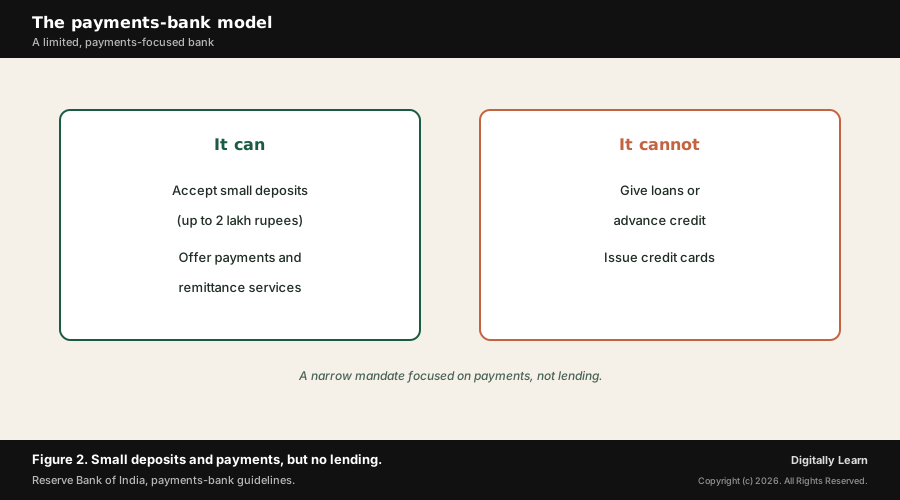
A payments bank is a limited bank that can take small deposits and offer payments and remittances, but cannot give loans or issue credit cards. It was created to widen access to banking.
The action was taken under Section 22(4) of the Banking Regulation Act, 1949, the law that lets the RBI cancel a licence. It followed years of supervisory concern and earlier restrictions on the bank.
The key elements of the RBI's action are:
- Cancellation: the bank’s licence was withdrawn from 24 April 2026.
- Legal basis: Section 22(4) of the Banking Regulation Act, 1949.
- Grounds: persistent non-compliance and supervisory concerns.
- Next step: the RBI will seek the bank’s winding up before the High Court.
Why the action matters
An escalation years in the making
Cancelling a bank's licence is one of the RBI's strongest powers, used sparingly. It signals that the regulator judged lesser measures to have failed and that depositor and public interest were at stake.
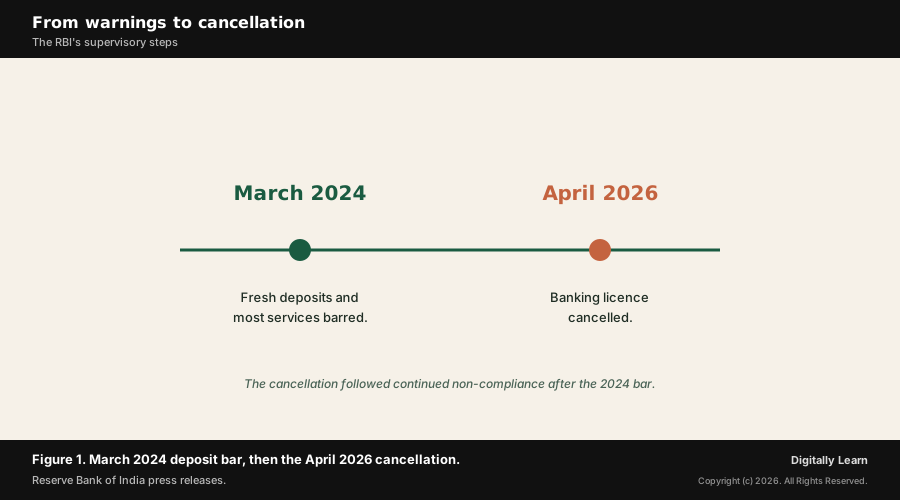
The RBI had earlier barred the bank from taking fresh deposits and offering most services from March 2024. The cancellation marks the end point of that supervisory process.
It also matters for trust in digital finance. Paytm Payments Bank served a large base of small users, so the action tests how well the system protects ordinary depositors when a licensed entity fails.
What the action signifies
Supervision, depositor protection, and the model
Three threads carry the weight: firm supervision, the priority on depositors, and questions about the payments-bank model.
First, firm supervision. The cancellation shows the RBI is willing to use its ultimate power when a bank repeatedly fails to comply, reinforcing the credibility of banking regulation.
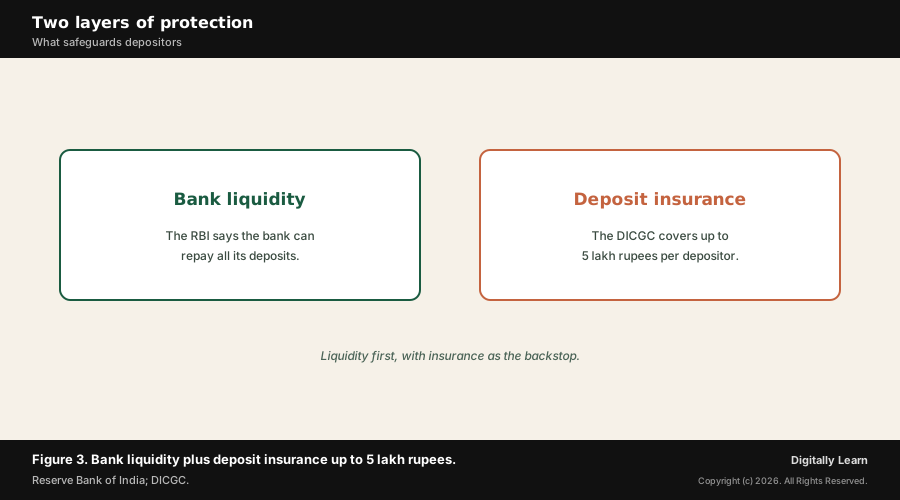
Second, the priority on depositors. The RBI stressed that the bank has enough liquidity to repay deposits, and deposit insurance offers a further safety net for small savers.
Third, the model under review. The failure of a large payments bank raises questions about governance and viability in the differentiated-banking experiment.
Distinguishing features of the action
The action at a glance
The table sets out the key facts, so the legal basis and the next steps are visible at a glance.
| Feature | Detail |
|---|---|
| Action | Cancellation of banking licence |
| Entity | Paytm Payments Bank Limited |
| Effective date | Close of business, 24 April 2026 |
| Legal basis | Section 22(4), Banking Regulation Act, 1949 |
| Next step | Winding up before the High Court |
Three features that define a payments bank
Three rules set a payments bank apart from a full commercial bank:
- (i) Limited deposits. It can accept deposits only up to a small per-customer cap, currently 2 lakh rupees.
- (ii) No lending. It cannot give loans or issue credit cards, so it earns mainly from payments and fees.
- (iii) Payments focus. It is built for remittances, wallets and digital payments rather than full banking.
Observable outcomes
Three trackable outcomes
The action translates into three developments to watch in the weeks ahead.
- (a) Winding up and repayment. A liquidator will be appointed and depositors repaid as the bank is wound up.
- (b) Service migration. Customer accounts and services tied to the bank must be moved to other banks.
- (c) Tighter scrutiny. The RBI is likely to sharpen oversight of governance across payments banks.
A licence cancellation protects the system, but the test is an orderly exit, that depositors are repaid in full and services move without disruption.
Depositor protection, the regulator and digital finance
DICGC insurance, the RBI's role and financial inclusion
Depositors are backed by deposit insurance from the Deposit Insurance and Credit Guarantee Corporation, which covers each depositor up to 5 lakh rupees if a bank fails.
The episode underlines the RBI's role as the banking regulator, which licenses banks, supervises them, and can withdraw a licence when a bank does not comply with the law.
It also connects to financial inclusion. Payments banks were licensed to bring small and rural users into formal banking, so their stability matters for that wider goal.
UPSC relevance and exam focus
Where this fits in the UPSC-CSE syllabus
This topic maps to General Studies Paper III: Indian economy, banking, and the role of regulators, with links to financial inclusion and consumer protection.
For Prelims, hold the high-yield facts: the legal basis is the Banking Regulation Act, 1949, what a payments bank can and cannot do, and the role of deposit insurance.
For Mains, two framings recur: the RBI's role as banking regulator, and the place of differentiated banks in financial inclusion.
Recurring linked concepts an aspirant should keep in working memory:
- Banking Regulation Act, 1949: the law governing banks in India.
- Payments bank: a deposit-and-payments bank that cannot lend.
- DICGC: the body that insures bank deposits.
- Differentiated banks: payments banks and small finance banks.
A payments bank cannot give loans or issue credit cards. Assuming it functions like a full commercial bank is a frequent error.
Do not read the cancellation as a failure of digital payments as a whole. It concerns one licensed bank, not the wider payments ecosystem.
Previous Year UPSC-CSE Questions By the end you will be able to draft model answers for the following UPSC questions. Each question carries a collapsible framework showing how to approach it in the exam.
- UPSC Mains 2022 GS-IIIIs inclusive growth possible under market economy? State the significance of financial inclusion in achieving economic growth in India.
How to structure the answer in the exam
Introduction: Open with inclusive growth as growth whose benefits reach all sections.
Body (sub-themes to develop):
- Markets may exclude the poor without policy support.
- Financial inclusion as access to banking, credit and payments.
- Vehicles: Jan Dhan accounts, payments banks and digital payments.
- Risks: governance failures, as the payments-bank case shows.
- Role of the regulator in keeping inclusion safe.
Conclusion: Conclude that inclusion needs both market reach and strong regulation to be durable.
- UPSC Prelims 2017What is the purpose of setting up of Small Finance Banks (SFBs) in India? Consider the following:
- To supply credit to small business units
- To supply credit to small and marginal farmers
- To encourage young entrepreneurs to set up business particularly in rural areas.
Select the correct answer using the code given below:
How to approach this Prelims question
Approach: Recall the stated purpose of small finance banks within differentiated banking.
Trap to watch: SFBs are meant to supply credit to small business units and to small and marginal farmers; the entrepreneur-encouragement statement is not their stated purpose, giving '1 and 2 only'.
Key facts to recall:
- Small finance banks supply credit to small business units.
- They also serve small and marginal farmers.
- Payments banks, unlike SFBs, cannot lend at all.
Answer signal: Statements 1 and 2 are correct. Correct answer: 1 and 2 only.
Sources and Further Reading
- Reserve Bank of India: RBI cancels the Licence of Paytm Payments Bank Limited (press release, 24 April 2026)
- Reserve Bank of India: Press Releases
- Reserve Bank of India: FAQs on business restrictions on Paytm Payments Bank
- Deposit Insurance and Credit Guarantee Corporation (DICGC)
- Reserve Bank of India: Deposit insurance FAQs
- Wikipedia: Paytm Payments Bank
Editorial Disclaimer
This article is compiled from the reference materials listed in the Sources section. It is an explainer for UPSC preparation and is not a substitute for primary documents (NCERTs, GoI ministry releases, IMD bulletins, RBI / CEA / MoEFCC publications, and Standing-Committee reports).


