


Overview
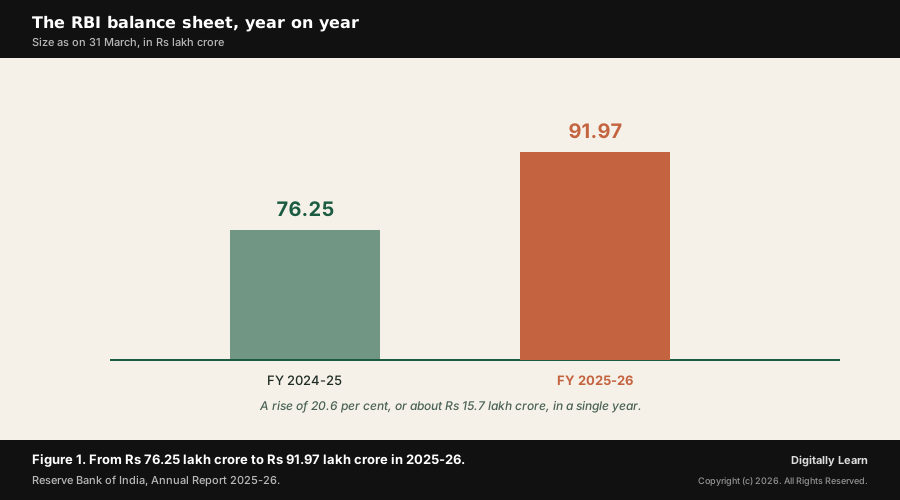
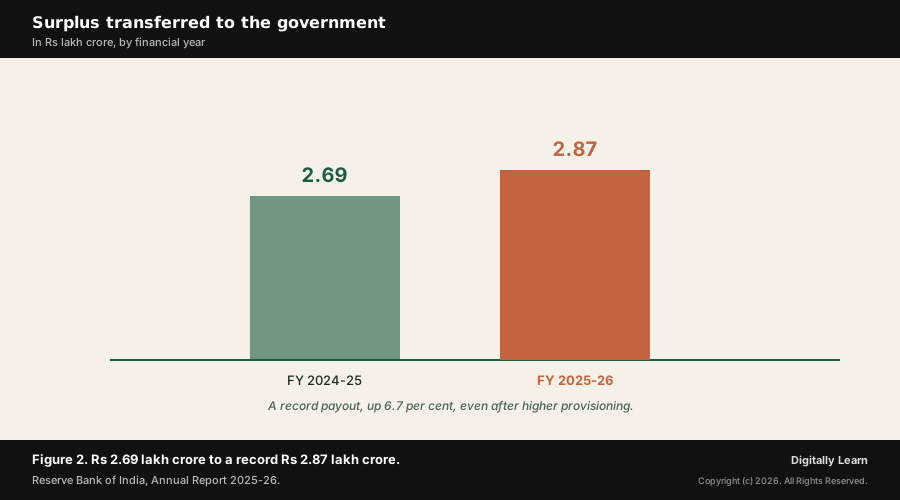
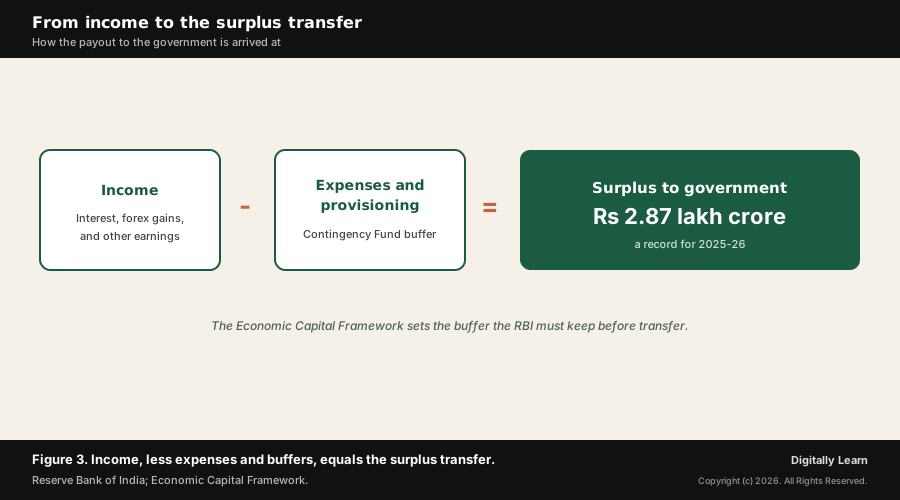
The RBI Annual Report is the statutory yearly account of the Reserve Bank of India, covering its working, its balance sheet, and its assessment of the economy. The 2025-26 report, for the year ending 31 March 2026, shows the balance sheet expanding 20.6 per cent to Rs 91.97 lakh crore and a record surplus transfer of Rs 2.87 lakh crore (Rs 2,86,588 crore) to the central government. The surplus is the RBI's transferable income after expenses and provisioning, paid to the government under the Reserve Bank of India Act, 1934.
Why the RBI Annual Report is in focus
A record surplus and a bigger balance sheet
The Reserve Bank of India released its Annual Report for 2025-26, covering the year ending 31 March 2026. It reported a record surplus transfer to the government and a sharply larger balance sheet.
The Annual Report is the RBI's statutory account of its operations, finances and economic assessment. Its balance sheet records the central bank's assets, such as gold and foreign currency, against its liabilities, mainly currency in circulation.
The headline numbers are large. The balance sheet grew 20.6 per cent to Rs 91.97 lakh crore, and the RBI approved a surplus of Rs 2.87 lakh crore for transfer to the central government, the highest ever.
The key figures of the 2025-26 report are:
- Balance sheet: Rs 91.97 lakh crore, up 20.6 per cent over the previous year.
- Surplus transfer: a record Rs 2.87 lakh crore (Rs 2,86,588 crore) to the central government.
- Income: total income up 26.4 per cent to Rs 4.28 lakh crore.
- Provisioning: Rs 1.09 lakh crore moved to the Contingency Fund to strengthen buffers.
Why the report matters
Fiscal room, buffers and the economy
The surplus transfer is a major non-tax receipt for the government. A record payout eases the fiscal deficit and gives the Union budget more room without raising taxes or borrowing.
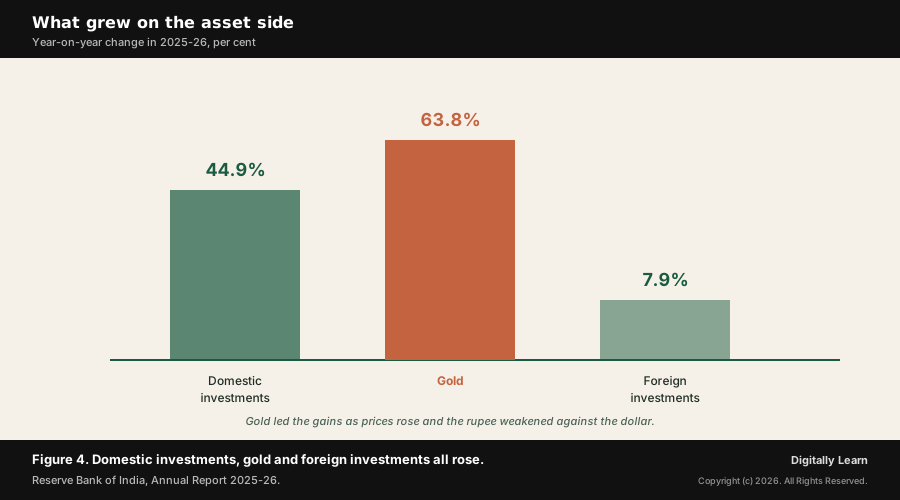
The balance sheet matters too. Its growth reflects the RBI's foreign-exchange operations, gold accumulation and liquidity actions, so the figures track how the central bank managed the rupee and market liquidity through the year.
The report also carries the RBI's reading of the economy. Its commentary on growth, inflation and financial stability guides expectations for monetary policy and signals risks the central bank is watching.
What the surplus transfer signifies
The surplus, the buffer and the framework
Three threads carry the weight: the fiscal cushion for the government, the balance against the RBI's risk buffers, and the framework that decides how much can be paid out.
First, the fiscal cushion. At Rs 2.87 lakh crore, the transfer is a large non-tax receipt that supports government spending and helps meet the fiscal-deficit target for the year.
Second, the buffer balance. The RBI raised its Contingency Fund provision to Rs 1.09 lakh crore, so it strengthened its own shock-absorbing reserves even while paying a record surplus.
Third, the framework. The payout is governed by the Economic Capital Framework, recommended by the Bimal Jalan committee, which sets how much risk provisioning the RBI keeps before transferring the rest.
Distinguishing features of the report
The 2025-26 numbers at a glance
The table sets out the headline figures of the 2025-26 report against the previous year, so the scale of the change is visible at a glance.
| Item | 2024-25 | 2025-26 |
|---|---|---|
| Balance sheet size | Rs 76.25 lakh crore | Rs 91.97 lakh crore |
| Surplus to government | Rs 2.69 lakh crore | Rs 2.87 lakh crore |
| Total income | Lower base | Up 26.4 per cent |
| Contingency Fund provision | Rs 0.45 lakh crore | Rs 1.09 lakh crore |
Three features that define the report
Three elements explain how the report works and why the numbers moved:
- (i) Statutory account. The report is a legal obligation under the Reserve Bank of India Act, 1934, presenting the audited balance sheet and economic review.
- (ii) Surplus, not profit-sharing. The surplus is transferable income after expenses and provisioning, paid to the government, not a dividend on shares.
- (iii) Framework-bound payout. The Economic Capital Framework caps how much the RBI must retain as buffers before the surplus can be transferred.
Observable outcomes
Three trackable outcomes
The report's numbers translate into three visible effects for the economy and the budget.
- (a) Easier fiscal maths. The record transfer adds to non-tax revenue, helping the government meet its deficit target without extra borrowing.
- (b) Stronger buffers. A larger Contingency Fund provision leaves the RBI better cushioned against future shocks to its books.
- (c) A policy signal. The report’s economic assessment shapes market expectations for inflation, growth and the path of interest rates.
A high surplus is partly driven by foreign-exchange gains and rupee movements, so the payout can swing year to year and should not be read as steady, recurring revenue.
The report and the wider economy
Fiscal policy, central-bank autonomy and reserves
The surplus transfer sits at the meeting point of monetary and fiscal policy. A large payout supports the budget, but the size of the transfer has long been debated as a question of central-bank autonomy.
It connects to the Economic Capital Framework debate. The Bimal Jalan committee tried to settle how much capital the RBI should hold, balancing the government's revenue needs against the central bank's financial strength.
The report also links to foreign-exchange reserves and gold. Rising gold values and reserve management lift both the balance sheet and income, tying the surplus to global prices and the rupee's movements.
UPSC relevance and exam focus
Where this fits in the UPSC-CSE syllabus
This topic maps to General Studies Paper III: the Indian economy, mobilisation of resources, banking and monetary policy, and to government budgeting through the surplus transfer.
For Prelims, hold the high-yield facts: the sources of the RBI's income, the legal basis of the surplus transfer under the RBI Act, the Economic Capital Framework, and the headline 2025-26 figures.
For Mains, two framings recur: how the RBI's surplus transfer interacts with fiscal management, and the tension between the government's revenue needs and the central bank's autonomy.
Recurring linked concepts an aspirant should keep in working memory:
- RBI Act, 1934: the statute under which the surplus is transferred to the government.
- Economic Capital Framework: the Bimal Jalan committee formula for buffers and transferable surplus.
- Contingency Fund: the RBI’s provision against unforeseen risks to its books.
- Non-tax revenue: the budget head under which the surplus transfer is received.
The RBI earns from government securities, foreign-currency operations and currency issuance, not from lending to private companies or running a pension fund. Mis-listing its income sources is a frequent error.
Do not treat the surplus as a tax or as steady revenue. It is non-tax income that swings with forex gains and provisioning, so it cannot be assumed to recur at the same level.
Previous Year UPSC-CSE Questions By the end you will be able to draft model answers for the following UPSC questions. Each question carries a collapsible framework showing how to approach it in the exam.
- UPSC Prelims 2025Which of the following are the sources of income for the Reserve Bank of India?
- Buying and selling Government bonds
- Buying and selling foreign currency
- Pension fund management
- Lending to private companies
- Printing and distributing currency notes
Select the correct answer using the code given below:
How to approach this Prelims question
Approach: Identify which listed activities the RBI actually performs to earn income.
Trap to watch: Printing and distributing currency notes is the trap: UPSC's official key does not count it as an income source. Pension fund management and lending to private companies are not RBI functions at all.
Key facts to recall:
- RBI earns from buying and selling government bonds.
- It earns from foreign-currency operations and reserve management.
- Issuing currency notes is not counted as an income source in UPSC's key; the RBI also does not lend to private firms.
Answer signal: Only I and II are income sources. Correct answer: (a) I and II only, as per UPSC's official answer key.
- UPSC Mains 2024 GS-IIIWhat are the causes of persistent high food inflation in India? Comment on the effectiveness of the monetary policy of the RBI to control this type of inflation.
How to structure the answer in the exam
Introduction: Open with food inflation as a supply-side phenomenon with an outsized weight in the consumer price index.
Body (sub-themes to develop):
- Causes: supply shocks, monsoon dependence, weak storage and value chains, and global prices.
- Monetary policy tools: the repo rate and liquidity management under inflation targeting.
- Limits: rate hikes do little against supply-driven food price spikes.
- Complementary measures: buffer stocks, imports, and agricultural-market reform.
- The RBI's own assessment in its annual review of inflation and growth.
Conclusion: Conclude that controlling food inflation needs supply-side reform alongside calibrated monetary policy.
Sources and Further Reading
Editorial Disclaimer
This article is compiled from the reference materials listed in the Sources section. It is an explainer for UPSC preparation and is not a substitute for primary documents (NCERTs, GoI ministry releases, IMD bulletins, RBI / CEA / MoEFCC publications, and Standing-Committee reports).


