


Overview
254th Birth Anniversary
Born 22 May 1772, the architect of the Indian Renaissance founded the Brahmo Sabha and led the Sati-abolition campaign.
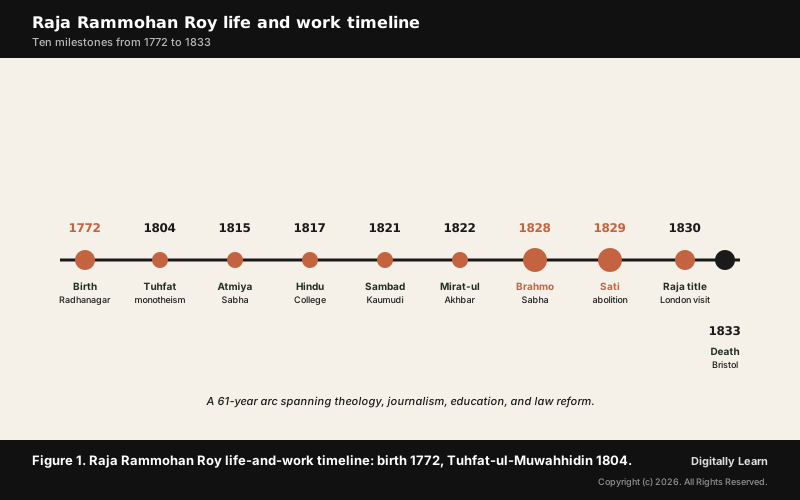
Raja Rammohan Roy (born 22 May 1772 at Radhanagar in Burdwan district of Bengal; died 27 September 1833 at Bristol, England) was the principal architect of the early nineteenth-century Indian Renaissance and is widely regarded as the father of modern India. He founded the Atmiya Sabha (1815) and the Brahmo Sabha (1828; later Brahmo Samaj), led the successful campaign for the abolition of Sati through Regulation XVII of 1829 under Lord William Bentinck, and pioneered modern Indian journalism, monotheistic theology, and Western-rationalist education.
Why this is in the news on 22 May 2026
The 254th birth anniversary and its commemoration
On 22 May 2026, India commemorates the 254th birth anniversary of Raja Rammohan Roy, the principal architect of the early nineteenth-century Indian socio-religious reform movement. Government tributes were paid by the President, the Vice-President, and the Prime Minister, alongside commemorative events at the Raja Rammohun Roy Memorial Museum in Kolkata and the Rammohun Roy Library Foundation.
Definition: Raja Rammohan Roy was the founder of the Brahmo Sabha (1828, later the Brahmo Samaj), the leader of the successful campaign for the abolition of Sati through Regulation XVII of 1829 under Lord William Bentinck, and a pioneer of modern Indian journalism through the Sambad Kaumudi (1821, Bengali) and the Mirat-ul-Akhbar (1822, Persian).
Three pillars define his legacy as commemorated on the 254th anniversary:
- (i) Socio-religious reform. Founder of the Atmiya Sabha (1815) and the Brahmo Sabha (1828); author of the monotheist tract Tuhfat-ul-Muwahhidin (1804) and English translations of the Upanishads; opposed image worship, caste rigidities, and ritual obscurantism on rational and scriptural grounds.
- (ii) Women’s-rights and Sati abolition. Campaigned through pamphlets, petitions, and direct engagement with Lord William Bentinck for the abolition of Sati; this culminated in Regulation XVII of 4 December 1829 declaring Sati illegal in the Bengal Presidency, later extended to Madras and Bombay.
- (iii) Modern Indian press and education. Founded the Sambad Kaumudi (1821) in Bengali and the Mirat-ul-Akhbar (1822) in Persian; opposed the Press Regulation of 1823 (Adam’s Press Ordinance); collaborated with David Hare on the Hindu College, Calcutta (1817); favoured English-and-Western-sciences education in the policy debate of the General Committee of Public Instruction.
Why Raja Rammohan Roy matters for the Indian Renaissance
The first synthesis of Indian tradition with rational modernity
Why it matters: Raja Rammohan Roy matters because he produced the first sustained synthesis of Indian classical theology with European Enlightenment rationalism. His translations of the Upanishads into English (1816 onwards) and his English-Persian-Bengali tri-lingual reform writings opened the conduit through which subsequent reformers worked.
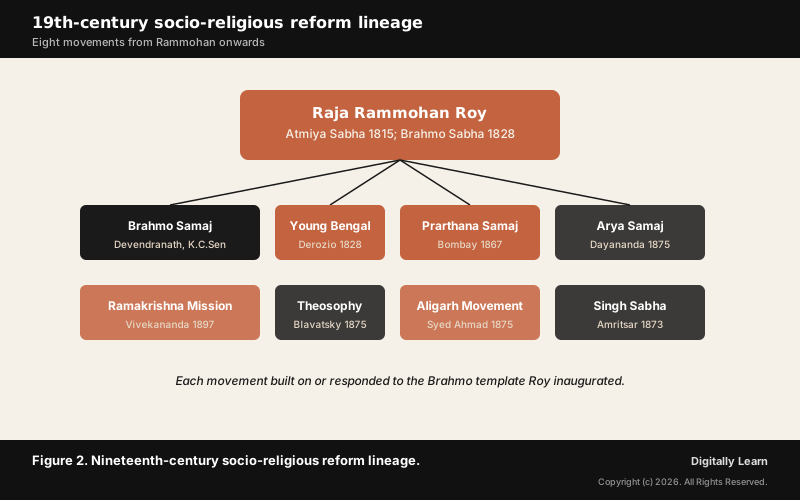
He matters because the social-reform movement he set in motion absorbed and seeded later movements: the Brahmo Samaj under Devendranath Tagore and Keshub Chandra Sen; the Prarthana Samaj in Maharashtra; the Arya Samaj under Swami Dayananda Saraswati in 1875; and the broader nineteenth-century reform stream that produced the Widow Remarriage Act of 1856 under Ishwar Chandra Vidyasagar and the Age of Consent Act of 1891.
Significance for nineteenth-century socio-religious reform
What the Rammohan Roy legacy signals for nineteenth-century socio-religious reform
What is the significance of this issue: Raja Rammohan Roy's legacy carries three significances for the nineteenth-century socio-religious reform stream:
- (i) Reform-from-within signal. He demonstrated that reform of Indian religion and society could draw on indigenous scriptural authority (Upanishads, Vedanta) rather than on colonial-Christian polemics. The Brahmo Samaj stood on the Upanishadic tat tvam asi and aham brahmasmi formulations of monotheist Brahman.
- (ii) Law-and-state-reform signal. The Sati abolition Regulation XVII of 4 December 1829 under Lord William Bentinck was the first significant colonial-state intervention in Indian social practice in response to organised Indian reform petitioning. The model recurred in the Widow Remarriage Act of 1856, the Age of Consent Act of 1891, and the Sarda Act of 1929.
- (iii) Modern-public-sphere signal. The Sambad Kaumudi (1821) and Mirat-ul-Akhbar (1822) inaugurated the modern Indian public sphere of debate through the printing press. The opposition to the Press Regulation of 1823 opened the long campaign for press freedom that culminated in the Constitution of India Article 19(1)(a) provision in 1950.
Distinguishing features of his reform contribution
The three pillars of the Rammohan reform project
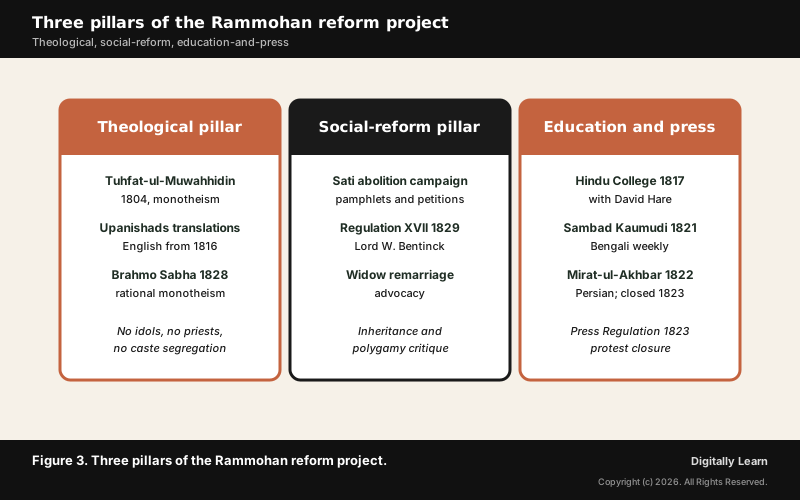
Distinguishing features: Three reform pillars define his contribution:
- (i) Theological pillar. Tuhfat-ul-Muwahhidin (1804, Persian-Arabic), a tract for monotheist universalism; English translations of the Upanishads from 1816 onwards; the Brahmo Sabha (1828, Calcutta) institutionalising rational monotheist worship without idols, priestly intermediaries, or caste segregation.
- (ii) Social-reform pillar. Direct campaign for the abolition of Sati through pamphlets, public petitions, and engagement with Lord William Bentinck; advocacy of widow remarriage, women’s property and inheritance rights, and condemnation of polygamy. The Regulation XVII of 1829 is the legislative victory.
- (iii) Education and press pillar. Collaboration with David Hare for the Hindu College, Calcutta (1817); founding of Sambad Kaumudi (Bengali, 1821) and Mirat-ul-Akhbar (Persian, 1822); opposition to the Press Regulation of 1823; preference for English-and-Western-sciences education in the policy contest with Orientalist Sanskritists.
Raja Rammohan Roy's life and reform work at a glance
| Life and reform milestone | Detail | Significance |
|---|---|---|
| Birth | 22 May 1772, Radhanagar, Burdwan district, Bengal | Architect of the Indian Renaissance |
| Death | 27 September 1833, Bristol, England | On diplomatic mission for Mughal pension case |
| First reform association | Atmiya Sabha, 1815 | Precursor to the Brahmo Sabha |
| Major theological tract | Tuhfat-ul-Muwahhidin, 1804 (Persian-Arabic) | Early monotheist universalism |
| Brahmo Sabha founding | 20 August 1828, Calcutta | Renamed Brahmo Samaj in 1830 |
| Sati abolition | Regulation XVII of 4 December 1829 | Under Lord William Bentinck |
| Title conferred | Raja, by Mughal Emperor Akbar II in 1830 | Sent to London for pension increase plea |
| Bengali newspaper | Sambad Kaumudi, 1821 | Modern Indian press inauguration |
| Persian newspaper | Mirat-ul-Akhbar, 1822 | Discontinued in protest of 1823 Press Regulation |
| Education collaboration | Hindu College, Calcutta, 1817, with David Hare | Western-sciences-and-English curriculum |
Observable outcomes traced from the Rammohan moment
Six downstream reform movements and statutes that built on Rammohan's work
Observable outcomes: Six downstream movements and statutes trace directly or indirectly to the reform stream Raja Rammohan Roy inaugurated:
- (a) Brahmo Samaj lineage. Devendranath Tagore (joined 1842) and Keshub Chandra Sen (1857) extended the Brahmo movement; later split into Adi Brahmo Samaj and Sadharan Brahmo Samaj (1878).
- (b) Prarthana Samaj. Founded in Bombay in 1867 by Atmaram Pandurang; influenced by Brahmo lineage and by Keshub Chandra Sen’s travels.
- (c) Arya Samaj. Founded by Swami Dayananda Saraswati in 1875 at Bombay; back-to-the-Vedas reformism running parallel to Brahmo rationalism.
- (d) Widow Remarriage Act, 1856. Driven by Ishwar Chandra Vidyasagar; legitimised Hindu widow remarriage and the inheritance rights of remarrying widows.
- (e) Age of Consent Act, 1891. Raised the legal age of consummation of marriage from 10 to 12 years; followed by the Sarda Act of 1929 raising minimum marriage age to 14 for girls and 18 for boys.
- (f) Modern Indian press. From Sambad Kaumudi (1821) to the Indian Press Act 1910 to the press-freedom provision under Article 19(1)(a) of the Constitution of India 1950.
Threads connecting Rammohan to contemporary Indian society
How the Brahmo-era reform tradition shapes contemporary India
Contemporary linkages: Three threads connect the Rammohan reform legacy to contemporary Indian society.
The first is the women's-rights thread. The Sati-abolition victory of 1829 inaugurated a legislative path that ran through the Widow Remarriage Act 1856, the Hindu Succession Act 1956 (and its 2005 amendment giving daughters coparcenary rights), the Sati Prevention Act 1987, the Protection of Women from Domestic Violence Act 2005, and the recent Bharatiya Nyaya Sanhita 2023 Section 80 on dowry deaths.
The second is the press-freedom thread. The Mirat-ul-Akhbar protest against the Press Regulation of 1823 prefigured the Article 19(1)(a) constitutional guarantee, the post-1975 jurisprudence on the freedom of the press (Bennett Coleman v. Union of India, Indian Express v. Union of India), and the Press Council of India Act 1978.
The third is the education-and-rational-modernity thread. The Hindu College of 1817 led to the Calcutta University of 1857 in the Wood's Despatch 1854 framework; the Western-sciences-and-English preference foreshadowed the post-Independence National Education Policy series (1968, 1986, 2020) and the contemporary tension between vernacular-medium and English-medium instruction.
UPSC Relevance
Where Raja Rammohan Roy sits in the UPSC syllabus
UPSC context: Raja Rammohan Roy falls within General Studies Paper I under modern Indian history from about the middle of the eighteenth century until the present, significant events, personalities, issues, and the Freedom Struggle – its various stages and important contributors / contributions from different parts of the country. The socio-religious-reform dimension also touches the women's-question and Indian-society heads.
Prelims relevance: The Prelims surface includes the birth date 22 May 1772, the Radhanagar (Burdwan) birthplace, the Atmiya Sabha (1815), the Brahmo Sabha (20 August 1828) at Calcutta, the Tuhfat-ul-Muwahhidin (1804), the Sambad Kaumudi (1821), and the Mirat-ul-Akhbar (1822).
It also covers the Press Regulation of 1823, the Hindu College Calcutta (1817) with David Hare, the Sati abolition Regulation XVII of 4 December 1829 under Lord William Bentinck, the Raja title from Mughal Emperor Akbar II in 1830, and the death at Bristol on 27 September 1833.
Mains relevance: Two framings dominate the Mains-paper surface:
- (i) Socio-religious-reform-movements framing. The rise and growth of socio-religious reform movements with reference to Young Bengal and Brahmo Samaj. Raja Rammohan Roy is the founding figure of the Brahmo stream and the precursor to Young Bengal.
- (ii) Women’s-question framing. The major issues and debates concerning women in the nineteenth-century reform movement. Sati abolition, widow remarriage, child marriage, and women’s education trace through to the Rammohan reform writings.
Mains practice question: A focused fifteen-mark question would read: The 254th birth anniversary of Raja Rammohan Roy on 22 May 2026 recalls the founding moment of the nineteenth-century Indian socio-religious reform stream. Examine his contribution to the theological, social, and press-and-education pillars of the Indian Renaissance.
- Past Mains linkage. 2021 GS-I: Trace the rise and growth of socio-religious reform movements with special reference to Young Bengal and Brahmo Samaj. The Brahmo Sabha founding of 1828 by Raja Rammohan Roy is the founding-moment evidence the question’s answer must include.
- Past Mains linkage. 2017 GS-I: The women’s questions arose in modern India as a part of the 19th century social reform movement. What were the major issues and debates concerning women in that period? Sati abolition, widow remarriage, and women’s education trace through the Rammohan reform writings that inaugurated the women’s-question agenda.
- Related Prelims linkage. Prelims questions on Brahmo Sabha founding date, Tuhfat-ul-Muwahhidin, Sambad Kaumudi, and Regulation XVII test the surface.
Previous Year UPSC-CSE Questions By the end you will be able to draft model answers for the following UPSC questions. Each question carries a collapsible framework showing how to approach it in the exam.
- UPSC Mains 2021 GS-ITrace the rise and growth of socio-religious reform movements with special reference to Young Bengal and Brahmo Samaj.
How to structure the answer in the exam
Introduction: Open with the early-nineteenth-century colonial-Bengal context of Western education at Hindu College and the Permanent Settlement social changes, name Atmiya Sabha 1815 and Brahmo Sabha 1828 as the Rammohan arc and Young Bengal as the Derozio cohort, and structure the answer through the two streams.
Body (sub-themes to develop):
- Context: post-1813 Charter Act Christian missionary entry; Permanent Settlement 1793 zamindar consolidation; Hindu College 1817 (Raja Rammohan Roy and David Hare) producing the bilingual elite of Calcutta.
- Rammohan arc: Atmiya Sabha 1815; Tuhfat-ul-Muwahhidin 1804 monotheism; Upanishad translations 1816 onwards; Brahmo Sabha 20 August 1828 at Calcutta with monotheist worship without idols or caste; Sati abolition campaign culminating in Regulation XVII of 4 December 1829 under Lord William Bentinck.
- Young Bengal: Henry Vivian Derozio at Hindu College 1828; rationalist circle critical of Hindu orthodoxy and Muslim conservatism; published Parthenon and Hesperus; dissolved after Derozio's dismissal and death in 1831.
- Brahmo Samaj growth: Devendranath Tagore (joined 1842, formal Brahmo declaration 1843) reorganised on Vedantic and Upanishadic basis; Keshub Chandra Sen (joined 1857) opened to broader audiences and to inter-caste-and-inter-religious openness; 1866 schism (Adi Brahmo Samaj vs Brahmo Samaj of India); 1878 schism (Sadharan Brahmo Samaj).
- Limits: Brahmo Samaj remained an elite Calcutta movement; mass-level penetration was limited; Young Bengal's iconoclasm alienated the larger Bengali Hindu community.
Conclusion: Conclude that the Rammohan Atmiya-to-Brahmo arc and the Derozio Young Bengal current together inaugurated the nineteenth-century Indian socio-religious reform stream, that the Brahmo Samaj's evolution through Devendranath and Keshub Chandra Sen produced both growth and schism, and that the Rammohan founding moment of 1828 is the headline reference.
The Brahmo Sabha founding of 20 August 1828 by Raja Rammohan Roy is the founding-moment evidence the 2021 GS-I question's answer must include. The body sub-theme on the Rammohan arc supplies the leading reform-stream evidence pillar.
- UPSC Mains 2017 GS-IThe women’s questions arose in modern India as a part of the 19th century social reform movement. What were the major issues and debates concerning women in that period?
How to structure the answer in the exam
Introduction: Open with the nineteenth-century reform-movement context shaped by Raja Rammohan Roy's Atmiya Sabha and Brahmo Sabha, name four major women's-issue clusters, and structure the answer through issues and corresponding legislative-or-social outcomes.
Body (sub-themes to develop):
- Issue 1: Sati abolition. Raja Rammohan Roy's pamphlet-and-petition campaign through the 1810s and 1820s; Regulation XVII of 4 December 1829 under Lord William Bentinck banned Sati in the Bengal Presidency; extended to Madras and Bombay; opposed by Dharma Sabha (Radhakanta Deb).
- Issue 2: Widow remarriage. Ishwar Chandra Vidyasagar's two-volume case from Hindu scripture; Hindu Widows Remarriage Act 1856 under Lord Dalhousie legalising widow remarriage and protecting inheritance rights of remarrying widows.
- Issue 3: Child marriage and age of consent. Behramji Malabari's campaign; Age of Consent Act 1891 raising age of consummation from 10 to 12 years; Sarda Act of 1929 raising minimum marriage age to 14 for girls and 18 for boys.
- Issue 4: Women's education. Pandita Ramabai's Sharada Sadan 1889 at Pune; Hunter Commission 1882 recommendations; Lady Dufferin Fund 1885 for women's medical education; Begum Rokeya Sakhawat Hossain in Bengal Muslim women's education.
- Inter-religious patterns: parallel reform within Muslim community via Aligarh Movement (Syed Ahmad Khan) and Khilafat movement; Parsi reform via Jamshetji Tata's contributions to women's education; Sikh reform via Singh Sabha (1873) and Chief Khalsa Diwan (1902).
Conclusion: Conclude that the women's-question in nineteenth-century India arose along four issue clusters (Sati, widow remarriage, child marriage, education) centred on the Rammohan Roy reform arc, that legislative victories (1829, 1856, 1891, 1929) followed the social-reform campaigns, and that the question pattern recurred across Hindu, Muslim, Parsi, and Sikh communities.
The Raja Rammohan Roy reform arc is the inaugural reference point for the nineteenth-century women's-question movement that the 2017 GS-I question asks examinees to map. The body sub-theme on Issue 1 Sati abolition supplies the founding-moment evidence pillar.
Sources
- Ministry of Culture: Raja Rammohan Roy institutional materials
- Press Information Bureau: Government tributes on Rammohan Roy anniversary
- Raja Rammohun Roy Library Foundation, Kolkata
- National Council for Educational Research and Training (NCERT): Themes in Indian History
- Indian Council of Historical Research
- Asiatic Society of Bengal historical archive
- Constitution of India: Article 19(1)(a) press-freedom provision
- Wikipedia: Ram Mohan Roy
Editorial Disclaimer
This article is compiled from the reference materials listed in the Sources section. It is an explainer for UPSC preparation and is not a substitute for primary documents (NCERTs, GoI ministry releases, IMD bulletins, RBI / CEA / MoEFCC publications, and Standing-Committee reports).


