


Overview
India's output-linked push to deepen manufacturing
The Production-Linked Incentive schemes give companies a financial incentive on the incremental sales of goods manufactured in India, across 14 key sectors, to build domestic manufacturing, cut imports and grow exports.
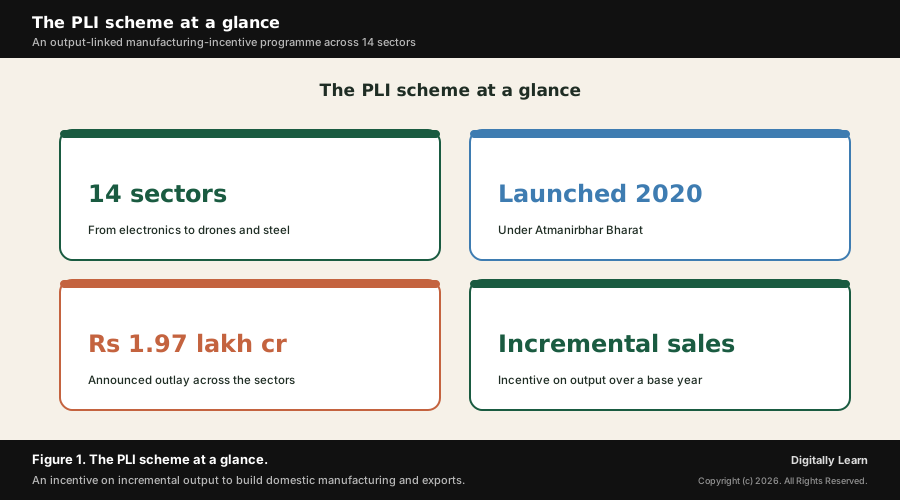
The Production-Linked Incentive (PLI) schemes are India's flagship manufacturing-incentive programme, a set of sector-specific schemes launched from 2020 as part of Atmanirbhar Bharat. Their core design is simple: a company earns a financial incentive, usually a percentage of the incremental sales of goods it manufactures in India over a base year, provided it meets agreed investment and output thresholds. The schemes now span 14 key sectors, from large-scale electronics and pharmaceuticals to automobiles, solar modules and drones, with an announced outlay of about Rs 1.97 lakh crore. Their stated aim is to make Indian manufacturing globally competitive, reduce import dependence, integrate Indian firms into global value chains and create jobs and exports.
What the PLI Scheme Is: An Output-Linked Manufacturing Incentive
A performance-linked incentive on incremental made-in-India output
The Production-Linked Incentive (PLI) schemes are a set of sector-specific incentive schemes through which the Government of India rewards firms for manufacturing more goods in India. They are best understood as a performance-linked incentive: rather than a subsidy paid up front, the support is paid only against results, specifically the rise in a firm's eligible sales of goods made in India over a chosen base year.
The schemes are a cornerstone of Atmanirbhar Bharat, the self-reliant-India effort launched in 2020. Their declared purpose is to make domestic manufacturing globally competitive, to attract investment into capacity, to create national manufacturing champions that can compete at world scale, and to lift India's standing in manufacturing and exports. In this sense PLI marks a shift in industrial policy toward incentives tied to measurable output.
Two features set PLI apart from older industrial support. First, it is output-linked, so a firm earns nothing unless it actually produces and sells more; the incentive scales with performance. Second, it is time-bound, running for a fixed scheme period before the support tapers and ends. This design is meant to crowd in private investment and then withdraw, rather than offer open-ended protection. The figure below sets out the headline facts.
Why the PLI Scheme Is in Focus: Manufacturing Depth and the Sunset Question
Rising disbursements, expanded sectors and questions of effectiveness
Why it matters now is that the PLI programme has moved from announcement to measurable results, and its record is being weighed as several schemes approach the end of their scheme periods. The Government reports rising cumulative investment, production and exports under the schemes, even as the pace of actual incentive disbursement has drawn scrutiny relative to the headline outlay.
The programme is also a live exam topic because it sits at the centre of the wider debate on India's industrial policy. As policymakers consider whether to extend, redesign or wind down individual schemes, the question of whether PLI builds durable competitiveness, or simply rewards a few large firms for a fixed period, has become central. That makes the design, the achievements and the criticisms all worth understanding precisely.
Understanding the Significance of the PLI Scheme for India's Economy
Manufacturing depth, self-reliance and a place in global value chains
What is the significance of the PLI scheme lies first in manufacturing depth. Manufacturing's share of India's output has long lagged the policy aspiration; the Economic Survey records it holding at roughly 17 to 18 per cent of GDP, against a long-standing goal of about 25 per cent. By rewarding extra production in chosen sectors, PLI is meant to push this share upward and broaden the industrial base.
Its second significance is self-reliance. Several PLI sectors, from bulk drugs and active pharmaceutical ingredients to electronics and solar modules, are areas where India has depended heavily on imports. By building domestic capacity in these inputs and finished goods, the scheme is designed to cut import dependence in strategically sensitive supply chains and reduce vulnerability to external shocks.
Its third significance is a place in global value chains. By drawing investment and large-scale capacity into India, PLI aims to move Indian firms up from assembly toward deeper value addition and to make the country an attractive node in world manufacturing networks, including for firms pursuing a China-plus-one diversification of their supply chains. The gains in jobs and exports follow from this larger industrial footprint.
How the PLI Scheme Works: Incremental Output, Thresholds and a Sunset Period
The incremental-output incentive, the base year, thresholds and the sunset
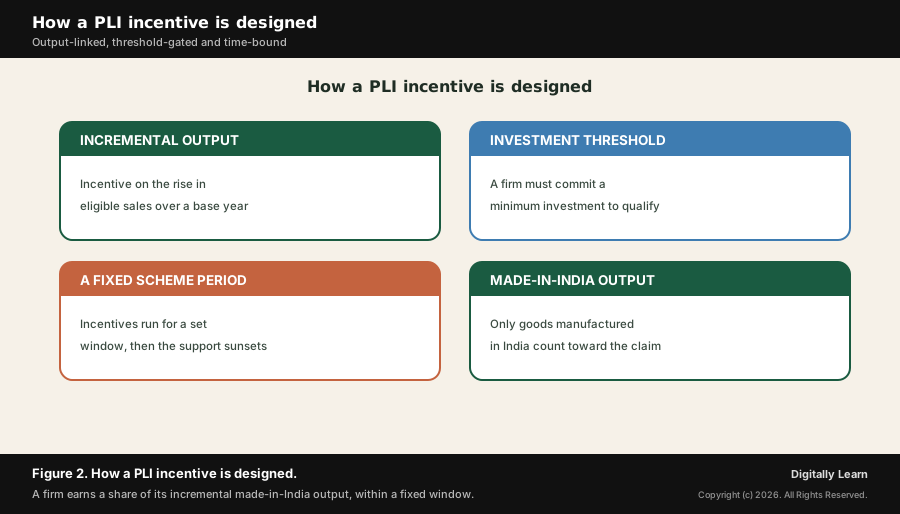
At the heart of every PLI scheme is the incremental-output incentive. A firm is paid an incentive, typically a percentage of the rise in its eligible sales of goods manufactured in India, measured against a base year. Because only the increment over that base counts, the scheme rewards genuine expansion of production rather than existing output, and the incentive grows as the firm produces and sells more.
To qualify, a firm must usually commit a minimum investment and meet output or sales thresholds set for its sector, so the benefit is gated on real capacity creation. Only goods actually manufactured in India count toward a claim, which is what ties the incentive to domestic value addition rather than to imports repackaged for sale. Claims are typically filed after a year of production, once the incremental output can be measured.
Crucially, each scheme runs for a fixed scheme period and then the support sunsets. The incentive is not open-ended: it is designed to kick-start investment, carry a sector through its build-up years, and then withdraw, leaving a competitive industry behind. This time-bound, performance-gated structure is what distinguishes PLI from earlier forms of protection such as permanent tariffs or blanket subsidies. The figure below summarises the design.
The rationale: manufacturing share, imports, value chains, jobs and China-plus-one
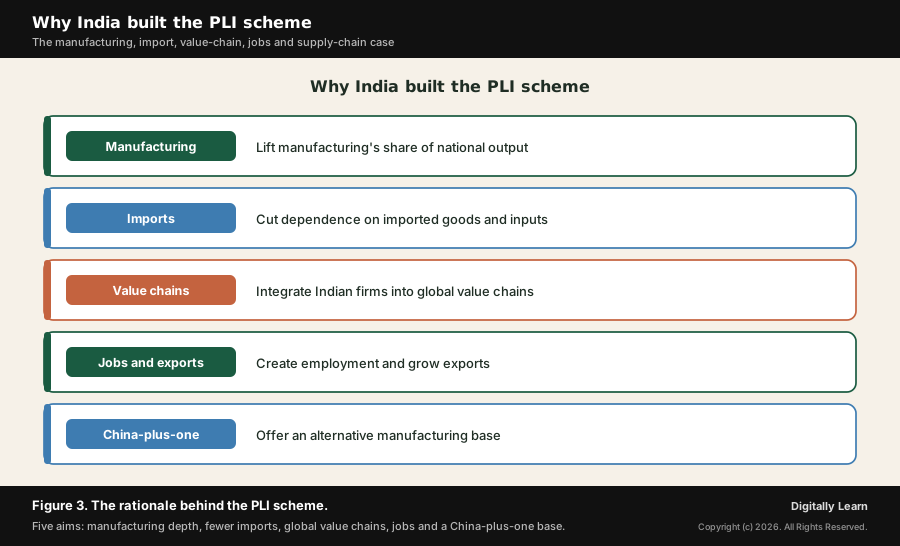
The rationale behind PLI rests on a diagnosis of India's growth. Although services have powered the economy, manufacturing has not kept pace, and a deeper industrial base is seen as essential for absorbing labour, earning exports and building resilience. PLI is the headline instrument meant to raise manufacturing's contribution to national output toward the long-stated goal.
A second strand of the rationale is import substitution with an outward face. By building capacity in electronics, pharmaceuticals, solar modules and other import-heavy areas, the scheme aims both to cut the import bill and to turn India into an exporter, plugging firms into global value chains rather than walling the market off. This is meant to avoid the trap of high-cost, inward-looking protection.
A third strand is the China-plus-one opportunity and the jobs it can bring. As global firms seek to diversify supply chains away from a single country, India hopes to offer an attractive alternative manufacturing base, drawing investment, technology and the employment that large-scale factories create. The figure below sets out these aims together.
The 14 PLI Sectors: From Electronics and Pharma to Solar, Steel and Drones
The fourteen sectors and the ministries that run them
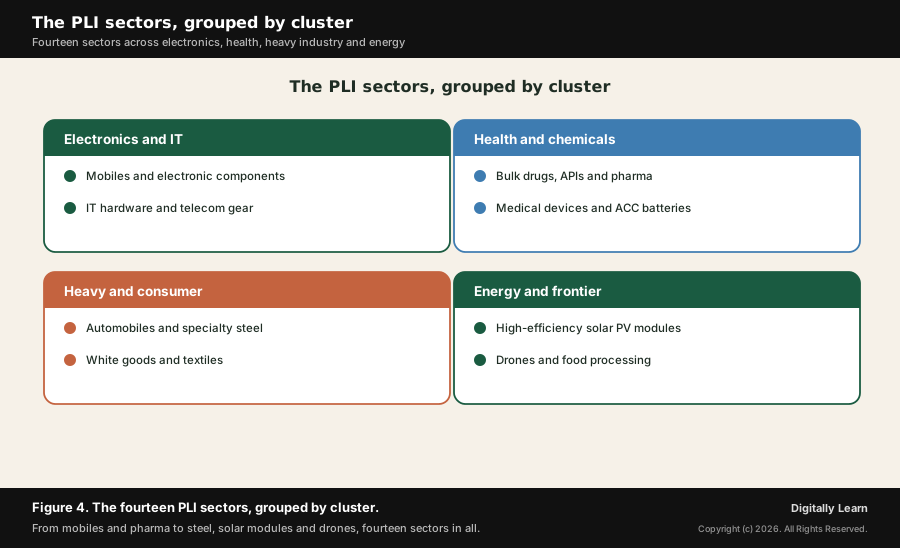
The PLI programme now covers 14 key sectors, chosen for their strategic and economic weight. They span high-technology manufacturing, health and chemicals, heavy and consumer industry, and energy and frontier goods. Each scheme is tailored to its sector with its own incentive rate, thresholds and period. The table below lists the fourteen sectors and the cluster each belongs to.
| Sector | Cluster | What it targets |
|---|---|---|
| Large-scale electronics and mobiles | Electronics and IT | Mobile phones and specified electronic components |
| IT hardware | Electronics and IT | Laptops, tablets and servers |
| Telecom and networking products | Electronics and IT | Telecom and networking equipment |
| Pharmaceuticals (drugs) | Health and chemicals | Finished formulations and complex generics |
| Bulk drugs, APIs and KSMs | Health and chemicals | Active pharmaceutical ingredients and intermediates |
| Medical devices | Health and chemicals | Domestic manufacture of medical devices |
| Advanced chemistry cell (ACC) battery | Health and chemicals | Large-scale battery-cell capacity |
| Automobiles and auto components | Heavy and consumer | Advanced automotive and component manufacturing |
| Specialty steel | Heavy and consumer | Value-added grades of steel |
| White goods | Heavy and consumer | Air conditioners and LED components |
| Textile products | Heavy and consumer | Man-made-fibre and technical textiles |
| High-efficiency solar PV modules | Energy and frontier | Solar photovoltaic module manufacturing |
| Food products | Energy and frontier | Processed and value-added food |
| Drones and drone components | Energy and frontier | Domestic drone manufacturing |
Reading the rows together shows the logic of the selection: the sectors mix areas where India already has scale (mobiles, pharmaceuticals) with areas of strategic vulnerability (APIs, solar modules, batteries) and frontier industries (drones, specialty steel) where early support could build a durable lead.
Per-cluster detail: electronics, pharma, telecom, autos, batteries and solar
In large-scale electronics and mobiles, the most visible PLI sector, the scheme has drawn major mobile-phone makers and component suppliers to manufacture in India, lifting handset production and turning the country into a significant exporter of mobile phones. The linked schemes for IT hardware and for telecom and networking products extend the same logic to laptops, servers and telecom equipment, areas of heavy import dependence.
In pharmaceuticals, the programme runs on two levels: one scheme for finished drugs and complex generics, and a separate scheme for bulk drugs, active pharmaceutical ingredients and key starting materials, the building blocks of medicines where India had become reliant on imports. A further scheme supports domestic medical devices. Together these aim to secure the pharmaceutical supply chain end to end.
In automobiles and auto components, the scheme rewards advanced automotive technology and component manufacturing, while the advanced chemistry cell (ACC) battery scheme targets large-scale battery-cell capacity that underpins electric mobility and energy storage. The high-efficiency solar PV module scheme aims to build an integrated domestic solar manufacturing base, and the schemes for specialty steel, white goods, textiles, food products and drones each address a distinct strategic or employment objective.
The Institutional Architecture: DPIIT Coordination and Line Ministries
Who runs the PLI scheme, through which bodies and under what oversight
The PLI programme is not run by a single department. The Department for Promotion of Industry and Internal Trade (DPIIT), in the Ministry of Commerce and Industry, coordinates all PLI schemes and provides the common framework, while each scheme is implemented by the line ministry responsible for that sector. The pharmaceuticals schemes, for instance, are run by the Department of Pharmaceuticals and the electronics scheme by the Ministry of Electronics and Information Technology.
To hold this together, the Government set up an Empowered Group of Secretaries (EGoS) to provide overall direction, review progress and resolve cross-cutting issues, supported by Project Development Cells in the participating ministries to prepare projects and ease investment. This layered design lets each sector keep its specialised scheme while DPIIT and the EGoS ensure consistency and quick decision-making across the programme.
The architecture matters for the exam because it shows PLI as a piece of coordinated industrial policy, not a one-off subsidy: a central coordinating department, sector ministries that run the schemes, and an empowered inter-ministerial body for oversight. This is the institutional answer to who designs the incentive, who pays it, and who checks that the claimed output and investment were genuinely delivered.
Achievements of the PLI Scheme, in Dated and Attributed Terms
Investment, production, exports, jobs and disbursement on the record
On the Government's own record, the PLI programme has attracted significant investment and output. According to official figures, 836 applications had been approved across the 14 sectors, against an incentive outlay the Government states as about Rs 1.91 lakh crore, part of the broader Rs 1.97 lakh crore announced for the programme. An earlier dated figure recorded 755 applications approved and about Rs 1.23 lakh crore of investment attracted till March 2024.
The cumulative results the Government reports, as on 31 December 2025, are an investment exceeding Rs 2.16 lakh crore, cumulative production or sales exceeding Rs 20.41 lakh crore, and cumulative exports exceeding Rs 8.3 lakh crore. On employment, the official figure is more than 14.39 lakh direct and indirect jobs generated under the schemes. These are the Government's stated numbers and are presented here as such.
On actual payouts, the Government reports that about Rs 28,748 crore had been disbursed as incentive as on 31 December 2025. This sum is modest against the headline outlay, a gap the Government attributes to the design: projects run over two to three years and firms file claims only after their first year of production, so most are still at the implementation and claim-filing stage. The strongest results so far are concentrated in electronics and a few other sectors.
Challenges and Debates Around the PLI Scheme, Presented Neutrally
Uneven uptake, the disbursement gap, jobs and picking winners
A balanced reading must weigh the debates around PLI. The first is uneven uptake across sectors. The schemes for mobiles and electronics have drawn strong participation and visible output, while several other sectors have seen slower take-up, raising the question of whether incentives work better in some industries than others and whether the sector mix was well chosen.
A second debate is the gap between committed and disbursed support. The amount actually paid out remains small against the headline outlay. Supporters read this as the natural lag of a results-based scheme in which claims follow production; critics ask whether the headline numbers overstate near-term impact and whether some targets will be met. The fairest reading holds both points together rather than treating either as settled.
A third set of debates concerns employment and competitiveness. Some analysts question how many durable, high-quality jobs the largely capital-intensive PLI sectors create relative to their cost, and whether incentives build genuine, lasting competitiveness or merely subsidise output for a fixed period. There is also the picking-winners critique, that selecting sectors and large firms risks misallocation, and a question of consistency with WTO rules on subsidies. These are presented here as live, contested questions, not as a verdict.
The Way Forward for the PLI Scheme and India's Industrial Policy
Deeper value addition, MSME inclusion and an honest assessment
The way forward most often discussed is to push PLI toward deeper value addition. Where early gains came from assembly, as in mobile phones, the next step is to localise components and inputs so that more of the value is created in India, reducing the reliance on imported parts that a pure-assembly model can leave in place.
A second direction is breadth: spreading benefits beyond a handful of large firms to a wider base, including small and medium enterprises, and smoothing the application and disbursement process so that approved projects translate into actual payouts and production. Complementary reforms in logistics, power, skills and ease of doing business are widely seen as necessary for the incentives to bite.
Finally, the consensus is for an evidence-based approach: a candid, scheme-by-scheme assessment of which PLI schemes are delivering investment, output, exports and jobs commensurate with their cost, extending or redesigning those that work and winding down those that do not. PLI is best seen as one important instrument within a broader industrial policy, to be judged on results rather than on its headline outlay.
UPSC Relevance and Exam Focus
Where the PLI scheme fits in the UPSC-CSE syllabus
This topic maps most directly to General Studies Paper III: growth and development, the manufacturing sector, and government policies for industry and the economy. PLI is a textbook case of modern industrial policy, and it links to Make in India, Atmanirbhar Bharat, the China-plus-one supply-chain debate and India's place in global value chains.
For Prelims, hold the high-yield facts: PLI is an incentive on the incremental sales of goods manufactured in India over a base year; it was launched in 2020 under Atmanirbhar Bharat; it covers 14 sectors with an announced outlay of about Rs 1.97 lakh crore; it is coordinated by DPIIT with an Empowered Group of Secretaries; and each scheme is implemented by the relevant line ministry.
For Mains, the recurring framing is to assess PLI as an instrument of industrial policy: its rationale for lifting manufacturing's share and cutting imports, its design strengths as a performance-linked, time-bound incentive, its achievements in dated terms, and the debates over uneven uptake, disbursement, jobs, picking winners and WTO consistency. A strong answer treats PLI as one tool among many and reaches a balanced judgment grounded in evidence.
Recurring linked concepts an aspirant should keep in working memory:
- Make in India and Atmanirbhar Bharat: The wider manufacturing and self-reliance effort within which the PLI schemes sit.
- Global value chains and China-plus-one: The supply-chain diversification that PLI seeks to attract into India.
- Import substitution and competitiveness: The balance between reducing imports and building genuinely competitive, export-capable industry.
- Industrial policy and picking winners: The debate over whether targeted, sector-specific incentives outperform broad, neutral reforms.
A common Prelims trap is to describe PLI as an up-front capital subsidy or a tariff; hold precisely that it is a performance-linked incentive paid on incremental made-in-India output over a base year, gated on investment and time-bound.
A common Mains trap is to present PLI as an unqualified success or failure. Its exam value lies in a balanced judgment: the genuine gains in investment, production and exports set against the uneven uptake, the disbursement gap, the questions on jobs and durable competitiveness, and the picking-winners and WTO debates, all in measured, attributed terms.
Previous Year UPSC-CSE Questions By the end you will be able to draft model answers for the following UPSC questions. Each question carries a collapsible framework showing how to approach it in the exam.
- UPSC Mains 2017 GS-IIIGive reasons why industrial growth has lagged GDP growth in the post-reform period, and assess how far recent changes in industrial policy can raise the industrial growth rate.
How to structure the answer in the exam
Body (sub-themes to develop):
- Reasons for the lag: services-led rather than manufacturing-led post-reform growth, heavy import dependence in key sectors, a shallow industrial base, weak competitiveness, and gaps in logistics, power, skills and ease of doing business.
- The recent industrial-policy shift: the PLI schemes as a performance-linked, time-bound incentive on incremental made-in-India output, gated on investment thresholds, across 14 sectors, coordinated by DPIIT, to crowd in investment and build competitive capacity.
- How far it can raise the rate, the positive case: dated and attributed gains in investment, production and exports, especially in electronics, and the cutting of import dependence in strategically sensitive supply chains.
- How far it can raise the rate, the limits: uneven sector uptake, the gap between committed outlay and actual disbursement, questions over durable jobs and competitiveness, and the picking-winners and WTO-subsidy critiques.
- Complementary requirements: deeper value addition, MSME inclusion, and reforms in logistics, power, skills and ease of doing business for incentives to translate into a sustained higher industrial growth rate.
Sources and Further Reading
- Press Information Bureau: Production Linked Incentive Schemes for 14 key sectors aim to enhance India's manufacturing capabilities and exports
- Press Information Bureau: PLI Scheme with Rs 1.91 Lakh Crore Outlay Drives Strong Industry Participation Across 14 Strategic Sectors
- Press Information Bureau: 755 applications approved across 14 sectors, investment of Rs. 1.23 lakh crore attracted under PLI Scheme till March 2024
- Press Information Bureau: Cabinet approves PLI Scheme to 10 key Sectors
- Department for Promotion of Industry and Internal Trade: PLI coordination and institutional arrangements
- Invest India: Manufacturing renaissance through PLI Schemes
- Ministry of Finance: Economic Survey, Industry chapter (manufacturing share of GDP)
- NITI Aayog: Sectoral insights on industry and manufacturing
- World Bank: Made in India, Industrial Policy in a Changing World
- Wikipedia: Production Linked Incentive schemes in India
Editorial Disclaimer
This briefing is for UPSC preparation. Verify the figures and provisions against the official PIB and DPIIT sources before relying on them.


