


Overview
The Indian Ocean Conference is a flagship annual forum on regional cooperation in the Indian Ocean, bringing together ministers, officials and experts from the region's states. Its ninth edition was held in Port Louis, Mauritius, in April 2026, where India's External Affairs Minister, Dr. S. Jaishankar, delivered the inaugural keynote. India used the occasion to set out its vision for the region, which has grown from SAGAR to the wider MAHASAGAR.
The Ninth Conference Convenes in Mauritius
The ninth edition, hosted in Mauritius
The ninth Indian Ocean Conference was held in Port Louis, Mauritius, in April 2026. India's External Affairs Minister, Dr. S. Jaishankar, addressed the inaugural session, making India a central voice at the gathering.
The conference is a regional forum that brings together governments and experts from across the Indian Ocean to discuss cooperation, security and connectivity. India used the platform to set out how it sees its own role in the region.
Why the Indian Ocean Matters to India
Trade, energy and security in a single ocean
Why it matters is that the Indian Ocean carries a large share of the world's trade and energy, and India sits at its centre with a long coastline and island territories. The security and prosperity of the region are therefore tied directly to India's own.
A regional forum lets India help shape the terms of cooperation and present itself as a trusted partner rather than a distant power. Hosting the conference in Mauritius, a close maritime neighbour, underlines India's place in the region's affairs.
From SAGAR Towards a Wider MAHASAGAR
What India's evolving vision signifies
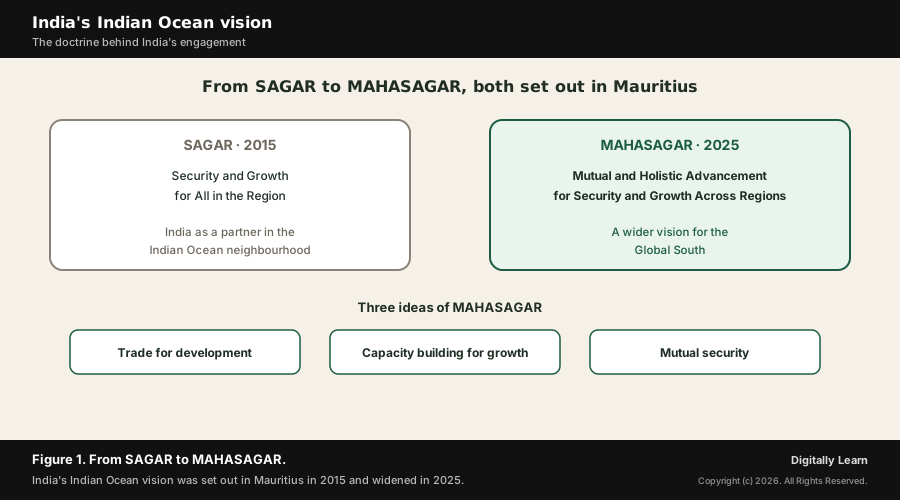
What is the significance of this vision lies in how it has grown. In 2015, in Mauritius, India set out SAGAR, meaning Security and Growth for All in the Region, casting India as a partner in its maritime neighbourhood. In 2025, again in Mauritius, that idea was widened into MAHASAGAR.
MAHASAGAR, Mutual and Holistic Advancement for Security and Growth Across Regions, extends the vision to the wider Global South and rests on three ideas: trade for development, capacity building for sustainable growth, and mutual security for a shared future.
Distinguishing features of India's approach
What India brings to the region
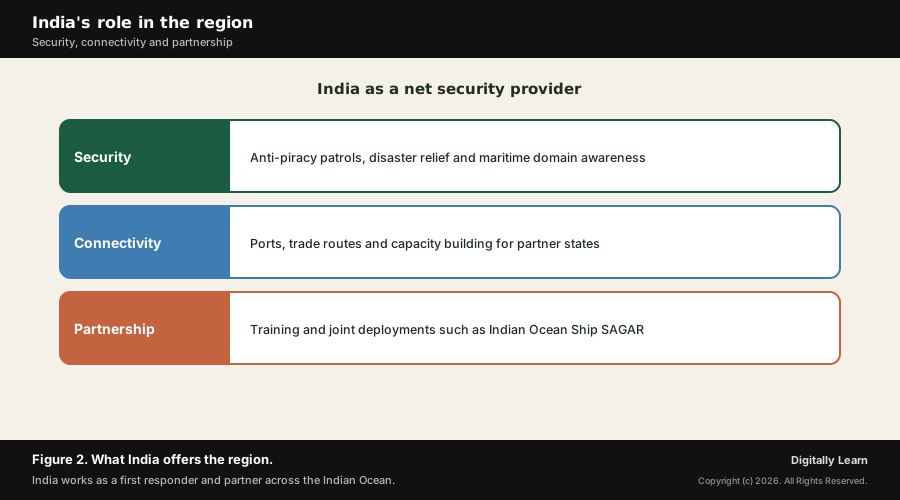
The table sets out the main ways in which India engages the Indian Ocean and what each involves. Together they explain why India describes itself as a net security provider for the region.
Read together, the rows show a role built on security, connectivity and partnership, rather than on power projection alone.
| Role | What it involves |
|---|---|
| Net security provider | First responder in disasters, anti-piracy patrols and maritime domain awareness |
| Connectivity partner | Support for ports, trade routes and the blue economy of partner states |
| Capacity builder | Training, equipment and joint deployments such as Indian Ocean Ship SAGAR |
| Convening power | Hosting and shaping regional forums on cooperation |
MAHASAGAR in practice through IOS SAGAR
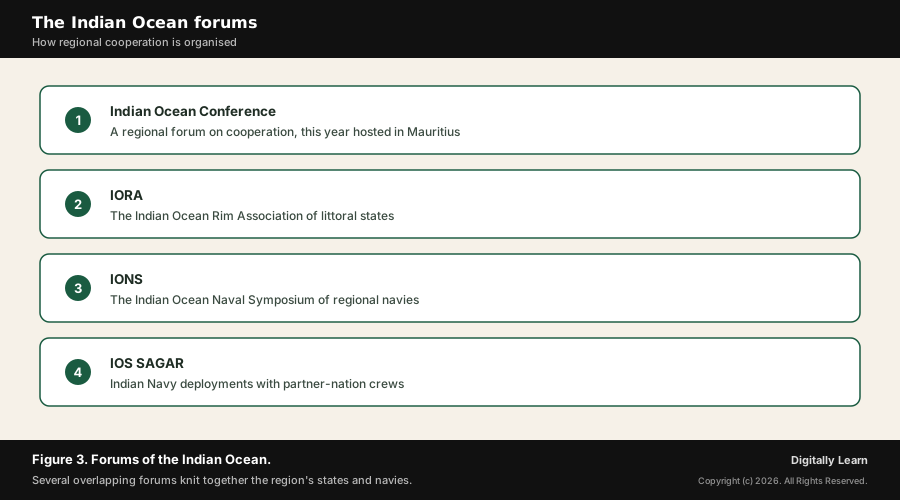
The vision is not only a statement; it is put into practice through concrete deployments. The clearest example is Indian Ocean Ship SAGAR, under which an Indian Navy ship sails with crew members drawn from several partner nations of the region.
Such deployments turn the idea of mutual security into shared training and collective readiness, and signal that India sees the region's security as a joint effort rather than a task for any single navy.
What to Watch in India's Regional Role
Three things to track from here
India's regional vision translates into three developments worth tracking, since a vision is judged by whether it produces working cooperation on the water.
- (a) From words to projects. Whether MAHASAGAR turns into concrete trade, training and security projects with partner states.
- (b) Island partnerships. Whether ties with island neighbours such as Mauritius, Seychelles and Sri Lanka continue to deepen.
- (c) Balancing other powers. Whether India sustains its role as a first responder as other powers expand their presence in the region.
The real test is whether the region's states see India as the partner they turn to first when they need help.
The Indo-Pacific, the Forums and the Blue Economy
How the conference fits India's wider strategy
Contemporary linkages tie the conference to India's engagement in the wider Indo-Pacific, where it works with partners to support a free, open and rules-based maritime order. The Indian Ocean is the western half of that strategic space.
India's regional role runs through several overlapping forums, including the Indian Ocean Rim Association of littoral states and the Indian Ocean Naval Symposium of regional navies, alongside the conference itself.
The vision also connects to the blue economy, the sustainable use of ocean resources for growth, which India promotes as a shared interest of the region's developing states.
UPSC relevance and exam focus
Where this fits in the UPSC-CSE syllabus
This topic maps to General Studies Paper II: bilateral, regional and global groupings involving India, and India's neighbourhood, with strong links to maritime security in Paper III.
For Prelims, hold the high-yield facts: the full forms of SAGAR and MAHASAGAR, the year and place of each, Indian Ocean Ship SAGAR, and the regional forums such as the Indian Ocean Rim Association and the Indian Ocean Naval Symposium.
For Mains, two framings recur: India as a net security provider in the Indian Ocean, and the maritime security challenges India faces and the steps it takes to meet them.
Recurring linked concepts an aspirant should keep in working memory:
- SAGAR: Security and Growth for All in the Region, set out in 2015.
- MAHASAGAR: the wider 2025 vision for the Global South.
- Indian Ocean Rim Association: the grouping of Indian Ocean littoral states.
- Blue economy: the sustainable use of ocean resources for growth.
A common Prelims trap is to confuse SAGAR with MAHASAGAR; SAGAR is the 2015 regional vision, while MAHASAGAR is the wider 2025 vision for the Global South.
A common Mains trap is to treat India's role as uncontested. Other powers are also expanding in the region, so India's position as the partner of first resort has to be sustained, not assumed.
Previous Year UPSC-CSE Questions By the end you will be able to draft model answers for the following UPSC questions. Each question carries a collapsible framework showing how to approach it in the exam.
- UPSC Mains 2022 GS-IIIWhat are the maritime security challenges in India? Discuss the organisational, technical and procedural initiatives taken to improve the maritime security.
How to structure the answer in the exam
Introduction: Open with the importance of the Indian Ocean to India's security and the range of threats it faces.
Body (sub-themes to develop):
- Challenges: piracy, terrorism from the sea, trafficking, and competition from other navies.
- Organisational: a net-security-provider role, the SAGAR and MAHASAGAR visions and regional forums.
- Cooperative: capacity building and joint deployments such as Indian Ocean Ship SAGAR.
- Procedural: maritime domain awareness, coastal security and disaster response.
Conclusion: Conclude that India meets maritime security challenges through national capability and regional partnership together.
Sources and Further Reading
- Ministry of External Affairs: Remarks by EAM Dr. S. Jaishankar at the 9th Indian Ocean Conference, Mauritius
- Ministry of External Affairs: Visit of External Affairs Minister to Mauritius and the UAE (9-12 April 2026)
- Ministry of External Affairs: Vision MAHASAGAR announced in Mauritius
- Press Information Bureau: India-Mauritius Joint Press Statement (Vision MAHASAGAR)
- Press Information Bureau: Indian Ocean Ship (IOS) SAGAR initiative
- Indian Navy
- Ministry of Defence
Editorial Disclaimer
This briefing is for UPSC preparation. Verify details against the official statements of the Ministry of External Affairs before relying on them.


